Malaysian HR Congress 2007 Succession Planning
What if something happens to the CEO or to a senior executive of my organization? Who will replace him? Will the new incumbent have the maturity and the desired competence to execute all responsibilities? Are people other than him, groomed enough to fill the void that would be created by his absence?
Charlie Bell, President and COO of McDonald, succeeded Jim Cantalupo, CEO hours after the sudden heart attack death Mr. Zeien, succeeded Chairman and CEO Colman  M. Mockler of Gillette Co.'s when he died of a heart attack in his office  The Wall Street Journal Online
Session Outline   Succession Planning - an introduction Succession Planning @ family run business An approach towards Succession Planning Steps to effective Succession Planning Identifying and nurturing Hi-Pos  Potential and Performance mix of a Hi-Pos  Putting success into Succession Planning How to measure its effectiveness  Conclusion
Succession Planning Is not just a process to merely find a deputy or 2IC It is a conscious process to ensure continuity of Business Operations Organization’s Policies  Organization’s Culture
Organic Business Growth Mergers Acquisition  Promotions, Demotions & Transfers Business Re-engineering Succession Planning “ Global aging (Over the 1998 - 2008 period), more job openings  are expected  to result  from  replacement needs (34.7 million)  than from employment  growth in the  economy (20.3 million)”  (Braddock, 1999)
Succession Planning: an age old art H R ecruitment of appropriate candidate etaining the good performers
Getting the  right number  of people  with the  right skills , experiences, &  competencies in the  right jobs   at the  right time . Workforce Planning   Nancy B. Kiyonaga, NYS Department of Civil Service
Succession planning ensures that there  are highly  qualified members   for  all  important positions , not just  today ,  but  tomorrow,   next year,  and  five years  from now.  Succession Planning   Kathryn Towe Littleton
What does an organization lose if it does  not implement succession planning? Revenue? Market Share? Company’s Image? Stock Prices or Market Cap? Human Cap? Workplace will lose high performers Lack of skilled workforce that understand business well Right skill mix for the future Right leaders to accomplish organization’s Vision & Mission
Success ion   Planning = Commercial   Success   There is a direct correlation between: Organization’s ability to develop senior executives  & Confidence to meet future growth needs Organization’s ability to recruit highly able executives  & having well-organized program to develop Hi-Pos’  Developmental ‘stretch’ assignments within company & the personal involvement of the CEO Organization’s need to hire outside leaders  & Lack of confidence to meet future growth needs  HUMAN RESOURCE MANAGEMENT, VOL. 13 NO. 1 2005
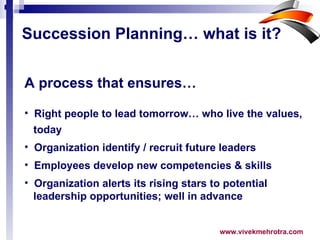
A process that ensures…   Right people to lead tomorrow… who live the values,  today   Organization identify / recruit future leaders Employees develop new competencies & skills Organization alerts its rising stars to potential  leadership opportunities; well in advance Succession Planning… what is it?
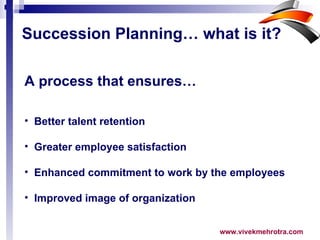
A process that ensures…   Better talent retention Greater employee satisfaction Enhanced commitment to work by the employees Improved image of organization Succession Planning… what is it?
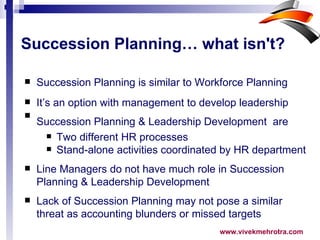
Succession Planning… what isn't? Succession Planning is similar to Workforce Planning It’s an option with management to develop leadership Succession Planning & Leadership Development  are   Two different HR processes Stand-alone activities coordinated by HR department Line Managers do not have much role in Succession Planning & Leadership Development Lack of Succession Planning may not pose a similar threat as accounting blunders or missed targets
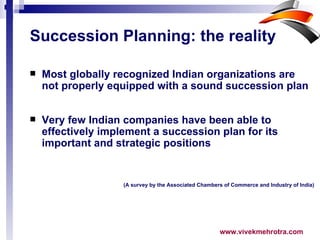
Succession Planning: the reality   Most globally recognized Indian organizations are not properly equipped with a sound succession plan Very few Indian companies have been able to effectively implement a succession plan for its important and strategic positions (A survey by the Associated Chambers of Commerce and Industry of India)
Succession Planning @ Family run businesses   More than half of the top 100 companies are family owned De-merger of business families, with trauma and acrimony, is fairly common in India.  Reliance Industries – Mukesh & Anil Ambani Bajaj Auto – Rahul & Shishir Bajaj Escorts – Rajan & Anil Nanda Jumbo Group – Bhavika, Kiran & Komal Chhabria Sahad P.V. - Family Values
Succession Planning @ Family run businesses Family run business groups, which dealt with Succession issues successfully  Murugappa Group Dabur India Thapars GMR Group  Sahad P.V. - Family Values
Succession Planning @   GMR group’s Succession Plan Clearly articulated set of rules to deal with  Management succession  Ownership succession  Control and power sharing  Sucheta Dalal, CHEQUES AND BALANCES
Family Constitution Family Business Board  Laid down policies on Consensus in decision making  Media policy  Code of conduct Process of inducting family members into the business  Providing benefits to those who do not want to enter the business   Succession Planning @
G M Rao to step down at the age of 70 Three next generation successors to decide next chairman Dead lock trustee Induction of family members is on merit and are paid on par with other professionals employed The economic benefits of shareholding will be separate  Succession Planning @   Sucheta Dalal, CHEQUES AND BALANCES
Succession Planning @ Family run businesses Ownership Vs. Management Family owns the controlling shares, but inducts professional managers to run their business.  Retail giant  Rob Walton - Chairman Lee Scott - CEO  "Successful business families are those who run businesses as capitalists and families as socialists." N. Srinivasan
Succession Planning @   India's largest pharmaceutical company 1952, Bhai Mohan Singh founded Ranbaxy 1967, Dr Parvinder Singh, Bhai Mohan Singh's son, a  doctorate in pharmacy from the University of Michigan joined the company  1982, he became the company's Managing Director 1993, D.S. Brar joined as Business Development Manager, became the President (Pharmaceuticals) and a whole time Director ICFAI - Center for Management Research
1997, Brar revealed his retirement plans to retire in 2002.  2003, Dr Brian Tempest (President, Pharmaceutical Division, Ranbaxy) took the reigns of Ranbaxy from Brar as CEO and MD 2006, Malvinder Singh has taken over as CEO & MD  Succession Planning @   India's largest pharmaceutical company
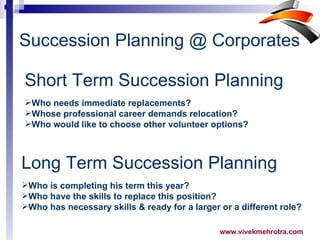
Succession Planning @ Corporates Long Term Succession Planning Who is completing his term this year? Who have the skills to replace this position? Who has necessary skills & ready for a larger or a different role? Short Term Succession Planning Who needs immediate replacements? Whose professional career demands relocation? Who would like to choose other volunteer options?
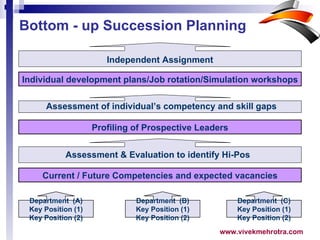
Department  (A) Key Position (1) Key Position (2) Department  (B) Key Position (1) Key Position (2) Department  (C) Key Position (1) Key Position (2) Current / Future Competencies and expected vacancies Assessment & Evaluation to identify Hi-Pos   Profiling of Prospective Leaders Individual development plans/Job rotation/Simulation workshops Independent Assignment Assessment of individual’s competency and skill gaps Bottom - up Succession Planning
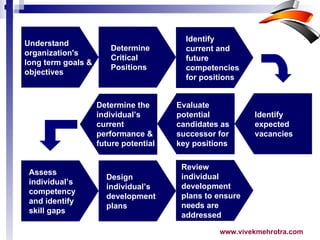
Understand organization's long term goals & objectives Determine  Critical  Positions Assess  individual’s  competency  and identify  skill gaps   Identify  current and  future  competencies  for positions Identify  expected   vacancies Evaluate potential candidates as successor for key positions Determine the  individual’s  current  performance &  future potential Design  individual’s  development  plans Review  individual  development  plans to ensure  needs are  addressed
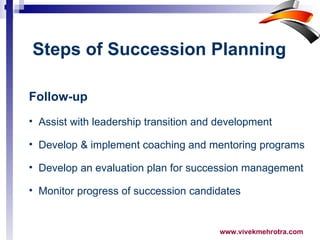
Steps of Succession Planning Follow-up Assist with leadership transition and development  Develop & implement coaching and mentoring programs Develop an evaluation plan for succession management Monitor progress of succession candidates
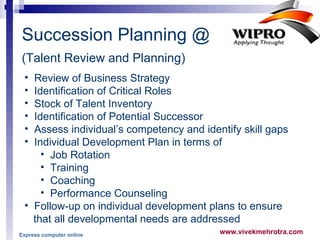
Succession Planning @  (Talent Review and Planning)   Review of Business Strategy Identification of Critical Roles Stock of Talent Inventory  Identification of Potential Successor Assess individual’s competency and identify skill gaps Individual Development Plan in terms of  Job Rotation Training Coaching Performance Counseling Follow-up on individual development plans to ensure  that all developmental needs are addressed Express computer online
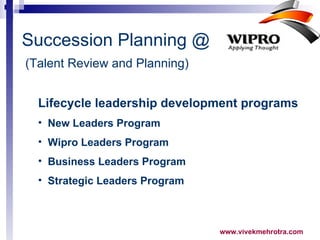
Succession Planning @   (Talent Review and Planning)   Lifecycle leadership development programs New Leaders Program  Wipro Leaders Program  Business Leaders Program  Strategic Leaders Program
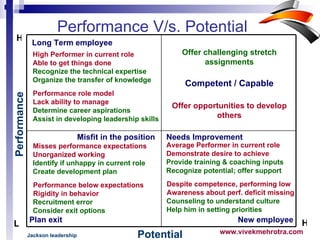
Current performance  is not the sole predictor  of future success Future potential  is a sign of prospective results Performance V/s.  Potential
Performance Performance is an assessment of Hi-Po’s Past Business results Past Performance review results Identifies mainly the areas of low performance/weakness  Build a poor image of the employee Minimal level of performance from Hi-Pos’ leading to Wasted resources Low morale Unsatisfactory performance Higher degrees of employee turnover   Potential V/s.
Potential is an assessment of Hi-Po’s Willingness to perform   Open-mindedness  Personal Accountability  Willingness to learn from successes & failures Performance V/s.  Potential
“ Future work potential is based on accumulated skills  and experience as evidenced by past achievement,  ability to learn new skills and willingness to tackle  bigger, more complex or higher quality assignments.” Charan, Drotter & Noel,  The Leadership Pipeline , Jossey-Bass, SF, 2001 Performance V/s.  Potential
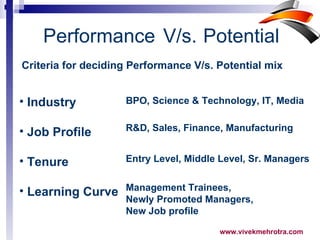
Criteria for deciding Performance V/s. Potential mix Industry Job Profile Tenure Learning Curve BPO, Science & Technology, IT, Media R&D, Sales, Finance, Manufacturing Entry Level, Middle Level, Sr. Managers Management Trainees,  Newly Promoted Managers, New Job profile Performance V/s.  Potential
How to assess pool of Hi-Pos: Negative feedback  Change in behavior based on the feedback or … Learning from mistakes/successes in past  Hunt for new information for self development or to improve workgroup Learning & Demonstration of new skills  Development of Team mates  leaders@jacksonleadership.com  Performance V/s.  Potential
Performance V/s. Potential   H L H Performance Potential Competent / Capable Needs Improvement Plan exit Long Term employee New employee Misfit in the position   High Performer in current role Able to get things done Recognize the technical expertise Organize the transfer of knowledge Performance role model Lack ability to manage Determine career aspirations  Assist in developing leadership skills Misses performance expectations  Unorganized working Identify if unhappy in current role Create development plan Performance below expectations Rigidity in behavior  Recruitment error  Consider exit options Average Performer in current role Demonstrate desire to achieve Provide training & coaching inputs Recognize potential; offer support  Despite competence, performing low Awareness about perf. deficit missing Counseling to understand culture  Help him in setting priorities  Offer challenging stretch assignments Offer opportunities to develop others Jackson leadership
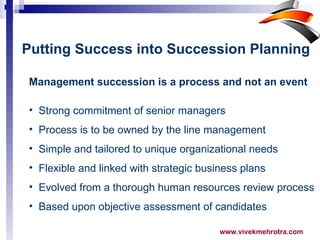
Putting Success into Succession Planning Management succession is a process and not an event Strong commitment of senior managers  Process is to be owned by the line management  Simple and tailored to unique organizational needs  Flexible and linked with strategic business plans  Evolved from a thorough human resources review process  Based upon objective assessment of candidates
Role of CEO & Senior Executives in Succession Planning Culture of coaching and mentorship  Focus on the company's competitive advantage and sustainable growth To withdraw from the key roles for short or even medium-term periods To take corrective steps in case of gaps arising due to their withdrawal
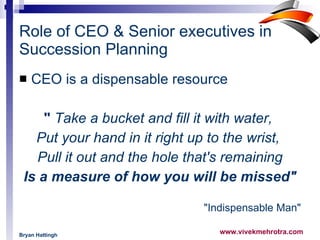
Role of CEO & Senior executives in Succession Planning CEO is a dispensable resource  "  Take a bucket and fill it with water,  Put your hand in it right up to the wrist,    Pull it out and the hole that's remaining    Is a measure of how you will be missed"   "Indispensable Man" Bryan Hattingh
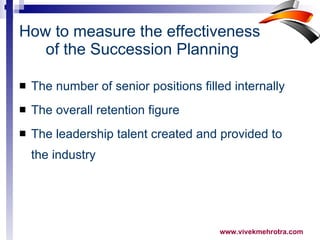
How to measure the effectiveness  of the Succession Planning The number of senior positions filled internally The overall retention figure  The leadership talent created and provided to the industry
Succession Planning - Check list Within  x  months, assessment for all key departments  and positions will be completed Within  x  months, developmental plan for all Hi-Pos will  be completed By year 20xx, increase in job rotation of Hi-Pos’ by x% By year 20xx, increase in Hi-Pos’ leaders by x% Over x years, increase in Hi-Pos’ retention by x%  ©2007 SHRM www.exceptionalleadership.com
Conclusion   Succession Planning is as critical as creating a business strategy Succession Planning is as important as running the business profitably While identifying successors appropriate weightage needs to be given to both performance and potential  For an effective implementation of Succession Planning involvement of CEO and line managers is a must  Measuring the effectiveness of a succession planning program is as critical as its implementation  Washout visual – Courtesy TOI
Thank You Visual – Courtesy TOI

Succession Planning

  • 1.
    Malaysian HR Congress2007 Succession Planning
  • 2.
    What if somethinghappens to the CEO or to a senior executive of my organization? Who will replace him? Will the new incumbent have the maturity and the desired competence to execute all responsibilities? Are people other than him, groomed enough to fill the void that would be created by his absence?
  • 3.
    Charlie Bell, Presidentand COO of McDonald, succeeded Jim Cantalupo, CEO hours after the sudden heart attack death Mr. Zeien, succeeded Chairman and CEO Colman M. Mockler of Gillette Co.'s when he died of a heart attack in his office The Wall Street Journal Online
  • 4.
    Session Outline Succession Planning - an introduction Succession Planning @ family run business An approach towards Succession Planning Steps to effective Succession Planning Identifying and nurturing Hi-Pos Potential and Performance mix of a Hi-Pos Putting success into Succession Planning How to measure its effectiveness Conclusion
  • 5.
    Succession Planning Isnot just a process to merely find a deputy or 2IC It is a conscious process to ensure continuity of Business Operations Organization’s Policies Organization’s Culture
  • 6.
    Organic Business GrowthMergers Acquisition Promotions, Demotions & Transfers Business Re-engineering Succession Planning “ Global aging (Over the 1998 - 2008 period), more job openings are expected to result from replacement needs (34.7 million) than from employment growth in the economy (20.3 million)” (Braddock, 1999)
  • 7.
    Succession Planning: anage old art H R ecruitment of appropriate candidate etaining the good performers
  • 8.
    Getting the right number of people with the right skills , experiences, & competencies in the right jobs at the right time . Workforce Planning Nancy B. Kiyonaga, NYS Department of Civil Service
  • 9.
    Succession planning ensuresthat there are highly qualified members for all important positions , not just today , but tomorrow, next year, and five years from now. Succession Planning Kathryn Towe Littleton
  • 10.
    What does anorganization lose if it does not implement succession planning? Revenue? Market Share? Company’s Image? Stock Prices or Market Cap? Human Cap? Workplace will lose high performers Lack of skilled workforce that understand business well Right skill mix for the future Right leaders to accomplish organization’s Vision & Mission
  • 11.
    Success ion Planning = Commercial Success There is a direct correlation between: Organization’s ability to develop senior executives & Confidence to meet future growth needs Organization’s ability to recruit highly able executives & having well-organized program to develop Hi-Pos’ Developmental ‘stretch’ assignments within company & the personal involvement of the CEO Organization’s need to hire outside leaders & Lack of confidence to meet future growth needs HUMAN RESOURCE MANAGEMENT, VOL. 13 NO. 1 2005
  • 12.
    A process thatensures… Right people to lead tomorrow… who live the values, today Organization identify / recruit future leaders Employees develop new competencies & skills Organization alerts its rising stars to potential leadership opportunities; well in advance Succession Planning… what is it?
  • 13.
    A process thatensures… Better talent retention Greater employee satisfaction Enhanced commitment to work by the employees Improved image of organization Succession Planning… what is it?
  • 14.
    Succession Planning… whatisn't? Succession Planning is similar to Workforce Planning It’s an option with management to develop leadership Succession Planning & Leadership Development are Two different HR processes Stand-alone activities coordinated by HR department Line Managers do not have much role in Succession Planning & Leadership Development Lack of Succession Planning may not pose a similar threat as accounting blunders or missed targets
  • 15.
    Succession Planning: thereality Most globally recognized Indian organizations are not properly equipped with a sound succession plan Very few Indian companies have been able to effectively implement a succession plan for its important and strategic positions (A survey by the Associated Chambers of Commerce and Industry of India)
  • 16.
    Succession Planning @Family run businesses More than half of the top 100 companies are family owned De-merger of business families, with trauma and acrimony, is fairly common in India. Reliance Industries – Mukesh & Anil Ambani Bajaj Auto – Rahul & Shishir Bajaj Escorts – Rajan & Anil Nanda Jumbo Group – Bhavika, Kiran & Komal Chhabria Sahad P.V. - Family Values
  • 17.
    Succession Planning @Family run businesses Family run business groups, which dealt with Succession issues successfully Murugappa Group Dabur India Thapars GMR Group Sahad P.V. - Family Values
  • 18.
    Succession Planning @ GMR group’s Succession Plan Clearly articulated set of rules to deal with Management succession Ownership succession Control and power sharing Sucheta Dalal, CHEQUES AND BALANCES
  • 19.
    Family Constitution FamilyBusiness Board Laid down policies on Consensus in decision making Media policy Code of conduct Process of inducting family members into the business Providing benefits to those who do not want to enter the business Succession Planning @
  • 20.
    G M Raoto step down at the age of 70 Three next generation successors to decide next chairman Dead lock trustee Induction of family members is on merit and are paid on par with other professionals employed The economic benefits of shareholding will be separate Succession Planning @ Sucheta Dalal, CHEQUES AND BALANCES
  • 21.
    Succession Planning @Family run businesses Ownership Vs. Management Family owns the controlling shares, but inducts professional managers to run their business. Retail giant Rob Walton - Chairman Lee Scott - CEO "Successful business families are those who run businesses as capitalists and families as socialists." N. Srinivasan
  • 22.
    Succession Planning @ India's largest pharmaceutical company 1952, Bhai Mohan Singh founded Ranbaxy 1967, Dr Parvinder Singh, Bhai Mohan Singh's son, a doctorate in pharmacy from the University of Michigan joined the company 1982, he became the company's Managing Director 1993, D.S. Brar joined as Business Development Manager, became the President (Pharmaceuticals) and a whole time Director ICFAI - Center for Management Research
  • 23.
    1997, Brar revealedhis retirement plans to retire in 2002. 2003, Dr Brian Tempest (President, Pharmaceutical Division, Ranbaxy) took the reigns of Ranbaxy from Brar as CEO and MD 2006, Malvinder Singh has taken over as CEO & MD Succession Planning @ India's largest pharmaceutical company
  • 24.
    Succession Planning @Corporates Long Term Succession Planning Who is completing his term this year? Who have the skills to replace this position? Who has necessary skills & ready for a larger or a different role? Short Term Succession Planning Who needs immediate replacements? Whose professional career demands relocation? Who would like to choose other volunteer options?
  • 25.
    Department (A)Key Position (1) Key Position (2) Department (B) Key Position (1) Key Position (2) Department (C) Key Position (1) Key Position (2) Current / Future Competencies and expected vacancies Assessment & Evaluation to identify Hi-Pos Profiling of Prospective Leaders Individual development plans/Job rotation/Simulation workshops Independent Assignment Assessment of individual’s competency and skill gaps Bottom - up Succession Planning
  • 26.
    Understand organization's longterm goals & objectives Determine Critical Positions Assess individual’s competency and identify skill gaps Identify current and future competencies for positions Identify expected vacancies Evaluate potential candidates as successor for key positions Determine the individual’s current performance & future potential Design individual’s development plans Review individual development plans to ensure needs are addressed
  • 27.
    Steps of SuccessionPlanning Follow-up Assist with leadership transition and development Develop & implement coaching and mentoring programs Develop an evaluation plan for succession management Monitor progress of succession candidates
  • 28.
    Succession Planning @ (Talent Review and Planning) Review of Business Strategy Identification of Critical Roles Stock of Talent Inventory Identification of Potential Successor Assess individual’s competency and identify skill gaps Individual Development Plan in terms of Job Rotation Training Coaching Performance Counseling Follow-up on individual development plans to ensure that all developmental needs are addressed Express computer online
  • 29.
    Succession Planning @ (Talent Review and Planning) Lifecycle leadership development programs New Leaders Program Wipro Leaders Program Business Leaders Program Strategic Leaders Program
  • 30.
    Current performance is not the sole predictor of future success Future potential is a sign of prospective results Performance V/s. Potential
  • 31.
    Performance Performance isan assessment of Hi-Po’s Past Business results Past Performance review results Identifies mainly the areas of low performance/weakness Build a poor image of the employee Minimal level of performance from Hi-Pos’ leading to Wasted resources Low morale Unsatisfactory performance Higher degrees of employee turnover Potential V/s.
  • 32.
    Potential is anassessment of Hi-Po’s Willingness to perform Open-mindedness Personal Accountability Willingness to learn from successes & failures Performance V/s. Potential
  • 33.
    “ Future workpotential is based on accumulated skills and experience as evidenced by past achievement, ability to learn new skills and willingness to tackle bigger, more complex or higher quality assignments.” Charan, Drotter & Noel, The Leadership Pipeline , Jossey-Bass, SF, 2001 Performance V/s. Potential
  • 34.
    Criteria for decidingPerformance V/s. Potential mix Industry Job Profile Tenure Learning Curve BPO, Science & Technology, IT, Media R&D, Sales, Finance, Manufacturing Entry Level, Middle Level, Sr. Managers Management Trainees, Newly Promoted Managers, New Job profile Performance V/s. Potential
  • 35.
    How to assesspool of Hi-Pos: Negative feedback Change in behavior based on the feedback or … Learning from mistakes/successes in past Hunt for new information for self development or to improve workgroup Learning & Demonstration of new skills Development of Team mates leaders@jacksonleadership.com Performance V/s. Potential
  • 36.
    Performance V/s. Potential H L H Performance Potential Competent / Capable Needs Improvement Plan exit Long Term employee New employee Misfit in the position High Performer in current role Able to get things done Recognize the technical expertise Organize the transfer of knowledge Performance role model Lack ability to manage Determine career aspirations Assist in developing leadership skills Misses performance expectations Unorganized working Identify if unhappy in current role Create development plan Performance below expectations Rigidity in behavior Recruitment error Consider exit options Average Performer in current role Demonstrate desire to achieve Provide training & coaching inputs Recognize potential; offer support Despite competence, performing low Awareness about perf. deficit missing Counseling to understand culture Help him in setting priorities Offer challenging stretch assignments Offer opportunities to develop others Jackson leadership
  • 37.
    Putting Success intoSuccession Planning Management succession is a process and not an event Strong commitment of senior managers Process is to be owned by the line management Simple and tailored to unique organizational needs Flexible and linked with strategic business plans Evolved from a thorough human resources review process Based upon objective assessment of candidates
  • 38.
    Role of CEO& Senior Executives in Succession Planning Culture of coaching and mentorship Focus on the company's competitive advantage and sustainable growth To withdraw from the key roles for short or even medium-term periods To take corrective steps in case of gaps arising due to their withdrawal
  • 39.
    Role of CEO& Senior executives in Succession Planning CEO is a dispensable resource " Take a bucket and fill it with water, Put your hand in it right up to the wrist,   Pull it out and the hole that's remaining   Is a measure of how you will be missed" "Indispensable Man" Bryan Hattingh
  • 40.
    How to measurethe effectiveness of the Succession Planning The number of senior positions filled internally The overall retention figure The leadership talent created and provided to the industry
  • 41.
    Succession Planning -Check list Within x months, assessment for all key departments and positions will be completed Within x months, developmental plan for all Hi-Pos will be completed By year 20xx, increase in job rotation of Hi-Pos’ by x% By year 20xx, increase in Hi-Pos’ leaders by x% Over x years, increase in Hi-Pos’ retention by x% ©2007 SHRM www.exceptionalleadership.com
  • 42.
    Conclusion Succession Planning is as critical as creating a business strategy Succession Planning is as important as running the business profitably While identifying successors appropriate weightage needs to be given to both performance and potential For an effective implementation of Succession Planning involvement of CEO and line managers is a must Measuring the effectiveness of a succession planning program is as critical as its implementation Washout visual – Courtesy TOI
  • 43.
    Thank You Visual– Courtesy TOI