Succession Planning: Building Bench Strength to Have the Right People in the Right Jobs at the Right Time Wendy M. Scheel December 1, 2008 Financial Services/Insurance HRD 830/440: Concepts of Human Resource Development HRD Clemson University
To Get Started l work in Encompass, Allstate’s Independent Agent Channel. Independent agents represent between 8 and 12 insurance brands in their agencies    whereas exclusive agents sell only Allstate products. Encompass Distribution Support works directly with 200 field sales leader to manage |   agency relationships with approximately 2,300 agents and drive business results.    Examples of that work are sales promotions, business reporting, training and    education, technology and delivering business messages to field sales and agents. I am communications manager for the Encompass Distribution Support, which is a    team of 23 people. I am focused on developing my role into an workforce effectiveness role and have    been taking on work, making strong suggestions, going ahead and doing things to    make that transition. This is especially true since I started the Masters in HRD    program. More empowered, bigger thinking have influenced my work since starting    the program.
My Topic: Succession Planning Over the past three years, Distribution Support employees’ intent to stay with the    organization scores on the annual survey have slipped. More employees are looking to    move on and take on more challenging positions in other parts of Encompass or    Allstate (the larger organization). Through thorough analysis of the annual employee survey results over the past three    years and voluntary “Vegas Meetings” with employees, I determined that their    dissatisfaction stems from lack of a clear career path and lack of effective development    plans. The concern most often expressed by employees was, “Tell me how I can grow in my    job and learn new things. If I can’t do more and advance here, I will go someplace    where I can.” The place most people indicated they would look at is the Allstate Distribution Support    team, a group of 125 individuals who support 13,000 Allstate Exclusive Agents and    approximately 700 field sales leaders. “It’s a bigger organization with more    opportunity.” The HRD intervention I designed is a succession planning model.
What is succession planning? There is an  abundance  of  information available on succession planning. I focused my research on what makes sense, what is simple to use, what will the leaders I need to influence be most open to and most able to “get.”  A “textbook” answer is:   a deliberate and systematic effort by an organization to ensure leadership continuity in  key positions, retain and develop intellectual capital for the future and encourage individual advancement The answer I used: Building bench strength to make sure we have the right people in place for the right jobs at the right time.
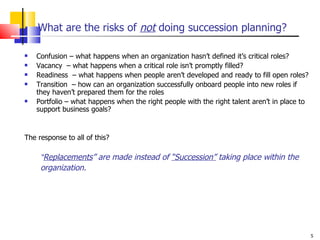
What are the risks of  not  doing succession planning?   Confusion – what happens when an organization hasn’t defined it’s critical roles? Vacancy  – what happens when a critical role isn’t promptly filled?  Readiness  – what happens when people aren’t developed and ready to fill open roles? Transition  – how can an organization successfully onboard people into new roles if they haven’t prepared them for the roles Portfolio – what happens when the right people with the right talent aren’t in place to support business goals? The response to all of this? “ Replacements ” are made instead of  “Succession”  taking place within the  organization.
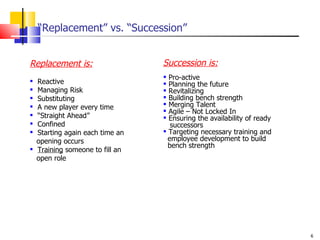
“ Replacement” vs. “Succession” Replacement is: Reactive Managing Risk Substituting  A new player every time “ Straight Ahead”  Confined Starting again each time an    opening occurs Training  someone to fill an    open role Succession is: Pro-active Planning the future Revitalizing  Building bench strength Merging Talent Agile – Not Locked In Ensuring the availability of ready   successors Targeting necessary training and    employee development to build bench strength
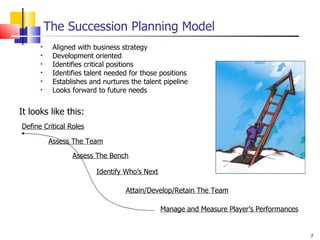
The Succession Planning Model Aligned with business strategy Development oriented Identifies critical positions Identifies talent needed for those positions Establishes and nurtures the talent pipeline Looks forward to future needs It looks like this:  Define Critical Roles Assess The Team Assess The Bench Manage and Measure Player’s Performances Identify Who’s Next Attain/Develop/Retain The Team
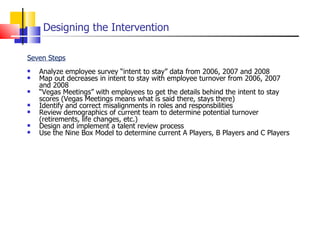
Designing the Intervention Seven Steps Analyze employee survey “intent to stay” data from 2006, 2007 and 2008 Map out decreases in intent to stay with employee turnover from 2006, 2007 and 2008 “ Vegas Meetings” with employees to get the details behind the intent to stay scores (Vegas Meetings means what is said there, stays there) Identify and correct misalignments in roles and responsbilities Review demographics of current team to determine potential turnover (retirements, life changes, etc.) Design and implement a talent review process Use the Nine Box Model to determine current A Players, B Players and C Players
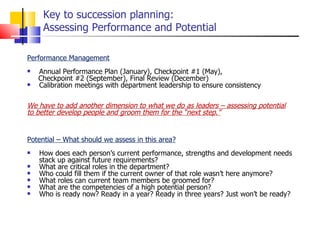
Key to succession planning: Assessing Performance and Potential Performance Management Annual Performance Plan (January), Checkpoint #1 (May),  Checkpoint #2 (September), Final Review (December) Calibration meetings with department leadership to ensure consistency We have to add another dimension to what we do as leaders – assessing potential to better develop people and groom them for the “next step.” Potential – What should we assess in this area? How does each person’s current performance, strengths and development needs stack up against future requirements? What are critical roles in the department?  Who could fill them if the current owner of that role wasn’t here anymore? What roles can current team members be groomed for?  What are the competencies of a high potential person?  Who is ready now? Ready in a year? Ready in three years? Just won’t be ready?
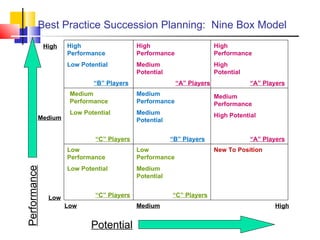
Best Practice Succession Planning:  Nine Box Model High Low Performance Low High Potential High Performance Low Potential Medium Performance High Potential Medium  Performance Medium Potential Medium Performance Low Potential High Performance Medium Potential High Performance High Potential New To Position Low Performance Medium Potential Low Performance Low Potential “ C” Players “ A” Players Medium Medium “ B” Players “ A” Players “ A” Players “ B” Players “ C” Players “ C” Players
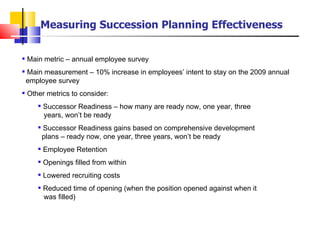
Main metric – annual employee survey Main measurement – 10% increase in employees’ intent to stay on the 2009 annual    employee survey  Other metrics to consider: Successor Readiness – how many are ready now, one year, three    years, won’t be ready Successor Readiness gains based on comprehensive development    plans – ready now, one year, three years, won’t be ready Employee Retention Openings filled from within Lowered recruiting costs Reduced time of opening (when the position opened against when it    was filled) Measuring Succession Planning Effectiveness
Performance Management Stretch Goals Don’t Pigeonhole People Development Plans Leadership Effectiveness Leaders’ ability to coach team members What else needs to be considered?
Wendy Scheel E-mail:  [email_address]  OR  [email_address] My Contact Information

scheel-wendy-830

  • 1.
    Succession Planning: BuildingBench Strength to Have the Right People in the Right Jobs at the Right Time Wendy M. Scheel December 1, 2008 Financial Services/Insurance HRD 830/440: Concepts of Human Resource Development HRD Clemson University
  • 2.
    To Get Startedl work in Encompass, Allstate’s Independent Agent Channel. Independent agents represent between 8 and 12 insurance brands in their agencies whereas exclusive agents sell only Allstate products. Encompass Distribution Support works directly with 200 field sales leader to manage | agency relationships with approximately 2,300 agents and drive business results. Examples of that work are sales promotions, business reporting, training and education, technology and delivering business messages to field sales and agents. I am communications manager for the Encompass Distribution Support, which is a team of 23 people. I am focused on developing my role into an workforce effectiveness role and have been taking on work, making strong suggestions, going ahead and doing things to make that transition. This is especially true since I started the Masters in HRD program. More empowered, bigger thinking have influenced my work since starting the program.
  • 3.
    My Topic: SuccessionPlanning Over the past three years, Distribution Support employees’ intent to stay with the organization scores on the annual survey have slipped. More employees are looking to move on and take on more challenging positions in other parts of Encompass or Allstate (the larger organization). Through thorough analysis of the annual employee survey results over the past three years and voluntary “Vegas Meetings” with employees, I determined that their dissatisfaction stems from lack of a clear career path and lack of effective development plans. The concern most often expressed by employees was, “Tell me how I can grow in my job and learn new things. If I can’t do more and advance here, I will go someplace where I can.” The place most people indicated they would look at is the Allstate Distribution Support team, a group of 125 individuals who support 13,000 Allstate Exclusive Agents and approximately 700 field sales leaders. “It’s a bigger organization with more opportunity.” The HRD intervention I designed is a succession planning model.
  • 4.
    What is successionplanning? There is an abundance of information available on succession planning. I focused my research on what makes sense, what is simple to use, what will the leaders I need to influence be most open to and most able to “get.” A “textbook” answer is: a deliberate and systematic effort by an organization to ensure leadership continuity in key positions, retain and develop intellectual capital for the future and encourage individual advancement The answer I used: Building bench strength to make sure we have the right people in place for the right jobs at the right time.
  • 5.
    What are therisks of not doing succession planning? Confusion – what happens when an organization hasn’t defined it’s critical roles? Vacancy – what happens when a critical role isn’t promptly filled? Readiness – what happens when people aren’t developed and ready to fill open roles? Transition – how can an organization successfully onboard people into new roles if they haven’t prepared them for the roles Portfolio – what happens when the right people with the right talent aren’t in place to support business goals? The response to all of this? “ Replacements ” are made instead of “Succession” taking place within the organization.
  • 6.
    “ Replacement” vs.“Succession” Replacement is: Reactive Managing Risk Substituting A new player every time “ Straight Ahead” Confined Starting again each time an opening occurs Training someone to fill an open role Succession is: Pro-active Planning the future Revitalizing Building bench strength Merging Talent Agile – Not Locked In Ensuring the availability of ready successors Targeting necessary training and employee development to build bench strength
  • 7.
    The Succession PlanningModel Aligned with business strategy Development oriented Identifies critical positions Identifies talent needed for those positions Establishes and nurtures the talent pipeline Looks forward to future needs It looks like this: Define Critical Roles Assess The Team Assess The Bench Manage and Measure Player’s Performances Identify Who’s Next Attain/Develop/Retain The Team
  • 8.
    Designing the InterventionSeven Steps Analyze employee survey “intent to stay” data from 2006, 2007 and 2008 Map out decreases in intent to stay with employee turnover from 2006, 2007 and 2008 “ Vegas Meetings” with employees to get the details behind the intent to stay scores (Vegas Meetings means what is said there, stays there) Identify and correct misalignments in roles and responsbilities Review demographics of current team to determine potential turnover (retirements, life changes, etc.) Design and implement a talent review process Use the Nine Box Model to determine current A Players, B Players and C Players
  • 9.
    Key to successionplanning: Assessing Performance and Potential Performance Management Annual Performance Plan (January), Checkpoint #1 (May), Checkpoint #2 (September), Final Review (December) Calibration meetings with department leadership to ensure consistency We have to add another dimension to what we do as leaders – assessing potential to better develop people and groom them for the “next step.” Potential – What should we assess in this area? How does each person’s current performance, strengths and development needs stack up against future requirements? What are critical roles in the department? Who could fill them if the current owner of that role wasn’t here anymore? What roles can current team members be groomed for? What are the competencies of a high potential person? Who is ready now? Ready in a year? Ready in three years? Just won’t be ready?
  • 10.
    Best Practice SuccessionPlanning: Nine Box Model High Low Performance Low High Potential High Performance Low Potential Medium Performance High Potential Medium Performance Medium Potential Medium Performance Low Potential High Performance Medium Potential High Performance High Potential New To Position Low Performance Medium Potential Low Performance Low Potential “ C” Players “ A” Players Medium Medium “ B” Players “ A” Players “ A” Players “ B” Players “ C” Players “ C” Players
  • 11.
    Main metric –annual employee survey Main measurement – 10% increase in employees’ intent to stay on the 2009 annual employee survey Other metrics to consider: Successor Readiness – how many are ready now, one year, three years, won’t be ready Successor Readiness gains based on comprehensive development plans – ready now, one year, three years, won’t be ready Employee Retention Openings filled from within Lowered recruiting costs Reduced time of opening (when the position opened against when it was filled) Measuring Succession Planning Effectiveness
  • 12.
    Performance Management StretchGoals Don’t Pigeonhole People Development Plans Leadership Effectiveness Leaders’ ability to coach team members What else needs to be considered?
  • 13.
    Wendy Scheel E-mail: [email_address] OR [email_address] My Contact Information