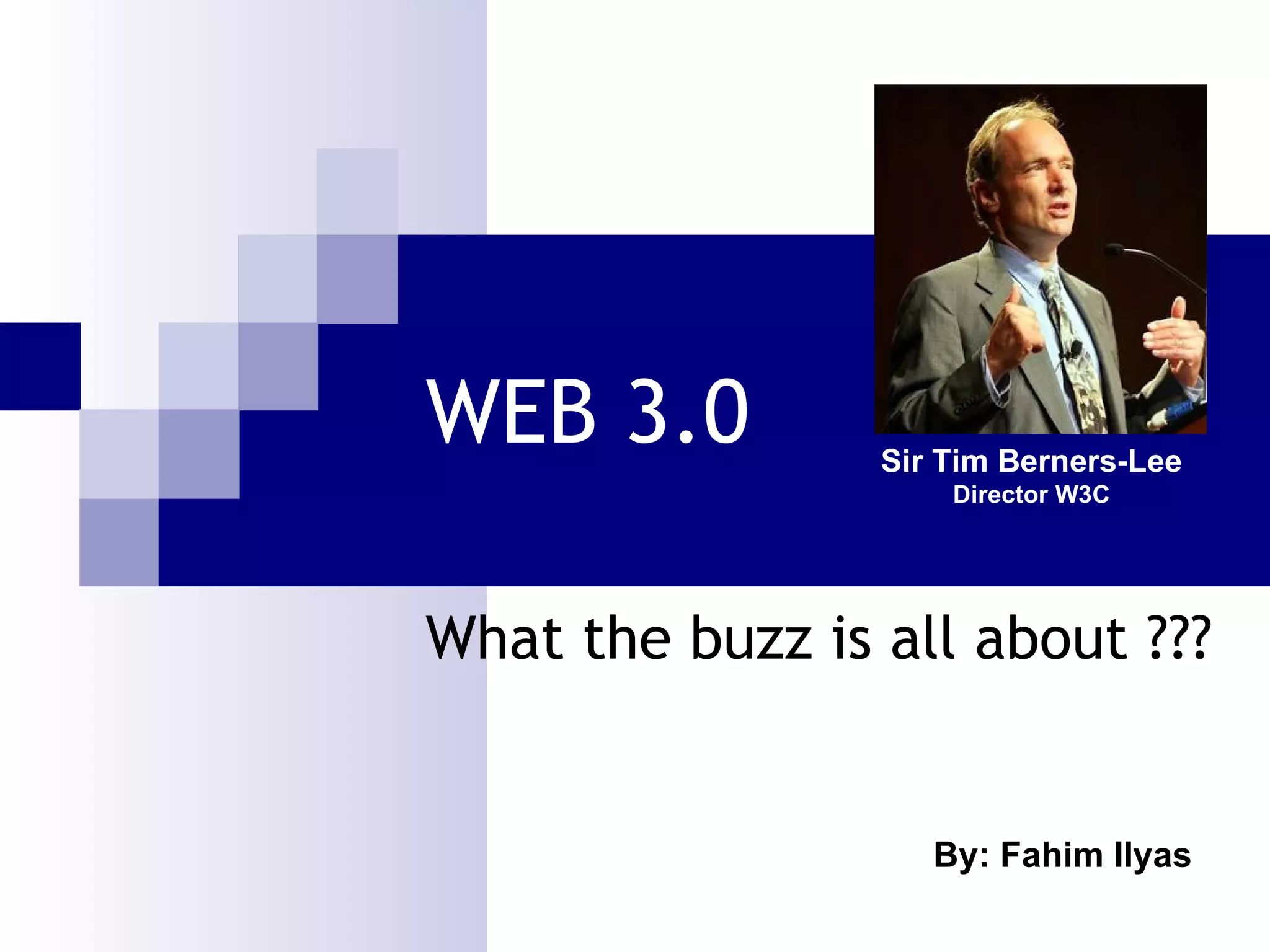
WEB 3.0 What the buzz is all about ??? By: Fahim Ilyas Sir Tim Berners-Lee Director W3C
History of WWW Created in 1989 by Sir Tim Berners-Lee (England) and Robert Cailliau (Belgium) On April 30, 1993, CERN announced that the World Wide Web would be free to anyone. In October 1994, Tim Berners-Lee founded W3C. In 1994, Mark Andreesen invents  MOSAIC  at National Center for Super Computing  Applications (NCSA) There were more than  550 billion  documents on the Web, mostly in the " invisible web ", or  deep web .(2001)
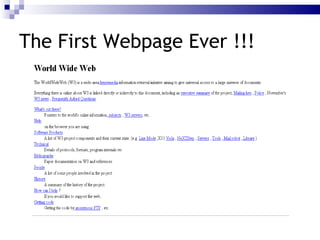
History… (contd) Info.cern.ch  was the address of the world's first-ever web site and web server, running computer at CERN.  The first web page address was  http://info.cern.ch/hypertext/WWW/TheProject.html , which centered on information regarding the WWW project.
The First Webpage Ever !!!
WWW has changed ???
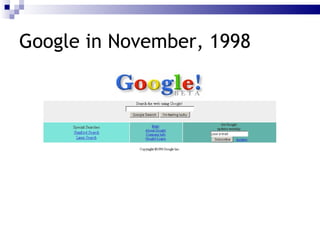
Google in November, 1998
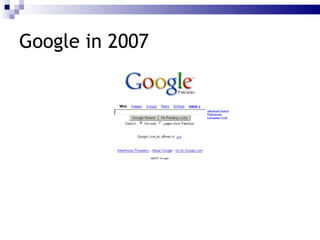
Google in 2007
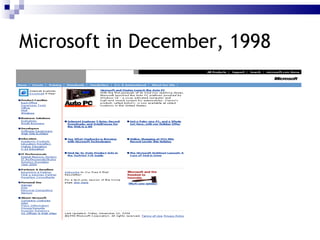
Microsoft in December, 1998
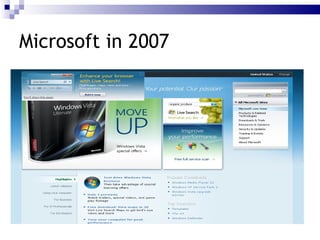
Microsoft in 2007
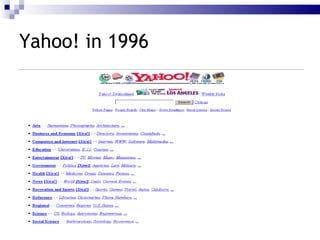
Yahoo! in 1996
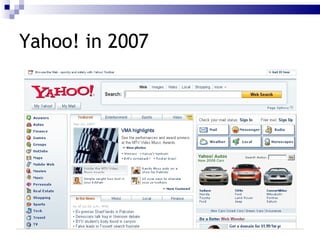
Yahoo! in 2007
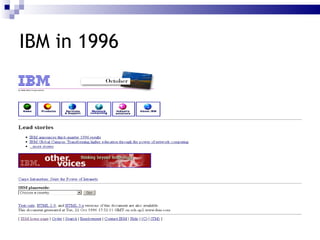
IBM in 1996
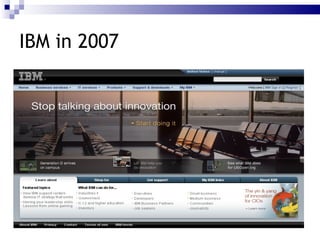
IBM in 2007
Web 2.0 (2003 – 2008) Rich Internet application  techniques, optionally Ajax-based. ( Ajax, Adobe Flash, Flex, Nexaweb, OpenLaszlo and Silverlight  ) CSS Semantically valid HTML markup and the use of  microformats .  Syndication of data in RSS/Atom Extensive use of  folksonomies  (e.g.  http://del.icio.us  ) Use of  wiki  software ( e.g.  www.wikipedia.org  ) Use of  Open source software  (e.g. apache, php, mysql)
Web 2.0 (cont) Weblog  publishing (e.g.  http://www.wordpress.org   ) Mashups  (e.g.  www.webmashup.com  &  www.webmunism.com   ) REST  or  XML Webservice APIs   Use of user-friendly  content-management systems  (CMS). (e.g. Joomla) Social Networking  (Orkut, Facebook) Optimized  search engine capability
Web 3.0 ??? Ubiquitous Connectivity ,  mobile Internet access and mobile devices  Network computing , software-as-a-service business models, Web services interoperability, distributed computing, grid computing and cloud computing  Open technologies , Open APIs and protocols, open data formats, open-source software platforms Open identity , OpenID, open reputation, roaming portable identity and personal data  The intelligent web , Semantic web technologies such as RDF, OWL, SPARQL and Semantic application platforms Distributed databases , the "World Wide Database" (enabled by Semantic Web technologies)  Intelligent applications , natural language processing, machine learning, machine reasoning, autonomous agents.
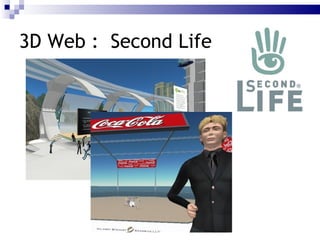
3D Web :  Second Life
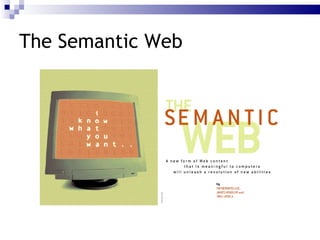
The Semantic Web
Semantic Web Semantic  = Information contained in Data . Semantic Web  is an evolving extension of the World Wide Web  Web content can be expressed not only in natural language, but also in a format that can be read and used by  software agents , thus permitting them to  find ,  share  and  integrate  information more easily.  Medium for data, information, and  knowledge exchange .
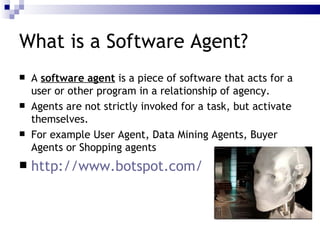
What is a Software Agent? A  software agent  is a piece of software that acts for a user or other program in a relationship of agency. Agents are not strictly invoked for a task, but activate themselves. For example User Agent, Data Mining Agents, Buyer Agents or Shopping agents http://www.botspot.com/
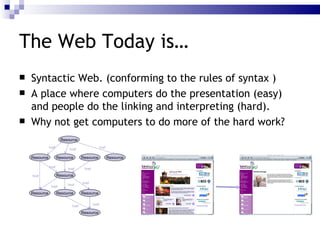
The Web Today is… Syntactic Web . (conforming to the rules of syntax ) A place where  computers do the presentation  (easy) and  people do the linking and interpreting  (hard). Why not get computers to do more of the hard work? Resource Resource Resource Resource Resource Resource Resource Resource Resource Resource href href href href href href href href href href href href
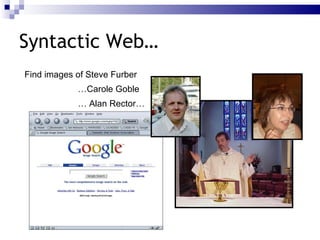
Syntactic Web… Find images of Steve Furber … Carole Goble  …  Alan Rector…
Impossible Today… Complex queries involving background knowledge Find information about “animals that use sonar but are neither bats nor dolphins” Locating information in data repositories Travel enquiries Prices of goods and services Results of human genome experiments Delegating complex tasks to web “agents” Book me a holiday next weekend somewhere warm, not too far away, and where they speak French or English
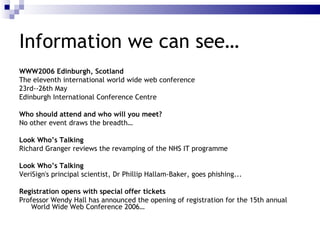
Information we can see… WWW2006 Edinburgh, Scotland The eleventh international world wide web conference 23rd--26th May Edinburgh International Conference Centre Who should attend and who will you meet? No other event draws the breadth… Look Who’s Talking Richard Granger reviews the revamping of the NHS IT programme Look Who’s Talking VeriSign's principal scientist, Dr Phillip Hallam-Baker, goes phishing... Registration opens with special offer tickets Professor Wendy Hall has announced the opening of registration for the 15th annual World Wide Web Conference 2006…
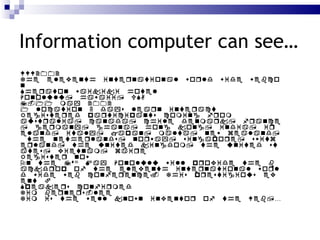
Information computer can see…            …    …
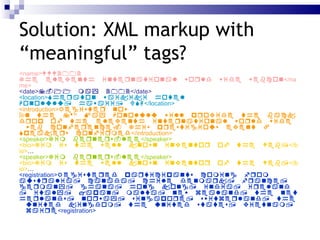
Solution: XML markup with “meaningful” tags? <name>   </name> <date>  </date>   <location>   </location> <introduction>    …  </introduction> <speaker>  </speaker> <bio>  </bio> … <speaker>  </speaker> <bio>  </bio> … <registration>   <registration>
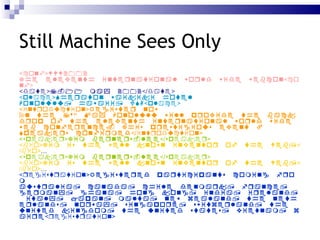
Still Machine Sees Only <  >   <  > <  >  </  >   <  >   <  > <  >    …  </  > <  >  </  > <  >  </  > … <  >  </  > <  >  </  > … <  >   <  >
Limits of XML How do I know that you mean the same thing by <price> that I do? Does that include tax? shipping? surcharges? This is critical in B2B e-commerce. That is, if the computers of two companies are negotiating, they need to know that they truly understand each other. Computer 1: Do you sell heavy duty crowbars? [thinks:  I need crowbars that can withstand 10,000 lbs. Pressure ] Computer 2: Yes. [thinks:  Our crowbars are good to 5,000 lbs. ]
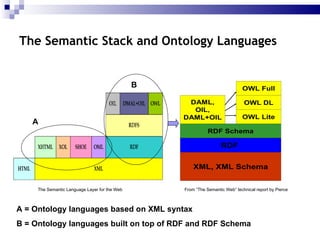
The Semantic Stack and Ontology Languages From “The Semantic Web” technical report by Pierce The Semantic Language Layer for the Web A B A = Ontology languages based on XML syntax  B = Ontology languages built on top of RDF and RDF Schema
Today, in computer science, an ontology is typically a  hierarchical collection of classes ,  permissible relationships amongst those classes , and  inference rules . Agents can  parse a page , and immediately  understand  its  semantics . No need  for  natural language processing . Searches can be done on  concepts .  Data and knowledge sharing .  What’s an Ontology?
What’s an Ontology? “ Ontology” is an often used term in the field of Knowledge Representation, Information Modeling, etc. English definitions tend to be vague to non-specialists “ A formal, explicit specification of a shared conceptionalization” But really, if you sit down to  describe a subject  in terms of its  classes  and their  relationships  using  RDFS  or  DAML , you are creating an  Ontology .
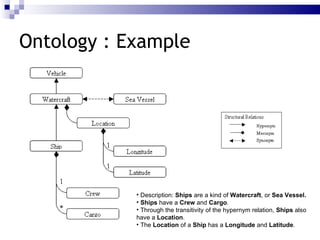
Ontology : Example Description:  Ships  are a kind of  Watercraft , or  Sea Vessel.   Ships  have a  Crew  and  Cargo . Through the transitivity of the hypernym relation,  Ships  also have a  Location . The  Location  of a  Ship  has a  Longitude  and  Latitude .
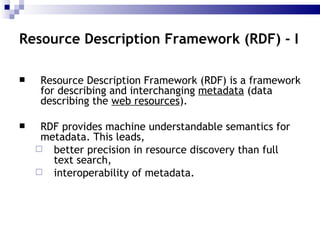
Resource Description Framework (RDF) is a  framework  for describing and interchanging  metadata  (data describing the  web resources ).  RDF provides  machine understandable  semantics for metadata. This leads,  better precision in resource discovery  than full text search,  interoperability of metadata .  Resource Description Framework (RDF) - I
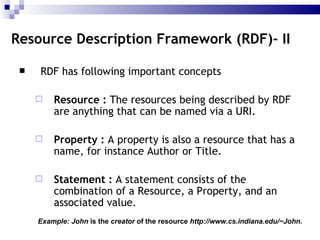
RDF has following important concepts Resource  :  The resources being described by RDF are anything that can be named via a URI.  Property  :  A property is also a resource that has a name, for instance Author or Title.  Statement  :  A statement consists of the combination of a Resource, a Property, and an associated value.  Resource Description Framework (RDF)- II Example: John  is the  creator  of the resource  http://www.cs.indiana.edu/~John.
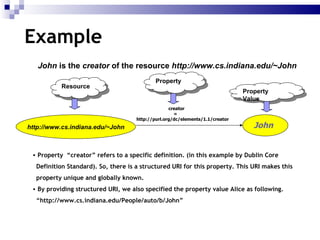
Example http://www.cs.indiana.edu/~John creator = http://purl.org/dc/elements/1.1/creator John  is the  creator  of the resource  http://www.cs.indiana.edu/~John   Property  “creator” refers to a specific definition. (in this example by Dublin Core Definition Standard). So, there is a structured URI for this property. This URI makes this property unique and globally known. By providing structured URI, we also specified the property value Alice as following.  “ http://www.cs.indiana.edu/People/auto/b/John” John Resource Property Property Value
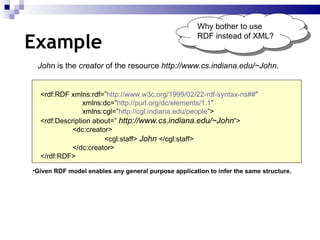
Example John  is the  creator  of the resource  http://www.cs.indiana.edu/~John .   <rdf:RDF xmlns:rdf=” http://www.w3c.org/1999/02/22-rdf-syntax-ns## ”   xmlns:dc=” http://purl.org/dc/elements/1.1 ”   xmlns:cgl=” http://cgl.indiana.edu/people ”> <rdf:Description about=”  http://www.cs.indiana.edu/~John ”> <dc:creator> <cgl:staff>  John   </cgl:staff> </dc:creator> </rdf:RDF> Given RDF model enables any general purpose application to infer the same structure. Why bother to use RDF instead of XML?
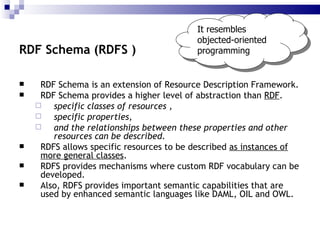
RDF Schema is an  extension  of Resource Description Framework. RDF Schema  provides a higher level of abstraction  than  RDF . specific classes of resources  , specific properties ,  and the relationships between these properties and other resources can be described . RDFS allows specific resources to be described  as instances of more general classes . RDFS provides  mechanisms where   custom RDF vocabulary can be developed . Also, RDFS provides important semantic capabilities that are used by enhanced semantic languages like DAML, OIL and OWL. RDF Schema (RDFS ) It resembles objected-oriented programming
No standard for expressing primitive data types  such as integer, etc.  All data types in RDF/RDFS are treated as strings .  No  standard for expressing relations  of properties  (unique, transitive, inverse etc.) No standard to express  equivalence, disjointedness etc. among properties Limitations of RDF/RDFS
Enters DAML + OIL
RDF\RDFS define a framework, however they have limitations. There is a need for new semantic web languages with following requirements They should be compatible with (XML, RDF/RDFS) They should have enough expressive power to fill in the gaps in RDFS They should provide automated reasoning support Ontology Inference Layer (OIL) and DARPA Agent Markup Language (DAML) are two important efforts developed to fulfill these requirements. Their combined efforts formed DAML+OIL declarative semantic language. DAML, OIL and DAML+OIL - I
DAML+OIL is built on top of RDFS.  It uses RDFS syntax. It has richer ways to express primitive data types. DAML+OIL allows other relationships (inverse and transitivity) to be directly expressed.  DAML+OIL  provides well defined semantics, This provides followings: Meaning of DAML+OIL statements can be formally specified. Machine understanding and automated reasoning can be supported. More expressive power can be provided. DAML, OIL and DAML + OIL - II
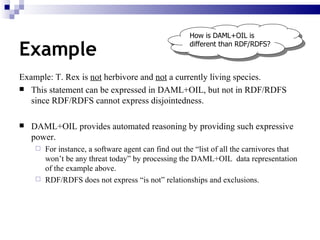
Example: T. Rex is  not  herbivore and  not  a currently living species.  This statement can be expressed in DAML+OIL, but not in RDF/RDFS since RDF/RDFS cannot express disjointedness. DAML+OIL provides automated reasoning by providing such expressive power. For instance, a software agent can find out the “list of all the carnivores that won’t be any threat today” by processing the DAML+OIL  data representation of the example above.  RDF/RDFS does not express “is not” relationships and exclusions. Example How is DAML+OIL is different than RDF/RDFS?
Web Ontology Language (OWL) is another effort developed by the OWL working group of the W3Consorsium. OWL is an extension of DAML+OIL. OWL is divided following sub languages. OWL Lite  OWL (Description Logics) DL OWL Full –  limited cardinality OWL Lite provides many of the facilities of DAML+OIL provides. In addition to RDF/RDFS tags, it also allows us to express equivalence, identity, difference, inverse, and transivity.  OWL Lite is a subset of OWL DL, which in turn is a subset of OWL Full.   Web Ontology Language (OWL)
Semantic Web as a Web of Services Automatic Discovery Location of Web Service Automatic Invocation Execution of discovered Web Service Software Agents Interpret the markup, Knows inputs and handle outputs and execute the service Automatic Composition and Interoperation Using many services to perform a task.
Future of WWW “ We can imagine a web-enabled microwave oven consulting the popcorn manufacturer’s website for optimal popping parameters”
Example : Indexing the Hidden Web Search engines – google, infoseek, etc. – work by  constantly crawling the web , and  building huge indexes , with entries for every word encountered. But a  lot of web information is not linked to directly .  It is “hidden” behind forms .  eg www.allmovies.com allows you to search a vast database of movies and actors. But it does not  link  to those movies and actors. You are required to enter a search term. A web-spider , not knowing how to interact with such sites,  cannot penetrate any deeper than the page with the form .
Indexing the Hidden Web (Contd.) Now imagine that allmovies.com had some  RDF attached , which said  “ I am allmovies.com. I am an interface to a vast database of movie and actor information.  If you input a movie title into the box , I will return a page with the following information about the movie: …  If you input an actor name ,  I will return a page with the following information about the actor : …”
Indexing the Hidden Web (Contd.) An RDF aware spider can come to such a page and do one of two things: If it is a spider for a specialized search engine, it may ignore the site altogether. If not, it can say to itself: “I know some movie titles. I’ll input them (being careful not to overwhelm the site), and index the results ( and  keep on spidering from the result pages). At the least, the search engine can record the fact that “ www.allmovies.com/execperson?name=x” returns information about the actor with name x.
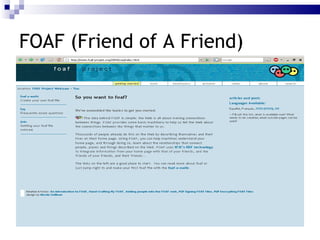
FOAF (Friend of A Friend)
See OpenID  ( www.openid.net   ) Second Life  ( www.secondlife.com ) DAML  ( www.daml.org/  ) RDF  ( www.w3.org/RDF/  ) FOAF  ( http://www.foaf-project.org /)

Web3uploaded

  • 1.
    WEB 3.0 Whatthe buzz is all about ??? By: Fahim Ilyas Sir Tim Berners-Lee Director W3C
  • 2.
    History of WWWCreated in 1989 by Sir Tim Berners-Lee (England) and Robert Cailliau (Belgium) On April 30, 1993, CERN announced that the World Wide Web would be free to anyone. In October 1994, Tim Berners-Lee founded W3C. In 1994, Mark Andreesen invents MOSAIC at National Center for Super Computing Applications (NCSA) There were more than 550 billion documents on the Web, mostly in the &quot; invisible web &quot;, or deep web .(2001)
  • 3.
    History… (contd) Info.cern.ch was the address of the world's first-ever web site and web server, running computer at CERN. The first web page address was http://info.cern.ch/hypertext/WWW/TheProject.html , which centered on information regarding the WWW project.
  • 4.
  • 5.
  • 6.
  • 7.
  • 8.
  • 9.
  • 10.
  • 11.
  • 12.
  • 13.
  • 14.
    Web 2.0 (2003– 2008) Rich Internet application techniques, optionally Ajax-based. ( Ajax, Adobe Flash, Flex, Nexaweb, OpenLaszlo and Silverlight ) CSS Semantically valid HTML markup and the use of microformats . Syndication of data in RSS/Atom Extensive use of folksonomies (e.g. http://del.icio.us ) Use of wiki software ( e.g. www.wikipedia.org ) Use of Open source software (e.g. apache, php, mysql)
  • 15.
    Web 2.0 (cont)Weblog publishing (e.g. http://www.wordpress.org ) Mashups (e.g. www.webmashup.com & www.webmunism.com ) REST or XML Webservice APIs Use of user-friendly content-management systems (CMS). (e.g. Joomla) Social Networking (Orkut, Facebook) Optimized search engine capability
  • 16.
    Web 3.0 ???Ubiquitous Connectivity , mobile Internet access and mobile devices Network computing , software-as-a-service business models, Web services interoperability, distributed computing, grid computing and cloud computing Open technologies , Open APIs and protocols, open data formats, open-source software platforms Open identity , OpenID, open reputation, roaming portable identity and personal data The intelligent web , Semantic web technologies such as RDF, OWL, SPARQL and Semantic application platforms Distributed databases , the &quot;World Wide Database&quot; (enabled by Semantic Web technologies) Intelligent applications , natural language processing, machine learning, machine reasoning, autonomous agents.
  • 17.
    3D Web : Second Life
  • 18.
  • 19.
    Semantic Web Semantic = Information contained in Data . Semantic Web is an evolving extension of the World Wide Web Web content can be expressed not only in natural language, but also in a format that can be read and used by software agents , thus permitting them to find , share and integrate information more easily. Medium for data, information, and knowledge exchange .
  • 20.
    What is aSoftware Agent? A software agent is a piece of software that acts for a user or other program in a relationship of agency. Agents are not strictly invoked for a task, but activate themselves. For example User Agent, Data Mining Agents, Buyer Agents or Shopping agents http://www.botspot.com/
  • 21.
    The Web Todayis… Syntactic Web . (conforming to the rules of syntax ) A place where computers do the presentation (easy) and people do the linking and interpreting (hard). Why not get computers to do more of the hard work? Resource Resource Resource Resource Resource Resource Resource Resource Resource Resource href href href href href href href href href href href href
  • 22.
    Syntactic Web… Findimages of Steve Furber … Carole Goble … Alan Rector…
  • 23.
    Impossible Today… Complexqueries involving background knowledge Find information about “animals that use sonar but are neither bats nor dolphins” Locating information in data repositories Travel enquiries Prices of goods and services Results of human genome experiments Delegating complex tasks to web “agents” Book me a holiday next weekend somewhere warm, not too far away, and where they speak French or English
  • 24.
    Information we cansee… WWW2006 Edinburgh, Scotland The eleventh international world wide web conference 23rd--26th May Edinburgh International Conference Centre Who should attend and who will you meet? No other event draws the breadth… Look Who’s Talking Richard Granger reviews the revamping of the NHS IT programme Look Who’s Talking VeriSign's principal scientist, Dr Phillip Hallam-Baker, goes phishing... Registration opens with special offer tickets Professor Wendy Hall has announced the opening of registration for the 15th annual World Wide Web Conference 2006…
  • 25.
    Information computer cansee…            …    …
  • 26.
    Solution: XML markupwith “meaningful” tags? <name>   </name> <date>  </date> <location>   </location> <introduction>    …  </introduction> <speaker>  </speaker> <bio>  </bio> … <speaker>  </speaker> <bio>  </bio> … <registration>   <registration>
  • 27.
    Still Machine SeesOnly <  >   <  > <  >  </  > <  >   <  > <  >    …  </  > <  >  </  > <  >  </  > … <  >  </  > <  >  </  > … <  >   <  >
  • 28.
    Limits of XMLHow do I know that you mean the same thing by <price> that I do? Does that include tax? shipping? surcharges? This is critical in B2B e-commerce. That is, if the computers of two companies are negotiating, they need to know that they truly understand each other. Computer 1: Do you sell heavy duty crowbars? [thinks: I need crowbars that can withstand 10,000 lbs. Pressure ] Computer 2: Yes. [thinks: Our crowbars are good to 5,000 lbs. ]
  • 29.
    The Semantic Stackand Ontology Languages From “The Semantic Web” technical report by Pierce The Semantic Language Layer for the Web A B A = Ontology languages based on XML syntax B = Ontology languages built on top of RDF and RDF Schema
  • 30.
    Today, in computerscience, an ontology is typically a hierarchical collection of classes , permissible relationships amongst those classes , and inference rules . Agents can parse a page , and immediately understand its semantics . No need for natural language processing . Searches can be done on concepts . Data and knowledge sharing . What’s an Ontology?
  • 31.
    What’s an Ontology?“ Ontology” is an often used term in the field of Knowledge Representation, Information Modeling, etc. English definitions tend to be vague to non-specialists “ A formal, explicit specification of a shared conceptionalization” But really, if you sit down to describe a subject in terms of its classes and their relationships using RDFS or DAML , you are creating an Ontology .
  • 32.
    Ontology : ExampleDescription: Ships are a kind of Watercraft , or Sea Vessel. Ships have a Crew and Cargo . Through the transitivity of the hypernym relation, Ships also have a Location . The Location of a Ship has a Longitude and Latitude .
  • 33.
    Resource Description Framework(RDF) is a framework for describing and interchanging metadata (data describing the web resources ). RDF provides machine understandable semantics for metadata. This leads, better precision in resource discovery than full text search, interoperability of metadata . Resource Description Framework (RDF) - I
  • 34.
    RDF has followingimportant concepts Resource : The resources being described by RDF are anything that can be named via a URI. Property : A property is also a resource that has a name, for instance Author or Title. Statement : A statement consists of the combination of a Resource, a Property, and an associated value. Resource Description Framework (RDF)- II Example: John is the creator of the resource http://www.cs.indiana.edu/~John.
  • 35.
    Example http://www.cs.indiana.edu/~John creator= http://purl.org/dc/elements/1.1/creator John is the creator of the resource http://www.cs.indiana.edu/~John Property “creator” refers to a specific definition. (in this example by Dublin Core Definition Standard). So, there is a structured URI for this property. This URI makes this property unique and globally known. By providing structured URI, we also specified the property value Alice as following. “ http://www.cs.indiana.edu/People/auto/b/John” John Resource Property Property Value
  • 36.
    Example John is the creator of the resource http://www.cs.indiana.edu/~John . <rdf:RDF xmlns:rdf=” http://www.w3c.org/1999/02/22-rdf-syntax-ns## ” xmlns:dc=” http://purl.org/dc/elements/1.1 ” xmlns:cgl=” http://cgl.indiana.edu/people ”> <rdf:Description about=” http://www.cs.indiana.edu/~John ”> <dc:creator> <cgl:staff> John </cgl:staff> </dc:creator> </rdf:RDF> Given RDF model enables any general purpose application to infer the same structure. Why bother to use RDF instead of XML?
  • 37.
    RDF Schema isan extension of Resource Description Framework. RDF Schema provides a higher level of abstraction than RDF . specific classes of resources , specific properties , and the relationships between these properties and other resources can be described . RDFS allows specific resources to be described as instances of more general classes . RDFS provides mechanisms where custom RDF vocabulary can be developed . Also, RDFS provides important semantic capabilities that are used by enhanced semantic languages like DAML, OIL and OWL. RDF Schema (RDFS ) It resembles objected-oriented programming
  • 38.
    No standard forexpressing primitive data types such as integer, etc. All data types in RDF/RDFS are treated as strings . No standard for expressing relations of properties (unique, transitive, inverse etc.) No standard to express equivalence, disjointedness etc. among properties Limitations of RDF/RDFS
  • 39.
  • 40.
    RDF\RDFS define aframework, however they have limitations. There is a need for new semantic web languages with following requirements They should be compatible with (XML, RDF/RDFS) They should have enough expressive power to fill in the gaps in RDFS They should provide automated reasoning support Ontology Inference Layer (OIL) and DARPA Agent Markup Language (DAML) are two important efforts developed to fulfill these requirements. Their combined efforts formed DAML+OIL declarative semantic language. DAML, OIL and DAML+OIL - I
  • 41.
    DAML+OIL is builton top of RDFS. It uses RDFS syntax. It has richer ways to express primitive data types. DAML+OIL allows other relationships (inverse and transitivity) to be directly expressed. DAML+OIL provides well defined semantics, This provides followings: Meaning of DAML+OIL statements can be formally specified. Machine understanding and automated reasoning can be supported. More expressive power can be provided. DAML, OIL and DAML + OIL - II
  • 42.
    Example: T. Rexis not herbivore and not a currently living species. This statement can be expressed in DAML+OIL, but not in RDF/RDFS since RDF/RDFS cannot express disjointedness. DAML+OIL provides automated reasoning by providing such expressive power. For instance, a software agent can find out the “list of all the carnivores that won’t be any threat today” by processing the DAML+OIL data representation of the example above. RDF/RDFS does not express “is not” relationships and exclusions. Example How is DAML+OIL is different than RDF/RDFS?
  • 43.
    Web Ontology Language(OWL) is another effort developed by the OWL working group of the W3Consorsium. OWL is an extension of DAML+OIL. OWL is divided following sub languages. OWL Lite OWL (Description Logics) DL OWL Full – limited cardinality OWL Lite provides many of the facilities of DAML+OIL provides. In addition to RDF/RDFS tags, it also allows us to express equivalence, identity, difference, inverse, and transivity. OWL Lite is a subset of OWL DL, which in turn is a subset of OWL Full. Web Ontology Language (OWL)
  • 44.
    Semantic Web asa Web of Services Automatic Discovery Location of Web Service Automatic Invocation Execution of discovered Web Service Software Agents Interpret the markup, Knows inputs and handle outputs and execute the service Automatic Composition and Interoperation Using many services to perform a task.
  • 45.
    Future of WWW“ We can imagine a web-enabled microwave oven consulting the popcorn manufacturer’s website for optimal popping parameters”
  • 46.
    Example : Indexingthe Hidden Web Search engines – google, infoseek, etc. – work by constantly crawling the web , and building huge indexes , with entries for every word encountered. But a lot of web information is not linked to directly . It is “hidden” behind forms . eg www.allmovies.com allows you to search a vast database of movies and actors. But it does not link to those movies and actors. You are required to enter a search term. A web-spider , not knowing how to interact with such sites, cannot penetrate any deeper than the page with the form .
  • 47.
    Indexing the HiddenWeb (Contd.) Now imagine that allmovies.com had some RDF attached , which said “ I am allmovies.com. I am an interface to a vast database of movie and actor information. If you input a movie title into the box , I will return a page with the following information about the movie: … If you input an actor name , I will return a page with the following information about the actor : …”
  • 48.
    Indexing the HiddenWeb (Contd.) An RDF aware spider can come to such a page and do one of two things: If it is a spider for a specialized search engine, it may ignore the site altogether. If not, it can say to itself: “I know some movie titles. I’ll input them (being careful not to overwhelm the site), and index the results ( and keep on spidering from the result pages). At the least, the search engine can record the fact that “ www.allmovies.com/execperson?name=x” returns information about the actor with name x.
  • 49.
    FOAF (Friend ofA Friend)
  • 50.
    See OpenID ( www.openid.net ) Second Life ( www.secondlife.com ) DAML ( www.daml.org/ ) RDF ( www.w3.org/RDF/ ) FOAF ( http://www.foaf-project.org /)