Feasibility of using a Quality
Improvement Approach within APHA?


              AN APHA-ISC/SC PERSPECTIVE
     O R I E N TAT I O N F A C I L I TAT E D B Y P R I T I I R A N I
                      F E B R U A RY 2 8 , 2 0 1 2
Acknowledgements
                          2

 Model for Improvement was developed by the
              p                   p    y
  Associate in Process Improvement and is used by
  the Institute for Healthcare Improvement
 New York State Health Department for their support


For APHA-ISC/SC                                   2/28/12
Eureka?
                      3


                      Describe the key
                       elements of Quality
                       Improvement Framework
                          p
                      Identify at least two
                       opportunities to apply
                       quality improvement
                      Have key information to
                       decide
                       d id on th fthe feasibility
                                           ibilit
                       of using the methods
                       within APHA
For APHA-ISC/SC                                2/28/12
Call For Action
                           4


   APHA membership has declined 12% from
    2007 to 2011.
   Similar decline seen in professional
    associations across the US due to shrinking
    budgets and g
        g         growing unemployment.
                          g      p y
   APHA wants to increase membership and
    better serve members’ needs.
   As liaison to units, ISC can help APHA better
    understand what needs to be done to better
    serve members and bring in new members.
For APHA-ISC/SC                                     2/28/12
ISC and APHA Units
                           5

 ISC/SC is the liaison to APHA units: Section, SPIGS,
  Forums, Caucuses
 2011 Action Report/2012 Workplan has been re-
  structured to be consistent with a quality
  improvement framework
 Q lit improvement framework?
  Quality i           tf          k?


For APHA-ISC/SC                                    2/28/12
6


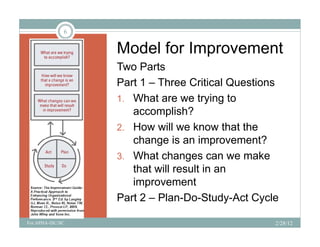
                  Model for Improvement
                  Two Parts
                  Part 1 – Three Critical Questions
                  1. What are we trying to
                      accomplish?
                                li h?
                  2. How will we know that the
                      change is an improvement?
                  3. What changes can we make
                      that will result in an
                      improvement
                  Part 2 – Plan-Do-Study-Act Cycle
                    a         a      o S udy c Cyc e

For APHA-ISC/SC                                    2/28/12
Have you used a similar framework in
            p
            personal or professional life?
                        p
                           7

1. What was the project?
                p j
2. What is similar?
3. What is different?
4. What are the critical elements?
5. What helped move it along to achieve objective?
           p               g              j
6. What were the barriers?


For APHA-ISC/SC                                  2/28/12
What we will need to get started
                            8

 Select a strategic p j
                 g project with significant impact?
                                  g           p
 Identified group who will test the interventions or
  changes?
 Potential to identify and collect process and outcome
  measures? Can some of these be tracked daily,
  weekly or monthly?
      kl          thl ?
 Identify interventions that be used that are known to
  have worked?
 Some aspect of project can be completed in 12
  months?
For APHA-ISC/SC                                         2/28/12
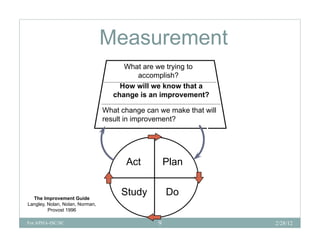
Measurement
                                       What are we trying to
                                          accomplish?
                                      How will we know that a
                                    change is an improvement?

                                 What h
                                 Wh t change can we make that will
                                                        k th t ill
                                 result in improvement?


                                       Act           Plan


  The Improvement Guide
                                      Study          Do
Langley, Nolan, Nolan, Norman,
         Provost 1996

For APHA-ISC/SC                                  9                   2/28/12
Adapting the Framework for the ISC/SC
                          10

What will we need?
What are we doing?
What is the timeline?
Can you picture what it will look like if most of the
 sections/spigs/APHA adopted a quality improvement
 approach?


For APHA-ISC/SC                                   2/28/12
What is the ISC/SC trying to accomplish?
                          11

    Examples
     Increase membership engagement in _#__
      sections/spigs by ___%.
     Number of identified strategies objectives
      improved and/or reached increased by 15%.
    IIncrease membership numbers i APHA b ___
                    b hi         b    in       by
      %.


For APHA-ISC/SC                                 2/28/12
Measurement Assumptions
                   p
     The purpose of measurement in quality
      improvement is for learning not judgment
     All measures have limitations, but the limitations do
      not negate their value
             g
         Seek usefulness, not perfection

     Measures are one voice of the system. Hearing the
                                        y             g
      voice of the system gives us information on how to
      act within the system
     Measures tell a story; goals in your aim statement
      give a reference point

For APHA-ISC/SC              12                       2/28/12
Identify a Balanced “Family” of Measures
       y                  y

    Outcome = Voice of the customer/student:
     How is the system performing?
     What is the result?
     How is the learning of the student affected?

    Process = Voice of the workings of the system:
     Are the parts/steps in the system performing as planned?
     Are key changes being implemented in the system?

    Balancing = Looking at a system from different dimensions
     What happened to the system as we improved the outcome and
      process measures?
     Are we improving some parts of the system at the expense of
      others?


For APHA-ISC/SC                   13                             2/28/12
How will we know that the change is an
                      improvement? -
                                     14


      Membership engagement examples Engagement ● Equity ● Outcomes


 % of members actively involved in leadership, committees,
     projects
    % of members who read emails, newsletters over a finite
     period of time (e.g. before and after a planned event)
    % of members by region, field, membership level
                        region field               level,
     ethnic/racial, geographic level, who participate
    % of strategic projects with clear focus, process and
     outcome measures change ideas
               measures,
    Project objectives movement, or lack thereof
    Section/SPIG/Project leaders/APHA staff satisfaction levels

    For APHA-ISC/SC                                               2/28/12
How will we know that the change is an
                improvement? Part 2
                  p
                          15

Membership Recruitment measures’ examples
           p                             p
 Percentage of membership change
 Number of PDSAs identified
 Number of PDSAs tested
 Proportion of member implementing PDSAs
      p                   p       g
 Section/SPIG/Project leaders/APHA staff satisfaction
  levels


For APHA-ISC/SC                                   2/28/12
What changes can ISC make that will result in
              an improvement
                           16

Examples
      p
 Develop or work with a few sections/spigs to write
  examples of clearly focused strategic projects.
 Test out metrics by using identified interventions
 Develop spreadsheet or dashboards if possible


For APHA-ISC/SC                                    2/28/12
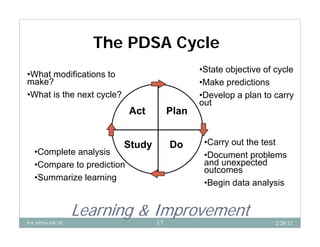
The PDSA Cycle
                                               •State objective of cycle
•What modifications to
 What
make?                                          •Make predictions
•What is the next cycle?                       •Develop a plan to carry
                                               out
                           Act
                           A t          Plan
                                        Pl


                           Study        Do      •Carry out the test
                                                 C       t th t t
  •Complete analysis                            •Document problems
  •Compare to prediction                        and unexpected
                                                outcomes
  •Summarize learning
                                                •Begin data analysis


                  Learning & Improvement
For APHA-ISC/SC                    17                              2/28/12
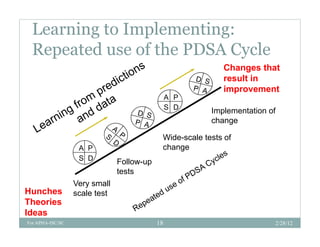
Learning to Implementing:
 Repeated use of th PDSA C l
 R     t d     f the     Cycle
                                                            Changes that
                                                            result in
                                                            improvement
                                                A P
                                                S D
                                                         Implementation of
                                                         I l     t ti    f
                                                         change

                                            Wide scale
                                            Wide-scale tests of
                   A P                      change
                   S D         Follow-up
                               tests
                  Very small
Hunches           scale test
Theories
Ideas
For APHA-ISC/SC                            18                            2/28/12
What resources does the ISC/SC need?
                                          19

1.    Training and opportunity for application
            Personal
            Group
2.
2     Defined roles someone who will:
              roles…someone
            facilitate access with leaders to allow for smooth operations;
            encourage/remind teams to be persistent;
            identify measures and best practice
3. Conference call with small group of knowledgeable
   leaders to identify measures and change ideas
4. 3-5 teams who are willing to test the framework until
   the September of 2012…Open Space Priorities?

For APHA-ISC/SC                                                               2/28/12
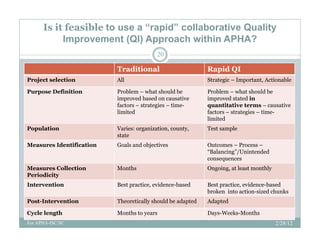
Is it feasible to use a “rapid” collaborative Quality
           Improvement (QI) Approach within APHA?
                                          20

                          Traditional                       Rapid QI
Project selection         All                               Strategic – Important, Actionable

Purpose Definition        Problem – what should be          Problem – what should be
                          improved based on causative       improved stated in
                          factors – strategies – time-
                                          g                 q
                                                            quantitative terms – causative
                          limited                           factors – strategies – time-
                                                            limited
Population                Varies: organization, county,     Test sample
                          state
Measures Identification   Goals and objectives              Outcomes – Process –
                                                            “Balancing”/Unintended
                                                            consequences
Measures Collection
  easu es Co ect o        Months
                           o t s                            O go g,
                                                            Ongoing, at least monthly
                                                                         east o t y
Periodicity
Intervention              Best practice, evidence-based     Best practice, evidence-based
                                                            broken into action-sized chunks
Post-Intervention         Theoretically should be adapted   Adapted

Cycle length              Months to years                   Days-Weeks-Months
For APHA-ISC/SC                                                                         2/28/12
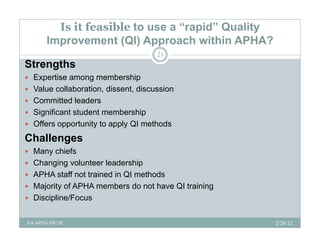
Is it feasible to use a “rapid” Quality
       Improvement (QI) Approach within APHA?
         p           ( ) pp
                                     21
Strengths
 Expertise among membership
 Value collaboration, dissent, discussion
 Committed leaders
 Significant student membership
 Offers opportunity to apply QI methods

Challenges
 Many chiefs
 Changing volunteer leadership
 APHA staff not trained in QI methods
 Majority of APHA members do not have QI training
 Discipline/Focus
       p

For APHA-ISC/SC                                      2/28/12
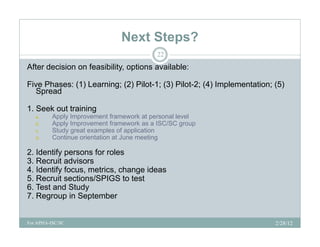
Next Steps?
                                           22

After decision on feasibility, options available:

Five Phases: (1) Learning; (2) Pilot-1; (3) Pilot-2; (4) Implementation; (5)
  Spread

1.
1 Seek out training
   a.     Apply Improvement framework at personal level
   b.     Apply Improvement framework as a ISC/SC group
   c.     Study great examples of application
   d.
   d      Continue orientation at June meeting

2. Identify persons for roles
3. Recruit advisors
4.
4 Identify focus metrics change ideas
            focus, metrics,
5. Recruit sections/SPIGS to test
6. Test and Study
7. Regroup in September


For APHA-ISC/SC                                                          2/28/12
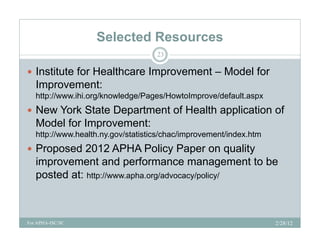
Selected Resources
                                    23

 Institute for Healthcare Improvement – Model for
                             p
   Improvement:
   http://www.ihi.org/knowledge/Pages/HowtoImprove/default.aspx
 Ne York State Department of Health application of
  New
   Model for Improvement:
   http://www.health.ny.gov/statistics/chac/improvement/index.htm
 Proposed 2012 APHA Policy Paper on quality
   improvement and performance management to be
   posted at: http://www.apha.org/advocacy/policy/


For APHA-ISC/SC                                                     2/28/12

Iscsc improvement framework_orientation_vs022112

  • 1.
    Feasibility of usinga Quality Improvement Approach within APHA? AN APHA-ISC/SC PERSPECTIVE O R I E N TAT I O N F A C I L I TAT E D B Y P R I T I I R A N I F E B R U A RY 2 8 , 2 0 1 2
  • 2.
    Acknowledgements 2  Model for Improvement was developed by the p p y Associate in Process Improvement and is used by the Institute for Healthcare Improvement  New York State Health Department for their support For APHA-ISC/SC 2/28/12
  • 3.
    Eureka? 3  Describe the key elements of Quality Improvement Framework p  Identify at least two opportunities to apply quality improvement  Have key information to decide d id on th fthe feasibility ibilit of using the methods within APHA For APHA-ISC/SC 2/28/12
  • 4.
    Call For Action 4  APHA membership has declined 12% from 2007 to 2011.  Similar decline seen in professional associations across the US due to shrinking budgets and g g growing unemployment. g p y  APHA wants to increase membership and better serve members’ needs.  As liaison to units, ISC can help APHA better understand what needs to be done to better serve members and bring in new members. For APHA-ISC/SC 2/28/12
  • 5.
    ISC and APHAUnits 5  ISC/SC is the liaison to APHA units: Section, SPIGS, Forums, Caucuses  2011 Action Report/2012 Workplan has been re- structured to be consistent with a quality improvement framework  Q lit improvement framework? Quality i tf k? For APHA-ISC/SC 2/28/12
  • 6.
    6 Model for Improvement Two Parts Part 1 – Three Critical Questions 1. What are we trying to accomplish? li h? 2. How will we know that the change is an improvement? 3. What changes can we make that will result in an improvement Part 2 – Plan-Do-Study-Act Cycle a a o S udy c Cyc e For APHA-ISC/SC 2/28/12
  • 7.
    Have you useda similar framework in p personal or professional life? p 7 1. What was the project? p j 2. What is similar? 3. What is different? 4. What are the critical elements? 5. What helped move it along to achieve objective? p g j 6. What were the barriers? For APHA-ISC/SC 2/28/12
  • 8.
    What we willneed to get started 8  Select a strategic p j g project with significant impact? g p  Identified group who will test the interventions or changes?  Potential to identify and collect process and outcome measures? Can some of these be tracked daily, weekly or monthly? kl thl ?  Identify interventions that be used that are known to have worked?  Some aspect of project can be completed in 12 months? For APHA-ISC/SC 2/28/12
  • 9.
    Measurement What are we trying to accomplish? How will we know that a change is an improvement? What h Wh t change can we make that will k th t ill result in improvement? Act Plan The Improvement Guide Study Do Langley, Nolan, Nolan, Norman, Provost 1996 For APHA-ISC/SC 9 2/28/12
  • 10.
    Adapting the Frameworkfor the ISC/SC 10 What will we need? What are we doing? What is the timeline? Can you picture what it will look like if most of the sections/spigs/APHA adopted a quality improvement approach? For APHA-ISC/SC 2/28/12
  • 11.
    What is theISC/SC trying to accomplish? 11 Examples  Increase membership engagement in _#__ sections/spigs by ___%.  Number of identified strategies objectives improved and/or reached increased by 15%. IIncrease membership numbers i APHA b ___ b hi b in by %. For APHA-ISC/SC 2/28/12
  • 12.
    Measurement Assumptions p  The purpose of measurement in quality improvement is for learning not judgment  All measures have limitations, but the limitations do not negate their value g  Seek usefulness, not perfection  Measures are one voice of the system. Hearing the y g voice of the system gives us information on how to act within the system  Measures tell a story; goals in your aim statement give a reference point For APHA-ISC/SC 12 2/28/12
  • 13.
    Identify a Balanced“Family” of Measures y y Outcome = Voice of the customer/student:  How is the system performing?  What is the result?  How is the learning of the student affected? Process = Voice of the workings of the system:  Are the parts/steps in the system performing as planned?  Are key changes being implemented in the system? Balancing = Looking at a system from different dimensions  What happened to the system as we improved the outcome and process measures?  Are we improving some parts of the system at the expense of others? For APHA-ISC/SC 13 2/28/12
  • 14.
    How will weknow that the change is an improvement? - 14 Membership engagement examples Engagement ● Equity ● Outcomes  % of members actively involved in leadership, committees, projects  % of members who read emails, newsletters over a finite period of time (e.g. before and after a planned event)  % of members by region, field, membership level region field level, ethnic/racial, geographic level, who participate  % of strategic projects with clear focus, process and outcome measures change ideas measures,  Project objectives movement, or lack thereof  Section/SPIG/Project leaders/APHA staff satisfaction levels For APHA-ISC/SC 2/28/12
  • 15.
    How will weknow that the change is an improvement? Part 2 p 15 Membership Recruitment measures’ examples p p  Percentage of membership change  Number of PDSAs identified  Number of PDSAs tested  Proportion of member implementing PDSAs p p g  Section/SPIG/Project leaders/APHA staff satisfaction levels For APHA-ISC/SC 2/28/12
  • 16.
    What changes canISC make that will result in an improvement 16 Examples p  Develop or work with a few sections/spigs to write examples of clearly focused strategic projects.  Test out metrics by using identified interventions  Develop spreadsheet or dashboards if possible For APHA-ISC/SC 2/28/12
  • 17.
    The PDSA Cycle •State objective of cycle •What modifications to What make? •Make predictions •What is the next cycle? •Develop a plan to carry out Act A t Plan Pl Study Do •Carry out the test C t th t t •Complete analysis •Document problems •Compare to prediction and unexpected outcomes •Summarize learning •Begin data analysis Learning & Improvement For APHA-ISC/SC 17 2/28/12
  • 18.
    Learning to Implementing: Repeated use of th PDSA C l R t d f the Cycle Changes that result in improvement A P S D Implementation of I l t ti f change Wide scale Wide-scale tests of A P change S D Follow-up tests Very small Hunches scale test Theories Ideas For APHA-ISC/SC 18 2/28/12
  • 19.
    What resources doesthe ISC/SC need? 19 1. Training and opportunity for application  Personal  Group 2. 2 Defined roles someone who will: roles…someone  facilitate access with leaders to allow for smooth operations;  encourage/remind teams to be persistent;  identify measures and best practice 3. Conference call with small group of knowledgeable leaders to identify measures and change ideas 4. 3-5 teams who are willing to test the framework until the September of 2012…Open Space Priorities? For APHA-ISC/SC 2/28/12
  • 20.
    Is it feasibleto use a “rapid” collaborative Quality Improvement (QI) Approach within APHA? 20 Traditional Rapid QI Project selection All Strategic – Important, Actionable Purpose Definition Problem – what should be Problem – what should be improved based on causative improved stated in factors – strategies – time- g q quantitative terms – causative limited factors – strategies – time- limited Population Varies: organization, county, Test sample state Measures Identification Goals and objectives Outcomes – Process – “Balancing”/Unintended consequences Measures Collection easu es Co ect o Months o t s O go g, Ongoing, at least monthly east o t y Periodicity Intervention Best practice, evidence-based Best practice, evidence-based broken into action-sized chunks Post-Intervention Theoretically should be adapted Adapted Cycle length Months to years Days-Weeks-Months For APHA-ISC/SC 2/28/12
  • 21.
    Is it feasibleto use a “rapid” Quality Improvement (QI) Approach within APHA? p ( ) pp 21 Strengths  Expertise among membership  Value collaboration, dissent, discussion  Committed leaders  Significant student membership  Offers opportunity to apply QI methods Challenges  Many chiefs  Changing volunteer leadership  APHA staff not trained in QI methods  Majority of APHA members do not have QI training  Discipline/Focus p For APHA-ISC/SC 2/28/12
  • 22.
    Next Steps? 22 After decision on feasibility, options available: Five Phases: (1) Learning; (2) Pilot-1; (3) Pilot-2; (4) Implementation; (5) Spread 1. 1 Seek out training a. Apply Improvement framework at personal level b. Apply Improvement framework as a ISC/SC group c. Study great examples of application d. d Continue orientation at June meeting 2. Identify persons for roles 3. Recruit advisors 4. 4 Identify focus metrics change ideas focus, metrics, 5. Recruit sections/SPIGS to test 6. Test and Study 7. Regroup in September For APHA-ISC/SC 2/28/12
  • 23.
    Selected Resources 23  Institute for Healthcare Improvement – Model for p Improvement: http://www.ihi.org/knowledge/Pages/HowtoImprove/default.aspx  Ne York State Department of Health application of New Model for Improvement: http://www.health.ny.gov/statistics/chac/improvement/index.htm  Proposed 2012 APHA Policy Paper on quality improvement and performance management to be posted at: http://www.apha.org/advocacy/policy/ For APHA-ISC/SC 2/28/12