Improving Technology Facilitation and Leadership  Resources for Professional Learning
Topics and Resources for Professional Development  Technology Operations and Concepts Planning and Designing Learning Environments Teaching, Learning, and the Curriculum Assessment and Evaluation Productivity and Professional Practice Social, Legal, Ethical, and Human Issues Procedures, Planning, and Budgeting Leadership and Vision Slide
1. Technology Operations & Concepts: Issues/Challenges/Gaps  De-emphasis on TOC, even though there is much work left to do and research shows that TOC does affect implementation Tech proficiency is evolving and complex Tech proficiency is local, contextual Educators have varying levels of technology proficiency Initial educator proficiency models are outdated  Proficiency profiles are difficult to administer, difficult to develop  Slide
2. Planning and Designing Learning Experiences: Issues/Challenges/Gaps  A high-percentage of technology implementation in classrooms focuses on lower-order cognitive skills and direct-instruction It is difficult to describe and measure the different types of technology implementation Moving technology-supported practice means shifting instructional design This change is tough—especially in a standardized testing environment Slide
3. Teaching, Learning, and the Curriculum: Issues/Challenges/Gaps  Teaching and learning is not aligned to the needs and preferences of digital age learners Our instructional resources aren’t digital While most states have adopted the NETS, we haven’t connected them to content standards in meaningful ways  Slide
3. Teaching, Learning, and the Curriculum: Resources Educating the Net Generation  www.educause.edu/educatingthenetgen   Slide
4. Assessment and Evaluation: Issues/Challenges/Gaps  Using technology to assess content standards (examples: computer-based testing, student response systems e-portfolios and computer-generated rubrics  for  assessment)  Using technology to collect, analyze, interpret, and report data Evaluating the impact of technology on student learning  Assessing student technology literacy  Slide
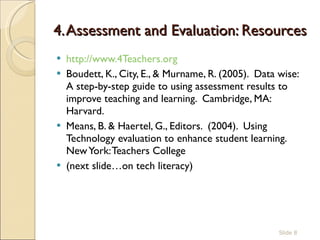
4. Assessment and Evaluation: Resources http://www.4Teachers.org   Boudett, K., City, E., & Murname, R. (2005).  Data wise:  A step-by-step guide to using assessment results to improve teaching and learning.  Cambridge, MA:  Harvard.  Means, B. & Haertel, G., Editors.  (2004).  Using Technology evaluation to enhance student learning. New York: Teachers College (next slide…on tech literacy)  Slide
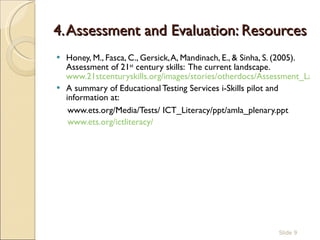
4. Assessment and Evaluation: Resources Honey, M., Fasca, C., Gersick, A, Mandinach, E., & Sinha, S. (2005).  Assessment of 21 st  century skills:  The current landscape.  www.21stcenturyskills.org/images/stories/otherdocs/Assessment_Landscape.pdf A summary of Educational Testing Services i-Skills pilot and information at:  www.ets.org/Media/Tests/ ICT_Literacy/ppt/amla_plenary.ppt  www.ets.org/ictliteracy/   Slide
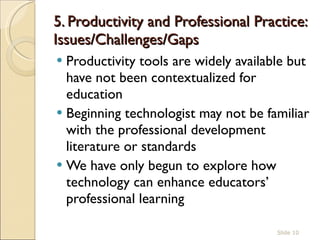
5. Productivity and Professional Practice: Issues/Challenges/Gaps  Productivity tools are widely available but have not been contextualized for education Beginning technologist may not be familiar with the professional development literature or standards  We have only begun to explore how technology can enhance educators’ professional learning Slide
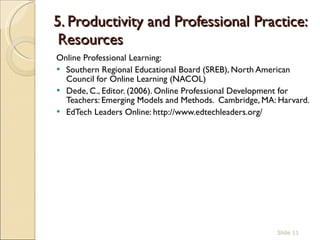
5. Productivity and Professional Practice:  Resources Online Professional Learning:  Southern Regional Educational Board (SREB), North American Council for Online Learning (NACOL)  Dede, C., Editor. (2006). Online Professional Development for Teachers: Emerging Models and Methods.  Cambridge, MA: Harvard. EdTech Leaders Online: http://www.edtechleaders.org/ Slide
6. Social, Legal, Ethical, & Human Issues: Issues/Challenges/Gaps  Copyright Cyberbullying  Updating Internet Safety and Acceptable Use Policies related to Web 2.0  Slide
6. Social, Legal, Ethical, & Human Issues: Resources National School Boards Association. (July 2007). Creating and connecting:  Research and guidelines on online social and educational networking:  www.nsba.org/SecondaryMenu/TLN/CreatingandConnecting.aspx   Slide
7.  Procedures, Planning, and Budgeting for Technology: Issues/Challenges/Gaps  Reliable, permanent access at the classroom level  Inadequate technology support  School administrative skills that are not often taught in instructional technology programs (budgeting, policy, procurement procedures, accounting practices, etc.)  Need for high levels of technical expertise and project management for technology facilitation and leadership The burden of learning for technology facilitators and leaders in this truly interdisciplinary field  Slide
Leadership & Vision : Resources ISTE’s Essential Conditions at:  www.iste.org/AM/Template.cfm?Section=NETS Whitehead, B., Jensen, D., Boshchee, F.  (2003).  Planning for technology:  A guide for school administrators, technology coordinators, and curriculum leaders.  Thousand Oaks, CA: Corwin.  Slide
Additional Resources on TF/TL Standards  Twomey, C., Shamburg, C, & Ziegler, L. (2006).  Teachers as Technology Leaders:  A Guide to ISTE TF/TL Accreditation .  Eugene, OR: ISTE.  (This text is helpful to university faculty seeking to develop and/or implement a graduate education or add-on endorsement program aligned to the TF/TL standards. Available from  www.iste.org  )  Williamson, J. & Redish, T. (August 2007).  Building Technology Facilitators and Leaders:  A Standards-based Approach.  Learning and Leading with Technology , 36(1), pp. 23-26.  (Provides in-depth information on the content and purpose of  TF/TL standards.)  Slide

Improving technologyfacilitationandleadership

  • 1.
    Improving Technology Facilitationand Leadership Resources for Professional Learning
  • 2.
    Topics and Resourcesfor Professional Development Technology Operations and Concepts Planning and Designing Learning Environments Teaching, Learning, and the Curriculum Assessment and Evaluation Productivity and Professional Practice Social, Legal, Ethical, and Human Issues Procedures, Planning, and Budgeting Leadership and Vision Slide
  • 3.
    1. Technology Operations& Concepts: Issues/Challenges/Gaps De-emphasis on TOC, even though there is much work left to do and research shows that TOC does affect implementation Tech proficiency is evolving and complex Tech proficiency is local, contextual Educators have varying levels of technology proficiency Initial educator proficiency models are outdated Proficiency profiles are difficult to administer, difficult to develop Slide
  • 4.
    2. Planning andDesigning Learning Experiences: Issues/Challenges/Gaps A high-percentage of technology implementation in classrooms focuses on lower-order cognitive skills and direct-instruction It is difficult to describe and measure the different types of technology implementation Moving technology-supported practice means shifting instructional design This change is tough—especially in a standardized testing environment Slide
  • 5.
    3. Teaching, Learning,and the Curriculum: Issues/Challenges/Gaps Teaching and learning is not aligned to the needs and preferences of digital age learners Our instructional resources aren’t digital While most states have adopted the NETS, we haven’t connected them to content standards in meaningful ways Slide
  • 6.
    3. Teaching, Learning,and the Curriculum: Resources Educating the Net Generation www.educause.edu/educatingthenetgen Slide
  • 7.
    4. Assessment andEvaluation: Issues/Challenges/Gaps Using technology to assess content standards (examples: computer-based testing, student response systems e-portfolios and computer-generated rubrics for assessment) Using technology to collect, analyze, interpret, and report data Evaluating the impact of technology on student learning Assessing student technology literacy Slide
  • 8.
    4. Assessment andEvaluation: Resources http://www.4Teachers.org Boudett, K., City, E., & Murname, R. (2005). Data wise: A step-by-step guide to using assessment results to improve teaching and learning. Cambridge, MA: Harvard. Means, B. & Haertel, G., Editors. (2004). Using Technology evaluation to enhance student learning. New York: Teachers College (next slide…on tech literacy) Slide
  • 9.
    4. Assessment andEvaluation: Resources Honey, M., Fasca, C., Gersick, A, Mandinach, E., & Sinha, S. (2005). Assessment of 21 st century skills: The current landscape. www.21stcenturyskills.org/images/stories/otherdocs/Assessment_Landscape.pdf A summary of Educational Testing Services i-Skills pilot and information at: www.ets.org/Media/Tests/ ICT_Literacy/ppt/amla_plenary.ppt www.ets.org/ictliteracy/ Slide
  • 10.
    5. Productivity andProfessional Practice: Issues/Challenges/Gaps Productivity tools are widely available but have not been contextualized for education Beginning technologist may not be familiar with the professional development literature or standards We have only begun to explore how technology can enhance educators’ professional learning Slide
  • 11.
    5. Productivity andProfessional Practice: Resources Online Professional Learning: Southern Regional Educational Board (SREB), North American Council for Online Learning (NACOL) Dede, C., Editor. (2006). Online Professional Development for Teachers: Emerging Models and Methods. Cambridge, MA: Harvard. EdTech Leaders Online: http://www.edtechleaders.org/ Slide
  • 12.
    6. Social, Legal,Ethical, & Human Issues: Issues/Challenges/Gaps Copyright Cyberbullying Updating Internet Safety and Acceptable Use Policies related to Web 2.0 Slide
  • 13.
    6. Social, Legal,Ethical, & Human Issues: Resources National School Boards Association. (July 2007). Creating and connecting: Research and guidelines on online social and educational networking: www.nsba.org/SecondaryMenu/TLN/CreatingandConnecting.aspx Slide
  • 14.
    7. Procedures,Planning, and Budgeting for Technology: Issues/Challenges/Gaps Reliable, permanent access at the classroom level Inadequate technology support School administrative skills that are not often taught in instructional technology programs (budgeting, policy, procurement procedures, accounting practices, etc.) Need for high levels of technical expertise and project management for technology facilitation and leadership The burden of learning for technology facilitators and leaders in this truly interdisciplinary field Slide
  • 15.
    Leadership & Vision: Resources ISTE’s Essential Conditions at: www.iste.org/AM/Template.cfm?Section=NETS Whitehead, B., Jensen, D., Boshchee, F. (2003). Planning for technology: A guide for school administrators, technology coordinators, and curriculum leaders. Thousand Oaks, CA: Corwin. Slide
  • 16.
    Additional Resources onTF/TL Standards Twomey, C., Shamburg, C, & Ziegler, L. (2006). Teachers as Technology Leaders: A Guide to ISTE TF/TL Accreditation . Eugene, OR: ISTE. (This text is helpful to university faculty seeking to develop and/or implement a graduate education or add-on endorsement program aligned to the TF/TL standards. Available from www.iste.org ) Williamson, J. & Redish, T. (August 2007). Building Technology Facilitators and Leaders: A Standards-based Approach. Learning and Leading with Technology , 36(1), pp. 23-26. (Provides in-depth information on the content and purpose of TF/TL standards.) Slide

Editor's Notes