WEB TECHNOLOGIES
• INTRODUCTION TO WEB SERVERS AND SERVER PRODUCTS
* INTRODUCTION TO DATABASES,
* PHARMACY DRUG DATABASE
HEMANT ALHAT
ASST. PROFESSOR ,
PES MODERN COLLEGE OF PHARMACY (FOR LADIES)
INTRODUCTION TO WEB SERVERS
AND SERVER PRODUCTS
• What is the web ?
• In a nutshell, the web is a whole bunch of
interconnected computers talking to one another.
• The computers (on the web) are typically
connected by phone lines, digital satellite
signals, cables, and other types of data-transfer
mechanisms.
• A ‘data-transfer mechanism’ is a nerd’s/ drip
way of saying: a way to move information from
point A to point B to point C and so on.
• The computers that make up the web can be
connected all the time (24/7), or they can be
connected only periodically. The computers that
are connected all the time are typically called a
‘SERVER’.
• Servers are computers just like the one you’re
using now to read this article, with one major
difference, they have a special software installed
called ‘SERVER’ SOFTWARE.
MCPLMOSHI
2
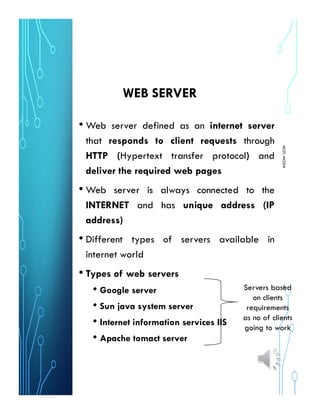
WEB SERVER
• Web server defined as an internet server
that responds to client requests through
HTTP (Hypertext transfer protocol) and
deliver the required web pages
• Web server is always connected to the
INTERNET and has unique address (IP
address)
• Different types of servers available in
internet world
• Types of web servers
• Google server
• Sun java system server
• Internet information services IIS
• Apache tomact server
MCPLMOSHI
3
Servers based
on clients
requirements
as no of clients
going to work
THE FUNCTION OF SERVER SOFTWARE /
PROGRAMS?
• To store and process the required
information and provides web pages to its
client
• Server software is created to ‘serve’ web
pages and web sites.
• Basically, the server computer has a bunch
of web sites loaded on it and it just waits
for people (via web browsers) to request or
ask for a particular page.
• When the browser requests a page the
server sends it out.
• Process of communication between cleint
and server takes places through HTTP. The
delivered pgs are available in HTML
format
MCPLMOSHI
4
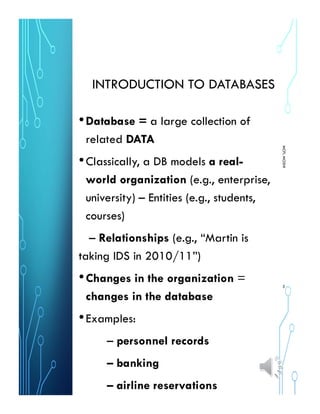
INTRODUCTION TO DATABASES
•Database = a large collection of
related DATA
•Classically, a DB models a real-
world organization (e.g., enterprise,
university) – Entities (e.g., students,
courses)
– Relationships (e.g., “Martin is
taking IDS in 2010/11”)
•Changes in the organization =
changes in the database
•Examples:
– personnel records
– banking
– airline reservations
MCPLMOSHI
5
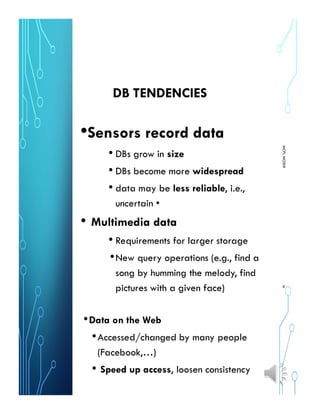
DB TENDENCIES
•Sensors record data
• DBs grow in size
• DBs become more widespread
• data may be less reliable, i.e.,
uncertain •
• Multimedia data
• Requirements for larger storage
•New query operations (e.g., find a
song by humming the melody, find
pictures with a given face)
•Data on the Web
•Accessed/changed by many people
(Facebook,…)
• Speed up access, loosen consistency
MCPLMOSHI
6
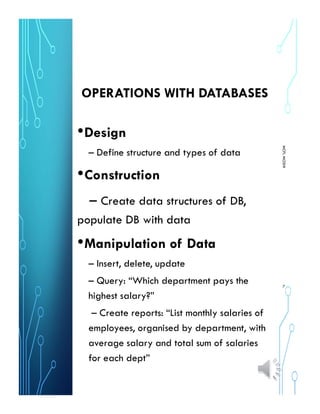
OPERATIONS WITH DATABASES
•Design
– Define structure and types of data
•Construction
– Create data structures of DB,
populate DB with data
•Manipulation of Data
– Insert, delete, update
– Query: “Which department pays the
highest salary?”
– Create reports: “List monthly salaries of
employees, organised by department, with
average salary and total sum of salaries
for each dept”
MCPLMOSHI
7
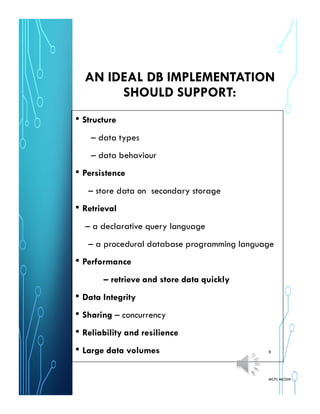
AN IDEAL DB IMPLEMENTATION
SHOULD SUPPORT:
• Structure
– data types
– data behaviour
• Persistence
– store data on secondary storage
• Retrieval
– a declarative query language
– a procedural database programming language
• Performance
– retrieve and store data quickly
• Data Integrity
• Sharing – concurrency
• Reliability and resilience
• Large data volumes
MCPL MOSHI
8
PHARMACY DRUG DATABASE
• Drug databases and web resources play a very
important role in the pharmaceutical field. Check
out this lesson to learn all about these databases
and resources and how they benefit a
pharmacist.
• So Many Drugs!
• There are thousands of medications available
These medications range from simple cough
medications to more powerful medications such as
chemotherapy drugs. It would be impossible for
any pharmacist to know about each and every
drug available. Just imagine you are a
pharmacist and a patient or doctor asks you
about a medication that is unfamiliar to you.
How can you answer questions about a drug that
you do not know much about?
• Luckily for pharmacists, there are drug databases
and web resources that are useful tools that can
be used to learn more about a medication or
drug that may be somewhat unfamiliar to them.
MCPLMOSHI
9
PHARMACY DRUG DATABASE
• Drug Databases
• Drug databases are SITES where information about drugs
and medications are STORED, and one of the largest (and
most commonly used) drug databases is compiled by
the Food & Drug Administration (FDA). The FDA is a
federal agency that oversees and controls all medications.,
which includes:
• Over-the-counter (OTC) medications
• Prescription medications
• Dietary supplements
• Vaccines
• The FDA drug database includes most of the drugs they
have approved. Best of all, this database is extremely
easy to use. To search this database, you simply need to
go to the FDA drug databases website. Once you get to
this website, you are able to search the database by
typing in the name of the drug or by typing in any active
ingredient of a drug.
MCPLMOSHI
10
PHARMACY DRUG DATABASE
• Additionally, the FDA drug database can
be used to search drugs that are currently
going through clinical trials and/or the
approval process
• The FDA must APPROVE a drug before it is
legally able to be SOLD and USED
Therefore, drug companies must formally
submit an application to the FDA for the
drug to be approved. The drugs that have
not been submitted to the FDA but not yet
approved can be found in this database.
• The Orange Book
• The Orange Book (officially known as
the Approved Drug Products with Therapeutic
Equivalence Evaluations) is a publication that
provides information about drugs approved
by the FDA.
MCPLMOSHI
11

Web technologies lecture 2

  • 1.
    WEB TECHNOLOGIES • INTRODUCTIONTO WEB SERVERS AND SERVER PRODUCTS * INTRODUCTION TO DATABASES, * PHARMACY DRUG DATABASE HEMANT ALHAT ASST. PROFESSOR , PES MODERN COLLEGE OF PHARMACY (FOR LADIES)
  • 2.
    INTRODUCTION TO WEBSERVERS AND SERVER PRODUCTS • What is the web ? • In a nutshell, the web is a whole bunch of interconnected computers talking to one another. • The computers (on the web) are typically connected by phone lines, digital satellite signals, cables, and other types of data-transfer mechanisms. • A ‘data-transfer mechanism’ is a nerd’s/ drip way of saying: a way to move information from point A to point B to point C and so on. • The computers that make up the web can be connected all the time (24/7), or they can be connected only periodically. The computers that are connected all the time are typically called a ‘SERVER’. • Servers are computers just like the one you’re using now to read this article, with one major difference, they have a special software installed called ‘SERVER’ SOFTWARE. MCPLMOSHI 2
  • 3.
    WEB SERVER • Webserver defined as an internet server that responds to client requests through HTTP (Hypertext transfer protocol) and deliver the required web pages • Web server is always connected to the INTERNET and has unique address (IP address) • Different types of servers available in internet world • Types of web servers • Google server • Sun java system server • Internet information services IIS • Apache tomact server MCPLMOSHI 3 Servers based on clients requirements as no of clients going to work
  • 4.
    THE FUNCTION OFSERVER SOFTWARE / PROGRAMS? • To store and process the required information and provides web pages to its client • Server software is created to ‘serve’ web pages and web sites. • Basically, the server computer has a bunch of web sites loaded on it and it just waits for people (via web browsers) to request or ask for a particular page. • When the browser requests a page the server sends it out. • Process of communication between cleint and server takes places through HTTP. The delivered pgs are available in HTML format MCPLMOSHI 4
  • 5.
    INTRODUCTION TO DATABASES •Database= a large collection of related DATA •Classically, a DB models a real- world organization (e.g., enterprise, university) – Entities (e.g., students, courses) – Relationships (e.g., “Martin is taking IDS in 2010/11”) •Changes in the organization = changes in the database •Examples: – personnel records – banking – airline reservations MCPLMOSHI 5
  • 6.
    DB TENDENCIES •Sensors recorddata • DBs grow in size • DBs become more widespread • data may be less reliable, i.e., uncertain • • Multimedia data • Requirements for larger storage •New query operations (e.g., find a song by humming the melody, find pictures with a given face) •Data on the Web •Accessed/changed by many people (Facebook,…) • Speed up access, loosen consistency MCPLMOSHI 6
  • 7.
    OPERATIONS WITH DATABASES •Design –Define structure and types of data •Construction – Create data structures of DB, populate DB with data •Manipulation of Data – Insert, delete, update – Query: “Which department pays the highest salary?” – Create reports: “List monthly salaries of employees, organised by department, with average salary and total sum of salaries for each dept” MCPLMOSHI 7
  • 8.
    AN IDEAL DBIMPLEMENTATION SHOULD SUPPORT: • Structure – data types – data behaviour • Persistence – store data on secondary storage • Retrieval – a declarative query language – a procedural database programming language • Performance – retrieve and store data quickly • Data Integrity • Sharing – concurrency • Reliability and resilience • Large data volumes MCPL MOSHI 8
  • 9.
    PHARMACY DRUG DATABASE •Drug databases and web resources play a very important role in the pharmaceutical field. Check out this lesson to learn all about these databases and resources and how they benefit a pharmacist. • So Many Drugs! • There are thousands of medications available These medications range from simple cough medications to more powerful medications such as chemotherapy drugs. It would be impossible for any pharmacist to know about each and every drug available. Just imagine you are a pharmacist and a patient or doctor asks you about a medication that is unfamiliar to you. How can you answer questions about a drug that you do not know much about? • Luckily for pharmacists, there are drug databases and web resources that are useful tools that can be used to learn more about a medication or drug that may be somewhat unfamiliar to them. MCPLMOSHI 9
  • 10.
    PHARMACY DRUG DATABASE •Drug Databases • Drug databases are SITES where information about drugs and medications are STORED, and one of the largest (and most commonly used) drug databases is compiled by the Food & Drug Administration (FDA). The FDA is a federal agency that oversees and controls all medications., which includes: • Over-the-counter (OTC) medications • Prescription medications • Dietary supplements • Vaccines • The FDA drug database includes most of the drugs they have approved. Best of all, this database is extremely easy to use. To search this database, you simply need to go to the FDA drug databases website. Once you get to this website, you are able to search the database by typing in the name of the drug or by typing in any active ingredient of a drug. MCPLMOSHI 10
  • 11.
    PHARMACY DRUG DATABASE •Additionally, the FDA drug database can be used to search drugs that are currently going through clinical trials and/or the approval process • The FDA must APPROVE a drug before it is legally able to be SOLD and USED Therefore, drug companies must formally submit an application to the FDA for the drug to be approved. The drugs that have not been submitted to the FDA but not yet approved can be found in this database. • The Orange Book • The Orange Book (officially known as the Approved Drug Products with Therapeutic Equivalence Evaluations) is a publication that provides information about drugs approved by the FDA. MCPLMOSHI 11