Web technologies: Introduction to HTML, XML, CSS and Programming languages, introduction to wet servers and Server Products introduction to databases, MYSQL, MS ACCESS, Pharmacy Drug database
Introduction to Web
Technologies
Welcometo this presentation on the fascinating world of web technologies. We'll
explore the fundamental components that build modern web applications and
drive the interconnected digital landscape. The global internet economy is
projected to reach an astounding $1.7 trillion by 2025, powered by over 5.3 billion
global internet users as of 2023.
2.
HTML: The Structureof the Web
Core Building Block
HyperText Markup Language (HTML) is the backbone of any web
page. It uses a system of elements, commonly known as tags, to
define the structure and content of web documents. These tags
organize text, embed images, and create links, forming the basic
layout that browsers understand.
Evolution and Rendering
The current standard, HTML5, released in 2014, significantly
enhanced web capabilities by adding native support for multimedia
elements like audio and video. Web browsers such as Chrome,
Firefox, and Edge interpret this HTML code and render it visually,
allowing users to interact with the content.
3.
XML: Data Description
Language
Self-DescribingData
Extensible Markup Language (XML) is designed specifically for storing and
transporting data. Unlike HTML, its primary focus is on describing data
rather than displaying it. This "self-describing" nature means that XML uses
tags to define the structure and meaning of the data itself.
Versatile Data Exchange
A simple example like <book><title>Web
Tech</title><author>Doe</author></book> clearly illustrates how data is
structured. XML is extensively used in Application Programming Interfaces
(APIs), particularly in web services like SOAP, to facilitate standardized data
exchange between different systems.
4.
CSS: Styling WebPages
Content and Presentation
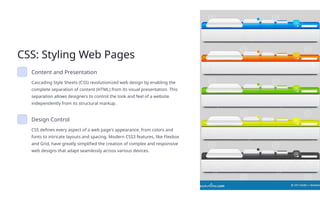
Cascading Style Sheets (CSS) revolutionized web design by enabling the
complete separation of content (HTML) from its visual presentation. This
separation allows designers to control the look and feel of a website
independently from its structural markup.
Design Control
CSS defines every aspect of a web page's appearance, from colors and
fonts to intricate layouts and spacing. Modern CSS3 features, like Flexbox
and Grid, have greatly simplified the creation of complex and responsive
web designs that adapt seamlessly across various devices.
5.
Programming Languages: BringingInteraction
Client-Side
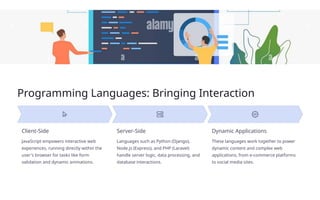
JavaScript empowers interactive web
experiences, running directly within the
user's browser for tasks like form
validation and dynamic animations.
Server-Side
Languages such as Python (Django),
Node.js (Express), and PHP (Laravel)
handle server logic, data processing, and
database interactions.
Dynamic Applications
These languages work together to power
dynamic content and complex web
applications, from e-commerce platforms
to social media sites.
6.
Web Servers andServer
Products
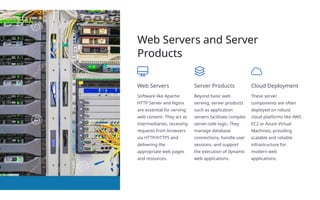
Web Servers
Software like Apache
HTTP Server and Nginx
are essential for serving
web content. They act as
intermediaries, receiving
requests from browsers
via HTTP/HTTPS and
delivering the
appropriate web pages
and resources.
Server Products
Beyond basic web
serving, server products
such as application
servers facilitate complex
server-side logic. They
manage database
connections, handle user
sessions, and support
the execution of dynamic
web applications.
Cloud Deployment
These server
components are often
deployed on robust
cloud platforms like AWS
EC2 or Azure Virtual
Machines, providing
scalable and reliable
infrastructure for
modern web
applications.
7.
Databases: Storing andManaging Data
1
Organized Data Storage
Databases are fundamental for any dynamic web application,
providing organized collections of data for efficient storage and
retrieval. They ensure that information can be accessed quickly and
reliably.
2 Relational Structures
Relational Databases (RDBMS) are a common type where data is
structured into tables with predefined relationships. This tabular
format allows for clear organization and easy querying using SQL
(Structured Query Language).
3
Web Application Foundation
They are crucial for web applications that need to store and manage
diverse information, such as user profiles, product catalogs, and
transactional data. Databases ensure data integrity, consistency,
and security, which are vital for reliable online services.
8.
MySQL and MSAccess
MySQL: The Web Powerhouse
MySQL is a widely adopted open-source Relational Database
Management System (RDBMS) renowned for its scalability and high
performance. It powers some of the world's largest web systems,
including Facebook and Wikipedia, capable of handling millions of
records efficiently. Its open-source nature makes it a popular choice
for web development projects.
MS Access: Desktop-Based Solution
In contrast, MS Access is a desktop-based RDBMS, typically part of
the Microsoft 365 suite. It is ideal for small-scale applications,
personal data management, and rapid prototyping due to its user-
friendly interface. However, it offers limited scalability compared to
enterprise-grade databases like MySQL, making it less suitable for
large, high-traffic web applications.
9.
Real-World Application: Pharmacy
DrugDatabase
Purpose Centralized system for managing drug
information and patient prescriptions.
Key Tables Drugs (NDC code, strength, dosage
form), Patients (ID, demographics),
Prescriptions (Rx ID, drug, patient,
dosage, date).
Data Points National Drug Codes (NDC), adverse
effects, contraindications, inventory
levels, patient history.
Benefits Enables precise dispensing, tracks
patient medication history, manages
stock efficiently for over 500,000 distinct
drug products in the US.
Compliance Crucial for ensuring patient safety and
adhering to regulatory standards like
HIPAA.
10.
Conclusion: The InterconnectedWeb
Ecosystem
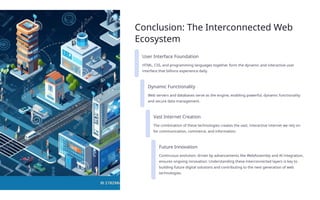
User Interface Foundation
HTML, CSS, and programming languages together form the dynamic and interactive user
interface that billions experience daily.
Dynamic Functionality
Web servers and databases serve as the engine, enabling powerful, dynamic functionality
and secure data management.
Vast Internet Creation
The combination of these technologies creates the vast, interactive internet we rely on
for communication, commerce, and information.
Future Innovation
Continuous evolution, driven by advancements like WebAssembly and AI integration,
ensures ongoing innovation. Understanding these interconnected layers is key to
building future digital solutions and contributing to the next generation of web
technologies.