PROPOSAL 
FOR 
WEB DEVELOPMENT
INTRODUCTION 
With the advancement of the use of internet, website has become a necessity so that a company can 
stay ahead from rest of their competitors. In 2005 only 16% of the world was using internet and in 
2013, 39% of the world is using internet. So, no. of internet users are increasing. In such a scenario, a 
website is a must for a company to reach among thousands of customers without actually being there. 
It’s not just about reaching out to the customers, but also to manage their data and to manage the 
data of employees so that multiple branches remain strongly connected. 
Website is a set of related web pages typically served from a single web domain. A website is hosted 
on at least one web server, accessible via a network such as the internet or a private local area 
network through an internet address known as a uniform resource locator. All publicly accessible 
websites collectively constitute the world wide web. 
Web development is a broad term for the work involved in developing a web site for the internet 
(world wide web) or an intranet (a private network). Web development can range from developing the 
simplest static single page of plain text to the most complex web-based internet applications, 
electronic businesses, and social network services.
STATEMENT OF PURPOSE 
A settled company which does not have a well-developed website loses lots of 
customers. Websites are useful in maintaining a virtual contact which helps the 
company to gather and exchange the data inside its network. Employees can 
access this data at any time and from anywhere. When the company is searched 
online via any search engine like Google, this site gives easy access to the 
customers making the company more connected and reachable to the people. 
Also, a website can serve as a medium for people to register their complaints or 
feedback regarding the company. 
This saves a lot of time and resources for the company and its clients. Making the 
company’s work more efficient and easy as compared to when there is no website.
OBJECTIVES 
• Provides a mechanism to support internet based services, programs and projects for the 
company. 
• Uses dynamic website features to communicate information about the company’s project. 
• Provides contact information and links to related websites. 
• Makes project documents available online. 
• Increases awareness of company’s features, interactivity and smart services. 
• Allows for the delivery of accurate and reliable information about services, activities, 
events, support and programs. 
• Supports and enhances existing services, training programs and business-to-business 
opportunities.
METHODOLOGY 
• Web-site design 
Creation and organization of web pages, maintain the color scheme and style of any existing 
promotional materials. 
• Technical authoring 
Gather all required text or information, related hyperlinks, and text structuring sections etc. 
• Data entry. 
Creation and maintenance of databases used by a web application. Provide a dynamic back-end 
interface to allow company to manage its content in all sections of the website. Provide a user 
manual and/or short (2-hour) training session to the company to prepare them for the entry of 
data on their website. 
• Graphics design. 
Use digital format for all text, information and/or visual content (photographs, diagrams, etc.) 
Included in the site, creation of 2D images using graphics design tools.
• 3d and vr design. 
Creation of 3d objects and environments with which the user can interact. 
• Sound engineering. 
Adaptation of existing audio tracks for use at web applications. 
• Animation and video editing. 
Building movies from existing images, video, text and sound. 
• Programming. 
Creation of server-side software and client-side programs that replace browsers. 
• Languages used : 
Html, html5, css, css3, jquery, javascript, php, mysql,
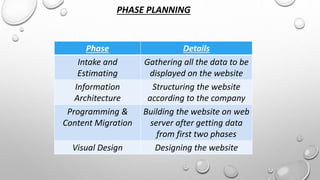
PHASE PLANNING 
Phase Details 
Intake and 
Estimating 
Gathering all the data to be 
displayed on the website 
Information 
Architecture 
Structuring the website 
according to the company 
Programming & 
Content Migration 
Building the website on web 
server after getting data 
from first two phases 
Visual Design Designing the website
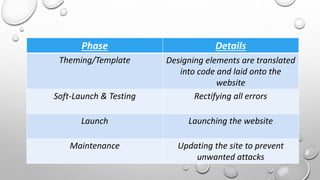
Phase Details 
Theming/Template Designing elements are translated 
into code and laid onto the 
website 
Soft-Launch & Testing Rectifying all errors 
Launch Launching the website 
Maintenance Updating the site to prevent 
unwanted attacks
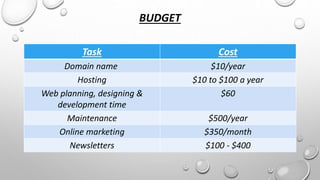
BUDGET 
Task Cost 
Domain name $10/year 
Hosting $10 to $100 a year 
Web planning, designing & 
development time 
$60 
Maintenance $500/year 
Online marketing $350/month 
Newsletters $100 - $400
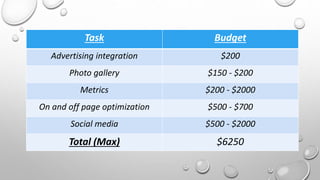
Task Budget 
Advertising integration $200 
Photo gallery $150 - $200 
Metrics $200 - $2000 
On and off page optimization $500 - $700 
Social media $500 - $2000 
Total (Max) $6250
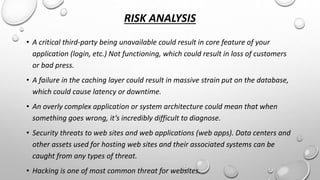
RISK ANALYSIS 
• A critical third-party being unavailable could result in core feature of your 
application (login, etc.) Not functioning, which could result in loss of customers 
or bad press. 
• A failure in the caching layer could result in massive strain put on the database, 
which could cause latency or downtime. 
• An overly complex application or system architecture could mean that when 
something goes wrong, it’s incredibly difficult to diagnose. 
• Security threats to web sites and web applications (web apps). Data centers and 
other assets used for hosting web sites and their associated systems can be 
caught from any types of threat. 
• Hacking is one of most common threat for websites.
BENEFITS 
• Consistent brand identity 
• More visitors who stay on the page 
• More customers 
• Distinction from competitors 
• Form, structure and purpose to content 
• Polished details 
• Objective perspective 
• Less spending down the road
• Reliable partnership 
• Room for development 
• Less bugs and cross browser compatibility 
• Increased search engine visibility 
• Greater reachability of your business profile 
• 24/7 availability 
• Time-saving
CONCLUSION 
A website can be a valuable tool to any business. Planning, developing, 
and promoting a website properly is the only way to ensure that the 
website will be successful. The “success” of a website can only be 
determined by obtaining consistent, reliable information on customer 
behavior and striving to constantly improve the website to benefit 
customers. A successful website will take a “customer-centric” approach 
and aim to keep user needs the top priority at all times. Success will 
ultimately be determined by the satisfaction of the customer, and the 
ability to improve the information and services that a business offers as 
technology advances.

Web development

  • 1.
    PROPOSAL FOR WEBDEVELOPMENT
  • 2.
    INTRODUCTION With theadvancement of the use of internet, website has become a necessity so that a company can stay ahead from rest of their competitors. In 2005 only 16% of the world was using internet and in 2013, 39% of the world is using internet. So, no. of internet users are increasing. In such a scenario, a website is a must for a company to reach among thousands of customers without actually being there. It’s not just about reaching out to the customers, but also to manage their data and to manage the data of employees so that multiple branches remain strongly connected. Website is a set of related web pages typically served from a single web domain. A website is hosted on at least one web server, accessible via a network such as the internet or a private local area network through an internet address known as a uniform resource locator. All publicly accessible websites collectively constitute the world wide web. Web development is a broad term for the work involved in developing a web site for the internet (world wide web) or an intranet (a private network). Web development can range from developing the simplest static single page of plain text to the most complex web-based internet applications, electronic businesses, and social network services.
  • 3.
    STATEMENT OF PURPOSE A settled company which does not have a well-developed website loses lots of customers. Websites are useful in maintaining a virtual contact which helps the company to gather and exchange the data inside its network. Employees can access this data at any time and from anywhere. When the company is searched online via any search engine like Google, this site gives easy access to the customers making the company more connected and reachable to the people. Also, a website can serve as a medium for people to register their complaints or feedback regarding the company. This saves a lot of time and resources for the company and its clients. Making the company’s work more efficient and easy as compared to when there is no website.
  • 4.
    OBJECTIVES • Providesa mechanism to support internet based services, programs and projects for the company. • Uses dynamic website features to communicate information about the company’s project. • Provides contact information and links to related websites. • Makes project documents available online. • Increases awareness of company’s features, interactivity and smart services. • Allows for the delivery of accurate and reliable information about services, activities, events, support and programs. • Supports and enhances existing services, training programs and business-to-business opportunities.
  • 5.
    METHODOLOGY • Web-sitedesign Creation and organization of web pages, maintain the color scheme and style of any existing promotional materials. • Technical authoring Gather all required text or information, related hyperlinks, and text structuring sections etc. • Data entry. Creation and maintenance of databases used by a web application. Provide a dynamic back-end interface to allow company to manage its content in all sections of the website. Provide a user manual and/or short (2-hour) training session to the company to prepare them for the entry of data on their website. • Graphics design. Use digital format for all text, information and/or visual content (photographs, diagrams, etc.) Included in the site, creation of 2D images using graphics design tools.
  • 6.
    • 3d andvr design. Creation of 3d objects and environments with which the user can interact. • Sound engineering. Adaptation of existing audio tracks for use at web applications. • Animation and video editing. Building movies from existing images, video, text and sound. • Programming. Creation of server-side software and client-side programs that replace browsers. • Languages used : Html, html5, css, css3, jquery, javascript, php, mysql,
  • 7.
    PHASE PLANNING PhaseDetails Intake and Estimating Gathering all the data to be displayed on the website Information Architecture Structuring the website according to the company Programming & Content Migration Building the website on web server after getting data from first two phases Visual Design Designing the website
  • 8.
    Phase Details Theming/TemplateDesigning elements are translated into code and laid onto the website Soft-Launch & Testing Rectifying all errors Launch Launching the website Maintenance Updating the site to prevent unwanted attacks
  • 9.
    BUDGET Task Cost Domain name $10/year Hosting $10 to $100 a year Web planning, designing & development time $60 Maintenance $500/year Online marketing $350/month Newsletters $100 - $400
  • 10.
    Task Budget Advertisingintegration $200 Photo gallery $150 - $200 Metrics $200 - $2000 On and off page optimization $500 - $700 Social media $500 - $2000 Total (Max) $6250
  • 11.
    RISK ANALYSIS •A critical third-party being unavailable could result in core feature of your application (login, etc.) Not functioning, which could result in loss of customers or bad press. • A failure in the caching layer could result in massive strain put on the database, which could cause latency or downtime. • An overly complex application or system architecture could mean that when something goes wrong, it’s incredibly difficult to diagnose. • Security threats to web sites and web applications (web apps). Data centers and other assets used for hosting web sites and their associated systems can be caught from any types of threat. • Hacking is one of most common threat for websites.
  • 12.
    BENEFITS • Consistentbrand identity • More visitors who stay on the page • More customers • Distinction from competitors • Form, structure and purpose to content • Polished details • Objective perspective • Less spending down the road
  • 13.
    • Reliable partnership • Room for development • Less bugs and cross browser compatibility • Increased search engine visibility • Greater reachability of your business profile • 24/7 availability • Time-saving
  • 14.
    CONCLUSION A websitecan be a valuable tool to any business. Planning, developing, and promoting a website properly is the only way to ensure that the website will be successful. The “success” of a website can only be determined by obtaining consistent, reliable information on customer behavior and striving to constantly improve the website to benefit customers. A successful website will take a “customer-centric” approach and aim to keep user needs the top priority at all times. Success will ultimately be determined by the satisfaction of the customer, and the ability to improve the information and services that a business offers as technology advances.