Presented by
Suresh Babu.G
Lecturer in General Education
MGUCTE,Nedumkandam
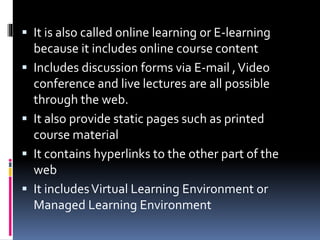
 It is also called online learning or E-learning
because it includes online course content
 Includes discussion forms via E-mail ,Video
conference and live lectures are all possible
through the web.
 It also provide static pages such as printed
course material
 It contains hyperlinks to the other part of the
web
 It includesVirtual Learning Environment or
Managed Learning Environment
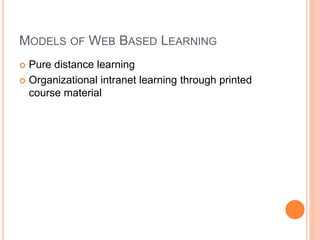
MODELS OF WEB BASED LEARNING
 Pure distance learning
 Organizational intranet learning through printed
course material
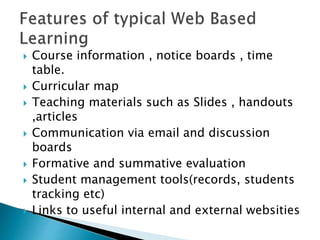
 Course information , notice boards , time
table.
 Curricular map
 Teaching materials such as Slides , handouts
,articles
 Communication via email and discussion
boards
 Formative and summative evaluation
 Student management tools(records, students
tracking etc)
 Links to useful internal and external websities
 Ability to link recourses in different formats
 Efficient way of delivering course materials
 Resources can be made available from any
location at any time
 Potential for widening access
 Encourage more independent and active
learning
 Provides useful source of supplementary
materials to conventional programmes
Disadvantages
 Access of appropriate computer equipments
 Learners find it frustrating if they cannot access
graphics , images etc
 Necessary infrastructure needed
 Information can vary in quality and accuracy , so
guidance and sign posting is needed
 Students can feel isolated

Web based leaning

  • 1.
    Presented by Suresh Babu.G Lecturerin General Education MGUCTE,Nedumkandam
  • 2.
     It isalso called online learning or E-learning because it includes online course content  Includes discussion forms via E-mail ,Video conference and live lectures are all possible through the web.  It also provide static pages such as printed course material  It contains hyperlinks to the other part of the web  It includesVirtual Learning Environment or Managed Learning Environment
  • 3.
    MODELS OF WEBBASED LEARNING  Pure distance learning  Organizational intranet learning through printed course material
  • 4.
     Course information, notice boards , time table.  Curricular map  Teaching materials such as Slides , handouts ,articles  Communication via email and discussion boards  Formative and summative evaluation  Student management tools(records, students tracking etc)  Links to useful internal and external websities
  • 5.
     Ability tolink recourses in different formats  Efficient way of delivering course materials  Resources can be made available from any location at any time  Potential for widening access  Encourage more independent and active learning  Provides useful source of supplementary materials to conventional programmes
  • 6.
    Disadvantages  Access ofappropriate computer equipments  Learners find it frustrating if they cannot access graphics , images etc  Necessary infrastructure needed  Information can vary in quality and accuracy , so guidance and sign posting is needed  Students can feel isolated