Web 2.0 Jennifer Robinson EDUC 7101
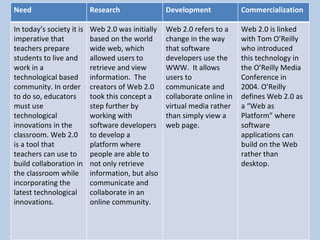
Need Research Development Commercialization In today’s society it is imperative that teachers prepare students to live and work in a technological based community. In order to do so, educators must use technological innovations in the classroom. Web 2.0 is a tool that teachers can use to build collaboration in the classroom while incorporating the latest technological innovations. Web 2.0 was initially based on the world wide web, which allowed users to retrieve and view information.  The creators of Web 2.0 took this concept a step further by working with software developers to develop a platform where people are able to not only retrieve information, but also communicate and collaborate in an online community.   Web 2.0 refers to a change in the way that software developers use the WWW.  It allows users to communicate and collaborate online in virtual media rather than simply view a web page.   Web 2.0 is linked with Tom O’Reilly who introduced this technology in the O’Reilly Media Conference in 2004. O’Reilly defines Web 2.0 as a “Web as Platform” where software applications can build on the Web rather than desktop. 
 
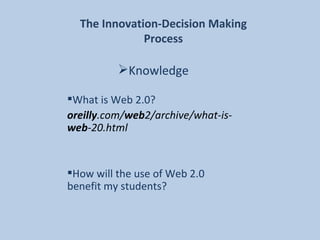
The Innovation-Decision Making Process Knowledge What is Web 2.0? oreilly .com/ web 2/archive/what-is- web -20.html   How will the use of Web 2.0 benefit my students?
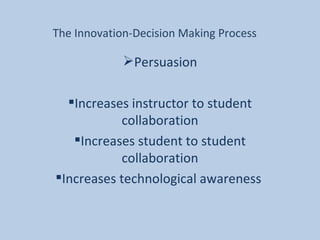
The Innovation-Decision Making Process Persuasion Increases instructor to student collaboration Increases student to student collaboration Increases technological awareness
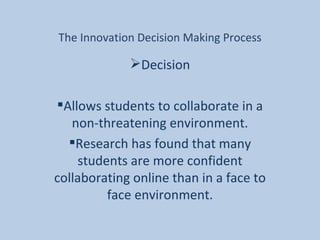
The Innovation Decision Making Process Decision Allows students to collaborate in a non-threatening environment. Research has found that many students are more confident collaborating online than in a face to face environment.
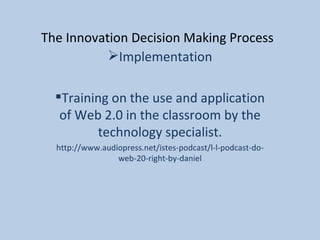
The Innovation Decision Making Process Implementation Training on the use and application of Web 2.0 in the classroom by the technology specialist. http://www.audiopress.net/istes-podcast/l-l-podcast-do-web-20-right-by-daniel
The Innovation Decision Making Process Confirmation Individual student’s response to prompts may be used to assess.  Use student responses to communicate understanding of standards to parents.
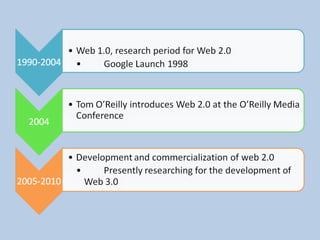
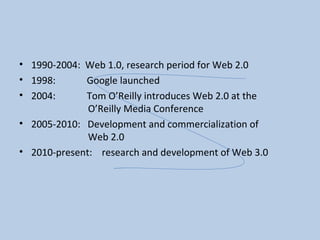
1990-2004:  Web 1.0, research period for Web 2.0 1998:             Google launched 2004:             Tom O’Reilly introduces Web 2.0 at the    O’Reilly Media Conference 2005-2010:  Development and commercialization of    Web 2.0 2010-present:    research and development of Web 3.0
Innovators and Early Adaptors Innovators of Web 2.0 include software companies who produce interactive programs.  Early adaptors in the field of education include technology specialist and the classroom teachers. 
Laggards Laggards in the adoption of Web 2.0 might be primary school teachers. In many cases, communicating online with students of this age would present challenges. In this case, the teacher could use Web 2.0 whole group to communicate with other classrooms or to create virtual experiences.  In order to persuade these individuals to adopt the innovation, compatibility must be shown.
  Critical Mass and Change Agents  Technology Specialists New teachers Teachers who are technological literate Students
“ If we teach today as we taught yesterday, we rob our students of tomorrow” ~John Dewey  Web 2.0  It’s for you! Bridges communication between students Promotes interaction between students and instructor in a non-threatening environment Allows students to increase technology  skills while meeting and exceeding standards

Week 11 Multi-Media Presentation

  • 1.
    Web 2.0 JenniferRobinson EDUC 7101
  • 2.
    Need Research DevelopmentCommercialization In today’s society it is imperative that teachers prepare students to live and work in a technological based community. In order to do so, educators must use technological innovations in the classroom. Web 2.0 is a tool that teachers can use to build collaboration in the classroom while incorporating the latest technological innovations. Web 2.0 was initially based on the world wide web, which allowed users to retrieve and view information.  The creators of Web 2.0 took this concept a step further by working with software developers to develop a platform where people are able to not only retrieve information, but also communicate and collaborate in an online community.  Web 2.0 refers to a change in the way that software developers use the WWW.  It allows users to communicate and collaborate online in virtual media rather than simply view a web page.  Web 2.0 is linked with Tom O’Reilly who introduced this technology in the O’Reilly Media Conference in 2004. O’Reilly defines Web 2.0 as a “Web as Platform” where software applications can build on the Web rather than desktop. 
  • 3.
  • 4.
    The Innovation-Decision MakingProcess Knowledge What is Web 2.0? oreilly .com/ web 2/archive/what-is- web -20.html How will the use of Web 2.0 benefit my students?
  • 5.
    The Innovation-Decision MakingProcess Persuasion Increases instructor to student collaboration Increases student to student collaboration Increases technological awareness
  • 6.
    The Innovation DecisionMaking Process Decision Allows students to collaborate in a non-threatening environment. Research has found that many students are more confident collaborating online than in a face to face environment.
  • 7.
    The Innovation DecisionMaking Process Implementation Training on the use and application of Web 2.0 in the classroom by the technology specialist. http://www.audiopress.net/istes-podcast/l-l-podcast-do-web-20-right-by-daniel
  • 8.
    The Innovation DecisionMaking Process Confirmation Individual student’s response to prompts may be used to assess. Use student responses to communicate understanding of standards to parents.
  • 9.
    1990-2004:  Web 1.0,research period for Web 2.0 1998:             Google launched 2004:             Tom O’Reilly introduces Web 2.0 at the O’Reilly Media Conference 2005-2010: Development and commercialization of Web 2.0 2010-present:    research and development of Web 3.0
  • 10.
    Innovators and EarlyAdaptors Innovators of Web 2.0 include software companies who produce interactive programs. Early adaptors in the field of education include technology specialist and the classroom teachers. 
  • 11.
    Laggards Laggards inthe adoption of Web 2.0 might be primary school teachers. In many cases, communicating online with students of this age would present challenges. In this case, the teacher could use Web 2.0 whole group to communicate with other classrooms or to create virtual experiences.  In order to persuade these individuals to adopt the innovation, compatibility must be shown.
  • 12.
    CriticalMass and Change Agents Technology Specialists New teachers Teachers who are technological literate Students
  • 13.
    “ If weteach today as we taught yesterday, we rob our students of tomorrow” ~John Dewey Web 2.0 It’s for you! Bridges communication between students Promotes interaction between students and instructor in a non-threatening environment Allows students to increase technology skills while meeting and exceeding standards