WEATHER LORE CUMULONIMBUS AND HAIL
The mechanisms at work inside a cumulonimbus cloud are very special indeed. It is this cloud, towering up to 12 km or more in height, that brings our most impressive and potentially destructive weather.
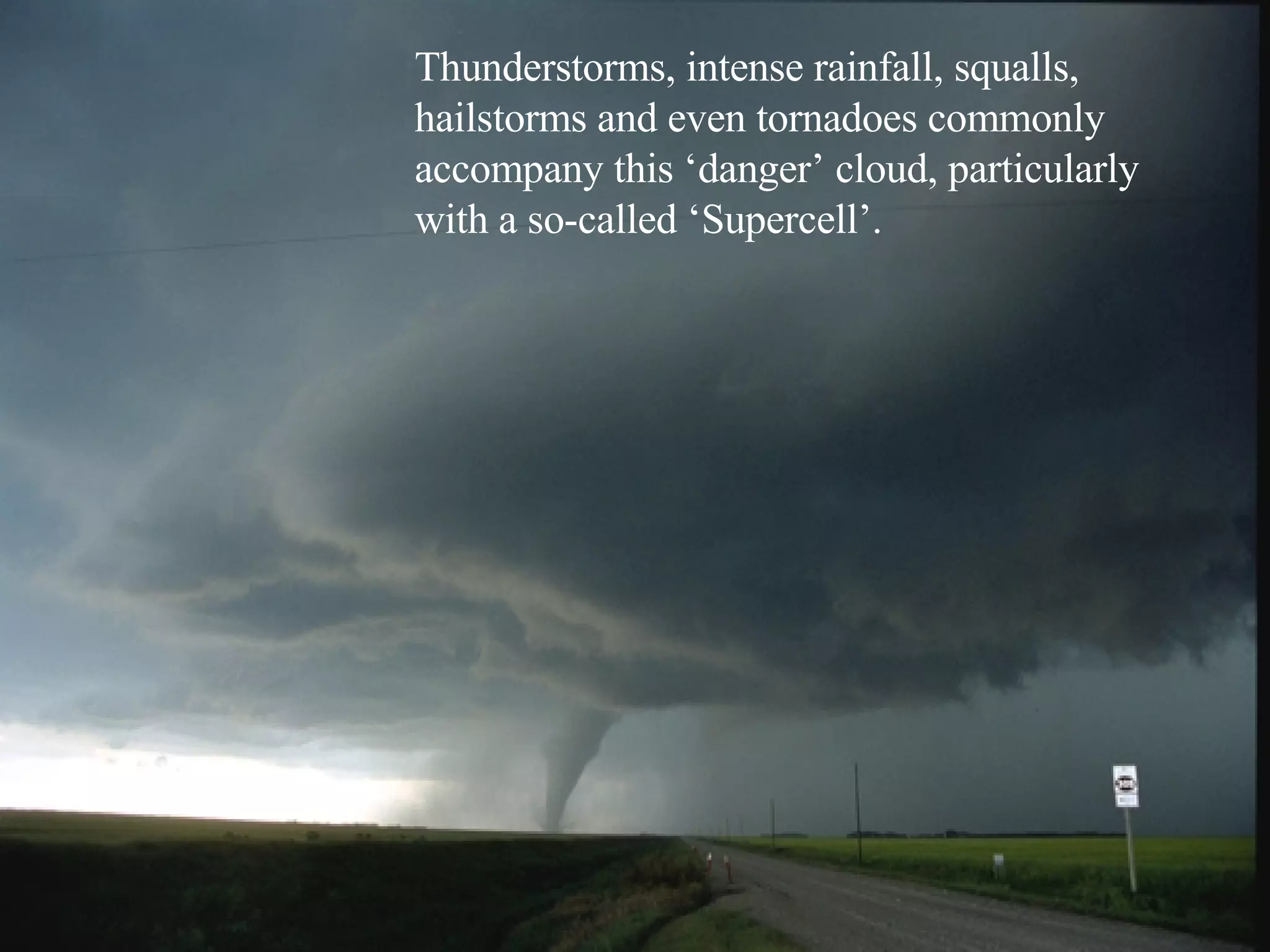
Thunderstorms, intense rainfall, squalls, hailstorms and even tornadoes commonly accompany this ‘danger’ cloud, particularly with a so-called ‘Supercell’.
Less obviously devastating than a tornado, hailstorms do immense damage, particularly in continental interiors such as the USA. Here the intense heat of the ground surface in summer stimulates rapid and powerful uplift
The world record hailstone fell on the state of Kansas in the USA. It weighed 758 g, that’s 1.7 lbs, and was 7.5 inches in diameter!
Here in Britain our contender for the championship fell on Horsham in West Sussex in 1958 and weighed a mere 141 g!
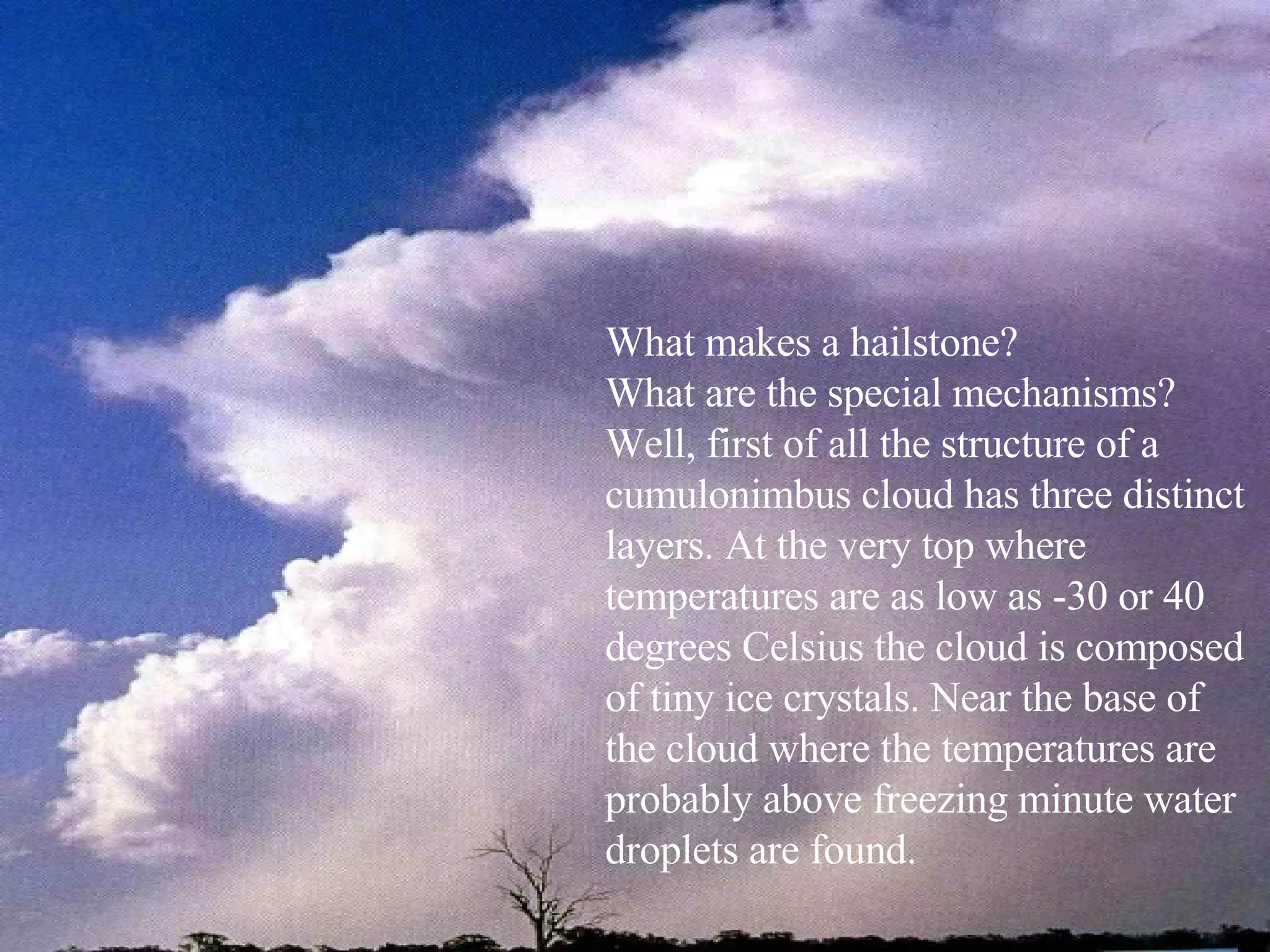
What makes a hailstone?  What are the special mechanisms? Well, first of all the structure of a cumulonimbus cloud has three distinct layers. At the very top where temperatures are as low as -30 or 40 degrees Celsius the cloud is composed of tiny ice crystals. Near the base of the cloud where the temperatures are probably above freezing minute water droplets are found.
Between these two layers is the important zone. Here ice crystals exist with ‘supercooled’ droplets. These are minute water droplets at a  temperature below 0 degrees Celsius!
Inside the cumulonimbus  cloud are powerful  up and down  currents, caused  by the convective turning of air  heated by the earths surface. A growing hailstone spends some time in the cloud being cycled between the different layers of the cloud, adding layers of clear  ice as droplets freeze  on to it, and white ice  as ice crystals are  attracted.
A true hailstone has several of these layers and the number of layers and therefore size of the hailstone depends on the time it has spent being rotated between the different parts of the cloud.
In April 1999 in Sydney hail caused one of Australia's costliest natural disasters. Hailstones the size of grapefruit damaged 200,000 homes and ruined 60,000 cars!
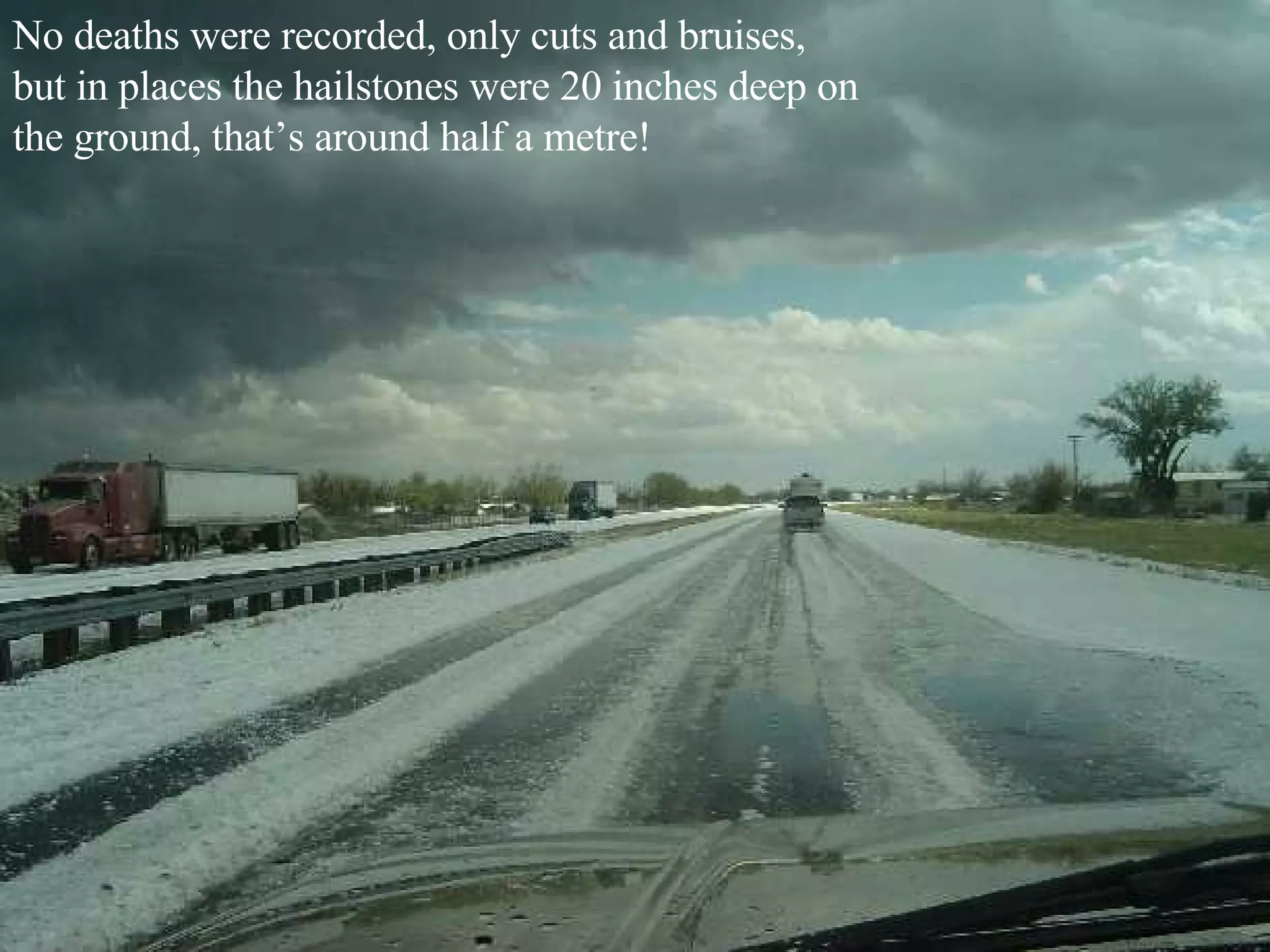
No deaths were recorded, only cuts and bruises, but in places the hailstones were 20 inches deep on the ground, that’s around half a metre!

Weather Hail

  • 1.
  • 2.
    The mechanisms atwork inside a cumulonimbus cloud are very special indeed. It is this cloud, towering up to 12 km or more in height, that brings our most impressive and potentially destructive weather.
  • 3.
    Thunderstorms, intense rainfall,squalls, hailstorms and even tornadoes commonly accompany this ‘danger’ cloud, particularly with a so-called ‘Supercell’.
  • 4.
    Less obviously devastatingthan a tornado, hailstorms do immense damage, particularly in continental interiors such as the USA. Here the intense heat of the ground surface in summer stimulates rapid and powerful uplift
  • 5.
    The world recordhailstone fell on the state of Kansas in the USA. It weighed 758 g, that’s 1.7 lbs, and was 7.5 inches in diameter!
  • 6.
    Here in Britainour contender for the championship fell on Horsham in West Sussex in 1958 and weighed a mere 141 g!
  • 7.
    What makes ahailstone? What are the special mechanisms? Well, first of all the structure of a cumulonimbus cloud has three distinct layers. At the very top where temperatures are as low as -30 or 40 degrees Celsius the cloud is composed of tiny ice crystals. Near the base of the cloud where the temperatures are probably above freezing minute water droplets are found.
  • 8.
    Between these twolayers is the important zone. Here ice crystals exist with ‘supercooled’ droplets. These are minute water droplets at a temperature below 0 degrees Celsius!
  • 9.
    Inside the cumulonimbus cloud are powerful up and down currents, caused by the convective turning of air heated by the earths surface. A growing hailstone spends some time in the cloud being cycled between the different layers of the cloud, adding layers of clear ice as droplets freeze on to it, and white ice as ice crystals are attracted.
  • 10.
    A true hailstonehas several of these layers and the number of layers and therefore size of the hailstone depends on the time it has spent being rotated between the different parts of the cloud.
  • 11.
    In April 1999in Sydney hail caused one of Australia's costliest natural disasters. Hailstones the size of grapefruit damaged 200,000 homes and ruined 60,000 cars!
  • 12.
    No deaths wererecorded, only cuts and bruises, but in places the hailstones were 20 inches deep on the ground, that’s around half a metre!