Formation of Hail in 
Cumulonimbus Clouds 
By Sarah Allen 
**Audio explanations can be found on 
slides 2 and 4**
Formation of Cumulonimbus Cloud 
• The sun heats the ground over the course of 
daylight hours, also heating the air close to the 
ground 
• That air then rises because it is less dense than 
the cold air above it 
• The air cools as it rises, lowering its ability to hold 
water vapor 
• When the dew point is reached, the vapor 
condenses and forms puffy clouds 
• That condensation releases heat, causing the air’s 
rise to accelerate 
• Cumulonimbus clouds contain a lot of energy, 
contained in updrafts and downdrafts
Cumulonimbus Cloud 
P 
i 
c
Formation of Hail 
• Hail forms in the cloud’s main updraft out of super 
cooled water 
-super cooled water is water which exists as a 
liquid, but is bellow 273 K 
• the super cooled water freezes when it encounters 
condensation nuclei- small particles in the cloud 
-example: salt, dirt, etc. 
• the now frozen water is dragged down by gravity, 
colliding with more super cooled water which will 
freeze upon collision, increasing the size of the hail 
• The hail will grow in size until it leaves the cloud and 
falls to earth, causing a cold downdraft
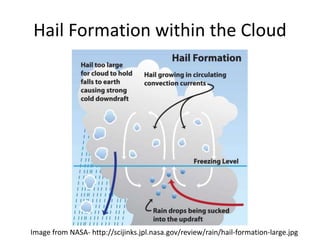
Hail Formation within the Cloud 
Image from NASA- http://scijinks.jpl.nasa.gov/review/rain/hail-formation-large.jpg
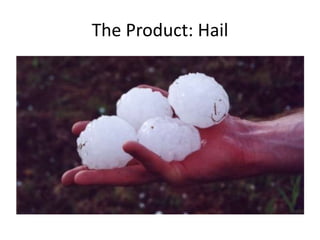
The Product: Hail
Sources 
http://weather.ou.edu/~edavis/clouds.html 
http://www.ucar.edu/communications/factshee 
ts/Hail.html 
http://scijinks.jpl.nasa.gov/review/rain/hail-formation- 
large.jpg 
http://stormgasm.com/4-17- 
02LPday/tom%20pics/hail.jpg

Hail formation within a Cumulonimbus Cloud

  • 1.
    Formation of Hailin Cumulonimbus Clouds By Sarah Allen **Audio explanations can be found on slides 2 and 4**
  • 2.
    Formation of CumulonimbusCloud • The sun heats the ground over the course of daylight hours, also heating the air close to the ground • That air then rises because it is less dense than the cold air above it • The air cools as it rises, lowering its ability to hold water vapor • When the dew point is reached, the vapor condenses and forms puffy clouds • That condensation releases heat, causing the air’s rise to accelerate • Cumulonimbus clouds contain a lot of energy, contained in updrafts and downdrafts
  • 3.
  • 4.
    Formation of Hail • Hail forms in the cloud’s main updraft out of super cooled water -super cooled water is water which exists as a liquid, but is bellow 273 K • the super cooled water freezes when it encounters condensation nuclei- small particles in the cloud -example: salt, dirt, etc. • the now frozen water is dragged down by gravity, colliding with more super cooled water which will freeze upon collision, increasing the size of the hail • The hail will grow in size until it leaves the cloud and falls to earth, causing a cold downdraft
  • 5.
    Hail Formation withinthe Cloud Image from NASA- http://scijinks.jpl.nasa.gov/review/rain/hail-formation-large.jpg
  • 6.
  • 7.
    Sources http://weather.ou.edu/~edavis/clouds.html http://www.ucar.edu/communications/factshee ts/Hail.html http://scijinks.jpl.nasa.gov/review/rain/hail-formation- large.jpg http://stormgasm.com/4-17- 02LPday/tom%20pics/hail.jpg