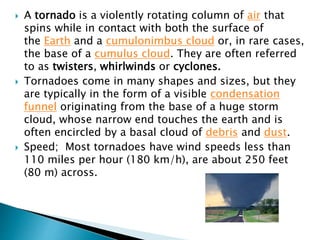
 A tornado is a violently rotating column of air that
spins while in contact with both the surface of
the Earth and a cumulonimbus cloud or, in rare cases,
the base of a cumulus cloud. They are often referred
to as twisters, whirlwinds or cyclones.
 Tornadoes come in many shapes and sizes, but they
are typically in the form of a visible condensation
funnel originating from the base of a huge storm
cloud, whose narrow end touches the earth and is
often encircled by a basal cloud of debris and dust.
 Speed; Most tornadoes have wind speeds less than
110 miles per hour (180 km/h), are about 250 feet
(80 m) across.
Various types of tornadoes include the
 multiple vortex tornado
 Landspout
 waterspout
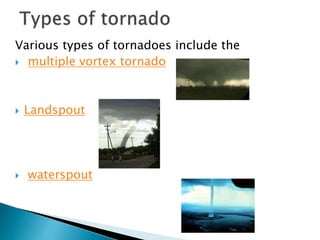
 A multiple-vortex tornado is a tornado that
contains several vortices rotating
around, inside of, and as part of the
main vortex. These multiple vortices are
somewhat similar to eyewall mesovortices found
in intense tropical cyclones. The only times
multiple vortices may be visible are when the
tornado is first forming or when condensation
and debris is balanced enough so that
subvortices are apparent without being
obscured.
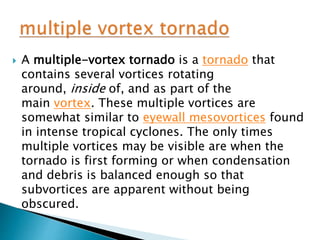
 A landspout is a term coined by
meteorologist Howard B. Bluestein in 1985
for a kind of tornado not associated with
the mesocyclone of a thunderstorm.
Landspouts form during the growth stage of
convective clouds by stretching boundary
layer vorticity upward and into the
cumuliform tower's updraft.
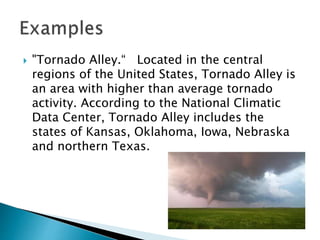
 A waterspout is an intense columnar vortex (usually
appearing as a funnel-shaped cloud) that occurs over
a body of water. They are connected to a
towering cumuliform cloud or a cumulonimbus cloud.
In the common form, it is a non-supercell tornado over
water. Most waterspouts do not suck up water; they
are small and weak rotating columns of air over water.
 Areas that report waterspouts, including Europe, New
Zealand, the Great Lakes, Antarctica and on rare
occasions, the Great Salt Lake.
 FIRE TORNADO
 WATER TORNADO
 Tornadoes can happen at any time during the
year, but are more likely to occur between
May and June in the southern area of the
United States. In the upper Midwest and
northern regions of the United States,
tornado season is considered to be in June or
July.
 "Tornado Alley.“ Located in the central
regions of the United States, Tornado Alley is
an area with higher than average tornado
activity. According to the National Climatic
Data Center, Tornado Alley includes the
states of Kansas, Oklahoma, Iowa, Nebraska
and northern Texas.
 Some after-effects of tornadoes are fatalities and
injuries to people and animals, damaged or
destroyed buildings, water supply contamination
and loss of services. Ongoing effects include
displacement, illness and disruption of everyday
life.

Tornado

  • 2.
     A tornadois a violently rotating column of air that spins while in contact with both the surface of the Earth and a cumulonimbus cloud or, in rare cases, the base of a cumulus cloud. They are often referred to as twisters, whirlwinds or cyclones.  Tornadoes come in many shapes and sizes, but they are typically in the form of a visible condensation funnel originating from the base of a huge storm cloud, whose narrow end touches the earth and is often encircled by a basal cloud of debris and dust.  Speed; Most tornadoes have wind speeds less than 110 miles per hour (180 km/h), are about 250 feet (80 m) across.
  • 3.
    Various types oftornadoes include the  multiple vortex tornado  Landspout  waterspout
  • 4.
     A multiple-vortextornado is a tornado that contains several vortices rotating around, inside of, and as part of the main vortex. These multiple vortices are somewhat similar to eyewall mesovortices found in intense tropical cyclones. The only times multiple vortices may be visible are when the tornado is first forming or when condensation and debris is balanced enough so that subvortices are apparent without being obscured.
  • 5.
     A landspoutis a term coined by meteorologist Howard B. Bluestein in 1985 for a kind of tornado not associated with the mesocyclone of a thunderstorm. Landspouts form during the growth stage of convective clouds by stretching boundary layer vorticity upward and into the cumuliform tower's updraft.
  • 6.
     A waterspoutis an intense columnar vortex (usually appearing as a funnel-shaped cloud) that occurs over a body of water. They are connected to a towering cumuliform cloud or a cumulonimbus cloud. In the common form, it is a non-supercell tornado over water. Most waterspouts do not suck up water; they are small and weak rotating columns of air over water.  Areas that report waterspouts, including Europe, New Zealand, the Great Lakes, Antarctica and on rare occasions, the Great Salt Lake.
  • 7.
     FIRE TORNADO WATER TORNADO
  • 8.
     Tornadoes canhappen at any time during the year, but are more likely to occur between May and June in the southern area of the United States. In the upper Midwest and northern regions of the United States, tornado season is considered to be in June or July.
  • 9.
     "Tornado Alley.“Located in the central regions of the United States, Tornado Alley is an area with higher than average tornado activity. According to the National Climatic Data Center, Tornado Alley includes the states of Kansas, Oklahoma, Iowa, Nebraska and northern Texas.
  • 10.
     Some after-effectsof tornadoes are fatalities and injuries to people and animals, damaged or destroyed buildings, water supply contamination and loss of services. Ongoing effects include displacement, illness and disruption of everyday life.