Karen Calhoun Vice President WorldCat and Metadata Services OCLC  OUR Space: the new world of metadata IFLA 13 August 2008
The Catalog: First Self-Service Information Tool 2007/2008 Statistics for a Large Research Library: 175K  unique visitors/month to Library Web pages (9% of overall site use) ------------------------- 2007/2008 Statistics for Amazon.com: 55M  unique visitors/month (U.S.) Data sources:  http:// siteanalytics.compete.com /  and  http:// www.alexa.com /
LC Action Item 6.4: “Support research and development on the changing nature of the catalog to include consideration of a framework for its integration with other discovery tools.” Calhoun, Karen.  The Changing Nature of the Catalog and Its Integration with Other  Discovery  Tools.    Washington, DC: Library of Congress, 17 March 2006.  http://www.loc.gov/catdir/calhoun-report-final.pdf
The Catalog in Context Online catalogs represent one node in the end user’s information universe
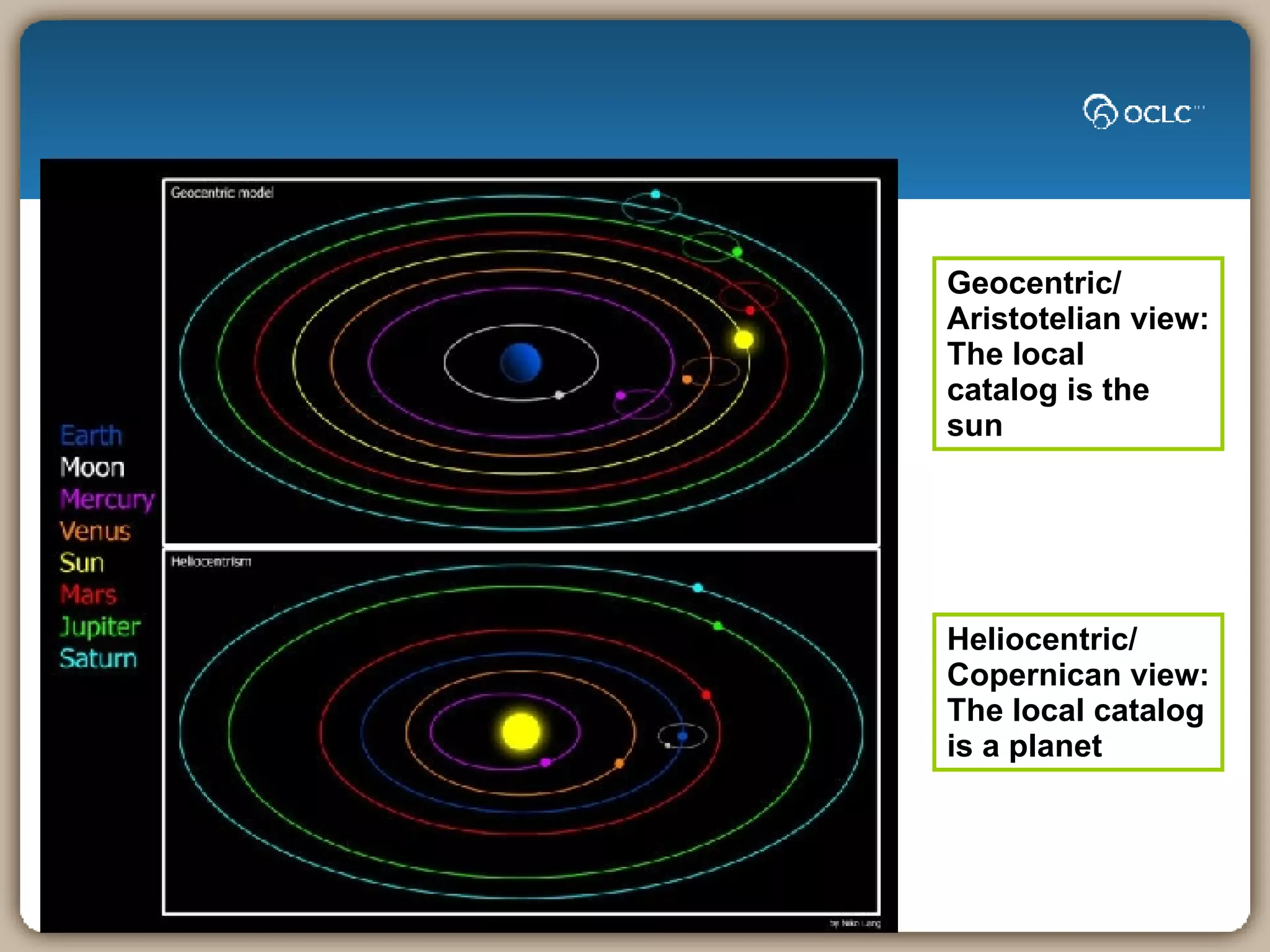
Geocentric/ Aristotelian view: The local  catalog is the sun Heliocentric/ Copernican view: The local catalog is a planet
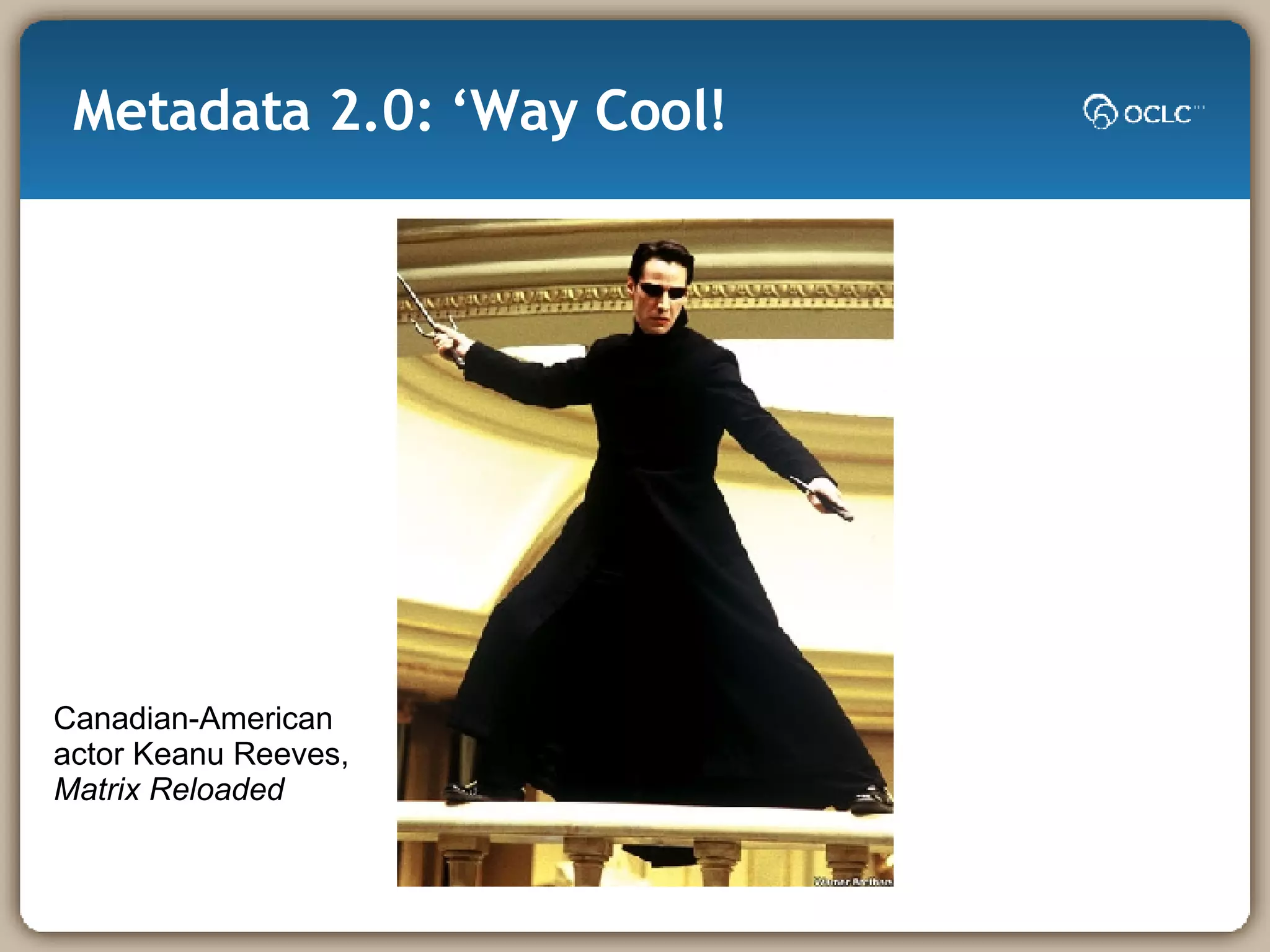
Metadata 2.0: ‘Way Cool! Canadian-American actor Keanu Reeves, Matrix Reloaded
Metadata in the Information Industry “Data is the next Intel Inside” Tim O’Reilly, “What is Web. 2.0?” http://www.oreilly.com/pub/a/oreilly/tim/news/2005/09/30/what-is-web-20.html?page=3 “The digital world … has never met a piece of information it didn’t like” David Weinberger,  Everything is Miscellaneous , Ch. 6, “Smart Leaves,” p. 119
ebay: User-Supplied Metadata Supported By Sophisticated Web Templates and Indexing Not shown: categories (controlled vocabulary), item specifics, abstract, more
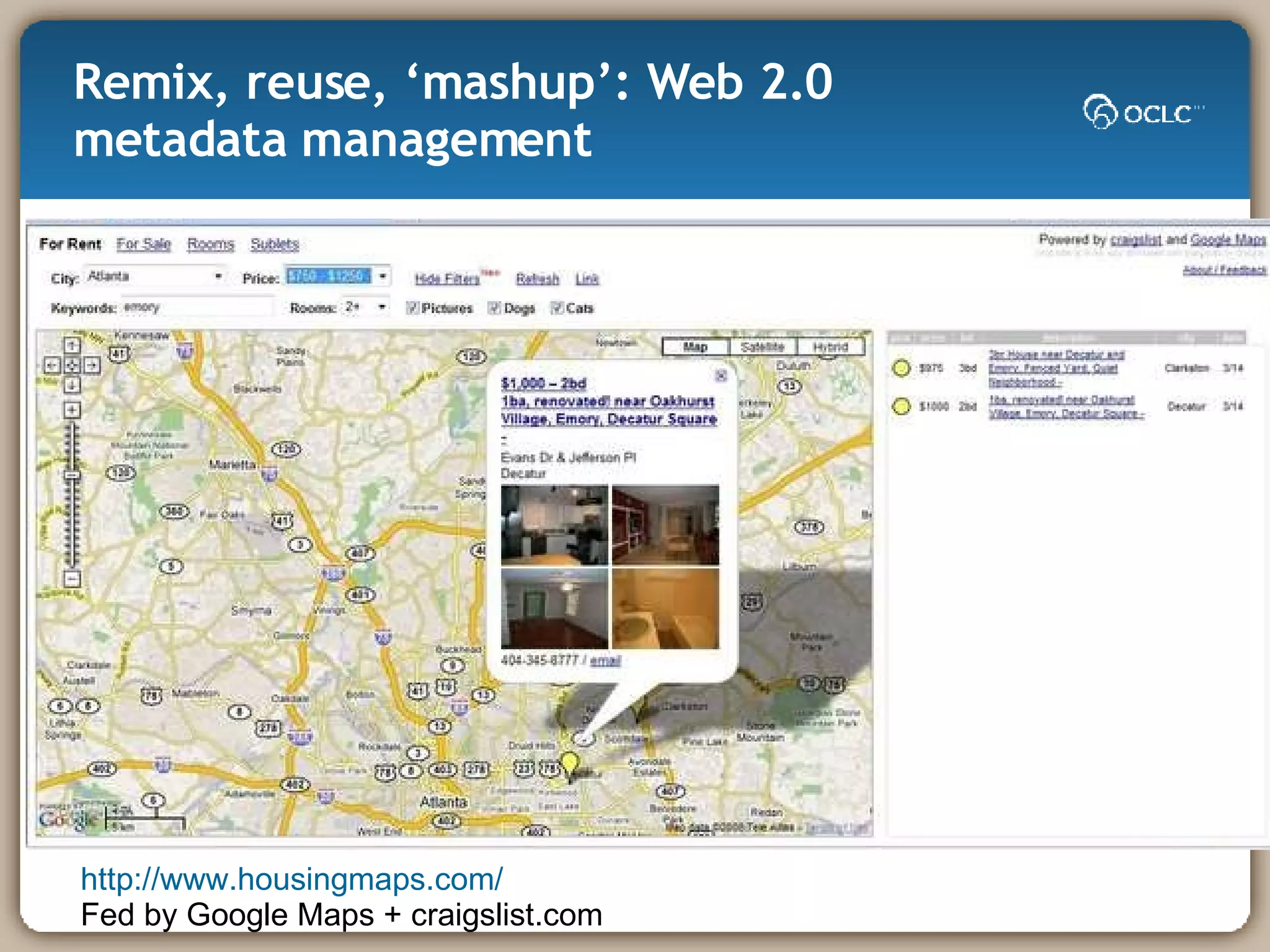
Remix, reuse, ‘mashup’: Web 2.0 metadata management http:// www.housingmaps.com / Fed by Google Maps + craigslist.com
Metadata + Full Text Searching
Which One Is the “Full” Record? + 3 more screens Product Description & Purchase Information More like this Editorial Reviews & Author Info Inside the Book Tags, Ratings Customer Reviews Lists More With thanks to David Lankes:   http://quartz.syr.edu/rdlankes/Presentations/ 2007/ALCTS.pdf Bibliographic Information Library Holdings Details Subjects Editions Reviews Bibliographic Information Australian Library Holdings
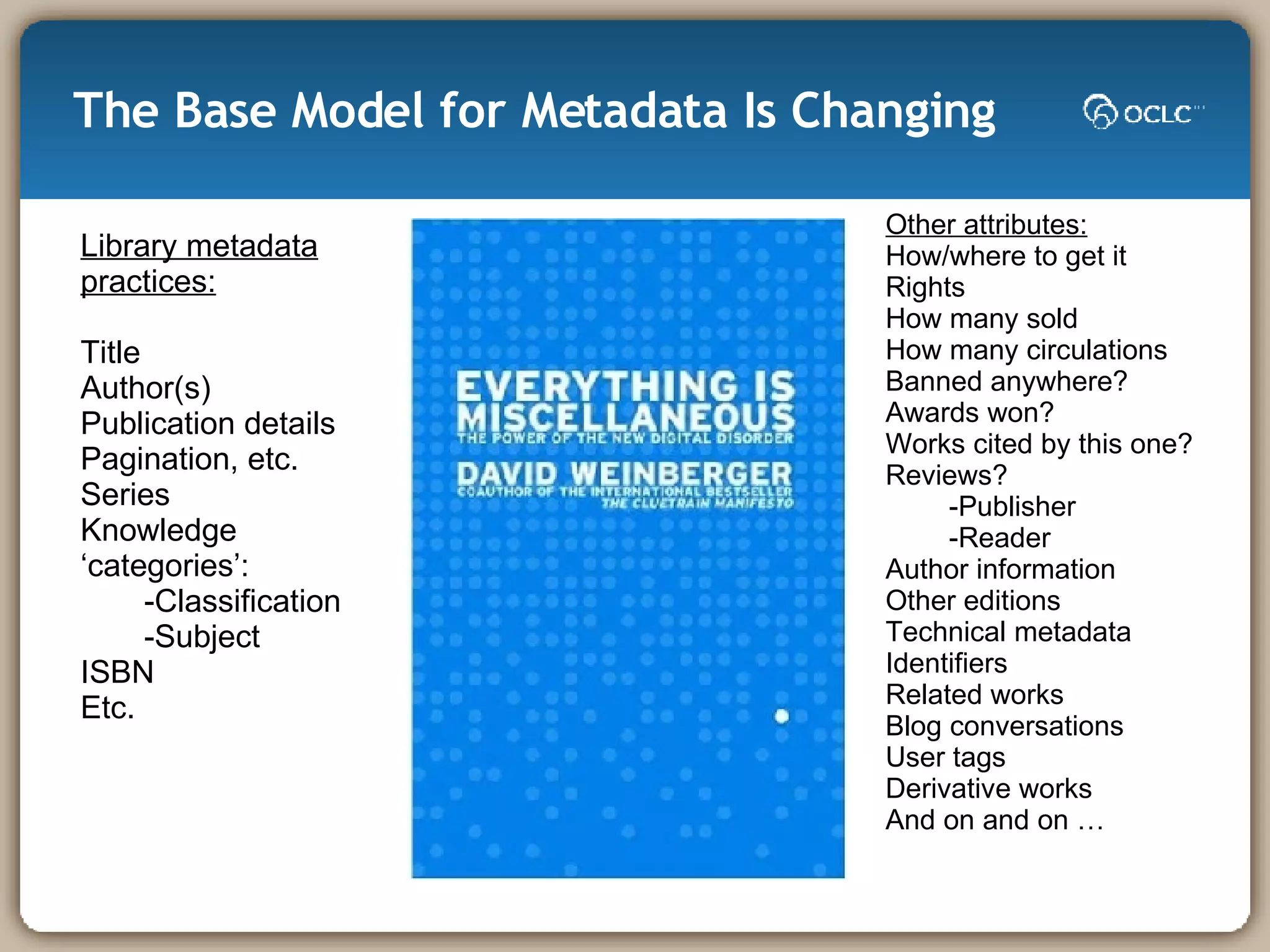
The Base Model for Metadata Is Changing Library metadata practices: Title Author(s) Publication details Pagination, etc. Series Knowledge  ‘ categories’: -Classification -Subject ISBN Etc. Other attributes: How/where to get it Rights How many sold How many circulations Banned anywhere? Awards won? Works cited by this one? Reviews? -Publisher -Reader Author information Other editions Technical metadata Identifiers Related works Blog conversations User tags Derivative works And on and on …
Changing Context for Library Metadata  B.W. (Before the Web) For finding and managing  library materials (mostly print) Catalog records (well-understood rules and encoding conventions) Shared cooperative cataloging systems Usually handcrafted, one at a time A.W. (After the Web) For finding and managing many types of materials, for many user communities Many types of records, many sources Loosely coupled metadata management, reuse and exchange services among multiple repositories Mix of manual and automated creation and metadata extract, conversion, mapping, ingest and transfer services
Collections Have Changed high low low high stewardship uniqueness Books Journals Newspapers Gov. docs CD, DVD Maps Scores Special  collections Rare books Local/Historical    newspapers Local history materials Archives & Manuscripts, Theses & dissertations Research, learning and administrative materials ,  ePrints/tech reports Learning objects Courseware E-portfolios Research data Institutional records Reports, newsletters, etc Freely-accessible web resources Open source software Newsgroup archives
Libraries and What They Collect on Behalf of Their Communities Books Journals Newspapers Gov. docs CD, DVD Maps Scores Special  collections Rare books Local/Historical    newspapers Local history materials Archives & Manuscripts, Theses & dissertations
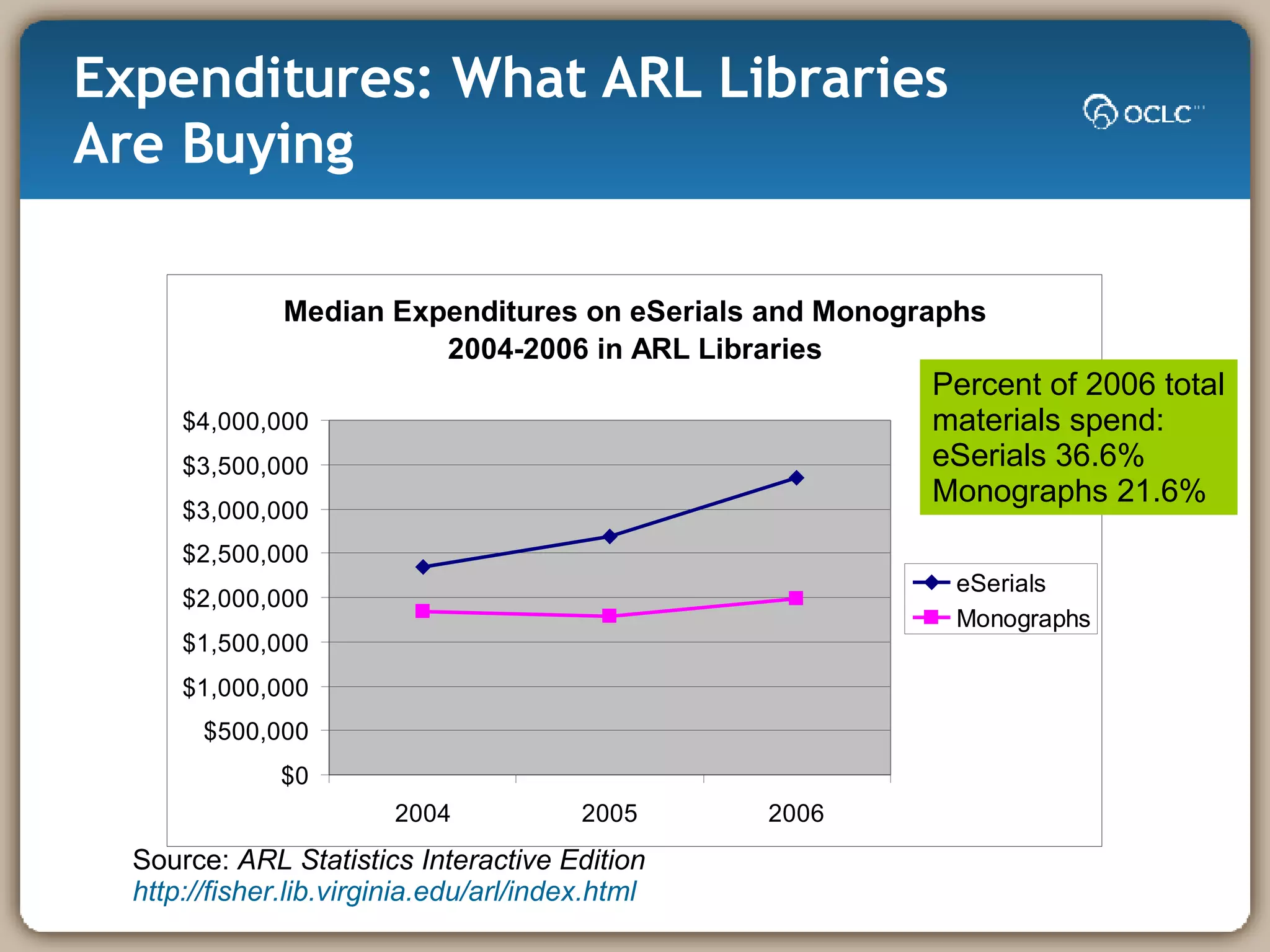
Expenditures: What ARL Libraries Are Buying Percent of 2006 total materials spend: eSerials 36.6% Monographs 21.6% Source:  ARL Statistics Interactive Edition http:// fisher.lib.virginia.edu/arl/index.html
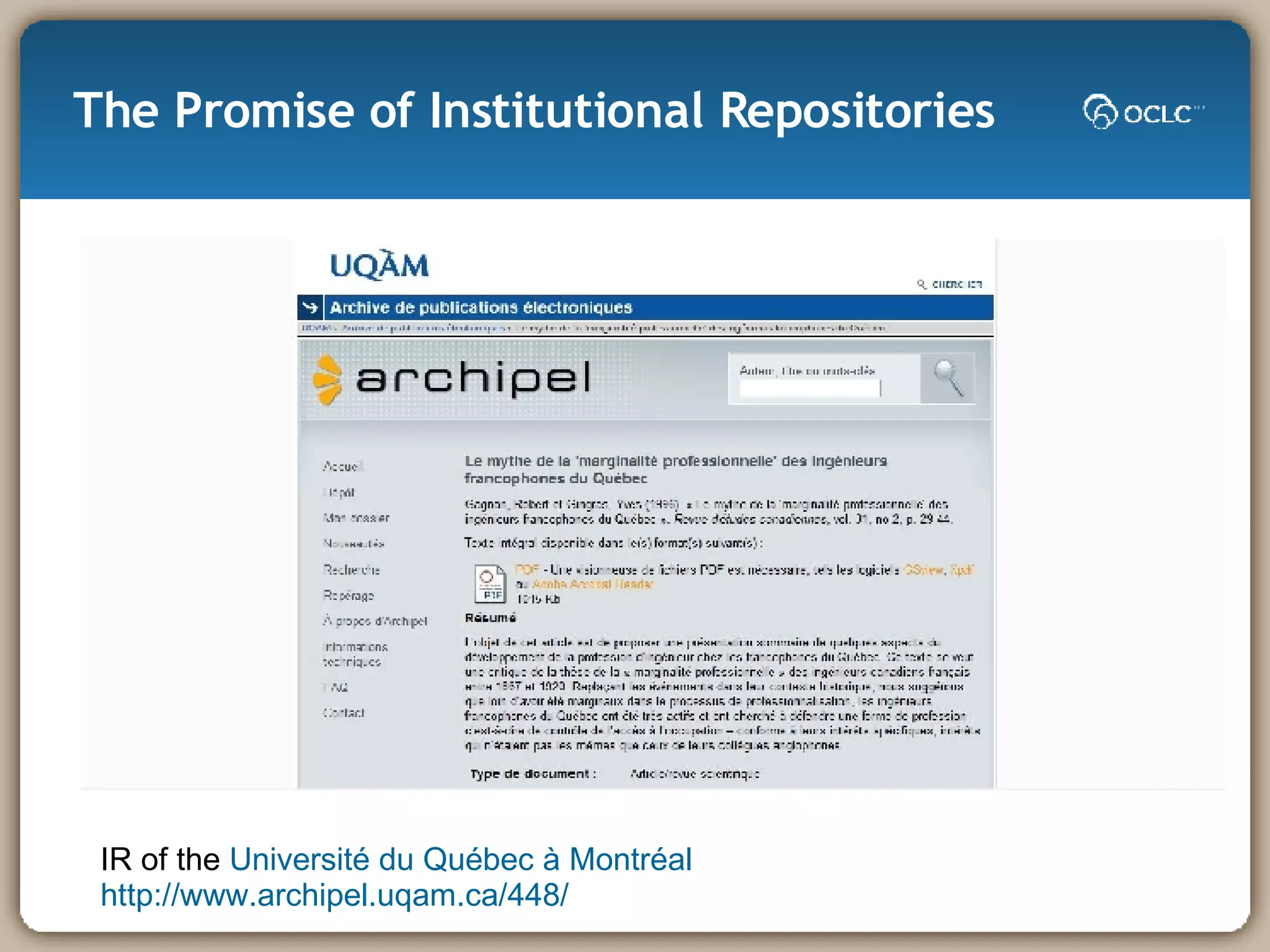
The Promise of Institutional Repositories IR of the  Université  du Québec à Montréal   http://www.archipel.uqam.ca/448/
Scholarly Portals arXiv.org Open access to 490,465 e-prints in Physics, Mathematics,  Computer Science, Quantitative Biology and Statistics
Exposing Scientific Research: Brazil’s IBICT Electronic Theses and Dissertations
Exciting New Digital Collections: Europeana Prototype http:// www.europeana.eu /
Library Special Collections Are Underutilized …  Digital visibility creates use Research Information Network. 2007. http://www.rin.ac.uk/files/hidden-resources-final-report.pdf
Scholarly/Community Digital Assets Are Too Often Hidden From the Network http:// isbellandes.library.cornell.edu /
http://www.loc.gov/bibliographic-future/news/lcwg-ontherecord-jan08-final.pdf 2  ENHANCE ACCESS TO RARE, UNIQUE, AND OTHER SPECIAL HIDDEN MATERIALS
2  ENHANCE ACCESS TO RARE, UNIQUE, AND OTHER SPECIAL HIDDEN MATERIALS  2.1.1 Make the discovery of rare, unique and other special hidden materials a high priority 2.1.2 Streamline cataloging for rare, unique and other special hidden materials, emphasizing greater coverage and broader access 2.1.3 Integrate access to rare, unique and other special hidden materials with other library materials 2.1.4 Encourage digitization to allow broader access 2.1.5 Share access to rare, unique and other special hidden materials
Information Seekers Have Changed [ about the people following them ]  Butch Cassidy : I couldn't do that. Could you do that?  Why can they do it?  Who  are  those guys?   http://outnow.ch/Movies/1969/ButchCassidyAndTheSundanceKid/Bilder/dvd-film.ws/11
The Changing Context for Research, Teaching, and Learning on University Campuses Knowledge itself will be modified and research and development transformed by the new capacities provided by IT.  Nothing will be left untouched.  The  liberal arts will be revived and transfigured, liberated from their age-long reliance on text alone. The silos  of the departments will topple as new approaches to bewildering issues are pursued with new vigor by  scholars in mind-boggling combinations of once insular and isolated disciplines.  – Frank H. T. Rhodes, past President of Cornell University, in  The Creation of the Future
The Toppling Silos of the Disciplines and Mind-Boggling New Forms of Scholarly Communication Kurt Wüthrich  Nobel Prize in Chemistry 2002 Swiss Federal Institute of Technology (ETH)  and the Scripps Research Institute Fields: Chemistry, physics, mathematics, biophysics --How does the library help him create new knowledge? --What are his information seeking/sharing behaviors and preferences? --In what ways does the library serve his colleagues and his graduate and post-doctoral students?
And Then There’s Today’s (and Tomorrow’s) Student No, you weren’t downloaded. You were born.”
The New Academic Library User in Sweden (and Everywhere Else) The ‘wild user’ wants to use the library’s collections: At a distance from the library Independently and self-sufficiently This is an international phenomenon Martha Kyrillidou and  Ann-Christin Persson. 2005.   The New Library User in Sweden:  a LibQUAL+™ study at Lund University. Conference presentation. Available: http://www.libqual.org/documents/admin/sweden_finalpaper3.doc Five Most Desired Items Overall Making electronic resources accessible from my home or office Easy-to-use access tools that allow me to find things on my own A library Web site enabling me to locate information on my own Making information easily accessible for independent use Print and/or electronic journal collections I require for my work
Summary So Far Metadata has changed Collections have changed Information seekers have changed What does it all mean for library metadata tradition and practice?
The Challenges for Library Metadata  Will search engines usurp the library catalog? Will Google Books usurp the library catalog? What if libraries don’t change how they support the discovery and delivery of their collections?
Will Search Engines Usurp Library Catalogs? College Students’ Perceptions of Libraries and Information Resources: a Report to the OCLC Membership :  http:// www.oclc.org/reports/perceptionscollege.htm
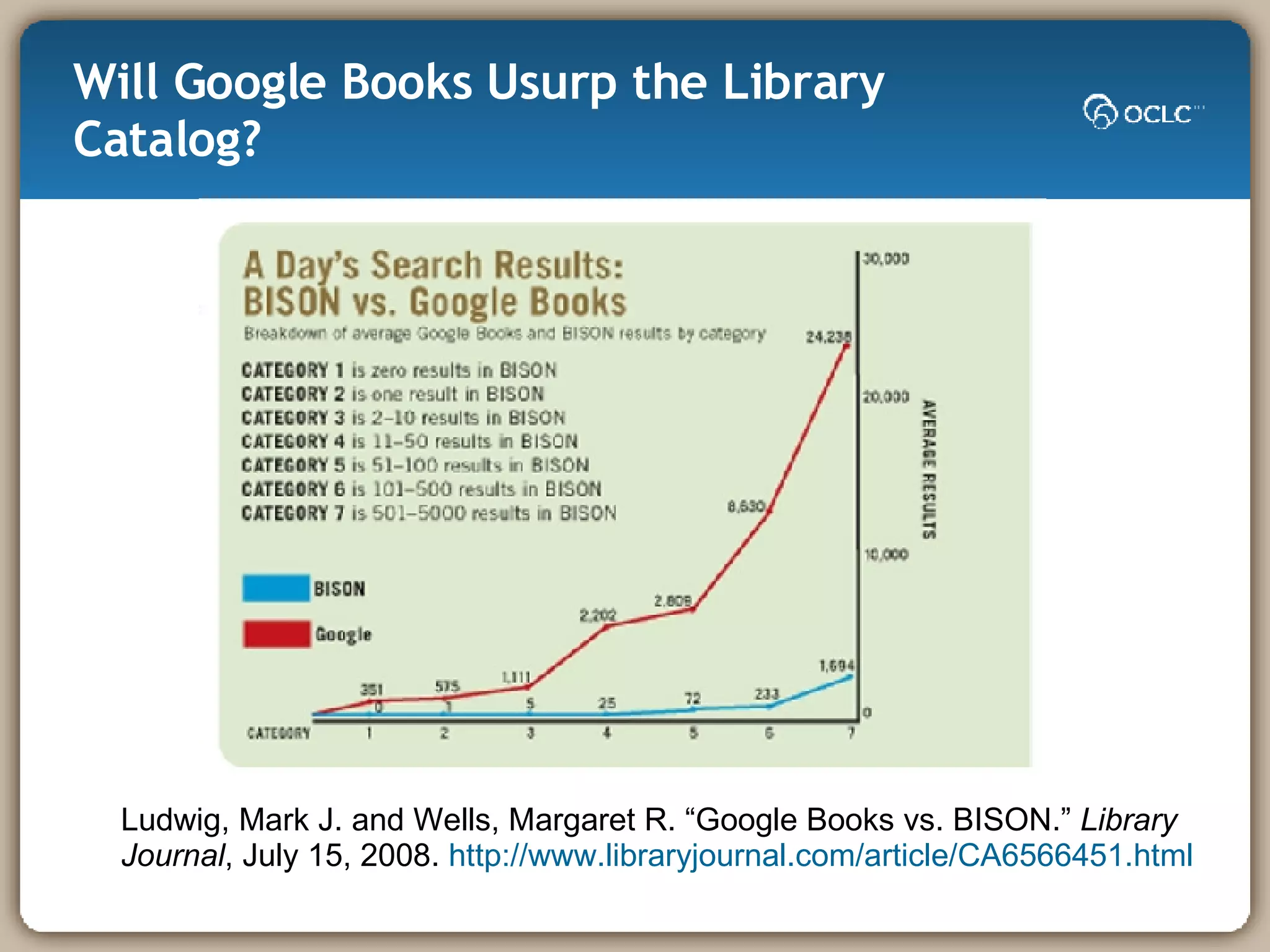
Will Google Books Usurp the Library Catalog? Ludwig, Mark J. and Wells, Margaret R. “Google Books vs. BISON.”  Library Journal , July 15, 2008.  http://www.libraryjournal.com/article/CA6566451.html
What If We Do Nothing?
Opportunities for Library Metadata Practice Take the collections to a wider audience:  be where their eyes are; expose your metadata! Open up metadata silos ; support metadata exchange, reuse, interoperation Develop  user-centered definitions of metadata ‘quality’
1.  Be Where Their Eyes Are La Grande bibliothèque nationale du Québec  Attribution: Uploaded on  May 8, 2005 by  Master Long   http://flickr.com/photos/long/12987307/ Library as Place Place as Library
‘ Promiscuous’ Metadata Global Group, national, regional Local
BnF
The European Library
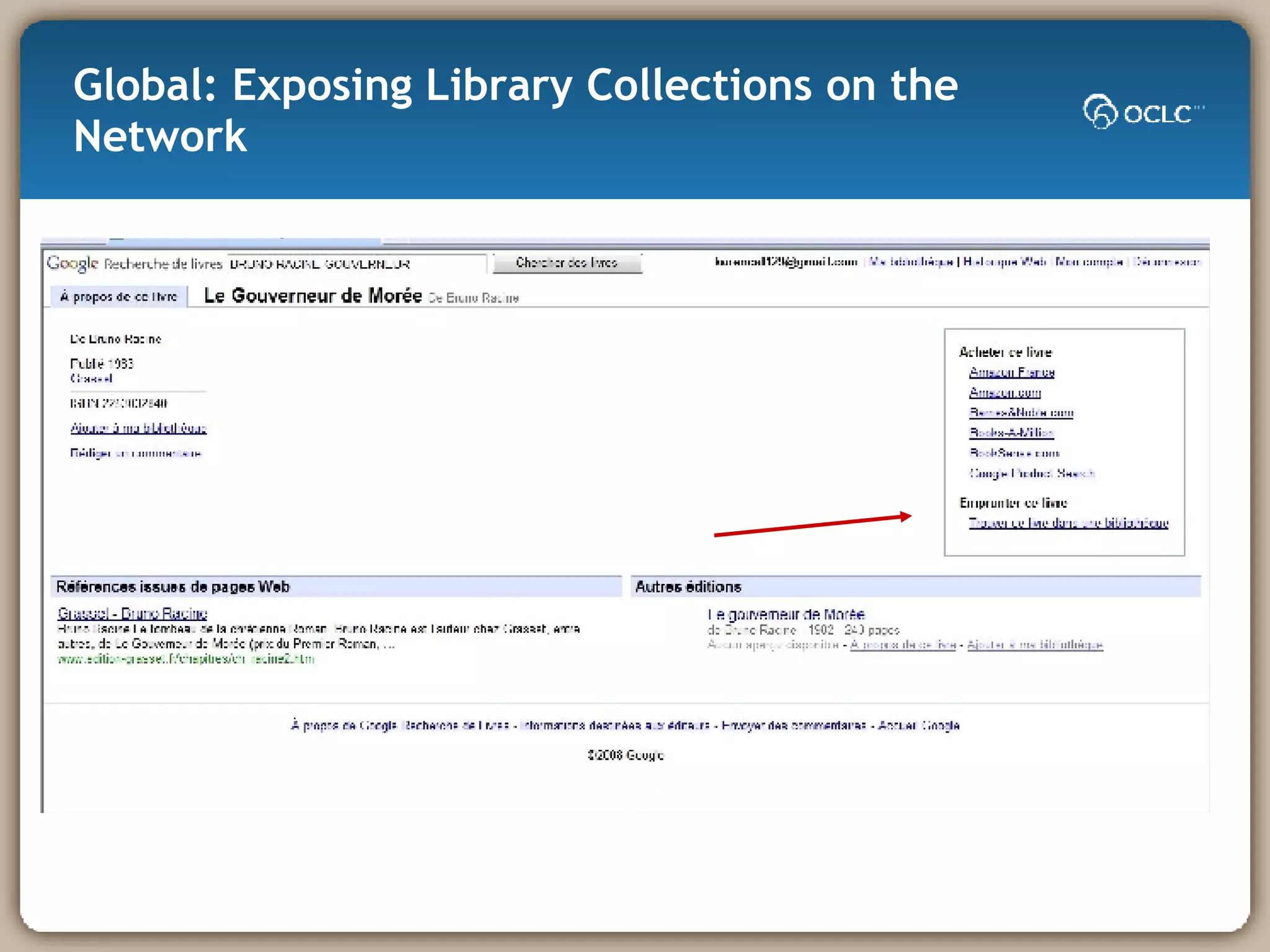
Global: Exposing Library Collections on the Network
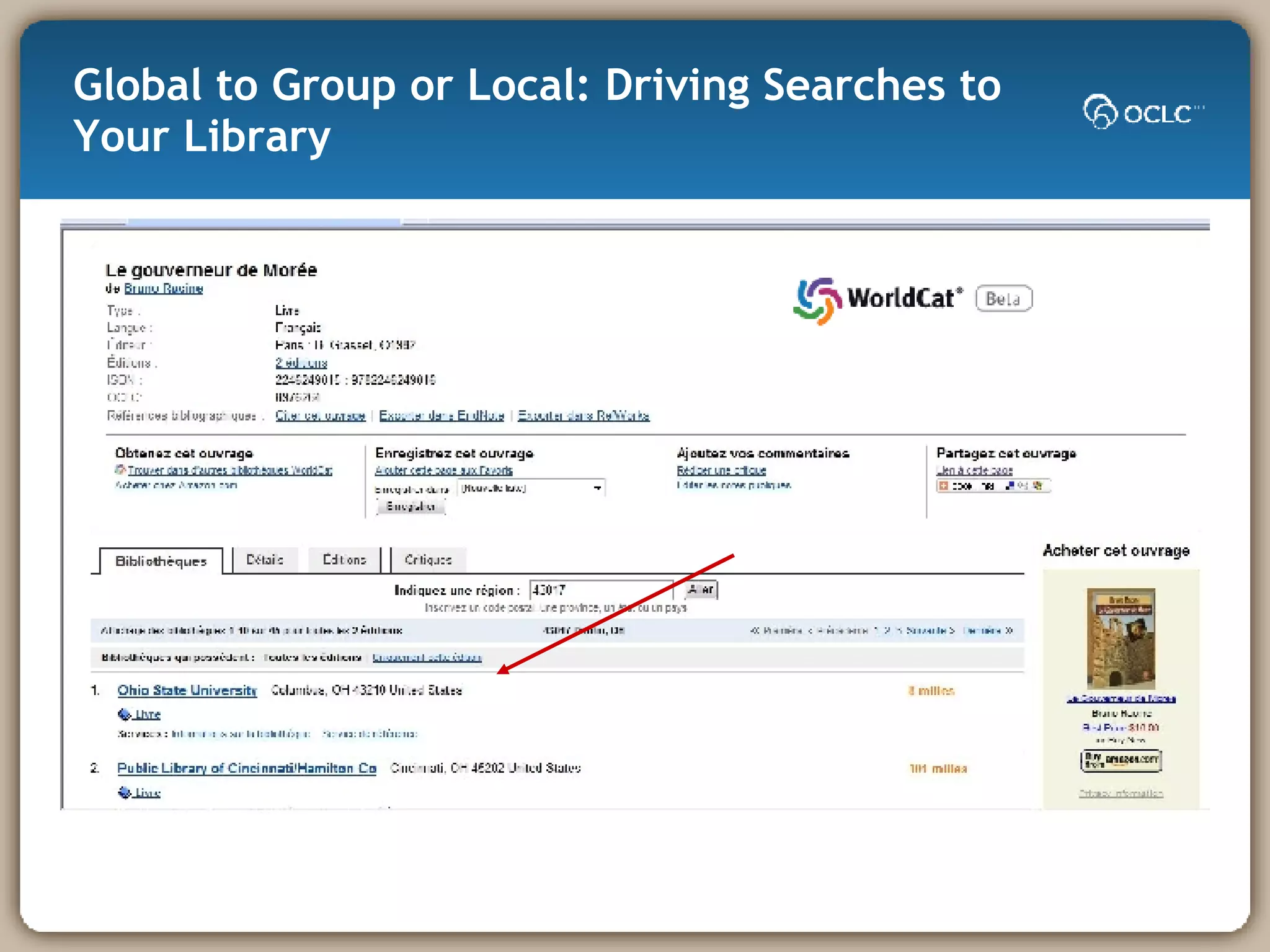
Global to Group or Local: Driving Searches to Your Library
Get It From My Library
What is OCLC Doing to Help Libraries Share Their Metadata at Web Scale? Support for a globally coordinated system of metadata management (metadata 2.0) WorldCat partnerships with national libraries and large consortia
A Globally Coordinated System of Metadata Sharing  Discovery and delivery are mediated by large information hubs
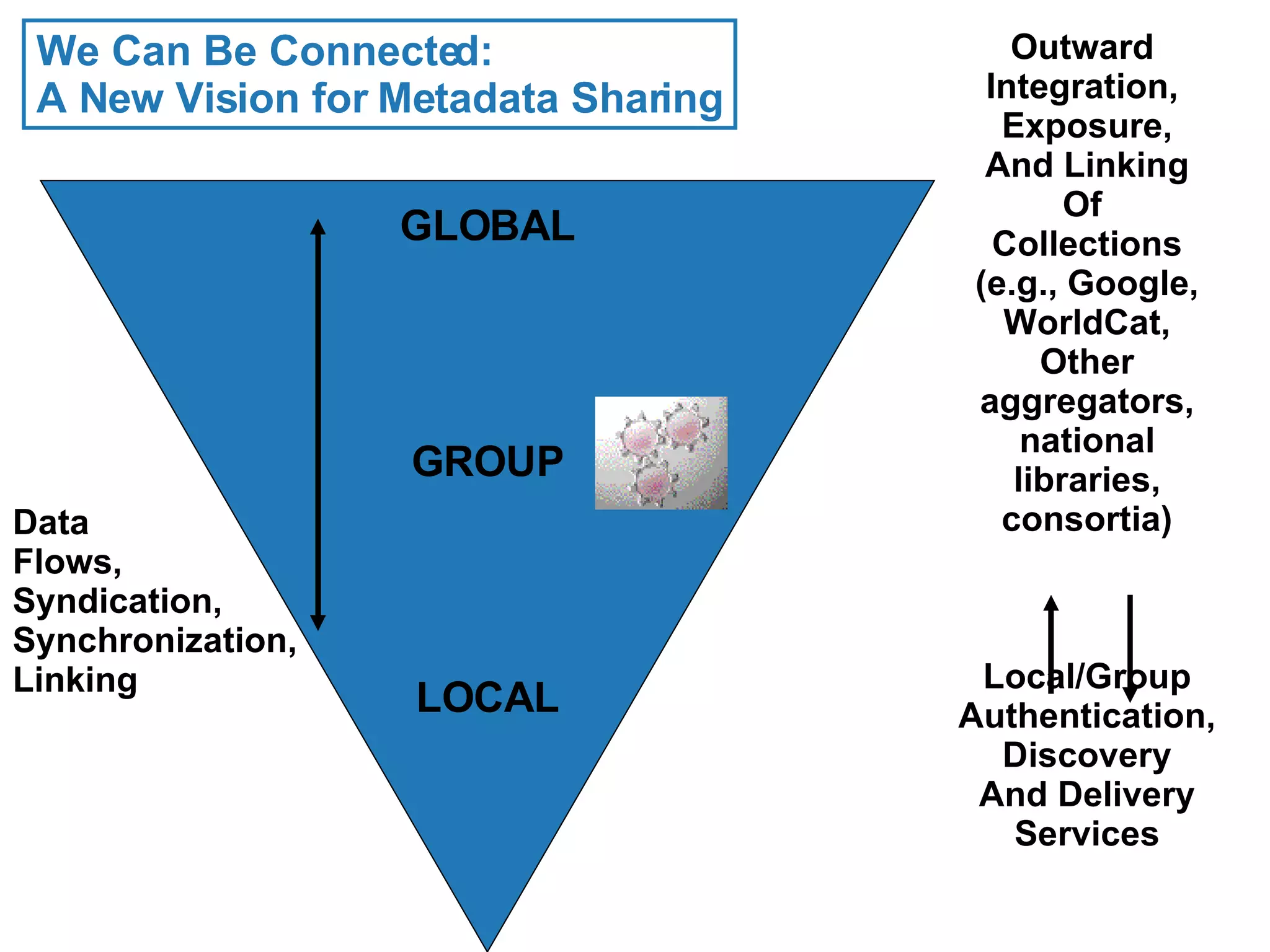
GLOBAL GROUP LOCAL Outward  Integration,  Exposure, And Linking Of  Collections (e.g., Google, WorldCat, Other aggregators, national libraries, consortia) Local/Group Authentication, Discovery And Delivery Services Data Flows, Syndication, Synchronization, Linking We Can Be Connected:  A New Vision for Metadata Sharing
WorldCat Partner Sites Google, Google Books,  Google Scholar HCI Bibliography  :  Human-Computer Interaction Resources
WorldCat.org: Destination or Metadata Switch? It’s a switch. Referrals to worldcat.org, Jan. 1 – May 31, 2008   Search Engines 47.45% Other Web Sites 39.91% Typed/Bookmarked URLs 12.64% Total
WorldCat Global Coverage *2007/08:forecast based on Q2 results Objectives for FY09: 300-500M records processed; Significant coverage in more countries outside N.A.
Introducing: A New National Library Web Page
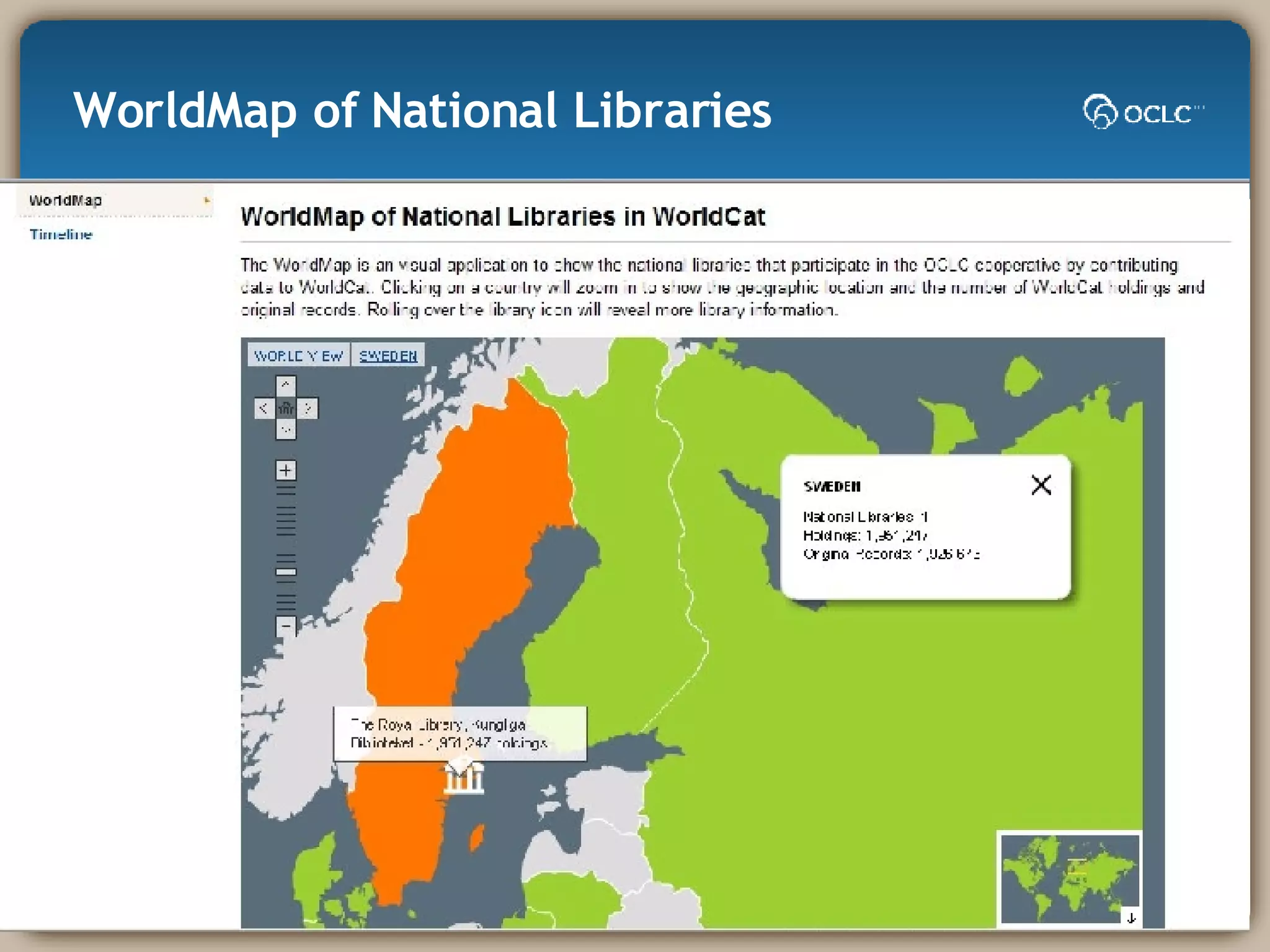
WorldMap of National Libraries
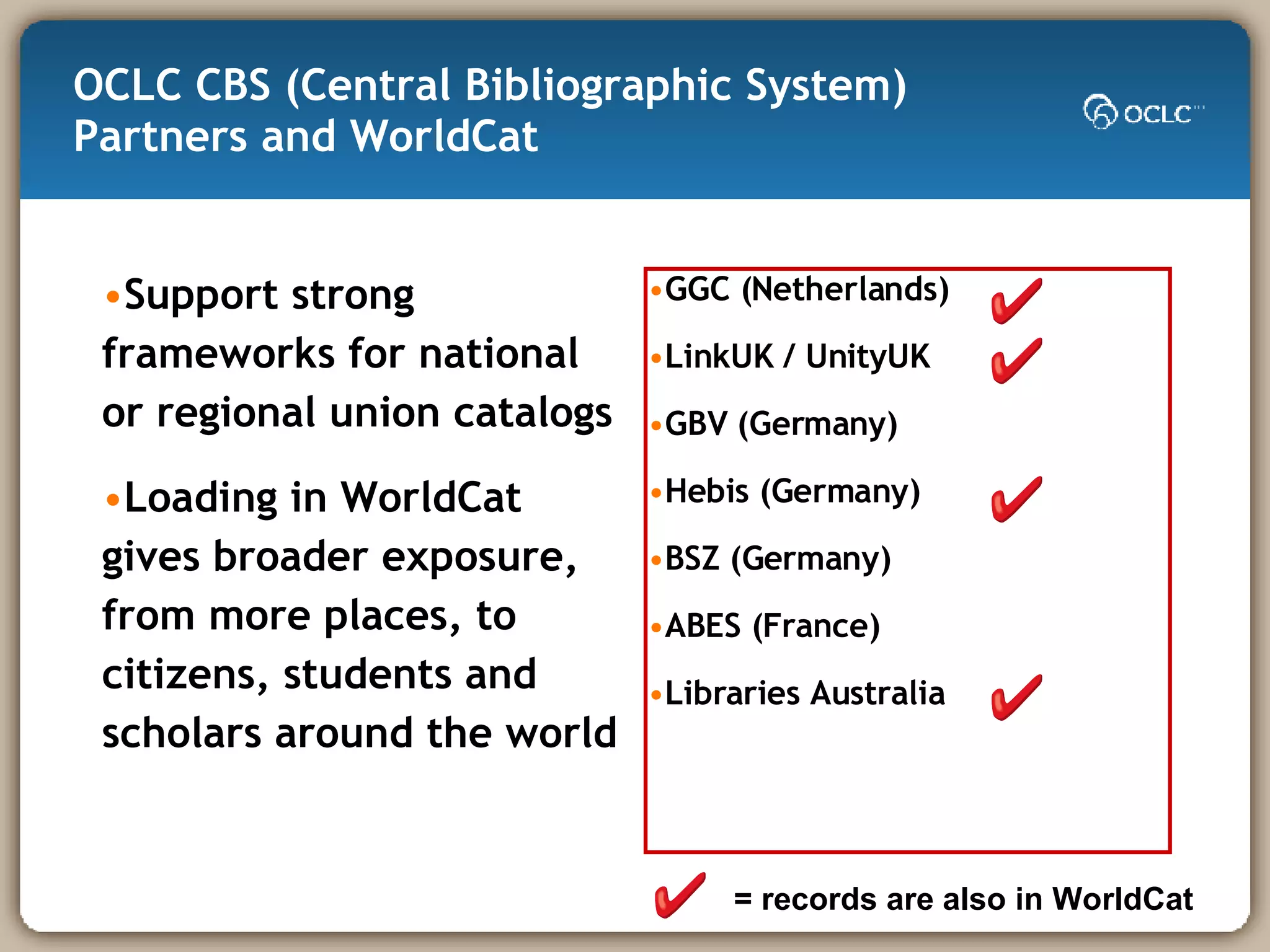
OCLC CBS (Central Bibliographic System) Partners and WorldCat Support strong frameworks for national or regional union catalogs  Loading in WorldCat gives broader exposure, from more places, to citizens, students and scholars around the world  GGC (Netherlands) LinkUK / UnityUK GBV (Germany) Hebis (Germany) BSZ (Germany) ABES (France) Libraries Australia = records are also in WorldCat
2.  Open Up Metadata Silos “ We have drawn a wall around  what is and what is not of interest to ‘cataloging’  that is not necessarily backed up by any good rationale. Many things that we decide are not of interest … are in fact of high significance to the success and ease our users will have in carrying out the tasks we mean to support … I don’t mean that “catalogers” need to apply the exact same standards to journal articles, institutional repository metadata, [etc.] … But we do need to consider it our responsibility to figure out how all these things can fit together.”  Rochkind, Jonathan. Bibliographic Wilderness [blog]. “‘Broken’ huh?” May 27, 2007 http://bibwild.wordpress.com/2007/05/25/broken-huh/#more-42
Metadata Silos Metadata  Communities for: Text Print Licensed Digital Archival Data Images Sound Video Multimedia Objects More
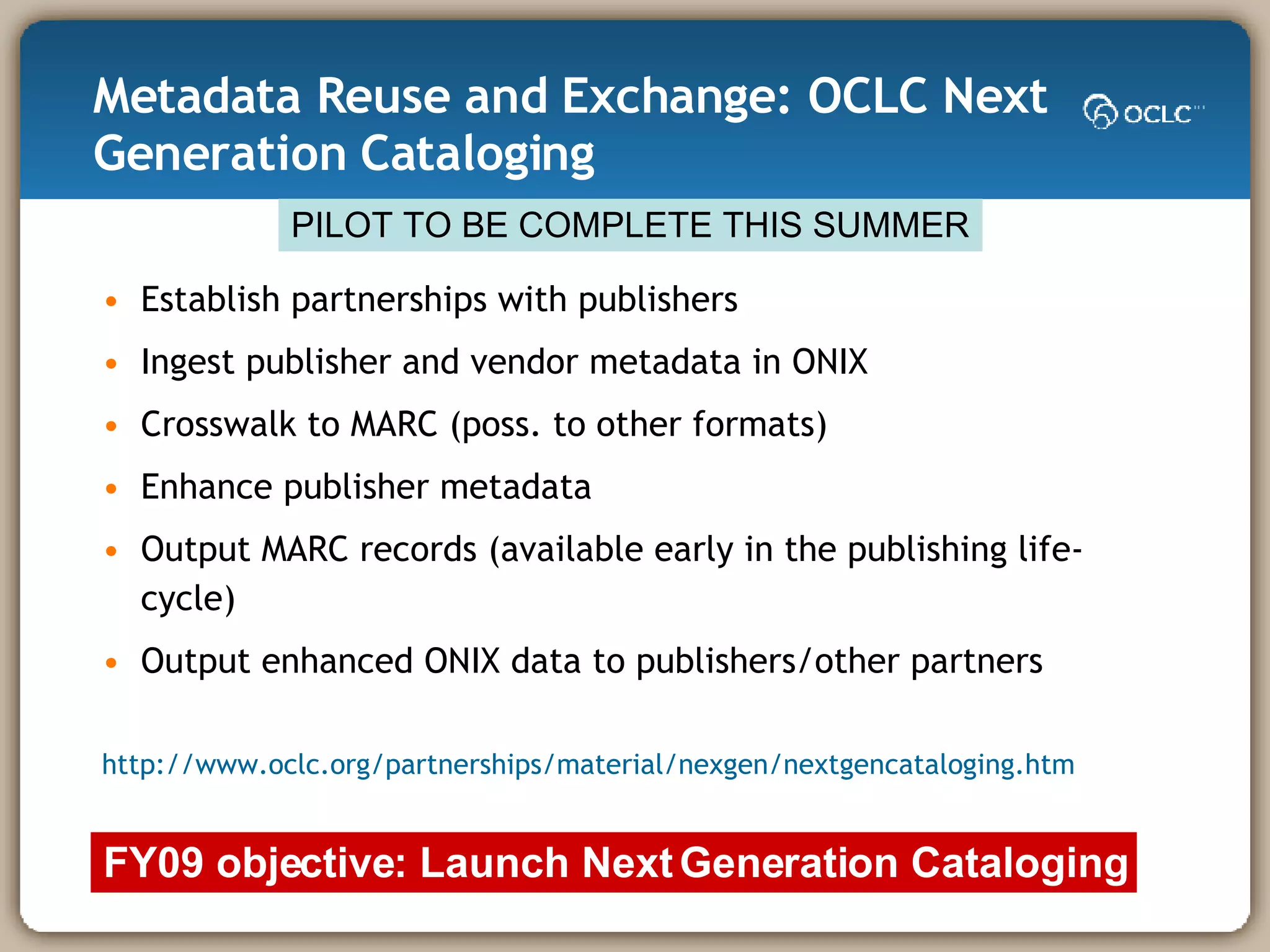
Metadata Reuse and Exchange: OCLC Next Generation Cataloging Establish partnerships with publishers Ingest publisher and vendor metadata in ONIX Crosswalk to MARC (poss. to other formats) Enhance publisher metadata  Output MARC records (available early in the publishing life-cycle) Output enhanced ONIX data to publishers/other partners http://www.oclc.org/partnerships/material/nexgen/nextgencataloging.htm PILOT TO BE COMPLETE THIS SUMMER FY09 objective: Launch Next Generation Cataloging
Fichier d'Autorité International Virtuel : VIAF  “ Une avancée de la francophonie dans le web sémantique"  Joint project: OCLC, Library of Congress, Deutsche Nationalbibliothek, Bibliothèque nationale de France http:// www.oclc.org/research/projects/viaf / Work in progress
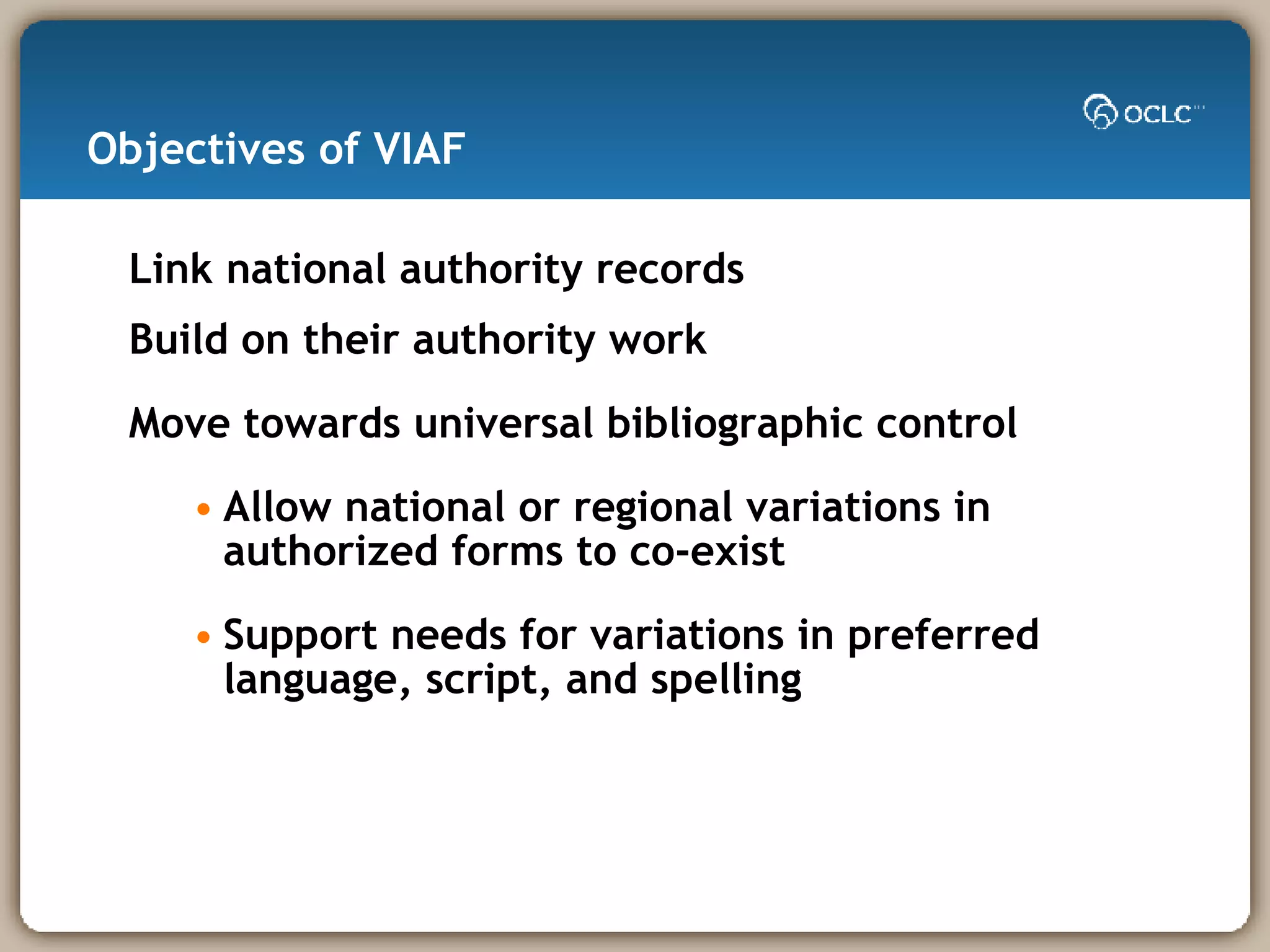
Objectives of VIAF Link national authority records Build on their authority work Move towards universal bibliographic control Allow national or regional variations in authorized forms to co-exist Support needs for variations in preferred language, script, and spelling
3. Develop user-centered definitions of metadata “quality” “ Quality” in the user workflow from discovery to delivery Library user studies suggest that users expect finding and getting information they want, when and where they want it, to be easy and convenient These users’ tolerance for barriers to easy and convenient discovery and delivery is limited.  How does what they  want  relate to what catalogers  do ?
Defining Catalog Metadata Quality: Research Project Underway WorldCat.org Pop-up Survey (done) WorldCat.org Usability/Focus Group Tests (done) Scholars and students Casual searchers Librarian Web survey (coming August/September) Research results to inform business case for new WorldCat Quality Management Program
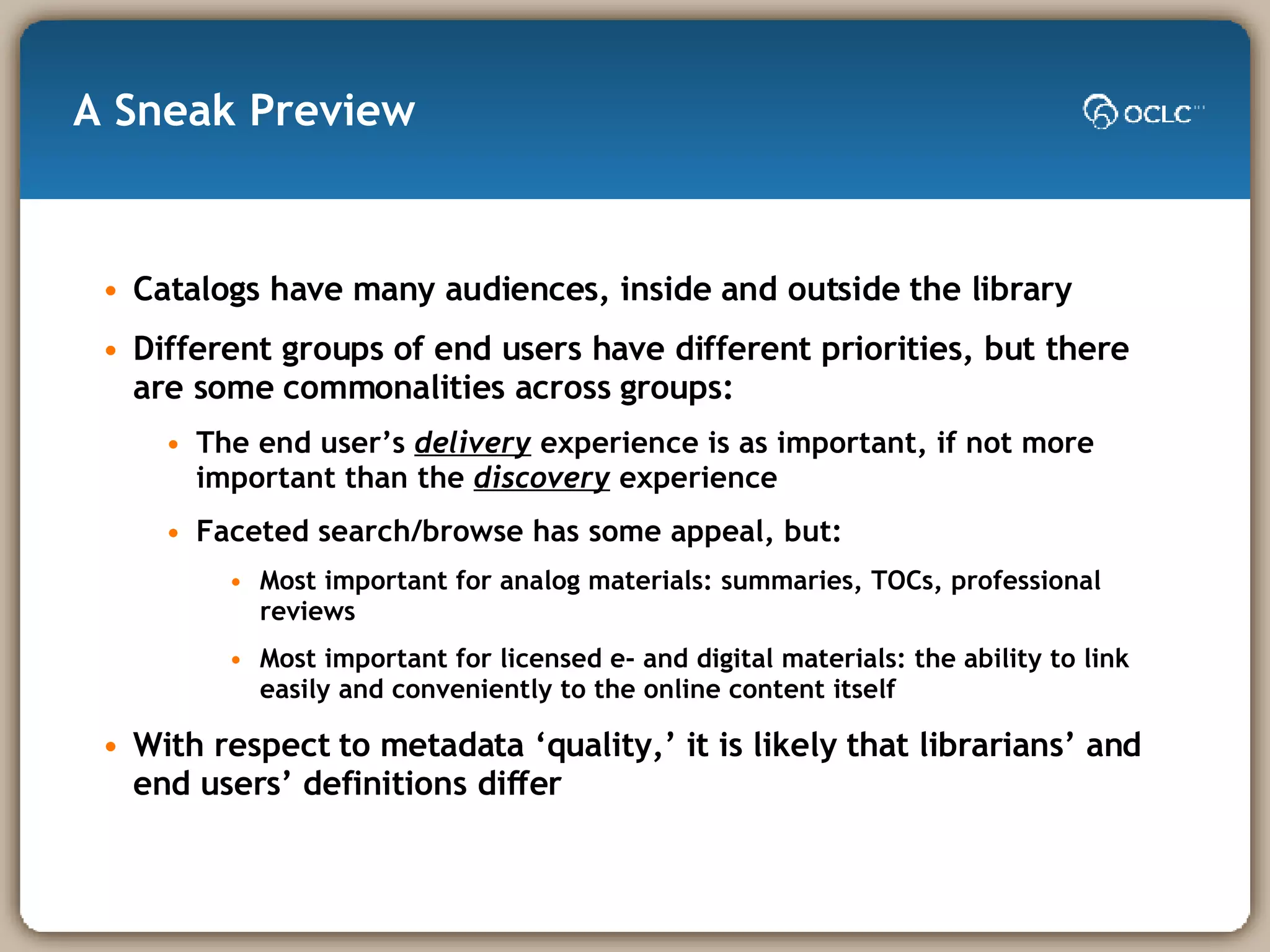
A Sneak Preview Catalogs have many audiences, inside and outside the library Different groups of end users have different priorities, but there are some commonalities across groups: The end user’s  delivery  experience is as important, if not more important than the  discovery  experience Faceted search/browse has some appeal, but: Most important for analog materials: summaries, TOCs, professional reviews Most important for licensed e- and digital materials: the ability to link easily and conveniently to the online content itself With respect to metadata ‘quality,’ it is likely that librarians’ and end users’ definitions differ
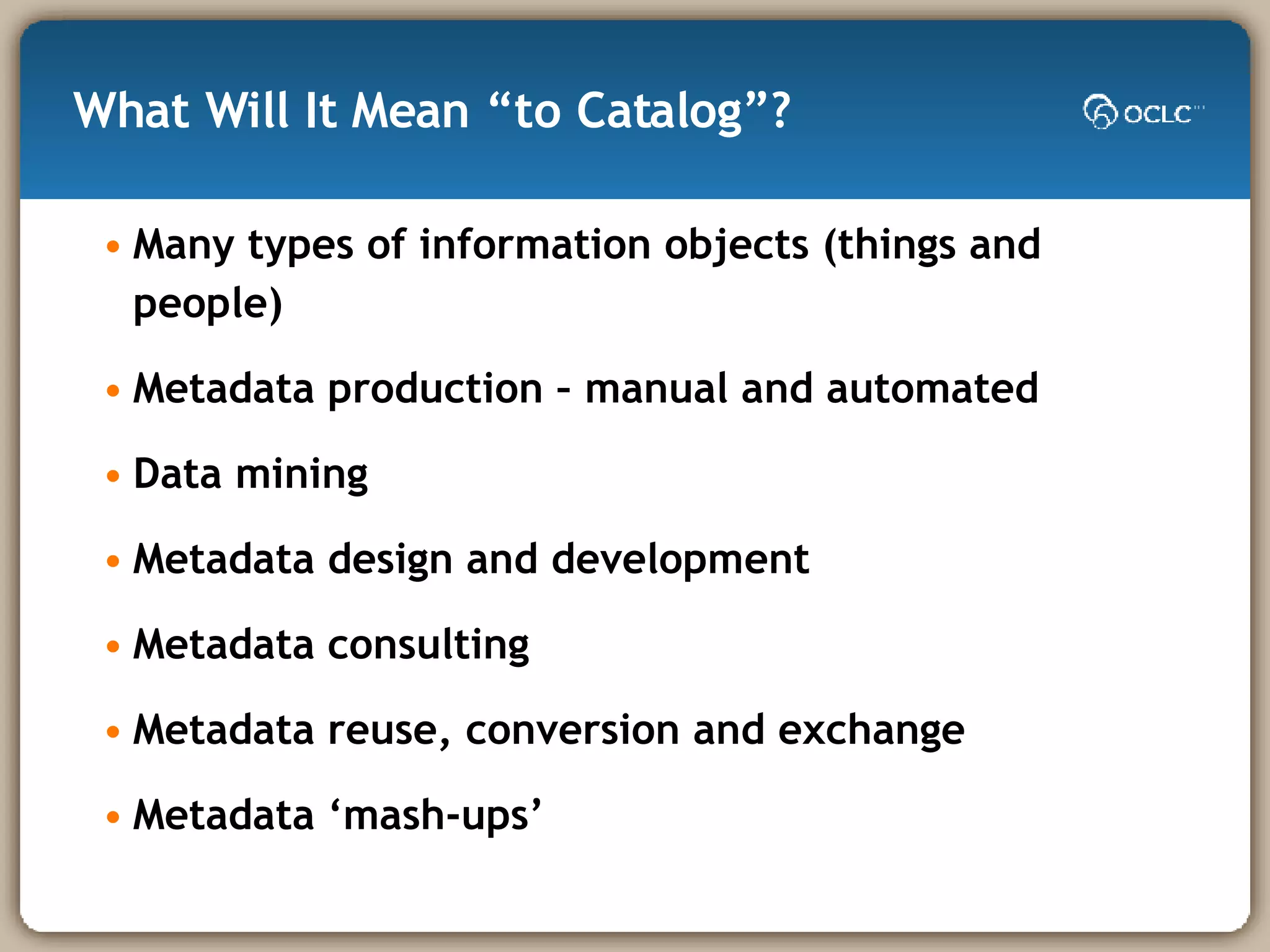
What Will It Mean “to Catalog”? Many types of information objects (things and people) Metadata production – manual and automated Data mining Metadata design and development Metadata consulting Metadata reuse, conversion and exchange Metadata ‘mash-ups’
A New Kind of Cataloger Examine assumptions Lifelong learning Be involved with information objects of all types Move to next generation systems and services Make information (including, but not limited to library collections) more visible and easier to use
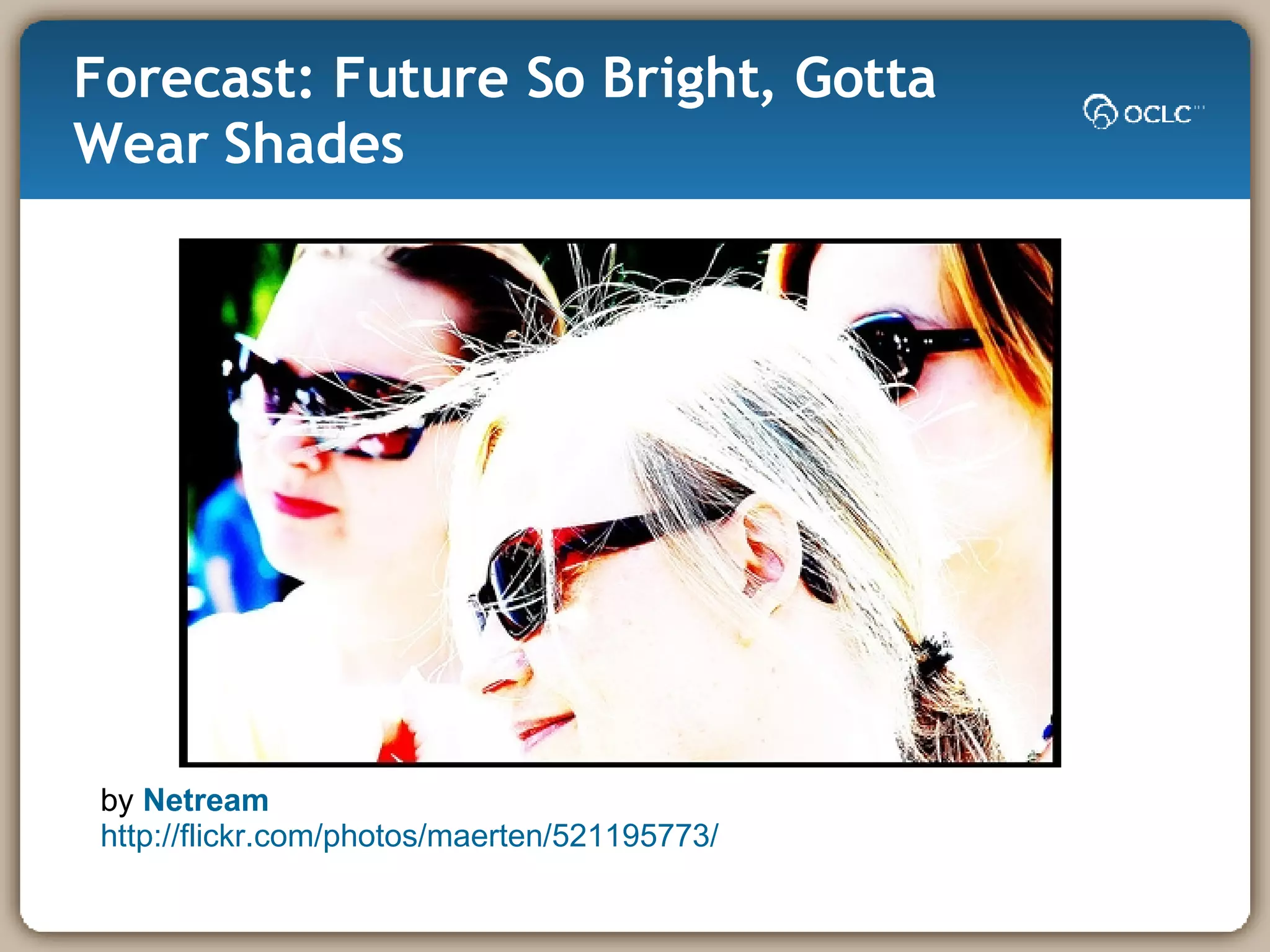
Forecast: Future So Bright, Gotta Wear Shades by  Netream   http://flickr.com/photos/maerten/521195773/
From article “Being a librarian” – cited next page Increasing expertise in discovery and delivery systems Help build new kinds of systems for IR and delivery; many new kinds of metadata; emphasis on re-use, interconnections, interoperability Active participation in the local community Blurring of lines between what has been public services and technical services; project and team-based workplaces;  involvement in local community projects and digital asset management; consulting work;  decreasing involvement in traditional cataloging duties Technology-driven research, teaching and learning Need for “IT fluency,” esp. metadata specialists; increasing involvement in large-scale digital library research, development, and production projects
Thank You Merci Gracias Shukran Xie xie  Danke  Spasibo  [email_address] http:// community.oclc.org/metalogue   Calhoun, Karen. Being a librarian: metadata and metadata specialists in the 21st century.  Library Hi Tech , Volume 25, Number 2, 2007 , pp. 174-187(14) Open access preprint:  http://ecommons.library.cornell.edu/bitstream/1813/2231/1/Calhoun-20041217-final-preprint1.pdf

OUR space: the new world of metadata

  • 1.
    Karen Calhoun VicePresident WorldCat and Metadata Services OCLC OUR Space: the new world of metadata IFLA 13 August 2008
  • 2.
    The Catalog: FirstSelf-Service Information Tool 2007/2008 Statistics for a Large Research Library: 175K unique visitors/month to Library Web pages (9% of overall site use) ------------------------- 2007/2008 Statistics for Amazon.com: 55M unique visitors/month (U.S.) Data sources: http:// siteanalytics.compete.com / and http:// www.alexa.com /
  • 3.
    LC Action Item6.4: “Support research and development on the changing nature of the catalog to include consideration of a framework for its integration with other discovery tools.” Calhoun, Karen.  The Changing Nature of the Catalog and Its Integration with Other Discovery Tools.   Washington, DC: Library of Congress, 17 March 2006. http://www.loc.gov/catdir/calhoun-report-final.pdf
  • 4.
    The Catalog inContext Online catalogs represent one node in the end user’s information universe
  • 5.
    Geocentric/ Aristotelian view:The local catalog is the sun Heliocentric/ Copernican view: The local catalog is a planet
  • 6.
    Metadata 2.0: ‘WayCool! Canadian-American actor Keanu Reeves, Matrix Reloaded
  • 7.
    Metadata in theInformation Industry “Data is the next Intel Inside” Tim O’Reilly, “What is Web. 2.0?” http://www.oreilly.com/pub/a/oreilly/tim/news/2005/09/30/what-is-web-20.html?page=3 “The digital world … has never met a piece of information it didn’t like” David Weinberger, Everything is Miscellaneous , Ch. 6, “Smart Leaves,” p. 119
  • 8.
    ebay: User-Supplied MetadataSupported By Sophisticated Web Templates and Indexing Not shown: categories (controlled vocabulary), item specifics, abstract, more
  • 9.
    Remix, reuse, ‘mashup’:Web 2.0 metadata management http:// www.housingmaps.com / Fed by Google Maps + craigslist.com
  • 10.
    Metadata + FullText Searching
  • 11.
    Which One Isthe “Full” Record? + 3 more screens Product Description & Purchase Information More like this Editorial Reviews & Author Info Inside the Book Tags, Ratings Customer Reviews Lists More With thanks to David Lankes: http://quartz.syr.edu/rdlankes/Presentations/ 2007/ALCTS.pdf Bibliographic Information Library Holdings Details Subjects Editions Reviews Bibliographic Information Australian Library Holdings
  • 12.
    The Base Modelfor Metadata Is Changing Library metadata practices: Title Author(s) Publication details Pagination, etc. Series Knowledge ‘ categories’: -Classification -Subject ISBN Etc. Other attributes: How/where to get it Rights How many sold How many circulations Banned anywhere? Awards won? Works cited by this one? Reviews? -Publisher -Reader Author information Other editions Technical metadata Identifiers Related works Blog conversations User tags Derivative works And on and on …
  • 13.
    Changing Context forLibrary Metadata B.W. (Before the Web) For finding and managing library materials (mostly print) Catalog records (well-understood rules and encoding conventions) Shared cooperative cataloging systems Usually handcrafted, one at a time A.W. (After the Web) For finding and managing many types of materials, for many user communities Many types of records, many sources Loosely coupled metadata management, reuse and exchange services among multiple repositories Mix of manual and automated creation and metadata extract, conversion, mapping, ingest and transfer services
  • 14.
    Collections Have Changedhigh low low high stewardship uniqueness Books Journals Newspapers Gov. docs CD, DVD Maps Scores Special collections Rare books Local/Historical newspapers Local history materials Archives & Manuscripts, Theses & dissertations Research, learning and administrative materials , ePrints/tech reports Learning objects Courseware E-portfolios Research data Institutional records Reports, newsletters, etc Freely-accessible web resources Open source software Newsgroup archives
  • 15.
    Libraries and WhatThey Collect on Behalf of Their Communities Books Journals Newspapers Gov. docs CD, DVD Maps Scores Special collections Rare books Local/Historical newspapers Local history materials Archives & Manuscripts, Theses & dissertations
  • 16.
    Expenditures: What ARLLibraries Are Buying Percent of 2006 total materials spend: eSerials 36.6% Monographs 21.6% Source: ARL Statistics Interactive Edition http:// fisher.lib.virginia.edu/arl/index.html
  • 17.
    The Promise ofInstitutional Repositories IR of the Université du Québec à Montréal http://www.archipel.uqam.ca/448/
  • 18.
    Scholarly Portals arXiv.orgOpen access to 490,465 e-prints in Physics, Mathematics, Computer Science, Quantitative Biology and Statistics
  • 19.
    Exposing Scientific Research:Brazil’s IBICT Electronic Theses and Dissertations
  • 20.
    Exciting New DigitalCollections: Europeana Prototype http:// www.europeana.eu /
  • 21.
    Library Special CollectionsAre Underutilized … Digital visibility creates use Research Information Network. 2007. http://www.rin.ac.uk/files/hidden-resources-final-report.pdf
  • 22.
    Scholarly/Community Digital AssetsAre Too Often Hidden From the Network http:// isbellandes.library.cornell.edu /
  • 23.
    http://www.loc.gov/bibliographic-future/news/lcwg-ontherecord-jan08-final.pdf 2 ENHANCE ACCESS TO RARE, UNIQUE, AND OTHER SPECIAL HIDDEN MATERIALS
  • 24.
    2 ENHANCEACCESS TO RARE, UNIQUE, AND OTHER SPECIAL HIDDEN MATERIALS 2.1.1 Make the discovery of rare, unique and other special hidden materials a high priority 2.1.2 Streamline cataloging for rare, unique and other special hidden materials, emphasizing greater coverage and broader access 2.1.3 Integrate access to rare, unique and other special hidden materials with other library materials 2.1.4 Encourage digitization to allow broader access 2.1.5 Share access to rare, unique and other special hidden materials
  • 25.
    Information Seekers HaveChanged [ about the people following them ] Butch Cassidy : I couldn't do that. Could you do that? Why can they do it? Who are those guys? http://outnow.ch/Movies/1969/ButchCassidyAndTheSundanceKid/Bilder/dvd-film.ws/11
  • 26.
    The Changing Contextfor Research, Teaching, and Learning on University Campuses Knowledge itself will be modified and research and development transformed by the new capacities provided by IT. Nothing will be left untouched. The liberal arts will be revived and transfigured, liberated from their age-long reliance on text alone. The silos of the departments will topple as new approaches to bewildering issues are pursued with new vigor by scholars in mind-boggling combinations of once insular and isolated disciplines. – Frank H. T. Rhodes, past President of Cornell University, in The Creation of the Future
  • 27.
    The Toppling Silosof the Disciplines and Mind-Boggling New Forms of Scholarly Communication Kurt Wüthrich Nobel Prize in Chemistry 2002 Swiss Federal Institute of Technology (ETH) and the Scripps Research Institute Fields: Chemistry, physics, mathematics, biophysics --How does the library help him create new knowledge? --What are his information seeking/sharing behaviors and preferences? --In what ways does the library serve his colleagues and his graduate and post-doctoral students?
  • 28.
    And Then There’sToday’s (and Tomorrow’s) Student No, you weren’t downloaded. You were born.”
  • 29.
    The New AcademicLibrary User in Sweden (and Everywhere Else) The ‘wild user’ wants to use the library’s collections: At a distance from the library Independently and self-sufficiently This is an international phenomenon Martha Kyrillidou and Ann-Christin Persson. 2005. The New Library User in Sweden: a LibQUAL+™ study at Lund University. Conference presentation. Available: http://www.libqual.org/documents/admin/sweden_finalpaper3.doc Five Most Desired Items Overall Making electronic resources accessible from my home or office Easy-to-use access tools that allow me to find things on my own A library Web site enabling me to locate information on my own Making information easily accessible for independent use Print and/or electronic journal collections I require for my work
  • 30.
    Summary So FarMetadata has changed Collections have changed Information seekers have changed What does it all mean for library metadata tradition and practice?
  • 31.
    The Challenges forLibrary Metadata Will search engines usurp the library catalog? Will Google Books usurp the library catalog? What if libraries don’t change how they support the discovery and delivery of their collections?
  • 32.
    Will Search EnginesUsurp Library Catalogs? College Students’ Perceptions of Libraries and Information Resources: a Report to the OCLC Membership : http:// www.oclc.org/reports/perceptionscollege.htm
  • 33.
    Will Google BooksUsurp the Library Catalog? Ludwig, Mark J. and Wells, Margaret R. “Google Books vs. BISON.” Library Journal , July 15, 2008. http://www.libraryjournal.com/article/CA6566451.html
  • 34.
    What If WeDo Nothing?
  • 35.
    Opportunities for LibraryMetadata Practice Take the collections to a wider audience: be where their eyes are; expose your metadata! Open up metadata silos ; support metadata exchange, reuse, interoperation Develop user-centered definitions of metadata ‘quality’
  • 36.
    1. BeWhere Their Eyes Are La Grande bibliothèque nationale du Québec Attribution: Uploaded on May 8, 2005 by Master Long http://flickr.com/photos/long/12987307/ Library as Place Place as Library
  • 37.
    ‘ Promiscuous’ MetadataGlobal Group, national, regional Local
  • 38.
  • 39.
  • 40.
    Global: Exposing LibraryCollections on the Network
  • 41.
    Global to Groupor Local: Driving Searches to Your Library
  • 42.
    Get It FromMy Library
  • 43.
    What is OCLCDoing to Help Libraries Share Their Metadata at Web Scale? Support for a globally coordinated system of metadata management (metadata 2.0) WorldCat partnerships with national libraries and large consortia
  • 44.
    A Globally CoordinatedSystem of Metadata Sharing Discovery and delivery are mediated by large information hubs
  • 45.
    GLOBAL GROUP LOCALOutward Integration, Exposure, And Linking Of Collections (e.g., Google, WorldCat, Other aggregators, national libraries, consortia) Local/Group Authentication, Discovery And Delivery Services Data Flows, Syndication, Synchronization, Linking We Can Be Connected: A New Vision for Metadata Sharing
  • 46.
    WorldCat Partner SitesGoogle, Google Books, Google Scholar HCI Bibliography : Human-Computer Interaction Resources
  • 47.
    WorldCat.org: Destination orMetadata Switch? It’s a switch. Referrals to worldcat.org, Jan. 1 – May 31, 2008 Search Engines 47.45% Other Web Sites 39.91% Typed/Bookmarked URLs 12.64% Total
  • 48.
    WorldCat Global Coverage*2007/08:forecast based on Q2 results Objectives for FY09: 300-500M records processed; Significant coverage in more countries outside N.A.
  • 49.
    Introducing: A NewNational Library Web Page
  • 50.
  • 51.
    OCLC CBS (CentralBibliographic System) Partners and WorldCat Support strong frameworks for national or regional union catalogs Loading in WorldCat gives broader exposure, from more places, to citizens, students and scholars around the world GGC (Netherlands) LinkUK / UnityUK GBV (Germany) Hebis (Germany) BSZ (Germany) ABES (France) Libraries Australia = records are also in WorldCat
  • 52.
    2. OpenUp Metadata Silos “ We have drawn a wall around what is and what is not of interest to ‘cataloging’ that is not necessarily backed up by any good rationale. Many things that we decide are not of interest … are in fact of high significance to the success and ease our users will have in carrying out the tasks we mean to support … I don’t mean that “catalogers” need to apply the exact same standards to journal articles, institutional repository metadata, [etc.] … But we do need to consider it our responsibility to figure out how all these things can fit together.” Rochkind, Jonathan. Bibliographic Wilderness [blog]. “‘Broken’ huh?” May 27, 2007 http://bibwild.wordpress.com/2007/05/25/broken-huh/#more-42
  • 53.
    Metadata Silos Metadata Communities for: Text Print Licensed Digital Archival Data Images Sound Video Multimedia Objects More
  • 54.
    Metadata Reuse andExchange: OCLC Next Generation Cataloging Establish partnerships with publishers Ingest publisher and vendor metadata in ONIX Crosswalk to MARC (poss. to other formats) Enhance publisher metadata Output MARC records (available early in the publishing life-cycle) Output enhanced ONIX data to publishers/other partners http://www.oclc.org/partnerships/material/nexgen/nextgencataloging.htm PILOT TO BE COMPLETE THIS SUMMER FY09 objective: Launch Next Generation Cataloging
  • 55.
    Fichier d'Autorité InternationalVirtuel : VIAF “ Une avancée de la francophonie dans le web sémantique" Joint project: OCLC, Library of Congress, Deutsche Nationalbibliothek, Bibliothèque nationale de France http:// www.oclc.org/research/projects/viaf / Work in progress
  • 56.
    Objectives of VIAFLink national authority records Build on their authority work Move towards universal bibliographic control Allow national or regional variations in authorized forms to co-exist Support needs for variations in preferred language, script, and spelling
  • 57.
    3. Develop user-centereddefinitions of metadata “quality” “ Quality” in the user workflow from discovery to delivery Library user studies suggest that users expect finding and getting information they want, when and where they want it, to be easy and convenient These users’ tolerance for barriers to easy and convenient discovery and delivery is limited. How does what they want relate to what catalogers do ?
  • 58.
    Defining Catalog MetadataQuality: Research Project Underway WorldCat.org Pop-up Survey (done) WorldCat.org Usability/Focus Group Tests (done) Scholars and students Casual searchers Librarian Web survey (coming August/September) Research results to inform business case for new WorldCat Quality Management Program
  • 59.
    A Sneak PreviewCatalogs have many audiences, inside and outside the library Different groups of end users have different priorities, but there are some commonalities across groups: The end user’s delivery experience is as important, if not more important than the discovery experience Faceted search/browse has some appeal, but: Most important for analog materials: summaries, TOCs, professional reviews Most important for licensed e- and digital materials: the ability to link easily and conveniently to the online content itself With respect to metadata ‘quality,’ it is likely that librarians’ and end users’ definitions differ
  • 60.
    What Will ItMean “to Catalog”? Many types of information objects (things and people) Metadata production – manual and automated Data mining Metadata design and development Metadata consulting Metadata reuse, conversion and exchange Metadata ‘mash-ups’
  • 61.
    A New Kindof Cataloger Examine assumptions Lifelong learning Be involved with information objects of all types Move to next generation systems and services Make information (including, but not limited to library collections) more visible and easier to use
  • 62.
    Forecast: Future SoBright, Gotta Wear Shades by Netream http://flickr.com/photos/maerten/521195773/
  • 63.
    From article “Beinga librarian” – cited next page Increasing expertise in discovery and delivery systems Help build new kinds of systems for IR and delivery; many new kinds of metadata; emphasis on re-use, interconnections, interoperability Active participation in the local community Blurring of lines between what has been public services and technical services; project and team-based workplaces; involvement in local community projects and digital asset management; consulting work; decreasing involvement in traditional cataloging duties Technology-driven research, teaching and learning Need for “IT fluency,” esp. metadata specialists; increasing involvement in large-scale digital library research, development, and production projects
  • 64.
    Thank You MerciGracias Shukran Xie xie Danke Spasibo [email_address] http:// community.oclc.org/metalogue Calhoun, Karen. Being a librarian: metadata and metadata specialists in the 21st century. Library Hi Tech , Volume 25, Number 2, 2007 , pp. 174-187(14) Open access preprint: http://ecommons.library.cornell.edu/bitstream/1813/2231/1/Calhoun-20041217-final-preprint1.pdf