Power System Transient
Chapter – 1
Introduction
Prepared by Viren Pandya
Contents
 Source of transients
 Various types of power systems transients
 Effect of transients on power systems
 Importance of study of transients for insulation
design
Source of transients
The sudden, short time and large magnitude surges
in energy system are termed as transients.
If the energy system is operated in static
equilibrium, system models are normally nonlinear
but algebraic equations e.g. power flow analysis,
optimal power flow etc.
Source of transients
Theory of small-scale dynamic perturbations
around the static equilibrium point requires system
models to be linear differential equations e.g.
ALFC and AVR study under steady state with
normal load variations.
Large scale disturbances -transients resulting into
dynamic state fluctuations in the energy system
need models to be nonlinear differential equations.
Source of transients
Internal Sources (Inside facilities)
Capacitor switching
Current interruption (motors, etc.)
Power electronics operation (SCRs, etc.)
Electrostatic discharge
(Arc) Welding
Copy machines
Faulty wiring or circuit breaker operation
Contact and relay closure
Load startup or disconnect
Source of transients
Internal sources do not produce surges of large
magnitude.
Experience shows that transients due to internal
sources hardly increase the system voltage to
twice the normal value.
Source of transients
External Sources (Outside facilities)
Lightning
Capacitor switching
Line/cable switching
Transformer switching
Current limiting fuse operation
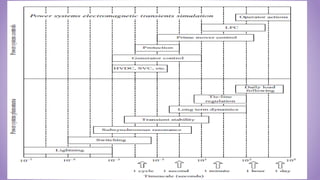
Types of power systems transients
Depending upon the speed of the transients, they
can be classified into three categories.
Class A: Ultrafast transients – Surge phenomena
Class B: Medium-fast transients – Short-circuit
phenomena
Class C: Slow transients – Transient stability
Types of power systems transients
Class A: Ultrafast transients – Surge phenomena
Due to lightning or switching operation of large
component in the energy system
Entirely electric in nature and normally involves
transmission system only
Electromagnetic transient - travelling wave travels
almost the speed of the light along the lines, giving
rise to reflected wave at the line termination
Types of power systems transients
A few milliseconds after initiation – then get attenuated
due to system R and die out
High inductance of transformers in most instances
effectively provides protection to generator against
such transients.
Lightning arrester provide protection against lighting
strokes striking on the lines.
These transients’ study basically provides a basis for
selection of insulation level of the line equipment.
Types of power systems transients
It is to be noted that if insulation of the system gets
destroyed due to such overvoltage transient, this type
of transient can lead to a short circuit, which is an
abrupt and abnormal structural change of the network
which will give rise to a new – slower type of transient
that belongs to Class-B.
Types of power systems transients
Class B: Medium-fast transients – Short-circuit
phenomena
These are caused by normally abrupt and abnormal
structural changes – short circuits in the system.
These could be caused due to Class A transients, salt
spray on insulators, birds sitting, other mechanical
causes etc.
LLL/LLLG, LG, LL, LLG, 1CO, 2CsO
Important to study for selection of CBs, protection
system design, transient stability analysis.
Types of power systems transients
Class C: Slow transients – Transient stability
Short circuit will always be accompanied by an
instantaneous collapse (partial or full) of bus voltages
throughout the system.
Now the generator voltages drop suddenly with sudden
reduction in generator output power under short circuit.
Since the mechanical/turbine input power to generator at
the time of fault stays constant for first instants, each
generator will be subjected to a surplus accelerating torque.
Types of power systems transients
If it is sustained, it can develop into the most
dangerous type of transient situation to which a power
system can be subjected - mechanical oscillations of
the synchronous machine rotors.
These electromechanical transients may under
unfortunate circumstances pull some or all the of the
machines out of synchronism.
Such an occurrence constitutes a partial or complete
breakdown of the energy system.
Types of power systems transients
Here the system is said to have reached its transient
stability limit.
It may take hours to resynchronize a fully blacked-out
system.
These rotor swings, being mechanical in nature, are
relatively slow.
Thus such transients' study becomes necessary to
assess transient stability.
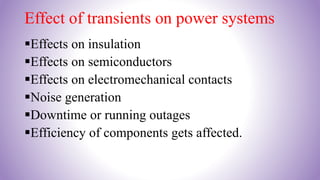
Effect of transients on power systems
Effects on insulation
Effects on semiconductors
Effects on electromechanical contacts
Noise generation
Downtime or running outages
Efficiency of components gets affected.
Effect of transients on power systems
Under severity, black out of power system will be
produced.
Lightning transient produces steep fronted wave on
transmission line.
Travelling wave produced due to transient will
shutter the insulations and week poles.
Cause damage to windings of transformer and
generators.
Importance of study of transients for insulation design
Failures in insulation cause safety risks for human,
fires and system outages.
Transient voltage peak value is very much
important for insulating material breakdown in the
power system.
Design of the insulation needs to be done in such a
way that it does not breakdown under lighting
impulses, switching surges or any other overvoltage
transients.
Importance of study of transients for insulation design
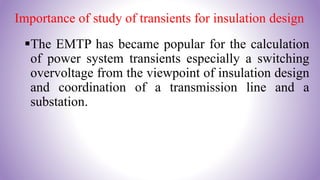
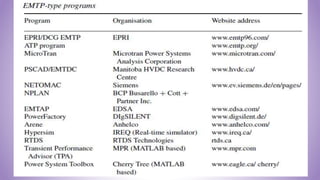
The EMTP has became popular for the calculation
of power system transients especially a switching
overvoltage from the viewpoint of insulation design
and coordination of a transmission line and a
substation.
Power System Transient - Introduction.pptx

Power System Transient - Introduction.pptx

  • 1.
    Power System Transient Chapter– 1 Introduction Prepared by Viren Pandya
  • 2.
    Contents  Source oftransients  Various types of power systems transients  Effect of transients on power systems  Importance of study of transients for insulation design
  • 3.
    Source of transients Thesudden, short time and large magnitude surges in energy system are termed as transients. If the energy system is operated in static equilibrium, system models are normally nonlinear but algebraic equations e.g. power flow analysis, optimal power flow etc.
  • 4.
    Source of transients Theoryof small-scale dynamic perturbations around the static equilibrium point requires system models to be linear differential equations e.g. ALFC and AVR study under steady state with normal load variations. Large scale disturbances -transients resulting into dynamic state fluctuations in the energy system need models to be nonlinear differential equations.
  • 5.
    Source of transients InternalSources (Inside facilities) Capacitor switching Current interruption (motors, etc.) Power electronics operation (SCRs, etc.) Electrostatic discharge (Arc) Welding Copy machines Faulty wiring or circuit breaker operation Contact and relay closure Load startup or disconnect
  • 6.
    Source of transients Internalsources do not produce surges of large magnitude. Experience shows that transients due to internal sources hardly increase the system voltage to twice the normal value.
  • 7.
    Source of transients ExternalSources (Outside facilities) Lightning Capacitor switching Line/cable switching Transformer switching Current limiting fuse operation
  • 8.
    Types of powersystems transients Depending upon the speed of the transients, they can be classified into three categories. Class A: Ultrafast transients – Surge phenomena Class B: Medium-fast transients – Short-circuit phenomena Class C: Slow transients – Transient stability
  • 9.
    Types of powersystems transients Class A: Ultrafast transients – Surge phenomena Due to lightning or switching operation of large component in the energy system Entirely electric in nature and normally involves transmission system only Electromagnetic transient - travelling wave travels almost the speed of the light along the lines, giving rise to reflected wave at the line termination
  • 10.
    Types of powersystems transients A few milliseconds after initiation – then get attenuated due to system R and die out High inductance of transformers in most instances effectively provides protection to generator against such transients. Lightning arrester provide protection against lighting strokes striking on the lines. These transients’ study basically provides a basis for selection of insulation level of the line equipment.
  • 11.
    Types of powersystems transients It is to be noted that if insulation of the system gets destroyed due to such overvoltage transient, this type of transient can lead to a short circuit, which is an abrupt and abnormal structural change of the network which will give rise to a new – slower type of transient that belongs to Class-B.
  • 12.
    Types of powersystems transients Class B: Medium-fast transients – Short-circuit phenomena These are caused by normally abrupt and abnormal structural changes – short circuits in the system. These could be caused due to Class A transients, salt spray on insulators, birds sitting, other mechanical causes etc. LLL/LLLG, LG, LL, LLG, 1CO, 2CsO Important to study for selection of CBs, protection system design, transient stability analysis.
  • 13.
    Types of powersystems transients Class C: Slow transients – Transient stability Short circuit will always be accompanied by an instantaneous collapse (partial or full) of bus voltages throughout the system. Now the generator voltages drop suddenly with sudden reduction in generator output power under short circuit. Since the mechanical/turbine input power to generator at the time of fault stays constant for first instants, each generator will be subjected to a surplus accelerating torque.
  • 14.
    Types of powersystems transients If it is sustained, it can develop into the most dangerous type of transient situation to which a power system can be subjected - mechanical oscillations of the synchronous machine rotors. These electromechanical transients may under unfortunate circumstances pull some or all the of the machines out of synchronism. Such an occurrence constitutes a partial or complete breakdown of the energy system.
  • 15.
    Types of powersystems transients Here the system is said to have reached its transient stability limit. It may take hours to resynchronize a fully blacked-out system. These rotor swings, being mechanical in nature, are relatively slow. Thus such transients' study becomes necessary to assess transient stability.
  • 17.
    Effect of transientson power systems Effects on insulation Effects on semiconductors Effects on electromechanical contacts Noise generation Downtime or running outages Efficiency of components gets affected.
  • 18.
    Effect of transientson power systems Under severity, black out of power system will be produced. Lightning transient produces steep fronted wave on transmission line. Travelling wave produced due to transient will shutter the insulations and week poles. Cause damage to windings of transformer and generators.
  • 19.
    Importance of studyof transients for insulation design Failures in insulation cause safety risks for human, fires and system outages. Transient voltage peak value is very much important for insulating material breakdown in the power system. Design of the insulation needs to be done in such a way that it does not breakdown under lighting impulses, switching surges or any other overvoltage transients.
  • 20.
    Importance of studyof transients for insulation design The EMTP has became popular for the calculation of power system transients especially a switching overvoltage from the viewpoint of insulation design and coordination of a transmission line and a substation.