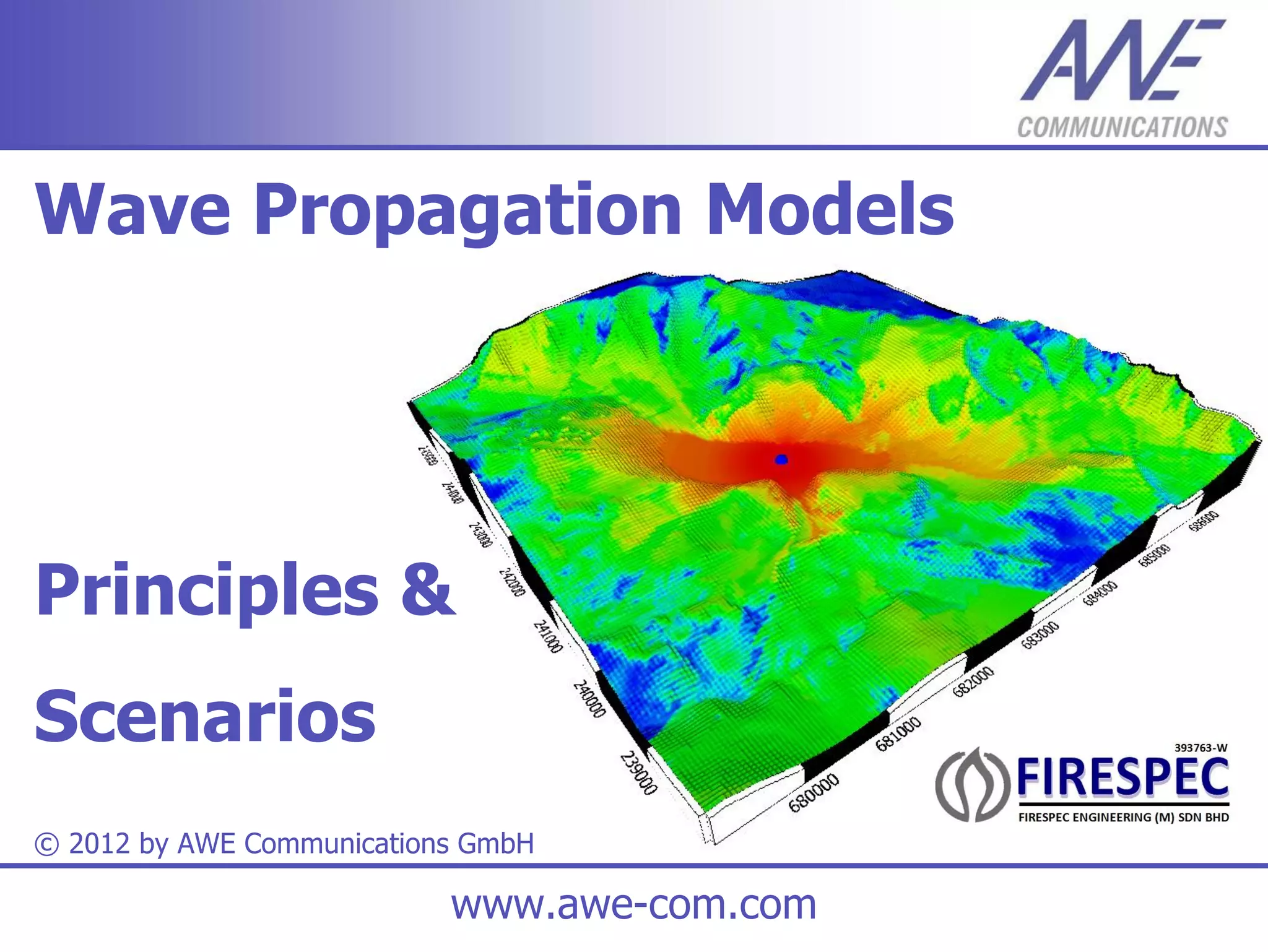
Wave Propagation Models


Principles &
Scenarios
© 2012 by AWE Communications GmbH

                           www.awe-com.com
Contents

   • Wave Propagation Model Principles
    -   Multipath propagation
    -   Reflection
    -   Diffraction
    -   Scattering
    -   Antenna pattern


                            © by AWE Communications GmbH   2
Wave Propagation Models

Multipath Propagation
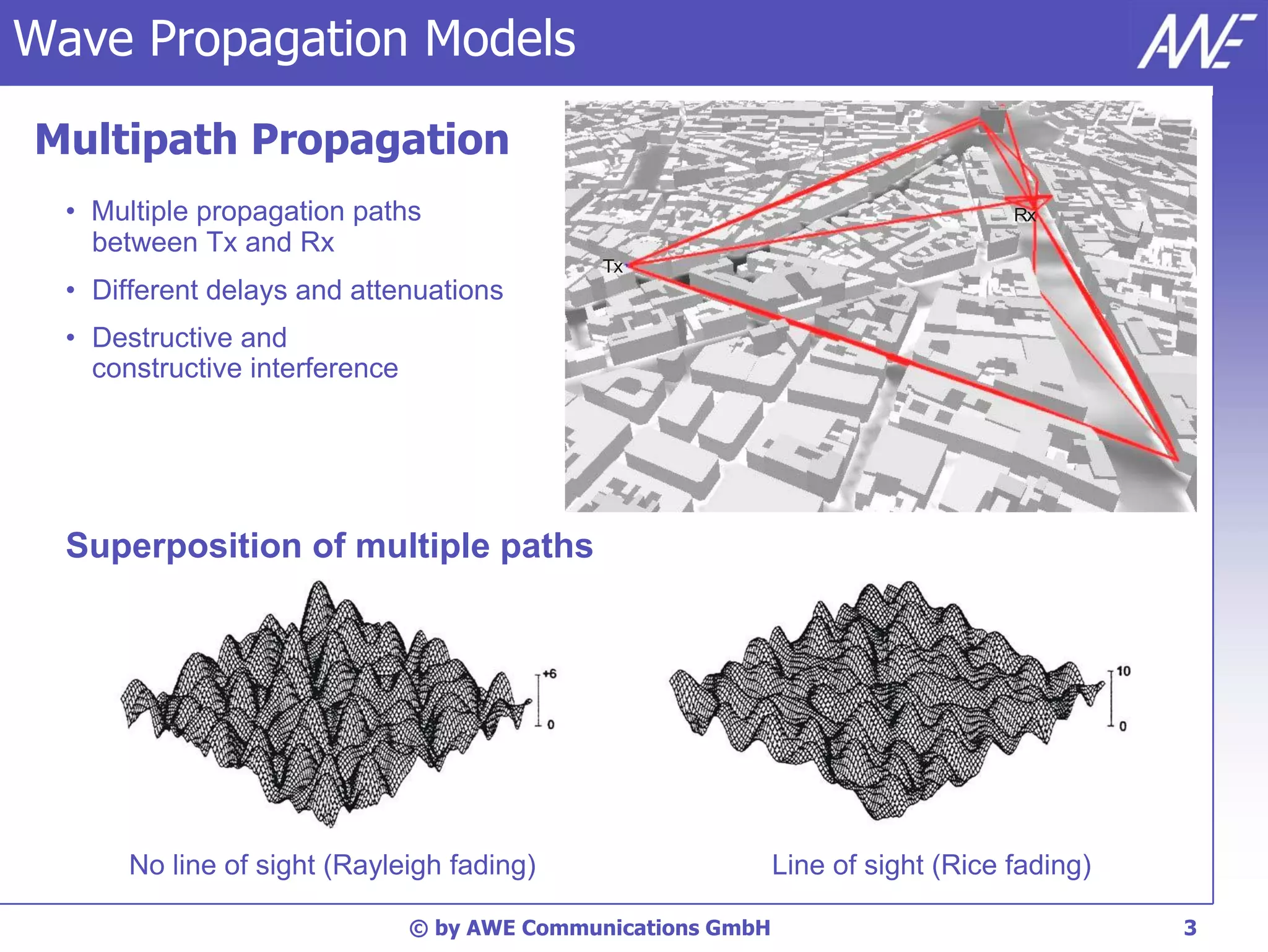
  • Multiple propagation paths                                                     Rx
    between Tx and Rx
                                              Tx
  • Different delays and attenuations
  • Destructive and
    constructive interference


  Superposition of multiple paths


       No line of sight (Rayleigh fading)                      Line of sight (Rice fading)

                                © by AWE Communications GmbH                                 3
Wave Propagation Models

Multipath Propagation
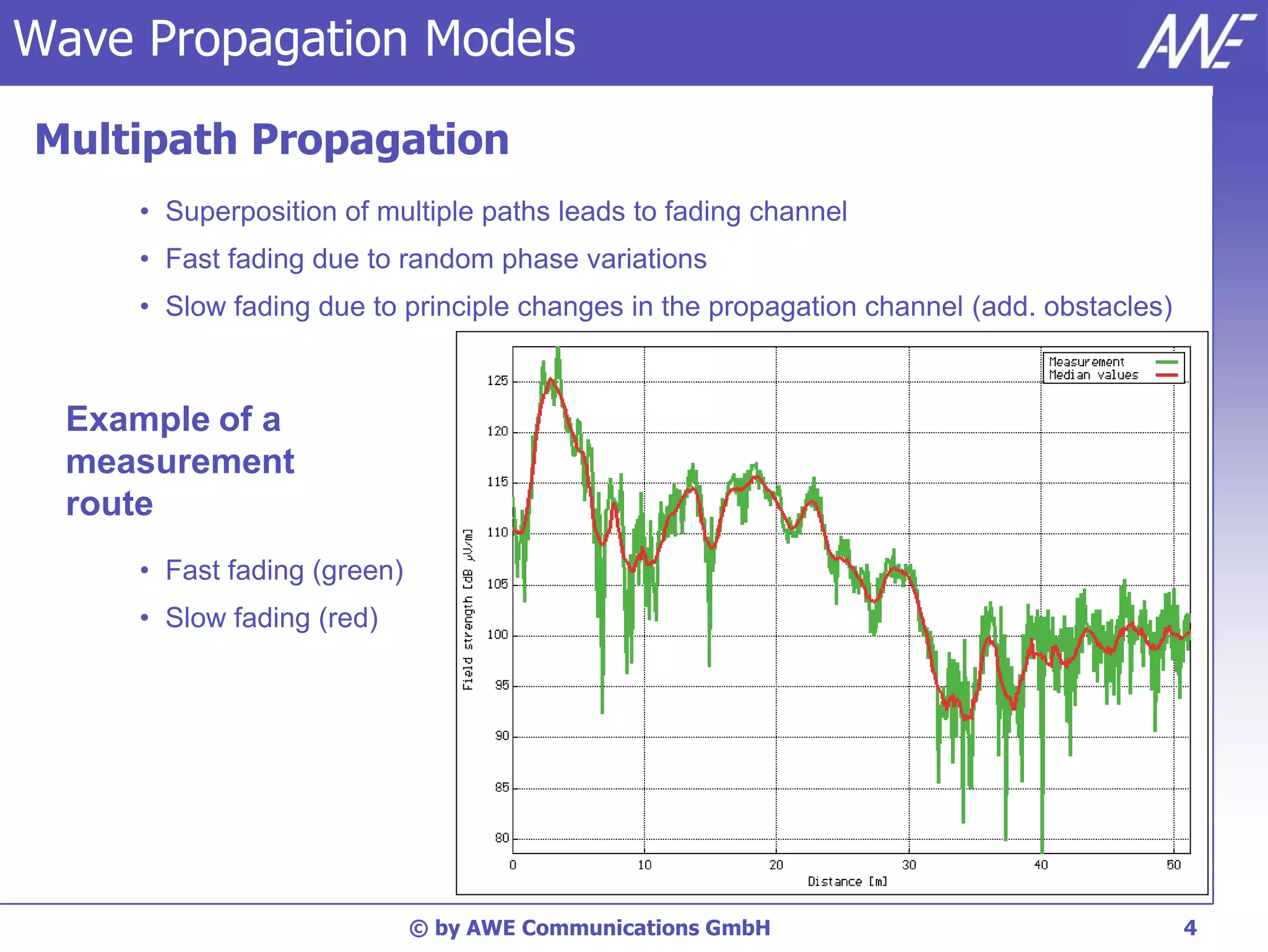
     • Superposition of multiple paths leads to fading channel
     • Fast fading due to random phase variations
     • Slow fading due to principle changes in the propagation channel (add. obstacles)


  Example of a
  measurement
  route
     • Fast fading (green)
     • Slow fading (red)


                             © by AWE Communications GmbH                                 4
Wave Propagation Models

Propagation Model Types
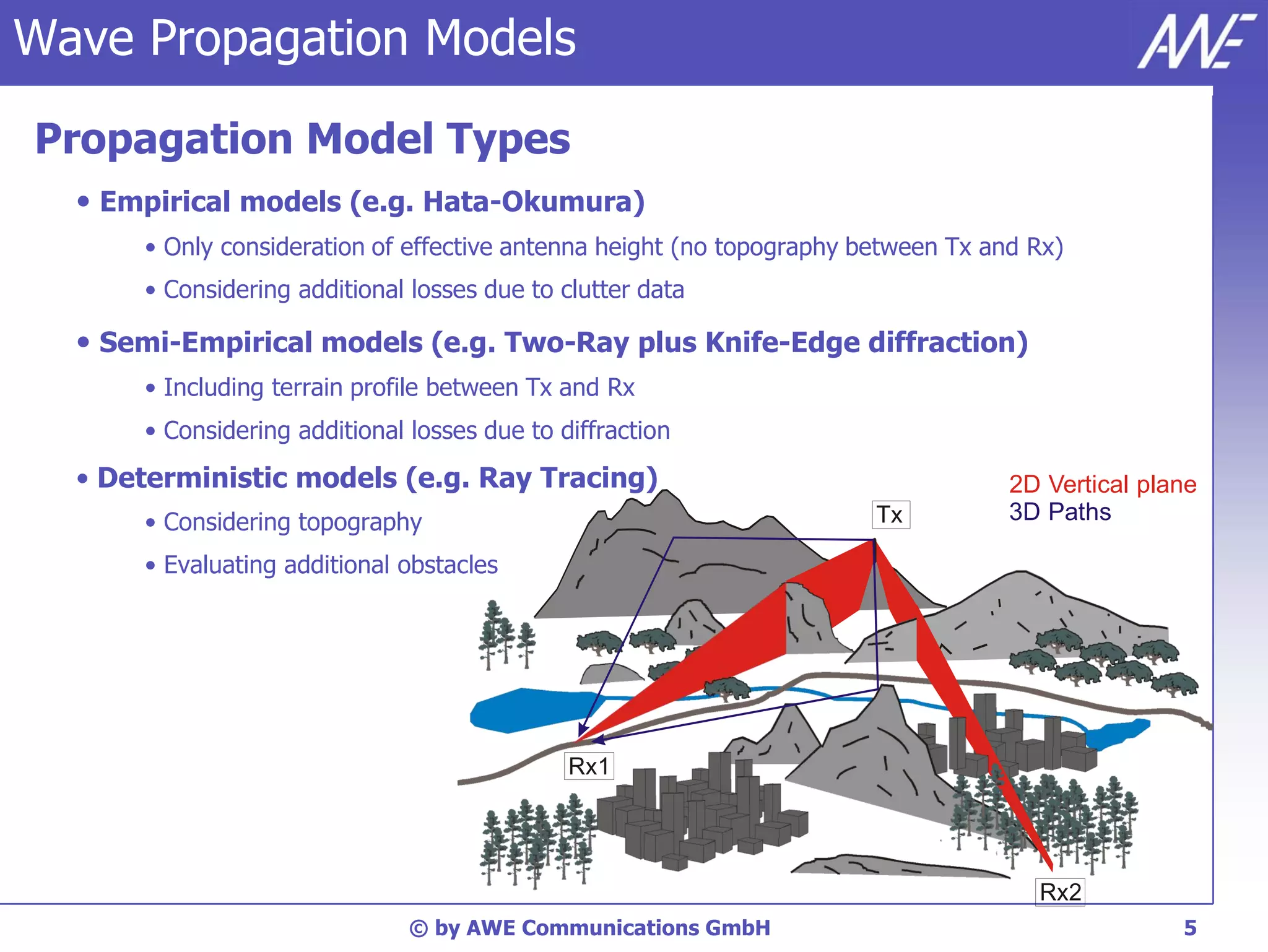
  • Empirical models (e.g. Hata-Okumura)
      • Only consideration of effective antenna height (no topography between Tx and Rx)
      • Considering additional losses due to clutter data

  • Semi-Empirical models (e.g. Two-Ray plus Knife-Edge diffraction)
      • Including terrain profile between Tx and Rx
      • Considering additional losses due to diffraction
  • Deterministic models (e.g. Ray Tracing)                                        2D Vertical plane
      • Considering topography                                         Tx          3D Paths

      • Evaluating additional obstacles


                                              Rx1


                                                                                     Rx2
                               © by AWE Communications GmbH                                       5
Wave Propagation Models

Basic Principle – Reflection I
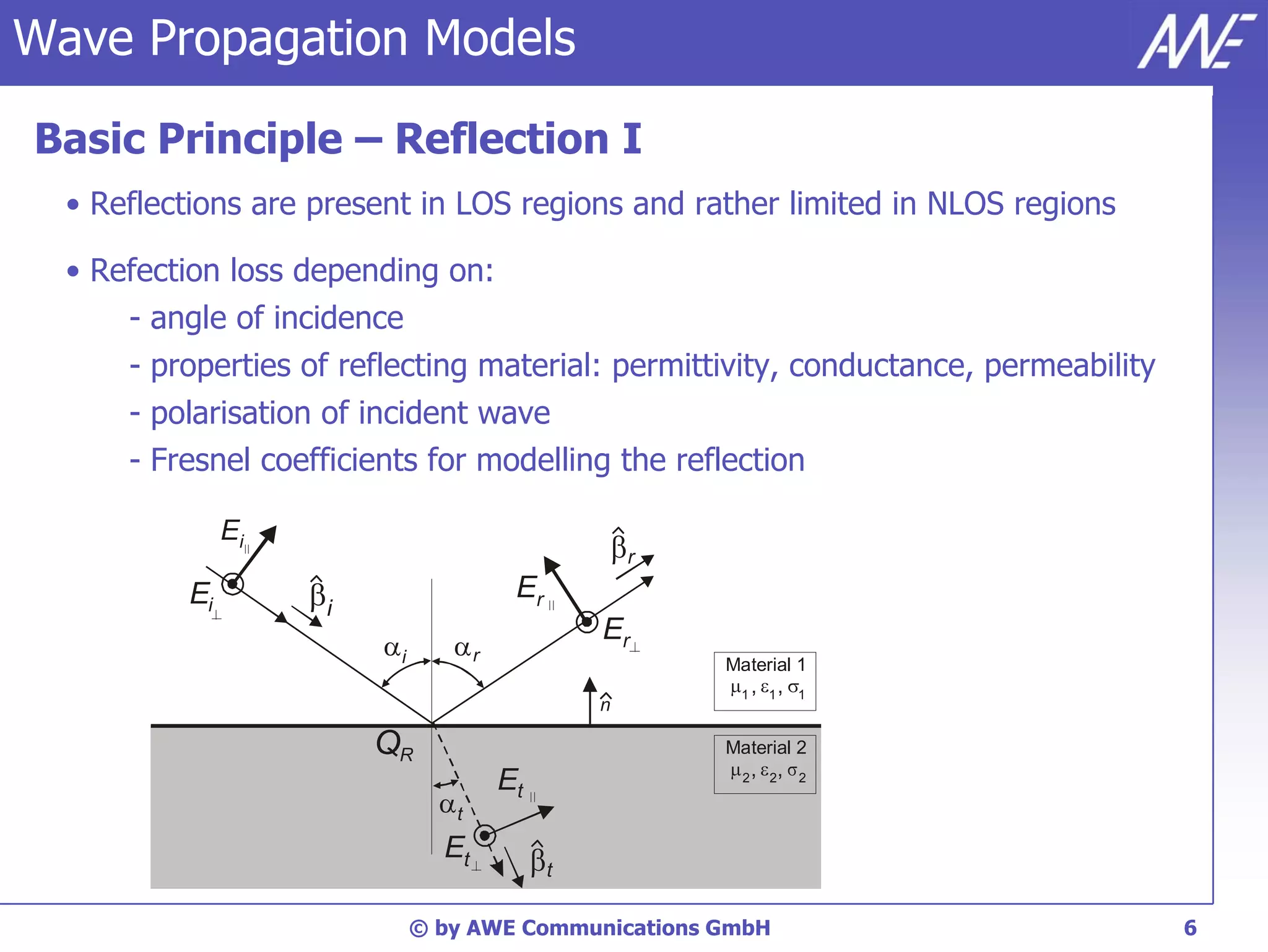
  • Reflections are present in LOS regions and rather limited in NLOS regions

  • Refection loss depending on:
      - angle of incidence
      - properties of reflecting material: permittivity, conductance, permeability
      - polarisation of incident wave
      - Fresnel coefficients for modelling the reflection

                Ei
                                                     r
           Ei        i                 Er
                                                 Er
                          i      r
                                                          Material 1
                                                          1 , 1 , 1
                                                 n

                          QR                              Material 2
                                                           2 ,  2,  2
                                       Et
                                 t
                                 Et         t

                               © by AWE Communications GmbH                          6
Wave Propagation Models

Basic Principle – Reflection II
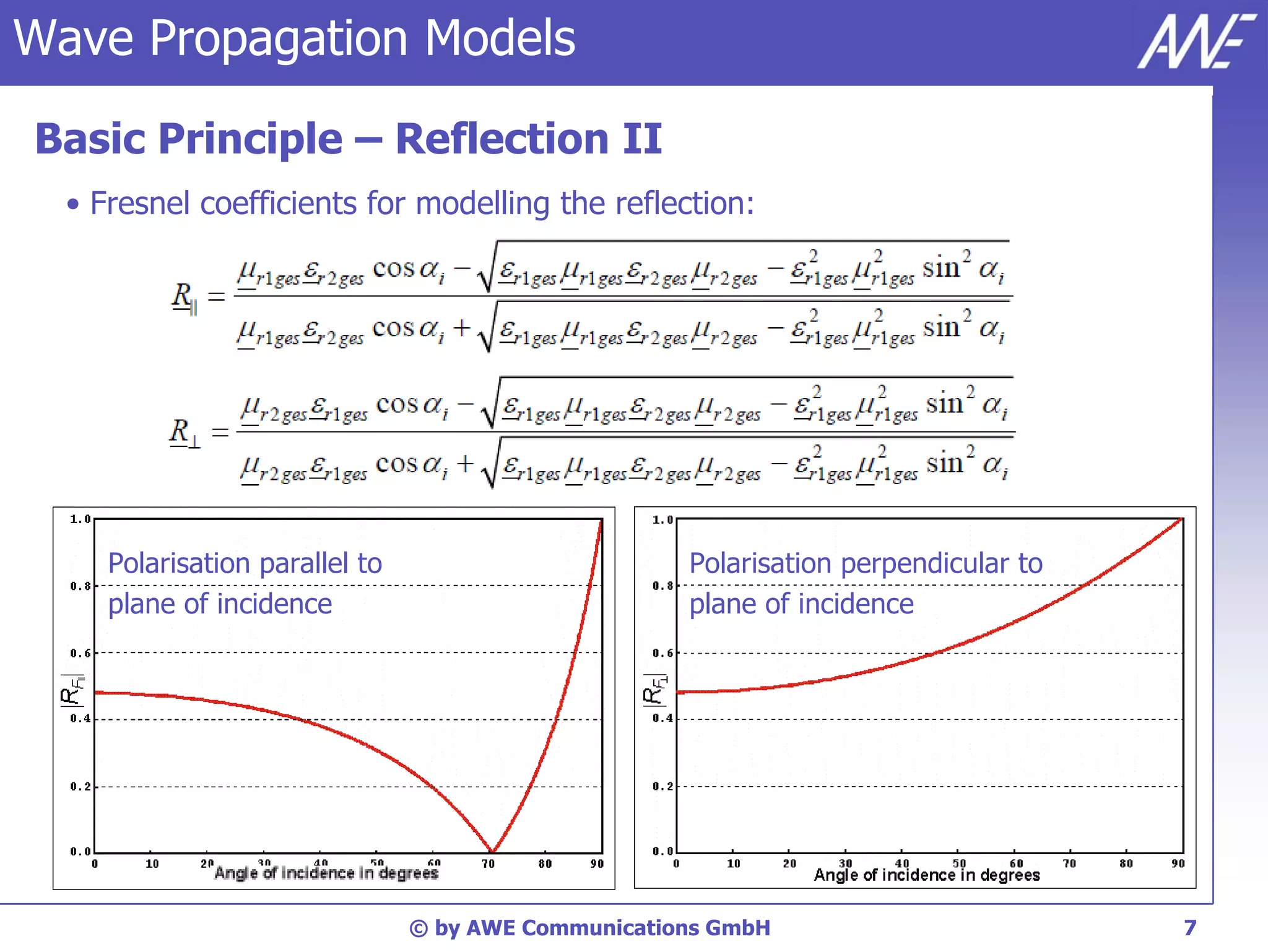
  • Fresnel coefficients for modelling the reflection:


     Polarisation parallel to                        Polarisation perpendicular to
     plane of incidence                              plane of incidence


                                © by AWE Communications GmbH                         7
Wave Propagation Models

Basic Principle – Breakpoint
                                              130
  • Free space:                                                                             Two path model
                                                                                            Free space model

   received power ~ 1 / d2
                                              120
    20 dB / decade

  • No longer valid from                      110

   a certain distance on     Path Loss [dB]


  • After breakpoint:
                                              100


   received power ~ 1 / d4
    40 dB / decade
                                               90


  • Deduced from                               80

   two-path model, i.e.
   superposition of direct                     70

   and ground-reflected rays:
                                                0,1             0,3              1,0        3,16               10,0
   BP = 4htxhrx/                                                        Distance [km]


                                                    Loss for 900 MHz and Tx height of 30m (Rx height 1.5m)
                                                                  breakpoint distance = 1.7 km

                             © by AWE Communications GmbH                                                      8
Wave Propagation Models

Basic Principle – Transmission I
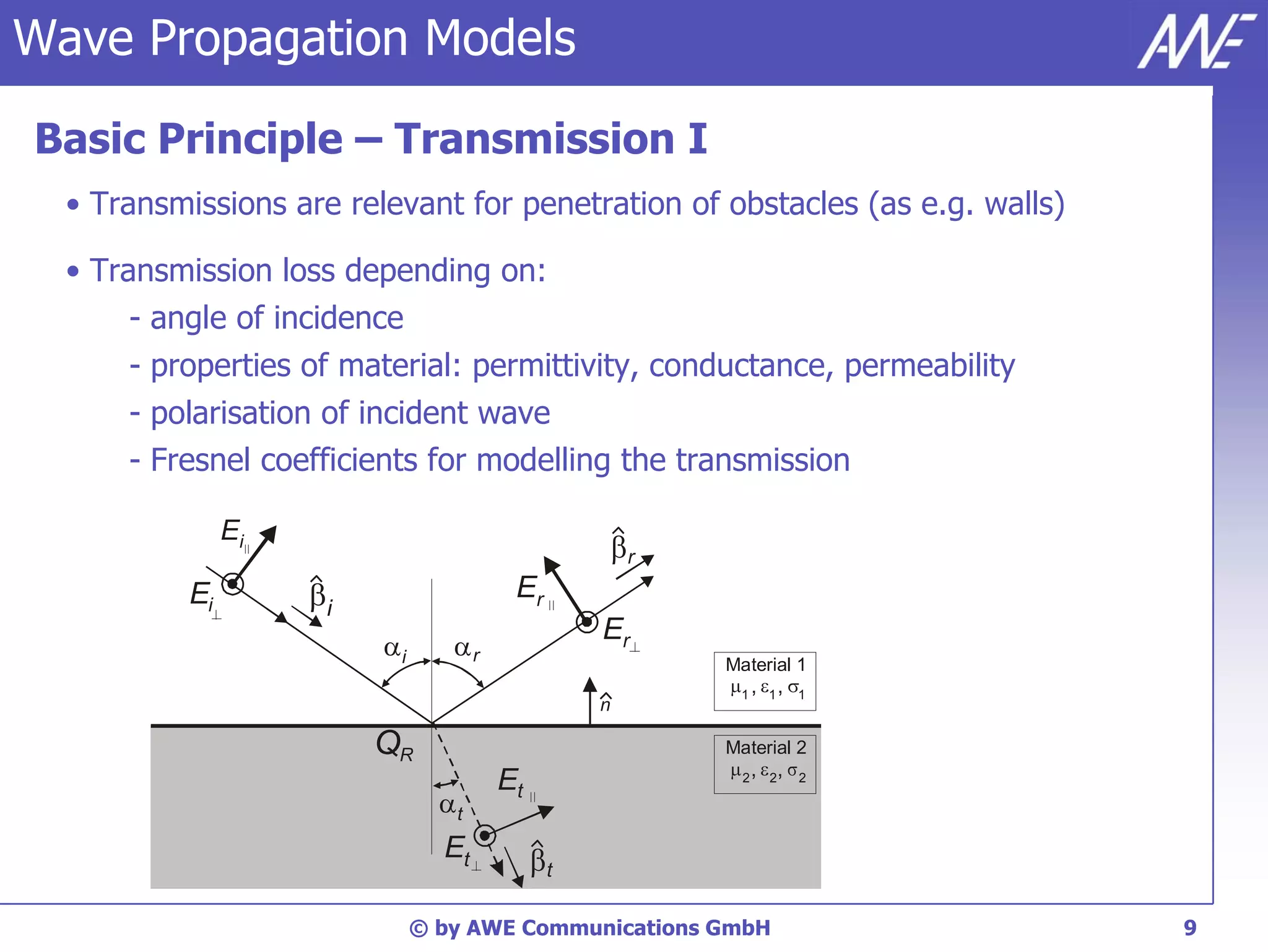
  • Transmissions are relevant for penetration of obstacles (as e.g. walls)

  • Transmission loss depending on:
       - angle of incidence
       - properties of material: permittivity, conductance, permeability
       - polarisation of incident wave
       - Fresnel coefficients for modelling the transmission

                Ei
                                                     r
           Ei        i                 Er
                                                 Er
                          i      r
                                                          Material 1
                                                          1 , 1 , 1
                                                 n

                          QR                              Material 2
                                                           2 ,  2,  2
                                       Et
                                 t
                                 Et         t

                               © by AWE Communications GmbH                   9
Wave Propagation Models

Basic Principle – Transmission II
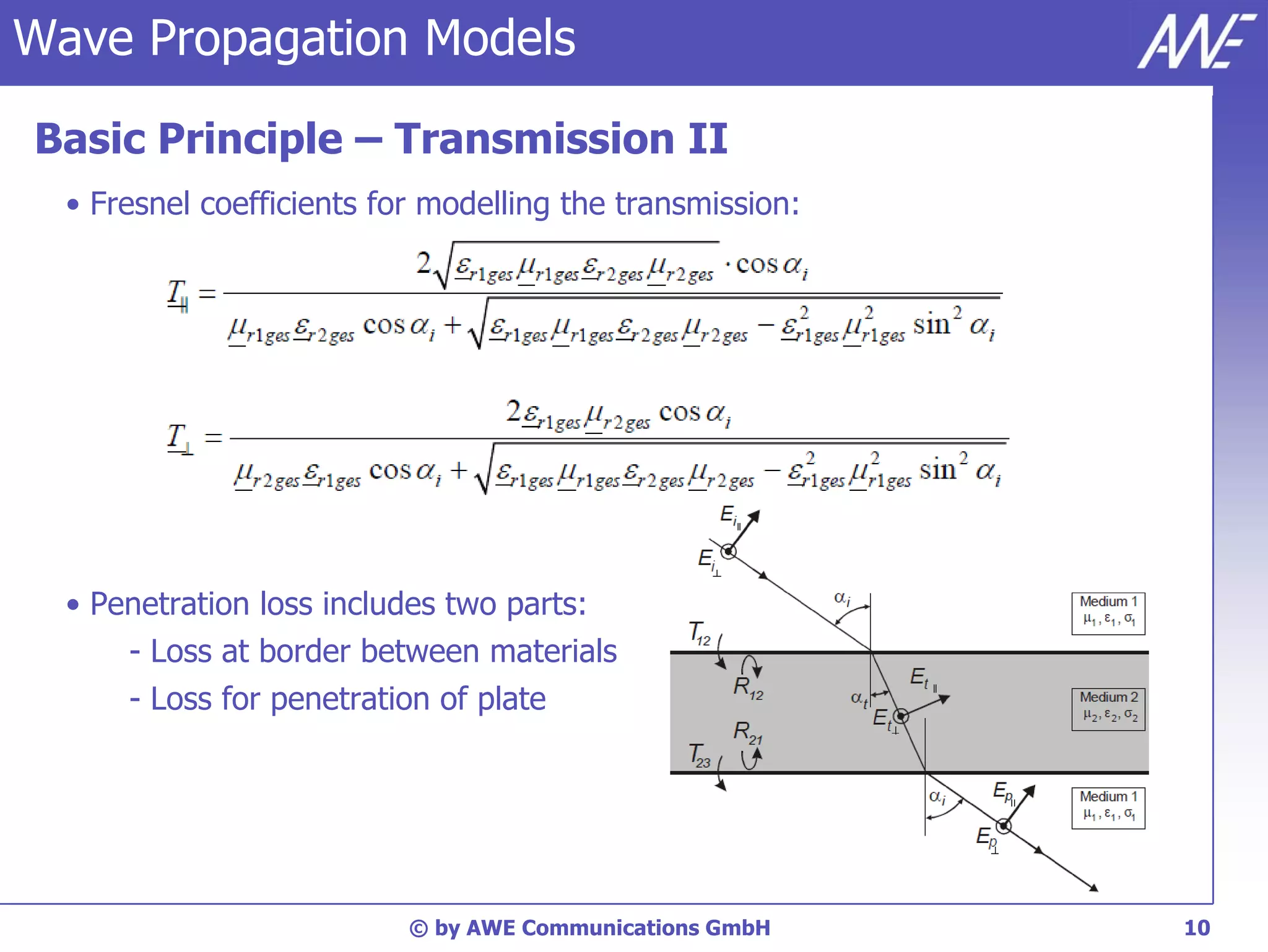
  • Fresnel coefficients for modelling the transmission:


  • Penetration loss includes two parts:
      - Loss at border between materials
      - Loss for penetration of plate


                           © by AWE Communications GmbH    10
Wave Propagation Models

Basic Principle – Diffraction I
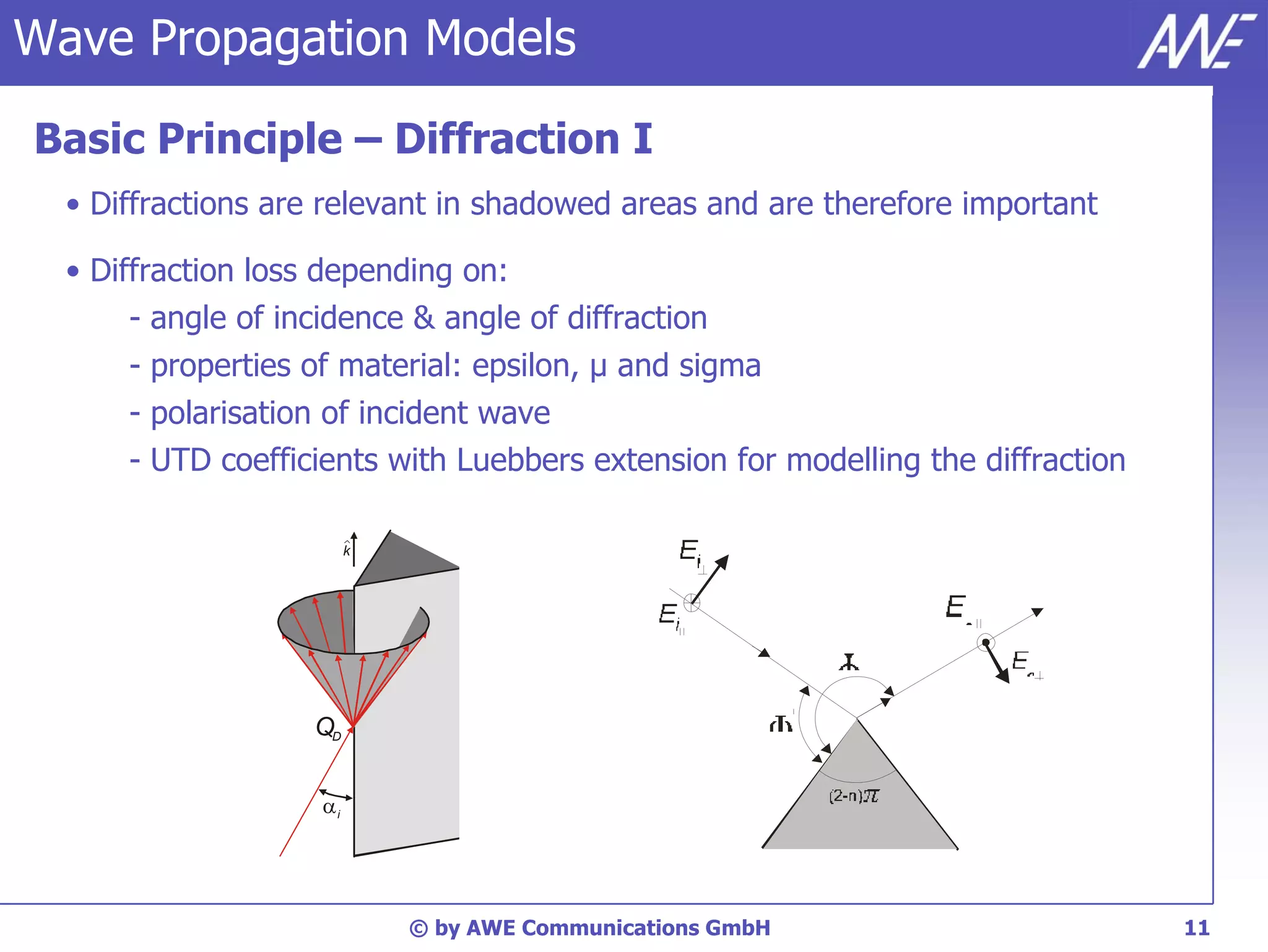
  • Diffractions are relevant in shadowed areas and are therefore important

  • Diffraction loss depending on:
       - angle of incidence & angle of diffraction
       - properties of material: epsilon, µ and sigma
       - polarisation of incident wave
       - UTD coefficients with Luebbers extension for modelling the diffraction

                         k


                    QD


                    i


                             © by AWE Communications GmbH                         11
Wave Propagation Models

Basic Principle – Diffraction II
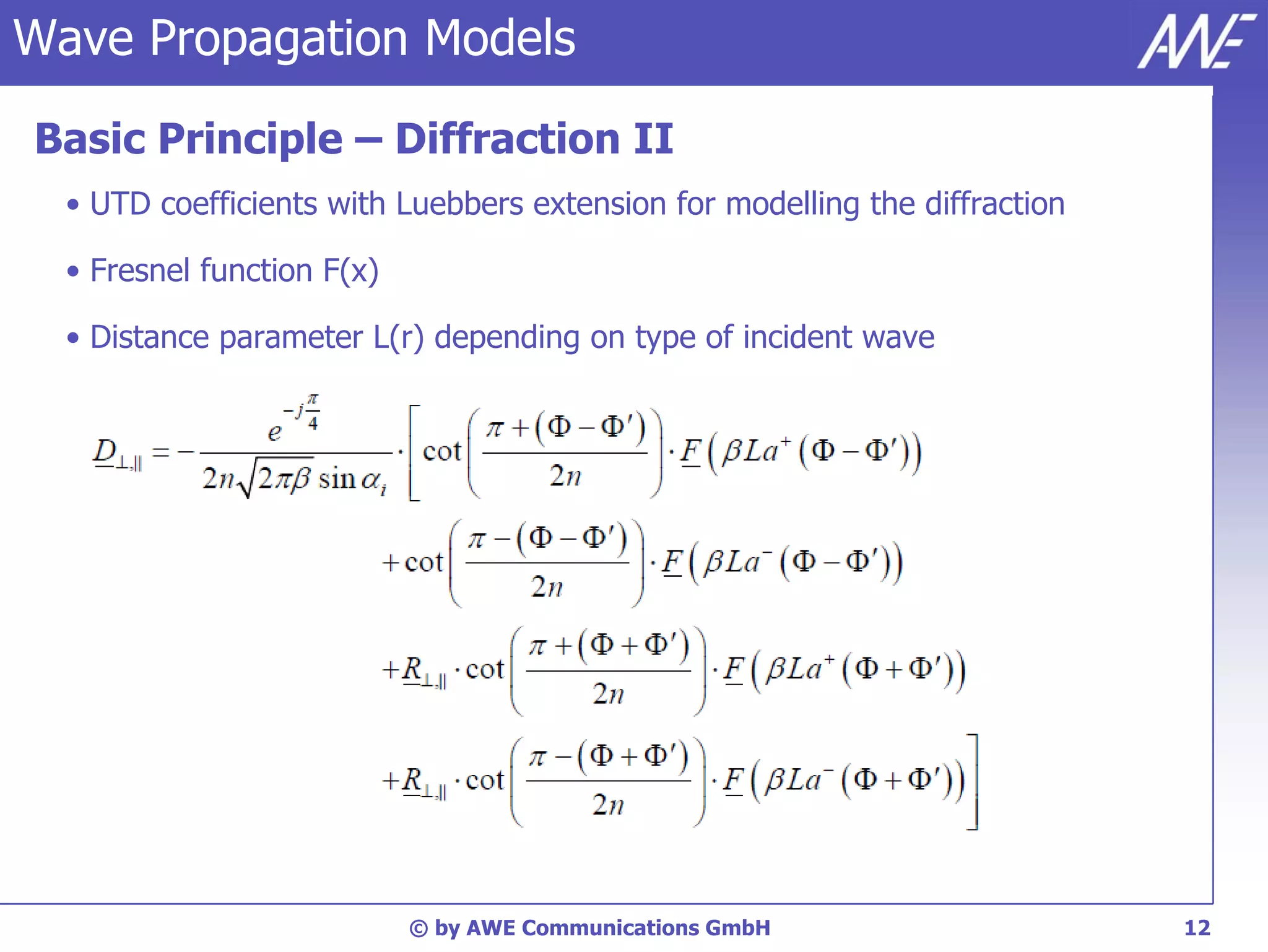
  • UTD coefficients with Luebbers extension for modelling the diffraction

  • Fresnel function F(x)

  • Distance parameter L(r) depending on type of incident wave


                            © by AWE Communications GmbH                     12
Wave Propagation Models

Basic Principle – Diffraction III
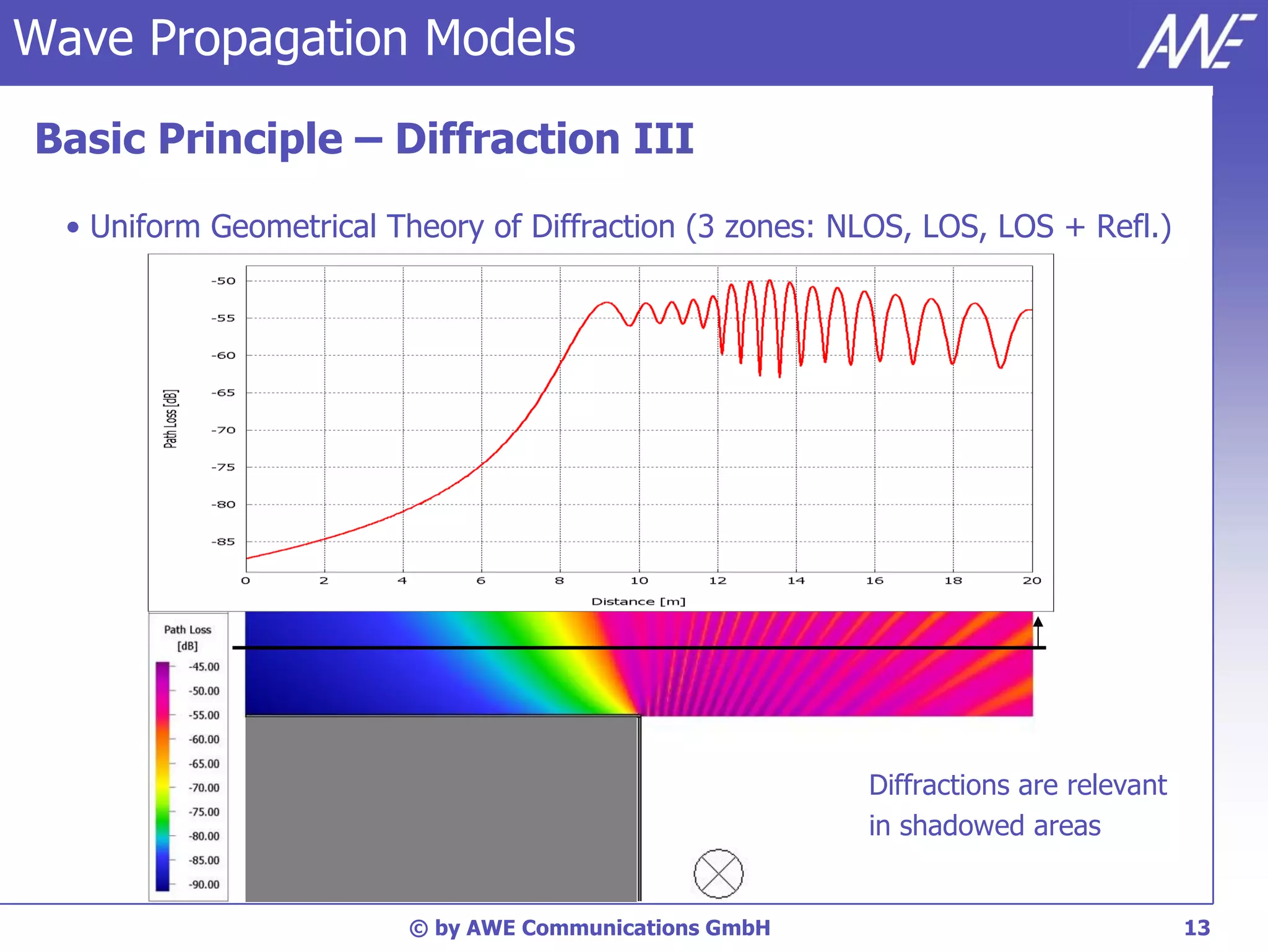
  • Uniform Geometrical Theory of Diffraction (3 zones: NLOS, LOS, LOS + Refl.)


                                                         Diffractions are relevant
                                                         in shadowed areas


                         © by AWE Communications GmbH                                13
Wave Propagation Models

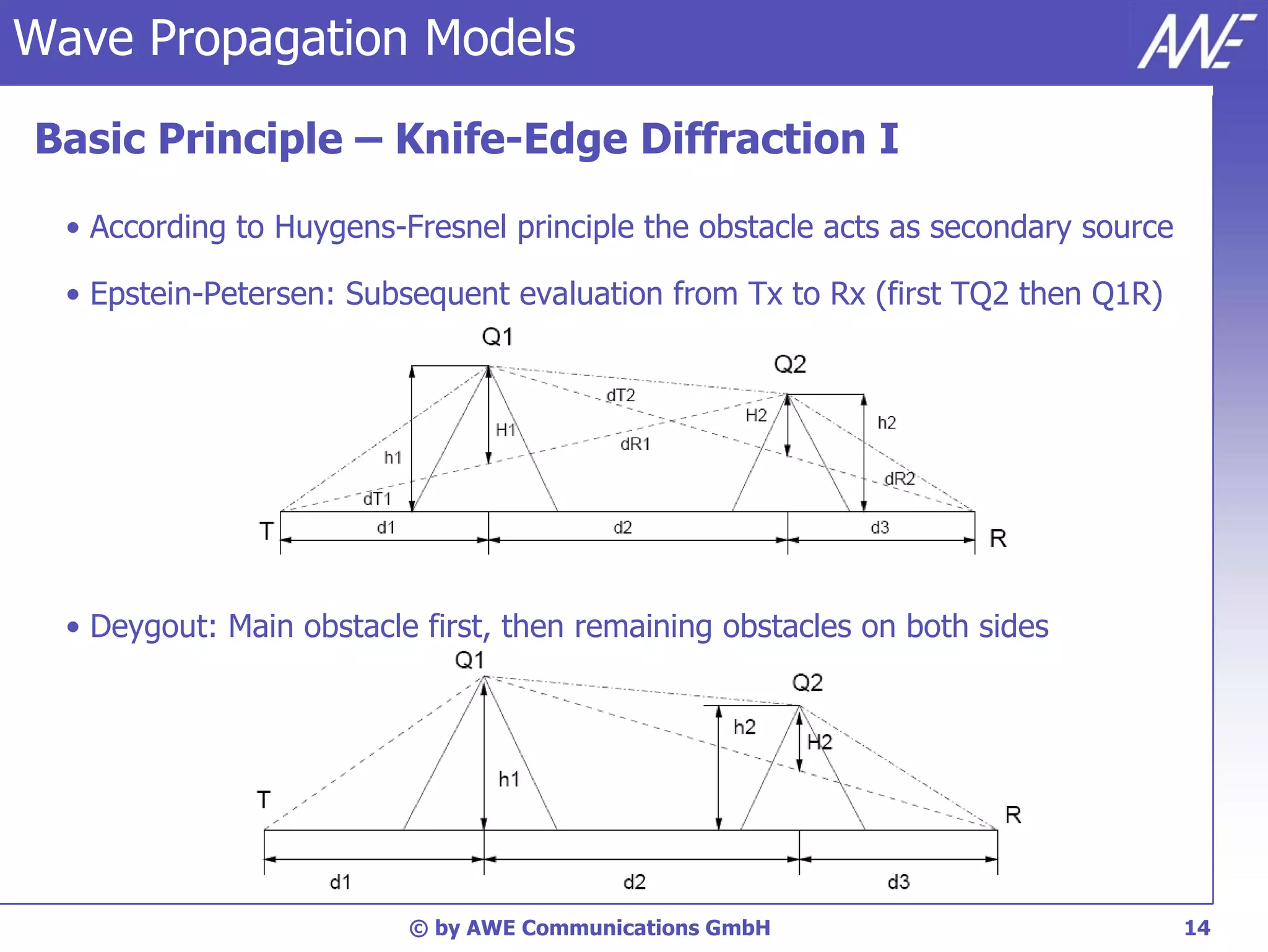
Basic Principle – Knife-Edge Diffraction I
  • According to Huygens-Fresnel principle the obstacle acts as secondary source

  • Epstein-Petersen: Subsequent evaluation from Tx to Rx (first TQ2 then Q1R)


  • Deygout: Main obstacle first, then remaining obstacles on both sides


                          © by AWE Communications GmbH                             14
Wave Propagation Models

Basic Principle – Knife-Edge Diffraction II
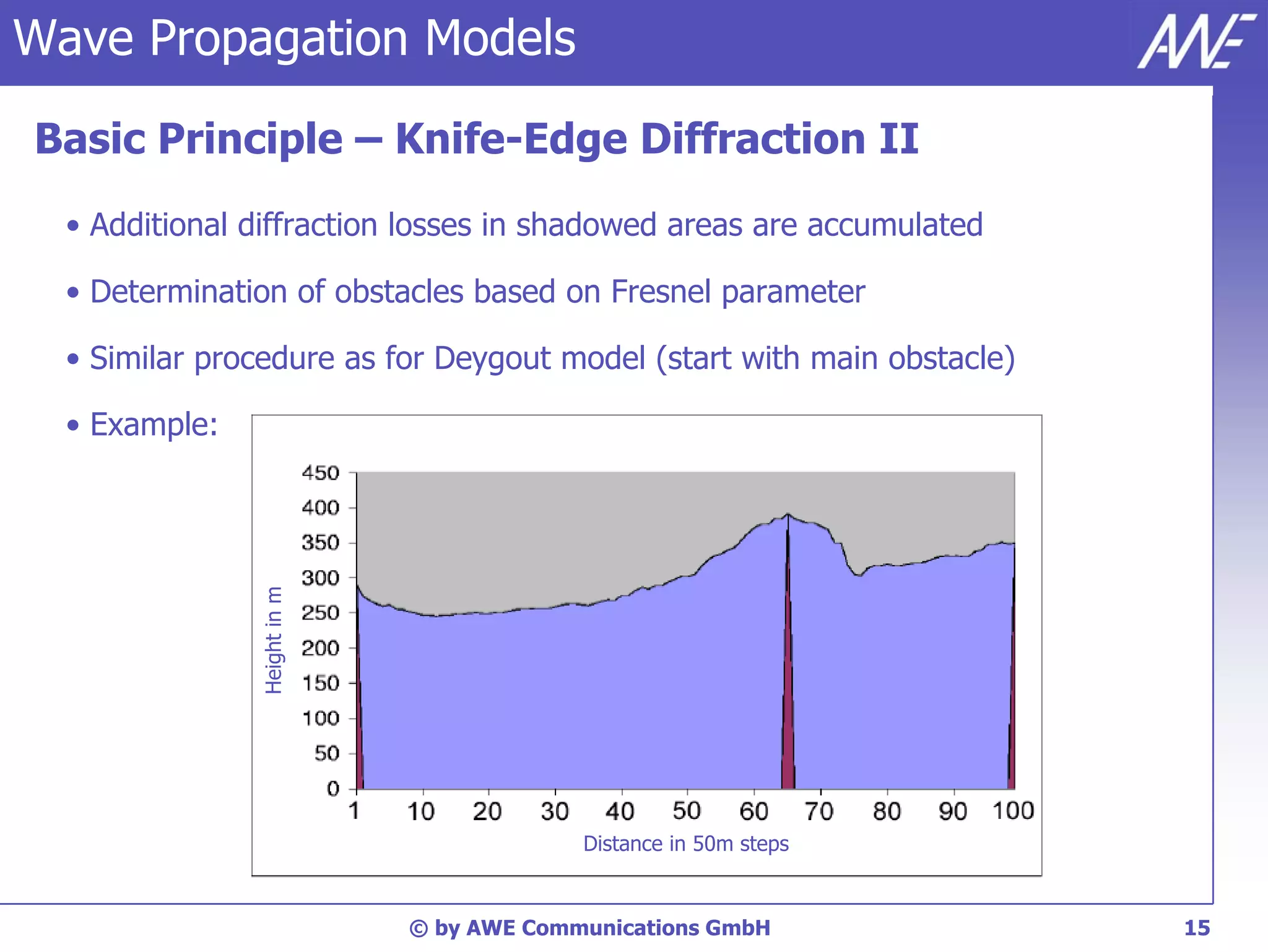
  • Additional diffraction losses in shadowed areas are accumulated

  • Determination of obstacles based on Fresnel parameter

  • Similar procedure as for Deygout model (start with main obstacle)

  • Example:
               Height in m


                                          Distance in 50m steps


                             © by AWE Communications GmbH               15
Wave Propagation Models

Basic Principle – Scattering
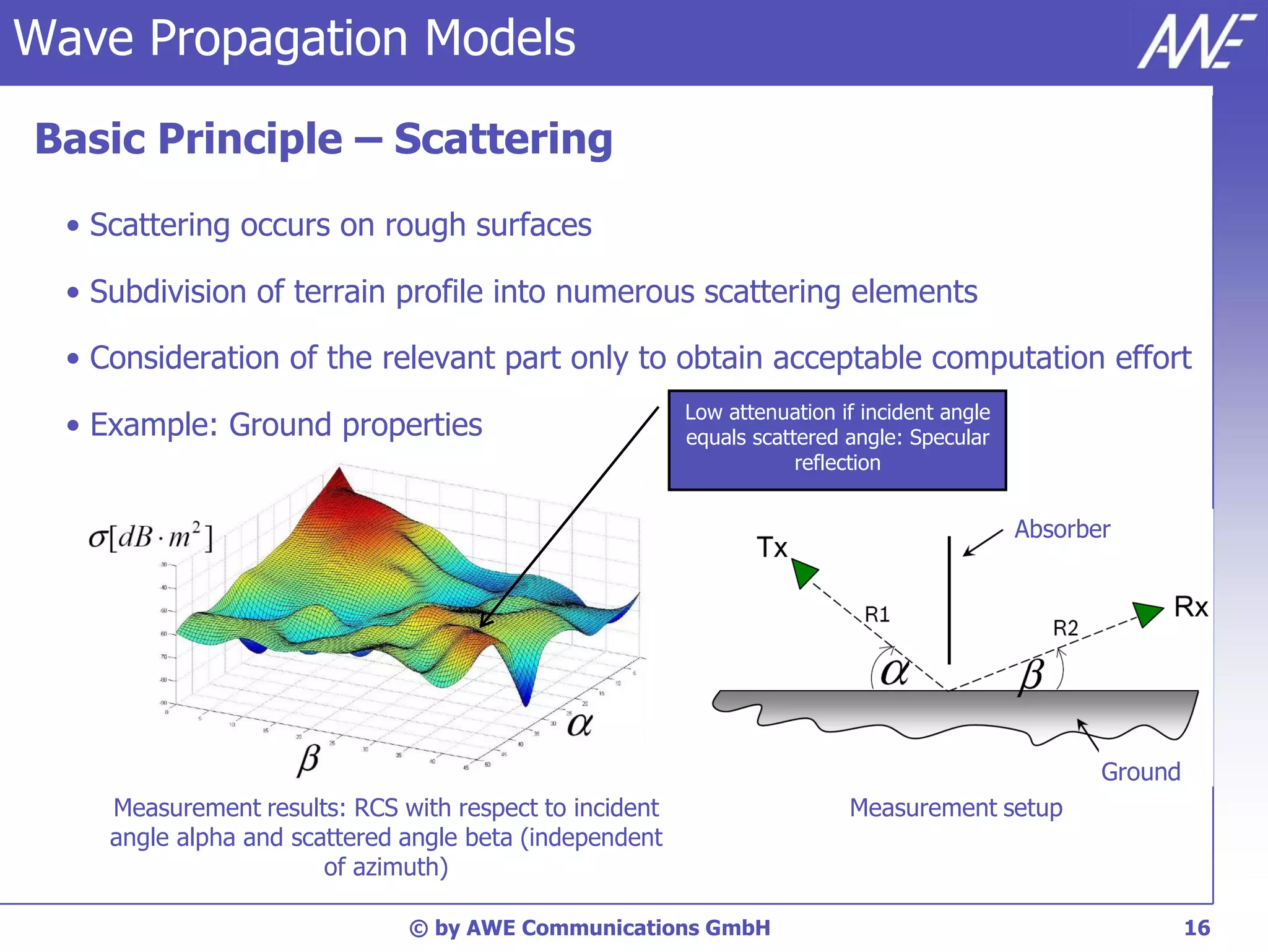
  • Scattering occurs on rough surfaces

  • Subdivision of terrain profile into numerous scattering elements

  • Consideration of the relevant part only to obtain acceptable computation effort
                                                         Low attenuation if incident angle
  • Example: Ground properties                           equals scattered angle: Specular
                                                                     reflection


                                                                                             Absorber


                                                                                                    Ground
     Measurement results: RCS with respect to incident                    Measurement setup
     angle alpha and scattered angle beta (independent
                        of azimuth)

                               © by AWE Communications GmbH                                                  16
Wave Propagation Models
    Consideration of Antenna Patterns
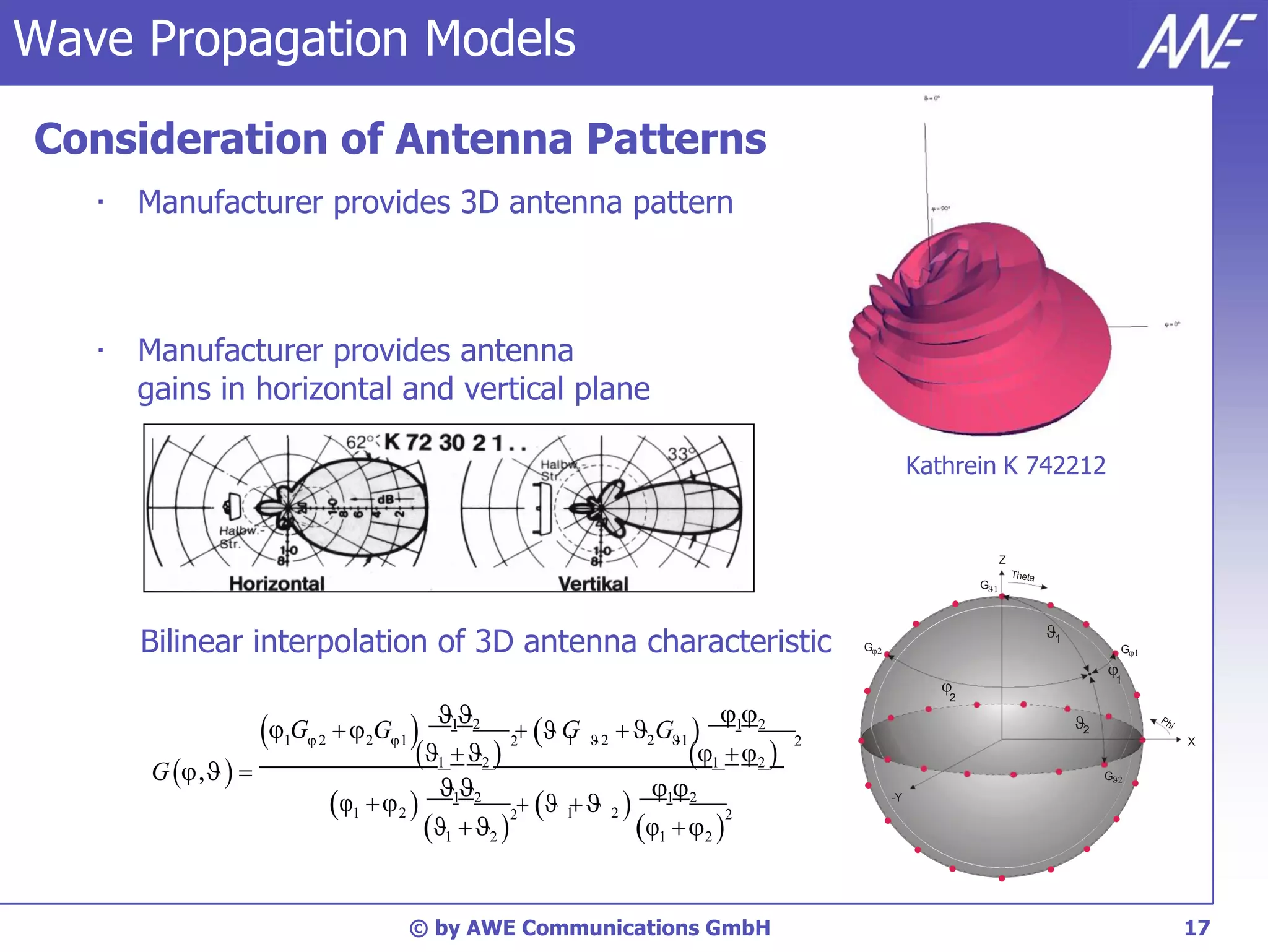
       •   Manufacturer provides 3D antenna pattern


       •   Manufacturer provides antenna
           gains in horizontal and vertical plane

                                                                                                            Kathrein K 742212


                                                                                                                       Z

                                                                                                                   G 


                                                                                                                           1
           Bilinear interpolation of 3D antenna characteristic                                  G                                     G


                                                                                                                                     
                                                                                                                                       1
                                                                                                               2
                                                      12                        
                            G           2G1                G  2G1  1 2 2
                                                               2  1  2
                                                                                                                                2
                                                  1  2                   1   2 
                               1   2                                                                                                           X

            G  ,   
                                                                                                                                            

                                                                        
                                                                                                                                     G

                                        1  2  1 2 2  1  2  1 2 2                          -Y


                                                    1  2             1  2 

                                                © by AWE Communications GmbH                                                                     17

Wave propagationmodels

  • 1.
    Wave Propagation Models Principles& Scenarios © 2012 by AWE Communications GmbH www.awe-com.com
  • 2.
    Contents • Wave Propagation Model Principles - Multipath propagation - Reflection - Diffraction - Scattering - Antenna pattern © by AWE Communications GmbH 2
  • 3.
    Wave Propagation Models MultipathPropagation • Multiple propagation paths Rx between Tx and Rx Tx • Different delays and attenuations • Destructive and constructive interference Superposition of multiple paths No line of sight (Rayleigh fading) Line of sight (Rice fading) © by AWE Communications GmbH 3
  • 4.
    Wave Propagation Models MultipathPropagation • Superposition of multiple paths leads to fading channel • Fast fading due to random phase variations • Slow fading due to principle changes in the propagation channel (add. obstacles) Example of a measurement route • Fast fading (green) • Slow fading (red) © by AWE Communications GmbH 4
  • 5.
    Wave Propagation Models PropagationModel Types • Empirical models (e.g. Hata-Okumura) • Only consideration of effective antenna height (no topography between Tx and Rx) • Considering additional losses due to clutter data • Semi-Empirical models (e.g. Two-Ray plus Knife-Edge diffraction) • Including terrain profile between Tx and Rx • Considering additional losses due to diffraction • Deterministic models (e.g. Ray Tracing) 2D Vertical plane • Considering topography Tx 3D Paths • Evaluating additional obstacles Rx1 Rx2 © by AWE Communications GmbH 5
  • 6.
    Wave Propagation Models BasicPrinciple – Reflection I • Reflections are present in LOS regions and rather limited in NLOS regions • Refection loss depending on: - angle of incidence - properties of reflecting material: permittivity, conductance, permeability - polarisation of incident wave - Fresnel coefficients for modelling the reflection Ei r Ei i Er Er i r Material 1 1 , 1 , 1 n QR Material 2  2 ,  2,  2 Et t Et t © by AWE Communications GmbH 6
  • 7.
    Wave Propagation Models BasicPrinciple – Reflection II • Fresnel coefficients for modelling the reflection: Polarisation parallel to Polarisation perpendicular to plane of incidence plane of incidence © by AWE Communications GmbH 7
  • 8.
    Wave Propagation Models BasicPrinciple – Breakpoint 130 • Free space: Two path model Free space model received power ~ 1 / d2 120  20 dB / decade • No longer valid from 110 a certain distance on Path Loss [dB] • After breakpoint: 100 received power ~ 1 / d4  40 dB / decade 90 • Deduced from 80 two-path model, i.e. superposition of direct 70 and ground-reflected rays: 0,1 0,3 1,0 3,16 10,0 BP = 4htxhrx/ Distance [km] Loss for 900 MHz and Tx height of 30m (Rx height 1.5m) breakpoint distance = 1.7 km © by AWE Communications GmbH 8
  • 9.
    Wave Propagation Models BasicPrinciple – Transmission I • Transmissions are relevant for penetration of obstacles (as e.g. walls) • Transmission loss depending on: - angle of incidence - properties of material: permittivity, conductance, permeability - polarisation of incident wave - Fresnel coefficients for modelling the transmission Ei r Ei i Er Er i r Material 1 1 , 1 , 1 n QR Material 2  2 ,  2,  2 Et t Et t © by AWE Communications GmbH 9
  • 10.
    Wave Propagation Models BasicPrinciple – Transmission II • Fresnel coefficients for modelling the transmission: • Penetration loss includes two parts: - Loss at border between materials - Loss for penetration of plate © by AWE Communications GmbH 10
  • 11.
    Wave Propagation Models BasicPrinciple – Diffraction I • Diffractions are relevant in shadowed areas and are therefore important • Diffraction loss depending on: - angle of incidence & angle of diffraction - properties of material: epsilon, µ and sigma - polarisation of incident wave - UTD coefficients with Luebbers extension for modelling the diffraction k QD i © by AWE Communications GmbH 11
  • 12.
    Wave Propagation Models BasicPrinciple – Diffraction II • UTD coefficients with Luebbers extension for modelling the diffraction • Fresnel function F(x) • Distance parameter L(r) depending on type of incident wave © by AWE Communications GmbH 12
  • 13.
    Wave Propagation Models BasicPrinciple – Diffraction III • Uniform Geometrical Theory of Diffraction (3 zones: NLOS, LOS, LOS + Refl.) Diffractions are relevant in shadowed areas © by AWE Communications GmbH 13
  • 14.
    Wave Propagation Models BasicPrinciple – Knife-Edge Diffraction I • According to Huygens-Fresnel principle the obstacle acts as secondary source • Epstein-Petersen: Subsequent evaluation from Tx to Rx (first TQ2 then Q1R) • Deygout: Main obstacle first, then remaining obstacles on both sides © by AWE Communications GmbH 14
  • 15.
    Wave Propagation Models BasicPrinciple – Knife-Edge Diffraction II • Additional diffraction losses in shadowed areas are accumulated • Determination of obstacles based on Fresnel parameter • Similar procedure as for Deygout model (start with main obstacle) • Example: Height in m Distance in 50m steps © by AWE Communications GmbH 15
  • 16.
    Wave Propagation Models BasicPrinciple – Scattering • Scattering occurs on rough surfaces • Subdivision of terrain profile into numerous scattering elements • Consideration of the relevant part only to obtain acceptable computation effort Low attenuation if incident angle • Example: Ground properties equals scattered angle: Specular reflection Absorber Ground Measurement results: RCS with respect to incident Measurement setup angle alpha and scattered angle beta (independent of azimuth) © by AWE Communications GmbH 16
  • 17.
    Wave Propagation Models Consideration of Antenna Patterns • Manufacturer provides 3D antenna pattern • Manufacturer provides antenna gains in horizontal and vertical plane Kathrein K 742212 Z G   1 Bilinear interpolation of 3D antenna characteristic G G     1 2  12    G   2G1   G  2G1  1 2 2 2  1  2 2  1  2  1   2  1 2  X G  ,          G 1  2  1 2 2  1  2  1 2 2 -Y 1  2  1  2  © by AWE Communications GmbH 17