Water Use Master Plan WUMP: the Nepal Experience

Scaling Integrated Water
Resource Management
Creating strong and healthy
communities and
environments
Rupa Mukerji
November 13, 2013
Assessment of Functionality
98% of Drinking Water
and Sanitation Schemes
are still functional 5 to 10
years after completion
22% need major repair
5% need rehabilitation to
meet increased demand
(these schemes are still
functional!)

65% of the households
are using toilets and
latrines (National average
is 43%!)
Results of the Helvetas Swiss Intercooperation
Nepal functionality study (2011)
A study covering 100 water supply schemes revealed that 98% of
the schemes are still functional 5 to 10 years after completion
2
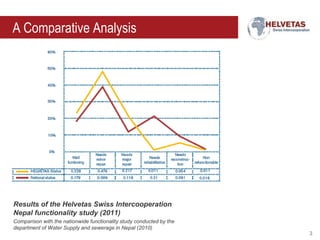
A Comparative Analysis

Results of the Helvetas Swiss Intercooperation
Nepal functionality study (2011)
Comparison with the nationwide functionality study conducted by the
department of Water Supply and sewerage in Nepal (2010)
3
Scaling up

4
Water Use Master Plan (WUMP)







WUMP is a participatory planning tool and process
Based on local initiative and ownership
Focus on water, its sources and uses
Applies an IWRM approach addressing different water uses and users
Developed based on a series of practical experiences
Can be adapted to different contextual situations

5
Purpose
 Use water - a common property
resource - as an entry point and
catalyse community based
planning and development
process
 Effective, equitable, inclusive and
efficient use of water at the local
level
 Strengthen delegated water
planning and management at the
community level
 Ensure that water resources are
used rationally and shared
equitably, fairly and inclusively
among and within communities
 Establish synergies with
decentralization processes

6
Principles
The WUMP process is
 community managed
 bottom-up and inclusive
 strengthens local capacities
 creates awareness of key issues in
water management and use
 strives for consensus within the
community
 follows the basic principle of
sustainable water development:
balancing supply and demand!

7
Process
 Identify water resources and related
infrastructure / facilities
 Analyse the potential and limitations of
different sources
 Assess boundary conditions upstream
– downstream and potential conflicts
 Identify water needs and water
allocation
 Analyse the institutional setup and
power structures
 Create links with local government and
line agencies
 Prioritise potential activities in the water
sector
 Promote conservation of water and
natural resources linked to water
 Identify funding sources and promote
convergence
8
Products
A Water Use Master Plan is a balanced
water resource development plan
considering social, environmental and
economic sustainability that provides
clarity on:







Available water resources
Water needs
Potentials and limitations
Institutional capacities
Social power structures
Community priorities (without detailed
technical studies)
 The Way forward

9
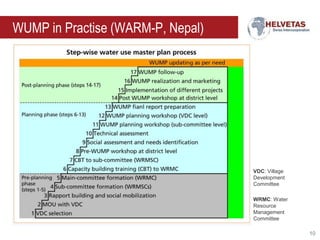
WUMP in Practise (WARM-P, Nepal)

VDC: Village
Development
Committee
WRMC: Water
Resource
Management
Committee
10
Experience from Nepal
 86 VDCs have prepared WUMPs
 More than 320 drinking water and sanitation schemes have been
implemented by the WARM-P Project in Nepal serving 116‘000 people
 Multiple Use Services (MUS) are developed combining drinking water and
farmer managed irrigation
 In some communes micro-hydropower plants could be established
 Source protection and river training activities are regular features in many
WUMPs
 Conflicts between villages over water sources could be resolved through
dialogue and negotiation
 WUMP approach is used by other organisations in Nepal to plan water related
interventions (e.g. WaterAid, Nepal-Finland Cooperation, EU funded projects)
 Government of Nepal is interested in developing its national guidelines for the
preparation of WUMPs in all 4,000 VDCs in Nepal.

11
The Outcomes: Functionality Study
 98% of Drinking Water and Sanitation Schemes supported by WARM-P are still functional
5 to 10 years after completion
 about 20% of the schemes need major repair and 5% need rehabilitation to meet
increased demand (these schemes are still functional!)
 65% of the households are using toilets and latrines (National average is 43%!)
 Major success factors:
 Local initiative and ownership
 Empowerment of the local stakeholders by systematic institution and capacity building:
inclusive User Committees (UC), Water Resource Management Committee (WRMC)
 Promotion of Local Service Providers and Villager Maintenance Workers
(remote areas!)
 Balanced mix of hardware and software support
 Use of appropriate technologies and high quality materials
 Encourage development of Multiple Use Services and promote productive water uses
 Support conservation and protection of water sources and water harvesting
 Establishment of an O & M Fund in each community
12
The Outcomes: Functionality Study

Results of the Helvetas Swiss Intercooperation Nepal
functionality study (2011)
Factors influencing functionality
13
Reference Links
Water Resources Management Program
WARM-P
http://nepal.helvetas.org/en/our_projects/war
m.cfm
WUMP Concept Paper HELVETAS Swiss
Intercooperation
https://assets.helvetas.ch/downloads/13_wateruse
masterplan_wump_blau_final_engl_a4_portrait.pdf

Nepal Finland Cooperation
http://www.rvwrmp.org.np/water-use-masterplan.html

ICIMOD (Nepcat)
http://www.icimod.org/?q=10410

14
Our domain experts
Agnes
Montangero

Team Leader

Agnes.​Montangero@​helvetas.​org

Chris
Morger

Senior Advisor
Water for Food

Chris.​Morger@​helvetas.​org

Lydia
Plüss

Advisor
Water for Food

Lydia.​Pluess@​helvetas.​org

Valérie
Cavin

Advisor Household
Water Treatment
Valerie.​Cavin@​helvetas.​org

Marco
Daniel

Water Policy
Advisor

Gisela
Keller

Senior Dev.
Manager New York Gisela.​Keller@​helvetas.​org

Marco.​Daniel@​helvetas.​org

15
Thank you!
Dannebad!
16

Helvetas Water Use Master Plan: The Nepal Experience (17 steps)

  • 1.
    Water Use MasterPlan WUMP: the Nepal Experience Scaling Integrated Water Resource Management Creating strong and healthy communities and environments Rupa Mukerji November 13, 2013
  • 2.
    Assessment of Functionality 98%of Drinking Water and Sanitation Schemes are still functional 5 to 10 years after completion 22% need major repair 5% need rehabilitation to meet increased demand (these schemes are still functional!) 65% of the households are using toilets and latrines (National average is 43%!) Results of the Helvetas Swiss Intercooperation Nepal functionality study (2011) A study covering 100 water supply schemes revealed that 98% of the schemes are still functional 5 to 10 years after completion 2
  • 3.
    A Comparative Analysis Resultsof the Helvetas Swiss Intercooperation Nepal functionality study (2011) Comparison with the nationwide functionality study conducted by the department of Water Supply and sewerage in Nepal (2010) 3
  • 4.
  • 5.
    Water Use MasterPlan (WUMP)       WUMP is a participatory planning tool and process Based on local initiative and ownership Focus on water, its sources and uses Applies an IWRM approach addressing different water uses and users Developed based on a series of practical experiences Can be adapted to different contextual situations 5
  • 6.
    Purpose  Use water- a common property resource - as an entry point and catalyse community based planning and development process  Effective, equitable, inclusive and efficient use of water at the local level  Strengthen delegated water planning and management at the community level  Ensure that water resources are used rationally and shared equitably, fairly and inclusively among and within communities  Establish synergies with decentralization processes 6
  • 7.
    Principles The WUMP processis  community managed  bottom-up and inclusive  strengthens local capacities  creates awareness of key issues in water management and use  strives for consensus within the community  follows the basic principle of sustainable water development: balancing supply and demand! 7
  • 8.
    Process  Identify waterresources and related infrastructure / facilities  Analyse the potential and limitations of different sources  Assess boundary conditions upstream – downstream and potential conflicts  Identify water needs and water allocation  Analyse the institutional setup and power structures  Create links with local government and line agencies  Prioritise potential activities in the water sector  Promote conservation of water and natural resources linked to water  Identify funding sources and promote convergence 8
  • 9.
    Products A Water UseMaster Plan is a balanced water resource development plan considering social, environmental and economic sustainability that provides clarity on:       Available water resources Water needs Potentials and limitations Institutional capacities Social power structures Community priorities (without detailed technical studies)  The Way forward 9
  • 10.
    WUMP in Practise(WARM-P, Nepal) VDC: Village Development Committee WRMC: Water Resource Management Committee 10
  • 11.
    Experience from Nepal 86 VDCs have prepared WUMPs  More than 320 drinking water and sanitation schemes have been implemented by the WARM-P Project in Nepal serving 116‘000 people  Multiple Use Services (MUS) are developed combining drinking water and farmer managed irrigation  In some communes micro-hydropower plants could be established  Source protection and river training activities are regular features in many WUMPs  Conflicts between villages over water sources could be resolved through dialogue and negotiation  WUMP approach is used by other organisations in Nepal to plan water related interventions (e.g. WaterAid, Nepal-Finland Cooperation, EU funded projects)  Government of Nepal is interested in developing its national guidelines for the preparation of WUMPs in all 4,000 VDCs in Nepal. 11
  • 12.
    The Outcomes: FunctionalityStudy  98% of Drinking Water and Sanitation Schemes supported by WARM-P are still functional 5 to 10 years after completion  about 20% of the schemes need major repair and 5% need rehabilitation to meet increased demand (these schemes are still functional!)  65% of the households are using toilets and latrines (National average is 43%!)  Major success factors:  Local initiative and ownership  Empowerment of the local stakeholders by systematic institution and capacity building: inclusive User Committees (UC), Water Resource Management Committee (WRMC)  Promotion of Local Service Providers and Villager Maintenance Workers (remote areas!)  Balanced mix of hardware and software support  Use of appropriate technologies and high quality materials  Encourage development of Multiple Use Services and promote productive water uses  Support conservation and protection of water sources and water harvesting  Establishment of an O & M Fund in each community 12
  • 13.
    The Outcomes: FunctionalityStudy Results of the Helvetas Swiss Intercooperation Nepal functionality study (2011) Factors influencing functionality 13
  • 14.
    Reference Links Water ResourcesManagement Program WARM-P http://nepal.helvetas.org/en/our_projects/war m.cfm WUMP Concept Paper HELVETAS Swiss Intercooperation https://assets.helvetas.ch/downloads/13_wateruse masterplan_wump_blau_final_engl_a4_portrait.pdf Nepal Finland Cooperation http://www.rvwrmp.org.np/water-use-masterplan.html ICIMOD (Nepcat) http://www.icimod.org/?q=10410 14
  • 15.
    Our domain experts Agnes Montangero TeamLeader Agnes.​Montangero@​helvetas.​org Chris Morger Senior Advisor Water for Food Chris.​Morger@​helvetas.​org Lydia Plüss Advisor Water for Food Lydia.​Pluess@​helvetas.​org Valérie Cavin Advisor Household Water Treatment Valerie.​Cavin@​helvetas.​org Marco Daniel Water Policy Advisor Gisela Keller Senior Dev. Manager New York Gisela.​Keller@​helvetas.​org Marco.​Daniel@​helvetas.​org 15
  • 16.

Editor's Notes

  • #6 maximise for 3 variables is not possible (Hardin „the tragedy of the commons“) so we can only „optimise“ and that requires trade offs!
  • #7 in a sustainable way considering all different needs