
Water Safety Plans – Experiences from the South-East Asia Region Payden,  Regional Advisor, Water, Sanitation & Health World Health Organization, South East Asia Region.
Current challenges About 60 percent of people in South-East Asia do not have access to sanitation About 84 percent of the region have access to water supply, however water delivered at the taps is not always safe to drink 1.1 millions deaths due to diarrhoea annually in South-East Asia mostly children
Key drivers for water safety plans It is estimated that about 88% of diarrheal diseases can be prevented through safe water, sanitation and good hygiene MDGs for drinking water and sanitation Access to safe water and sanitation declared as basic human right
Key drivers for water safety plans WHO guidelines – emphasis on risk assessment and risk management WSP piloted in 15 countries and implemented in 20 countries Global collaboration – WHO, IWA, AusAID, CDC, UN-Habitat, ADB, UNICEF
What is a Water Safety Plan A documented plan that: Identifies   hazards, assesses risks from catchment to consumer Prioritizes  risks – focuses on highest risks Mitigates   risks through control measures Moving away from reliance on  output  monitoring -  i.e. measuring parameters in final water More  input  monitoring – i.e. measuring parameters showing that the system is working
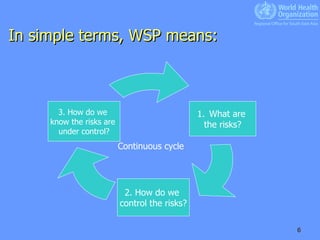
In simple terms, WSP means: What are  the risks? 2. How do we  control the risks? 3. How do we  know the risks are  under control? Continuous cycle
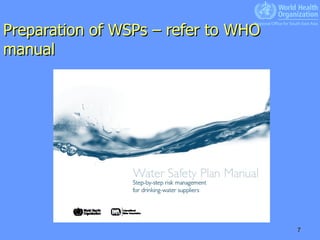
Preparation of WSPs – refer to WHO manual
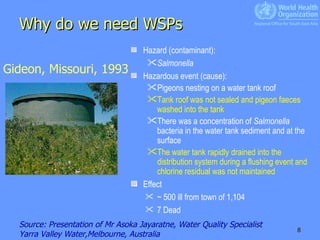
Why do we need WSPs Hazard (contaminant):  Salmonella Hazardous event (cause): Pigeons nesting on a water tank roof Tank roof was not sealed and pigeon faeces washed into the tank There was a concentration of  Salmonella  bacteria in the water tank sediment and at the surface The water tank rapidly drained into the distribution system during a flushing event and chlorine residual was not maintained Effect ~ 500 ill from town of 1,104 7 Dead Gideon, Missouri, 1993 Source: Presentation of Mr Asoka Jayaratne, Water Quality Specialist Yarra Valley Water,Melbourne, Australia
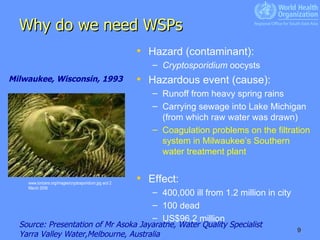
Why do we need WSPs Milwaukee, Wisconsin, 1993 Hazard (contaminant):  Cryptosporidium  oocysts Hazardous event (cause): Runoff from heavy spring rains  Carrying sewage into Lake Michigan (from which raw water was drawn) Coagulation problems on the filtration system in Milwaukee’s Southern water treatment plant Effect:  400,000 ill from 1.2 million in city 100 dead US$96.2 million www.ionizers.org/images/cryptosporidium.jpg acd 2 March 2006 Source: Presentation of Mr Asoka Jayaratne, Water Quality Specialist Yarra Valley Water,Melbourne, Australia
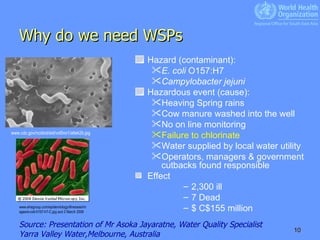
Why do we need WSPs www.cdc.gov/ncidod/eid/vol5no1/altek2b.jpg www.ehagroup.com/epidemiology/illnesses/images/e-coli-0157-h7-C.jpg acd 2 March 2006 Hazard (contaminant):  E. coli  O157:H7  Campylobacter jejuni Hazardous event (cause): Heaving Spring rains Cow manure washed into the well No on line monitoring Failure to chlorinate Water supplied by local water utility Operators, managers & government cutbacks found responsible Effect 2,300 ill  7 Dead $  C$155 million Source: Presentation of Mr Asoka Jayaratne, Water Quality Specialist Yarra Valley Water,Melbourne, Australia
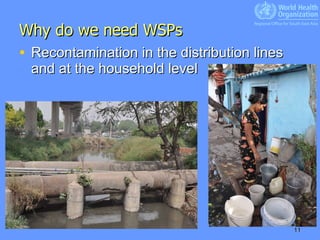
Why do we need WSPs Recontamination in the distribution lines and at the household level
Why do we need WSPs Increasing risks of water quality – microbiological as well as chemicals from agricultural and industrial activities Increased awareness among consumers – the need to have safe water Typhoid and cholera outbreaks in many countries – due to (re)contamination of water
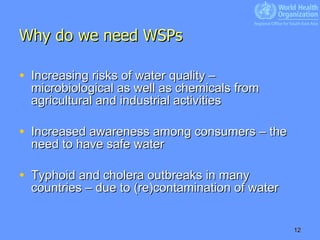
Success stories from Bangladesh The Government approved Water Safety Framework  National Vetting Guidelines put in place - requires all new water projects to include WSPs Mayor of Chandpur  Municipality – advocator  of WSPs WSP implemented in  10  urban supplies,  15 rural  supplies and  point  sources in two districts
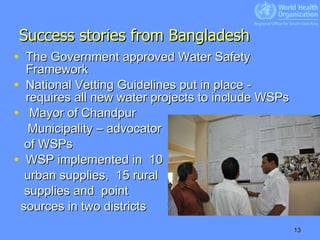
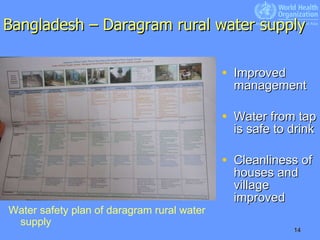
Bangladesh – Daragram rural water supply Improved management  Water from tap is safe to drink Cleanliness of houses and village improved Water safety plan of daragram rural water supply
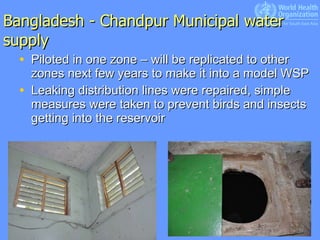
Bangladesh - Chandpur Municipal water supply Piloted in one zone – will be replicated to other zones next few years to make it into a model WSP Leaking distribution lines were repaired, simple measures were taken to prevent birds and insects getting into the reservoir
Bangladesh- Kapaura village (46 shallow tubewells) Mass campaign for proper collection of water from handpumps and safe storage  Raised awareness regarding linkage between safe water practices and diseases Latrines close to water point were moved Tube well platform were repaired and raised
Success stories from Bhutan   Policy level changes – WSP included in rural water  policy WSP implemented in 5 urban supplies and 50 rural supplies WSP Quality assurance tool developed WSP facilitation guide for rural supplies – participatory approach
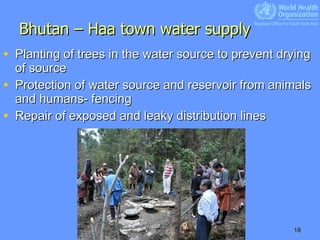
Bhutan – Haa town water supply Planting of trees in the water source to prevent drying of source Protection of water source and reservoir from animals and humans- fencing  Repair of exposed and leaky distribution lines
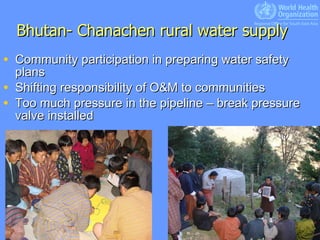
Bhutan- Chanachen rural water supply Community participation in preparing water safety plans Shifting responsibility of O&M to communities Too much pressure in the pipeline – break pressure valve installed
Success stories from India Piloted in Hyderabad water system Pilot in progress in Nagpur municipal water system  1 st  WSP hands-on training conducted in Nagpur jointly with National Environmental Engineering Research Institute (NEERI) in July 2011 Spin-off effect to Bangalore and Mumbai cities
Benefits of WSP – seen from initial experiences in the Region Improves water quality – reduces water borne diseases Reduces maintenance cost and cost of treating water at home Improves sustainability of water supply system Better planning for rehabilitation/expansion of water supply system Address water management and sanitation at the household level Principles applicable to any type of water system
Thank you!!

WSP_Payden

  • 1.
    Water Safety Plans– Experiences from the South-East Asia Region Payden, Regional Advisor, Water, Sanitation & Health World Health Organization, South East Asia Region.
  • 2.
    Current challenges About60 percent of people in South-East Asia do not have access to sanitation About 84 percent of the region have access to water supply, however water delivered at the taps is not always safe to drink 1.1 millions deaths due to diarrhoea annually in South-East Asia mostly children
  • 3.
    Key drivers forwater safety plans It is estimated that about 88% of diarrheal diseases can be prevented through safe water, sanitation and good hygiene MDGs for drinking water and sanitation Access to safe water and sanitation declared as basic human right
  • 4.
    Key drivers forwater safety plans WHO guidelines – emphasis on risk assessment and risk management WSP piloted in 15 countries and implemented in 20 countries Global collaboration – WHO, IWA, AusAID, CDC, UN-Habitat, ADB, UNICEF
  • 5.
    What is aWater Safety Plan A documented plan that: Identifies hazards, assesses risks from catchment to consumer Prioritizes risks – focuses on highest risks Mitigates risks through control measures Moving away from reliance on output monitoring - i.e. measuring parameters in final water More input monitoring – i.e. measuring parameters showing that the system is working
  • 6.
    In simple terms,WSP means: What are the risks? 2. How do we control the risks? 3. How do we know the risks are under control? Continuous cycle
  • 7.
    Preparation of WSPs– refer to WHO manual
  • 8.
    Why do weneed WSPs Hazard (contaminant): Salmonella Hazardous event (cause): Pigeons nesting on a water tank roof Tank roof was not sealed and pigeon faeces washed into the tank There was a concentration of Salmonella bacteria in the water tank sediment and at the surface The water tank rapidly drained into the distribution system during a flushing event and chlorine residual was not maintained Effect ~ 500 ill from town of 1,104 7 Dead Gideon, Missouri, 1993 Source: Presentation of Mr Asoka Jayaratne, Water Quality Specialist Yarra Valley Water,Melbourne, Australia
  • 9.
    Why do weneed WSPs Milwaukee, Wisconsin, 1993 Hazard (contaminant): Cryptosporidium oocysts Hazardous event (cause): Runoff from heavy spring rains Carrying sewage into Lake Michigan (from which raw water was drawn) Coagulation problems on the filtration system in Milwaukee’s Southern water treatment plant Effect: 400,000 ill from 1.2 million in city 100 dead US$96.2 million www.ionizers.org/images/cryptosporidium.jpg acd 2 March 2006 Source: Presentation of Mr Asoka Jayaratne, Water Quality Specialist Yarra Valley Water,Melbourne, Australia
  • 10.
    Why do weneed WSPs www.cdc.gov/ncidod/eid/vol5no1/altek2b.jpg www.ehagroup.com/epidemiology/illnesses/images/e-coli-0157-h7-C.jpg acd 2 March 2006 Hazard (contaminant): E. coli O157:H7 Campylobacter jejuni Hazardous event (cause): Heaving Spring rains Cow manure washed into the well No on line monitoring Failure to chlorinate Water supplied by local water utility Operators, managers & government cutbacks found responsible Effect 2,300 ill 7 Dead $ C$155 million Source: Presentation of Mr Asoka Jayaratne, Water Quality Specialist Yarra Valley Water,Melbourne, Australia
  • 11.
    Why do weneed WSPs Recontamination in the distribution lines and at the household level
  • 12.
    Why do weneed WSPs Increasing risks of water quality – microbiological as well as chemicals from agricultural and industrial activities Increased awareness among consumers – the need to have safe water Typhoid and cholera outbreaks in many countries – due to (re)contamination of water
  • 13.
    Success stories fromBangladesh The Government approved Water Safety Framework National Vetting Guidelines put in place - requires all new water projects to include WSPs Mayor of Chandpur Municipality – advocator of WSPs WSP implemented in 10 urban supplies, 15 rural supplies and point sources in two districts
  • 14.
    Bangladesh – Daragramrural water supply Improved management Water from tap is safe to drink Cleanliness of houses and village improved Water safety plan of daragram rural water supply
  • 15.
    Bangladesh - ChandpurMunicipal water supply Piloted in one zone – will be replicated to other zones next few years to make it into a model WSP Leaking distribution lines were repaired, simple measures were taken to prevent birds and insects getting into the reservoir
  • 16.
    Bangladesh- Kapaura village(46 shallow tubewells) Mass campaign for proper collection of water from handpumps and safe storage Raised awareness regarding linkage between safe water practices and diseases Latrines close to water point were moved Tube well platform were repaired and raised
  • 17.
    Success stories fromBhutan Policy level changes – WSP included in rural water policy WSP implemented in 5 urban supplies and 50 rural supplies WSP Quality assurance tool developed WSP facilitation guide for rural supplies – participatory approach
  • 18.
    Bhutan – Haatown water supply Planting of trees in the water source to prevent drying of source Protection of water source and reservoir from animals and humans- fencing Repair of exposed and leaky distribution lines
  • 19.
    Bhutan- Chanachen ruralwater supply Community participation in preparing water safety plans Shifting responsibility of O&M to communities Too much pressure in the pipeline – break pressure valve installed
  • 20.
    Success stories fromIndia Piloted in Hyderabad water system Pilot in progress in Nagpur municipal water system 1 st WSP hands-on training conducted in Nagpur jointly with National Environmental Engineering Research Institute (NEERI) in July 2011 Spin-off effect to Bangalore and Mumbai cities
  • 21.
    Benefits of WSP– seen from initial experiences in the Region Improves water quality – reduces water borne diseases Reduces maintenance cost and cost of treating water at home Improves sustainability of water supply system Better planning for rehabilitation/expansion of water supply system Address water management and sanitation at the household level Principles applicable to any type of water system
  • 22.

Editor's Notes

  • #14 WSP implemented in 10 urban supplies, 15 rural supplies and mass campaign for point sources in two districts The Government approved Water Safety Framework which includes health based targets for water quality, guideline for the development of WSP and a protocol for independent surveillance. National Vetting Guidelines put in place - requires all new water projects to include WSPs