 BOILER PROBLEM AND
SOFTENING METHOD
BOILER WATER (WATER FOR STEAM GENERATION):
 A boiler is a closed vessel in which water under pressure is
transferred into steam by the application of heat.
 In the boiler furnace, the chemical energy in the fuel is
converted into heat, and it is the function of the boiler to
transfer this heat to the contained water in the most efficient
manner.
1. It should be free from suspended solid and dissolved
gases such as- CO2,SOx,NOx,halogen and hydrogen
halide.
2. Hardness should be less than 0.1 ppm.
3. Alkalinity should be in the range 0.1to1 ppm.0.5
alkalinity is preferable.
4. Free from oily/soapy matter that reduce the surface
tension of water.
5. Free from hardness producing substance.
 Excess of impurities, if present, in boiler feed water
generally cause the following problems:
 BOILER PROBLEM:
 1. SLUDGE & SCALE FORMATION
 2. PRIMING & FOAMING
 3. CARRY OVER
 4. BOILER CORROSION
 5. CAUSTIC EMBRITTLEMENT
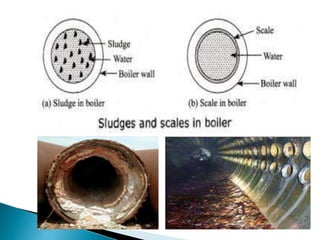
In boiler, water is converted to steam. during this
process ,when the volume of water decrease and
saturation point is reached and all dissolved salts
precipitate out.
If the precipitates formed are soft loose and slimy,
these are known as sludges, while if the precipitate is
hard and adhering on the inner walls, it is called as
scale.
SLUDGE:-
 Sludge is a soft, loose and slimy precipitate formed
within the boiler.
 Sludge are formed by substances which have greater
solubility in hot water than in cold water, e.g.
MgCO3, MgCl2, CaCl2,MgSO4 etc.
 They are formed at comparatively colder portions of
the boiler get collected at places where the flow rate
is slow; they can be easily removed (scrapped off)
with a wire brush.
(i) Sludges are poor conductors of heat, so they tend
to waste a portion of heat generated and thus decrease
the efficiency of boiler.
(ii) Excessive sludge formation disturbs the working of
the boiler. It settles in the regions of poor water
circulation such as pipe connection, plug opening,
gauge-glass connection, there by causing even choking
of the pipes.
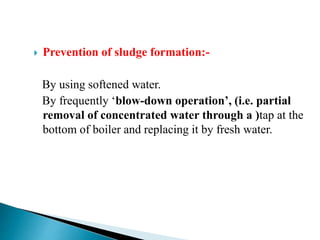
 Prevention of sludge formation:-
By using softened water.
By frequently ‘blow-down operation’, (i.e. partial
removal of concentrated water through a )tap at the
bottom of boiler and replacing it by fresh water.
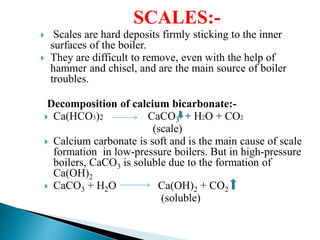
SCALES:-
 Scales are hard deposits firmly sticking to the inner
surfaces of the boiler.
 They are difficult to remove, even with the help of
hammer and chisel, and are the main source of boiler
troubles.
Decomposition of calcium bicarbonate:-
 Ca(HCO3)2 CaCO3 + H2O + CO2
(scale)
 Calcium carbonate is soft and is the main cause of scale
formation in low-pressure boilers. But in high-pressure
boilers, CaCO3 is soluble due to the formation of
Ca(OH)2
 CaCO3 + H2O Ca(OH)2 + CO2
(soluble)
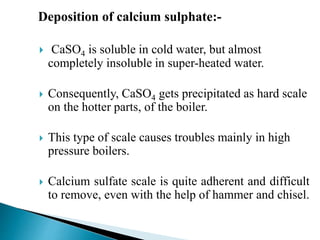
Deposition of calcium sulphate:-
 CaSO4 is soluble in cold water, but almost
completely insoluble in super-heated water.
 Consequently, CaSO4 gets precipitated as hard scale
on the hotter parts, of the boiler.
 This type of scale causes troubles mainly in high
pressure boilers.
 Calcium sulfate scale is quite adherent and difficult
to remove, even with the help of hammer and chisel.
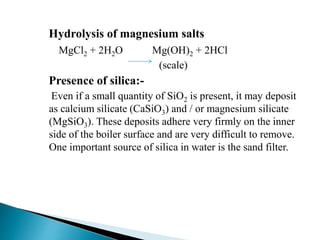
Hydrolysis of magnesium salts
MgCl2 + 2H2O Mg(OH)2 + 2HCl
(scale)
Presence of silica:-
Even if a small quantity of SiO2 is present, it may deposit
as calcium silicate (CaSiO3) and / or magnesium silicate
(MgSiO3). These deposits adhere very firmly on the inner
side of the boiler surface and are very difficult to remove.
One important source of silica in water is the sand filter.
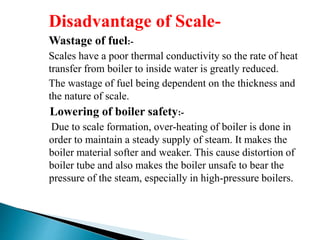
Disadvantage of Scale-
Wastage of fuel:-
Scales have a poor thermal conductivity so the rate of heat
transfer from boiler to inside water is greatly reduced.
The wastage of fuel being dependent on the thickness and
the nature of scale.
Lowering of boiler safety:-
Due to scale formation, over-heating of boiler is done in
order to maintain a steady supply of steam. It makes the
boiler material softer and weaker. This cause distortion of
boiler tube and also makes the boiler unsafe to bear the
pressure of the steam, especially in high-pressure boilers.
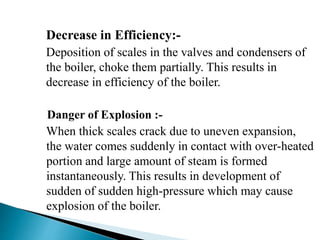
Decrease in Efficiency:-
Deposition of scales in the valves and condensers of
the boiler, choke them partially. This results in
decrease in efficiency of the boiler.
Danger of Explosion :-
When thick scales crack due to uneven expansion,
the water comes suddenly in contact with over-heated
portion and large amount of steam is formed
instantaneously. This results in development of
sudden of sudden high-pressure which may cause
explosion of the boiler.
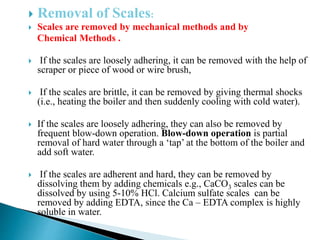
 Removal of Scales:
 Scales are removed by mechanical methods and by
Chemical Methods .
 If the scales are loosely adhering, it can be removed with the help of
scraper or piece of wood or wire brush,
 If the scales are brittle, it can be removed by giving thermal shocks
(i.e., heating the boiler and then suddenly cooling with cold water).
 If the scales are loosely adhering, they can also be removed by
frequent blow-down operation. Blow-down operation is partial
removal of hard water through a ‘tap’ at the bottom of the boiler and
add soft water.
 If the scales are adherent and hard, they can be removed by
dissolving them by adding chemicals e.g., CaCO3 scales can be
dissolved by using 5-10% HCl. Calcium sulfate scales can be
removed by adding EDTA, since the Ca – EDTA complex is highly
soluble in water.
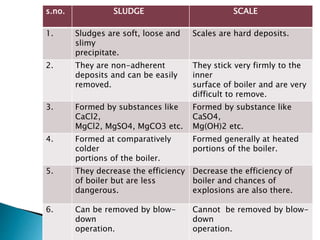
s.no. SLUDGE SCALE
1. Sludges are soft, loose and
slimy
precipitate.
Scales are hard deposits.
2. They are non-adherent
deposits and can be easily
removed.
They stick very firmly to the
inner
surface of boiler and are very
difficult to remove.
3. Formed by substances like
CaCl2,
MgCl2, MgSO4, MgCO3 etc.
Formed by substance like
CaSO4,
Mg(OH)2 etc.
4. Formed at comparatively
colder
portions of the boiler.
Formed generally at heated
portions of the boiler.
5. They decrease the efficiency
of boiler but are less
dangerous.
Decrease the efficiency of
boiler and chances of
explosions are also there.
6. Can be removed by blow-
down
operation.
Cannot be removed by blow-
down
operation.
 Priming:-
 When steam is produced rapidly in the boilers, some droplets of the
liquid water are carried along-with the steam. This process of ‘wet-
steam’ formation is called priming.
 The moisture contamination in the steam is expressed in percentage
by weight of Steam.
 For example, if steam contains 0.2% moisture, its steam quality will
be reported as 100 – 0.2 = 99.8%.
 Mainly due to suspended impurities and due to
dissolved impurities in water.
 Steam velocities high enough to carry droplets of
water into the steam pipe;
 Sudden boiling;
 Faulty design of boiler.
 Controlling rapid change in steaming velocities,
 The proper design of boilers (maintaining low
water levels in boilers)
 Ensuring efficient softening and Filtration of the
boiler-water carried over to the boiler.
 By blowing off sludge or scales from time to time.
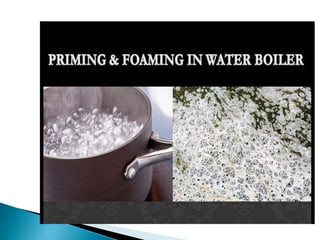
 Foaming is the formation of small but persistent foam or bubbles at the
water surface in boilers, which do not break easily.
 Foaming is caused by the presence of oil and alkalis in boiler-feed
water.
 Actually oils and alkalis react to form soap, which greatly lowers the
surface tension of water, and thus increase the foaming tendency of the
liquid.
 With respect to foaming, water can be following grades:
 (i) Foaming water:- It is that water which produces foam
even in two days, if blowing off operation is not done.
 (ii) Semi-Foaming water:-. It is that water which does
not produce any foam in locomotive boilers for two days.
 (iii) Non-Foaming water:- It is that water which does not
produce any foam in locomotive boilers for one week.
Foaming can be avoided by:
 The addition of anti foaming agent, for example addition of castor
oil (which spreads on the surface of water and therefore)
neutralizes the surface tension reduction.
 Traces oils are generally introduced in boiler feed water through
the lubricating materials used for pumps etc. the removal of
foaming agent (Lubricating oil) from boiler water.
 Oils can be removed by the addition of aluminum compounds, like
Sodium Aluminate and Aluminum sulphate which is
hydrolyzed to form Aluminum hydroxide flocks which entrap oil
drops.
 The flocks of Al(OH)3 containing oil droplets are removed by
filtration through anthracite (Anthracite, also known as hard
coal,)filter bed.
The phenomenon of carrying of water along with impurities by steam is called
“carry over”.
 This is mainly due to priming and foaming .
 Priming and foaming usually occur together.
Dissolved salts or suspended solids in boiler water are
carried by the wet steam to super heater and turbine blades,
where they get deposited as water evaporates. This deposit
decreases the efficiency of boiler.
Dissolved salts may enter the parts of other machinery, thereby
decreasing their life;
The maintenance of the boiler pressure becomes difficult
because of improper judgment of actual height of water colum.
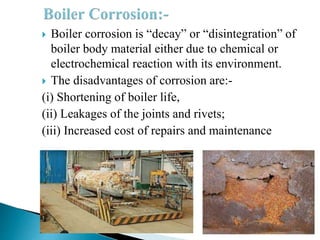
 Boiler corrosion is “decay” or “disintegration” of
boiler body material either due to chemical or
electrochemical reaction with its environment.
 The disadvantages of corrosion are:-
(i) Shortening of boiler life,
(ii) Leakages of the joints and rivets;
(iii) Increased cost of repairs and maintenance
Dissolved oxygen:-
This is the most usual corrosion causing factor.
 In boiler oxygen is introduce through the raw water
supply. Water usually contains about 8 PPM of dissolved
oxygen at room temp.
 As the water is heated, the dissolved oxygen is set free .
 Dissolved oxygen reacts with the iron of boiler in
presence of water and under prevailing high temperature
to form ferric oxide (rust).
 4Fe + 2H2O+ O2 4Fe(OH)2
 4Fe(OH)2 + O2 2 [Fe2O3 . 2H2O]
Ferric Oxide (Rust)
Corrosion in boilers is due to the following reasons:-
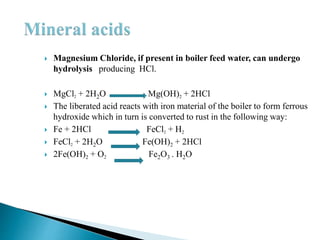
 Magnesium Chloride, if present in boiler feed water, can undergo
hydrolysis producing HCl.
 MgCl2 + 2H2O Mg(OH)2 + 2HCl
 The liberated acid reacts with iron material of the boiler to form ferrous
hydroxide which in turn is converted to rust in the following way:
 Fe + 2HCl FeCl2 + H2
 FeCl2 + 2H2O Fe(OH)2 + 2HCl
 2Fe(OH)2 + O2 Fe2O3 . H2O
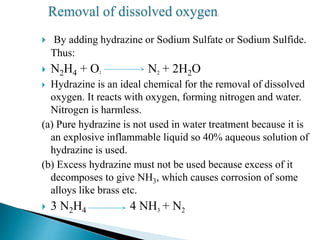
 By adding hydrazine or Sodium Sulfate or Sodium Sulfide.
Thus:
 N2H4 + O2 N2 + 2H2O
 Hydrazine is an ideal chemical for the removal of dissolved
oxygen. It reacts with oxygen, forming nitrogen and water.
Nitrogen is harmless.
(a) Pure hydrazine is not used in water treatment because it is
an explosive inflammable liquid so 40% aqueous solution of
hydrazine is used.
(b) Excess hydrazine must not be used because excess of it
decomposes to give NH3, which causes corrosion of some
alloys like brass etc.
 3 N2H4 4 NH3 + N2
Removal of dissolved oxygen:
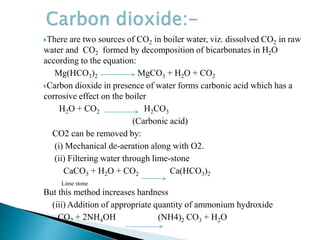
There are two sources of CO2 in boiler water, viz. dissolved CO2 in raw
water and CO2 formed by decomposition of bicarbonates in H2O
according to the equation:
Mg(HCO3)2 MgCO3 + H2O + CO2
Carbon dioxide in presence of water forms carbonic acid which has a
corrosive effect on the boiler
H2O + CO2 H2CO3
(Carbonic acid)
CO2 can be removed by:
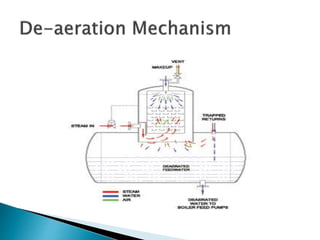
(i) Mechanical de-aeration along with O2.
(ii) Filtering water through lime-stone
CaCO3 + H2O + CO2 Ca(HCO3)2
Lime stone
But this method increases hardness
(iii) Addition of appropriate quantity of ammonium hydroxide
 CO2 + 2NH4OH (NH4)2 CO3 + H2O
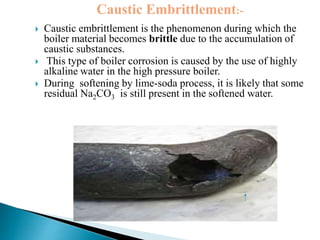
 Caustic embrittlement is the phenomenon during which the
boiler material becomes brittle due to the accumulation of
caustic substances.
 This type of boiler corrosion is caused by the use of highly
alkaline water in the high pressure boiler.
 During softening by lime-soda process, it is likely that some
residual Na2CO3 is still present in the softened water.
Caustic Embrittlement:-
 In high pressure boilers Na2CO3 decomposes to give
sodium hydroxide and CO2, and Sodium hydroxide
thus produced makes the boiler water “caustic”.
 Na2CO3 + H2O 2NaOH + CO2
 This caustic water flows into the minute hair-cracks,
present in the inner side of boiler, by capillary
action.
 On evaporation of water the dissolved caustic soda
concentration increases progressively which attacks
the surrounding area, thereby dissolving iron of
boiler as Sodium ferrote (Na2FeO2).
3 Na2FeO2 + 4 H2O 6 NaOH + Fe3O4 + H2
 By using sodium phosphate as softening reagent,
instead of sodium carbonate in external treatment of
boiler water.
 By adding tannin or lignin(decomposed part of plants
or nature organic matter) to boiler water which blocks
the hair-cracks in the boiler walls thereby preventing
infiltration of caustic soda solution into these areas, by
adding sodium sulphate to boiler water.
 Na2SO4 also blocks hair-cracks, thereby preventing
infiltration of caustic soda solution in these areas.
 Tannin and lignin blocks the heir line cracks and
thus prevent penetration of NaOH in these areas .
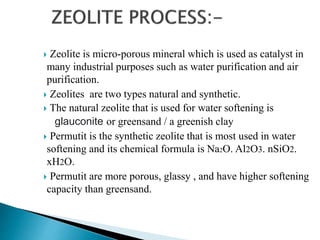
 Zeolite is micro-porous mineral which is used as catalyst in
many industrial purposes such as water purification and air
purification.
 Zeolites are two types natural and synthetic.
 The natural zeolite that is used for water softening is
glauconite or greensand / a greenish clay
 Permutit is the synthetic zeolite that is most used in water
softening and its chemical formula is Na2O. Al2O3. nSiO2.
xH2O.
 Permutit are more porous, glassy , and have higher softening
capacity than greensand.
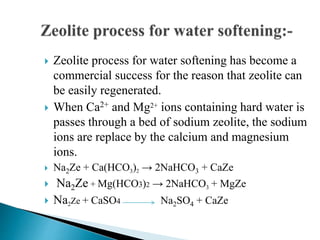
 Zeolite process for water softening has become a
commercial success for the reason that zeolite can
be easily regenerated.
 When Ca2+ and Mg2+ ions containing hard water is
passes through a bed of sodium zeolite, the sodium
ions are replace by the calcium and magnesium
ions.
 Na2Ze + Ca(HCO3)2 → 2NaHCO3 + CaZe
 Na2Ze + Mg(HCO3)2 → 2NaHCO3 + MgZe
 Na2Ze + CaSO4 Na2SO4 + CaZe
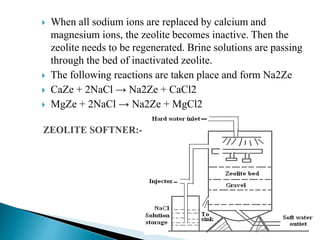
 When all sodium ions are replaced by calcium and
magnesium ions, the zeolite becomes inactive. Then the
zeolite needs to be regenerated. Brine solutions are passing
through the bed of inactivated zeolite.
 The following reactions are taken place and form Na2Ze
 CaZe + 2NaCl → Na2Ze + CaCl2
 MgZe + 2NaCl → Na2Ze + MgCl2
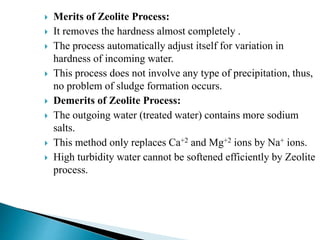
 Merits of Zeolite Process:
 It removes the hardness almost completely .
 The process automatically adjust itself for variation in
hardness of incoming water.
 This process does not involve any type of precipitation, thus,
no problem of sludge formation occurs.
 Demerits of Zeolite Process:
 The outgoing water (treated water) contains more sodium
salts.
 This method only replaces Ca+2 and Mg+2 ions by Na+ ions.
 High turbidity water cannot be softened efficiently by Zeolite
process.
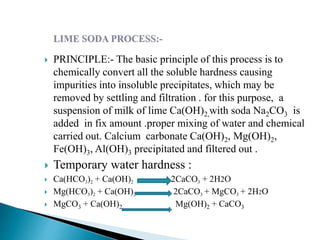
 PRINCIPLE:- The basic principle of this process is to
chemically convert all the soluble hardness causing
impurities into insoluble precipitates, which may be
removed by settling and filtration . for this purpose, a
suspension of milk of lime Ca(OH)2,with soda Na2CO3 is
added in fix amount .proper mixing of water and chemical
carried out. Calcium carbonate Ca(OH)2, Mg(OH)2,
Fe(OH)3, Al(OH)3 precipitated and filtered out .
 Temporary water hardness :
 Ca(HCO3)2 + Ca(OH)2 2CaCO3 + 2H2O
 Mg(HCO3)2 + Ca(OH)2 2CaCO3 + MgCO3 + 2H2O
 MgCO3 + Ca(OH)2 Mg(OH)2 + CaCO3
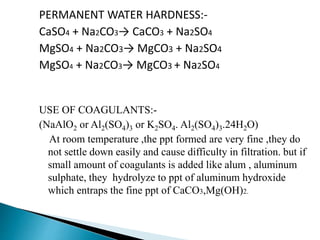
PERMANENT WATER HARDNESS:-
CaSO4 + Na2CO3→ CaCO3 + Na2SO4
MgSO4 + Na2CO3→ MgCO3 + Na2SO4
USE OF COAGULANTS:-
(NaAlO2 or Al2(SO4)3 or K2SO4. Al2(SO4)3.24H2O)
At room temperature ,the ppt formed are very fine ,they do
not settle down easily and cause difficulty in filtration. but if
small amount of coagulants is added like alum , aluminum
sulphate, they hydrolyze to ppt of aluminum hydroxide
which entraps the fine ppt of CaCO3,Mg(OH)2.
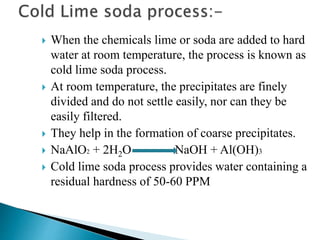
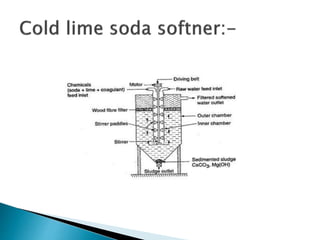
 When the chemicals lime or soda are added to hard
water at room temperature, the process is known as
cold lime soda process.
 At room temperature, the precipitates are finely
divided and do not settle easily, nor can they be
easily filtered.
 They help in the formation of coarse precipitates.
 NaAlO2 + 2H2O NaOH + Al(OH)3
 Cold lime soda process provides water containing a
residual hardness of 50-60 PPM
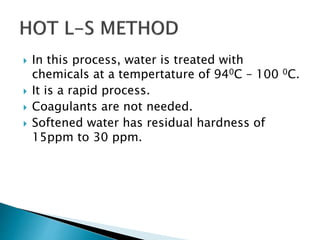
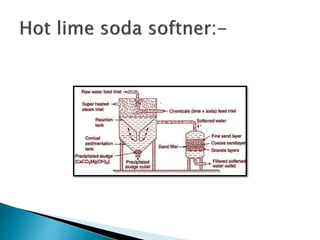
 In this process, water is treated with
chemicals at a tempertature of 940C – 100 0C.
 It is a rapid process.
 Coagulants are not needed.
 Softened water has residual hardness of
15ppm to 30 ppm.
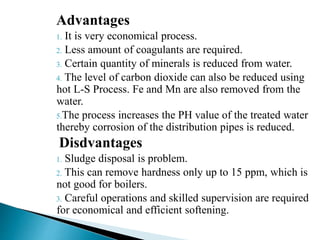
Advantages
1. It is very economical process.
2. Less amount of coagulants are required.
3. Certain quantity of minerals is reduced from water.
4. The level of carbon dioxide can also be reduced using
hot L-S Process. Fe and Mn are also removed from the
water.
5.The process increases the PH value of the treated water
thereby corrosion of the distribution pipes is reduced.
Disdvantages
1. Sludge disposal is problem.
2. This can remove hardness only up to 15 ppm, which is
not good for boilers.
3. Careful operations and skilled supervision are required
for economical and efficient softening.
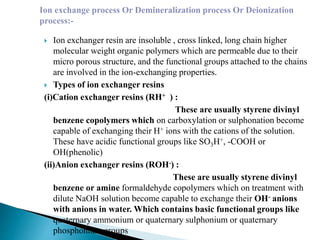
 Ion exchanger resin are insoluble , cross linked, long chain higher
molecular weight organic polymers which are permeable due to their
micro porous structure, and the functional groups attached to the chains
are involved in the ion-exchanging properties.
 Types of ion exchanger resins
(i)Cation exchanger resins (RH+ ) :
These are usually styrene divinyl
benzene copolymers which on carboxylation or sulphonation become
capable of exchanging their H+ ions with the cations of the solution.
These have acidic functional groups like SO3H+, -COOH or
OH(phenolic)
(ii)Anion exchanger resins (ROH-) :
These are usually styrene divinyl
benzene or amine formaldehyde copolymers which on treatment with
dilute NaOH solution become capable to exchange their OH- anions
with anions in water. Which contains basic functional groups like
quaternary ammonium or quaternary sulphonium or quaternary
phosphonium groups
Ion exchange process Or Demineralization process Or Deionization
process:-
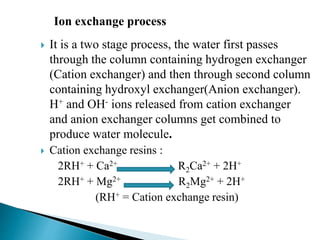
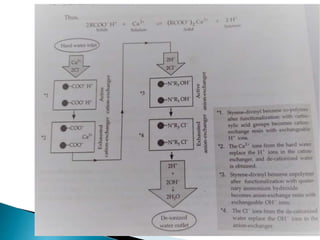
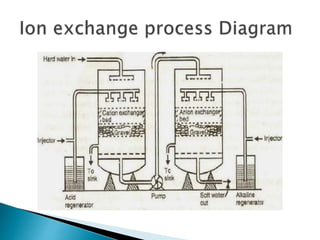
 It is a two stage process, the water first passes
through the column containing hydrogen exchanger
(Cation exchanger) and then through second column
containing hydroxyl exchanger(Anion exchanger).
H+ and OH- ions released from cation exchanger
and anion exchanger columns get combined to
produce water molecule.
 Cation exchange resins :
2RH+ + Ca2+ R2Ca2+ + 2H+
2RH+ + Mg2+ R2Mg2+ + 2H+
(RH+ = Cation exchange resin)
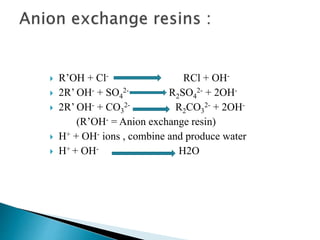
Ion exchange process
 R’OH + Cl- RCl + OH-
 2R’ OH- + SO4
2- R2SO4
2- + 2OH-
 2R’ OH- + CO3
2- R2CO3
2- + 2OH-
(R’OH- = Anion exchange resin)
 H+ + OH- ions , combine and produce water
 H+ + OH- H2O
 After some time the cation and anion exchanging resins lose
the capacity to remove H+ ions and OH- ions respectively,
they are then said to be exhausted.
 When the resins are exhausted, the supply of water is
stopped.
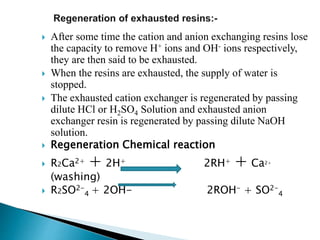
 The exhausted cation exchanger is regenerated by passing
dilute HCl or H2SO4 Solution and exhausted anion
exchanger resin is regenerated by passing dilute NaOH
solution.
 Regeneration Chemical reaction
 R2Ca2+ + 2H+ 2RH+ + Ca2+
(washing)
 R2SO2-
4 + 2OH- 2ROH- + SO2-
4
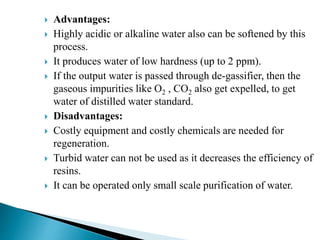
 Advantages:
 Highly acidic or alkaline water also can be softened by this
process.
 It produces water of low hardness (up to 2 ppm).
 If the output water is passed through de-gassifier, then the
gaseous impurities like O2 , CO2 also get expelled, to get
water of distilled water standard.
 Disadvantages:
 Costly equipment and costly chemicals are needed for
regeneration.
 Turbid water can not be used as it decreases the efficiency of
resins.
 It can be operated only small scale purification of water.
 Important internal conditioning / treatment
methods are :
(i) Colloidal Conditioning: In low pressure boilers,
scale formation can be avoided by adding organic
substances like kerosene, tannin, agar – agar etc,
which get coated over the scale forming
precipitates, thereby yielding non-sticky & loose
deposits, which can easily be removed by pre-
determined blow down operations.
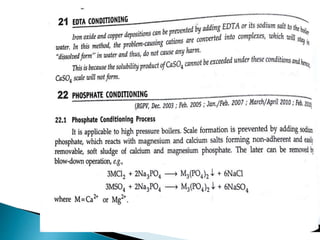
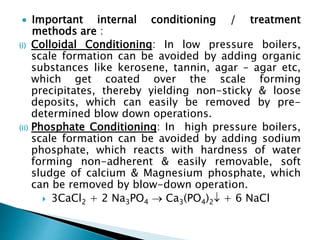
(ii) Phosphate Conditioning: In high pressure boilers,
scale formation can be avoided by adding sodium
phosphate, which reacts with hardness of water
forming non-adherent & easily removable, soft
sludge of calcium & Magnesium phosphate, which
can be removed by blow-down operation.
 3CaCl2 + 2 Na3PO4  Ca3(PO4)2 + 6 NaCl
 Carbonate Conditioning: In low pressure boilers, scale
formation can be avoided by adding sodium carbonate
to boiler water when CaSO4 is converted into calcium
carbonate in equilibrium
 CaSO4 + Na2CO3 CaCO3 + Na2SO4
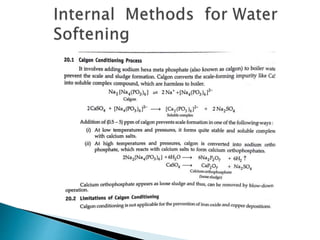
 (iv) Calgon Conditioning: It involves adding calgon
(NaPO3)6 to boiler water. It prevents the scale & sludge
formation by forming soluble complex compound with
CaSO4.
 Na2[Na4(PO3)6] 2Na+ + [Na4P6O18]2-
calgon
2CaSO4 + [Na4(P6O18)]2-  [Ca2P6O18]2- + 2Na2SO4
Soluble complex ion
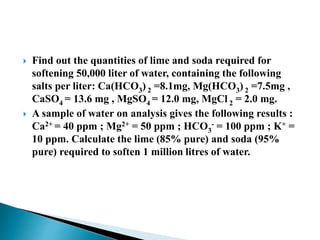
 Find out the quantities of lime and soda required for
softening 50,000 liter of water, containing the following
salts per liter: Ca(HCO3) 2 =8.1mg, Mg(HCO3) 2 =7.5mg ,
CaSO4 = 13.6 mg , MgSO4 = 12.0 mg, MgCl 2 = 2.0 mg.
 A sample of water on analysis gives the following results :
Ca2+ = 40 ppm ; Mg2+ = 50 ppm ; HCO3
- = 100 ppm ; K+ =
10 ppm. Calculate the lime (85% pure) and soda (95%
pure) required to soften 1 million litres of water.

unit 2_Boiler Problem and Softening methods_1681804779.pptx

  • 1.
     BOILER PROBLEMAND SOFTENING METHOD
  • 2.
    BOILER WATER (WATERFOR STEAM GENERATION):  A boiler is a closed vessel in which water under pressure is transferred into steam by the application of heat.  In the boiler furnace, the chemical energy in the fuel is converted into heat, and it is the function of the boiler to transfer this heat to the contained water in the most efficient manner.
  • 3.
    1. It shouldbe free from suspended solid and dissolved gases such as- CO2,SOx,NOx,halogen and hydrogen halide. 2. Hardness should be less than 0.1 ppm. 3. Alkalinity should be in the range 0.1to1 ppm.0.5 alkalinity is preferable. 4. Free from oily/soapy matter that reduce the surface tension of water. 5. Free from hardness producing substance.
  • 4.
     Excess ofimpurities, if present, in boiler feed water generally cause the following problems:  BOILER PROBLEM:  1. SLUDGE & SCALE FORMATION  2. PRIMING & FOAMING  3. CARRY OVER  4. BOILER CORROSION  5. CAUSTIC EMBRITTLEMENT
  • 5.
    In boiler, wateris converted to steam. during this process ,when the volume of water decrease and saturation point is reached and all dissolved salts precipitate out. If the precipitates formed are soft loose and slimy, these are known as sludges, while if the precipitate is hard and adhering on the inner walls, it is called as scale.
  • 7.
    SLUDGE:-  Sludge isa soft, loose and slimy precipitate formed within the boiler.  Sludge are formed by substances which have greater solubility in hot water than in cold water, e.g. MgCO3, MgCl2, CaCl2,MgSO4 etc.  They are formed at comparatively colder portions of the boiler get collected at places where the flow rate is slow; they can be easily removed (scrapped off) with a wire brush.
  • 8.
    (i) Sludges arepoor conductors of heat, so they tend to waste a portion of heat generated and thus decrease the efficiency of boiler. (ii) Excessive sludge formation disturbs the working of the boiler. It settles in the regions of poor water circulation such as pipe connection, plug opening, gauge-glass connection, there by causing even choking of the pipes.
  • 9.
     Prevention ofsludge formation:- By using softened water. By frequently ‘blow-down operation’, (i.e. partial removal of concentrated water through a )tap at the bottom of boiler and replacing it by fresh water.
  • 10.
    SCALES:-  Scales arehard deposits firmly sticking to the inner surfaces of the boiler.  They are difficult to remove, even with the help of hammer and chisel, and are the main source of boiler troubles. Decomposition of calcium bicarbonate:-  Ca(HCO3)2 CaCO3 + H2O + CO2 (scale)  Calcium carbonate is soft and is the main cause of scale formation in low-pressure boilers. But in high-pressure boilers, CaCO3 is soluble due to the formation of Ca(OH)2  CaCO3 + H2O Ca(OH)2 + CO2 (soluble)
  • 11.
    Deposition of calciumsulphate:-  CaSO4 is soluble in cold water, but almost completely insoluble in super-heated water.  Consequently, CaSO4 gets precipitated as hard scale on the hotter parts, of the boiler.  This type of scale causes troubles mainly in high pressure boilers.  Calcium sulfate scale is quite adherent and difficult to remove, even with the help of hammer and chisel.
  • 12.
    Hydrolysis of magnesiumsalts MgCl2 + 2H2O Mg(OH)2 + 2HCl (scale) Presence of silica:- Even if a small quantity of SiO2 is present, it may deposit as calcium silicate (CaSiO3) and / or magnesium silicate (MgSiO3). These deposits adhere very firmly on the inner side of the boiler surface and are very difficult to remove. One important source of silica in water is the sand filter.
  • 13.
    Disadvantage of Scale- Wastageof fuel:- Scales have a poor thermal conductivity so the rate of heat transfer from boiler to inside water is greatly reduced. The wastage of fuel being dependent on the thickness and the nature of scale. Lowering of boiler safety:- Due to scale formation, over-heating of boiler is done in order to maintain a steady supply of steam. It makes the boiler material softer and weaker. This cause distortion of boiler tube and also makes the boiler unsafe to bear the pressure of the steam, especially in high-pressure boilers.
  • 14.
    Decrease in Efficiency:- Depositionof scales in the valves and condensers of the boiler, choke them partially. This results in decrease in efficiency of the boiler. Danger of Explosion :- When thick scales crack due to uneven expansion, the water comes suddenly in contact with over-heated portion and large amount of steam is formed instantaneously. This results in development of sudden of sudden high-pressure which may cause explosion of the boiler.
  • 15.
     Removal ofScales:  Scales are removed by mechanical methods and by Chemical Methods .  If the scales are loosely adhering, it can be removed with the help of scraper or piece of wood or wire brush,  If the scales are brittle, it can be removed by giving thermal shocks (i.e., heating the boiler and then suddenly cooling with cold water).  If the scales are loosely adhering, they can also be removed by frequent blow-down operation. Blow-down operation is partial removal of hard water through a ‘tap’ at the bottom of the boiler and add soft water.  If the scales are adherent and hard, they can be removed by dissolving them by adding chemicals e.g., CaCO3 scales can be dissolved by using 5-10% HCl. Calcium sulfate scales can be removed by adding EDTA, since the Ca – EDTA complex is highly soluble in water.
  • 16.
    s.no. SLUDGE SCALE 1.Sludges are soft, loose and slimy precipitate. Scales are hard deposits. 2. They are non-adherent deposits and can be easily removed. They stick very firmly to the inner surface of boiler and are very difficult to remove. 3. Formed by substances like CaCl2, MgCl2, MgSO4, MgCO3 etc. Formed by substance like CaSO4, Mg(OH)2 etc. 4. Formed at comparatively colder portions of the boiler. Formed generally at heated portions of the boiler. 5. They decrease the efficiency of boiler but are less dangerous. Decrease the efficiency of boiler and chances of explosions are also there. 6. Can be removed by blow- down operation. Cannot be removed by blow- down operation.
  • 17.
     Priming:-  Whensteam is produced rapidly in the boilers, some droplets of the liquid water are carried along-with the steam. This process of ‘wet- steam’ formation is called priming.  The moisture contamination in the steam is expressed in percentage by weight of Steam.  For example, if steam contains 0.2% moisture, its steam quality will be reported as 100 – 0.2 = 99.8%.
  • 19.
     Mainly dueto suspended impurities and due to dissolved impurities in water.  Steam velocities high enough to carry droplets of water into the steam pipe;  Sudden boiling;  Faulty design of boiler.
  • 20.
     Controlling rapidchange in steaming velocities,  The proper design of boilers (maintaining low water levels in boilers)  Ensuring efficient softening and Filtration of the boiler-water carried over to the boiler.  By blowing off sludge or scales from time to time.
  • 21.
     Foaming isthe formation of small but persistent foam or bubbles at the water surface in boilers, which do not break easily.  Foaming is caused by the presence of oil and alkalis in boiler-feed water.  Actually oils and alkalis react to form soap, which greatly lowers the surface tension of water, and thus increase the foaming tendency of the liquid.  With respect to foaming, water can be following grades:  (i) Foaming water:- It is that water which produces foam even in two days, if blowing off operation is not done.  (ii) Semi-Foaming water:-. It is that water which does not produce any foam in locomotive boilers for two days.  (iii) Non-Foaming water:- It is that water which does not produce any foam in locomotive boilers for one week.
  • 22.
    Foaming can beavoided by:  The addition of anti foaming agent, for example addition of castor oil (which spreads on the surface of water and therefore) neutralizes the surface tension reduction.  Traces oils are generally introduced in boiler feed water through the lubricating materials used for pumps etc. the removal of foaming agent (Lubricating oil) from boiler water.  Oils can be removed by the addition of aluminum compounds, like Sodium Aluminate and Aluminum sulphate which is hydrolyzed to form Aluminum hydroxide flocks which entrap oil drops.  The flocks of Al(OH)3 containing oil droplets are removed by filtration through anthracite (Anthracite, also known as hard coal,)filter bed.
  • 23.
    The phenomenon ofcarrying of water along with impurities by steam is called “carry over”.  This is mainly due to priming and foaming .  Priming and foaming usually occur together. Dissolved salts or suspended solids in boiler water are carried by the wet steam to super heater and turbine blades, where they get deposited as water evaporates. This deposit decreases the efficiency of boiler. Dissolved salts may enter the parts of other machinery, thereby decreasing their life; The maintenance of the boiler pressure becomes difficult because of improper judgment of actual height of water colum.
  • 24.
     Boiler corrosionis “decay” or “disintegration” of boiler body material either due to chemical or electrochemical reaction with its environment.  The disadvantages of corrosion are:- (i) Shortening of boiler life, (ii) Leakages of the joints and rivets; (iii) Increased cost of repairs and maintenance
  • 25.
    Dissolved oxygen:- This isthe most usual corrosion causing factor.  In boiler oxygen is introduce through the raw water supply. Water usually contains about 8 PPM of dissolved oxygen at room temp.  As the water is heated, the dissolved oxygen is set free .  Dissolved oxygen reacts with the iron of boiler in presence of water and under prevailing high temperature to form ferric oxide (rust).  4Fe + 2H2O+ O2 4Fe(OH)2  4Fe(OH)2 + O2 2 [Fe2O3 . 2H2O] Ferric Oxide (Rust) Corrosion in boilers is due to the following reasons:-
  • 26.
     Magnesium Chloride,if present in boiler feed water, can undergo hydrolysis producing HCl.  MgCl2 + 2H2O Mg(OH)2 + 2HCl  The liberated acid reacts with iron material of the boiler to form ferrous hydroxide which in turn is converted to rust in the following way:  Fe + 2HCl FeCl2 + H2  FeCl2 + 2H2O Fe(OH)2 + 2HCl  2Fe(OH)2 + O2 Fe2O3 . H2O
  • 27.
     By addinghydrazine or Sodium Sulfate or Sodium Sulfide. Thus:  N2H4 + O2 N2 + 2H2O  Hydrazine is an ideal chemical for the removal of dissolved oxygen. It reacts with oxygen, forming nitrogen and water. Nitrogen is harmless. (a) Pure hydrazine is not used in water treatment because it is an explosive inflammable liquid so 40% aqueous solution of hydrazine is used. (b) Excess hydrazine must not be used because excess of it decomposes to give NH3, which causes corrosion of some alloys like brass etc.  3 N2H4 4 NH3 + N2 Removal of dissolved oxygen:
  • 28.
    There are twosources of CO2 in boiler water, viz. dissolved CO2 in raw water and CO2 formed by decomposition of bicarbonates in H2O according to the equation: Mg(HCO3)2 MgCO3 + H2O + CO2 Carbon dioxide in presence of water forms carbonic acid which has a corrosive effect on the boiler H2O + CO2 H2CO3 (Carbonic acid) CO2 can be removed by: (i) Mechanical de-aeration along with O2. (ii) Filtering water through lime-stone CaCO3 + H2O + CO2 Ca(HCO3)2 Lime stone But this method increases hardness (iii) Addition of appropriate quantity of ammonium hydroxide  CO2 + 2NH4OH (NH4)2 CO3 + H2O
  • 30.
     Caustic embrittlementis the phenomenon during which the boiler material becomes brittle due to the accumulation of caustic substances.  This type of boiler corrosion is caused by the use of highly alkaline water in the high pressure boiler.  During softening by lime-soda process, it is likely that some residual Na2CO3 is still present in the softened water. Caustic Embrittlement:-
  • 31.
     In highpressure boilers Na2CO3 decomposes to give sodium hydroxide and CO2, and Sodium hydroxide thus produced makes the boiler water “caustic”.  Na2CO3 + H2O 2NaOH + CO2  This caustic water flows into the minute hair-cracks, present in the inner side of boiler, by capillary action.  On evaporation of water the dissolved caustic soda concentration increases progressively which attacks the surrounding area, thereby dissolving iron of boiler as Sodium ferrote (Na2FeO2). 3 Na2FeO2 + 4 H2O 6 NaOH + Fe3O4 + H2
  • 32.
     By usingsodium phosphate as softening reagent, instead of sodium carbonate in external treatment of boiler water.  By adding tannin or lignin(decomposed part of plants or nature organic matter) to boiler water which blocks the hair-cracks in the boiler walls thereby preventing infiltration of caustic soda solution into these areas, by adding sodium sulphate to boiler water.  Na2SO4 also blocks hair-cracks, thereby preventing infiltration of caustic soda solution in these areas.  Tannin and lignin blocks the heir line cracks and thus prevent penetration of NaOH in these areas .
  • 34.
     Zeolite ismicro-porous mineral which is used as catalyst in many industrial purposes such as water purification and air purification.  Zeolites are two types natural and synthetic.  The natural zeolite that is used for water softening is glauconite or greensand / a greenish clay  Permutit is the synthetic zeolite that is most used in water softening and its chemical formula is Na2O. Al2O3. nSiO2. xH2O.  Permutit are more porous, glassy , and have higher softening capacity than greensand.
  • 35.
     Zeolite processfor water softening has become a commercial success for the reason that zeolite can be easily regenerated.  When Ca2+ and Mg2+ ions containing hard water is passes through a bed of sodium zeolite, the sodium ions are replace by the calcium and magnesium ions.  Na2Ze + Ca(HCO3)2 → 2NaHCO3 + CaZe  Na2Ze + Mg(HCO3)2 → 2NaHCO3 + MgZe  Na2Ze + CaSO4 Na2SO4 + CaZe
  • 36.
     When allsodium ions are replaced by calcium and magnesium ions, the zeolite becomes inactive. Then the zeolite needs to be regenerated. Brine solutions are passing through the bed of inactivated zeolite.  The following reactions are taken place and form Na2Ze  CaZe + 2NaCl → Na2Ze + CaCl2  MgZe + 2NaCl → Na2Ze + MgCl2
  • 37.
     Merits ofZeolite Process:  It removes the hardness almost completely .  The process automatically adjust itself for variation in hardness of incoming water.  This process does not involve any type of precipitation, thus, no problem of sludge formation occurs.  Demerits of Zeolite Process:  The outgoing water (treated water) contains more sodium salts.  This method only replaces Ca+2 and Mg+2 ions by Na+ ions.  High turbidity water cannot be softened efficiently by Zeolite process.
  • 38.
     PRINCIPLE:- Thebasic principle of this process is to chemically convert all the soluble hardness causing impurities into insoluble precipitates, which may be removed by settling and filtration . for this purpose, a suspension of milk of lime Ca(OH)2,with soda Na2CO3 is added in fix amount .proper mixing of water and chemical carried out. Calcium carbonate Ca(OH)2, Mg(OH)2, Fe(OH)3, Al(OH)3 precipitated and filtered out .  Temporary water hardness :  Ca(HCO3)2 + Ca(OH)2 2CaCO3 + 2H2O  Mg(HCO3)2 + Ca(OH)2 2CaCO3 + MgCO3 + 2H2O  MgCO3 + Ca(OH)2 Mg(OH)2 + CaCO3
  • 39.
    PERMANENT WATER HARDNESS:- CaSO4+ Na2CO3→ CaCO3 + Na2SO4 MgSO4 + Na2CO3→ MgCO3 + Na2SO4 MgSO4 + Na2CO3→ MgCO3 + Na2SO4 USE OF COAGULANTS:- (NaAlO2 or Al2(SO4)3 or K2SO4. Al2(SO4)3.24H2O) At room temperature ,the ppt formed are very fine ,they do not settle down easily and cause difficulty in filtration. but if small amount of coagulants is added like alum , aluminum sulphate, they hydrolyze to ppt of aluminum hydroxide which entraps the fine ppt of CaCO3,Mg(OH)2.
  • 40.
     When thechemicals lime or soda are added to hard water at room temperature, the process is known as cold lime soda process.  At room temperature, the precipitates are finely divided and do not settle easily, nor can they be easily filtered.  They help in the formation of coarse precipitates.  NaAlO2 + 2H2O NaOH + Al(OH)3  Cold lime soda process provides water containing a residual hardness of 50-60 PPM
  • 42.
     In thisprocess, water is treated with chemicals at a tempertature of 940C – 100 0C.  It is a rapid process.  Coagulants are not needed.  Softened water has residual hardness of 15ppm to 30 ppm.
  • 44.
    Advantages 1. It isvery economical process. 2. Less amount of coagulants are required. 3. Certain quantity of minerals is reduced from water. 4. The level of carbon dioxide can also be reduced using hot L-S Process. Fe and Mn are also removed from the water. 5.The process increases the PH value of the treated water thereby corrosion of the distribution pipes is reduced. Disdvantages 1. Sludge disposal is problem. 2. This can remove hardness only up to 15 ppm, which is not good for boilers. 3. Careful operations and skilled supervision are required for economical and efficient softening.
  • 45.
     Ion exchangerresin are insoluble , cross linked, long chain higher molecular weight organic polymers which are permeable due to their micro porous structure, and the functional groups attached to the chains are involved in the ion-exchanging properties.  Types of ion exchanger resins (i)Cation exchanger resins (RH+ ) : These are usually styrene divinyl benzene copolymers which on carboxylation or sulphonation become capable of exchanging their H+ ions with the cations of the solution. These have acidic functional groups like SO3H+, -COOH or OH(phenolic) (ii)Anion exchanger resins (ROH-) : These are usually styrene divinyl benzene or amine formaldehyde copolymers which on treatment with dilute NaOH solution become capable to exchange their OH- anions with anions in water. Which contains basic functional groups like quaternary ammonium or quaternary sulphonium or quaternary phosphonium groups Ion exchange process Or Demineralization process Or Deionization process:-
  • 46.
     It isa two stage process, the water first passes through the column containing hydrogen exchanger (Cation exchanger) and then through second column containing hydroxyl exchanger(Anion exchanger). H+ and OH- ions released from cation exchanger and anion exchanger columns get combined to produce water molecule.  Cation exchange resins : 2RH+ + Ca2+ R2Ca2+ + 2H+ 2RH+ + Mg2+ R2Mg2+ + 2H+ (RH+ = Cation exchange resin) Ion exchange process
  • 49.
     R’OH +Cl- RCl + OH-  2R’ OH- + SO4 2- R2SO4 2- + 2OH-  2R’ OH- + CO3 2- R2CO3 2- + 2OH- (R’OH- = Anion exchange resin)  H+ + OH- ions , combine and produce water  H+ + OH- H2O
  • 50.
     After sometime the cation and anion exchanging resins lose the capacity to remove H+ ions and OH- ions respectively, they are then said to be exhausted.  When the resins are exhausted, the supply of water is stopped.  The exhausted cation exchanger is regenerated by passing dilute HCl or H2SO4 Solution and exhausted anion exchanger resin is regenerated by passing dilute NaOH solution.  Regeneration Chemical reaction  R2Ca2+ + 2H+ 2RH+ + Ca2+ (washing)  R2SO2- 4 + 2OH- 2ROH- + SO2- 4
  • 51.
     Advantages:  Highlyacidic or alkaline water also can be softened by this process.  It produces water of low hardness (up to 2 ppm).  If the output water is passed through de-gassifier, then the gaseous impurities like O2 , CO2 also get expelled, to get water of distilled water standard.  Disadvantages:  Costly equipment and costly chemicals are needed for regeneration.  Turbid water can not be used as it decreases the efficiency of resins.  It can be operated only small scale purification of water.
  • 55.
     Important internalconditioning / treatment methods are : (i) Colloidal Conditioning: In low pressure boilers, scale formation can be avoided by adding organic substances like kerosene, tannin, agar – agar etc, which get coated over the scale forming precipitates, thereby yielding non-sticky & loose deposits, which can easily be removed by pre- determined blow down operations. (ii) Phosphate Conditioning: In high pressure boilers, scale formation can be avoided by adding sodium phosphate, which reacts with hardness of water forming non-adherent & easily removable, soft sludge of calcium & Magnesium phosphate, which can be removed by blow-down operation.  3CaCl2 + 2 Na3PO4  Ca3(PO4)2 + 6 NaCl
  • 56.
     Carbonate Conditioning:In low pressure boilers, scale formation can be avoided by adding sodium carbonate to boiler water when CaSO4 is converted into calcium carbonate in equilibrium  CaSO4 + Na2CO3 CaCO3 + Na2SO4  (iv) Calgon Conditioning: It involves adding calgon (NaPO3)6 to boiler water. It prevents the scale & sludge formation by forming soluble complex compound with CaSO4.  Na2[Na4(PO3)6] 2Na+ + [Na4P6O18]2- calgon 2CaSO4 + [Na4(P6O18)]2-  [Ca2P6O18]2- + 2Na2SO4 Soluble complex ion
  • 57.
     Find outthe quantities of lime and soda required for softening 50,000 liter of water, containing the following salts per liter: Ca(HCO3) 2 =8.1mg, Mg(HCO3) 2 =7.5mg , CaSO4 = 13.6 mg , MgSO4 = 12.0 mg, MgCl 2 = 2.0 mg.  A sample of water on analysis gives the following results : Ca2+ = 40 ppm ; Mg2+ = 50 ppm ; HCO3 - = 100 ppm ; K+ = 10 ppm. Calculate the lime (85% pure) and soda (95% pure) required to soften 1 million litres of water.