LIFE PROCESSES
Class – 10th
PART – 2
neharohtagi1
TRANSPORTATION
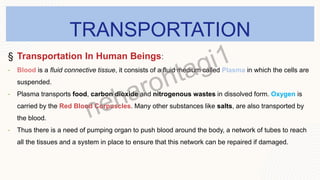
§ Transportation In Human Beings:
‱ Blood is a fluid connective tissue, it consists of a fluid medium called Plasma in which the cells are
suspended.
‱ Plasma transports food, carbon dioxide and nitrogenous wastes in dissolved form. Oxygen is
carried by the Red Blood Corpuscles. Many other substances like salts, are also transported by
the blood.
‱ Thus there is a need of pumping organ to push blood around the body, a network of tubes to reach
all the tissues and a system in place to ensure that this network can be repaired if damaged.
The Heart
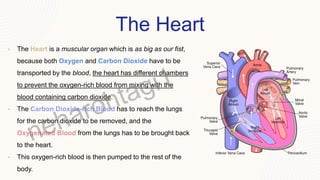
‱ The Heart is a muscular organ which is as big as our fist,
because both Oxygen and Carbon Dioxide have to be
transported by the blood, the heart has different chambers
to prevent the oxygen-rich blood from mixing with the
blood containing carbon dioxide.
‱ The Carbon Dioxide-rich Blood has to reach the lungs
for the carbon dioxide to be removed, and the
Oxygenated Blood from the lungs has to be brought back
to the heart.
‱ This oxygen-rich blood is then pumped to the rest of the
body.
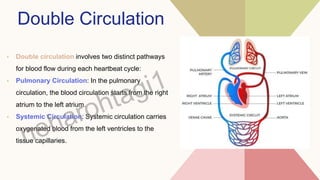
Double Circulation
‱ Double circulation involves two distinct pathways
for blood flow during each heartbeat cycle:
‱ Pulmonary Circulation: In the pulmonary
circulation, the blood circulation starts from the right
atrium to the left atrium.
‱ Systemic Circulation: Systemic circulation carries
oxygenated blood from the left ventricles to the
tissue capillaries.
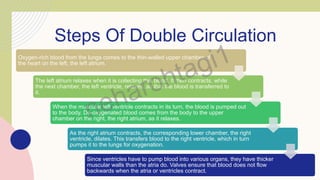
Steps Of Double Circulation
Oxygen-rich blood from the lungs comes to the thin-walled upper chamber of
the heart on the left, the left atrium.
The left atrium relaxes when it is collecting this blood. It then contracts, while
the next chamber, the left ventricle, relaxes, so that the blood is transferred to
it.
When the muscular left ventricle contracts in its turn, the blood is pumped out
to the body. De-oxygenated blood comes from the body to the upper
chamber on the right, the right atrium, as it relaxes.
As the right atrium contracts, the corresponding lower chamber, the right
ventricle, dilates. This transfers blood to the right ventricle, which in turn
pumps it to the lungs for oxygenation.
Since ventricles have to pump blood into various organs, they have thicker
muscular walls than the atria do. Valves ensure that blood does not flow
backwards when the atria or ventricles contract.
Oxygenation Of The Blood
o The separation of the right side and the left side of the heart is useful
to keep Oxygenated and Deoxygenated Blood from mixing. Such
separation allows a highly efficient supply of oxygen to the body.
o This is useful in animals that have high energy needs, such as Birds
and Mammals, which constantly use energy to maintain their body
temperature.
o In animals that do not use energy for this purpose, the body
temperature depends on the temperature in the environment.
o Such animals, like Amphibians or many reptiles have three-
chambered hearts, and tolerate some mixing of the oxygenated and
de-oxygenated blood streams.
o Fishes, on the other hand, have only two chambers to their hearts,
and the blood is pumped to the gills, is oxygenated there, and passes
directly to the rest of the body.
o Thus, blood goes only once through the heart in the fish during one
cycle of passage through the body.
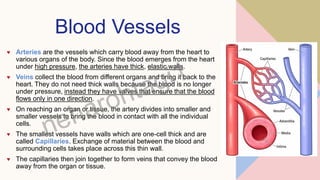
Blood Vessels
♄ Arteries are the vessels which carry blood away from the heart to
various organs of the body. Since the blood emerges from the heart
under high pressure, the arteries have thick, elastic walls.
♄ Veins collect the blood from different organs and bring it back to the
heart. They do not need thick walls because the blood is no longer
under pressure, instead they have valves that ensure that the blood
flows only in one direction.
♄ On reaching an organ or tissue, the artery divides into smaller and
smaller vessels to bring the blood in contact with all the individual
cells.
♄ The smallest vessels have walls which are one-cell thick and are
called Capillaries. Exchange of material between the blood and
surrounding cells takes place across this thin wall.
♄ The capillaries then join together to form veins that convey the blood
away from the organ or tissue.
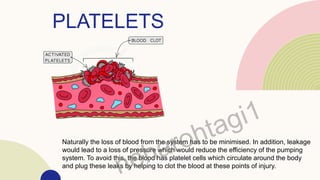
PLATELETS
Naturally the loss of blood from the system has to be minimised. In addition, leakage
would lead to a loss of pressure which would reduce the efficiency of the pumping
system. To avoid this, the blood has platelet cells which circulate around the body
and plug these leaks by helping to clot the blood at these points of injury.
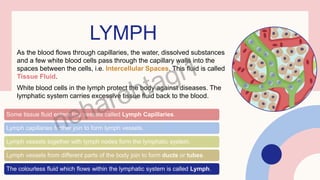
LYMPH
As the blood flows through capillaries, the water, dissolved substances
and a few white blood cells pass through the capillary walls into the
spaces between the cells, i.e. Intercellular Spaces. This fluid is called
Tissue Fluid.
White blood cells in the lymph protect the body against diseases. The
lymphatic system carries excessive tissue fluid back to the blood.
Some tissue fluid enters tiny vessels called Lymph Capillaries.
Lymph capillaries further join to form lymph vessels.
Lymph vessels together with lymph nodes form the lymphatic system.
Lymph vessels from different parts of the body join to form ducts or tubes.
The colourless fluid which flows within the lymphatic system is called Lymph.
Blood Pressure
 The force that blood exerts against the wall of a vessel is called Blood Pressure. This
pressure is much greater in arteries than in veins.
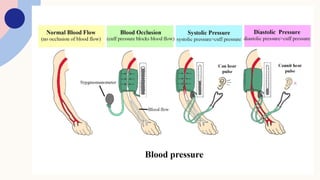
 The pressure of blood inside the artery during Ventricular Systole (contraction) is called
Systolic Pressure and pressure in artery during Ventricular Diastole (relaxation) is called
Diastolic Pressure.
 The normal systolic pressure is about 120 mm of Hg and diastolic pressure is 80 mm of Hg.
 Blood pressure is measured with an instrument called Sphygmomanometer.
 High blood pressure is also called Hypertension and is caused by the constriction of
arterioles, which results in increased resistance to blood flow.
 It can lead to the rupture of an artery and internal bleeding.
Transportation In Plants
‱ Transportation in plants is the process by which a substance, absorbed or synthesised in one part
of the plant, is transported to the other parts of the plant. Substances transported by the transport
system are water, mineral and food prepared by plants.
‱ The absorption of these substances therefore occurs through the part in contact with the soil,
namely Roots.
‱ If the distances between soil-contacting organs and chlorophyll containing organs are small, energy
and raw materials can easily diffuse to all parts of the plant body.
‱ But if these distances become large because of changes in plant body design, diffusion processes
will not be sufficient to provide raw material in leaves and energy in roots.
‱ A proper system of transportation is therefore essential in such situations.
Energy Requirements Of Plants
‱ Energy needs differ between different body designs. Plants do not move,
and plant bodies have a large proportion of dead cells in many tissues.
‱ As a result, plants have low energy needs, and can use relatively slow
transport systems. The distances over which transport systems have to
operate, however, can be very large in plants such as very tall trees.
‱ Plant transport systems will move energy stores from leaves and raw
materials from roots.
‱ These two pathways are constructed as independently organised conducting
tubes.
‱ Xylem: moves water and minerals obtained from the soil.
‱ Phloem: transports products of photosynthesis from the leaves where they
are synthesised to other parts of the plant.
Transport By Xylem
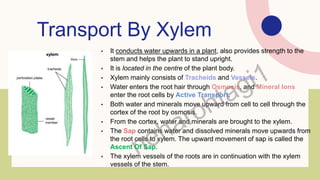
‱ It conducts water upwards in a plant, also provides strength to the
stem and helps the plant to stand upright.
‱ It is located in the centre of the plant body.
‱ Xylem mainly consists of Tracheids and Vessels.
‱ Water enters the root hair through Osmosis, and Mineral Ions
enter the root cells by Active Transport.
‱ Both water and minerals move upward from cell to cell through the
cortex of the root by osmosis.
‱ From the cortex, water and minerals are brought to the xylem.
‱ The Sap contains water and dissolved minerals move upwards from
the root cells to xylem. The upward movement of sap is called the
Ascent Of Sap.
‱ The xylem vessels of the roots are in continuation with the xylem
vessels of the stem.
Transpiration
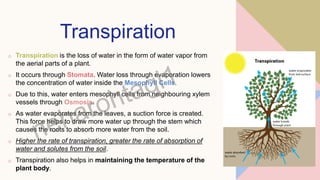
o Transpiration is the loss of water in the form of water vapor from
the aerial parts of a plant.
o It occurs through Stomata. Water loss through evaporation lowers
the concentration of water inside the Mesophyll Cells.
o Due to this, water enters mesophyll cells from neighbouring xylem
vessels through Osmosis.
o As water evaporates from the leaves, a suction force is created.
This force helps to draw more water up through the stem which
causes the roots to absorb more water from the soil.
o Higher the rate of transpiration, greater the rate of absorption of
water and solutes from the soil.
o Transpiration also helps in maintaining the temperature of the
plant body.
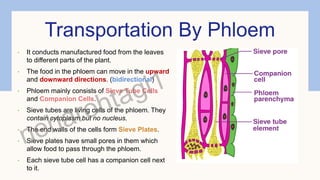
Transportation By Phloem
‱ It conducts manufactured food from the leaves
to different parts of the plant.
‱ The food in the phloem can move in the upward
and downward directions. (bidirectional)
‱ Phloem mainly consists of Sieve Tube Cells
and Companion Cells.
‱ Sieve tubes are living cells of the phloem. They
contain cytoplasm but no nucleus.
‱ The end walls of the cells form Sieve Plates.
‱ Sieve plates have small pores in them which
allow food to pass through the phloem.
‱ Each sieve tube cell has a companion cell next
to it.
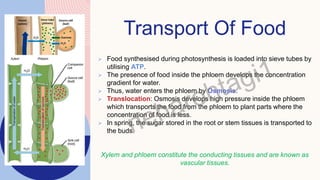
Transport Of Food
 Food synthesised during photosynthesis is loaded into sieve tubes by
utilising ATP.
 The presence of food inside the phloem develops the concentration
gradient for water.
 Thus, water enters the phloem by Osmosis.
 Translocation: Osmosis develops high pressure inside the phloem
which transports the food from the phloem to plant parts where the
concentration of food is less.
 In spring, the sugar stored in the root or stem tissues is transported to
the buds.
Xylem and phloem constitute the conducting tissues and are known as
vascular tissues.
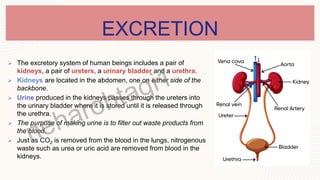
EXCRETION
 The excretory system of human beings includes a pair of
kidneys, a pair of ureters, a urinary bladder and a urethra.
 Kidneys are located in the abdomen, one on either side of the
backbone.
 Urine produced in the kidneys passes through the ureters into
the urinary bladder where it is stored until it is released through
the urethra.
 The purpose of making urine is to filter out waste products from
the blood.
 Just as CO2 is removed from the blood in the lungs, nitrogenous
waste such as urea or uric acid are removed from blood in the
kidneys.
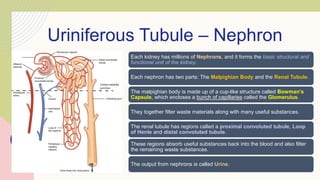
Uriniferous Tubule – Nephron
Each kidney has millions of Nephrons, and it forms the basic structural and
functional unit of the kidney.
Each nephron has two parts: The Malpighian Body and the Renal Tubule.
The malpighian body is made up of a cup-like structure called Bowman’s
Capsule, which encloses a bunch of capillaries called the Glomerulus.
They together filter waste materials along with many useful substances.
The renal tubule has regions called a proximal convoluted tubule, Loop
of Henle and distal convoluted tubule.
These regions absorb useful substances back into the blood and also filter
the remaining waste substances.
The output from nephrons is called Urine.
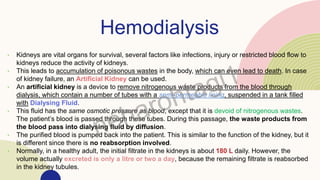
Hemodialysis
‱ Kidneys are vital organs for survival, several factors like infections, injury or restricted blood flow to
kidneys reduce the activity of kidneys.
‱ This leads to accumulation of poisonous wastes in the body, which can even lead to death. In case
of kidney failure, an Artificial Kidney can be used.
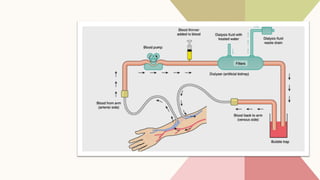
‱ An artificial kidney is a device to remove nitrogenous waste products from the blood through
dialysis, which contain a number of tubes with a semi-permeable lining, suspended in a tank filled
with Dialysing Fluid.
‱ This fluid has the same osmotic pressure as blood, except that it is devoid of nitrogenous wastes.
The patient’s blood is passed through these tubes. During this passage, the waste products from
the blood pass into dialysing fluid by diffusion.
‱ The purified blood is pumped back into the patient. This is similar to the function of the kidney, but it
is different since there is no reabsorption involved.
‱ Normally, in a healthy adult, the initial filtrate in the kidneys is about 180 L daily. However, the
volume actually excreted is only a litre or two a day, because the remaining filtrate is reabsorbed
in the kidney tubules.
Excretion By Plants
‱ Plants use completely different strategies for excretion than those of animals.
‱ Oxygen itself can be thought of as a waste product generated during
photosynthesis.
‱ They can get rid of excess water by transpiration.
‱ For other wastes, plants use the fact that many of their tissues consist of dead
cells, and that they can even lose some parts such as leaves.
‱ Many plant waste products are stored in cellular vacuoles. Waste products
may be stored in leaves that fall off.
‱ Other waste products are stored as resins and gums, especially in old xylem.
‱ Plants also excrete some waste substances into the soil around them.
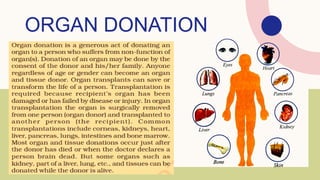
ORGAN DONATION
Life Processes Class 10th Part 2 CBSE NCERT

Life Processes Class 10th Part 2 CBSE NCERT

  • 1.
    LIFE PROCESSES Class –10th PART – 2 neharohtagi1
  • 2.
    TRANSPORTATION § Transportation InHuman Beings: ‱ Blood is a fluid connective tissue, it consists of a fluid medium called Plasma in which the cells are suspended. ‱ Plasma transports food, carbon dioxide and nitrogenous wastes in dissolved form. Oxygen is carried by the Red Blood Corpuscles. Many other substances like salts, are also transported by the blood. ‱ Thus there is a need of pumping organ to push blood around the body, a network of tubes to reach all the tissues and a system in place to ensure that this network can be repaired if damaged.
  • 3.
    The Heart ‱ TheHeart is a muscular organ which is as big as our fist, because both Oxygen and Carbon Dioxide have to be transported by the blood, the heart has different chambers to prevent the oxygen-rich blood from mixing with the blood containing carbon dioxide. ‱ The Carbon Dioxide-rich Blood has to reach the lungs for the carbon dioxide to be removed, and the Oxygenated Blood from the lungs has to be brought back to the heart. ‱ This oxygen-rich blood is then pumped to the rest of the body.
  • 4.
    Double Circulation ‱ Doublecirculation involves two distinct pathways for blood flow during each heartbeat cycle: ‱ Pulmonary Circulation: In the pulmonary circulation, the blood circulation starts from the right atrium to the left atrium. ‱ Systemic Circulation: Systemic circulation carries oxygenated blood from the left ventricles to the tissue capillaries.
  • 5.
    Steps Of DoubleCirculation Oxygen-rich blood from the lungs comes to the thin-walled upper chamber of the heart on the left, the left atrium. The left atrium relaxes when it is collecting this blood. It then contracts, while the next chamber, the left ventricle, relaxes, so that the blood is transferred to it. When the muscular left ventricle contracts in its turn, the blood is pumped out to the body. De-oxygenated blood comes from the body to the upper chamber on the right, the right atrium, as it relaxes. As the right atrium contracts, the corresponding lower chamber, the right ventricle, dilates. This transfers blood to the right ventricle, which in turn pumps it to the lungs for oxygenation. Since ventricles have to pump blood into various organs, they have thicker muscular walls than the atria do. Valves ensure that blood does not flow backwards when the atria or ventricles contract.
  • 6.
    Oxygenation Of TheBlood o The separation of the right side and the left side of the heart is useful to keep Oxygenated and Deoxygenated Blood from mixing. Such separation allows a highly efficient supply of oxygen to the body. o This is useful in animals that have high energy needs, such as Birds and Mammals, which constantly use energy to maintain their body temperature. o In animals that do not use energy for this purpose, the body temperature depends on the temperature in the environment. o Such animals, like Amphibians or many reptiles have three- chambered hearts, and tolerate some mixing of the oxygenated and de-oxygenated blood streams. o Fishes, on the other hand, have only two chambers to their hearts, and the blood is pumped to the gills, is oxygenated there, and passes directly to the rest of the body. o Thus, blood goes only once through the heart in the fish during one cycle of passage through the body.
  • 7.
    Blood Vessels ♄ Arteriesare the vessels which carry blood away from the heart to various organs of the body. Since the blood emerges from the heart under high pressure, the arteries have thick, elastic walls. ♄ Veins collect the blood from different organs and bring it back to the heart. They do not need thick walls because the blood is no longer under pressure, instead they have valves that ensure that the blood flows only in one direction. ♄ On reaching an organ or tissue, the artery divides into smaller and smaller vessels to bring the blood in contact with all the individual cells. ♄ The smallest vessels have walls which are one-cell thick and are called Capillaries. Exchange of material between the blood and surrounding cells takes place across this thin wall. ♄ The capillaries then join together to form veins that convey the blood away from the organ or tissue.
  • 8.
    PLATELETS Naturally the lossof blood from the system has to be minimised. In addition, leakage would lead to a loss of pressure which would reduce the efficiency of the pumping system. To avoid this, the blood has platelet cells which circulate around the body and plug these leaks by helping to clot the blood at these points of injury.
  • 9.
    LYMPH As the bloodflows through capillaries, the water, dissolved substances and a few white blood cells pass through the capillary walls into the spaces between the cells, i.e. Intercellular Spaces. This fluid is called Tissue Fluid. White blood cells in the lymph protect the body against diseases. The lymphatic system carries excessive tissue fluid back to the blood. Some tissue fluid enters tiny vessels called Lymph Capillaries. Lymph capillaries further join to form lymph vessels. Lymph vessels together with lymph nodes form the lymphatic system. Lymph vessels from different parts of the body join to form ducts or tubes. The colourless fluid which flows within the lymphatic system is called Lymph.
  • 10.
    Blood Pressure  Theforce that blood exerts against the wall of a vessel is called Blood Pressure. This pressure is much greater in arteries than in veins.  The pressure of blood inside the artery during Ventricular Systole (contraction) is called Systolic Pressure and pressure in artery during Ventricular Diastole (relaxation) is called Diastolic Pressure.  The normal systolic pressure is about 120 mm of Hg and diastolic pressure is 80 mm of Hg.  Blood pressure is measured with an instrument called Sphygmomanometer.  High blood pressure is also called Hypertension and is caused by the constriction of arterioles, which results in increased resistance to blood flow.  It can lead to the rupture of an artery and internal bleeding.
  • 12.
    Transportation In Plants ‱Transportation in plants is the process by which a substance, absorbed or synthesised in one part of the plant, is transported to the other parts of the plant. Substances transported by the transport system are water, mineral and food prepared by plants. ‱ The absorption of these substances therefore occurs through the part in contact with the soil, namely Roots. ‱ If the distances between soil-contacting organs and chlorophyll containing organs are small, energy and raw materials can easily diffuse to all parts of the plant body. ‱ But if these distances become large because of changes in plant body design, diffusion processes will not be sufficient to provide raw material in leaves and energy in roots. ‱ A proper system of transportation is therefore essential in such situations.
  • 13.
    Energy Requirements OfPlants ‱ Energy needs differ between different body designs. Plants do not move, and plant bodies have a large proportion of dead cells in many tissues. ‱ As a result, plants have low energy needs, and can use relatively slow transport systems. The distances over which transport systems have to operate, however, can be very large in plants such as very tall trees. ‱ Plant transport systems will move energy stores from leaves and raw materials from roots. ‱ These two pathways are constructed as independently organised conducting tubes. ‱ Xylem: moves water and minerals obtained from the soil. ‱ Phloem: transports products of photosynthesis from the leaves where they are synthesised to other parts of the plant.
  • 14.
    Transport By Xylem ‱It conducts water upwards in a plant, also provides strength to the stem and helps the plant to stand upright. ‱ It is located in the centre of the plant body. ‱ Xylem mainly consists of Tracheids and Vessels. ‱ Water enters the root hair through Osmosis, and Mineral Ions enter the root cells by Active Transport. ‱ Both water and minerals move upward from cell to cell through the cortex of the root by osmosis. ‱ From the cortex, water and minerals are brought to the xylem. ‱ The Sap contains water and dissolved minerals move upwards from the root cells to xylem. The upward movement of sap is called the Ascent Of Sap. ‱ The xylem vessels of the roots are in continuation with the xylem vessels of the stem.
  • 15.
    Transpiration o Transpiration isthe loss of water in the form of water vapor from the aerial parts of a plant. o It occurs through Stomata. Water loss through evaporation lowers the concentration of water inside the Mesophyll Cells. o Due to this, water enters mesophyll cells from neighbouring xylem vessels through Osmosis. o As water evaporates from the leaves, a suction force is created. This force helps to draw more water up through the stem which causes the roots to absorb more water from the soil. o Higher the rate of transpiration, greater the rate of absorption of water and solutes from the soil. o Transpiration also helps in maintaining the temperature of the plant body.
  • 16.
    Transportation By Phloem ‱It conducts manufactured food from the leaves to different parts of the plant. ‱ The food in the phloem can move in the upward and downward directions. (bidirectional) ‱ Phloem mainly consists of Sieve Tube Cells and Companion Cells. ‱ Sieve tubes are living cells of the phloem. They contain cytoplasm but no nucleus. ‱ The end walls of the cells form Sieve Plates. ‱ Sieve plates have small pores in them which allow food to pass through the phloem. ‱ Each sieve tube cell has a companion cell next to it.
  • 17.
    Transport Of Food Food synthesised during photosynthesis is loaded into sieve tubes by utilising ATP.  The presence of food inside the phloem develops the concentration gradient for water.  Thus, water enters the phloem by Osmosis.  Translocation: Osmosis develops high pressure inside the phloem which transports the food from the phloem to plant parts where the concentration of food is less.  In spring, the sugar stored in the root or stem tissues is transported to the buds. Xylem and phloem constitute the conducting tissues and are known as vascular tissues.
  • 18.
    EXCRETION  The excretorysystem of human beings includes a pair of kidneys, a pair of ureters, a urinary bladder and a urethra.  Kidneys are located in the abdomen, one on either side of the backbone.  Urine produced in the kidneys passes through the ureters into the urinary bladder where it is stored until it is released through the urethra.  The purpose of making urine is to filter out waste products from the blood.  Just as CO2 is removed from the blood in the lungs, nitrogenous waste such as urea or uric acid are removed from blood in the kidneys.
  • 19.
    Uriniferous Tubule –Nephron Each kidney has millions of Nephrons, and it forms the basic structural and functional unit of the kidney. Each nephron has two parts: The Malpighian Body and the Renal Tubule. The malpighian body is made up of a cup-like structure called Bowman’s Capsule, which encloses a bunch of capillaries called the Glomerulus. They together filter waste materials along with many useful substances. The renal tubule has regions called a proximal convoluted tubule, Loop of Henle and distal convoluted tubule. These regions absorb useful substances back into the blood and also filter the remaining waste substances. The output from nephrons is called Urine.
  • 20.
    Hemodialysis ‱ Kidneys arevital organs for survival, several factors like infections, injury or restricted blood flow to kidneys reduce the activity of kidneys. ‱ This leads to accumulation of poisonous wastes in the body, which can even lead to death. In case of kidney failure, an Artificial Kidney can be used. ‱ An artificial kidney is a device to remove nitrogenous waste products from the blood through dialysis, which contain a number of tubes with a semi-permeable lining, suspended in a tank filled with Dialysing Fluid. ‱ This fluid has the same osmotic pressure as blood, except that it is devoid of nitrogenous wastes. The patient’s blood is passed through these tubes. During this passage, the waste products from the blood pass into dialysing fluid by diffusion. ‱ The purified blood is pumped back into the patient. This is similar to the function of the kidney, but it is different since there is no reabsorption involved. ‱ Normally, in a healthy adult, the initial filtrate in the kidneys is about 180 L daily. However, the volume actually excreted is only a litre or two a day, because the remaining filtrate is reabsorbed in the kidney tubules.
  • 22.
    Excretion By Plants ‱Plants use completely different strategies for excretion than those of animals. ‱ Oxygen itself can be thought of as a waste product generated during photosynthesis. ‱ They can get rid of excess water by transpiration. ‱ For other wastes, plants use the fact that many of their tissues consist of dead cells, and that they can even lose some parts such as leaves. ‱ Many plant waste products are stored in cellular vacuoles. Waste products may be stored in leaves that fall off. ‱ Other waste products are stored as resins and gums, especially in old xylem. ‱ Plants also excrete some waste substances into the soil around them.
  • 23.