WATER SUPPLY AND SEWERAGE
ENGINEERING
(SESSIONAL)
CEE 334
Presented By Group- 2
1
INTRODUCTION
Reg:2013333027
SAFE DRINKING WATER
???
• SAFE to drink
• Free from disease spreading pathogens
• Free from aesthetic problem
• Above all free from all health risks
222 2
INTRODUCTION
Reg:2013333027
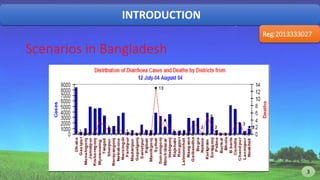
Scenarios in Bangladesh
3 3
INTRODUCTION
Reg:2013333027
THERE IS A BIG CRISIS OF SAFE
WATER IN BANGLADESH
4 4
INTRODUCTION
Reg:2013333027
.
• Experimented water of 2nd ladies hall
• Water Supply Engineering Sewerage Engineering
1. pH
2. CARBON DIOXIDE OF WATER
3. TURBIDITY OF WATER
4. CO2
5. IRON IN WATER
6. MANGANESE IN WATER
7. HARDNESS OF WATER
8. TS, DS AND SS
9. BIOCHEMICAL OXYGEN DEMAND (BOD) OF SEWAGE
10. CHEMICAL OXYGEN DEMAND (COD) OF SEWAGE
11. CHLORIDE
5 5
DETERMINATION OF pH OF WATER
Reg:2013333020PH=-log10[H+]
Measure- acid or alkaline condition of water.
PH is important for,
 Water supply.
 Sewage treatment.
 Chemical process plant.
 Biological treatment.
 Drinking water.
Use-digital PH meter.
-Electrometric method.
6 6
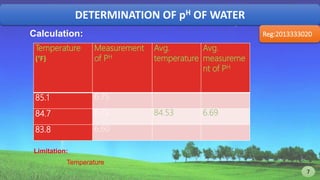
DETERMINATION OF pH OF WATER
Reg:2013333020
Temperature
(‘F)
Measurement
of PH
Avg.
temperature
Avg.
measureme
nt of PH
85.1 6.75
84.7 6.72 84.53 6.69
83.8 6.60
Calculation:
Limitation:
Temperature
7 7
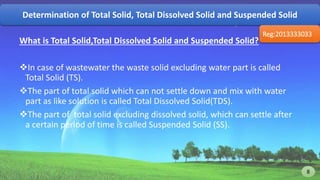
What is Total Solid,Total Dissolved Solid and Suspended Solid?
In case of wastewater the waste solid excluding water part is called
Total Solid (TS).
The part of total solid which can not settle down and mix with water
part as like solution is called Total Dissolved Solid(TDS).
The part of total solid excluding dissolved solid, which can settle after
a certain period of time is called Suspended Solid (SS).
Determination of Total Solid, Total Dissolved Solid and Suspended Solid
Reg:2013333033
8 8
Why its need to determine TS,TDS and SS?
First we detect ,what is our concern, to determine TS,TDS and SS or
to find out the proper treatment of wastewater?
If our concern with wastewater treatment then it will need to know
how much efficiency of wastewater to suspended its waste solid.
That’s why we need to measure these parameter.
Determination of Total Solid, Total Dissolved Solid and Suspended Solid
Reg:2013333033
9 9
Determination of Total Solid, Total Dissolved Solid and Suspended Solid
Figure:1 Figure:2
Reg:2013333033
10 10
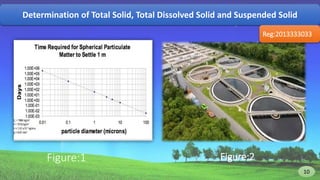
This (Fig. 1) indicate that if particle size is large (i.e. suspended solid)
then it can be remove in short time.
On the other hand, small particle (i.e. dissolved solid) take infinite
time period.
Data Table
Determination of Total Solid, Total Dissolved Solid and Suspended Solid
Weight of beaker
W1 (gm)
Weight of beaker
+ Suspended Solid
W2 (gm)
Weight of Suspended
Solid
(W2 -W1) mg
Total Solid
TS mg/L
100.998 101.0813 83.3 833
Weight of beaker
W1 (gm)
Weight of beaker
+ Dissolve Solid
W3 (gm)
Weight of Dissolve
Solid
(W3 -W1) mg
Total Dissolve Solid
TDS mg/L
108.4650 108.5237 58.7 587
Reg:2013333033
11 11
Findings: From experimental data we find,
TS =833 mg/l
TDS =587 mg/l
SS =246 mg/l
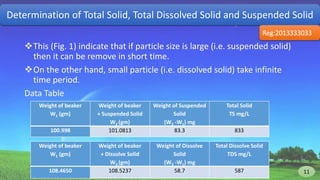
Its clear that sample contains more dissolve solid then suspended solid,
which is significantly tough to remove or treat the waste solid. Because
filter media ( Fig. 2) can remove only suspended solid from wastewater.
Determination of Total Solid, Total Dissolved Solid and Suspended Solid
Reg:2013333033
12 11
DETERMINATION OF CO2
Reg:2013333021
INTRODUCTION
→ Discovered in 1754 by the Scottish scientist Joseph Black (1727-
1799).
→ A colorless, odorless, incombustible gas
→ Total C𝑶 𝟐 = C𝑶 𝟐(free) + C𝑶 𝟐(HC𝑶 𝟑
−
& C𝑶 𝟑
𝟐−
)
→ Surface waters normally contain less than 10 ppm(1 ppm =1
milligram of something per liter of water) free C𝑶 𝟐 up to 50 ppm.
→ Ground waters may easily exceed that concentration.
13 13
DETERMINATION OF CO2
Reg:2013333021
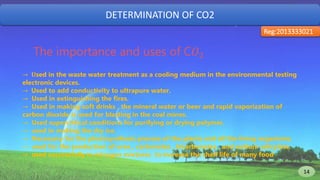
The importance and uses of C𝑂2
→ 𝐔sed in the waste water treatment as a cooling medium in the environmental testing
electronic devices.
→ Used to add conductivity to ultrapure water.
→ Used in extinguishing the fires.
→ Used in making soft drinks , the mineral water or beer and rapid vaporization of
carbon dioxide is used for blasting in the coal mines.
→ Used supercritical conditions for purifying or drying polymer.
→ used in making the dry ice.
→ Necessary for the photosynthesis process of the plants and all the living organisms.
→ used for the production of urea , carbonates , bicarbonates , and sodium salicylate.
→ used successfully in nitrogen mixtures to increase the shelf life of many food
14 14
DETERMINATION OF CO2
Reg:2013333021CALCULATION
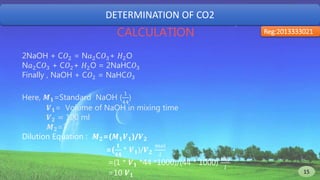
2NaOH + C𝑂2 = N𝑎2C𝑂3+ 𝐻2O
N𝑎2C𝑂3 + C𝑂2+ 𝐻2O = 2NaHC𝑂3
Finally , NaOH + C𝑂2 = NaHC𝑂3
Here, 𝑴 𝟏=Standard NaOH (
1
44
)
𝑽 𝟏= Volume of NaOH in mixing time
𝑽 𝟐 = 100 ml
𝑴 𝟐=?
Dilution Equation : 𝑴 𝟐=(𝑴 𝟏 𝑽 𝟏)/𝑽 𝟐
=(
𝟏
𝟒𝟒
* 𝑽 𝟏)/𝑽 𝟐
𝑚𝑜𝑙
𝑙
=(1 * 𝑽 𝟏 *44 *1000)/(44 * 1000)
𝑚𝑔
𝑙
=10 𝑽 𝟏
15 15
DETERMINATION OF CO2
Reg:2013333021
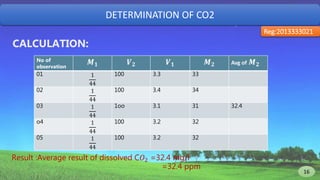
Result :Average result of dissolved C𝑂2 =32.4 mg/l
=32.4 ppm
No of
observation
𝑴 𝟏 𝑽 𝟐 𝑽 𝟏 𝑴 𝟐 Avg of 𝑴 𝟐
01 1
44
100 3.3 33
02 1
44
100 3.4 34
03 1
44
1oo 3.1 31 32.4
o4 1
44
100 3.2 32
05 1
44
100 3.2 32
CALCULATION:
16 16
DETERMINATION OF CO2
Reg:2013333021
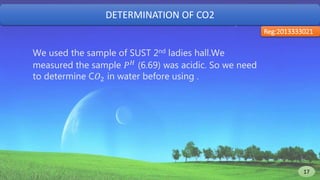
We used the sample of SUST 2nd ladies hall.We
measured the sample 𝑃 𝐻 (6.69) was acidic. So we need
to determine C𝑂2 in water before using .
17 17
Determination of Turbidity
Reg:2013333018
Turbidity
• Turbidity is a measure of the degree to which the water loses its transparency
due to the presence of suspended particulates.
• The more total suspended solids in the water, the murkier it seems and the
higher the turbidity.
• Turbidity is considered as a good measure of the quality of water.
18 18
Determination of Turbidity
Reg:2013333018
What causes turbidity?
There are various parameters influencing the cloudiness of the water.
Some of these are:
• Phytoplankton
• Sediments from erosion
• Suspended sediments from the bottom (frequently stir up by bottom feeders
like carp)
• Waste discharge
• Algae growth
• Urban runoff
19 19
Determination of Turbidity
Reg:2013333018
Maximum allowed turbidity in drinking water
• The WHO (World Health Organization), establishes that the turbidity
of drinking water shouldn't be more than 5 NTU, and should ideally
be below 1 NTU.
• For Bangladesh maximum limit of turbidity in drinking water is 25NTU
20 20
Determination of Turbidity
Reg:2013333018
Our Result
We found 3.315 NTU turbidity in our water sample.
21 21
Determination of Turbidity
About Our Result
3.315NTU<<<25NTU (Local standard for Bangladesh)
3.315NTU< 5NTU (International standard by WHO)
So our water is drinkable in turbidity standards. But as we know this
method does not measure any chemical or organic compound, which
can be harmful for human body the water must not be used until
further reports are compared.
Reg:2013333018
22 22
ALKALINITY TEST OF WATER
Reg:2013333031
What is alkalinity?
Alkalinity is measure of the ability of a solution to neutralize acids to the equivalence
point of hydroxide, carbonate or bicarbonate
23 23
ALKALINITY TEST OF WATER
Reg:2013333031
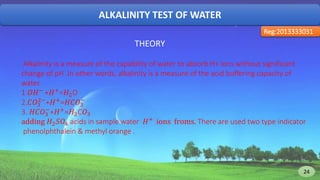
Alkalinity is a measure of the capability of water to absorb H+ ions without significant
change of pH .In other words, alkalinity is a measure of the acid buffering capacity of
water.
1.𝑂𝐻− +𝐻+=𝐻2O
2.𝐶𝑂3
2−
+𝐻+=𝐻𝐶𝑂3
−
3. 𝐻𝐶𝑂3
−
+𝐻+=𝐻2C𝑂3
adding 𝐻2 𝑆𝑂4 acids in sample water 𝐻+ ions froms. There are used two type indicator
phenolphthalein & methyl orange .
THEORY
24 24
ALKALINITY TEST OF WATER
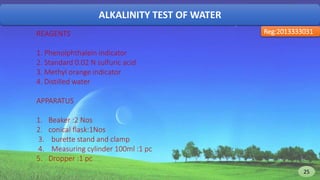
Reg:2013333031REAGENTS
1. Phenolphthalein indicator
2. Standard 0.02 N sulfuric acid
3. Methyl orange indicator
4. Distilled water
APPARATUS
1. Beaker :2 Nos
2. conical flask:1Nos
3. burette stand and clamp
4. Measuring cylinder 100ml :1 pc
5. Dropper :1 pc
25 25
ALKALINITY TEST OF WATER
Reg:2013333031
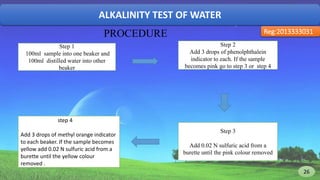
Step 1
100ml sample into one beaker and
100ml distilled water into other
beaker
Step 2
Add 3 drops of phenolphthalein
indicator to each. If the sample
becomes pink go to step 3 or step 4
Step 3
Add 0.02 N sulfuric acid from a
burette until the pink colour removed
PROCEDURE
step 4
Add 3 drops of methyl orange indicator
to each beaker. If the sample becomes
yellow add 0.02 N sulfuric acid from a
burette until the yellow colour
removed .
26 26
ALKALINITY TEST OF WATER
Reg:2013333031
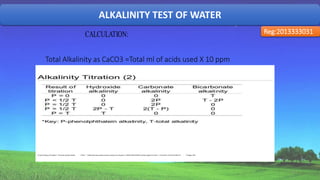
Total Alkalinity as CaCO3 =Total ml of acids used X 10 ppm
27
ALKALINITY TEST OF WATER
Reg:2013333031
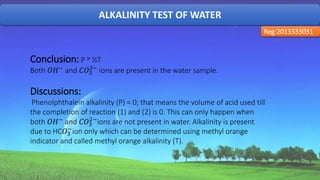
Conclusion: P ˃ ½T
Both 𝑂𝐻− and 𝐶𝑂3
2−
ions are present in the water sample.
Discussions:
Phenolphthalein alkalinity (P) = 0; that means the volume of acid used till
the completion of reaction (1) and (2) is 0. This can only happen when
both 𝑂𝐻− and 𝐶𝑂3
2−
ions are not present in water. Alkalinity is present
due to HC𝑂3
−
ion only which can be determined using methyl orange
indicator and called methyl orange alkalinity (T).
28
Iron is the fourth most abundant mineral in the earth’s crust. Soils
and rocks in Minnesota may contain minerals very high in iron.
 Water in the form of rain or melted snow travels from the ground’s
surface and through the soil to become part of a water supply.
DETERMINATION OF IRON IN WATER
Reg:2013333025
29
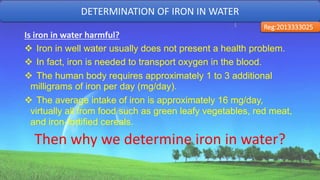
Is iron in water harmful?
 Iron in well water usually does not present a health problem.
 In fact, iron is needed to transport oxygen in the blood.
 The human body requires approximately 1 to 3 additional
milligrams of iron per day (mg/day).
 The average intake of iron is approximately 16 mg/day,
virtually all from food such as green leafy vegetables, red meat,
and iron-fortified cereals.
Then why we determine iron in water?
DETERMINATION OF IRON IN WATER
Reg:2013333025
30
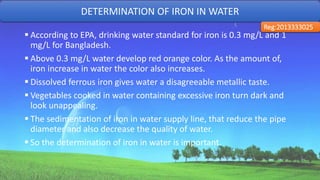
 According to EPA, drinking water standard for iron is 0.3 mg/L and 1
mg/L for Bangladesh.
 Above 0.3 mg/L water develop red orange color. As the amount of,
iron increase in water the color also increases.
 Dissolved ferrous iron gives water a disagreeable metallic taste.
 Vegetables cooked in water containing excessive iron turn dark and
look unappealing.
 The sedimentation of iron in water supply line, that reduce the pipe
diameter and also decrease the quality of water.
 So the determination of iron in water is important.
DETERMINATION OF IRON IN WATER
Reg:2013333025
31
DETERMINATION OF IRON IN WATER
Reg:2013333025
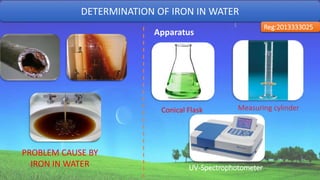
PROBLEM CAUSE BY
IRON IN WATER
Apparatus
Conical Flask Measuring cylinder
UV-Spectrophotometer 32
Findings: From experimental data we found,
 Iron concentration in sample was .16mg/L.
 The concentration is below the tolerable rang, so the sample has no
problem for iron concentration.
DETERMINATION OF IRON IN WATER
Reg:2013333025
33
DETRMINATION OF MANGANESE IN GIVEN SUPPLIED SAMPLE
Reg:2013333027
About Manganese….
Manganese is considered to be the 12th most abundant element in the
biosphere. Its concentration in earth crust reaches as high as 0.098%. It is
widely distributed in soil, water, sediment and biological materials
34
DETRMINATION OF MANGANESE IN GIVEN SUPPLIED SAMPLE
Reg:2013333027
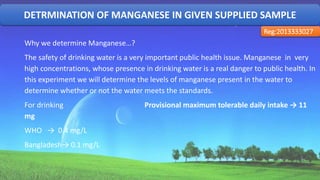
Why we determine Manganese…?
The safety of drinking water is a very important public health issue. Manganese in very
high concentrations, whose presence in drinking water is a real danger to public health. In
this experiment we will determine the levels of manganese present in the water to
determine whether or not the water meets the standards.
For drinking Provisional maximum tolerable daily intake → 11
mg
WHO → 0.4 mg/L
Bangladesh→ 0.1 mg/L
35
DETRMINATION OF MANGANESE IN GIVEN SUPPLIED SAMPLE
Reg:2013333027Following occurance can occur
Lack of Manganes
- Fatness
- Glucose intolerance
- Blood clotting
- Skin problems
- Lowered cholesterol levels
- Skeleton disorders
- Birth defects
- Changes of hair color
- Neurological symptoms
36
DETRMINATION OF MANGANESE IN GIVEN SUPPLIED SAMPLE
Reg:2013333027
Excess of Manganese
- Schizophrenia
- Dullness
- Weak muscles
- Headaches
- Insomnia
- Parkinson
37
DETRMINATION OF MANGANESE IN GIVEN SUPPLIED SAMPLE
Reg:2013333027
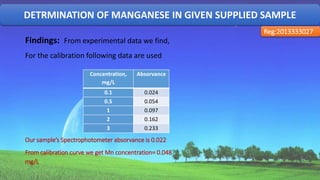
Findings: From experimental data we find,
For the calibration following data are used
Concentration,
mg/L
Absorvance
0.1 0.024
0.5 0.054
1 0.097
2 0.162
3 0.233
Our sample’s Spectrophotometer absorvance is 0.022
From calibration curve we get Mn concentration= 0.048
mg/L
38
DETRMINATION OF MANGANESE IN GIVEN SUPPLIED SAMPLE
Reg:2013333027
The sample we used for experiment is taken from 2nd ladis hall. Manganese
concentration of our sample water is 0.048 mg/L which is below than standard
limit of 0.1 mg/L in Bangladesh. So, this water is safe for drinking.
39
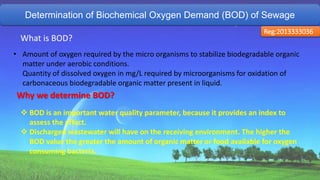
Determination of Biochemical Oxygen Demand (BOD) of Sewage
What is BOD?
• Amount of oxygen required by the micro organisms to stabilize biodegradable organic
matter under aerobic conditions.
Quantity of dissolved oxygen in mg/L required by microorganisms for oxidation of
carbonaceous biodegradable organic matter present in liquid.
Why we determine BOD?
 BOD is an important water quality parameter, because it provides an index to
assess the effect.
 Discharged wastewater will have on the receiving environment. The higher the
BOD value the greater the amount of organic matter or food available for oxygen
consuming bacteria.
Reg:2013333036
40
Determination of Biochemical Oxygen Demand (BOD) of Sewage
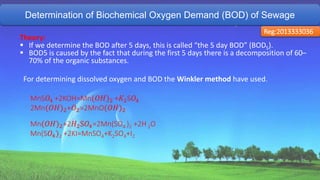
Theory:
 If we determine the BOD after 5 days, this is called “the 5 day BOD” (BOD5).
 BOD5 is caused by the fact that during the first 5 days there is a decomposition of 60–
70% of the organic substances.
For determining dissolved oxygen and BOD the Winkler method have used.
MnS𝑂4 +2KOH=Mn(𝑂𝐻)2 +𝐾2S𝑂4
2Mn(𝑂𝐻)2+𝑂2=2MnO(𝑂𝐻)2
Mn(𝑂𝐻)2+2𝐻2S𝑂4=2Mn(SO4 )2 +2H 2O
Mn(S𝑂4)2 +2KI=MnSO4+K2SO4+I2
Reg:2013333036
41
Determination of Biochemical Oxygen Demand (BOD) of Sewage
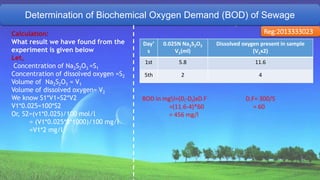
Calculation:
What result we have found from the
experiment is given below
Let,
Concentration of Na2S2O3 =S1
Concentration of dissolved oxygen =S2
Volume of Na2S2O3 = V1
Volume of dissolved oxygen= V2
We know S1*V1=S2*V2
V1*0.025=100*S2
Or, S2=(v1*0.025)/100 mol/l
= (V1*0.025*8*1000)/100 mg/l
=V1*2 mg/l
Day’
s
0.025N Na2S2O3
V1(ml)
Dissolved oxygen present in sample
(V1x2)
1st 5.8 11.6
5th 2 4
BOD in mgl=(Di-Df)xD.F
=(11.6-4)*60
= 456 mg/l
D.F= 300/5
= 60
Reg:2013333023
42
Determination of Biochemical Oxygen Demand (BOD) of Sewage
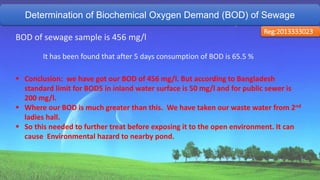
BOD of sewage sample is 456 mg/l
It has been found that after 5 days consumption of BOD is 65.5 %
 Conclusion: we have got our BOD of 456 mg/l. But according to Bangladesh
standard limit for BOD5 in inland water surface is 50 mg/l and for public sewer is
200 mg/l.
 Where our BOD is much greater than this. We have taken our waste water from 2nd
ladies hall.
 So this needed to further treat before exposing it to the open environment. It can
cause Environmental hazard to nearby pond.
Reg:2013333023
43
Determination of CHLORIDE (Mohr Method)
Reg:2013333022
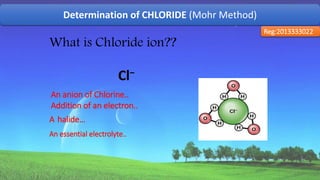
Cl−
An anion of Chlorine..
Addition of an electron..
A halide…
An essential electrolyte..
What is Chloride ion??
44
Determination of CHLORIDE (Mohr Method)
Reg:2013333022
Do we need chloride in our water ????
• Osmotic activity of body fluids…
• Combat against microbial contamination..
• Maintains our cell homeostasis..
• Transmits action potentials in neurons..
45
Determination of CHLORIDE (Mohr Method)
Reg:2013333022
But….
46
Determination of CHLORIDE (Mohr Method)
Reg:2013333022
Acceptable limits of Chloride
Daily needs Man 2 – 2.3 g
of chloride Woman 2 - 2.3 g
WHO 250 mg/L
Bangladesh 250 mg/L
47
Determination of CHLORIDE (Mohr Method)
Reg:2013333022
Harmful effects of Chloride in water
• Salty taste..
• Greater risk of developing bladder and rectal cancers..
• Pitting corrosion of most metals in sea-water..
• Heart Disease..
• Destruction of the cellular barriers surrounding the
lungs..
• Adverse effect of human respiratory system
48
Determination of CHLORIDE (Mohr Method)
Reg:2013333022
Methods
1. Mohr Method
2. Mercuric Nitrate Method
49
Determination of CHLORIDE (Mohr Method)
Reg:2013333022
Mohr Method
Reagents
1. Phenolphthalein Indicator (2)
2. Methyl Orange indicator (4)
3. Potassium chromate indicator
(13)
4. Silver nitrate solution (14)
5. 0.02N Sulfuric acid (3)
Apparatus
1. Conical Flask 2 pcs
2. Measuring cylinder 100ml 1
pc
3. Dropper 1 pc
50
Determination of CHLORIDE (Mohr Method)
Reg:2013333022
Mohr Method (Basic reactions)
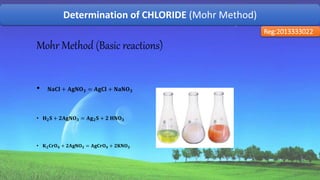
• 𝐍𝐚𝐂𝐥 + 𝐀𝐠𝐍𝐎 𝟑 = 𝐀𝐠𝐂𝐥 + 𝐍𝐚𝐍𝐎 𝟑
• 𝐇 𝟐 𝐒 + 𝟐𝐀𝐠𝐍𝐎 𝟑 = 𝐀𝐠 𝟐 𝐒 + 𝟐 𝐇𝐍𝐎 𝟑
• 𝐊 𝟐 𝐂𝐫𝐎 𝟒 + 𝟐𝐀𝐠𝐍𝐎 𝟑 = 𝐀𝐠𝐂𝐫𝐎 𝟒 + 𝟐𝐊𝐍𝐎 𝟑
51
Determination of CHLORIDE (Mohr Method)
Reg:2013333022
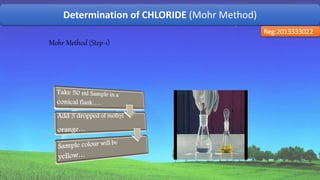
Mohr Method (Step-1)
52
Determination of CHLORIDE (Mohr Method)
Reg:2013333022
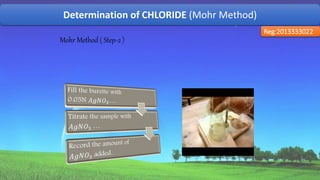
Mohr Method ( Step-2 )
53
Determination of CHLORIDE (Mohr Method)
Reg:2013333022
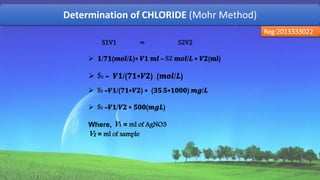
S1V1 = S2V2
 𝟏/𝟕𝟏(𝒎𝒐𝒍/𝑳)∗ 𝑽𝟏 𝒎𝒍 = S2 𝒎𝒐𝒍/𝑳 ∗ 𝑽𝟐(𝐦𝐥)
 S2 = 𝑽𝟏/(𝟕𝟏∗𝑽𝟐) (𝒎𝒐𝒍/𝑳)
 S2 =𝑽𝟏/(𝟕𝟏∗𝑽𝟐) ∗ (𝟑𝟓.𝟓∗𝟏𝟎𝟎𝟎) 𝒎𝒈/𝑳
 S2 =𝑽𝟏/𝑽𝟐 ∗ 𝟓𝟎𝟎(𝒎𝒈𝑳)
Where, V1 = ml of AgNO3
V2 = ml of sample
54
Determination of CHLORIDE (Mohr Method)
Reg:2013333022
Volume of
sample, V2
(ml)
Con. Of
𝐻2 𝑆𝑂4, S1
(mol)
Volume of
𝐻2 𝑆𝑂4, V1
(ml)
Con. Of
sample, S2=
( V1 – 0.2 )*
10 (mol)
50 1/71 1.1 9
Chloride content, mg/l = [(ml of AgNO3 used – 0.2*) x
500] / [ml of sample]
55
Determination of CHLORIDE (Mohr Method)
Reg:2013333022
Result
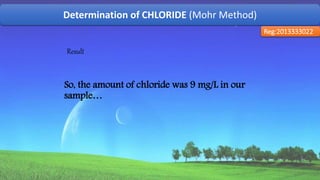
So, the amount of chloride was 9 mg/L in our
sample…
56
Determination of CHLORIDE (Mohr Method)
Reg:2013333022
Limitations
• The sample has to be free from alkalinity…
• All the cations that give insoluble chromate must
be removed before titration…
57

Water supply and sewerage engineering

  • 1.
    WATER SUPPLY ANDSEWERAGE ENGINEERING (SESSIONAL) CEE 334 Presented By Group- 2 1
  • 2.
    INTRODUCTION Reg:2013333027 SAFE DRINKING WATER ??? •SAFE to drink • Free from disease spreading pathogens • Free from aesthetic problem • Above all free from all health risks 222 2
  • 3.
  • 4.
    INTRODUCTION Reg:2013333027 THERE IS ABIG CRISIS OF SAFE WATER IN BANGLADESH 4 4
  • 5.
    INTRODUCTION Reg:2013333027 . • Experimented waterof 2nd ladies hall • Water Supply Engineering Sewerage Engineering 1. pH 2. CARBON DIOXIDE OF WATER 3. TURBIDITY OF WATER 4. CO2 5. IRON IN WATER 6. MANGANESE IN WATER 7. HARDNESS OF WATER 8. TS, DS AND SS 9. BIOCHEMICAL OXYGEN DEMAND (BOD) OF SEWAGE 10. CHEMICAL OXYGEN DEMAND (COD) OF SEWAGE 11. CHLORIDE 5 5
  • 6.
    DETERMINATION OF pHOF WATER Reg:2013333020PH=-log10[H+] Measure- acid or alkaline condition of water. PH is important for,  Water supply.  Sewage treatment.  Chemical process plant.  Biological treatment.  Drinking water. Use-digital PH meter. -Electrometric method. 6 6
  • 7.
    DETERMINATION OF pHOF WATER Reg:2013333020 Temperature (‘F) Measurement of PH Avg. temperature Avg. measureme nt of PH 85.1 6.75 84.7 6.72 84.53 6.69 83.8 6.60 Calculation: Limitation: Temperature 7 7
  • 8.
    What is TotalSolid,Total Dissolved Solid and Suspended Solid? In case of wastewater the waste solid excluding water part is called Total Solid (TS). The part of total solid which can not settle down and mix with water part as like solution is called Total Dissolved Solid(TDS). The part of total solid excluding dissolved solid, which can settle after a certain period of time is called Suspended Solid (SS). Determination of Total Solid, Total Dissolved Solid and Suspended Solid Reg:2013333033 8 8
  • 9.
    Why its needto determine TS,TDS and SS? First we detect ,what is our concern, to determine TS,TDS and SS or to find out the proper treatment of wastewater? If our concern with wastewater treatment then it will need to know how much efficiency of wastewater to suspended its waste solid. That’s why we need to measure these parameter. Determination of Total Solid, Total Dissolved Solid and Suspended Solid Reg:2013333033 9 9
  • 10.
    Determination of TotalSolid, Total Dissolved Solid and Suspended Solid Figure:1 Figure:2 Reg:2013333033 10 10
  • 11.
    This (Fig. 1)indicate that if particle size is large (i.e. suspended solid) then it can be remove in short time. On the other hand, small particle (i.e. dissolved solid) take infinite time period. Data Table Determination of Total Solid, Total Dissolved Solid and Suspended Solid Weight of beaker W1 (gm) Weight of beaker + Suspended Solid W2 (gm) Weight of Suspended Solid (W2 -W1) mg Total Solid TS mg/L 100.998 101.0813 83.3 833 Weight of beaker W1 (gm) Weight of beaker + Dissolve Solid W3 (gm) Weight of Dissolve Solid (W3 -W1) mg Total Dissolve Solid TDS mg/L 108.4650 108.5237 58.7 587 Reg:2013333033 11 11
  • 12.
    Findings: From experimentaldata we find, TS =833 mg/l TDS =587 mg/l SS =246 mg/l Its clear that sample contains more dissolve solid then suspended solid, which is significantly tough to remove or treat the waste solid. Because filter media ( Fig. 2) can remove only suspended solid from wastewater. Determination of Total Solid, Total Dissolved Solid and Suspended Solid Reg:2013333033 12 11
  • 13.
    DETERMINATION OF CO2 Reg:2013333021 INTRODUCTION →Discovered in 1754 by the Scottish scientist Joseph Black (1727- 1799). → A colorless, odorless, incombustible gas → Total C𝑶 𝟐 = C𝑶 𝟐(free) + C𝑶 𝟐(HC𝑶 𝟑 − & C𝑶 𝟑 𝟐− ) → Surface waters normally contain less than 10 ppm(1 ppm =1 milligram of something per liter of water) free C𝑶 𝟐 up to 50 ppm. → Ground waters may easily exceed that concentration. 13 13
  • 14.
    DETERMINATION OF CO2 Reg:2013333021 Theimportance and uses of C𝑂2 → 𝐔sed in the waste water treatment as a cooling medium in the environmental testing electronic devices. → Used to add conductivity to ultrapure water. → Used in extinguishing the fires. → Used in making soft drinks , the mineral water or beer and rapid vaporization of carbon dioxide is used for blasting in the coal mines. → Used supercritical conditions for purifying or drying polymer. → used in making the dry ice. → Necessary for the photosynthesis process of the plants and all the living organisms. → used for the production of urea , carbonates , bicarbonates , and sodium salicylate. → used successfully in nitrogen mixtures to increase the shelf life of many food 14 14
  • 15.
    DETERMINATION OF CO2 Reg:2013333021CALCULATION 2NaOH+ C𝑂2 = N𝑎2C𝑂3+ 𝐻2O N𝑎2C𝑂3 + C𝑂2+ 𝐻2O = 2NaHC𝑂3 Finally , NaOH + C𝑂2 = NaHC𝑂3 Here, 𝑴 𝟏=Standard NaOH ( 1 44 ) 𝑽 𝟏= Volume of NaOH in mixing time 𝑽 𝟐 = 100 ml 𝑴 𝟐=? Dilution Equation : 𝑴 𝟐=(𝑴 𝟏 𝑽 𝟏)/𝑽 𝟐 =( 𝟏 𝟒𝟒 * 𝑽 𝟏)/𝑽 𝟐 𝑚𝑜𝑙 𝑙 =(1 * 𝑽 𝟏 *44 *1000)/(44 * 1000) 𝑚𝑔 𝑙 =10 𝑽 𝟏 15 15
  • 16.
    DETERMINATION OF CO2 Reg:2013333021 Result:Average result of dissolved C𝑂2 =32.4 mg/l =32.4 ppm No of observation 𝑴 𝟏 𝑽 𝟐 𝑽 𝟏 𝑴 𝟐 Avg of 𝑴 𝟐 01 1 44 100 3.3 33 02 1 44 100 3.4 34 03 1 44 1oo 3.1 31 32.4 o4 1 44 100 3.2 32 05 1 44 100 3.2 32 CALCULATION: 16 16
  • 17.
    DETERMINATION OF CO2 Reg:2013333021 Weused the sample of SUST 2nd ladies hall.We measured the sample 𝑃 𝐻 (6.69) was acidic. So we need to determine C𝑂2 in water before using . 17 17
  • 18.
    Determination of Turbidity Reg:2013333018 Turbidity •Turbidity is a measure of the degree to which the water loses its transparency due to the presence of suspended particulates. • The more total suspended solids in the water, the murkier it seems and the higher the turbidity. • Turbidity is considered as a good measure of the quality of water. 18 18
  • 19.
    Determination of Turbidity Reg:2013333018 Whatcauses turbidity? There are various parameters influencing the cloudiness of the water. Some of these are: • Phytoplankton • Sediments from erosion • Suspended sediments from the bottom (frequently stir up by bottom feeders like carp) • Waste discharge • Algae growth • Urban runoff 19 19
  • 20.
    Determination of Turbidity Reg:2013333018 Maximumallowed turbidity in drinking water • The WHO (World Health Organization), establishes that the turbidity of drinking water shouldn't be more than 5 NTU, and should ideally be below 1 NTU. • For Bangladesh maximum limit of turbidity in drinking water is 25NTU 20 20
  • 21.
    Determination of Turbidity Reg:2013333018 OurResult We found 3.315 NTU turbidity in our water sample. 21 21
  • 22.
    Determination of Turbidity AboutOur Result 3.315NTU<<<25NTU (Local standard for Bangladesh) 3.315NTU< 5NTU (International standard by WHO) So our water is drinkable in turbidity standards. But as we know this method does not measure any chemical or organic compound, which can be harmful for human body the water must not be used until further reports are compared. Reg:2013333018 22 22
  • 23.
    ALKALINITY TEST OFWATER Reg:2013333031 What is alkalinity? Alkalinity is measure of the ability of a solution to neutralize acids to the equivalence point of hydroxide, carbonate or bicarbonate 23 23
  • 24.
    ALKALINITY TEST OFWATER Reg:2013333031 Alkalinity is a measure of the capability of water to absorb H+ ions without significant change of pH .In other words, alkalinity is a measure of the acid buffering capacity of water. 1.𝑂𝐻− +𝐻+=𝐻2O 2.𝐶𝑂3 2− +𝐻+=𝐻𝐶𝑂3 − 3. 𝐻𝐶𝑂3 − +𝐻+=𝐻2C𝑂3 adding 𝐻2 𝑆𝑂4 acids in sample water 𝐻+ ions froms. There are used two type indicator phenolphthalein & methyl orange . THEORY 24 24
  • 25.
    ALKALINITY TEST OFWATER Reg:2013333031REAGENTS 1. Phenolphthalein indicator 2. Standard 0.02 N sulfuric acid 3. Methyl orange indicator 4. Distilled water APPARATUS 1. Beaker :2 Nos 2. conical flask:1Nos 3. burette stand and clamp 4. Measuring cylinder 100ml :1 pc 5. Dropper :1 pc 25 25
  • 26.
    ALKALINITY TEST OFWATER Reg:2013333031 Step 1 100ml sample into one beaker and 100ml distilled water into other beaker Step 2 Add 3 drops of phenolphthalein indicator to each. If the sample becomes pink go to step 3 or step 4 Step 3 Add 0.02 N sulfuric acid from a burette until the pink colour removed PROCEDURE step 4 Add 3 drops of methyl orange indicator to each beaker. If the sample becomes yellow add 0.02 N sulfuric acid from a burette until the yellow colour removed . 26 26
  • 27.
    ALKALINITY TEST OFWATER Reg:2013333031 Total Alkalinity as CaCO3 =Total ml of acids used X 10 ppm 27
  • 28.
    ALKALINITY TEST OFWATER Reg:2013333031 Conclusion: P ˃ ½T Both 𝑂𝐻− and 𝐶𝑂3 2− ions are present in the water sample. Discussions: Phenolphthalein alkalinity (P) = 0; that means the volume of acid used till the completion of reaction (1) and (2) is 0. This can only happen when both 𝑂𝐻− and 𝐶𝑂3 2− ions are not present in water. Alkalinity is present due to HC𝑂3 − ion only which can be determined using methyl orange indicator and called methyl orange alkalinity (T). 28
  • 29.
    Iron is thefourth most abundant mineral in the earth’s crust. Soils and rocks in Minnesota may contain minerals very high in iron.  Water in the form of rain or melted snow travels from the ground’s surface and through the soil to become part of a water supply. DETERMINATION OF IRON IN WATER Reg:2013333025 29
  • 30.
    Is iron inwater harmful?  Iron in well water usually does not present a health problem.  In fact, iron is needed to transport oxygen in the blood.  The human body requires approximately 1 to 3 additional milligrams of iron per day (mg/day).  The average intake of iron is approximately 16 mg/day, virtually all from food such as green leafy vegetables, red meat, and iron-fortified cereals. Then why we determine iron in water? DETERMINATION OF IRON IN WATER Reg:2013333025 30
  • 31.
     According toEPA, drinking water standard for iron is 0.3 mg/L and 1 mg/L for Bangladesh.  Above 0.3 mg/L water develop red orange color. As the amount of, iron increase in water the color also increases.  Dissolved ferrous iron gives water a disagreeable metallic taste.  Vegetables cooked in water containing excessive iron turn dark and look unappealing.  The sedimentation of iron in water supply line, that reduce the pipe diameter and also decrease the quality of water.  So the determination of iron in water is important. DETERMINATION OF IRON IN WATER Reg:2013333025 31
  • 32.
    DETERMINATION OF IRONIN WATER Reg:2013333025 PROBLEM CAUSE BY IRON IN WATER Apparatus Conical Flask Measuring cylinder UV-Spectrophotometer 32
  • 33.
    Findings: From experimentaldata we found,  Iron concentration in sample was .16mg/L.  The concentration is below the tolerable rang, so the sample has no problem for iron concentration. DETERMINATION OF IRON IN WATER Reg:2013333025 33
  • 34.
    DETRMINATION OF MANGANESEIN GIVEN SUPPLIED SAMPLE Reg:2013333027 About Manganese…. Manganese is considered to be the 12th most abundant element in the biosphere. Its concentration in earth crust reaches as high as 0.098%. It is widely distributed in soil, water, sediment and biological materials 34
  • 35.
    DETRMINATION OF MANGANESEIN GIVEN SUPPLIED SAMPLE Reg:2013333027 Why we determine Manganese…? The safety of drinking water is a very important public health issue. Manganese in very high concentrations, whose presence in drinking water is a real danger to public health. In this experiment we will determine the levels of manganese present in the water to determine whether or not the water meets the standards. For drinking Provisional maximum tolerable daily intake → 11 mg WHO → 0.4 mg/L Bangladesh→ 0.1 mg/L 35
  • 36.
    DETRMINATION OF MANGANESEIN GIVEN SUPPLIED SAMPLE Reg:2013333027Following occurance can occur Lack of Manganes - Fatness - Glucose intolerance - Blood clotting - Skin problems - Lowered cholesterol levels - Skeleton disorders - Birth defects - Changes of hair color - Neurological symptoms 36
  • 37.
    DETRMINATION OF MANGANESEIN GIVEN SUPPLIED SAMPLE Reg:2013333027 Excess of Manganese - Schizophrenia - Dullness - Weak muscles - Headaches - Insomnia - Parkinson 37
  • 38.
    DETRMINATION OF MANGANESEIN GIVEN SUPPLIED SAMPLE Reg:2013333027 Findings: From experimental data we find, For the calibration following data are used Concentration, mg/L Absorvance 0.1 0.024 0.5 0.054 1 0.097 2 0.162 3 0.233 Our sample’s Spectrophotometer absorvance is 0.022 From calibration curve we get Mn concentration= 0.048 mg/L 38
  • 39.
    DETRMINATION OF MANGANESEIN GIVEN SUPPLIED SAMPLE Reg:2013333027 The sample we used for experiment is taken from 2nd ladis hall. Manganese concentration of our sample water is 0.048 mg/L which is below than standard limit of 0.1 mg/L in Bangladesh. So, this water is safe for drinking. 39
  • 40.
    Determination of BiochemicalOxygen Demand (BOD) of Sewage What is BOD? • Amount of oxygen required by the micro organisms to stabilize biodegradable organic matter under aerobic conditions. Quantity of dissolved oxygen in mg/L required by microorganisms for oxidation of carbonaceous biodegradable organic matter present in liquid. Why we determine BOD?  BOD is an important water quality parameter, because it provides an index to assess the effect.  Discharged wastewater will have on the receiving environment. The higher the BOD value the greater the amount of organic matter or food available for oxygen consuming bacteria. Reg:2013333036 40
  • 41.
    Determination of BiochemicalOxygen Demand (BOD) of Sewage Theory:  If we determine the BOD after 5 days, this is called “the 5 day BOD” (BOD5).  BOD5 is caused by the fact that during the first 5 days there is a decomposition of 60– 70% of the organic substances. For determining dissolved oxygen and BOD the Winkler method have used. MnS𝑂4 +2KOH=Mn(𝑂𝐻)2 +𝐾2S𝑂4 2Mn(𝑂𝐻)2+𝑂2=2MnO(𝑂𝐻)2 Mn(𝑂𝐻)2+2𝐻2S𝑂4=2Mn(SO4 )2 +2H 2O Mn(S𝑂4)2 +2KI=MnSO4+K2SO4+I2 Reg:2013333036 41
  • 42.
    Determination of BiochemicalOxygen Demand (BOD) of Sewage Calculation: What result we have found from the experiment is given below Let, Concentration of Na2S2O3 =S1 Concentration of dissolved oxygen =S2 Volume of Na2S2O3 = V1 Volume of dissolved oxygen= V2 We know S1*V1=S2*V2 V1*0.025=100*S2 Or, S2=(v1*0.025)/100 mol/l = (V1*0.025*8*1000)/100 mg/l =V1*2 mg/l Day’ s 0.025N Na2S2O3 V1(ml) Dissolved oxygen present in sample (V1x2) 1st 5.8 11.6 5th 2 4 BOD in mgl=(Di-Df)xD.F =(11.6-4)*60 = 456 mg/l D.F= 300/5 = 60 Reg:2013333023 42
  • 43.
    Determination of BiochemicalOxygen Demand (BOD) of Sewage BOD of sewage sample is 456 mg/l It has been found that after 5 days consumption of BOD is 65.5 %  Conclusion: we have got our BOD of 456 mg/l. But according to Bangladesh standard limit for BOD5 in inland water surface is 50 mg/l and for public sewer is 200 mg/l.  Where our BOD is much greater than this. We have taken our waste water from 2nd ladies hall.  So this needed to further treat before exposing it to the open environment. It can cause Environmental hazard to nearby pond. Reg:2013333023 43
  • 44.
    Determination of CHLORIDE(Mohr Method) Reg:2013333022 Cl− An anion of Chlorine.. Addition of an electron.. A halide… An essential electrolyte.. What is Chloride ion?? 44
  • 45.
    Determination of CHLORIDE(Mohr Method) Reg:2013333022 Do we need chloride in our water ???? • Osmotic activity of body fluids… • Combat against microbial contamination.. • Maintains our cell homeostasis.. • Transmits action potentials in neurons.. 45
  • 46.
    Determination of CHLORIDE(Mohr Method) Reg:2013333022 But…. 46
  • 47.
    Determination of CHLORIDE(Mohr Method) Reg:2013333022 Acceptable limits of Chloride Daily needs Man 2 – 2.3 g of chloride Woman 2 - 2.3 g WHO 250 mg/L Bangladesh 250 mg/L 47
  • 48.
    Determination of CHLORIDE(Mohr Method) Reg:2013333022 Harmful effects of Chloride in water • Salty taste.. • Greater risk of developing bladder and rectal cancers.. • Pitting corrosion of most metals in sea-water.. • Heart Disease.. • Destruction of the cellular barriers surrounding the lungs.. • Adverse effect of human respiratory system 48
  • 49.
    Determination of CHLORIDE(Mohr Method) Reg:2013333022 Methods 1. Mohr Method 2. Mercuric Nitrate Method 49
  • 50.
    Determination of CHLORIDE(Mohr Method) Reg:2013333022 Mohr Method Reagents 1. Phenolphthalein Indicator (2) 2. Methyl Orange indicator (4) 3. Potassium chromate indicator (13) 4. Silver nitrate solution (14) 5. 0.02N Sulfuric acid (3) Apparatus 1. Conical Flask 2 pcs 2. Measuring cylinder 100ml 1 pc 3. Dropper 1 pc 50
  • 51.
    Determination of CHLORIDE(Mohr Method) Reg:2013333022 Mohr Method (Basic reactions) • 𝐍𝐚𝐂𝐥 + 𝐀𝐠𝐍𝐎 𝟑 = 𝐀𝐠𝐂𝐥 + 𝐍𝐚𝐍𝐎 𝟑 • 𝐇 𝟐 𝐒 + 𝟐𝐀𝐠𝐍𝐎 𝟑 = 𝐀𝐠 𝟐 𝐒 + 𝟐 𝐇𝐍𝐎 𝟑 • 𝐊 𝟐 𝐂𝐫𝐎 𝟒 + 𝟐𝐀𝐠𝐍𝐎 𝟑 = 𝐀𝐠𝐂𝐫𝐎 𝟒 + 𝟐𝐊𝐍𝐎 𝟑 51
  • 52.
    Determination of CHLORIDE(Mohr Method) Reg:2013333022 Mohr Method (Step-1) 52
  • 53.
    Determination of CHLORIDE(Mohr Method) Reg:2013333022 Mohr Method ( Step-2 ) 53
  • 54.
    Determination of CHLORIDE(Mohr Method) Reg:2013333022 S1V1 = S2V2  𝟏/𝟕𝟏(𝒎𝒐𝒍/𝑳)∗ 𝑽𝟏 𝒎𝒍 = S2 𝒎𝒐𝒍/𝑳 ∗ 𝑽𝟐(𝐦𝐥)  S2 = 𝑽𝟏/(𝟕𝟏∗𝑽𝟐) (𝒎𝒐𝒍/𝑳)  S2 =𝑽𝟏/(𝟕𝟏∗𝑽𝟐) ∗ (𝟑𝟓.𝟓∗𝟏𝟎𝟎𝟎) 𝒎𝒈/𝑳  S2 =𝑽𝟏/𝑽𝟐 ∗ 𝟓𝟎𝟎(𝒎𝒈𝑳) Where, V1 = ml of AgNO3 V2 = ml of sample 54
  • 55.
    Determination of CHLORIDE(Mohr Method) Reg:2013333022 Volume of sample, V2 (ml) Con. Of 𝐻2 𝑆𝑂4, S1 (mol) Volume of 𝐻2 𝑆𝑂4, V1 (ml) Con. Of sample, S2= ( V1 – 0.2 )* 10 (mol) 50 1/71 1.1 9 Chloride content, mg/l = [(ml of AgNO3 used – 0.2*) x 500] / [ml of sample] 55
  • 56.
    Determination of CHLORIDE(Mohr Method) Reg:2013333022 Result So, the amount of chloride was 9 mg/L in our sample… 56
  • 57.
    Determination of CHLORIDE(Mohr Method) Reg:2013333022 Limitations • The sample has to be free from alkalinity… • All the cations that give insoluble chromate must be removed before titration… 57