WASTE WATER
TREATMENT PLANT
BSc Agricultural engineering
Section A2
3rd semester
PRESENTED BY
NAME
 MUHAMMAD ZAWAHIR BIN KAZIM
AG NUMBER
 2018-AG-7869
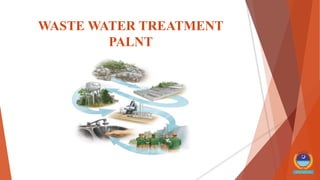
WASTE WATER TREATMENT
PALNT
CONTENTS
Introduction
What is waste water treatment?
Primary treatment
•Screening
•Grid chamber
•Primary sedimentary tank
Secondary treatment
•Aeration basin
•Chemical Addition
•Coagulation and Flocculation
Tertiary treatment
•Disinfection
•Chlorine Disinfection
•Ozone Disinfection
•UV Disinfection
Why is waste water treatment important?
Over view of waste water management in Pakistan
• Sedimentation and Clarification
• Filtration
Introduction
 Wastewater treatment is a process used to remove contaminants
from wastewater or sewage and convert it into an effluent that can be
returned to the water cycle with minimum impact on the environment, or
directly reused.
 Wastewater treatment is the process of converting wastewater – water that is
no longer needed or is no longer suitable for use – into bilge water that can be
discharged back into the environment. It's formed by a number of activities
including bathing, washing, using the toilet, and rainwater runoff
What is waste water treatment?
 Wastewater treatment is a process used to
remove contaminants from wastewater or sewage and convert it into
an effluent that can be returned to the water cycle with minimum impact on
the environment, or directly reused.
 Wastewater is used water. It includes substances such as human waste, food
scraps, oils, soaps and chemicals. In homes, this includes water from sinks,
showers, bathtubs, toilets, washing machines and dishwashers. Businesses and
industries also contribute their share of used water that must be cleaned
there are 3 parts of this process:
1. Primary treatment
2. Secondary treatment
3. Tertiary treatment
Primary treatment
1.Screening
 Bar screens: they are large vertical bars standing in
passage of sewage water to stop larger items from getting
up in the way so that they should not hurt the machinery
like pumps etc.
 This is also known as the pre treatment.
 It make the water a little homogenous and less junky.
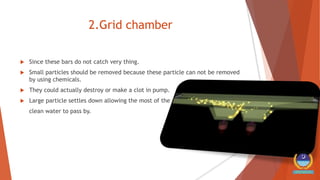
2.Grid chamber
 Since these bars do not catch very thing.
 Small particles should be removed because these particle can not be removed
by using chemicals.
 They could actually destroy or make a clot in pump.
 Large particle settles down allowing the most of the
clean water to pass by.
3.Primary sedimentary tank
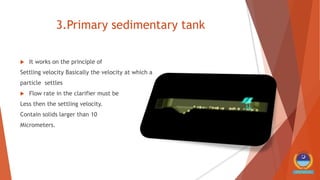
 It works on the principle of
Settling velocity Basically the velocity at which a
particle settles
 Flow rate in the clarifier must be
Less then the settling velocity.
Contain solids larger than 10
Micrometers.
Secondary treatment
1.Aeration basin
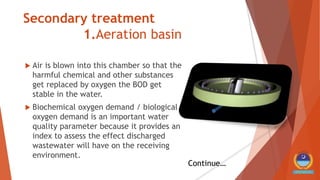
 Air is blown into this chamber so that the
harmful chemical and other substances
get replaced by oxygen the BOD get
stable in the water.
 Biochemical oxygen demand / biological
oxygen demand is an important water
quality parameter because it provides an
index to assess the effect discharged
wastewater will have on the receiving
environment.
Continue…
1.Aeration basin
 There are some microorganisms added into water
where AEROBIC DIGESTION take place which help to
covert harmful nitrates into less harmful nitrates and
into nitrogen gas.
 Mean while the oxygen help to break down the organic
matter present in water.
 And at the end the removal of solids matter take place
in this step.
Chemical addition
 Some of the following chemicals are used for the further
purification in the wastewater…
 Alum or aluminum sulfate.
 Sodium aluminate.
 Polyaluminum Chloride.
 Polymer (dewatering)
 Sodium hydroxide.
 Ferric Chloride.
 Ferrous Chloride
 These chemicals are frequently used by the waste water
management plant.
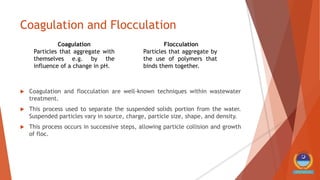
Coagulation and Flocculation
 Coagulation and flocculation are well-known techniques within wastewater
treatment.
 This process used to separate the suspended solids portion from the water.
Suspended particles vary in source, charge, particle size, shape, and density.
 This process occurs in successive steps, allowing particle collision and growth
of floc.
Coagulation
Particles that aggregate with
themselves e.g. by the
influence of a change in pH.
Flocculation
Particles that aggregate by
the use of polymers that
binds them together.
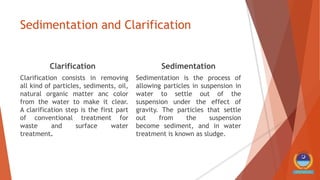
Sedimentation and Clarification
Clarification
Sedimentation is the process of
allowing particles in suspension in
water to settle out of the
suspension under the effect of
gravity. The particles that settle
out from the suspension
become sediment, and in water
treatment is known as sludge.
Sedimentation
Clarification consists in removing
all kind of particles, sediments, oil,
natural organic matter anc color
from the water to make it clear.
A clarification step is the first part
of conventional treatment for
waste and surface water
treatment.
Filtration
 Water flows through a filter designed to remove particles
in the water. The filters are made of layers of sand and
gravel, and in some cases, crushed anthracite.
 Filtration collects the suspended impurities in water and
enhances the effectiveness of disinfection.
TERTIARY TEATMENT
 DISINFECTION:
Water disinfection means the removal, deactivation or
killing of pathogenic microorganisms. Microorganisms are
destroyed or deactivated, resulting in termination of growth
and reproduction. In most of the cases these methods are
used to kills the harmful bacteria that is resting in water.
1. Chlorine disinfection
2. Ozone disinfection
3. UV radiation disinfection
Chlorine disinfection
 As a halogen, chlorine is a highly efficient disinfectant, and is added
to public water supplies to kill disease-causing pathogens, such as
bacteria, viruses, and protozoans, that commonly grow in water
supply reservoirs, on the walls of water mains and in storage tanks
 Most of the chlorine is removed form the water before discharge but
some slight quantity is left behind so that if any harmful substance is
some how added later on it could not effect water.
 Chlorine levels up to 4 milligrams per liter is considered safe in
drinking water.
Ozone disinfection
 it is applied for the disinfection of drinking water, for the removal of
effluents from wastewater treatment plants
 Ozone oxides the iron, manganese, and sulfur in the water to form
insoluble metal oxides or elemental sulfur. These insoluble particles
are then removed by post-filtration. Organic particles and chemicals
will be eliminated through either coagulation or chemical oxidation.
 Ozoneated water may improve brain function, fight bacteria, and
speed up healing. There have been some promising studies examining
how ozone may be beneficial to health by: inactivating bacteria,
viruses, fungi, parasites, yeast, and protozoa. stimulating the immune
system to speed up healing.
UV radiation disinfection
 The ultraviolet (UV) treatment process is an extremely quick physical
process. Ultraviolet light mutates and/or degrades DNA.
 In the UV disinfection process, water is purified as it runs through a stainless
steel chamber (also called a “reactor”) that contains a special UV- producing
lamp.
 Unlike chemical approaches to water disinfection, UV light provides rapid,
effective inactivation of microorganisms through a physical process. When
bacteria, viruses and protozoa are exposed to the germicidal wavelengths
of UV light, they are rendered incapable of reproducing and infecting.
Why is waste water treatment
important?
 Untreated, the chemical compounds and pathogens
in wastewater can harm the health of animals, plants and
birds that live in or near the water.
 Wastewater, properly treated, is a source of water for
many purposes. Good wastewater treatment allows the
maximum amount of water to be reused instead of going
to waste.
Over view of waste water management
in Pakistan
 In big cities like Lahore only 0.01per cent of the sewerage
water is being treated, in Faisalabad 25.6 per cent, in
Karachi it is 15.9 per cent, in Hyderabad it is 34 per cent,
in Peshawar it is 36.2 per cent.
 there are only a few water and wastewater treatment
plants in the country. In fact, construction of wastewater
treatment plant is a huge expense especially for
developing economies who barely meet the necessities for
survival. Pakistan has also been ignoring wastewater
treatment plants due to lack of adequate funding and
resources.
Continue…
Continue…
 The sewerage is disposed of in nearby river system or river
bed. There is no mechanism for monitoring or testing the
composition of wastewaters in the country. There is a
crucial need to develop wastewater treatment plants to
save the quality of water in the rivers and under the
ground. This may be initiated by primary level treatment
systems made out of indigenous technology.
Any question?
THANK YOU

Waste water management

  • 1.
    WASTE WATER TREATMENT PLANT BScAgricultural engineering Section A2 3rd semester
  • 2.
    PRESENTED BY NAME  MUHAMMADZAWAHIR BIN KAZIM AG NUMBER  2018-AG-7869
  • 3.
  • 4.
    CONTENTS Introduction What is wastewater treatment? Primary treatment •Screening •Grid chamber •Primary sedimentary tank Secondary treatment •Aeration basin •Chemical Addition •Coagulation and Flocculation Tertiary treatment •Disinfection •Chlorine Disinfection •Ozone Disinfection •UV Disinfection Why is waste water treatment important? Over view of waste water management in Pakistan • Sedimentation and Clarification • Filtration
  • 5.
    Introduction  Wastewater treatmentis a process used to remove contaminants from wastewater or sewage and convert it into an effluent that can be returned to the water cycle with minimum impact on the environment, or directly reused.  Wastewater treatment is the process of converting wastewater – water that is no longer needed or is no longer suitable for use – into bilge water that can be discharged back into the environment. It's formed by a number of activities including bathing, washing, using the toilet, and rainwater runoff
  • 6.
    What is wastewater treatment?  Wastewater treatment is a process used to remove contaminants from wastewater or sewage and convert it into an effluent that can be returned to the water cycle with minimum impact on the environment, or directly reused.  Wastewater is used water. It includes substances such as human waste, food scraps, oils, soaps and chemicals. In homes, this includes water from sinks, showers, bathtubs, toilets, washing machines and dishwashers. Businesses and industries also contribute their share of used water that must be cleaned there are 3 parts of this process: 1. Primary treatment 2. Secondary treatment 3. Tertiary treatment
  • 7.
    Primary treatment 1.Screening  Barscreens: they are large vertical bars standing in passage of sewage water to stop larger items from getting up in the way so that they should not hurt the machinery like pumps etc.  This is also known as the pre treatment.  It make the water a little homogenous and less junky.
  • 8.
    2.Grid chamber  Sincethese bars do not catch very thing.  Small particles should be removed because these particle can not be removed by using chemicals.  They could actually destroy or make a clot in pump.  Large particle settles down allowing the most of the clean water to pass by.
  • 9.
    3.Primary sedimentary tank It works on the principle of Settling velocity Basically the velocity at which a particle settles  Flow rate in the clarifier must be Less then the settling velocity. Contain solids larger than 10 Micrometers.
  • 10.
    Secondary treatment 1.Aeration basin Air is blown into this chamber so that the harmful chemical and other substances get replaced by oxygen the BOD get stable in the water.  Biochemical oxygen demand / biological oxygen demand is an important water quality parameter because it provides an index to assess the effect discharged wastewater will have on the receiving environment. Continue…
  • 11.
    1.Aeration basin  Thereare some microorganisms added into water where AEROBIC DIGESTION take place which help to covert harmful nitrates into less harmful nitrates and into nitrogen gas.  Mean while the oxygen help to break down the organic matter present in water.  And at the end the removal of solids matter take place in this step.
  • 12.
    Chemical addition  Someof the following chemicals are used for the further purification in the wastewater…  Alum or aluminum sulfate.  Sodium aluminate.  Polyaluminum Chloride.  Polymer (dewatering)  Sodium hydroxide.  Ferric Chloride.  Ferrous Chloride  These chemicals are frequently used by the waste water management plant.
  • 13.
    Coagulation and Flocculation Coagulation and flocculation are well-known techniques within wastewater treatment.  This process used to separate the suspended solids portion from the water. Suspended particles vary in source, charge, particle size, shape, and density.  This process occurs in successive steps, allowing particle collision and growth of floc. Coagulation Particles that aggregate with themselves e.g. by the influence of a change in pH. Flocculation Particles that aggregate by the use of polymers that binds them together.
  • 14.
    Sedimentation and Clarification Clarification Sedimentationis the process of allowing particles in suspension in water to settle out of the suspension under the effect of gravity. The particles that settle out from the suspension become sediment, and in water treatment is known as sludge. Sedimentation Clarification consists in removing all kind of particles, sediments, oil, natural organic matter anc color from the water to make it clear. A clarification step is the first part of conventional treatment for waste and surface water treatment.
  • 15.
    Filtration  Water flowsthrough a filter designed to remove particles in the water. The filters are made of layers of sand and gravel, and in some cases, crushed anthracite.  Filtration collects the suspended impurities in water and enhances the effectiveness of disinfection.
  • 16.
    TERTIARY TEATMENT  DISINFECTION: Waterdisinfection means the removal, deactivation or killing of pathogenic microorganisms. Microorganisms are destroyed or deactivated, resulting in termination of growth and reproduction. In most of the cases these methods are used to kills the harmful bacteria that is resting in water. 1. Chlorine disinfection 2. Ozone disinfection 3. UV radiation disinfection
  • 17.
    Chlorine disinfection  Asa halogen, chlorine is a highly efficient disinfectant, and is added to public water supplies to kill disease-causing pathogens, such as bacteria, viruses, and protozoans, that commonly grow in water supply reservoirs, on the walls of water mains and in storage tanks  Most of the chlorine is removed form the water before discharge but some slight quantity is left behind so that if any harmful substance is some how added later on it could not effect water.  Chlorine levels up to 4 milligrams per liter is considered safe in drinking water.
  • 18.
    Ozone disinfection  itis applied for the disinfection of drinking water, for the removal of effluents from wastewater treatment plants  Ozone oxides the iron, manganese, and sulfur in the water to form insoluble metal oxides or elemental sulfur. These insoluble particles are then removed by post-filtration. Organic particles and chemicals will be eliminated through either coagulation or chemical oxidation.  Ozoneated water may improve brain function, fight bacteria, and speed up healing. There have been some promising studies examining how ozone may be beneficial to health by: inactivating bacteria, viruses, fungi, parasites, yeast, and protozoa. stimulating the immune system to speed up healing.
  • 19.
    UV radiation disinfection The ultraviolet (UV) treatment process is an extremely quick physical process. Ultraviolet light mutates and/or degrades DNA.  In the UV disinfection process, water is purified as it runs through a stainless steel chamber (also called a “reactor”) that contains a special UV- producing lamp.  Unlike chemical approaches to water disinfection, UV light provides rapid, effective inactivation of microorganisms through a physical process. When bacteria, viruses and protozoa are exposed to the germicidal wavelengths of UV light, they are rendered incapable of reproducing and infecting.
  • 20.
    Why is wastewater treatment important?  Untreated, the chemical compounds and pathogens in wastewater can harm the health of animals, plants and birds that live in or near the water.  Wastewater, properly treated, is a source of water for many purposes. Good wastewater treatment allows the maximum amount of water to be reused instead of going to waste.
  • 21.
    Over view ofwaste water management in Pakistan  In big cities like Lahore only 0.01per cent of the sewerage water is being treated, in Faisalabad 25.6 per cent, in Karachi it is 15.9 per cent, in Hyderabad it is 34 per cent, in Peshawar it is 36.2 per cent.  there are only a few water and wastewater treatment plants in the country. In fact, construction of wastewater treatment plant is a huge expense especially for developing economies who barely meet the necessities for survival. Pakistan has also been ignoring wastewater treatment plants due to lack of adequate funding and resources. Continue…
  • 22.
    Continue…  The sewerageis disposed of in nearby river system or river bed. There is no mechanism for monitoring or testing the composition of wastewaters in the country. There is a crucial need to develop wastewater treatment plants to save the quality of water in the rivers and under the ground. This may be initiated by primary level treatment systems made out of indigenous technology.
  • 23.
  • 24.