Water Walk10 Different pictures/scenarios with brief descriptionWrite Down Number of Station and the scenario you are looking at.  Start at the number of the station you are atMove clockwiseAnswer the following questions for each…How does the structure of water relate to this action/scenario?
WaterThe Universal Solvent
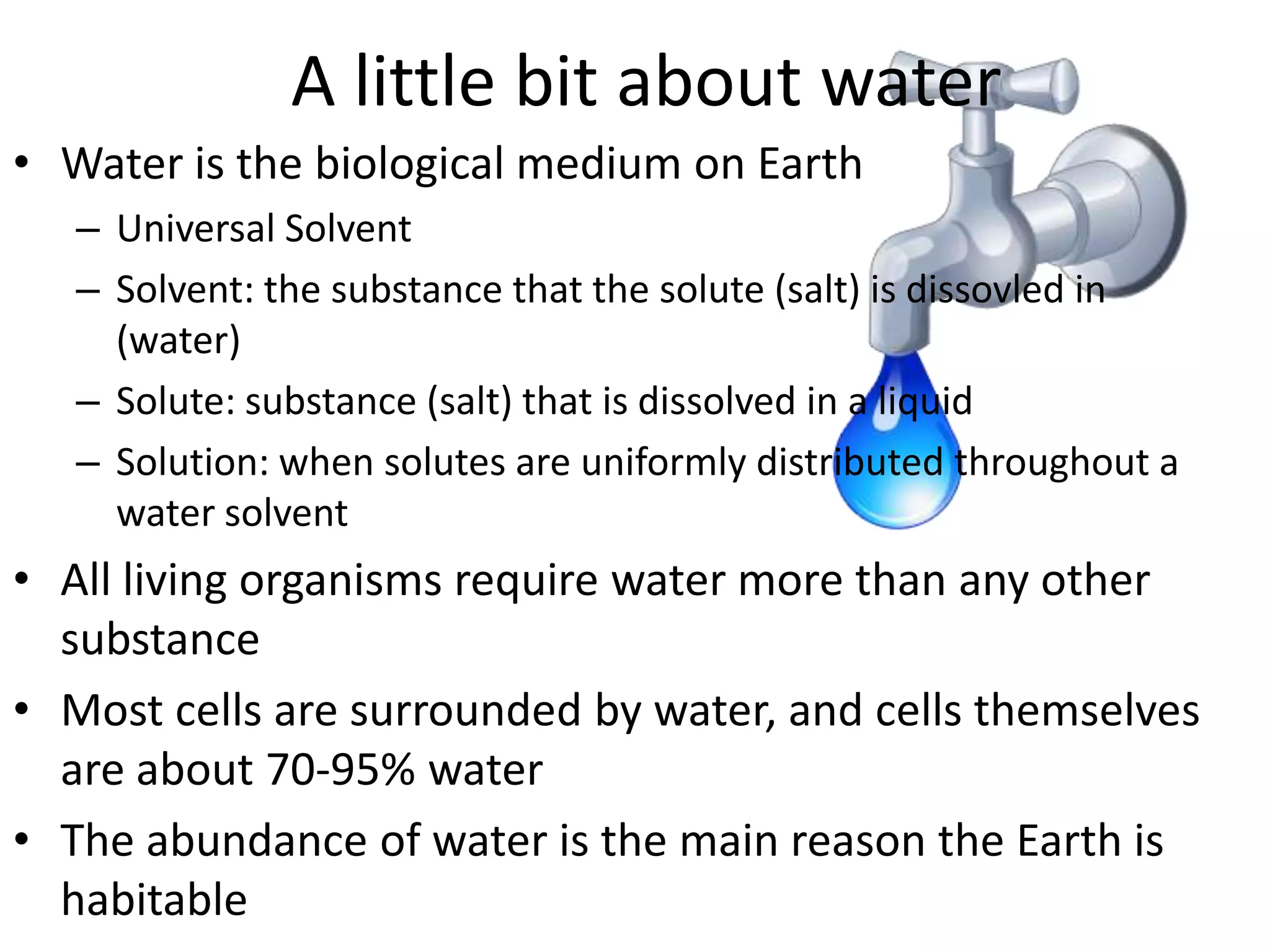
A little bit about waterWater is the biological medium on EarthUniversal SolventSolvent: the substance that the solute (salt) is dissovled in (water)Solute: substance (salt) that is dissolved in a liquidSolution: when solutes are uniformly distributed throughout a water solventAll living organisms require water more than any other substanceMost cells are surrounded by water, and cells themselves are about 70-95% waterThe abundance of water is the main reason the Earth is habitable
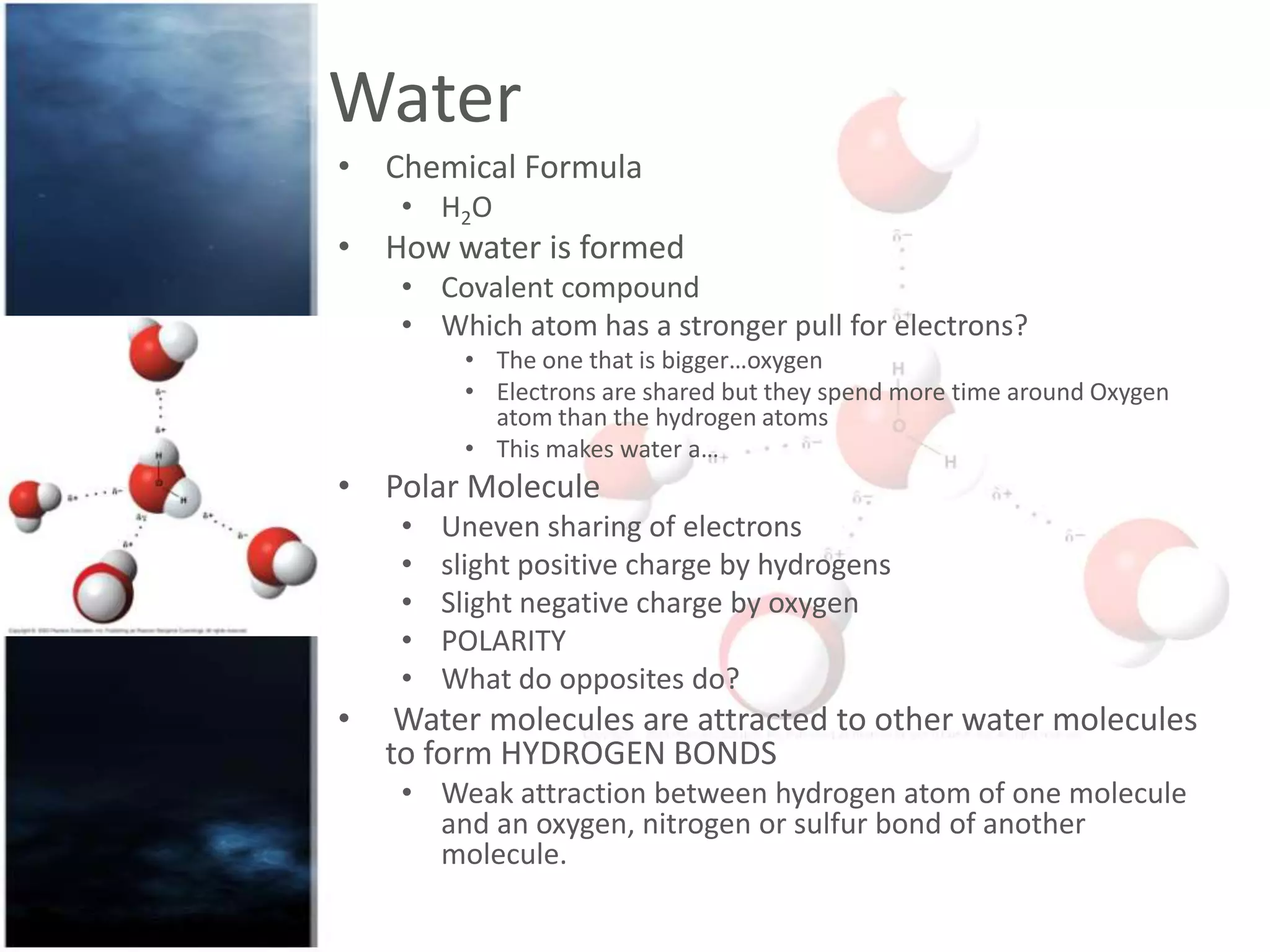
WaterChemical Formula H2OHow water is formedCovalent compound
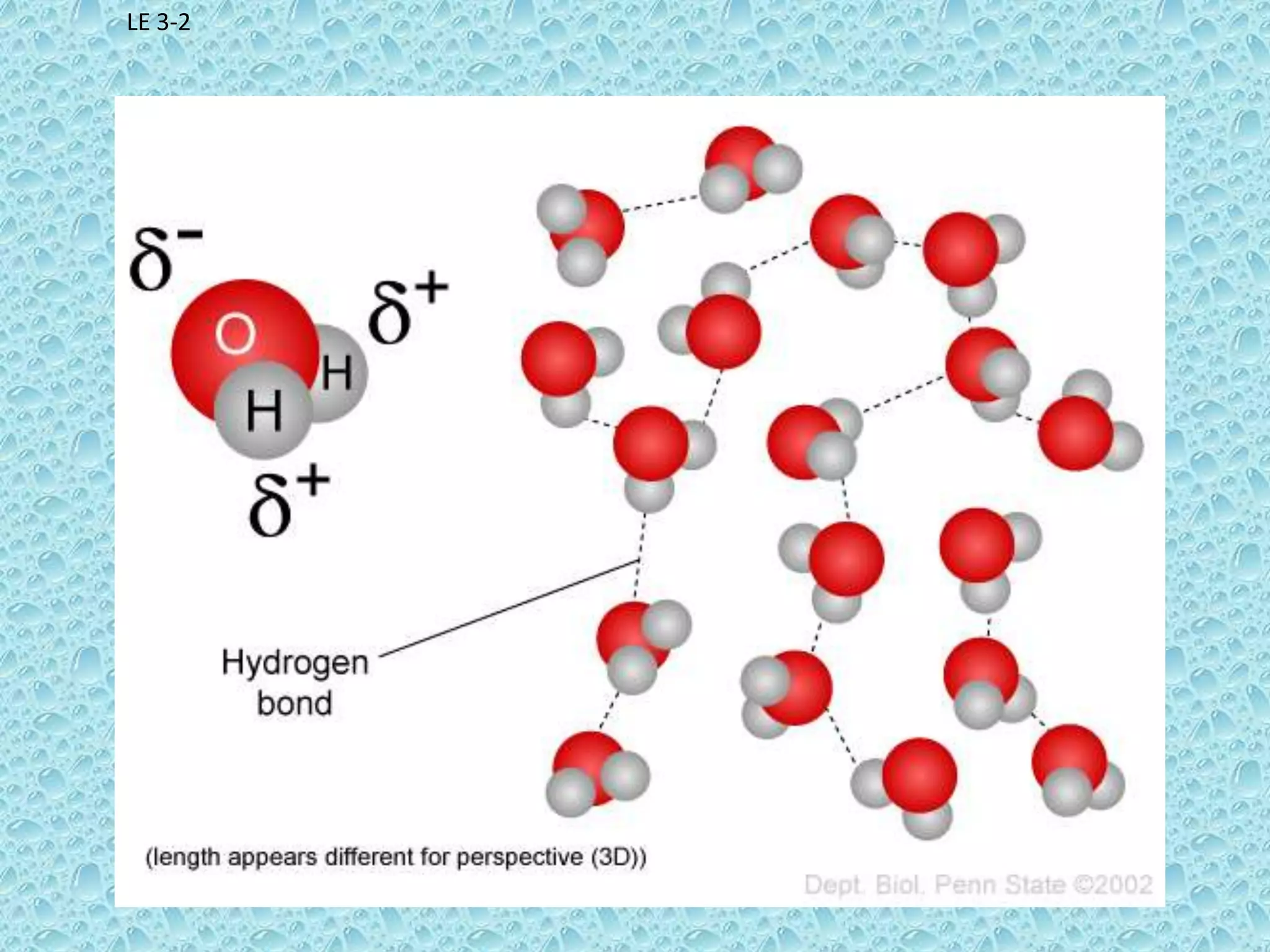
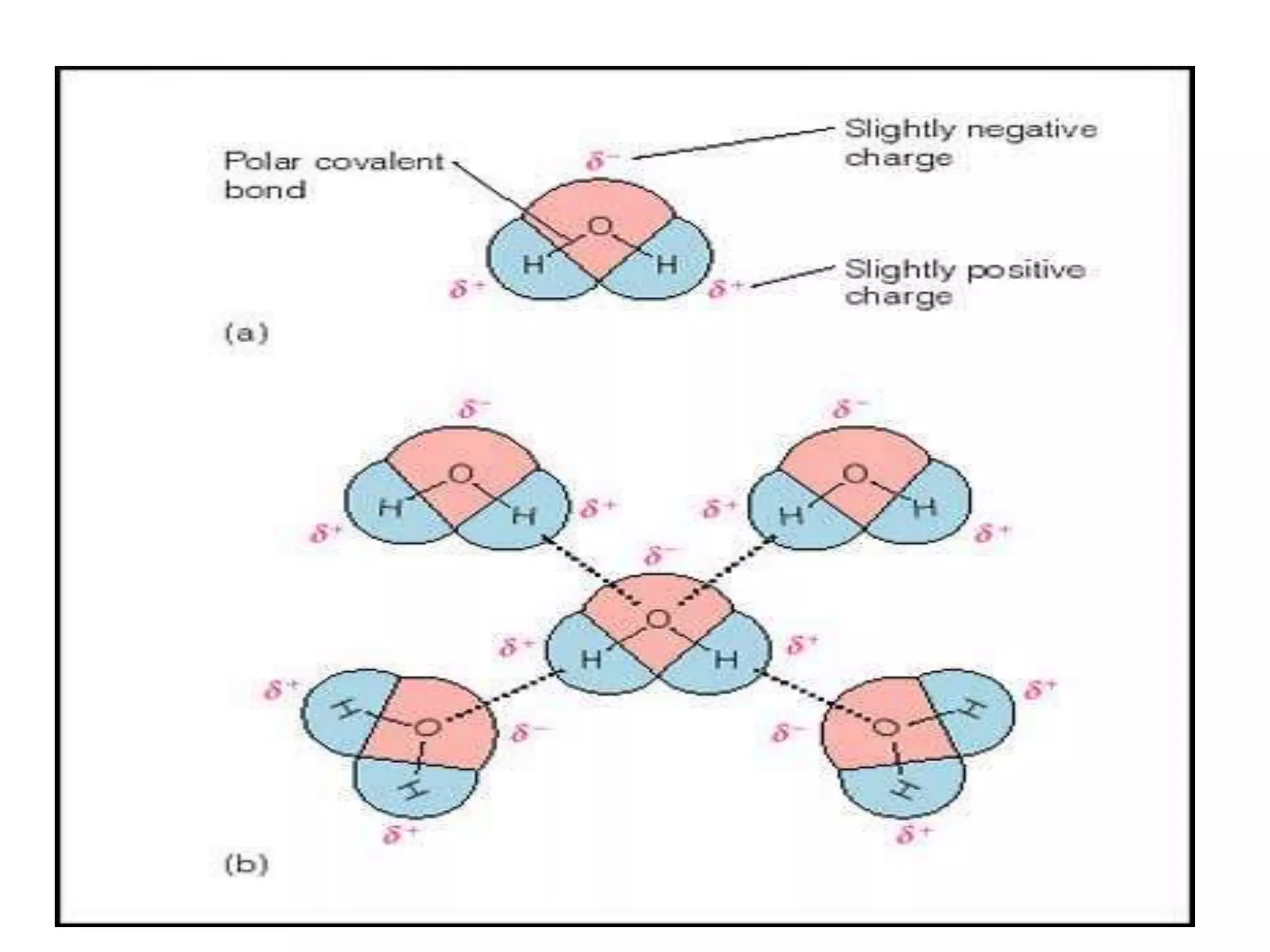
Which atom has a stronger pull for electrons?The one that is bigger…oxygenElectrons are shared but they spend more time around Oxygen atom than the hydrogen atomsThis makes water a…Polar MoleculeUneven sharing of electrons
slight positive charge by hydrogens
Slight negative charge by oxygen
POLARITY
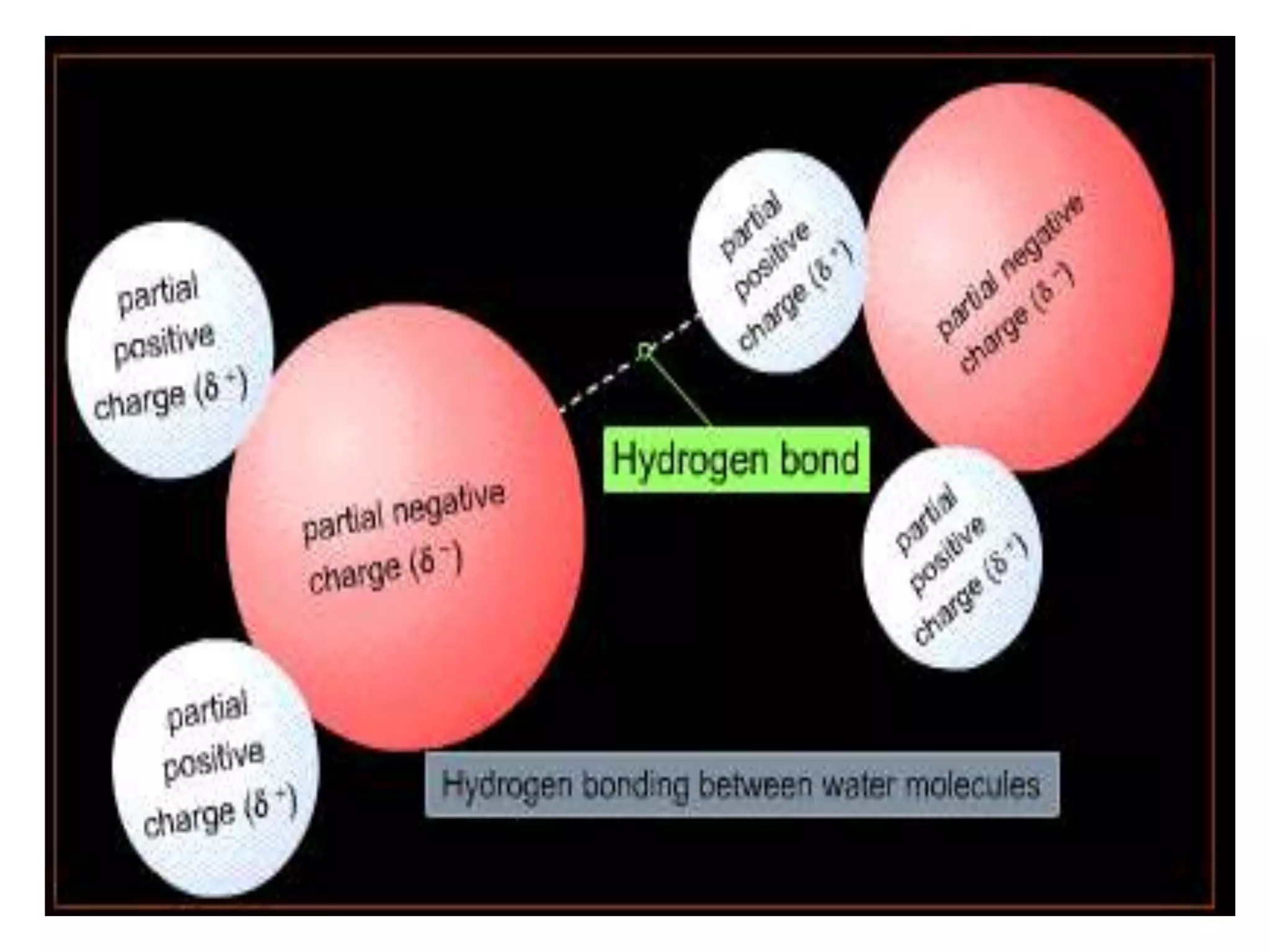
What do opposites do? Water molecules are attracted to other water molecules to form HYDROGEN BONDSWeak attraction between hydrogen atom of one molecule and an oxygen, nitrogen or sulfur bond of another molecule.LE 3-2
Properties of waterVersatility  as a solventCohesive and AdhesivebehaviorExpansion uponfreezingTemperaturemoderation
The Solvent of LifeA solution is a liquid that is a homogeneous mixture of substancesA solvent is the dissolving agent of a solutionThe solute is the substance that is dissolvedWater is a versatile solvent due to its polarityAn aqueous solution is one in which water is the solvent
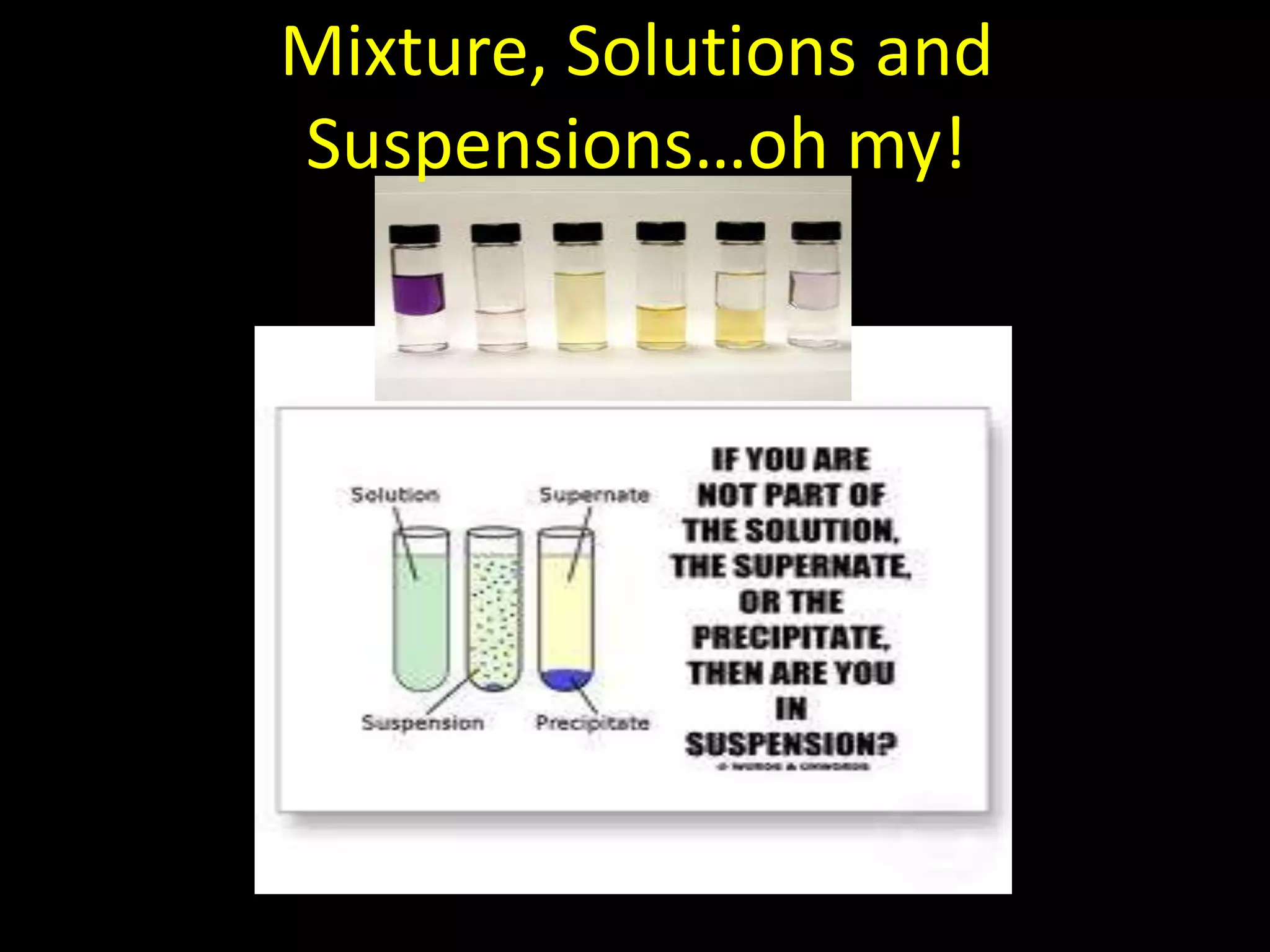
Mixture, Solutions and Suspensions…oh my!
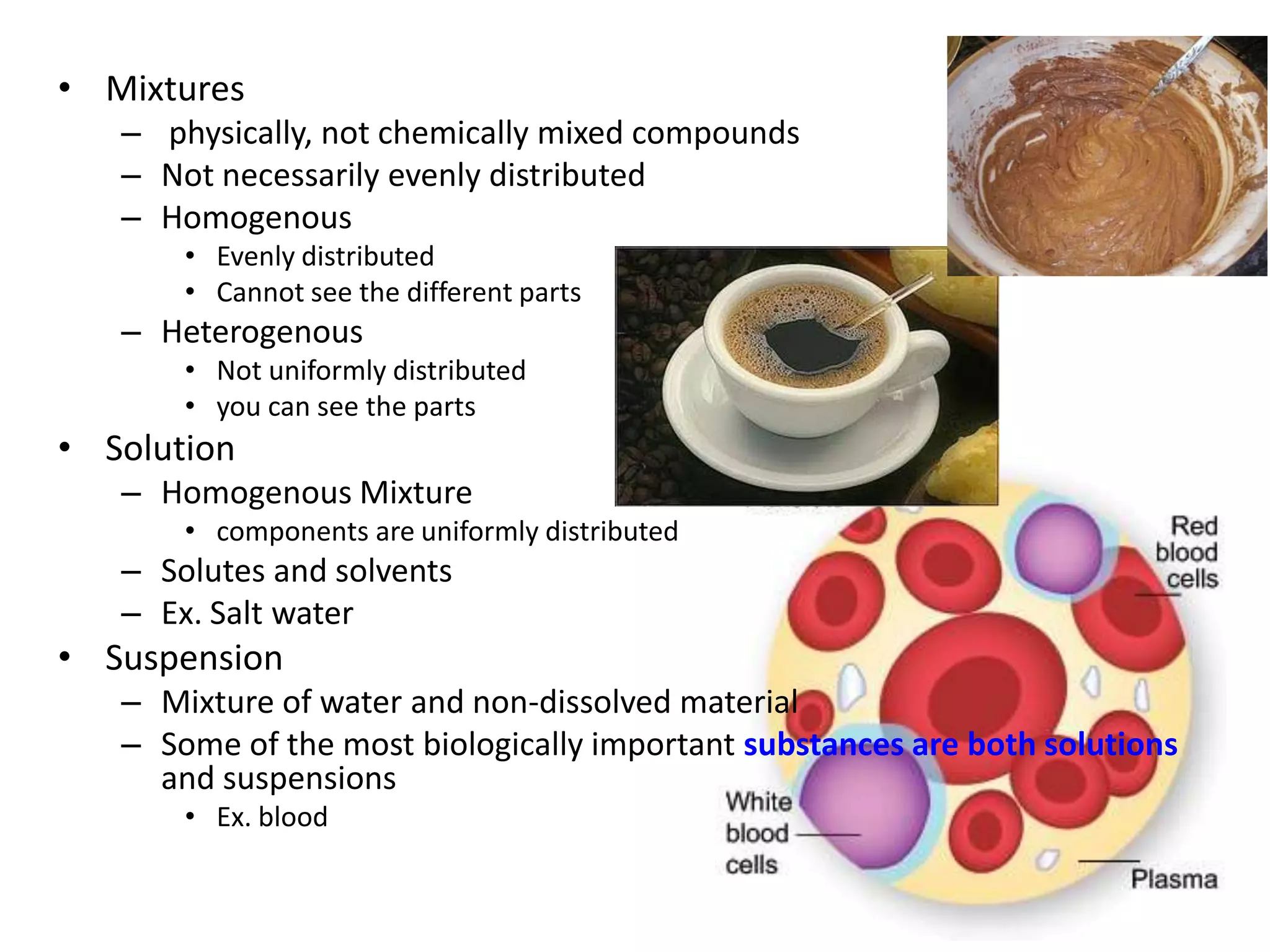
Mixtures
physically, not chemically mixed compounds
Not necessarily evenly distributed
Homogenous
Evenly distributed
Cannot see the different parts
Heterogenous
Not uniformly distributed
you can see the parts
Solution
Homogenous Mixture
components are uniformly distributed
Solutes and solvents
Ex. Salt water
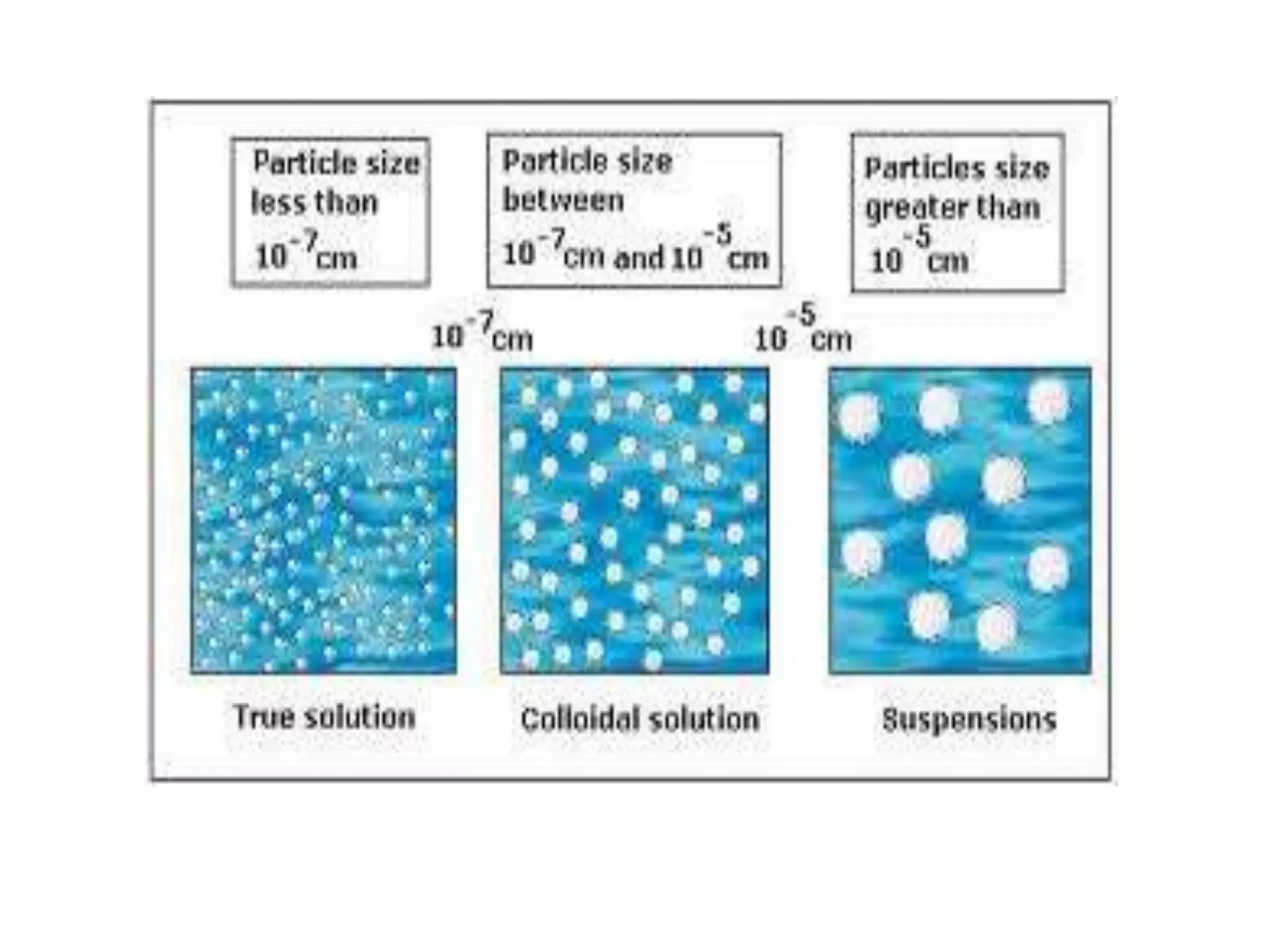
Suspension
Mixture of water and non-dissolved material
Some of the most biologically important substances are both solutions and suspensions
Ex. blood
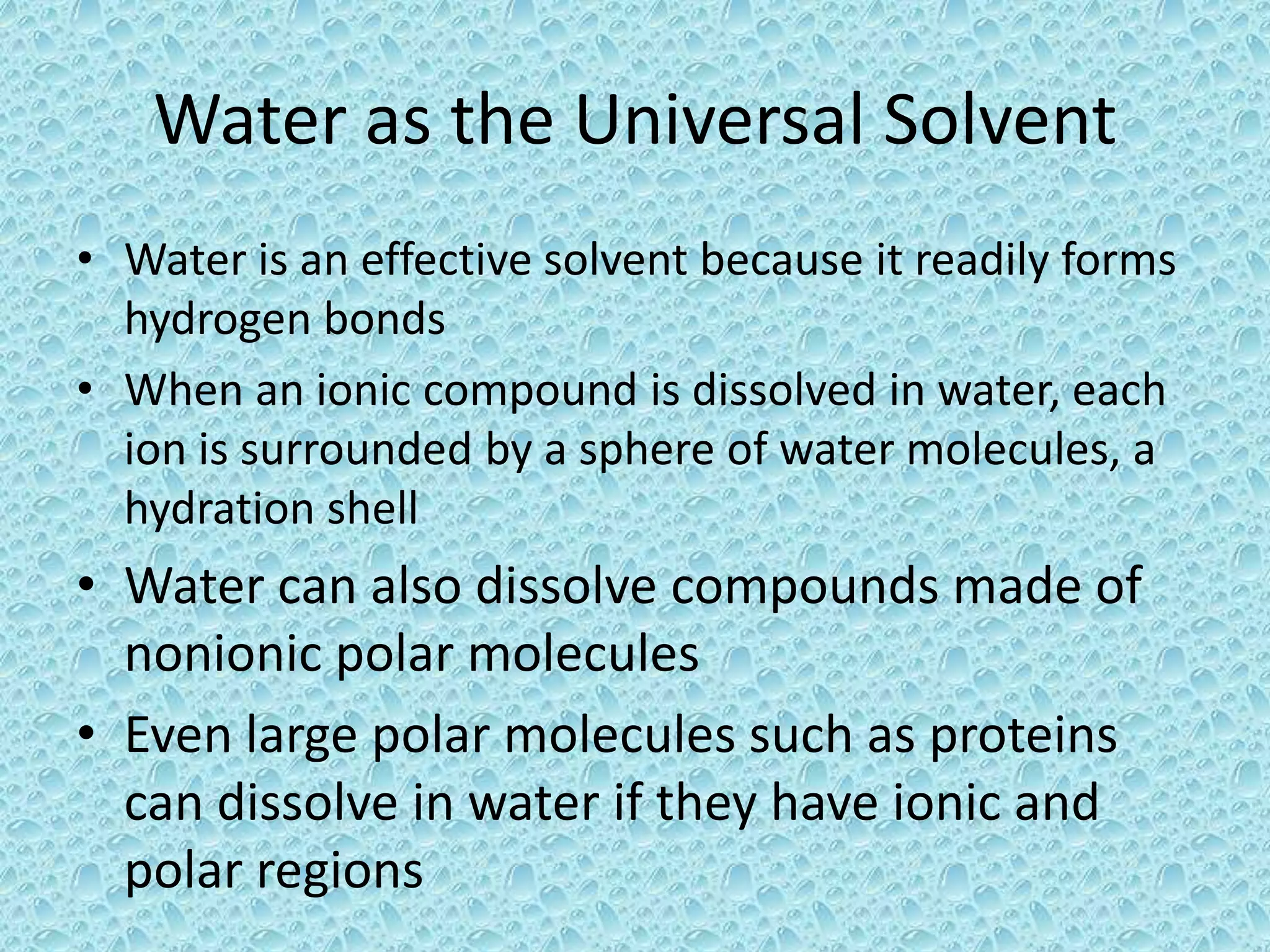
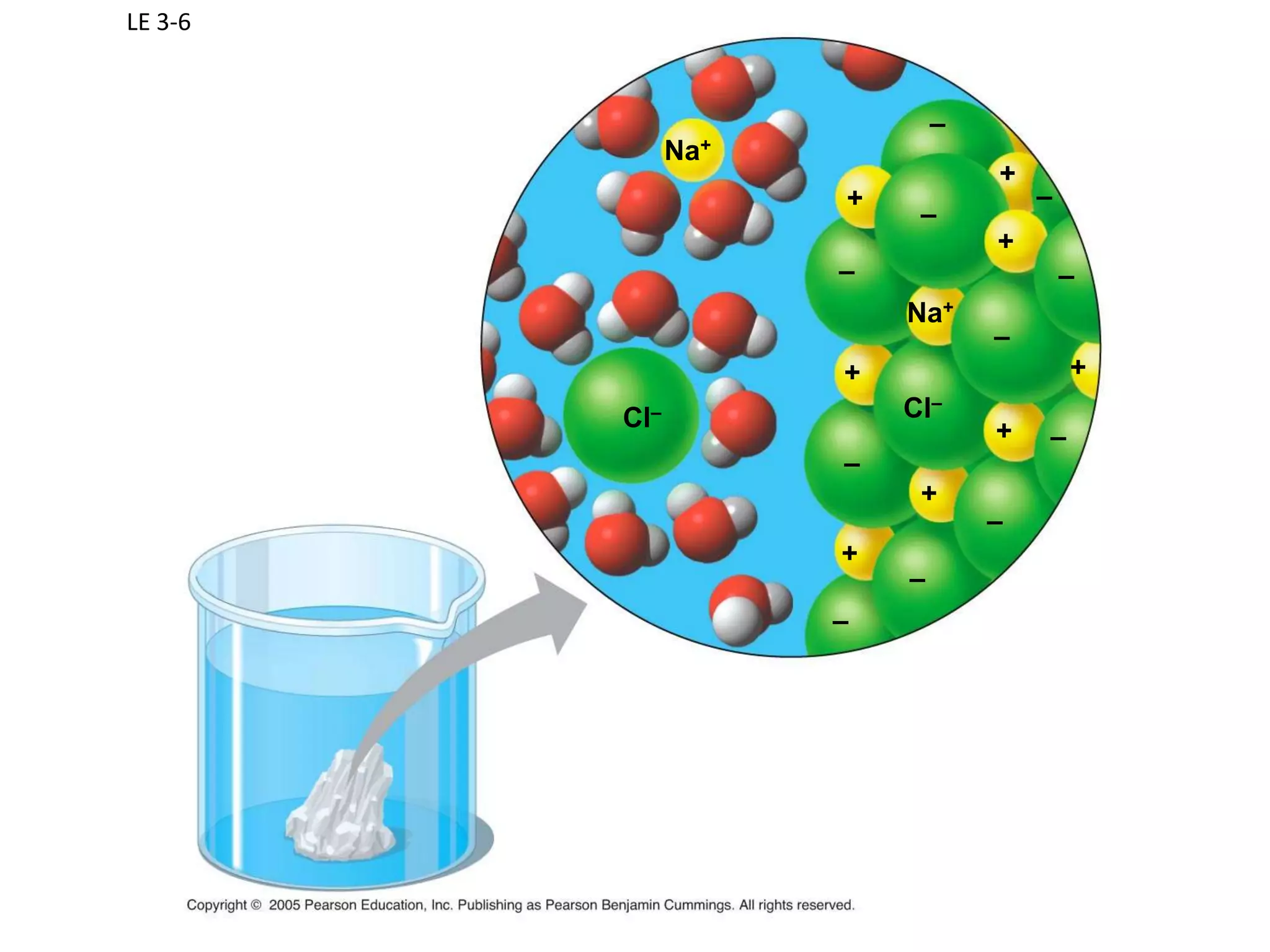
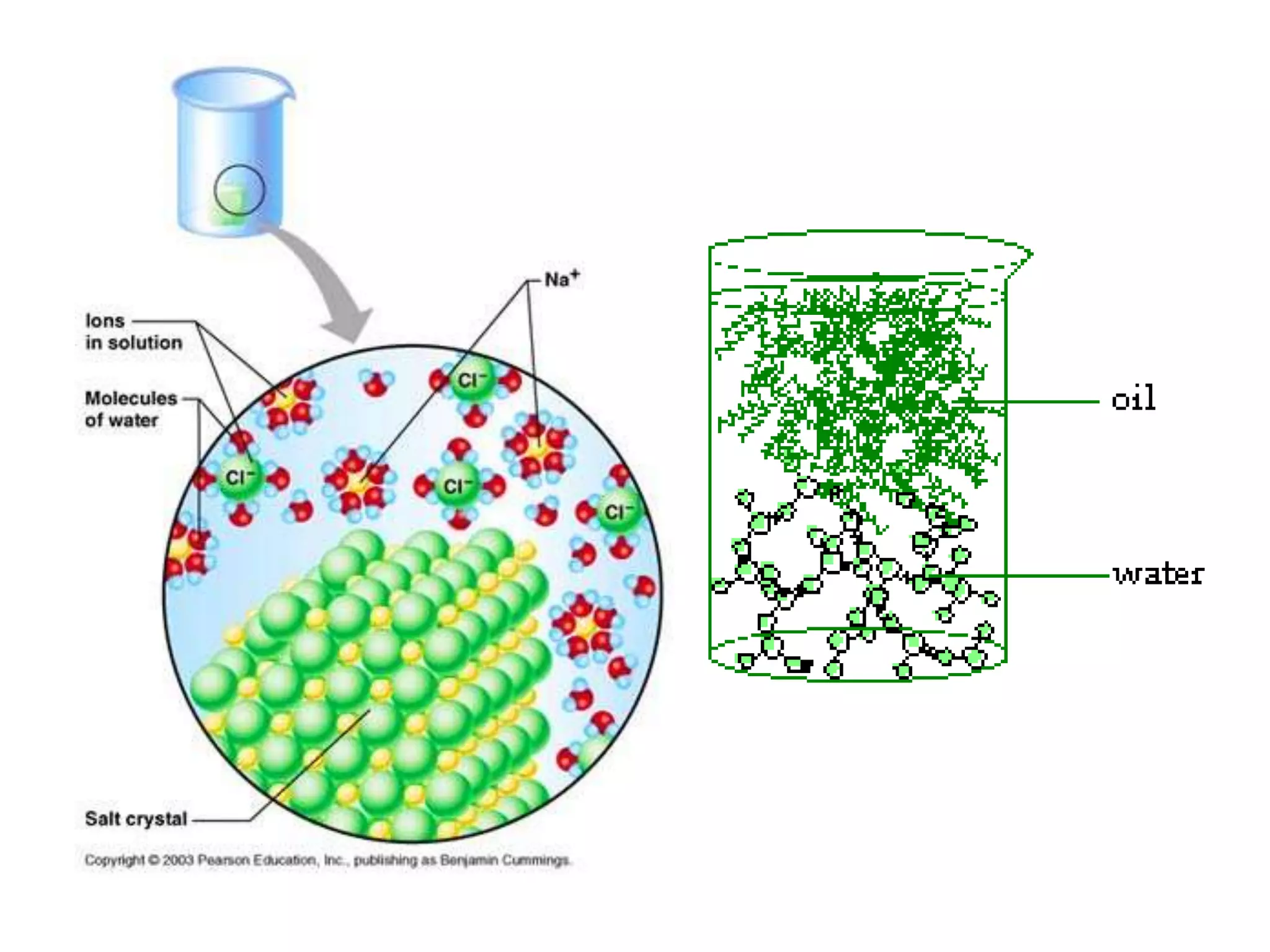
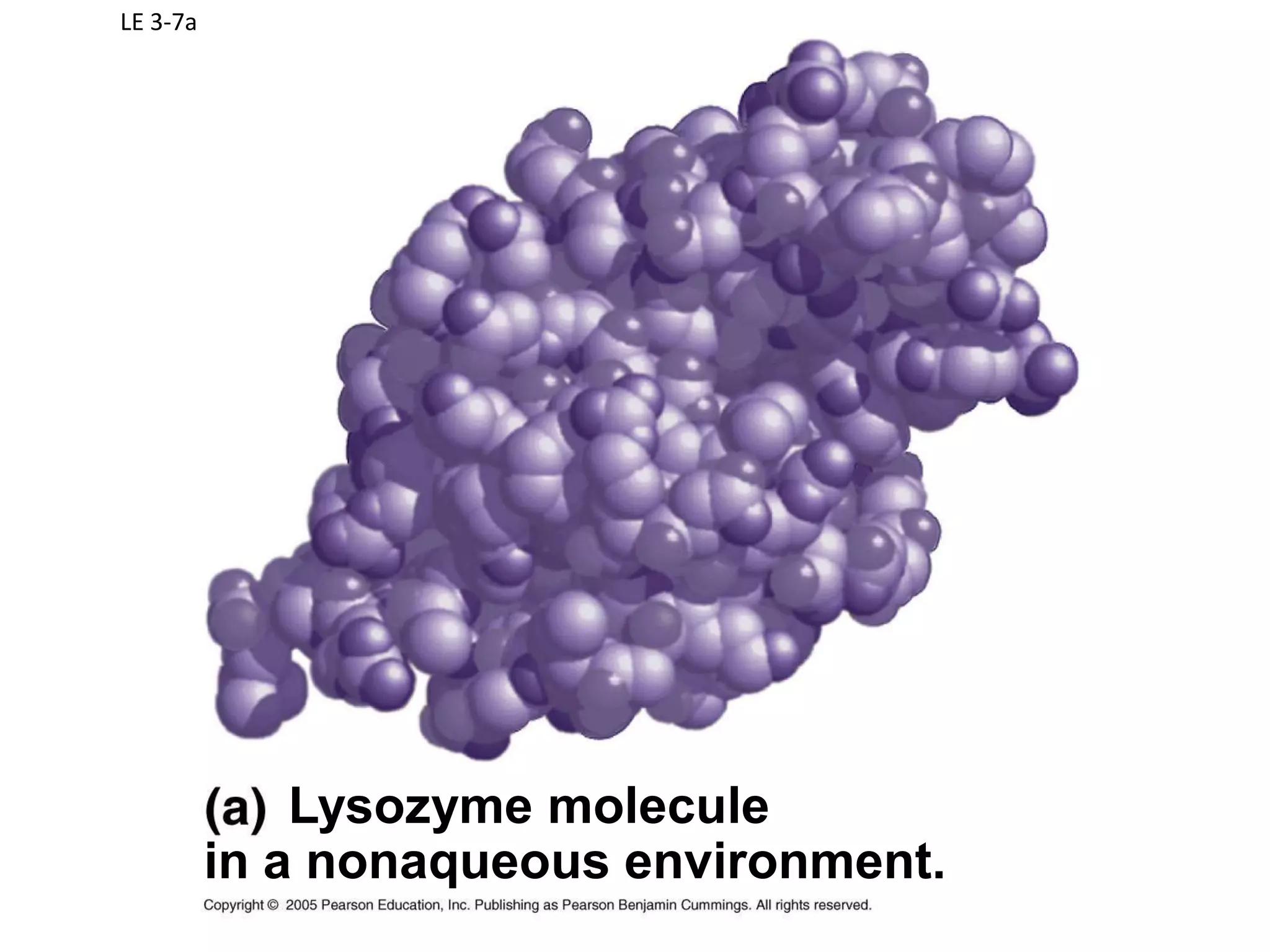
Water as the Universal SolventWater is an effective solvent because it readily forms hydrogen bonds When an ionic compound is dissolved in water, each ion is surrounded by a sphere of water molecules, a hydration shellWater can also dissolve compounds made of nonionic polar moleculesEven large polar molecules such as proteins can dissolve in water if they have ionic and polar regions
LE 3-6–Na++–+–+––Na+–++Cl–Cl–+––+–+––
LE 3-7a      Lysozyme moleculein a nonaqueous environment.
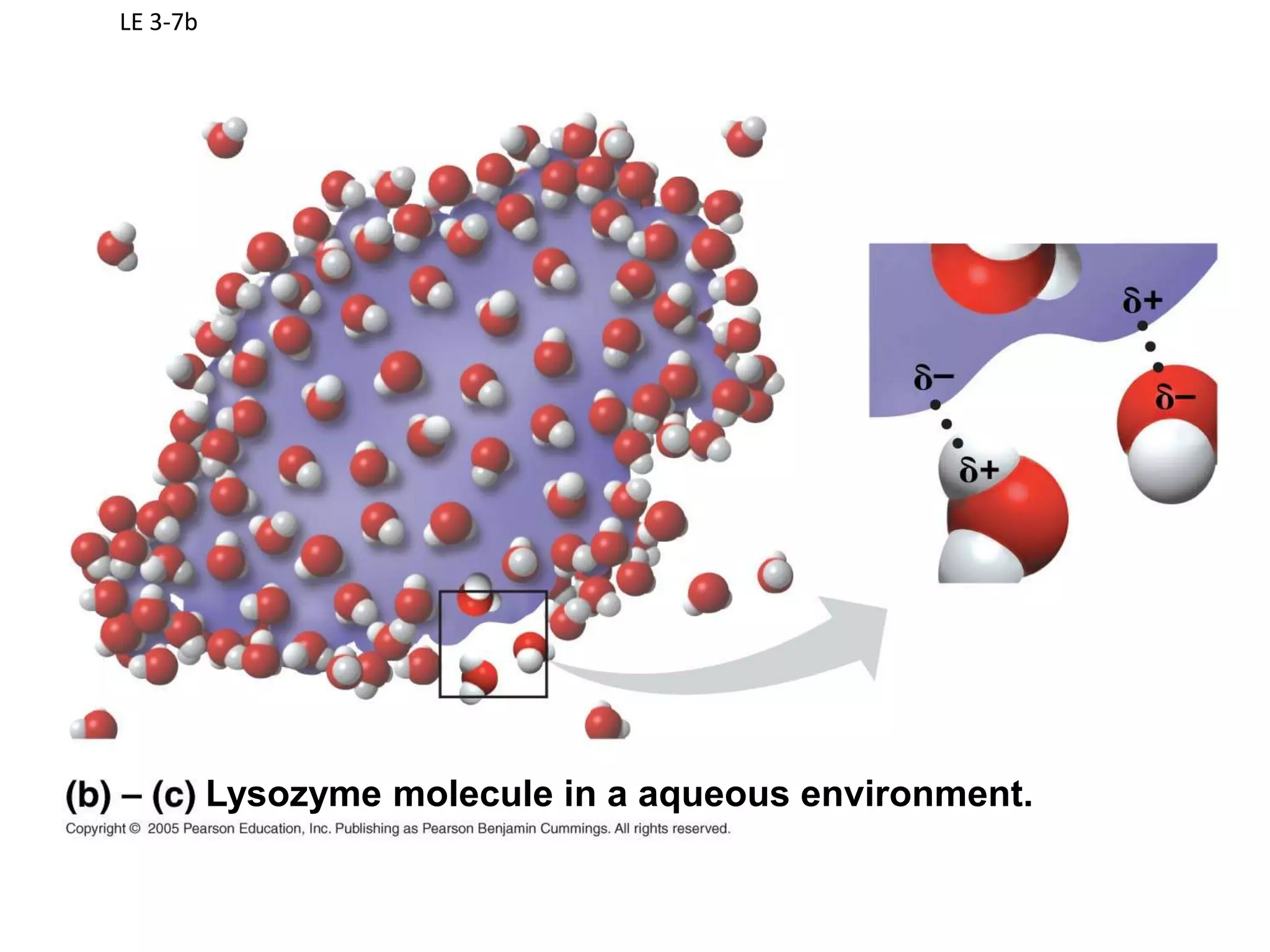
LE 3-7bLysozyme molecule in a aqueous environment.
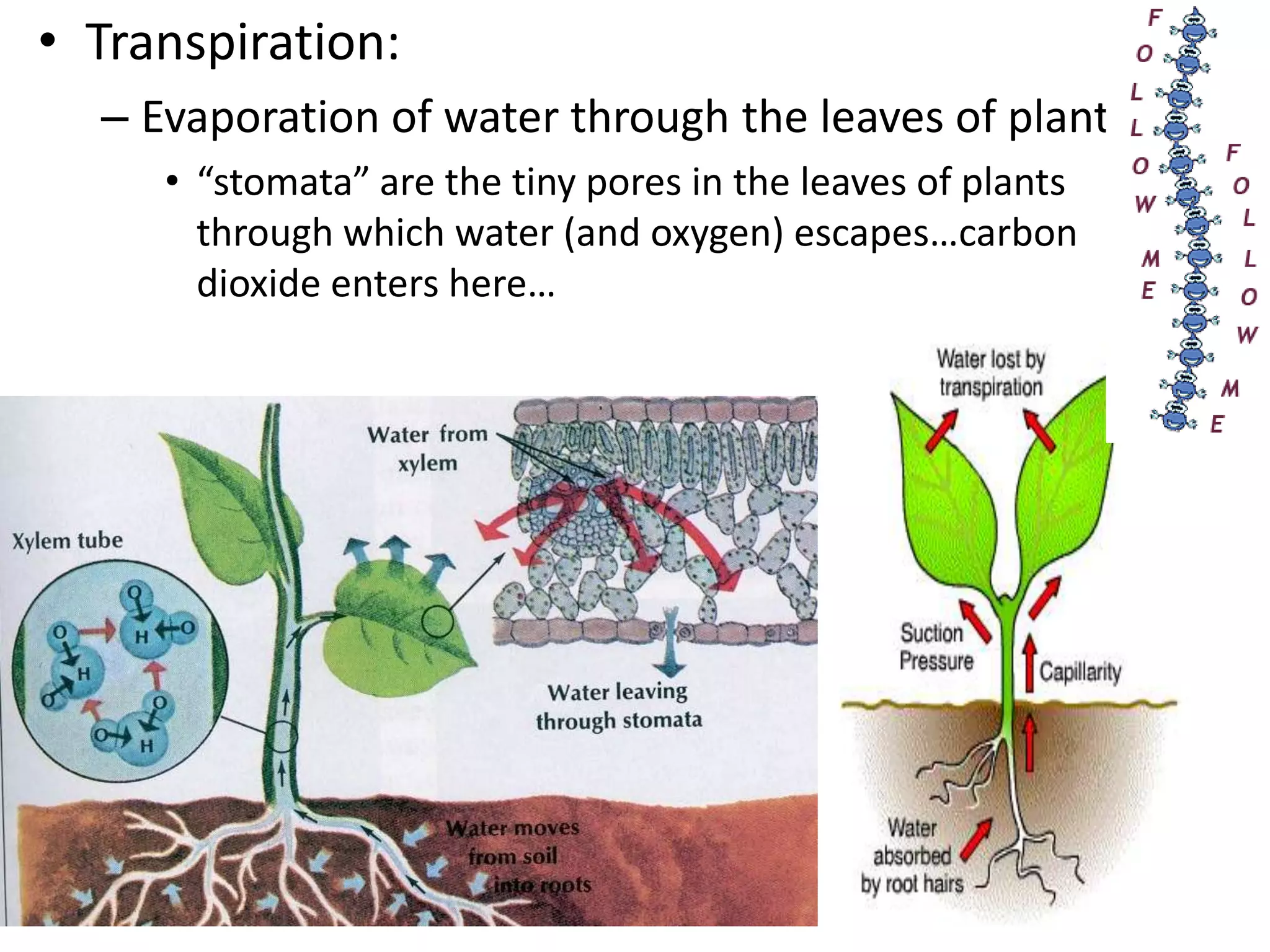
Transpiration:Evaporation of water through the leaves of plants“stomata” are the tiny pores in the leaves of plants through which water (and oxygen) escapes…carbon dioxide enters here…
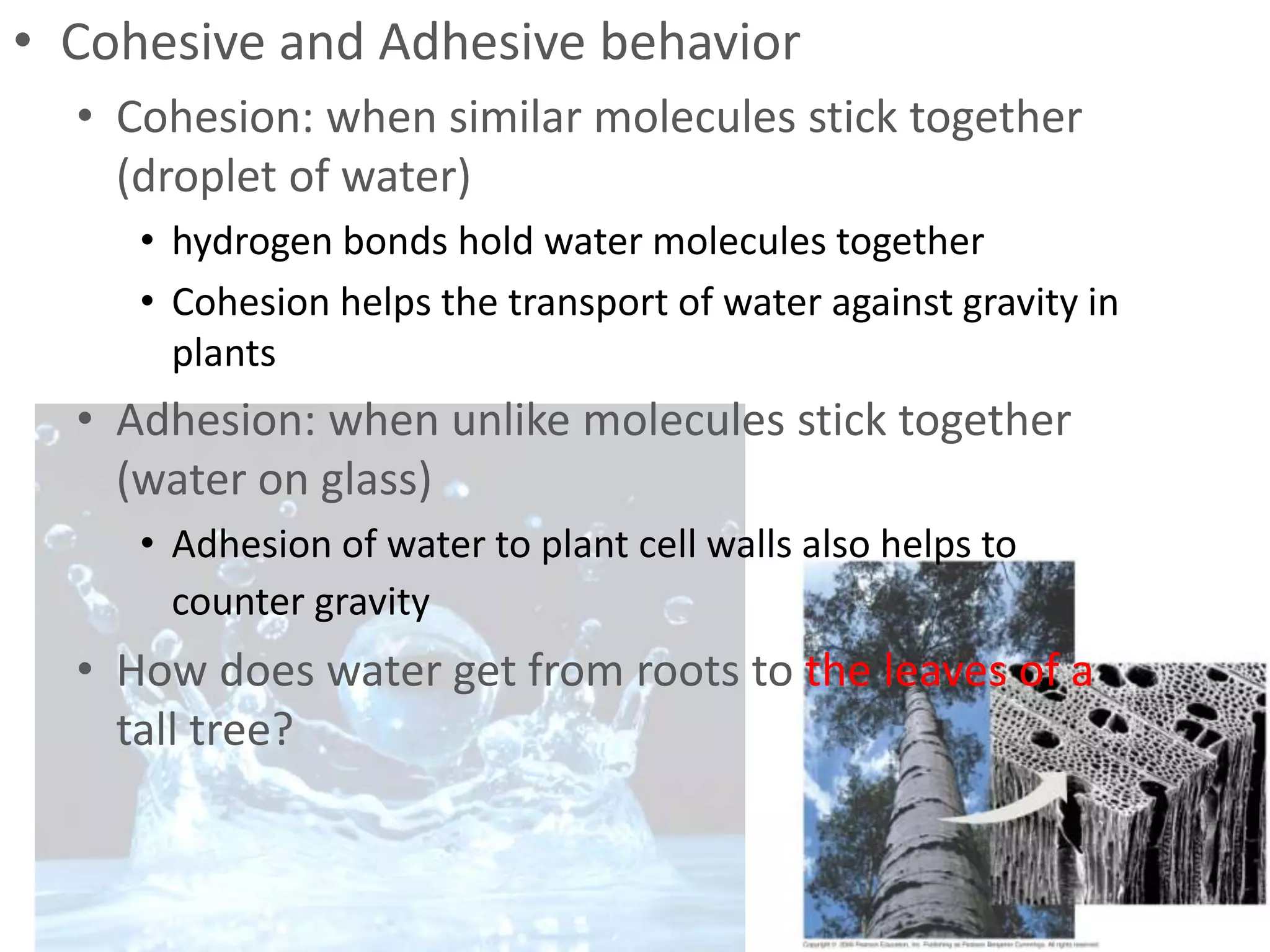
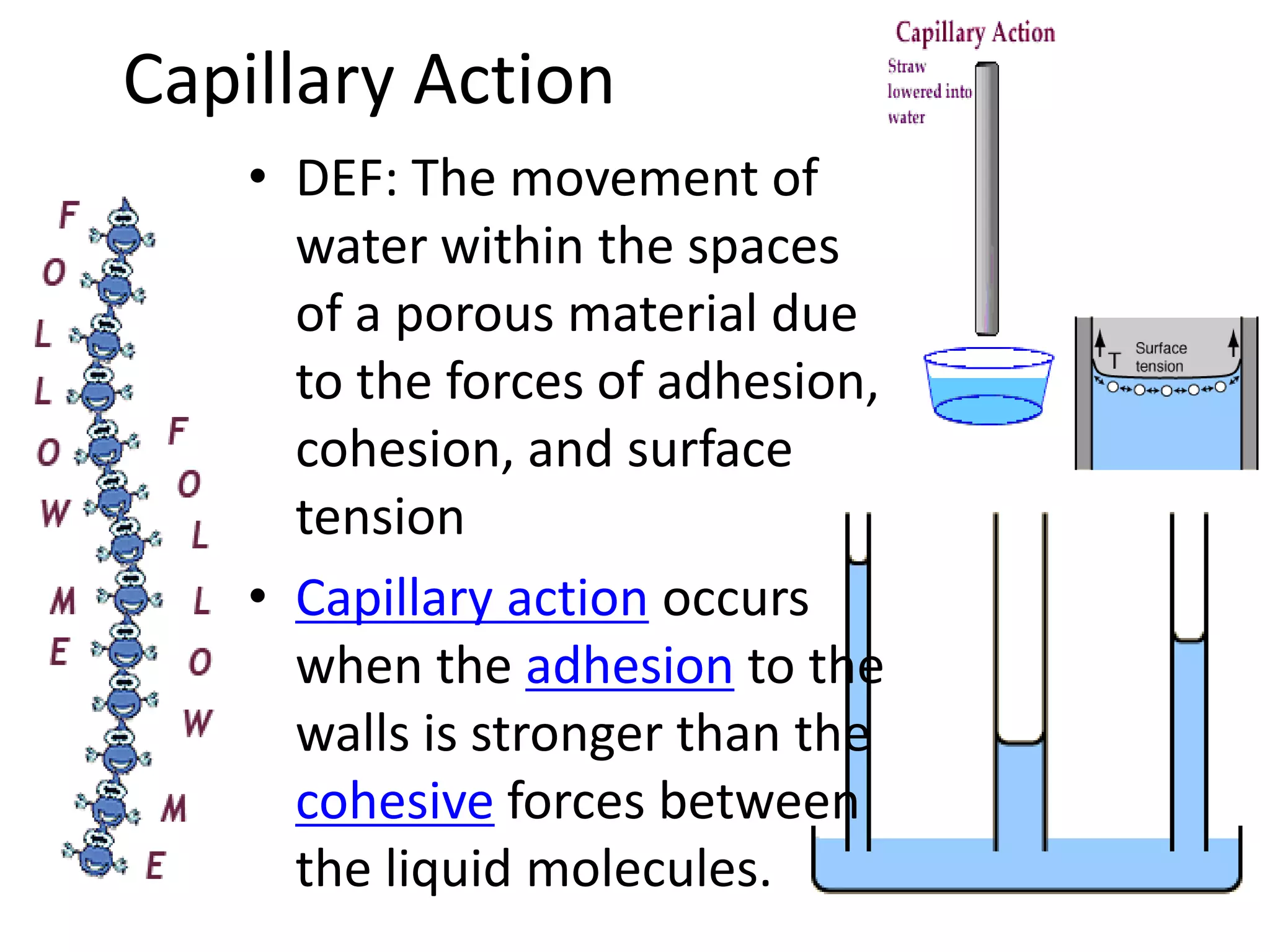
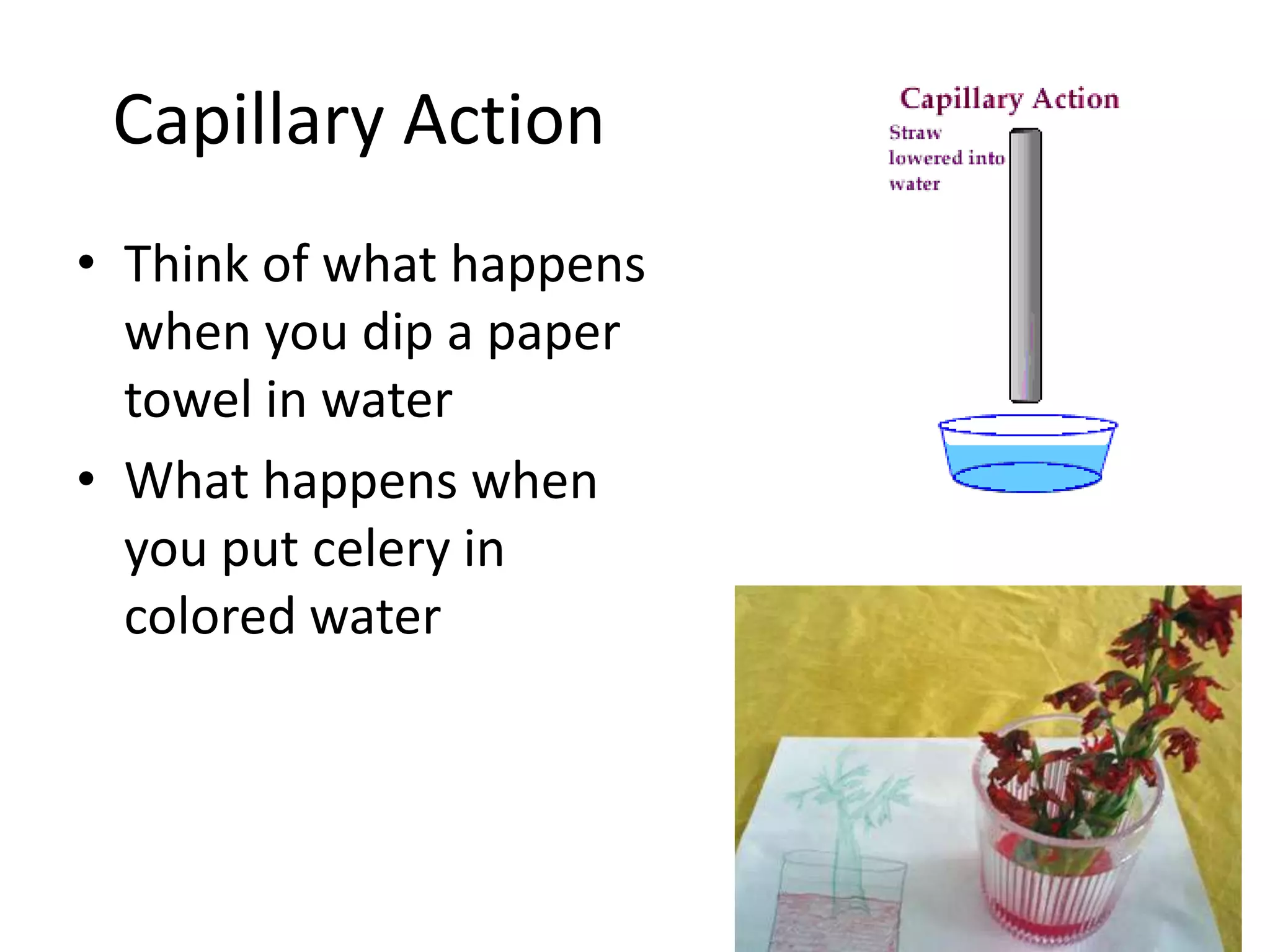
Cohesive and AdhesivebehaviorCohesion: whensimilarmolecules stick together (droplet of water)hydrogen bonds hold water molecules togetherCohesion helps the transport of water against gravity in plantsAdhesion: whenunlikemolecules stick together (water on glass)Adhesion of water to plant cell walls also helps to counter gravityHow does water getfromroots to the leaves of a  talltree?Capillary ActionDEF: The movement of water within the spaces of a porous material due to the forces of adhesion, cohesion, and surface tensionCapillary action occurs when the adhesion to the walls is stronger than the cohesive forces between the liquid molecules.
Capillary ActionThink of what happens when you dip a paper towel in waterWhat happens when you put celery in colored water
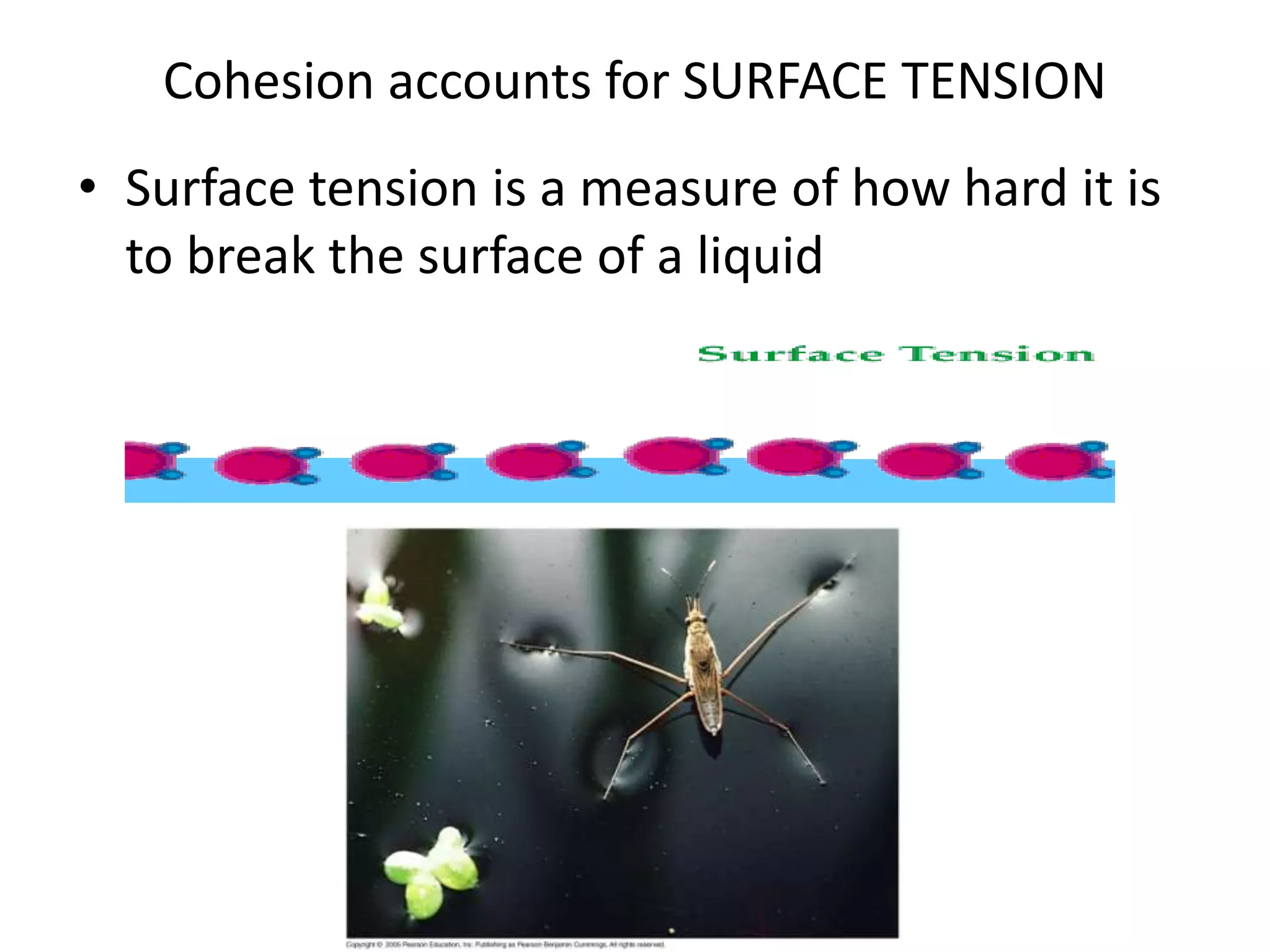
Cohesion accounts for SURFACE TENSIONSurface tension is a measure of how hard it is to break the surface of a liquid
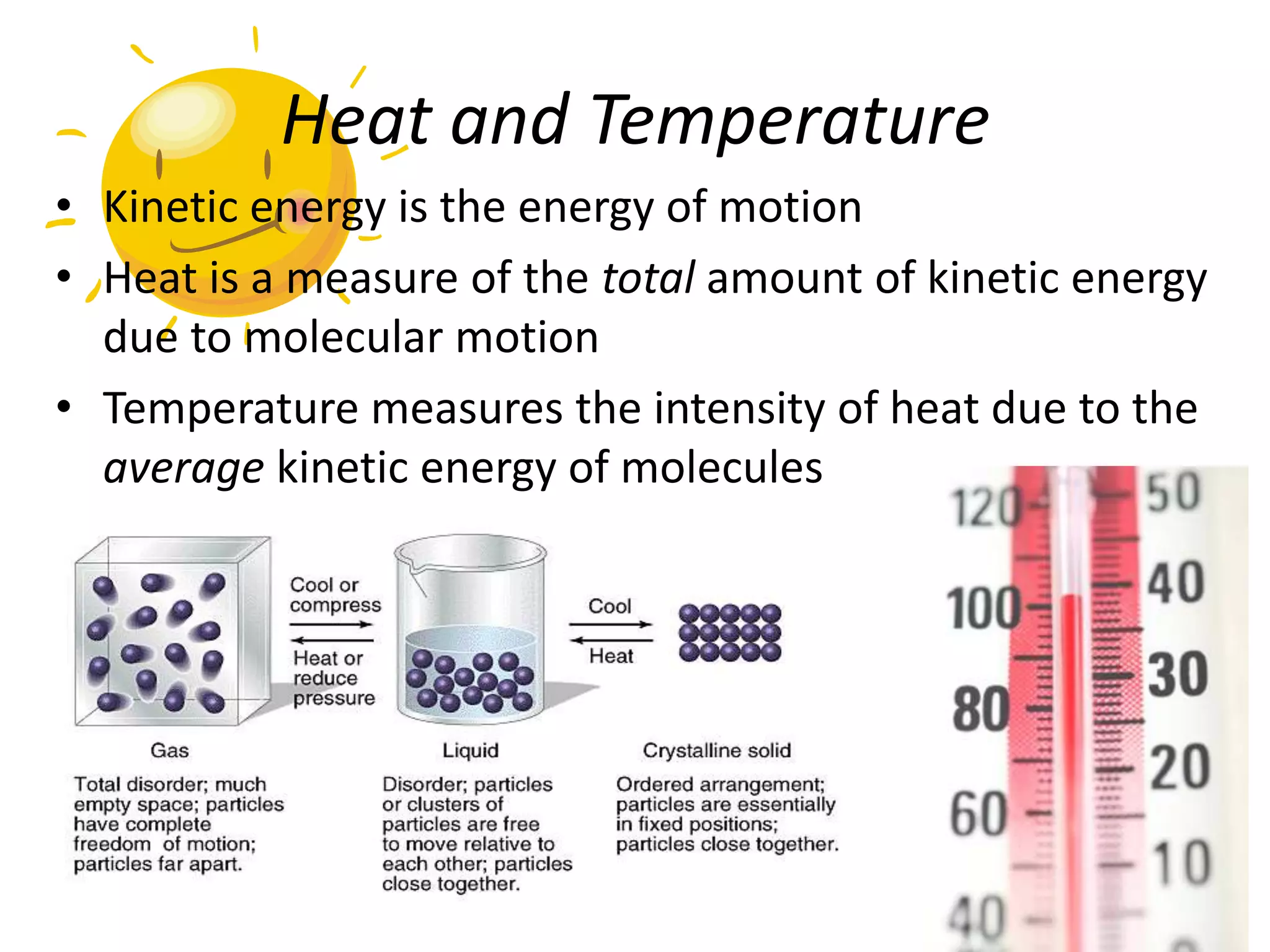
Heat and TemperatureKinetic energy is the energy of motionHeat is a measure of the total amount of kinetic energy due to molecular motion
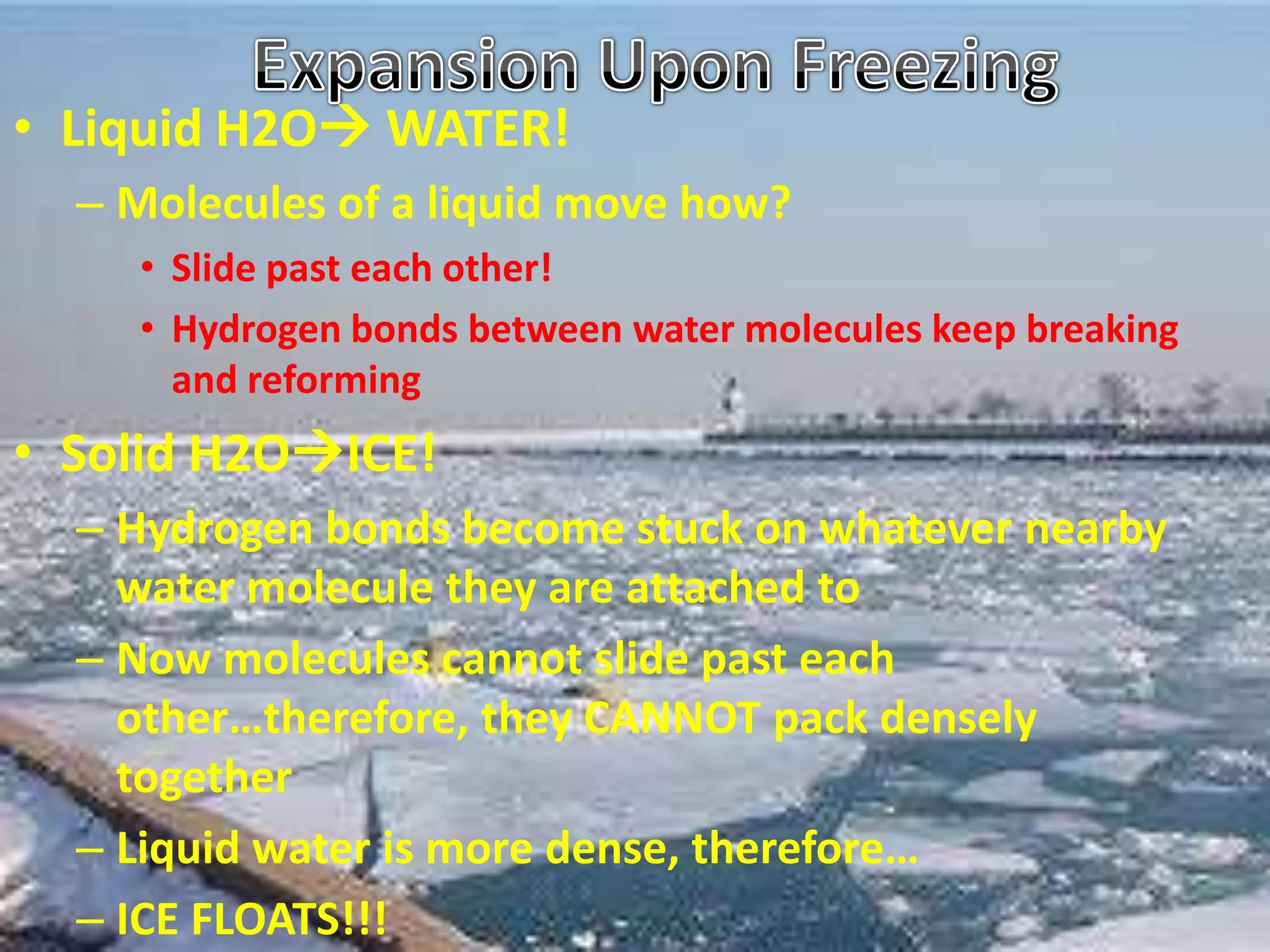
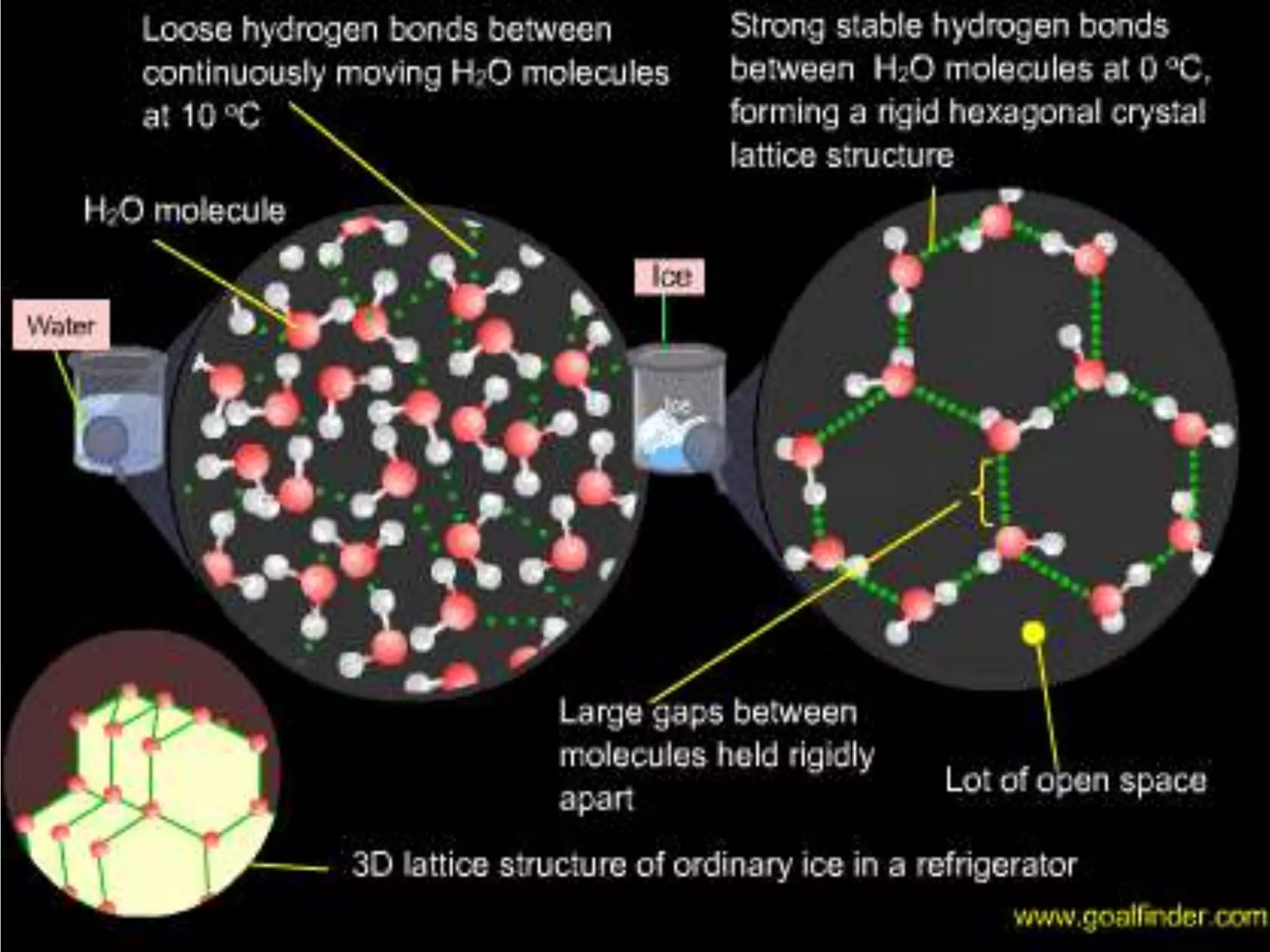
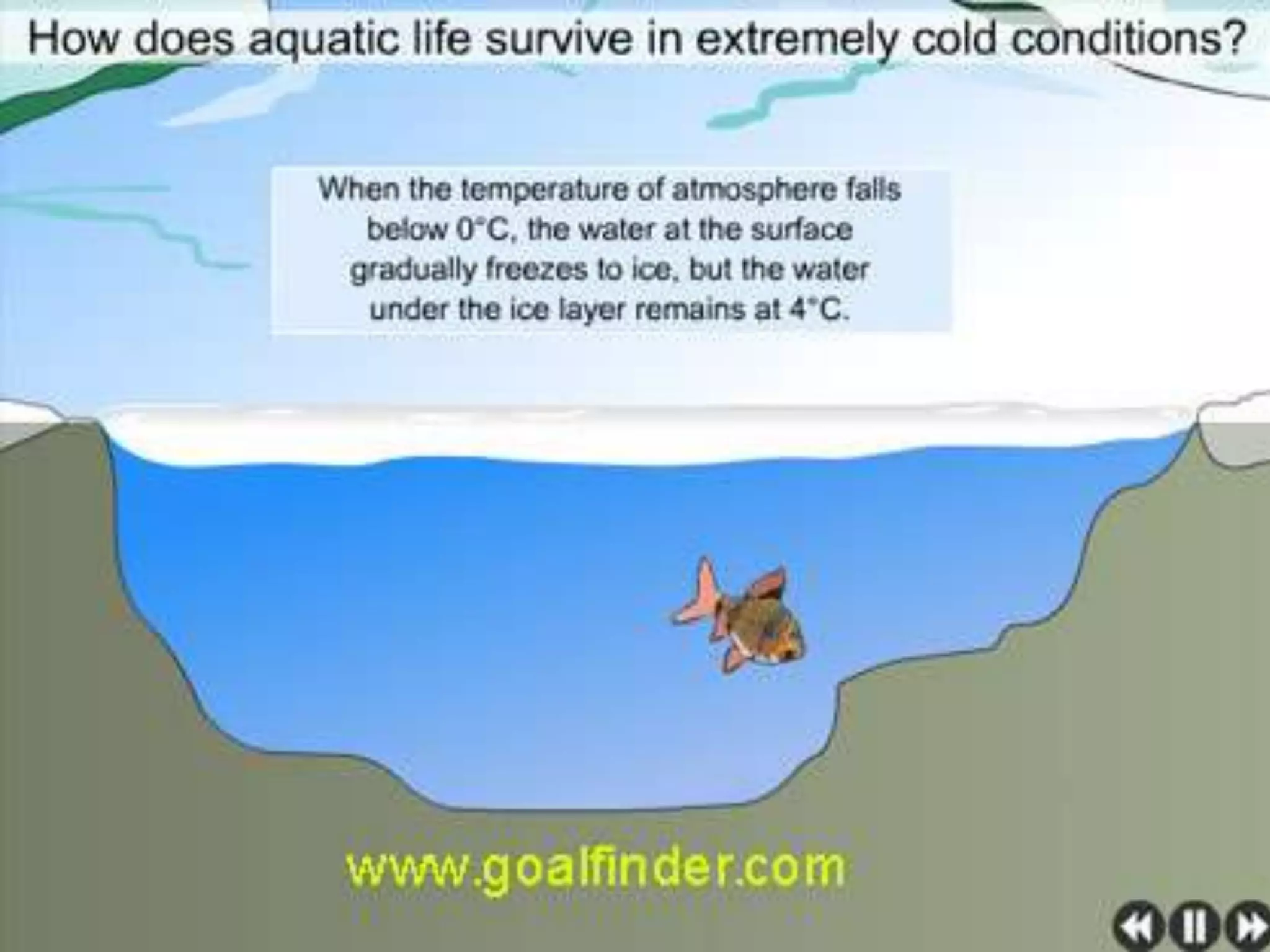
Temperature measures the intensity of heat due to the average kinetic energy of moleculesExpansion Upon FreezingLiquid H2O WATER!Molecules of a liquid move how?Slide past each other!Hydrogen bonds between water molecules keep breaking and reformingSolid H2OICE!Hydrogen bonds become stuck on whatever nearby water molecule they are attached toNow molecules cannot slide past each other…therefore, they CANNOT pack densely togetherLiquid water is more dense, therefore…ICE FLOATS!!!
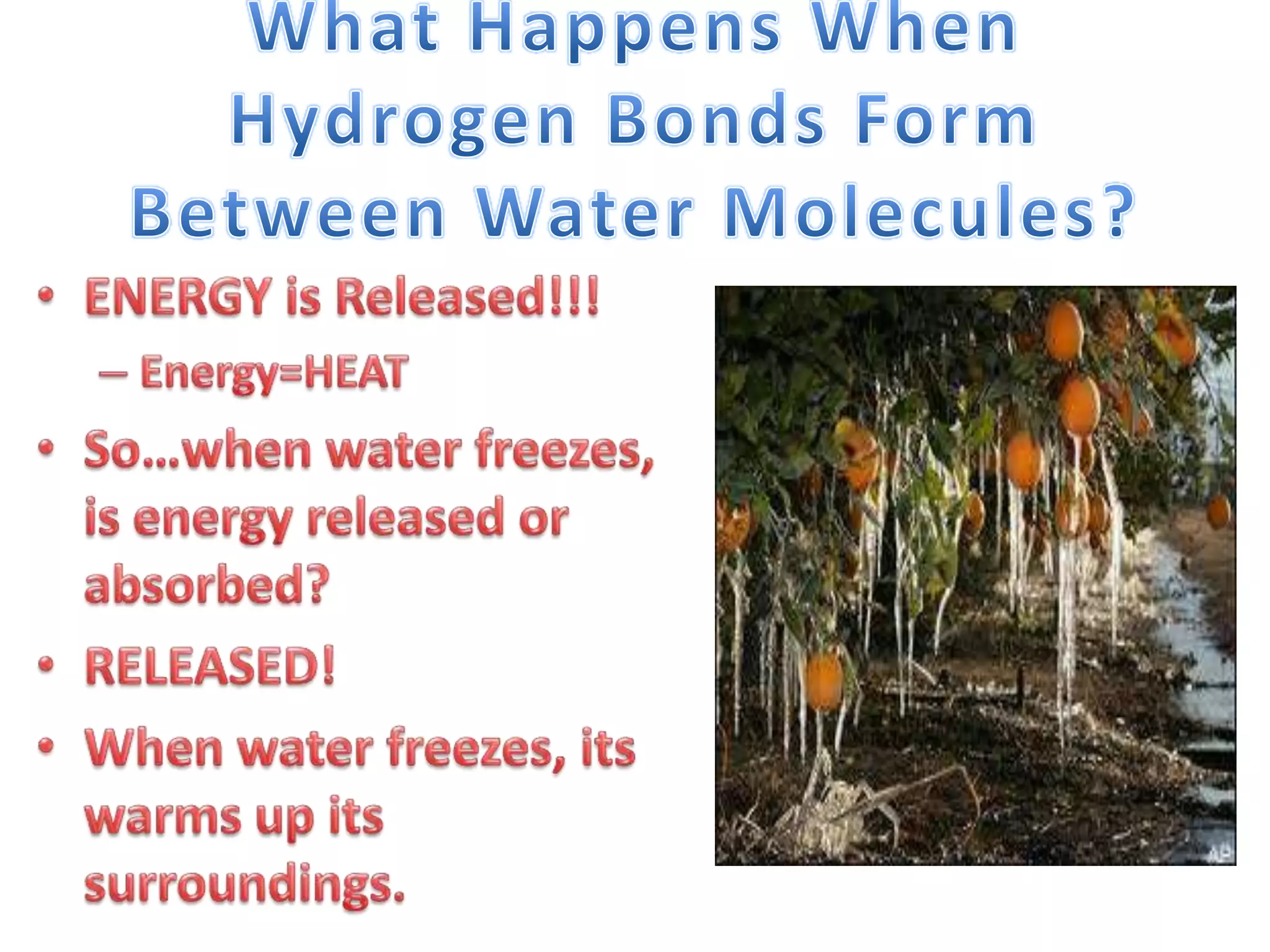
What Happens When Hydrogen Bonds Form Between Water Molecules?ENERGY is Released!!!
Energy=HEAT
So…when water freezes, is energy released or absorbed?
RELEASED!
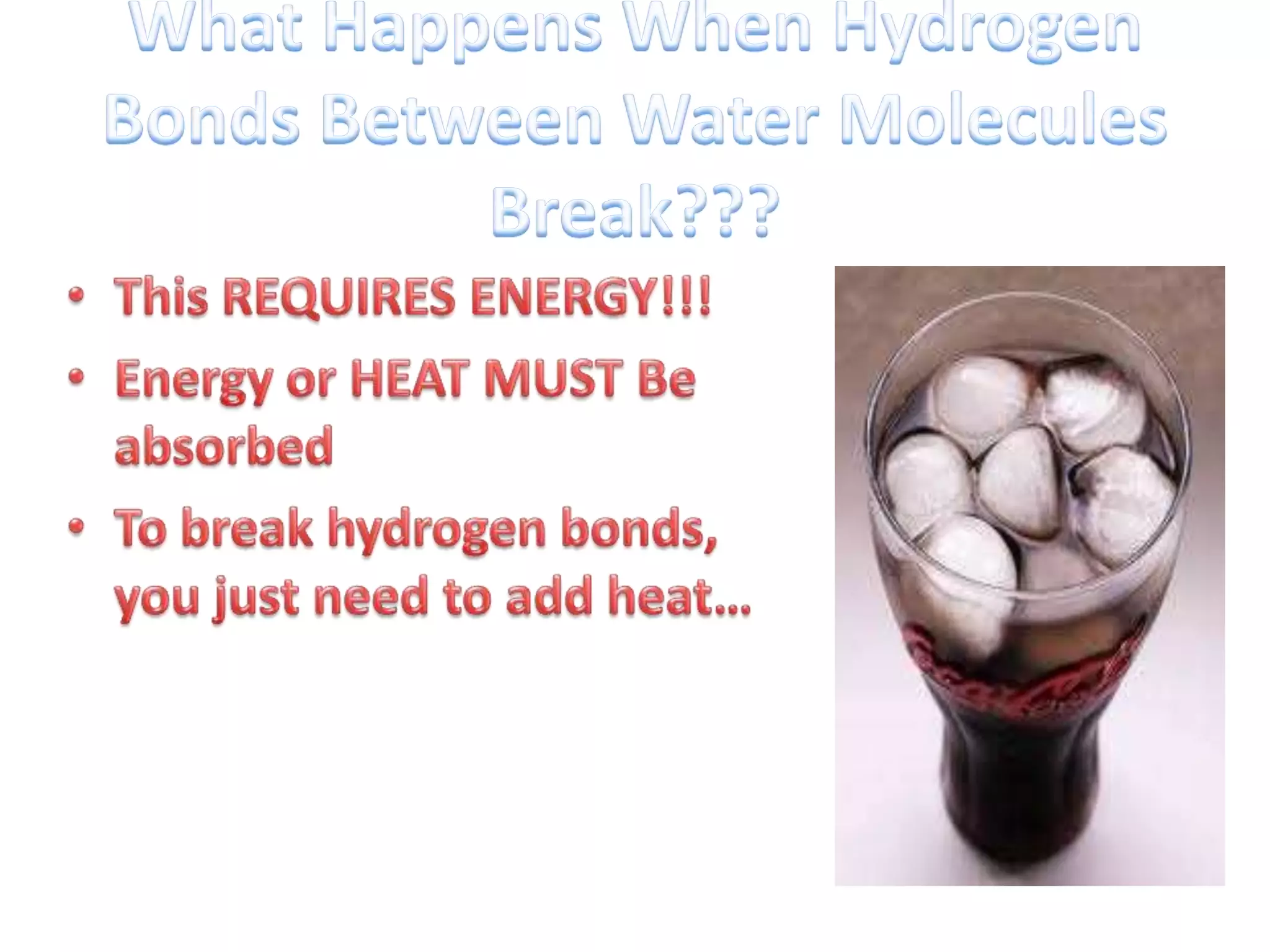
When water freezes, its warms up its surroundings.What Happens When Hydrogen Bonds Between Water Molecules Break???This REQUIRES ENERGY!!!
Energy or HEAT MUST Be absorbed
To break hydrogen bonds, you just need to add heat…Moderation of TemperatureWater absorbs heat from warmer air and releases stored heat to cooler airWater can absorb or release a large amount of heat with only a slight change in its own temperature
Weather and WaterCoastal AreasDuring the hot day, the ocean/lake will absorb energy from the air so that it feels coolerAt night, when the air is cooler, the water releases all the stored energy, making it warmer at night“moderate” temperatureInland areas (no water nearby)During the hot day, there is NO water to absorb heat so it is realllllyy hot (think desert)At night, no energy is release, so it gets very cold

Water edited

  • 1.
    Water Walk10 Differentpictures/scenarios with brief descriptionWrite Down Number of Station and the scenario you are looking at. Start at the number of the station you are atMove clockwiseAnswer the following questions for each…How does the structure of water relate to this action/scenario?
  • 2.
  • 3.
    A little bitabout waterWater is the biological medium on EarthUniversal SolventSolvent: the substance that the solute (salt) is dissovled in (water)Solute: substance (salt) that is dissolved in a liquidSolution: when solutes are uniformly distributed throughout a water solventAll living organisms require water more than any other substanceMost cells are surrounded by water, and cells themselves are about 70-95% waterThe abundance of water is the main reason the Earth is habitable
  • 4.
    WaterChemical Formula H2OHowwater is formedCovalent compound
  • 5.
    Which atom hasa stronger pull for electrons?The one that is bigger…oxygenElectrons are shared but they spend more time around Oxygen atom than the hydrogen atomsThis makes water a…Polar MoleculeUneven sharing of electrons
  • 6.
  • 7.
  • 8.
  • 9.
    What do oppositesdo? Water molecules are attracted to other water molecules to form HYDROGEN BONDSWeak attraction between hydrogen atom of one molecule and an oxygen, nitrogen or sulfur bond of another molecule.LE 3-2
  • 12.
    Properties of waterVersatility as a solventCohesive and AdhesivebehaviorExpansion uponfreezingTemperaturemoderation
  • 13.
    The Solvent ofLifeA solution is a liquid that is a homogeneous mixture of substancesA solvent is the dissolving agent of a solutionThe solute is the substance that is dissolvedWater is a versatile solvent due to its polarityAn aqueous solution is one in which water is the solvent
  • 14.
    Mixture, Solutions andSuspensions…oh my!
  • 15.
  • 16.
  • 17.
  • 18.
  • 19.
  • 20.
    Cannot see thedifferent parts
  • 21.
  • 22.
  • 23.
    you can seethe parts
  • 24.
  • 25.
  • 26.
  • 27.
  • 28.
  • 29.
  • 30.
    Mixture of waterand non-dissolved material
  • 31.
    Some of themost biologically important substances are both solutions and suspensions
  • 32.
  • 33.
    Water as theUniversal SolventWater is an effective solvent because it readily forms hydrogen bonds When an ionic compound is dissolved in water, each ion is surrounded by a sphere of water molecules, a hydration shellWater can also dissolve compounds made of nonionic polar moleculesEven large polar molecules such as proteins can dissolve in water if they have ionic and polar regions
  • 34.
  • 36.
    LE 3-7a Lysozyme moleculein a nonaqueous environment.
  • 37.
    LE 3-7bLysozyme moleculein a aqueous environment.
  • 38.
    Transpiration:Evaporation of waterthrough the leaves of plants“stomata” are the tiny pores in the leaves of plants through which water (and oxygen) escapes…carbon dioxide enters here…
  • 39.
    Cohesive and AdhesivebehaviorCohesion:whensimilarmolecules stick together (droplet of water)hydrogen bonds hold water molecules togetherCohesion helps the transport of water against gravity in plantsAdhesion: whenunlikemolecules stick together (water on glass)Adhesion of water to plant cell walls also helps to counter gravityHow does water getfromroots to the leaves of a talltree?Capillary ActionDEF: The movement of water within the spaces of a porous material due to the forces of adhesion, cohesion, and surface tensionCapillary action occurs when the adhesion to the walls is stronger than the cohesive forces between the liquid molecules.
  • 40.
    Capillary ActionThink ofwhat happens when you dip a paper towel in waterWhat happens when you put celery in colored water
  • 41.
    Cohesion accounts forSURFACE TENSIONSurface tension is a measure of how hard it is to break the surface of a liquid
  • 42.
    Heat and TemperatureKineticenergy is the energy of motionHeat is a measure of the total amount of kinetic energy due to molecular motion
  • 43.
    Temperature measures theintensity of heat due to the average kinetic energy of moleculesExpansion Upon FreezingLiquid H2O WATER!Molecules of a liquid move how?Slide past each other!Hydrogen bonds between water molecules keep breaking and reformingSolid H2OICE!Hydrogen bonds become stuck on whatever nearby water molecule they are attached toNow molecules cannot slide past each other…therefore, they CANNOT pack densely togetherLiquid water is more dense, therefore…ICE FLOATS!!!
  • 46.
    What Happens WhenHydrogen Bonds Form Between Water Molecules?ENERGY is Released!!!
  • 47.
  • 48.
    So…when water freezes,is energy released or absorbed?
  • 49.
  • 50.
    When water freezes,its warms up its surroundings.What Happens When Hydrogen Bonds Between Water Molecules Break???This REQUIRES ENERGY!!!
  • 51.
    Energy or HEATMUST Be absorbed
  • 52.
    To break hydrogenbonds, you just need to add heat…Moderation of TemperatureWater absorbs heat from warmer air and releases stored heat to cooler airWater can absorb or release a large amount of heat with only a slight change in its own temperature
  • 53.
    Weather and WaterCoastalAreasDuring the hot day, the ocean/lake will absorb energy from the air so that it feels coolerAt night, when the air is cooler, the water releases all the stored energy, making it warmer at night“moderate” temperatureInland areas (no water nearby)During the hot day, there is NO water to absorb heat so it is realllllyy hot (think desert)At night, no energy is release, so it gets very cold
  • 54.
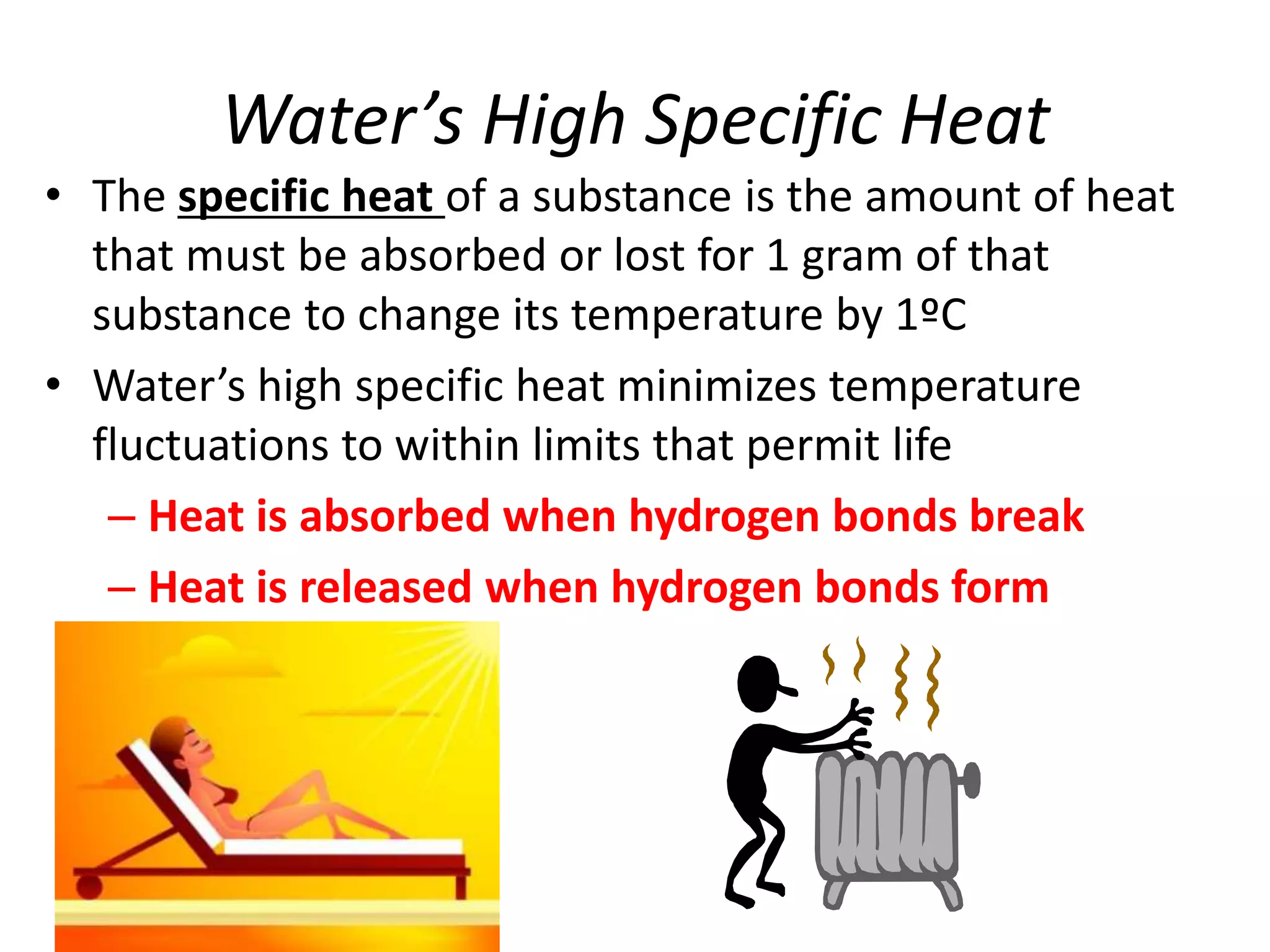
    Water’s High SpecificHeatThe specific heat of a substance is the amount of heat that must be absorbed or lost for 1 gram of that substance to change its temperature by 1ºCWater’s high specific heat minimizes temperature fluctuations to within limits that permit lifeHeat is absorbed when hydrogen bonds breakHeat is released when hydrogen bonds form
  • 55.
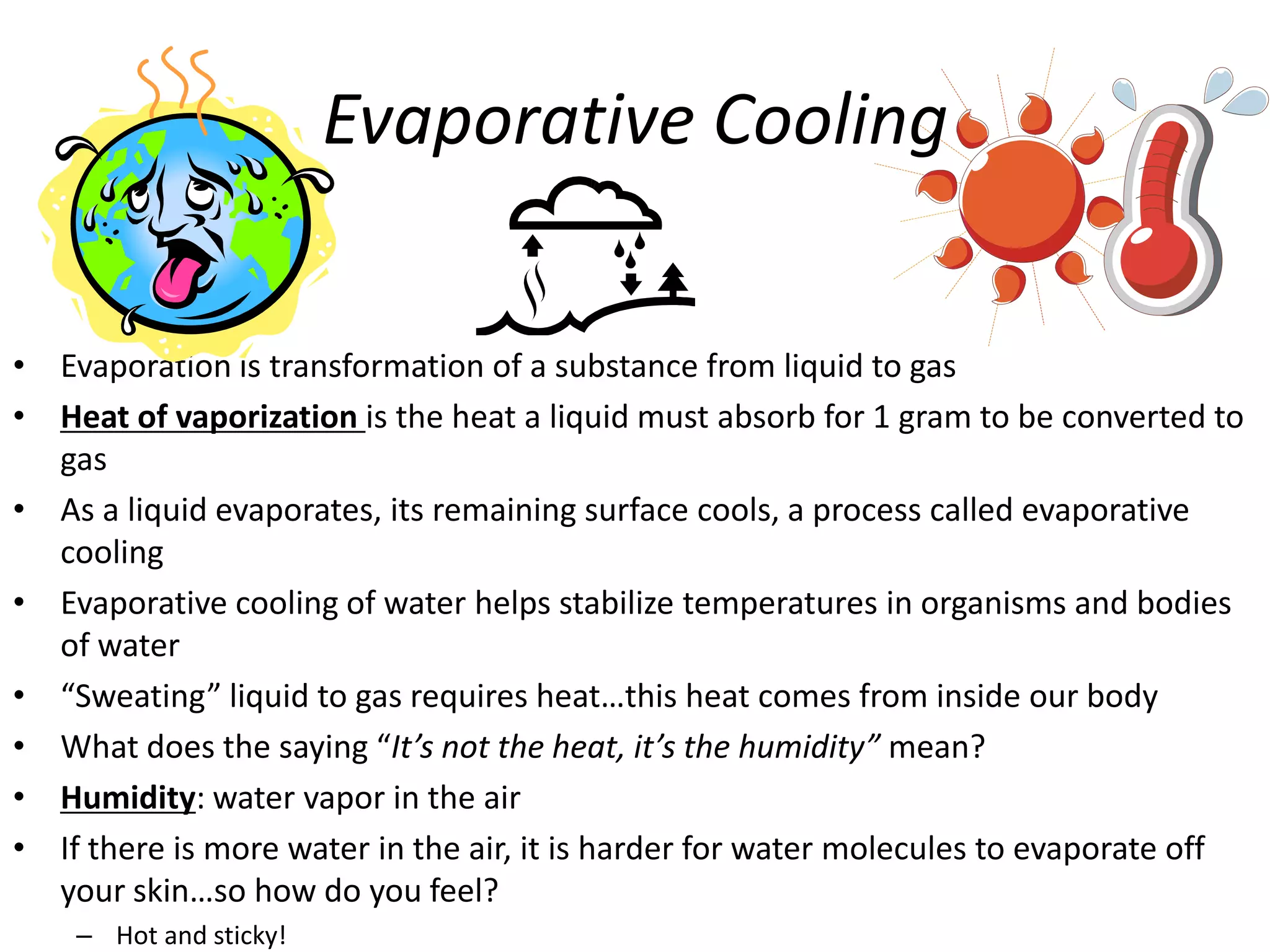
    Evaporative CoolingEvaporation istransformation of a substance from liquid to gasHeat of vaporization is the heat a liquid must absorb for 1 gram to be converted to gasAs a liquid evaporates, its remaining surface cools, a process called evaporative cooling Evaporative cooling of water helps stabilize temperatures in organisms and bodies of water“Sweating” liquid to gas requires heat…this heat comes from inside our bodyWhat does the saying “It’s not the heat, it’s the humidity”mean?Humidity: water vapor in the airIf there is more water in the air, it is harder for water molecules to evaporate off your skin…so how do you feel?Hot and sticky!
  • 56.
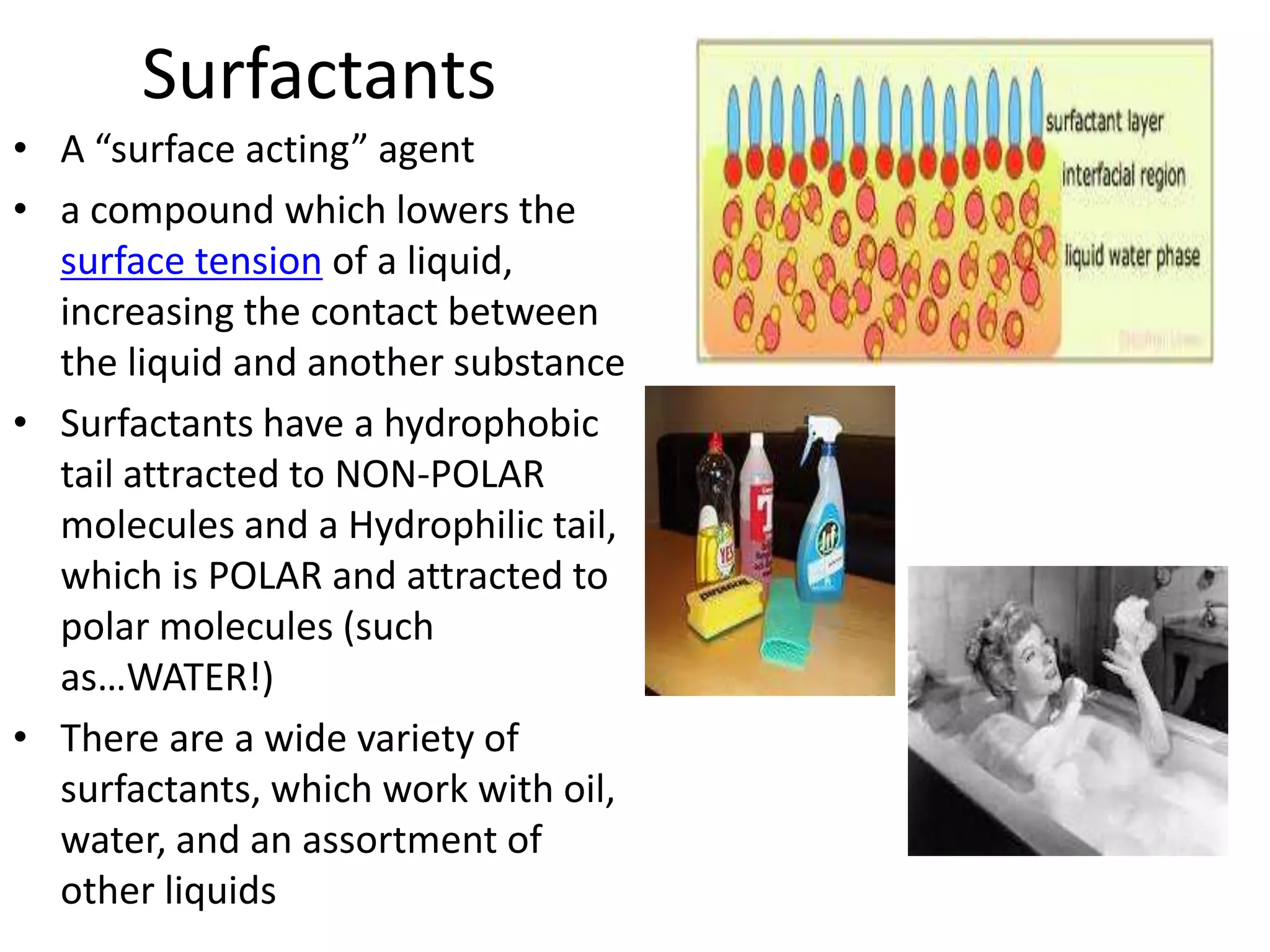
    SurfactantsA “surface acting”agenta compound which lowers the surface tension of a liquid, increasing the contact between the liquid and another substanceSurfactants have a hydrophobic tail attracted to NON-POLAR molecules and a Hydrophilic tail, which is POLAR and attracted to polar molecules (such as…WATER!)There are a wide variety of surfactants, which work with oil, water, and an assortment of other liquids
  • 57.
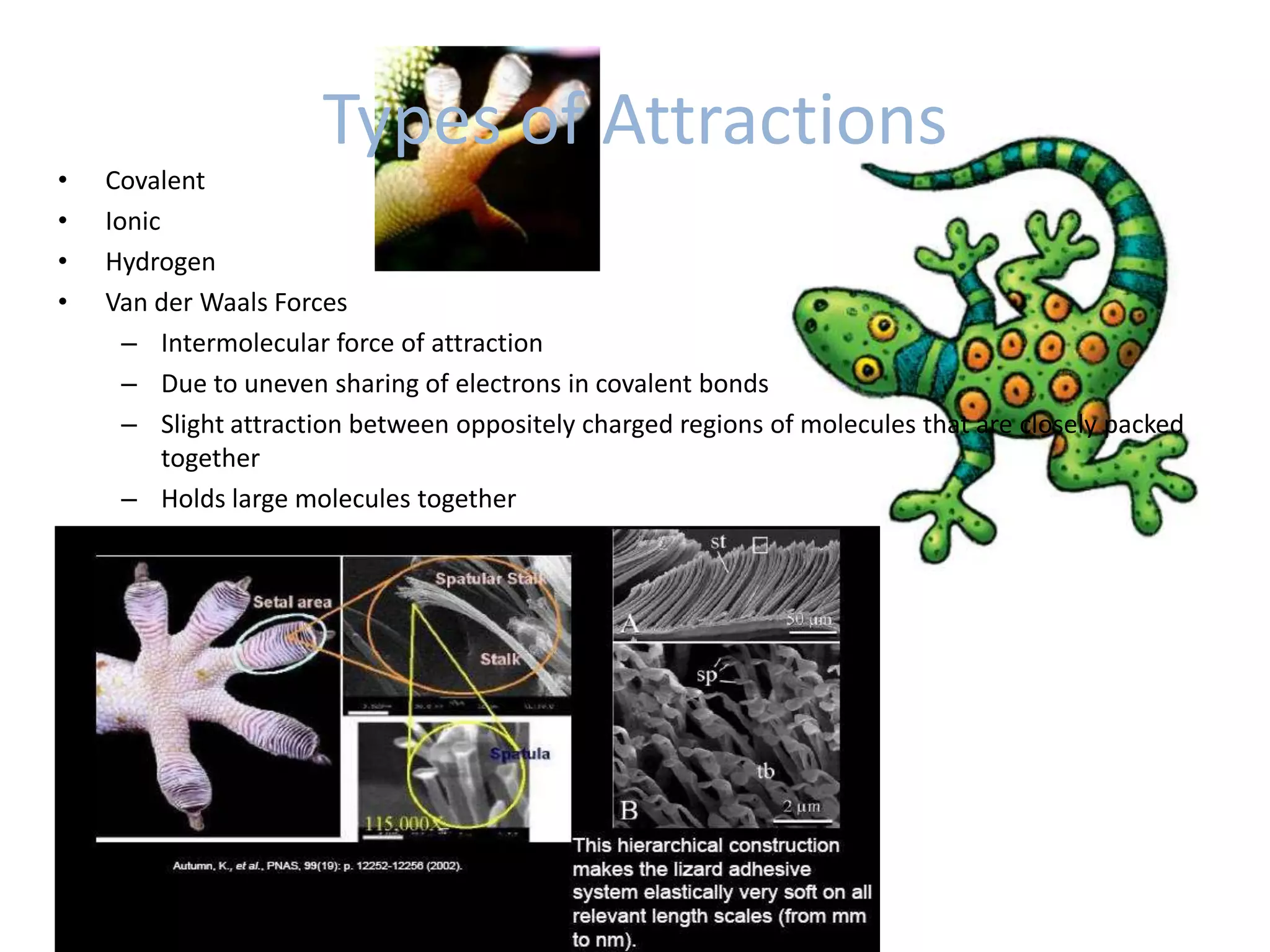
    Types of AttractionsCovalentIonicHydrogenVander Waals ForcesIntermolecular force of attractionDue to uneven sharing of electrons in covalent bondsSlight attraction between oppositely charged regions of molecules that are closely packed togetherHolds large molecules together
  • 58.
    Hydrophilic and HydrophobicSubstancesA hydrophilic substance is one that has an affinity (likes!) for waterA hydrophobic substance is one that does not have an affinity (does NOT like; scared of) for water
  • 59.
    How water actsin solutionOccasionally a water molecule dissociates (breaks up) into ions H2O H+ + OH-This happens to every one water molecule in a million in pure water…not very commonThe H+ immediately reacts with another water molecule in the solution to make a HYDRONIUM ion H30+
  • 60.
  • 61.
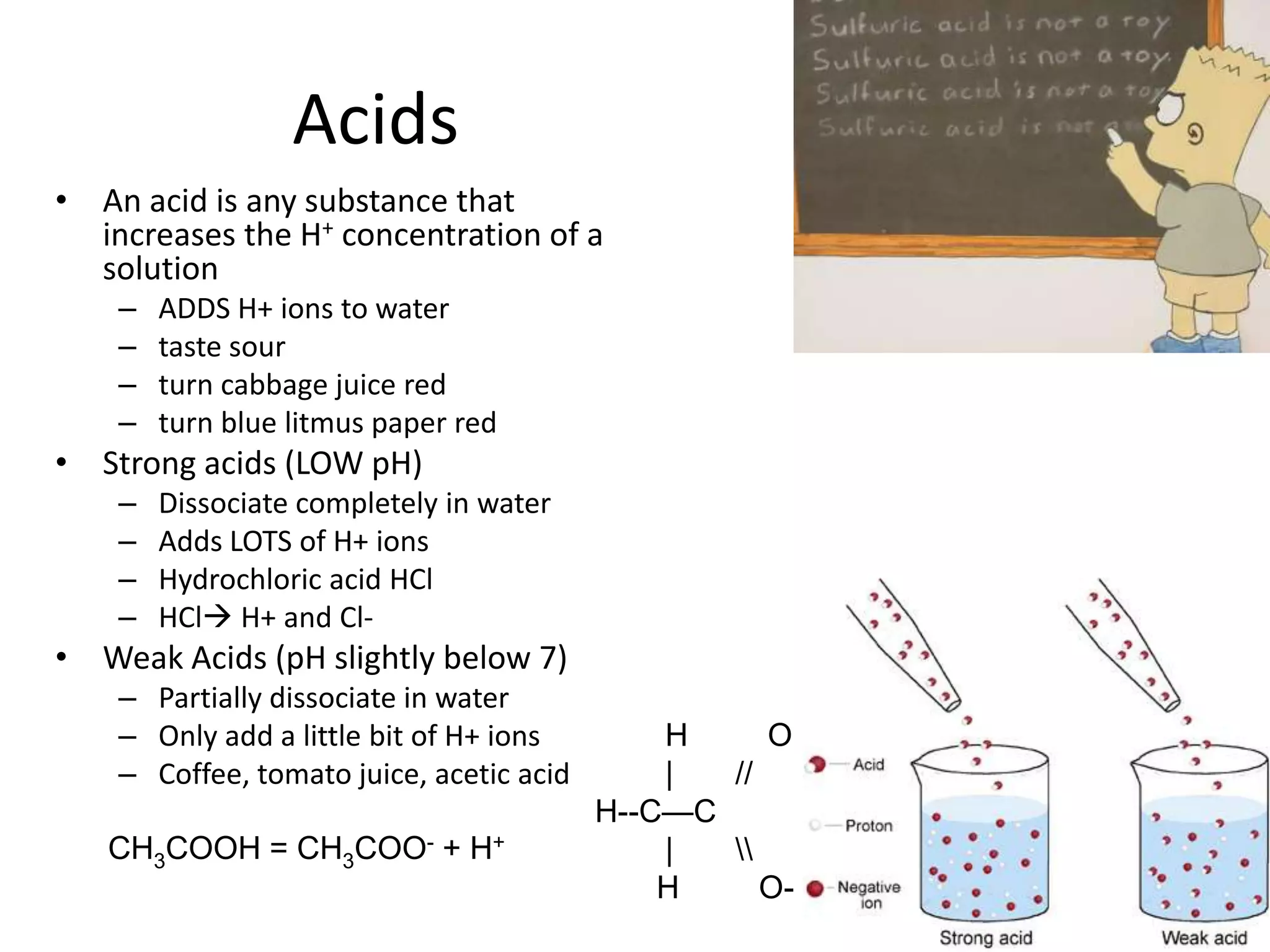
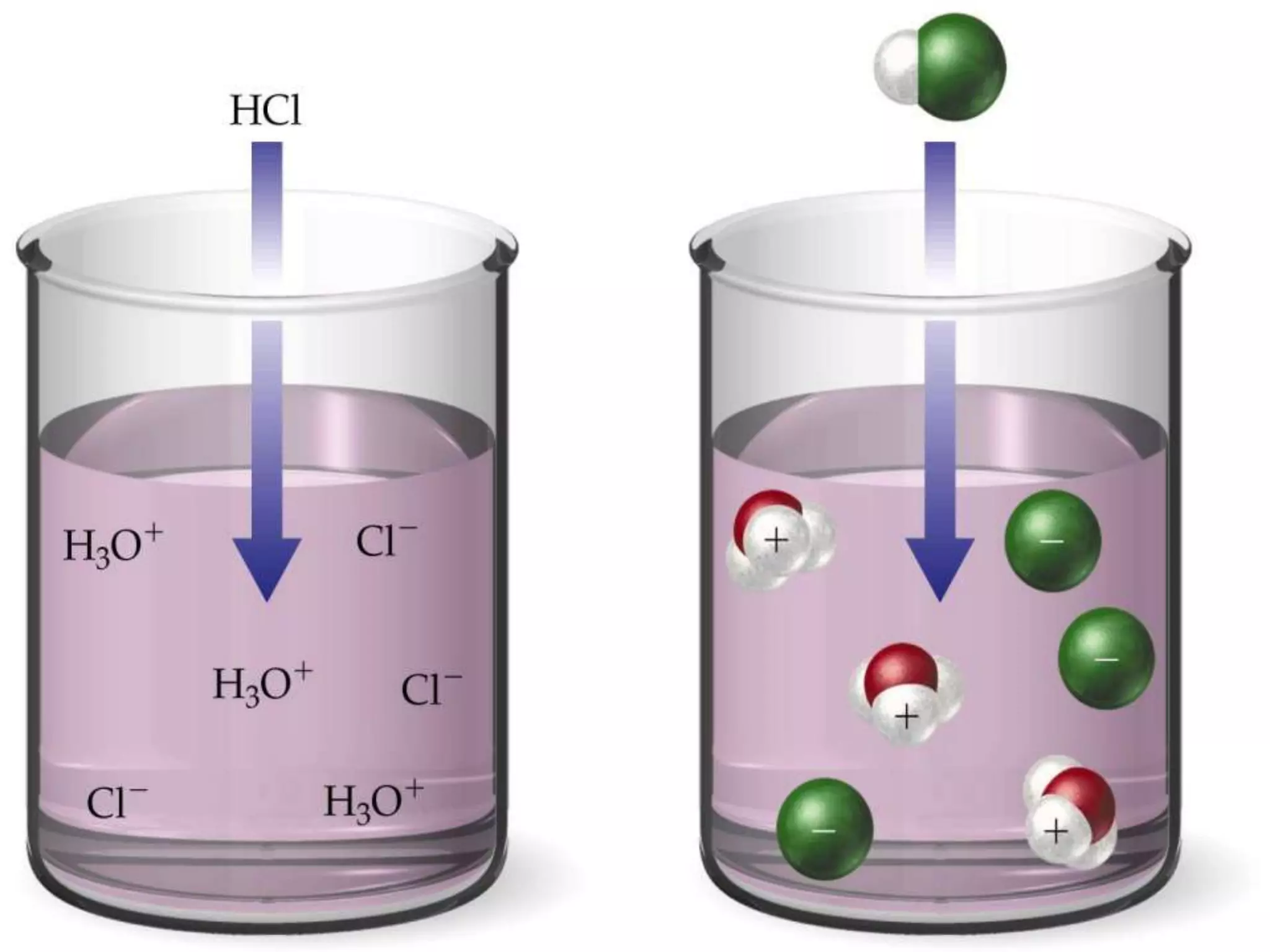
    AcidsAn acid isany substance that increases the H+ concentration of a solution
  • 62.
    ADDS H+ ionsto water
  • 63.
  • 64.
  • 65.
  • 66.
  • 67.
  • 68.
  • 69.
  • 70.
  • 71.
    Weak Acids (pHslightly below 7)
  • 72.
  • 73.
    Only add alittle bit of H+ ions
  • 74.
    Coffee, tomato juice,acetic acid  H         O        |       //H--C—C        |       \\       H         O-CH3COOH = CH3COO- + H+
  • 76.
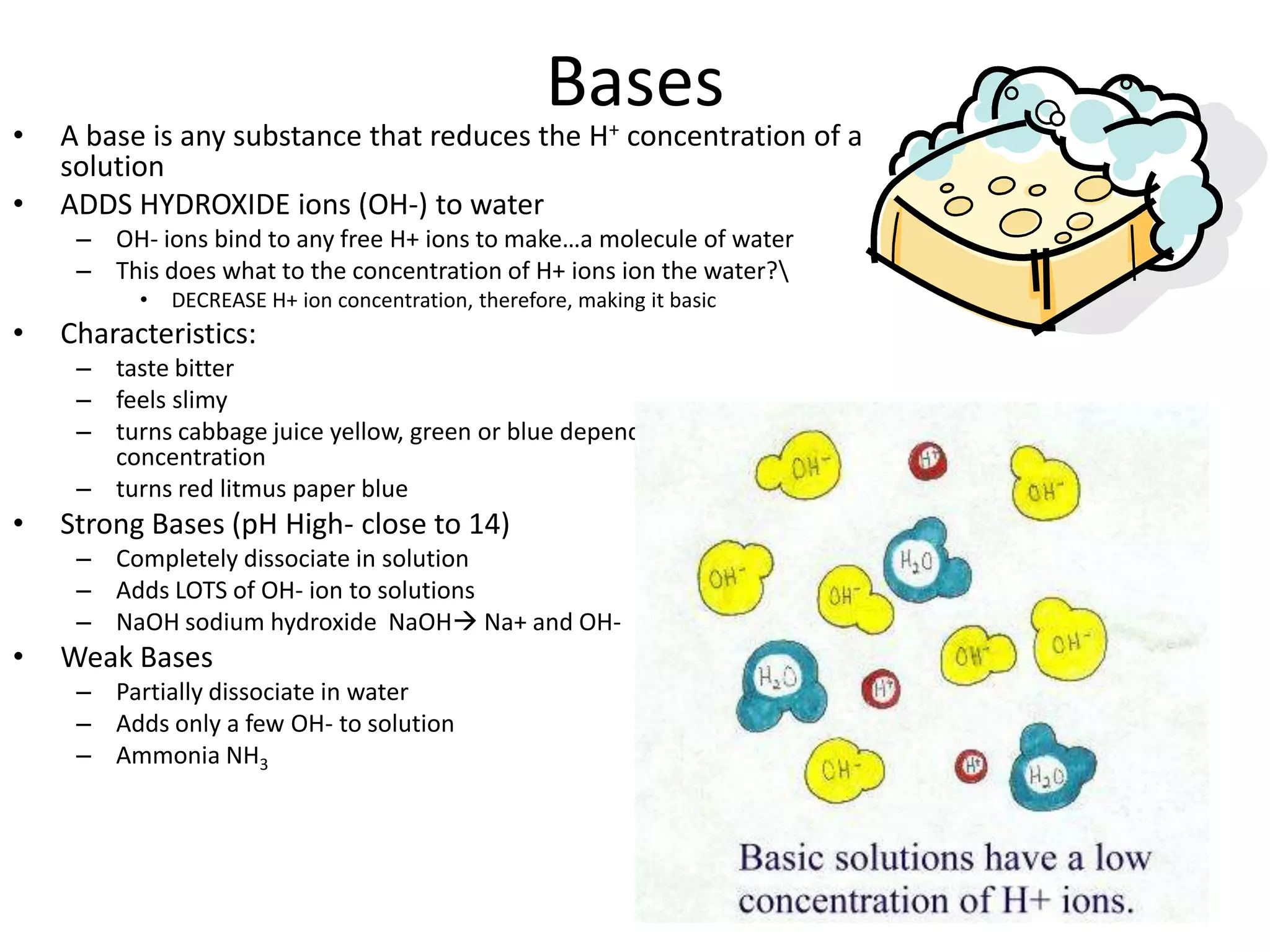
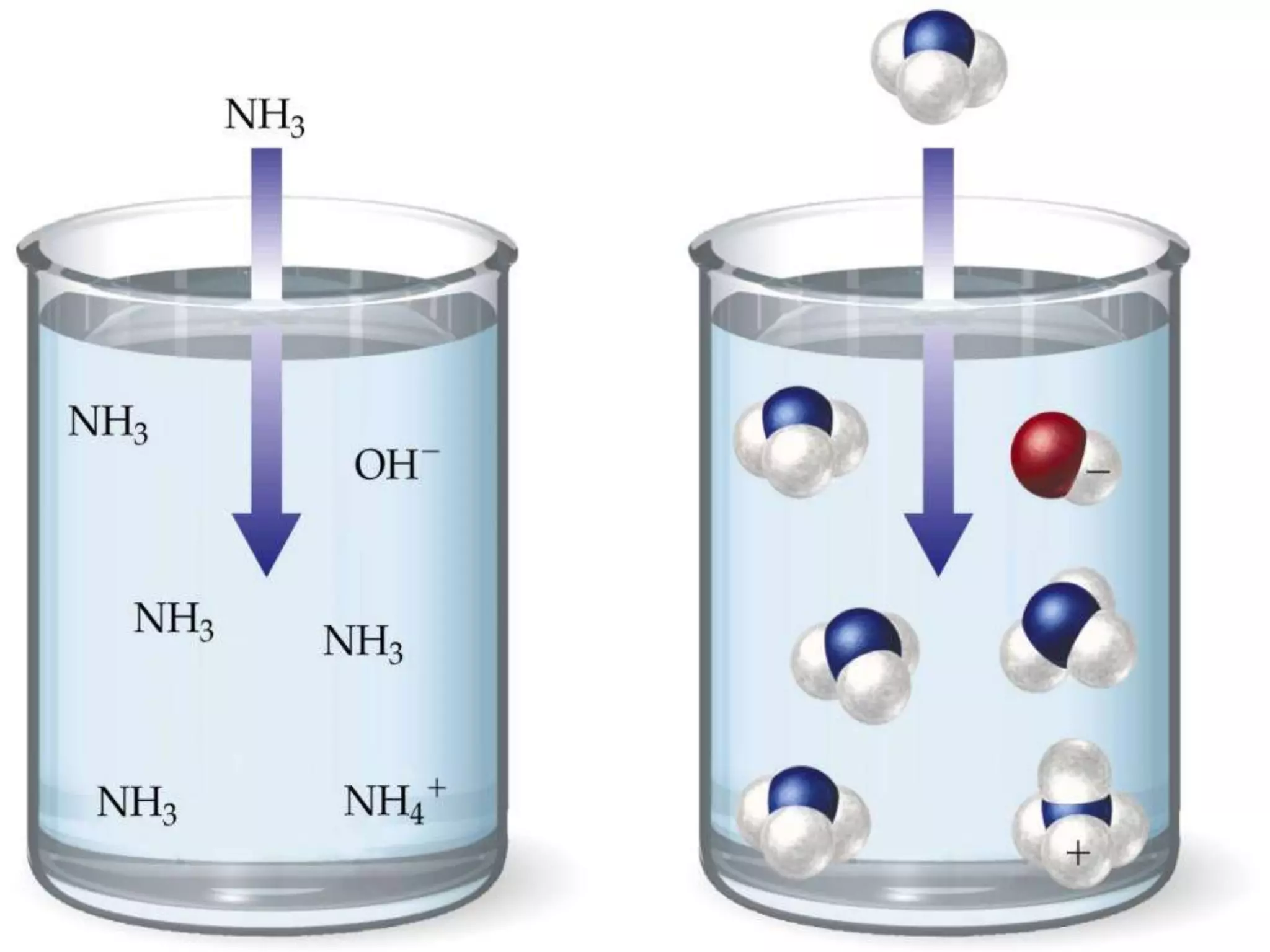
    BasesA base isany substance that reduces the H+ concentration of a solutionADDS HYDROXIDE ions (OH-) to waterOH- ions bind to any free H+ ions to make…a molecule of waterThis does what to the concentration of H+ ions ion the water?\DECREASE H+ ion concentration, therefore, making it basicCharacteristics:taste bitter feels slimy turns cabbage juice yellow, green or blue depending upon the solution concentration turns red litmus paper blue Strong Bases (pH High- close to 14)Completely dissociate in solutionAdds LOTS of OH- ion to solutionsNaOH sodium hydroxide NaOH Na+ and OH-Weak BasesPartially dissociate in water Adds only a few OH- to solutionAmmonia NH3
  • 79.
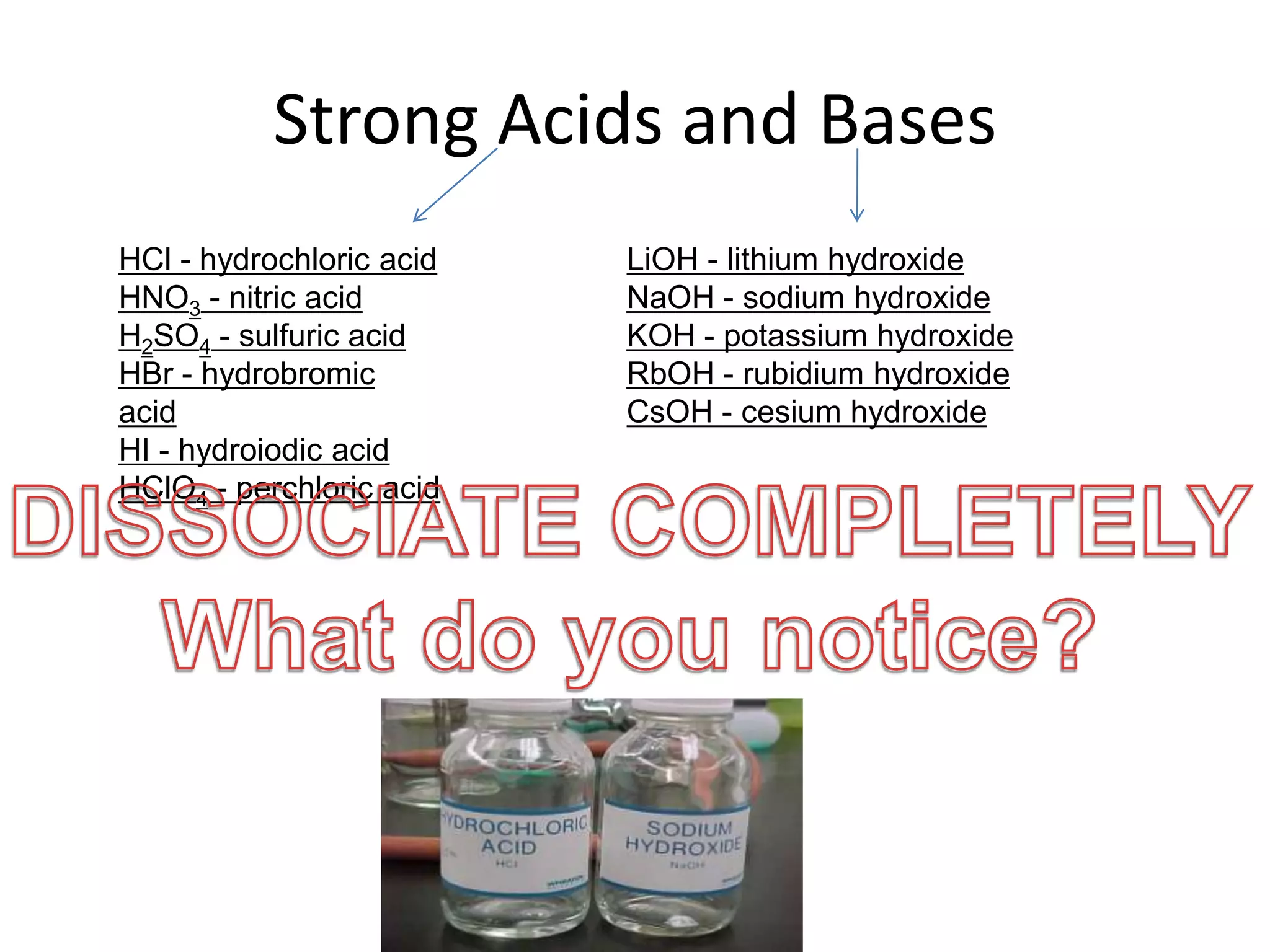
    Strong Acids andBasesHCl - hydrochloric acid HNO3 - nitric acid H2SO4 - sulfuric acid HBr - hydrobromic acid HI - hydroiodic acid HClO4 - perchloric acidLiOH - lithium hydroxide NaOH - sodium hydroxide KOH - potassium hydroxide RbOH - rubidium hydroxide CsOH - cesium hydroxide DISSOCIATE COMPLETELYWhat do you notice?
  • 80.
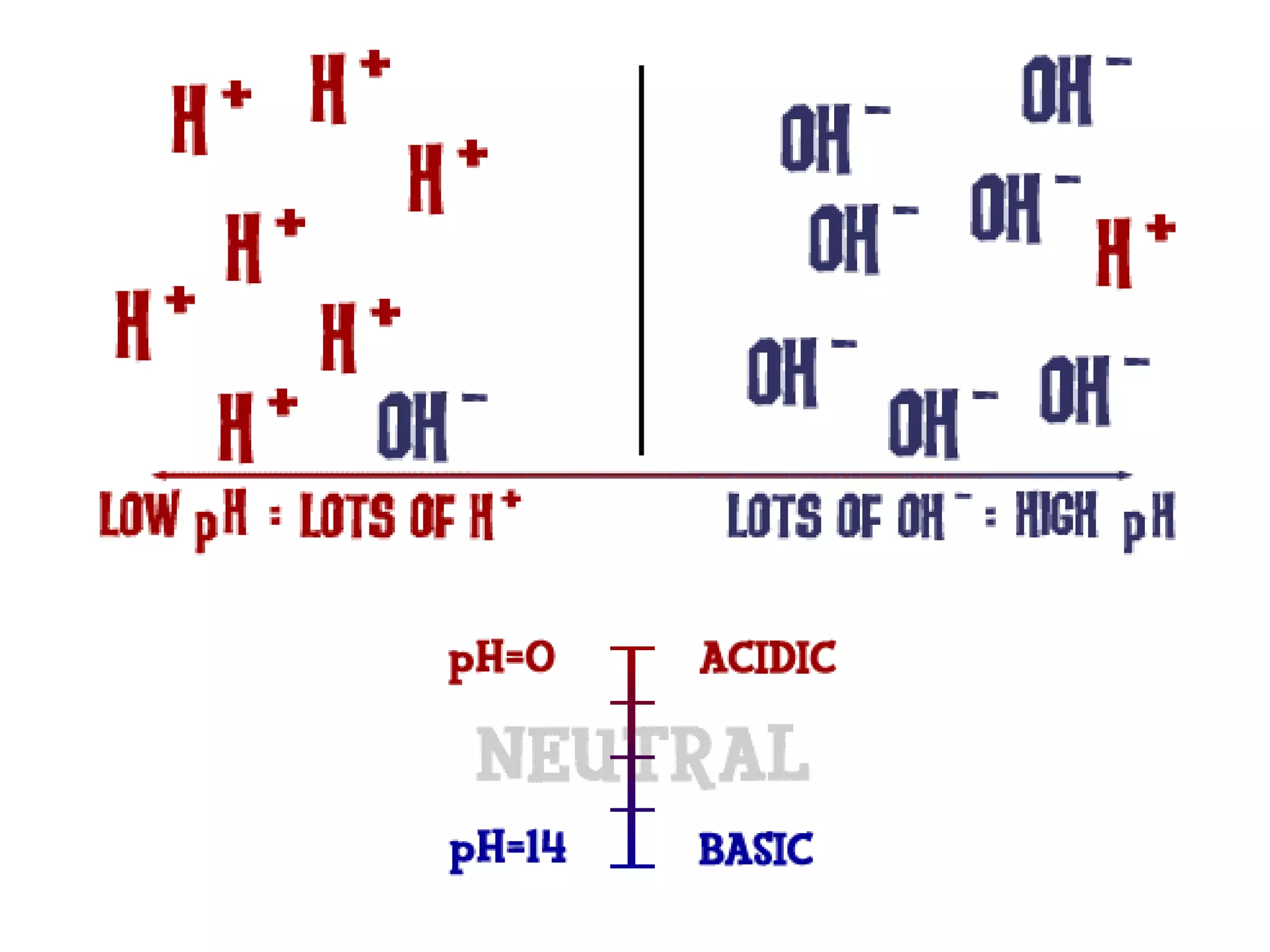
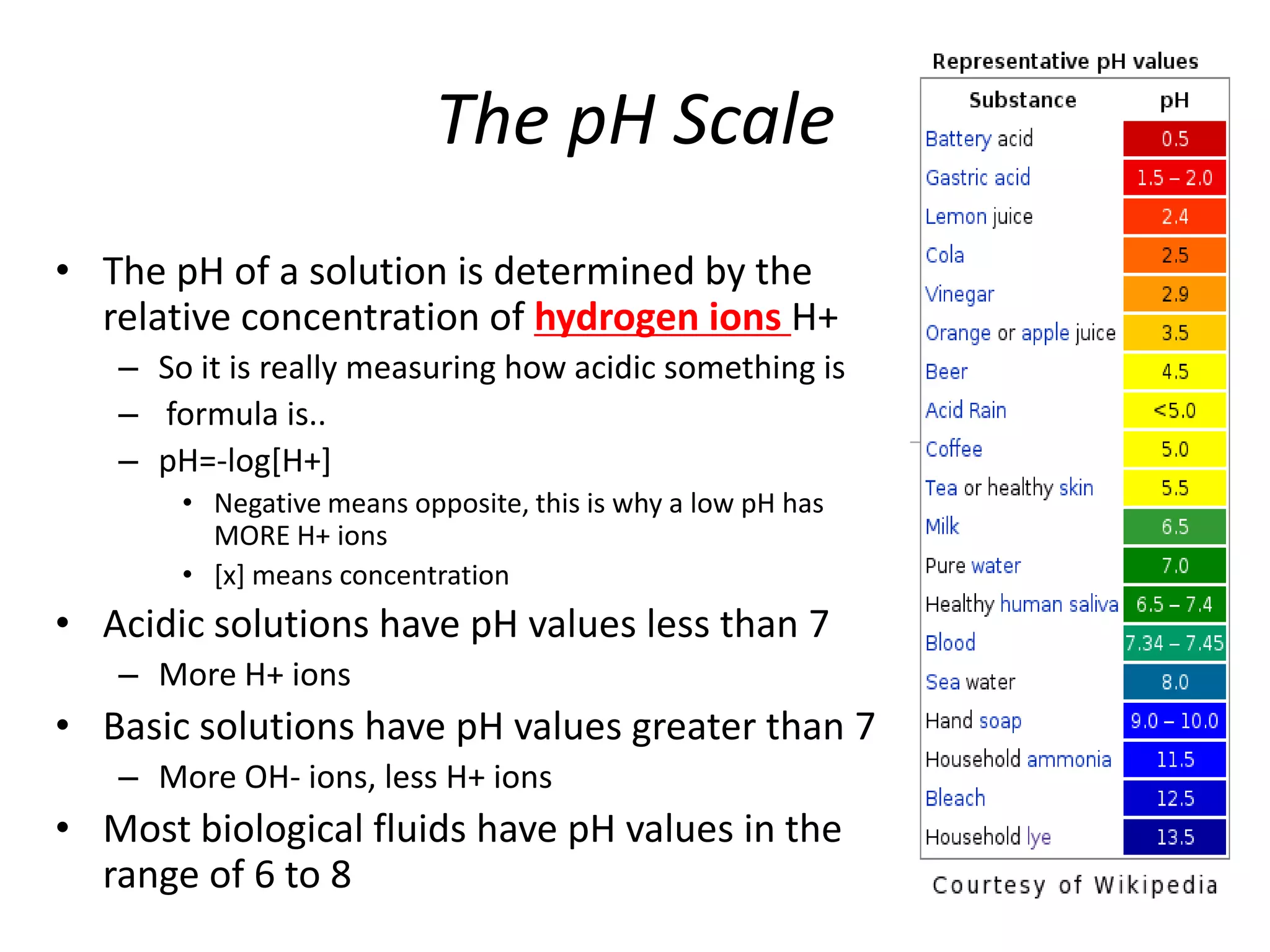
    The pH ScaleThepH of a solution is determined by the relative concentration of hydrogen ions H+
  • 81.
    So it isreally measuring how acidic something is
  • 82.
  • 83.
  • 84.
    Negative means opposite,this is why a low pH has MORE H+ ions
  • 85.
  • 86.
    Acidic solutions havepH values less than 7
  • 87.
  • 88.
    Basic solutions havepH values greater than 7
  • 89.
    More OH- ions,less H+ ions
  • 90.
    Most biological fluidshave pH values in the range of 6 to 8
  • 91.
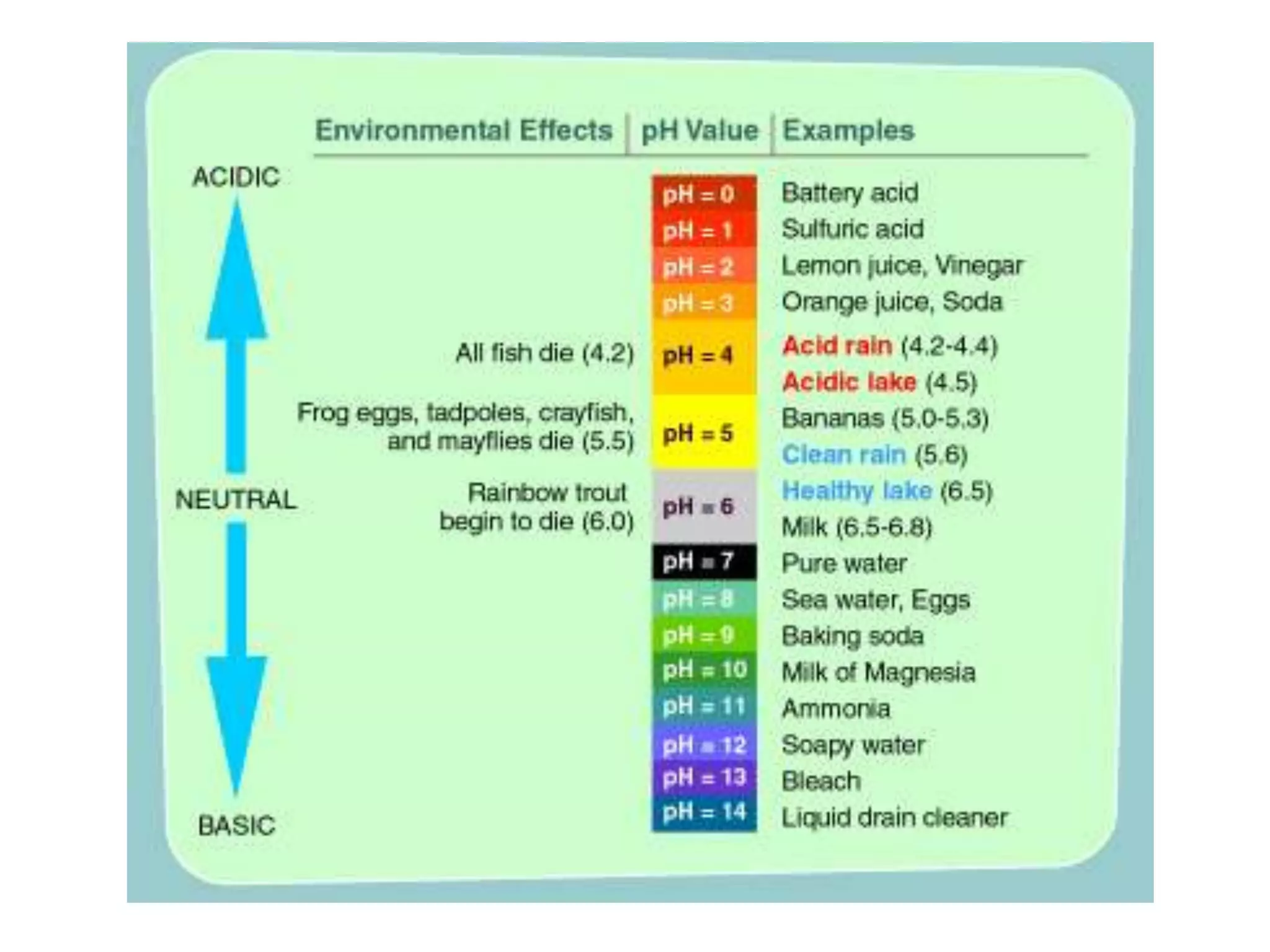
    LE 3-8pH Scale01Batteryacid2Digestive (stomach)juice, lemon juiceVinegar, beer, wine,cola3Increasingly Acidic[H+] > [OH–]4Tomato juiceBlack coffee5RainwaterUrine6Neutral[H+] = [OH–]Pure water7Human blood8Seawater910Increasingly Basic[H+] < [OH–]Milk of magnesia11Household ammonia12Household bleach13Oven cleaner14
  • 92.
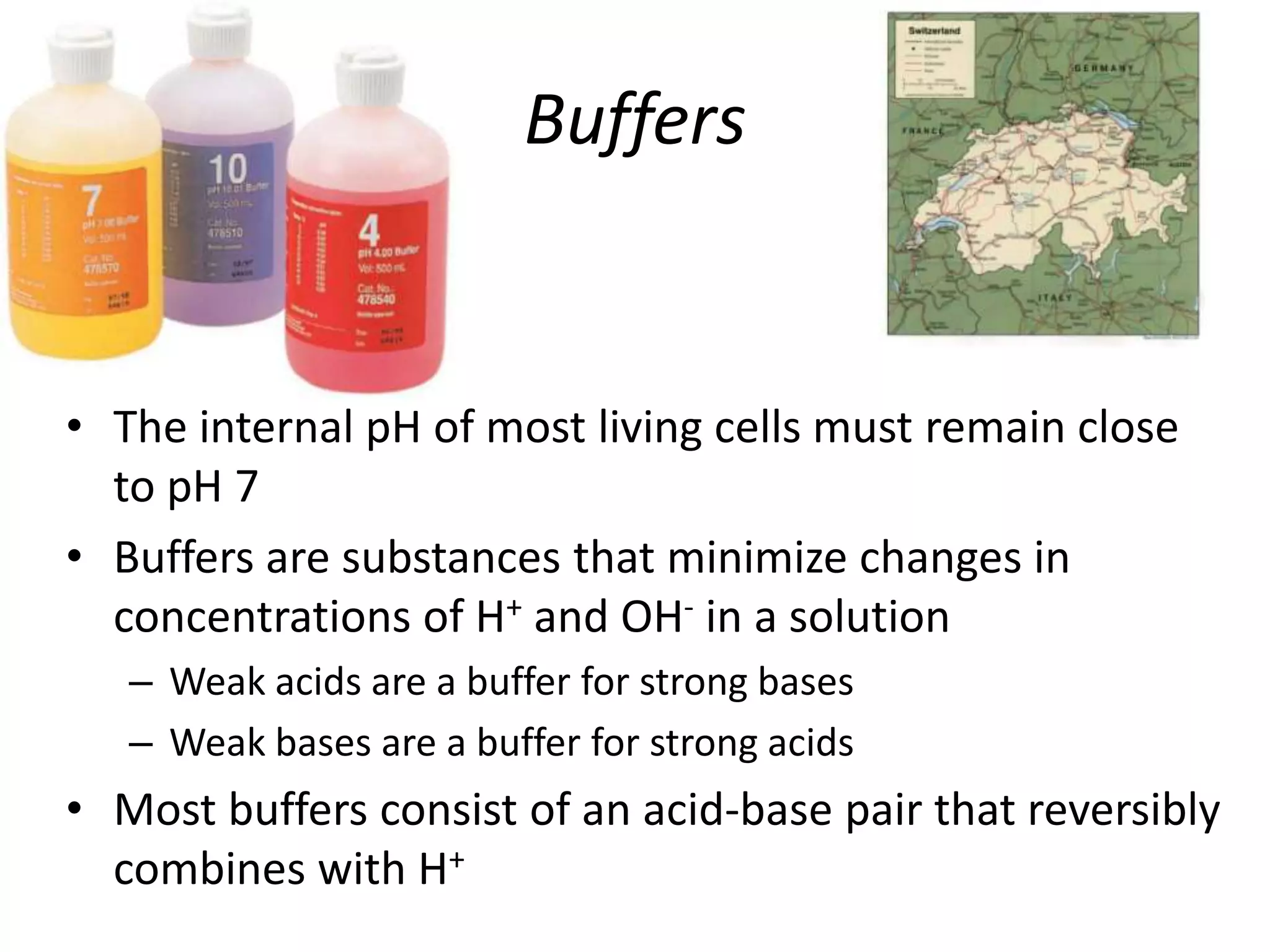
    BuffersThe internal pHof most living cells must remain close to pH 7Buffers are substances that minimize changes in concentrations of H+ and OH- in a solutionWeak acids are a buffer for strong basesWeak bases are a buffer for strong acidsMost buffers consist of an acid-base pair that reversibly combines with H+
  • 93.
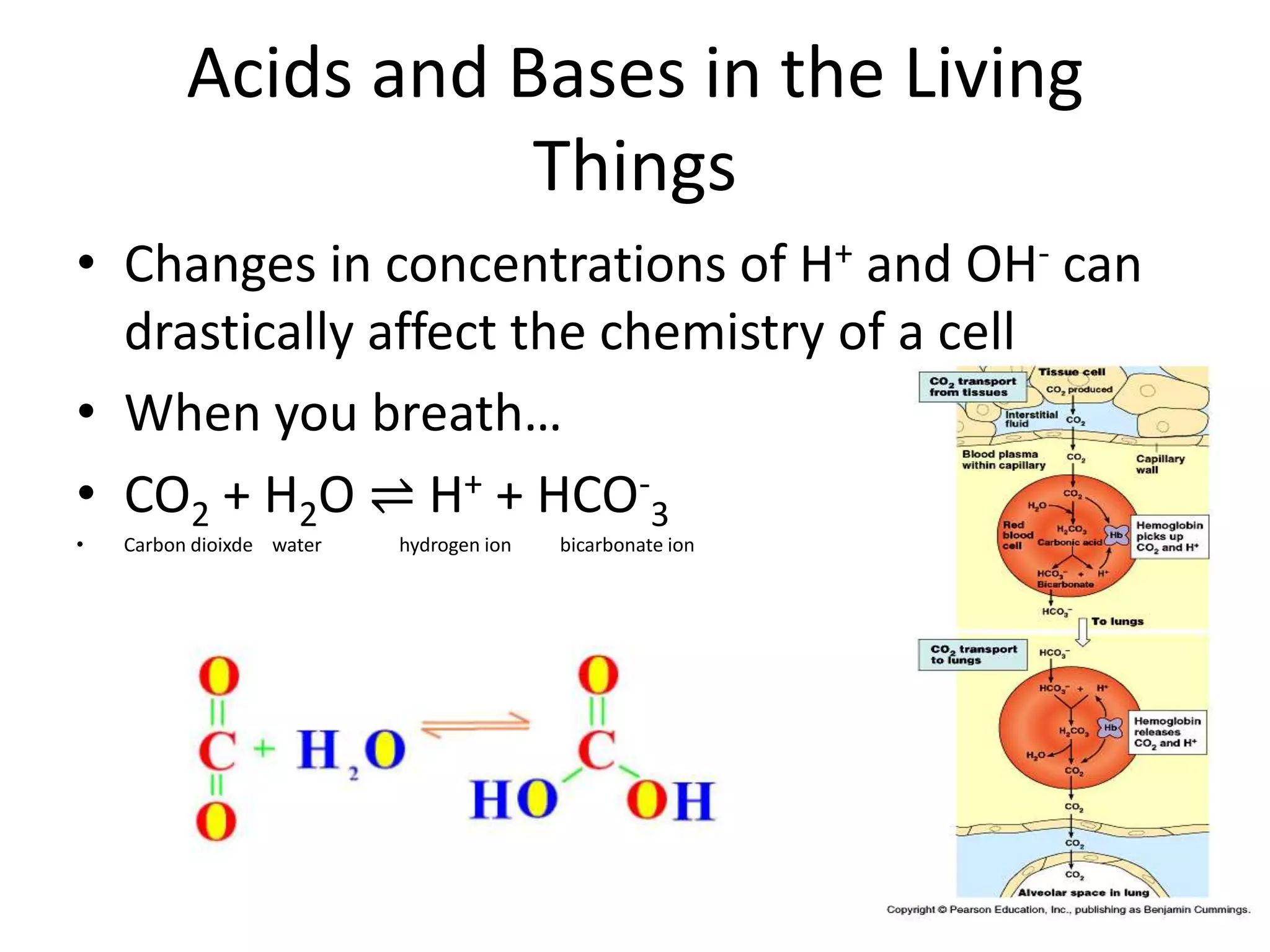
    Acids and Basesin the Living ThingsChanges in concentrations of H+ and OH- can drastically affect the chemistry of a cellWhen you breath…CO2 + H2O ⇌ H+ + HCO-3Carbon dioixde water hydrogen ion bicarbonate ion
  • 94.
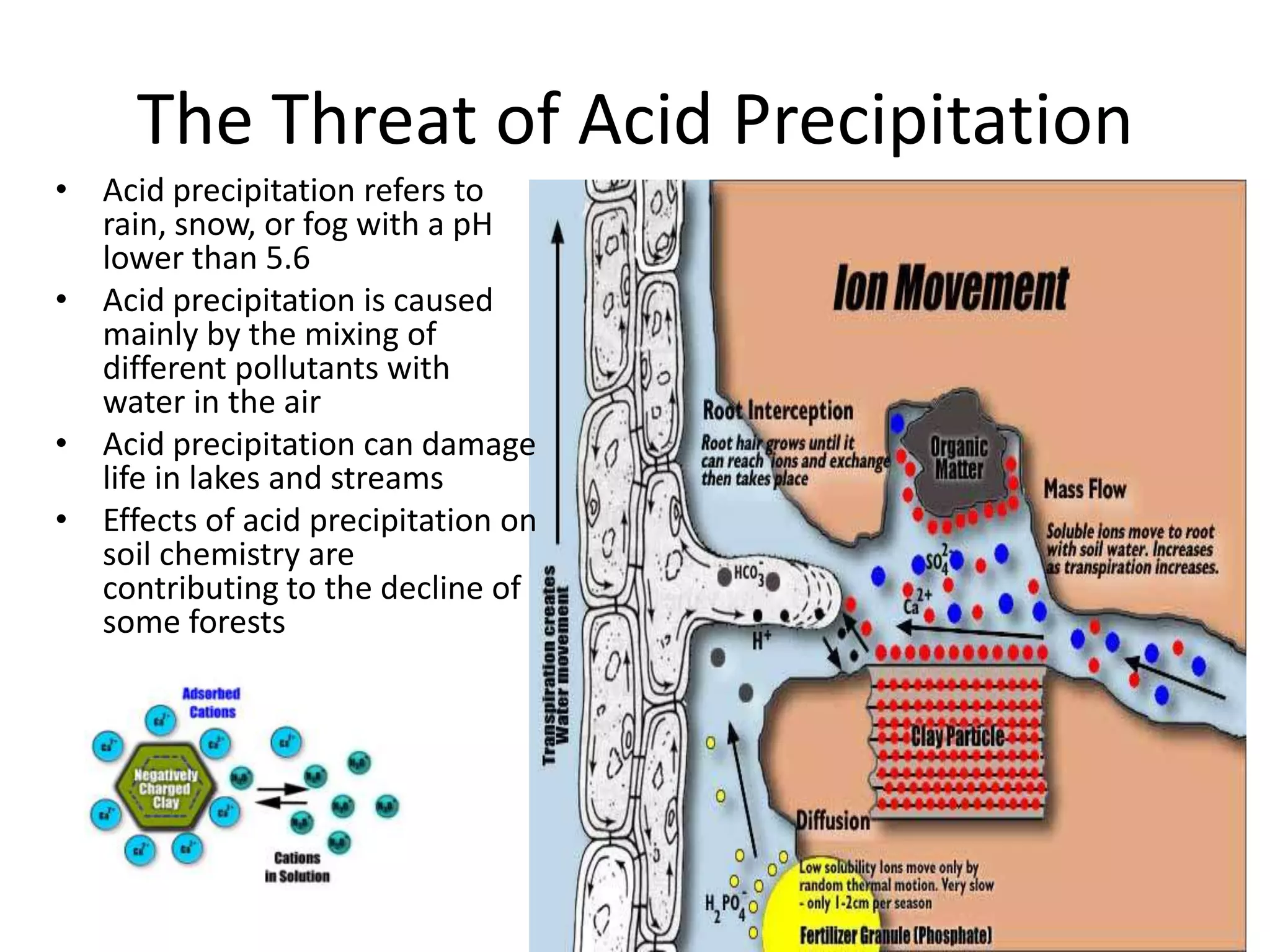
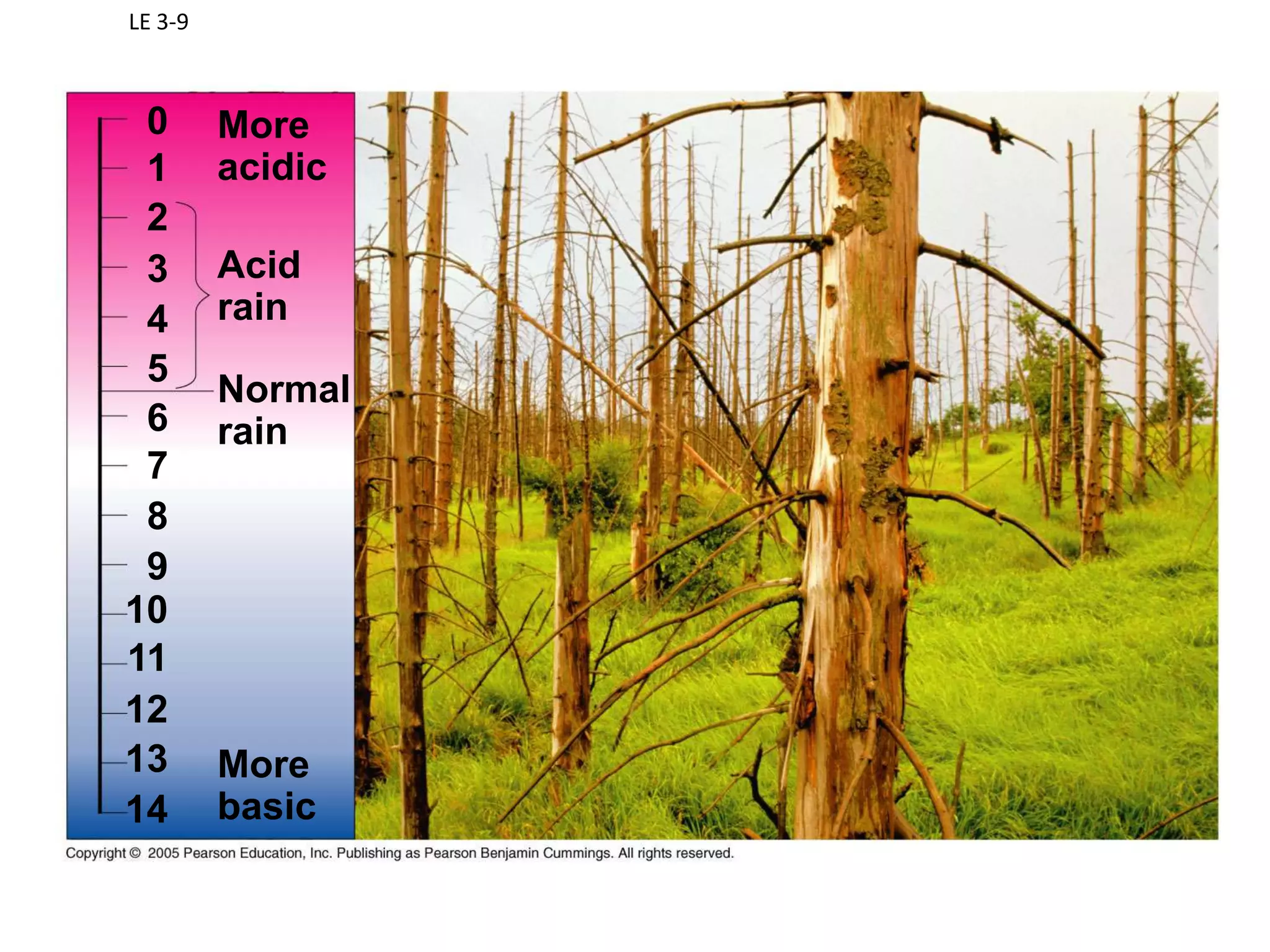
    The Threat ofAcid PrecipitationAcid precipitation refers to rain, snow, or fog with a pH lower than 5.6
  • 95.
    Acid precipitation iscaused mainly by the mixing of different pollutants with water in the air
  • 96.
    Acid precipitation candamage life in lakes and streams
  • 97.
    Effects of acidprecipitation on soil chemistry are contributing to the decline of some forestsLE 3-90Moreacidic12Acidrain345Normalrain678910111213Morebasic14
  • 98.
    Hydrophilic and HydrophobicSubstancesA hydrophilic substance is one that has an affinity (likes!) for waterA hydrophobic substance is one that does not have an affinity (does NOT like; scared of) for water
  • 99.
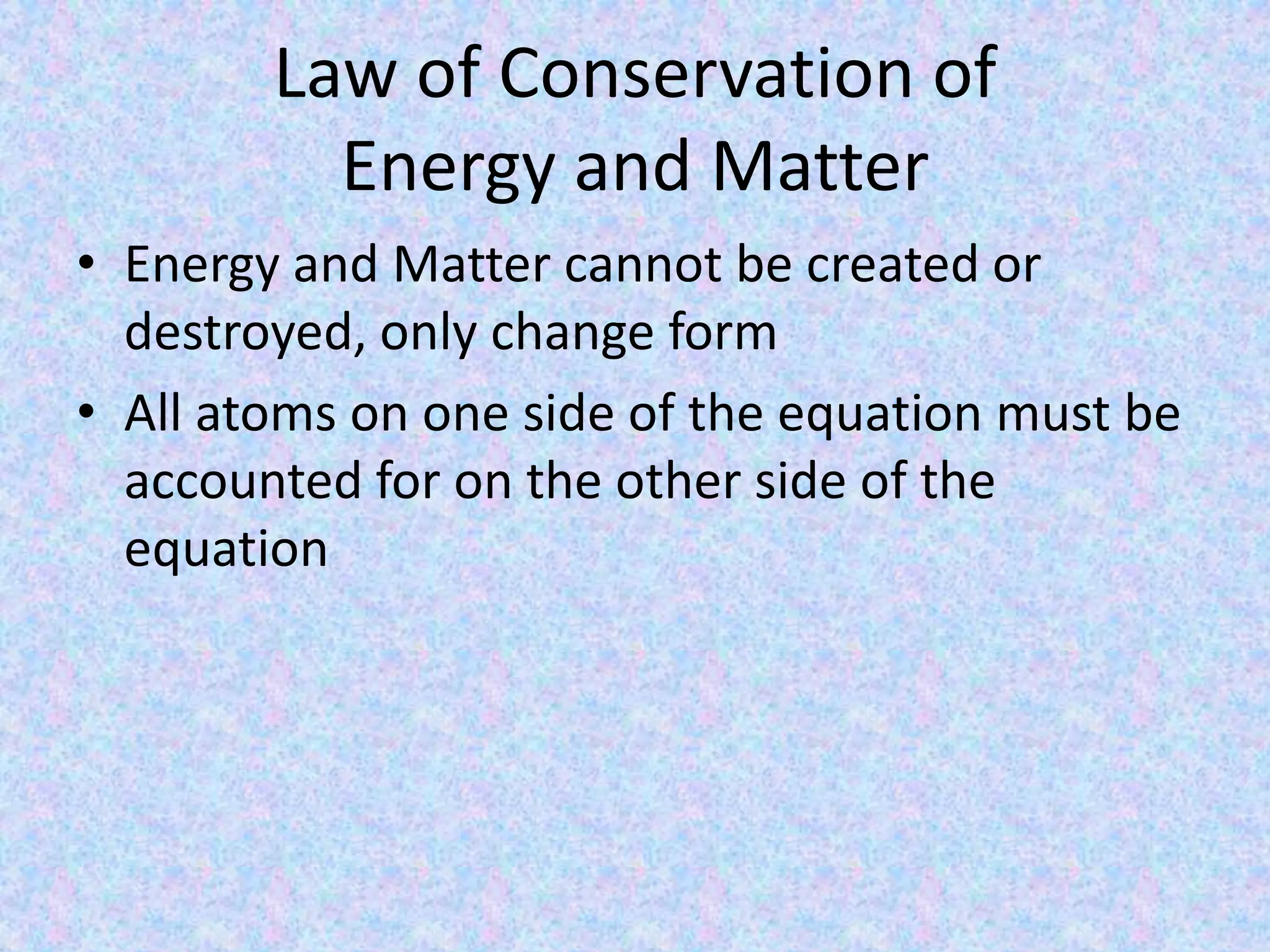
    Law of Conservationof Energy and MatterEnergy and Matter cannot be created or destroyed, only change formAll atoms on one side of the equation must be accounted for on the other side of the equation
  • 100.
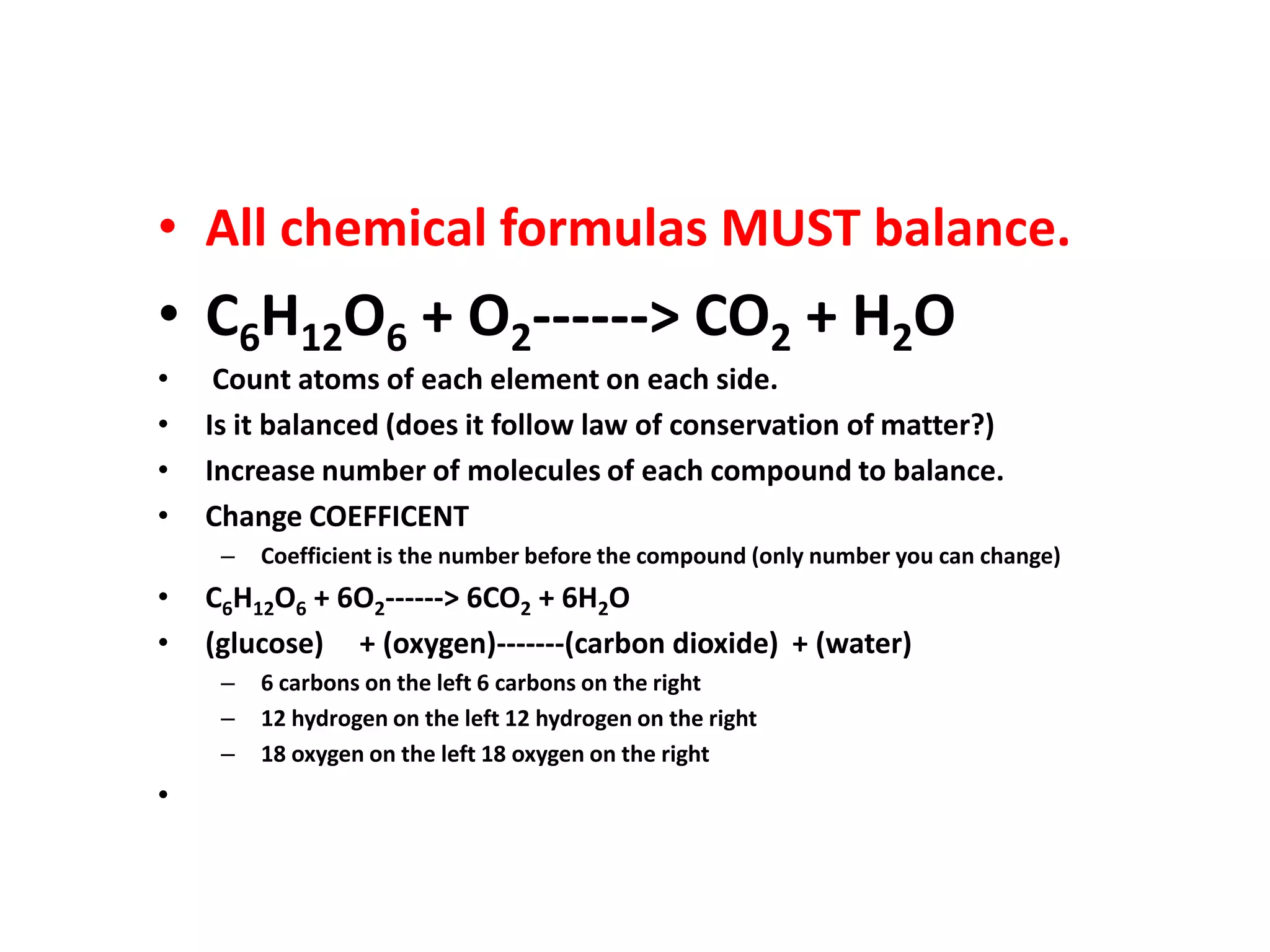
    All chemical formulasMUST balance.   C6H12O6 + O2------> CO2 + H2O Count atoms of each element on each side.Is it balanced (does it follow law of conservation of matter?)Increase number of molecules of each compound to balance.Change COEFFICENTCoefficient is the number before the compound (only number you can change)C6H12O6 + 6O2------> 6CO2 + 6H2O(glucose)     + (oxygen)-------(carbon dioxide)  + (water) 6 carbons on the left 6 carbons on the right12 hydrogen on the left 12 hydrogen on the right18 oxygen on the left 18 oxygen on the right