Chapter

 15
 Chapter 17 in your books


“Water and Aqueous Systems”
Section 15.1
                              Water and its Properties
OBJECTIVES:
• Explain the high surface tension and low vapor pressure of water in terms of the
  structure of the water molecule and hydrogen bonding.
• Describe the structure of ice.

The Water Molecule: a Review

•   Water is a simple tri-atomic molecule, H2O
•   Each O-H bond is _____________________________, because of the high
    electronegativity of the oxygen (N, O, F, and Cl have high values)
•   bond angle of water = 105o
•   due to the _______________________, the O-H bond polarities do not cancel. This
    means: _________________________________________________________.

• Water’s bent shape and ability to hydrogen bond gives it many special properties!
• Water molecules are attracted to one another by dipole interactions
• This hydrogen bonding gives water:
 a) its _________________________________________________, and
 b) its _________________________________________________.

a) High Surface Tension?

•   liquid water acts like it has a “skin”
            – glass of water bulges over the top
•   Water forms round drops
            – spray water on greasy surface
•   All because water hydrogen bonds.

Surface Tension

•   One water molecule can hydrogen bond
    to another because of this electrostatic attraction.
•   Also, hydrogen bonding occurs with many other
    molecules surrounding them on all sides.


•   A water molecule in the middle of a solution is
    pulled in all directions.


                                                                                      2
•   Not true at the surface.
•   They are pulled down and to each side, not upward
    since the water and air are not attracted to each other.
•   This holds the molecules at the surface together tightly.
•   This causes surface tension.


•   Water drops are rounded, because all molecules on the
    edge are pulled to the middle, not outward to the air!
•   A drop has the least amount of surface area for any given
    volume.


•   Glass has polar molecules.
•   Glass can also hydrogen bond.
•   This attracts the water molecules.
•   Some of them are pulled up a cylinder wall.

Meniscus

A meniscus is the _________________________________________________________

•   Thus, water curves up along the sides of glass.
•   This makes the meniscus, as in a graduated cylinder
•   However, Plastics are non-wetting; there is no attraction to water

Surface tension

•   All liquids have surface tension
            – water is just __________________ than most others, due to the hydrogen
                bonding present
•   How can we decrease surface tension?
            – Use a surfactant - surface active agent
            – Also called a “wetting agent”, like detergent or soap (makes water
                “wetter”)
            – Interferes with hydrogen bonding

b) Low vapor pressure?

•   Hydrogen bonding also explains water’s unusually low vapor pressure.
          – It holds water molecules together, so they do not escape (evaporate)
             easily, like gasoline or acetone does.
          – This is a good thing, because lakes and oceans would evaporate very
             quickly due to their large surface area!


                                                                                       3
Ice

•     Most liquids contract (get smaller) as they are cooled.
             – They get more dense.
      • When they change to solid, they are more dense than the liquid.
      • Solid metals sink in their own liquid metal.
             – But, ice ________________ in water.
      • Why?

      •  Water becomes more dense as it cools, until it reaches about _________
             – Then it becomes less dense by starting to expand
      • Because as the molecules slow down, they arrange themselves into
         __________________________________________________________
      • These are held together by hydrogen bonds.
       Liquid = random shaped arrangement      Solid = honeycomb-shaped
                                               arrangement


Ice

      •   Is 10% lower in density than liquid water.
      •   Water freezes from the top down.
              – The layer of ice on a pond acts as an insulator for water below
      •   Why is ice less dense than liquid water?
              – The structure of ice is a regular __________________________________
              _______________________________________, arranged like a honeycomb.

      •   A considerable amount of energy is required to return water in the solid state to
          the liquid (called melting)


                                                                                              4
–   The heat absorbed when 1 g of water changes from solid to liquid is _____
–   This is the same amount of energy needed to raise the temperature of 1 g
    of liquid water from 0 oC to 80 oC!


                                                                           5
Name _______________________________________ Date ______________________

                                15-1 Section Review


   1. Describe the hydrogen bonding between molecules of water.


   2. How is hydrogen bonding responsible for the high surface tension and low vapor
      pressure of water?


   3. What is the difference between the structure of liquid water and the structure of
      ice? How does this explain why ice floats in water?


                                                                                          6
Section 15.2
                      Homogeneous Aqueous Solutions
OBJECTIVES:
  • Distinguish between a solvent and a solute.
  • Describe what happens in the solution process.
  • Explain why all ionic compounds are known as electrolytes.
  • Demonstrate how the formula for a hydrate is written.

Solvents and Solutes

•  Solution - a ________________________________________, that is mixed
   molecule by molecule; made of:
1) a Solvent - ______________________________________________
2) a Solute - _______________________________________________
• Aqueous solution- a solution with __________________as the solvent.
• Particle size is less than 1 nm; ___________________be separated by filtration – Fig.
   15.6, p.450

Parts of a Solution:

1. the Solute

A solute is the dissolved substance in a solution.

         ___________ in salt water       ____________________ in soda drinks

                           _______________________________ in soda drinks

2. the Solvent

A solvent is the dissolving medium in a solution.

    ______________________ in salt water          _______________________ in soda

Solutions

•   Keep in mind that solutions do not have to contain water, but this is the type we are
    studying in this chapter = ________________________________________
           – Example: air is also a type of solution.

Concentrated vs. Dilute

Concentrated - Lots of ______________________, but little______________________


                                                                                            7
Dilute - Lots of _______________________, but little _________________________

Aqueous Solutions

•   Water _________________________ ionic compounds and polar covalent molecules
    very well.
•   The rule is: ___________________________________________
•   Polar dissolves polar.
•   Nonpolar dissolves nonpolar.
•   Oil is nonpolar.
             – Oil and water don’t mix.
•   Salt is ionic- makes salt water.

The Solution Process

•   Called _____________________________
•   Water
    1) ______________________________________________________________, and
    2) _____________________________________________
•   But, in some ionic compounds, the attraction _______________________________
    is greater than the attraction ____________________________________________
            – Barium sulfate and calcium carbonate do not dissolve in water!

    •   Solids _____________________________________ the attractive force of the
        water molecules is stronger than the attractive force of the crystal.
    •   If not, the solids are ______________________________
    •   Water doesn’t dissolve nonpolar molecules (like oil) because the water molecules
        can’t hold onto them.
    •   The water molecules hold onto other water molecules, and separate from the
        nonpolar molecules.
    •   Nonpolars? No repulsion between them

Electrolytes and Nonelectrolytes

    Electrolytes- __________________________________________________________
    ____________________________________________________________________
    ____________________________________________________________________
    __
           – all ionic compounds are electrolytes because they dissociate into ions
               (they are also called “salts”)
    • barium sulfate- will conduct when molten, but is insoluble in water!

    •   Do not conduct? = _____________________________________
           – Most are molecular materials, because they ________________________


                                                                                       8
•   Not all electrolytes conduct to the same degree
          – there are weak electrolytes, and strong electrolytes
          – depends on: the degree of ionization


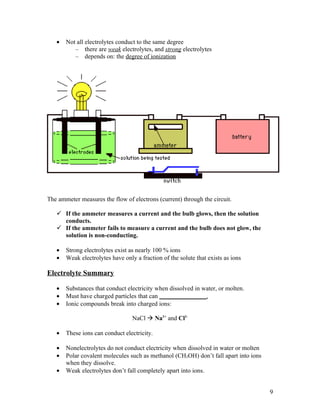
The ammeter measures the flow of electrons (current) through the circuit.

    If the ammeter measures a current and the bulb glows, then the solution
     conducts.
    If the ammeter fails to measure a current and the bulb does not glow, the
     solution is non-conducting.

   •   Strong electrolytes exist as nearly 100 % ions
   •   Weak electrolytes have only a fraction of the solute that exists as ions

Electrolyte Summary

   •   Substances that conduct electricity when dissolved in water, or molten.
   •   Must have charged particles that can _______________.
   •   Ionic compounds break into charged ions:

                                  NaCl  Na1+ and Cl1-

   •   These ions can conduct electricity.

   •   Nonelectrolytes do not conduct electricity when dissolved in water or molten
   •   Polar covalent molecules such as methanol (CH3OH) don’t fall apart into ions
       when they dissolve.
   •   Weak electrolytes don’t fall completely apart into ions.


                                                                                      9
•   Strong electrolytes do ionize completely.

Water of Hydration (or Water of Crystallization)

   •   Water molecules are chemically bonded to solid salt molecules (not in solution)
   •   These compounds have fixed amounts of water.
   •   The water can be driven off by heating:

                      + heat
       CuSO4 ∙5H2O          ↔     CuSO4 + 5H2O
                       - heat

   •   Called _______________________________________________.

Hydrates

   •   Table 15.2, p.455 list some familiar hydrates
   •   Since heat can drive off the water, the forces holding the water are weak
   •   If a hydrate has a vapor pressure higher than that of water vapor in air, the
       hydrate will _________________________ by losing ______________________
       ___________________________________________

   •   Some hydrates that have a low vapor pressure remove water from the air to form
       higher hydrates- these are called ________________________________
          – used as drying agents, or _________________________________
          – packaged with products to absorb moisture

Sample Problem - Finding the Percent of Water in a Hydrate

Calculate the percent by mass of water in washing soda, sodium carbonate decahydrate
(Na2CO3 ∙ 10H2O).


Hydrates

   •   Some compounds are so hygroscopic, they become wet when exposed to normally
       moist air - called ____________________________________
          – remove sufficient water to dissolve completely and form solutions


                                                                                         10
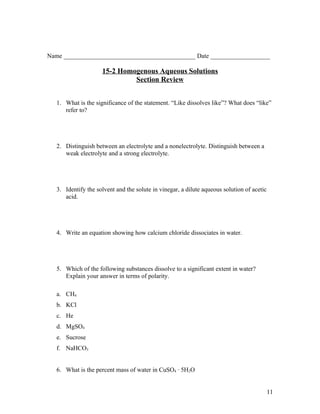
Name __________________________________________ Date ___________________

                     15-2 Homogenous Aqueous Solutions
                              Section Review


   1. What is the significance of the statement. “Like dissolves like”? What does “like”
      refer to?


   2. Distinguish between an electrolyte and a nonelectrolyte. Distinguish between a
      weak electrolyte and a strong electrolyte.


   3. Identify the solvent and the solute in vinegar, a dilute aqueous solution of acetic
      acid.


   4. Write an equation showing how calcium chloride dissociates in water.


   5. Which of the following substances dissolve to a significant extent in water?
      Explain your answer in terms of polarity.

   a. CH4
   b. KCl
   c. He
   d. MgSO4
   e. Sucrose
   f. NaHCO3


   6. What is the percent mass of water in CuSO4 ∙ 5H2O


                                                                                            11
Section 15.3
                       Heterogeneous Aqueous Systems
OBJECTIVES:
  • Distinguish between a suspension and a solution.
  • Identify the distinguishing characteristics of a colloid.


Mixtures that are NOT Solutions:

1. __________________________________: mixtures that slowly settle upon standing.
Example: ___________________________________
          – Particles of a suspension are __________________________in diameter
               than 1000 nm.
          – ___________ be separated by filtering
2.__________________________________: heterogeneous mixtures with particles
between the size of suspensions and true solutions (1-1000 nm)

•   The colloid particles are the _______________________________________, and are
    spread throughout the ____________________________________________
•   The first colloids were glues. Others include mixtures such as gelatin, paint, aerosol
    sprays, and smoke
•   Table 17.5, p.491 (next slide) lists some common colloidal systems and examples

•   Many colloids are cloudy or milky in appearance when concentrated, but almost clear
    when dilute
            – They _____________________ settle out
            – They _____________________ be filtered out
•   Colloids exhibit the ____________________________________________ - the
    scattering of visible light in all directions.
            – suspensions also show Tyndall effect

The Tyndall Effect

•   Colloids and suspensions scatter light, making a beam visible, due to their
    _________________ particle size.

•   Solutions do not scatter light, because of their _______________ particle size.

Mixtures that are NOT Solutions

•   Flashes of light are seen when colloids are studied under a microscope- light is
    reflecting- called Brownian motion to describe the chaotic movement of the particles.
    Observed by Robert Brown.


                                                                                       12
•   ______________________________- dispersions of a liquid in a liquid (2
    immiscible liquids + an _________________________)
          – an ______________________________________ is essential for
              maintaining stability; it has ___________________________, and the
              other end is ___________________________.
          – oil and water not soluble; but with soap or detergent added, they will be.
    • Oil + vinegar in dressing – are they soluble?
          – What makes up Mayonnaise?


                                                                                         13
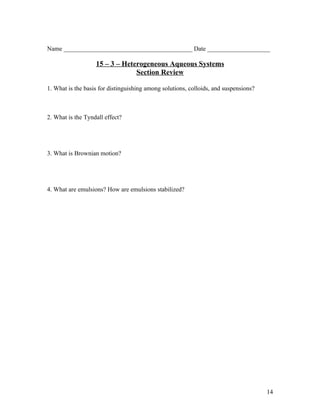
Name _________________________________________ Date ____________________

                   15 – 3 – Heterogeneous Aqueous Systems
                                Section Review

1. What is the basis for distinguishing among solutions, colloids, and suspensions?


2. What is the Tyndall effect?


3. What is Brownian motion?


4. What are emulsions? How are emulsions stabilized?


                                                                                      14

Chemistry - Chp 15 - Water and Aqueous Systems - Notes

  • 1.
    Chapter 15 Chapter17 in your books “Water and Aqueous Systems”
  • 2.
    Section 15.1 Water and its Properties OBJECTIVES: • Explain the high surface tension and low vapor pressure of water in terms of the structure of the water molecule and hydrogen bonding. • Describe the structure of ice. The Water Molecule: a Review • Water is a simple tri-atomic molecule, H2O • Each O-H bond is _____________________________, because of the high electronegativity of the oxygen (N, O, F, and Cl have high values) • bond angle of water = 105o • due to the _______________________, the O-H bond polarities do not cancel. This means: _________________________________________________________. • Water’s bent shape and ability to hydrogen bond gives it many special properties! • Water molecules are attracted to one another by dipole interactions • This hydrogen bonding gives water: a) its _________________________________________________, and b) its _________________________________________________. a) High Surface Tension? • liquid water acts like it has a “skin” – glass of water bulges over the top • Water forms round drops – spray water on greasy surface • All because water hydrogen bonds. Surface Tension • One water molecule can hydrogen bond to another because of this electrostatic attraction. • Also, hydrogen bonding occurs with many other molecules surrounding them on all sides. • A water molecule in the middle of a solution is pulled in all directions. 2
  • 3.
    Not true at the surface. • They are pulled down and to each side, not upward since the water and air are not attracted to each other. • This holds the molecules at the surface together tightly. • This causes surface tension. • Water drops are rounded, because all molecules on the edge are pulled to the middle, not outward to the air! • A drop has the least amount of surface area for any given volume. • Glass has polar molecules. • Glass can also hydrogen bond. • This attracts the water molecules. • Some of them are pulled up a cylinder wall. Meniscus A meniscus is the _________________________________________________________ • Thus, water curves up along the sides of glass. • This makes the meniscus, as in a graduated cylinder • However, Plastics are non-wetting; there is no attraction to water Surface tension • All liquids have surface tension – water is just __________________ than most others, due to the hydrogen bonding present • How can we decrease surface tension? – Use a surfactant - surface active agent – Also called a “wetting agent”, like detergent or soap (makes water “wetter”) – Interferes with hydrogen bonding b) Low vapor pressure? • Hydrogen bonding also explains water’s unusually low vapor pressure. – It holds water molecules together, so they do not escape (evaporate) easily, like gasoline or acetone does. – This is a good thing, because lakes and oceans would evaporate very quickly due to their large surface area! 3
  • 4.
    Ice • Most liquids contract (get smaller) as they are cooled. – They get more dense. • When they change to solid, they are more dense than the liquid. • Solid metals sink in their own liquid metal. – But, ice ________________ in water. • Why? • Water becomes more dense as it cools, until it reaches about _________ – Then it becomes less dense by starting to expand • Because as the molecules slow down, they arrange themselves into __________________________________________________________ • These are held together by hydrogen bonds. Liquid = random shaped arrangement Solid = honeycomb-shaped arrangement Ice • Is 10% lower in density than liquid water. • Water freezes from the top down. – The layer of ice on a pond acts as an insulator for water below • Why is ice less dense than liquid water? – The structure of ice is a regular __________________________________ _______________________________________, arranged like a honeycomb. • A considerable amount of energy is required to return water in the solid state to the liquid (called melting) 4
  • 5.
    The heat absorbed when 1 g of water changes from solid to liquid is _____ – This is the same amount of energy needed to raise the temperature of 1 g of liquid water from 0 oC to 80 oC! 5
  • 6.
    Name _______________________________________ Date______________________ 15-1 Section Review 1. Describe the hydrogen bonding between molecules of water. 2. How is hydrogen bonding responsible for the high surface tension and low vapor pressure of water? 3. What is the difference between the structure of liquid water and the structure of ice? How does this explain why ice floats in water? 6
  • 7.
    Section 15.2 Homogeneous Aqueous Solutions OBJECTIVES: • Distinguish between a solvent and a solute. • Describe what happens in the solution process. • Explain why all ionic compounds are known as electrolytes. • Demonstrate how the formula for a hydrate is written. Solvents and Solutes • Solution - a ________________________________________, that is mixed molecule by molecule; made of: 1) a Solvent - ______________________________________________ 2) a Solute - _______________________________________________ • Aqueous solution- a solution with __________________as the solvent. • Particle size is less than 1 nm; ___________________be separated by filtration – Fig. 15.6, p.450 Parts of a Solution: 1. the Solute A solute is the dissolved substance in a solution. ___________ in salt water ____________________ in soda drinks _______________________________ in soda drinks 2. the Solvent A solvent is the dissolving medium in a solution. ______________________ in salt water _______________________ in soda Solutions • Keep in mind that solutions do not have to contain water, but this is the type we are studying in this chapter = ________________________________________ – Example: air is also a type of solution. Concentrated vs. Dilute Concentrated - Lots of ______________________, but little______________________ 7
  • 8.
    Dilute - Lotsof _______________________, but little _________________________ Aqueous Solutions • Water _________________________ ionic compounds and polar covalent molecules very well. • The rule is: ___________________________________________ • Polar dissolves polar. • Nonpolar dissolves nonpolar. • Oil is nonpolar. – Oil and water don’t mix. • Salt is ionic- makes salt water. The Solution Process • Called _____________________________ • Water 1) ______________________________________________________________, and 2) _____________________________________________ • But, in some ionic compounds, the attraction _______________________________ is greater than the attraction ____________________________________________ – Barium sulfate and calcium carbonate do not dissolve in water! • Solids _____________________________________ the attractive force of the water molecules is stronger than the attractive force of the crystal. • If not, the solids are ______________________________ • Water doesn’t dissolve nonpolar molecules (like oil) because the water molecules can’t hold onto them. • The water molecules hold onto other water molecules, and separate from the nonpolar molecules. • Nonpolars? No repulsion between them Electrolytes and Nonelectrolytes Electrolytes- __________________________________________________________ ____________________________________________________________________ ____________________________________________________________________ __ – all ionic compounds are electrolytes because they dissociate into ions (they are also called “salts”) • barium sulfate- will conduct when molten, but is insoluble in water! • Do not conduct? = _____________________________________ – Most are molecular materials, because they ________________________ 8
  • 9.
    Not all electrolytes conduct to the same degree – there are weak electrolytes, and strong electrolytes – depends on: the degree of ionization The ammeter measures the flow of electrons (current) through the circuit.  If the ammeter measures a current and the bulb glows, then the solution conducts.  If the ammeter fails to measure a current and the bulb does not glow, the solution is non-conducting. • Strong electrolytes exist as nearly 100 % ions • Weak electrolytes have only a fraction of the solute that exists as ions Electrolyte Summary • Substances that conduct electricity when dissolved in water, or molten. • Must have charged particles that can _______________. • Ionic compounds break into charged ions: NaCl  Na1+ and Cl1- • These ions can conduct electricity. • Nonelectrolytes do not conduct electricity when dissolved in water or molten • Polar covalent molecules such as methanol (CH3OH) don’t fall apart into ions when they dissolve. • Weak electrolytes don’t fall completely apart into ions. 9
  • 10.
    Strong electrolytes do ionize completely. Water of Hydration (or Water of Crystallization) • Water molecules are chemically bonded to solid salt molecules (not in solution) • These compounds have fixed amounts of water. • The water can be driven off by heating: + heat CuSO4 ∙5H2O ↔ CuSO4 + 5H2O - heat • Called _______________________________________________. Hydrates • Table 15.2, p.455 list some familiar hydrates • Since heat can drive off the water, the forces holding the water are weak • If a hydrate has a vapor pressure higher than that of water vapor in air, the hydrate will _________________________ by losing ______________________ ___________________________________________ • Some hydrates that have a low vapor pressure remove water from the air to form higher hydrates- these are called ________________________________ – used as drying agents, or _________________________________ – packaged with products to absorb moisture Sample Problem - Finding the Percent of Water in a Hydrate Calculate the percent by mass of water in washing soda, sodium carbonate decahydrate (Na2CO3 ∙ 10H2O). Hydrates • Some compounds are so hygroscopic, they become wet when exposed to normally moist air - called ____________________________________ – remove sufficient water to dissolve completely and form solutions 10
  • 11.
    Name __________________________________________ Date___________________ 15-2 Homogenous Aqueous Solutions Section Review 1. What is the significance of the statement. “Like dissolves like”? What does “like” refer to? 2. Distinguish between an electrolyte and a nonelectrolyte. Distinguish between a weak electrolyte and a strong electrolyte. 3. Identify the solvent and the solute in vinegar, a dilute aqueous solution of acetic acid. 4. Write an equation showing how calcium chloride dissociates in water. 5. Which of the following substances dissolve to a significant extent in water? Explain your answer in terms of polarity. a. CH4 b. KCl c. He d. MgSO4 e. Sucrose f. NaHCO3 6. What is the percent mass of water in CuSO4 ∙ 5H2O 11
  • 12.
    Section 15.3 Heterogeneous Aqueous Systems OBJECTIVES: • Distinguish between a suspension and a solution. • Identify the distinguishing characteristics of a colloid. Mixtures that are NOT Solutions: 1. __________________________________: mixtures that slowly settle upon standing. Example: ___________________________________ – Particles of a suspension are __________________________in diameter than 1000 nm. – ___________ be separated by filtering 2.__________________________________: heterogeneous mixtures with particles between the size of suspensions and true solutions (1-1000 nm) • The colloid particles are the _______________________________________, and are spread throughout the ____________________________________________ • The first colloids were glues. Others include mixtures such as gelatin, paint, aerosol sprays, and smoke • Table 17.5, p.491 (next slide) lists some common colloidal systems and examples • Many colloids are cloudy or milky in appearance when concentrated, but almost clear when dilute – They _____________________ settle out – They _____________________ be filtered out • Colloids exhibit the ____________________________________________ - the scattering of visible light in all directions. – suspensions also show Tyndall effect The Tyndall Effect • Colloids and suspensions scatter light, making a beam visible, due to their _________________ particle size. • Solutions do not scatter light, because of their _______________ particle size. Mixtures that are NOT Solutions • Flashes of light are seen when colloids are studied under a microscope- light is reflecting- called Brownian motion to describe the chaotic movement of the particles. Observed by Robert Brown. 12
  • 13.
    ______________________________- dispersions of a liquid in a liquid (2 immiscible liquids + an _________________________) – an ______________________________________ is essential for maintaining stability; it has ___________________________, and the other end is ___________________________. – oil and water not soluble; but with soap or detergent added, they will be. • Oil + vinegar in dressing – are they soluble? – What makes up Mayonnaise? 13
  • 14.
    Name _________________________________________ Date____________________ 15 – 3 – Heterogeneous Aqueous Systems Section Review 1. What is the basis for distinguishing among solutions, colloids, and suspensions? 2. What is the Tyndall effect? 3. What is Brownian motion? 4. What are emulsions? How are emulsions stabilized? 14