Water Resources Engineering (CVE 728)
Distribution System
Engr. Ado Mohammed
Dept. of civil Engineering
Nile University
HIGHLIGHTS
•Layout of distribution networks.
•Methods of water distribution.
•Storage capacity of Elevated Storage Reservoir (ESR), and
underground service reservoir.
Introduction…
The purpose of distribution system is to deliver
water to consumer with appropriate quality,
quantity and pressure.
Distribution system is used to describe
collectively the facilities used to supply water
from its source to the point of usage.
Requirements of Good Distribution System...
Water quality should not get deteriorated in the
distribution pipes.
It should be capable of supplying water at all
the intended places with sufficient pressure head.
It should be capable of supplying the requisite
amount of water during fire fighting.
The layout should be such that no consumer would
be without water supply, during the repair of any
section of the system.
All the distribution pipes should be preferably
laid one metre away or above the sewer lines.
It should be fairly water-tight as to keep losses
due to leakage to the minimum.
Layouts of Distribution Network
The distribution pipes are generally laid below
the road pavements, and as such their layouts
generally follow the layouts of roads.
There are, in general, four different types of
pipe networks; any one of which either singly or
in combinations, can be used for a particular
place.
They are:
1. Dead End System
2. Radial System
3. Grid Iron System
4. Ring System
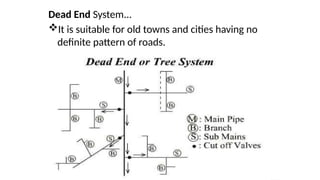
Dead End System...
It is suitable for old towns and cities having no
definite pattern of roads.
Advantages
Relatively cheap.
Determination of discharges and pressure easier
due to less number of valves.
Disadvantages
Due to many dead ends, stagnation of water
occurs in pipes.
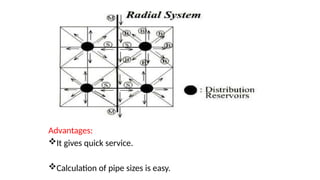
Radial System...
The area is divided into different zones.
The water is pumped into the distribution
reservoir kept in the middle of each zone.
The supply pipes are laid radially ending
towards the periphery.
Advantages:
It gives quick service.
Calculation of pipe sizes is easy.
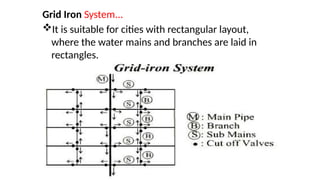
Grid Iron System...
It is suitable for cities with rectangular layout,
where the water mains and branches are laid in
rectangles.
Advantages
Water is kept in good circulation due to the
absence of dead ends.
In the cases of a breakdown in some section,
water is available from some other direction.
Disadvantages
Exact calculation of sizes of pipes is not possible
due to provision of valves on all branches.
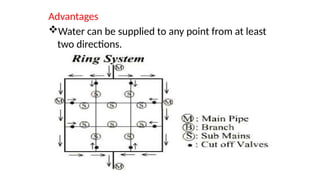
Ring System...
The supply main is laid all along the peripheral
roads and sub mains branch out from the mains.
This system also follows the grid iron system with
the flow pattern similar in character to that of
dead end system.
So, determination of the size of pipes is easy.
Advantages
Water can be supplied to any point from at least
two directions.
Methods of water distribution…
For efficient distribution system adequate water pressure
required at various points.
Depending upon the level of source, topography of the
area and other local conditions the water may be forced
into distribution system by following ways –
1. Gravity system
2. Pumping system
3. Combined gravity and pumping system
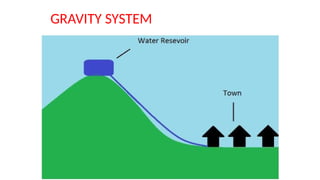
Gravity system…
Suitable when source of supply is at sufficient
height.
Most reliable and economical distribution
system.
The water head available at the consumer is just
minimum required.
The remaining head is consumed in the frictional
and other losses.
GRAVITY SYSTEM
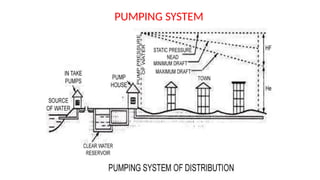
Pumping system…
Treated water is directly pumped in to the distribution
main with out storing.
Also called pumping without storage system.
High lifts pumps are required.
If power supply fails, complete stoppage of water supply.
This method is not generally used.
PUMPING SYSTEM
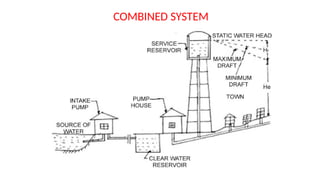
Combined gravity and pumping system
Most common system.
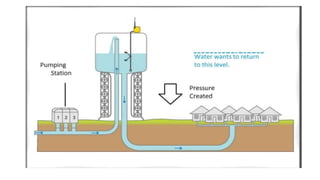
Treated water is pumped and stored in an elevated
distribution reservoir.
Then supplies to consumer by action of gravity.
The excess water during low demand periods get stored
in reservoir and get supplied during high demand period.
Economical, efficient and reliable system.
COMBINED SYSTEM
Distribution Reservoirs...
Distribution reservoirs, also called service
reservoirs, are the storage reservoirs,
which store the treated water for supplying
water during emergencies (such as during
fires, repairs, etc.) and also to help in
absorbing the hourly fluctuations in the
normal water demand.
Functions of Distribution Reservoirs
to absorb the hourly variations in demand.
to maintain constant pressure in the distribution
mains.
water stored can be supplied during emergencies.
Location and Height of Distribution Reservoirs
should be located as close as possible to the
centre of demand.
water level in the reservoir must be at a sufficient
elevation to permit gravity flow at an adequate
pressure.
Types of Reservoirs...
Depending upon their elevation w.r.t ground it may
be classified into
1. Surface reservoirs
2. Elevated reservoirs
Surface reservoirs…
These also called ground reservoir.
Mostly circular or rectangular tank.
Under ground reservoirs are preferred especially
when the size is large.
These reservoirs are constructed on high natural
grounds and are usually made of stones, bricks,
plain or reinforced cement concrete.
The side walls are designed to take up the
pressure of the water, when the reservoir is full
and the earth pressure when it is empty.
The position of ground water table is also
considered while designing these reservoirs.
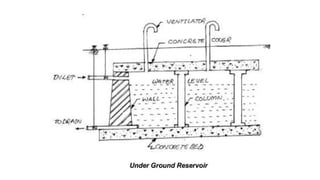
The floors of these reservoirs may constructed
with R.C.C slab or square stone blocks resting
on columns.
To obtain water tightness bitumen compounds
are used at all construction joints.
At the top of roof about 60cm thick earth layer
is deposited and maintained green lawns to
protect the reservoir from cold and heat.
For aeration of water and inspection, ventilation
pipes and stairs are provided.
TYPES OF TANKS
R.C.C TANKS: R.C.C tanks are very popular because
1) They have long life
2) Very little maintenance
3) decent appearance
G.I. TANKS: G.I. tanks are generally in rectangular or
square in shape. Now a days G.I. tanks are not
preferring because
1) Life of the tank is short
2) Corrosion of metal
3) maintenance cost may be more
HIGH DENSITY POLYETHYLENE(HDPE) TANKS: Now a days HDPE tanks are
very popular for storing less quantity of water and hence useful for
residential purpose.
The following are the advantages of HDPE tanks
1) Handling is easy because of light weight
2) Cheap in cost
3) Maintenance cost is low
4) Cleaning of tanks are easy
Elevated Storage Reservoirs (ESR)...
Elevated Storage Reservoirs (ESRs) also referred to as Overhead Tanks
are required at distribution areas which are not governed and
controlled by the gravity system of distribution.
These are rectangular, circular or elliptical in
shape.
If the topography of the town not suitable for
under gravity, the elevated tank or reservoir are
used.
They are constructed where combine gravity and pumping
system of water distribution is adopted.
These tanks may be steel or RCC.
Now RCC is commonly preferred.
The accessories of Elevated Storage Reservoirs (ESR) are -
Inlet and outlet pipe, overflow pipe discharging into a drain
Float gauge, indicating depth of water.
Automatic device to stop pumping when the
tank is full.
A manhole and ladder.
Ventilator for circulation of fresh air.
Storage Capacity of Distribution Reservoirs...
The total storage capacity of a distribution reservoir is the
summation of:
Balancing Storage: The quantity of water required to be stored in
the reservoir for equalising or balancing fluctuating demand
against constant supply is known as the balancing storage (or
equalising or operating storage).
Breakdown Storage: The breakdown storage or often called
emergency storage is the storage preserved in order to tide over
the emergencies posed by the failure of pumps, electricity, or any
other mechanism driving the pumps.
A value of about 25% of the total storage
capacity of reservoirs, or 1.5 to 2 times of the
average hourly supply, may be considered as
enough provision for accounting this storage.
Fire Storage: The third component of the total reservoir storage
is the fire storage.
This provision takes care of the requirements of water for
extinguishing fires.
A provision of 1 to 4 per person per day is
sufficient to meet the requirement.
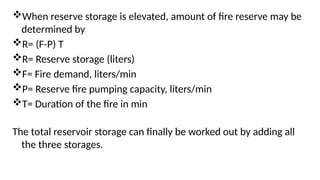
When reserve storage is elevated, amount of fire reserve may be
determined by
R= (F-P) T
R= Reserve storage (liters)
F= Fire demand, liters/min
P= Reserve fire pumping capacity, liters/min
T= Duration of the fire in min
The total reservoir storage can finally be worked out by adding all
the three storages.
Dams and Reservoir
• What Is Dams and Reservoir ?
A dam is a hydraulic structure of fairly impervious
material built across a river to create a reservoir
on its upstream side for impounding water for
various purposes.
A reservoir is an artificial lake where water is
stored. Most of them are formed by constructing
dams across rivers.
Dams and Reservoir Cont.
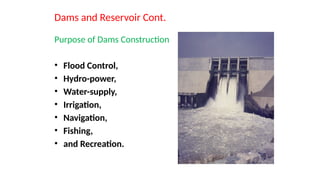
Purpose of Dams Construction
• Flood Control,
• Hydro-power,
• Water-supply,
• Irrigation,
• Navigation,
• Fishing,
• and Recreation.
Dams and Reservoir Cont.
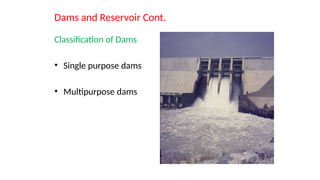
Classification of Dams
• Single purpose dams
• Multipurpose dams
Dams and Reservoir Cont.
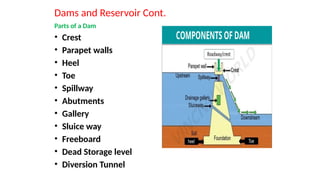
Parts of a Dam
• Crest
• Parapet walls
• Heel
• Toe
• Spillway
• Abutments
• Gallery
• Sluice way
• Freeboard
• Dead Storage level
• Diversion Tunnel
Dams and Reservoir Cont.
Different Types of Dams according to their use and construction method
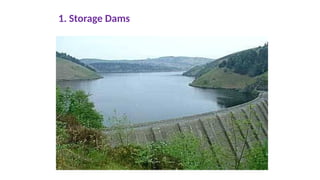
1. Storage Dams
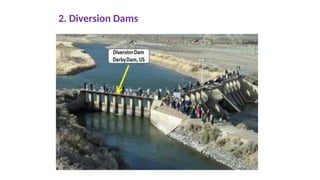
2. Diversion Dams
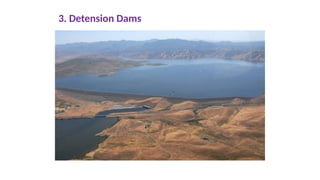
3. Detention Dams
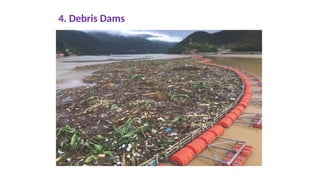
4. Debris Dams
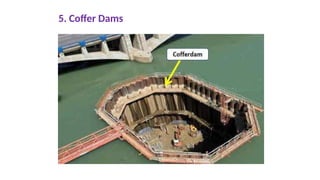
5. Cofferdams
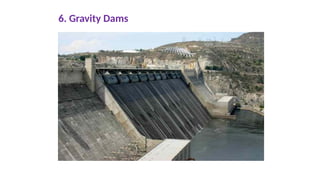
6. Gravity Dams
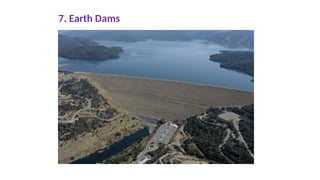
7. Earth Dams
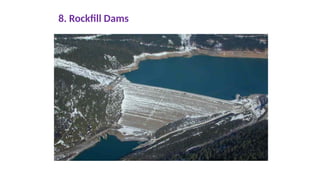
8. Rockfill Dams
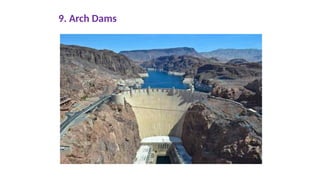
9. Arch Dams
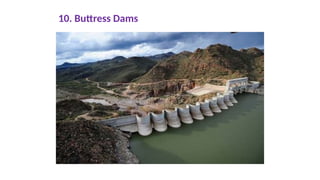
10. Buttress Dams
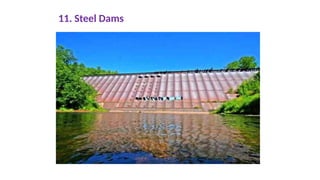
11. Steel Dams
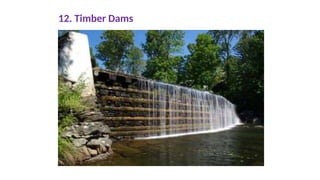
12. Timber dams
1. Storage Dams
2. Diversion Dams
3. Detension Dams
4. Debris Dams
5. Coffer Dams
6. Gravity Dams
7. Earth Dams
8. Rockfill Dams
9. Arch Dams
10. Buttress Dams
11. Steel Dams
12. Timber Dams
Dams and Reservoirs
Advantages of Dams and Reservoir projects:
i. Provide water for Agriculture
ii. Provide water for domestic and industrial use
iii. Combat flooding
iv. Provide lakes for fish production
v. Provide electricity or serve as cooling system
for nuclear power plants
vi. Provide means for water transportation
vii. Create tourism and recreation centers
Dams and Reservoirs
Disadvantages of Dams and Reservoir projects:
i. Displaces people
ii. Can submerge agricultural lands
iii. Destroys riverine ecologies and habitats
iv. Destroys historic and archaelogical sites
v. Reduce prospects of other rivers
vi. Disrupts downstream ecologies and estuary

Water Resources Engineering (CVE 728)--Slide 5.pptx

  • 1.
  • 2.
    Distribution System Engr. AdoMohammed Dept. of civil Engineering Nile University
  • 3.
    HIGHLIGHTS •Layout of distributionnetworks. •Methods of water distribution. •Storage capacity of Elevated Storage Reservoir (ESR), and underground service reservoir.
  • 4.
    Introduction… The purpose ofdistribution system is to deliver water to consumer with appropriate quality, quantity and pressure. Distribution system is used to describe collectively the facilities used to supply water from its source to the point of usage.
  • 5.
    Requirements of GoodDistribution System... Water quality should not get deteriorated in the distribution pipes. It should be capable of supplying water at all the intended places with sufficient pressure head. It should be capable of supplying the requisite amount of water during fire fighting.
  • 6.
    The layout shouldbe such that no consumer would be without water supply, during the repair of any section of the system. All the distribution pipes should be preferably laid one metre away or above the sewer lines. It should be fairly water-tight as to keep losses due to leakage to the minimum.
  • 7.
    Layouts of DistributionNetwork The distribution pipes are generally laid below the road pavements, and as such their layouts generally follow the layouts of roads. There are, in general, four different types of pipe networks; any one of which either singly or in combinations, can be used for a particular place.
  • 8.
    They are: 1. DeadEnd System 2. Radial System 3. Grid Iron System 4. Ring System
  • 9.
    Dead End System... Itis suitable for old towns and cities having no definite pattern of roads.
  • 10.
    Advantages Relatively cheap. Determination ofdischarges and pressure easier due to less number of valves. Disadvantages Due to many dead ends, stagnation of water occurs in pipes.
  • 11.
    Radial System... The areais divided into different zones. The water is pumped into the distribution reservoir kept in the middle of each zone. The supply pipes are laid radially ending towards the periphery.
  • 12.
    Advantages: It gives quickservice. Calculation of pipe sizes is easy.
  • 13.
    Grid Iron System... Itis suitable for cities with rectangular layout, where the water mains and branches are laid in rectangles.
  • 14.
    Advantages Water is keptin good circulation due to the absence of dead ends. In the cases of a breakdown in some section, water is available from some other direction. Disadvantages Exact calculation of sizes of pipes is not possible due to provision of valves on all branches.
  • 15.
    Ring System... The supplymain is laid all along the peripheral roads and sub mains branch out from the mains. This system also follows the grid iron system with the flow pattern similar in character to that of dead end system. So, determination of the size of pipes is easy.
  • 16.
    Advantages Water can besupplied to any point from at least two directions.
  • 17.
    Methods of waterdistribution… For efficient distribution system adequate water pressure required at various points. Depending upon the level of source, topography of the area and other local conditions the water may be forced into distribution system by following ways – 1. Gravity system 2. Pumping system 3. Combined gravity and pumping system
  • 18.
    Gravity system… Suitable whensource of supply is at sufficient height. Most reliable and economical distribution system. The water head available at the consumer is just minimum required. The remaining head is consumed in the frictional and other losses.
  • 19.
  • 20.
    Pumping system… Treated wateris directly pumped in to the distribution main with out storing. Also called pumping without storage system. High lifts pumps are required. If power supply fails, complete stoppage of water supply. This method is not generally used.
  • 21.
  • 22.
    Combined gravity andpumping system Most common system. Treated water is pumped and stored in an elevated distribution reservoir. Then supplies to consumer by action of gravity. The excess water during low demand periods get stored in reservoir and get supplied during high demand period. Economical, efficient and reliable system.
  • 23.
  • 24.
    Distribution Reservoirs... Distribution reservoirs,also called service reservoirs, are the storage reservoirs, which store the treated water for supplying water during emergencies (such as during fires, repairs, etc.) and also to help in absorbing the hourly fluctuations in the normal water demand.
  • 25.
    Functions of DistributionReservoirs to absorb the hourly variations in demand. to maintain constant pressure in the distribution mains. water stored can be supplied during emergencies. Location and Height of Distribution Reservoirs should be located as close as possible to the centre of demand. water level in the reservoir must be at a sufficient elevation to permit gravity flow at an adequate pressure.
  • 26.
    Types of Reservoirs... Dependingupon their elevation w.r.t ground it may be classified into 1. Surface reservoirs 2. Elevated reservoirs
  • 27.
    Surface reservoirs… These alsocalled ground reservoir. Mostly circular or rectangular tank. Under ground reservoirs are preferred especially when the size is large. These reservoirs are constructed on high natural grounds and are usually made of stones, bricks, plain or reinforced cement concrete.
  • 28.
    The side wallsare designed to take up the pressure of the water, when the reservoir is full and the earth pressure when it is empty. The position of ground water table is also considered while designing these reservoirs. The floors of these reservoirs may constructed with R.C.C slab or square stone blocks resting on columns.
  • 29.
    To obtain watertightness bitumen compounds are used at all construction joints. At the top of roof about 60cm thick earth layer is deposited and maintained green lawns to protect the reservoir from cold and heat. For aeration of water and inspection, ventilation pipes and stairs are provided.
  • 31.
    TYPES OF TANKS R.C.CTANKS: R.C.C tanks are very popular because 1) They have long life 2) Very little maintenance 3) decent appearance
  • 32.
    G.I. TANKS: G.I.tanks are generally in rectangular or square in shape. Now a days G.I. tanks are not preferring because 1) Life of the tank is short 2) Corrosion of metal 3) maintenance cost may be more
  • 33.
    HIGH DENSITY POLYETHYLENE(HDPE)TANKS: Now a days HDPE tanks are very popular for storing less quantity of water and hence useful for residential purpose. The following are the advantages of HDPE tanks 1) Handling is easy because of light weight 2) Cheap in cost 3) Maintenance cost is low 4) Cleaning of tanks are easy
  • 34.
    Elevated Storage Reservoirs(ESR)... Elevated Storage Reservoirs (ESRs) also referred to as Overhead Tanks are required at distribution areas which are not governed and controlled by the gravity system of distribution. These are rectangular, circular or elliptical in shape. If the topography of the town not suitable for under gravity, the elevated tank or reservoir are used.
  • 35.
    They are constructedwhere combine gravity and pumping system of water distribution is adopted. These tanks may be steel or RCC. Now RCC is commonly preferred.
  • 36.
    The accessories ofElevated Storage Reservoirs (ESR) are - Inlet and outlet pipe, overflow pipe discharging into a drain Float gauge, indicating depth of water. Automatic device to stop pumping when the tank is full. A manhole and ladder. Ventilator for circulation of fresh air.
  • 38.
    Storage Capacity ofDistribution Reservoirs... The total storage capacity of a distribution reservoir is the summation of: Balancing Storage: The quantity of water required to be stored in the reservoir for equalising or balancing fluctuating demand against constant supply is known as the balancing storage (or equalising or operating storage).
  • 39.
    Breakdown Storage: Thebreakdown storage or often called emergency storage is the storage preserved in order to tide over the emergencies posed by the failure of pumps, electricity, or any other mechanism driving the pumps. A value of about 25% of the total storage capacity of reservoirs, or 1.5 to 2 times of the average hourly supply, may be considered as enough provision for accounting this storage.
  • 40.
    Fire Storage: Thethird component of the total reservoir storage is the fire storage. This provision takes care of the requirements of water for extinguishing fires. A provision of 1 to 4 per person per day is sufficient to meet the requirement.
  • 41.
    When reserve storageis elevated, amount of fire reserve may be determined by R= (F-P) T R= Reserve storage (liters) F= Fire demand, liters/min P= Reserve fire pumping capacity, liters/min T= Duration of the fire in min The total reservoir storage can finally be worked out by adding all the three storages.
  • 42.
    Dams and Reservoir •What Is Dams and Reservoir ? A dam is a hydraulic structure of fairly impervious material built across a river to create a reservoir on its upstream side for impounding water for various purposes. A reservoir is an artificial lake where water is stored. Most of them are formed by constructing dams across rivers.
  • 43.
    Dams and ReservoirCont. Purpose of Dams Construction • Flood Control, • Hydro-power, • Water-supply, • Irrigation, • Navigation, • Fishing, • and Recreation.
  • 44.
    Dams and ReservoirCont. Classification of Dams • Single purpose dams • Multipurpose dams
  • 45.
    Dams and ReservoirCont. Parts of a Dam • Crest • Parapet walls • Heel • Toe • Spillway • Abutments • Gallery • Sluice way • Freeboard • Dead Storage level • Diversion Tunnel
  • 46.
    Dams and ReservoirCont. Different Types of Dams according to their use and construction method 1. Storage Dams 2. Diversion Dams 3. Detention Dams 4. Debris Dams 5. Cofferdams 6. Gravity Dams 7. Earth Dams 8. Rockfill Dams 9. Arch Dams 10. Buttress Dams 11. Steel Dams 12. Timber dams
  • 47.
  • 48.
  • 49.
  • 50.
  • 51.
  • 52.
  • 53.
  • 54.
  • 55.
  • 56.
  • 57.
  • 58.
  • 59.
    Dams and Reservoirs Advantagesof Dams and Reservoir projects: i. Provide water for Agriculture ii. Provide water for domestic and industrial use iii. Combat flooding iv. Provide lakes for fish production v. Provide electricity or serve as cooling system for nuclear power plants vi. Provide means for water transportation vii. Create tourism and recreation centers
  • 60.
    Dams and Reservoirs Disadvantagesof Dams and Reservoir projects: i. Displaces people ii. Can submerge agricultural lands iii. Destroys riverine ecologies and habitats iv. Destroys historic and archaelogical sites v. Reduce prospects of other rivers vi. Disrupts downstream ecologies and estuary