The Water Cycle
SOL 3.9b
Strand Earth’s Patterns, Cycles SOL3.9The student will investigate and understand the water cycle and its
relationship to life on Earth. Key concepts include
b)the energy from the sun drives the water cycle; c)the water cycle involves several processes.
Related SOL3.1 The student will demonstrate an understanding of scientific reasoning, logic, and the nature of
science by planning and conducting investigations in which
d)natural events are sequenced chronologically; l)models are designed and built.
Background Information
Approximately 97% of the water is found in the oceans and the other 3%, which is fresh water, is found in glaciers,
icecaps, rivers, lakes, underground, and in the atmosphere. Of this 3%, only 1% is suitable for drinking. Water
continuously circulates between Earth’s surface, the air, and underground. This circulation is driven by the sun’s
energy. As the sun warms the surface of oceans and other water sources, the movements of water molecules
increase until some molecules change state from liquid water to gaseous water (water vapor). This is called
evaporation. When energy is lost, the water vapor condenses, forming liquid water again. This is called
condensation. When the droplets get large enough, they fall back to Earth as precipitation.
Vocabulary
water cycle, evaporation, condensation, precipitation, water molecule
Steps In The Water Cycle
• Evaporation
• Condensation
• Precipitation
• Collection
The purpose of the water cycle is to constantly replenish the most
important natural resource needed for all living things to exist: water.
I. Evaporation happens when:
a. The heat from the sun dries up the water.
b. boiling water on the stove can cause water
to evaporate .
c. Wind or air can also cause the water to
evaporate.
Evaporation:
Evaporation is a type of vaporization of a
liquid that occurs from the surface of a liquid
into a gaseous phase that is not saturated
with the evaporating substance. The other
type of vaporization is boiling, which is
characterized by bubbles of saturated vapor
forming in the liquid phase.
II. Condensation happens when:
a. When the water temperature is
colder than the room temperature.
b. When the water temperature is
warmer than the room temperature.
Condensation:
Condensation is the change of the physical
state of matter from gas phase into liquid
phase, and is the reverse of evaporation.
Mostly refers to the water cycle. It can also be
defined as the change in the state of water
vapor to liquid water when in contact with a
liquid or solid surface or cloud condensation
within the atmosphere.
III. Precipitation happens when:
The clouds are full of moisture and release
the moisture in the form of;
a. Rain
b. Snow
c. Sleet
d. Hail
Precipitation:
Precipitation is any product of the
condensation of atmospheric water vapor
that falls under gravity. The main forms of
precipitation include drizzle, rain, sleet, snow,
and hail. Precipitation occurs when a portion
of the atmosphere becomes saturated with
water vapor, so that the water condenses and
"precipitates".
IV. Collection of water is gathered in these
bodies of water:
a. rivers
b. streams
c. oceans
d. lakes
Collection:
Collection refers to the process by which water
gathers back into bodies of water. As the sun heats
up the water, the collected water begins to
evaporate to start the process of the water cycle
over again.
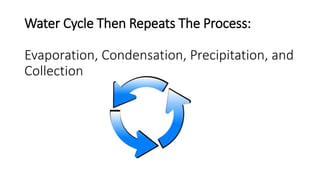
Water Cycle Then Repeats The Process:
Evaporation, Condensation, Precipitation, and
Collection

Water cycle bad

  • 1.
    The Water Cycle SOL3.9b Strand Earth’s Patterns, Cycles SOL3.9The student will investigate and understand the water cycle and its relationship to life on Earth. Key concepts include b)the energy from the sun drives the water cycle; c)the water cycle involves several processes. Related SOL3.1 The student will demonstrate an understanding of scientific reasoning, logic, and the nature of science by planning and conducting investigations in which d)natural events are sequenced chronologically; l)models are designed and built. Background Information Approximately 97% of the water is found in the oceans and the other 3%, which is fresh water, is found in glaciers, icecaps, rivers, lakes, underground, and in the atmosphere. Of this 3%, only 1% is suitable for drinking. Water continuously circulates between Earth’s surface, the air, and underground. This circulation is driven by the sun’s energy. As the sun warms the surface of oceans and other water sources, the movements of water molecules increase until some molecules change state from liquid water to gaseous water (water vapor). This is called evaporation. When energy is lost, the water vapor condenses, forming liquid water again. This is called condensation. When the droplets get large enough, they fall back to Earth as precipitation. Vocabulary water cycle, evaporation, condensation, precipitation, water molecule
  • 2.
    Steps In TheWater Cycle • Evaporation • Condensation • Precipitation • Collection The purpose of the water cycle is to constantly replenish the most important natural resource needed for all living things to exist: water.
  • 3.
    I. Evaporation happenswhen: a. The heat from the sun dries up the water. b. boiling water on the stove can cause water to evaporate . c. Wind or air can also cause the water to evaporate.
  • 4.
    Evaporation: Evaporation is atype of vaporization of a liquid that occurs from the surface of a liquid into a gaseous phase that is not saturated with the evaporating substance. The other type of vaporization is boiling, which is characterized by bubbles of saturated vapor forming in the liquid phase.
  • 5.
    II. Condensation happenswhen: a. When the water temperature is colder than the room temperature. b. When the water temperature is warmer than the room temperature.
  • 6.
    Condensation: Condensation is thechange of the physical state of matter from gas phase into liquid phase, and is the reverse of evaporation. Mostly refers to the water cycle. It can also be defined as the change in the state of water vapor to liquid water when in contact with a liquid or solid surface or cloud condensation within the atmosphere.
  • 7.
    III. Precipitation happenswhen: The clouds are full of moisture and release the moisture in the form of; a. Rain b. Snow c. Sleet d. Hail
  • 8.
    Precipitation: Precipitation is anyproduct of the condensation of atmospheric water vapor that falls under gravity. The main forms of precipitation include drizzle, rain, sleet, snow, and hail. Precipitation occurs when a portion of the atmosphere becomes saturated with water vapor, so that the water condenses and "precipitates".
  • 9.
    IV. Collection ofwater is gathered in these bodies of water: a. rivers b. streams c. oceans d. lakes
  • 10.
    Collection: Collection refers tothe process by which water gathers back into bodies of water. As the sun heats up the water, the collected water begins to evaporate to start the process of the water cycle over again.
  • 11.
    Water Cycle ThenRepeats The Process: Evaporation, Condensation, Precipitation, and Collection