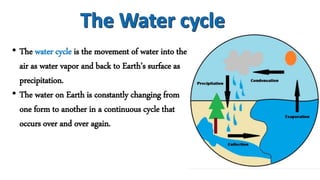
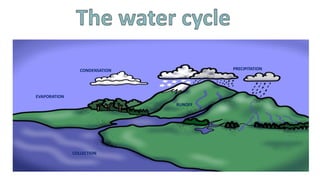
• The water cycle is the movement of water into the
air as water vapor and back to Earth’s surface as
precipitation.
• The water on Earth is constantly changing from
one form to another in a continuous cycle that
occurs over and over again.
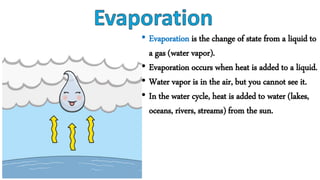
• Evaporation is the change of state from a liquid to
a gas (water vapor).
• Evaporation occurs when heat is added to a liquid.
• Water vapor is in the air, but you cannot see it.
• In the water cycle, heat is added to water (lakes,
oceans, rivers, streams) from the sun.
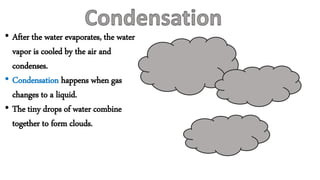
• After the water evaporates, the water
vapor is cooled by the air and
condenses.
• Condensation happens when gas
changes to a liquid.
• The tiny drops of water combine
together to form clouds.
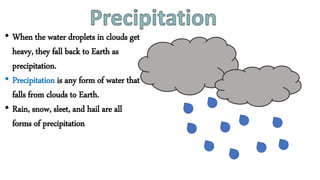
• When the water droplets in clouds get
heavy, they fall back to Earth as
precipitation.
• Precipitation is any form of water that
falls from clouds to Earth.
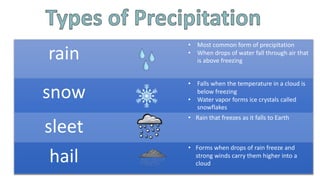
• Rain, snow, sleet, and hail are all
forms of precipitation
rain
• Most common form of precipitation
• When drops of water fall through air that
is above freezing
snow
• Falls when the temperature in a cloud is
below freezing
• Water vapor forms ice crystals called
snowflakes
sleet
• Rain that freezes as it falls to Earth
hail
• Forms when drops of rain freeze and
strong winds carry them higher into a
cloud
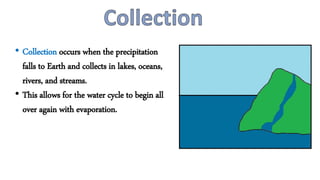
• Collection occurs when the precipitation
falls to Earth and collects in lakes, oceans,
rivers, and streams.
• This allows for the water cycle to begin all
over again with evaporation.
• When precipitation occurs, not all water
makes it back to oceans, lakes, streams,
and rivers.
• Some water soaks into the Earth.
• This process is called infiltration.
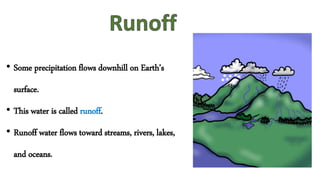
• Some precipitation flows downhill on Earth’s
surface.
• This water is called runoff.
• Runoff water flows toward streams, rivers, lakes,
and oceans.
EVAPORATION
CONDENSATION PRECIPITATION
RUNOFF
COLLECTION

water cycle presentation.pptx

  • 2.
    • The watercycle is the movement of water into the air as water vapor and back to Earth’s surface as precipitation. • The water on Earth is constantly changing from one form to another in a continuous cycle that occurs over and over again.
  • 3.
    • Evaporation isthe change of state from a liquid to a gas (water vapor). • Evaporation occurs when heat is added to a liquid. • Water vapor is in the air, but you cannot see it. • In the water cycle, heat is added to water (lakes, oceans, rivers, streams) from the sun.
  • 4.
    • After thewater evaporates, the water vapor is cooled by the air and condenses. • Condensation happens when gas changes to a liquid. • The tiny drops of water combine together to form clouds.
  • 5.
    • When thewater droplets in clouds get heavy, they fall back to Earth as precipitation. • Precipitation is any form of water that falls from clouds to Earth. • Rain, snow, sleet, and hail are all forms of precipitation
  • 6.
    rain • Most commonform of precipitation • When drops of water fall through air that is above freezing snow • Falls when the temperature in a cloud is below freezing • Water vapor forms ice crystals called snowflakes sleet • Rain that freezes as it falls to Earth hail • Forms when drops of rain freeze and strong winds carry them higher into a cloud
  • 7.
    • Collection occurswhen the precipitation falls to Earth and collects in lakes, oceans, rivers, and streams. • This allows for the water cycle to begin all over again with evaporation.
  • 8.
    • When precipitationoccurs, not all water makes it back to oceans, lakes, streams, and rivers. • Some water soaks into the Earth. • This process is called infiltration.
  • 9.
    • Some precipitationflows downhill on Earth’s surface. • This water is called runoff. • Runoff water flows toward streams, rivers, lakes, and oceans.
  • 10.