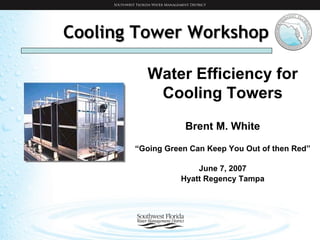
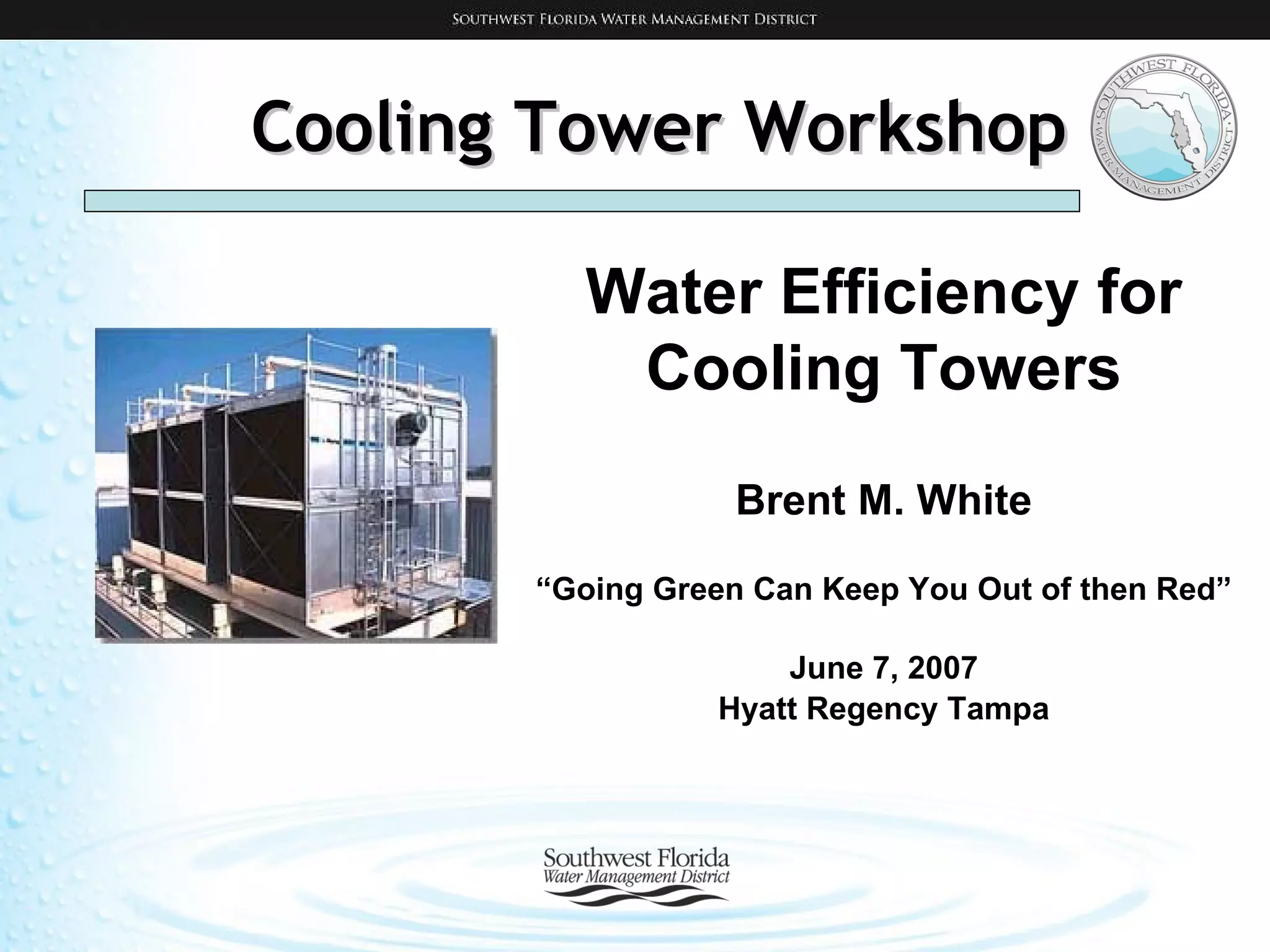
Cooling Tower Workshop Water Efficiency for Cooling Towers Brent M. White “ Going Green Can Keep You Out of then Red” June 7, 2007 Hyatt Regency Tampa
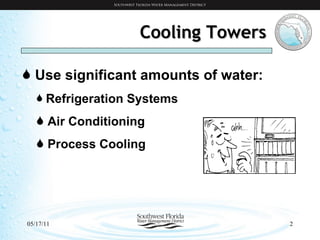
Use significant amounts of water: Refrigeration Systems  Air Conditioning Process Cooling Cooling Towers
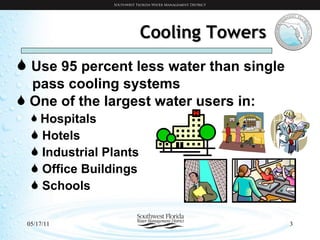
Use 95 percent less water than single  pass cooling systems One of the largest water users in: Hospitals Hotels Industrial Plants Office Buildings Schools Cooling Towers
Uses evaporation Lowers water temperature of heated  water from: A building’s operation A piece of equipment A specific process Evaporation is most efficient when: Maximum water surface area is exposed to  the maximum flow of air. Cooling Tower Function
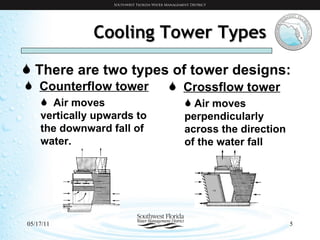
There are two types of tower designs: Cooling Tower Types Counterflow tower Air moves vertically upwards to the downward fall of water. Crossflow tower Air moves perpendicularly across the direction of the water fall
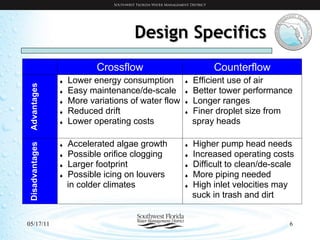
Design Specifics
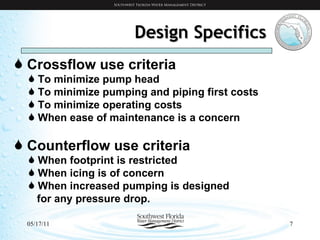
Design Specifics Crossflow use criteria To minimize pump head To minimize pumping and piping first costs To minimize operating costs When ease of maintenance is a concern Counterflow use criteria When footprint is restricted When icing is of concern When increased pumping is designed  for any pressure drop.
Cooling Tower Water Loss Minimizing loss if possible Understanding basic operating principles Water is lost three ways: Evaporation Bleed off Drift and other minor loses
Evaporation Warmed water goes from liquid to a vapor Removes the latent heat Cools the water left behind Evaporation depends on: Length of time water is in contact with the air Temperature of the air and the water Surrounding wind and humidity Occurs at a rate of about 1 percent for  every 10 ° temperature drop
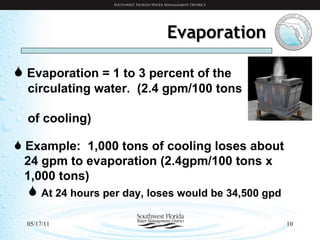
Evaporation Evaporation = 1 to 3 percent of the  circulating water.  (2.4 gpm/100 tons  of cooling) Example:  1,000 tons of cooling loses about  24 gpm to evaporation (2.4gpm/100 tons x  1,000 tons) At 24 hours per day, loses would be 34,500 gpd
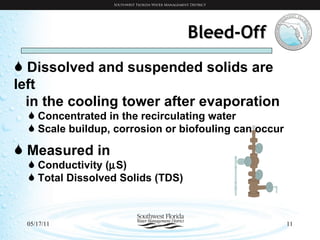
Bleed-Off Dissolved and suspended solids are left  in the cooling tower after evaporation Concentrated in the recirculating water Scale buildup, corrosion or biofouling can occur  Measured in Conductivity (  S) Total Dissolved Solids (TDS)
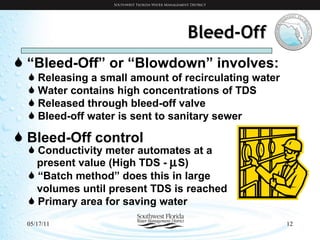
Bleed-Off “ Bleed-Off” or “Blowdown” involves: Releasing a small amount of recirculating water Water contains high concentrations of TDS Released through bleed-off valve Bleed-off water is sent to sanitary sewer Bleed-Off control Conductivity meter automates at a  present value (High TDS -   S) “ Batch method” does this in large  volumes until present TDS is reached Primary area for saving water
Drift and Other Losses Water drops carried off by airflow In the form of mist, or drift Drift release is not controlled Drift Rates are low Between 0.05 and 0.2 percent of the  airflow rate Not critical to the efficiency of the  cooling tower Other types of losses: Valve leaks Drawdown/draw-off
Cooling Tower Efficiency Related to the water quality inside the  tower Conductivity (TDS/  S) concentration How much water is bled-off How much water is used to make-up Concentration ratio Make-up water -vs- Tower basin water Determines how much water the tower uses
Water Quality Requirements Includes Controlling the rates of bleed-off/make-up Adding the right amounts of chemicals Applying other treatment methods Monitoring levels of 4 contaminants Scale Corrosion Biological fouling Foreign matter
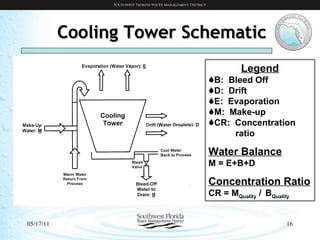
Cooling Tower Schematic Legend B:  Bleed Off D:  Drift E:  Evaporation M:  Make-up CR:  Concentration  ratio Water Balance M = E+B+D Concentration Ratio CR = M Quality  /   B Quality
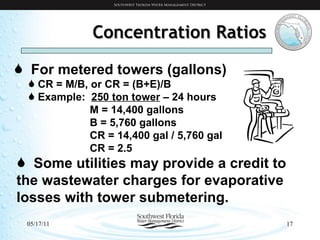
Concentration Ratios For metered towers (gallons) CR = M/B, or CR = (B+E)/B Example:  250 ton tower  – 24 hours M = 14,400 gallons B = 5,760 gallons CR = 14,400 gal / 5,760 gal CR = 2.5 Some utilities may provide a credit to the wastewater charges for evaporative losses with tower submetering.
Concentration Ratios For unmetered towers (gallons) Calculation based on the conductivity  concentration ratio (TDS/  S) CR = [B] / [M] Example:  Bleed-off conductivity = 1,400   S Make-up conductivity = 550   S CR = 1,400 / 550 CR = 2.5
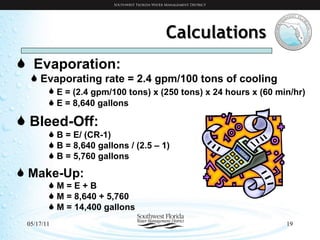
Calculations Evaporation: Evaporating rate = 2.4 gpm/100 tons of cooling E = (2.4 gpm/100 tons) x (250 tons) x 24 hours x (60 min/hr)   E = 8,640 gallons Bleed-Off: B = E/ (CR-1) B = 8,640 gallons / (2.5 – 1) B = 5,760 gallons Make-Up: M = E + B M = 8,640 + 5,760 M = 14,400 gallons
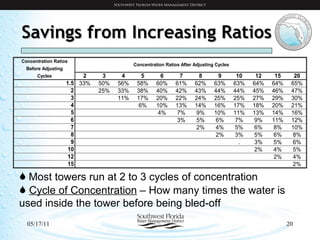
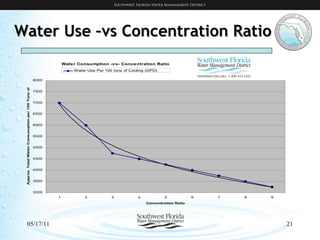
Savings from Increasing Ratios Most towers run at 2 to 3 cycles of concentration Cycle of Concentration  – How many times the water is used inside the tower before being bled-off
Water Use –vs Concentration Ratio
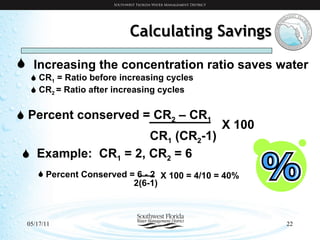
Calculating Savings Increasing the concentration ratio saves water CR 1  = Ratio before increasing cycles CR 2  = Ratio after increasing cycles Percent conserved = CR 2  – CR 1 CR 1  (CR 2 -1) X 100 Example:  CR 1  = 2, CR 2  = 6 Percent Conserved = 6 - 2 2(6-1) X 100 = 4/10 = 40%
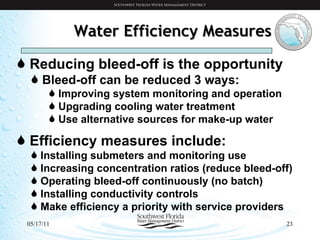
Water Efficiency Measures Reducing bleed-off is the opportunity Bleed-off can be reduced 3 ways: Improving system monitoring and operation Upgrading cooling water treatment Use alternative sources for make-up water Efficiency measures include: Installing submeters and monitoring use Increasing concentration ratios (reduce bleed-off) Operating bleed-off continuously (no batch) Installing conductivity controls Make efficiency a priority with service providers
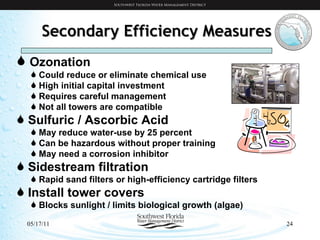
Secondary Efficiency Measures Ozonation Could reduce or eliminate chemical use High initial capital investment Requires careful management Not all towers are compatible Sulfuric / Ascorbic Acid May reduce water-use by 25 percent Can be hazardous without proper training May need a corrosion inhibitor Sidestream filtration Rapid sand filters or high-efficiency cartridge filters Install tower covers Blocks sunlight / limits biological growth (algae)
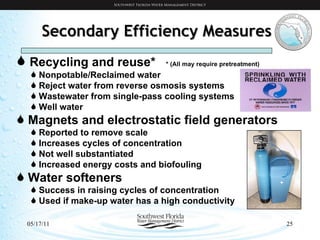
Secondary Efficiency Measures Recycling and reuse*  * (All may require pretreatment) Nonpotable/Reclaimed water Reject water from reverse osmosis systems Wastewater from single-pass cooling systems Well water Magnets and electrostatic field generators Reported to remove scale Increases cycles of concentration Not well substantiated Increased energy costs and biofouling Water softeners Success in raising cycles of concentration Used if make-up water has a high conductivity
Thank You!  Any Questions? For more info:  [email_address]

Water Conservation - Cooling Tower Management Overview

  • 1.
    Cooling Tower WorkshopWater Efficiency for Cooling Towers Brent M. White “ Going Green Can Keep You Out of then Red” June 7, 2007 Hyatt Regency Tampa
  • 2.
    Use significant amountsof water: Refrigeration Systems Air Conditioning Process Cooling Cooling Towers
  • 3.
    Use 95 percentless water than single pass cooling systems One of the largest water users in: Hospitals Hotels Industrial Plants Office Buildings Schools Cooling Towers
  • 4.
    Uses evaporation Lowerswater temperature of heated water from: A building’s operation A piece of equipment A specific process Evaporation is most efficient when: Maximum water surface area is exposed to the maximum flow of air. Cooling Tower Function
  • 5.
    There are twotypes of tower designs: Cooling Tower Types Counterflow tower Air moves vertically upwards to the downward fall of water. Crossflow tower Air moves perpendicularly across the direction of the water fall
  • 6.
  • 7.
    Design Specifics Crossflowuse criteria To minimize pump head To minimize pumping and piping first costs To minimize operating costs When ease of maintenance is a concern Counterflow use criteria When footprint is restricted When icing is of concern When increased pumping is designed for any pressure drop.
  • 8.
    Cooling Tower WaterLoss Minimizing loss if possible Understanding basic operating principles Water is lost three ways: Evaporation Bleed off Drift and other minor loses
  • 9.
    Evaporation Warmed watergoes from liquid to a vapor Removes the latent heat Cools the water left behind Evaporation depends on: Length of time water is in contact with the air Temperature of the air and the water Surrounding wind and humidity Occurs at a rate of about 1 percent for every 10 ° temperature drop
  • 10.
    Evaporation Evaporation =1 to 3 percent of the circulating water. (2.4 gpm/100 tons of cooling) Example: 1,000 tons of cooling loses about 24 gpm to evaporation (2.4gpm/100 tons x 1,000 tons) At 24 hours per day, loses would be 34,500 gpd
  • 11.
    Bleed-Off Dissolved andsuspended solids are left in the cooling tower after evaporation Concentrated in the recirculating water Scale buildup, corrosion or biofouling can occur Measured in Conductivity (  S) Total Dissolved Solids (TDS)
  • 12.
    Bleed-Off “ Bleed-Off”or “Blowdown” involves: Releasing a small amount of recirculating water Water contains high concentrations of TDS Released through bleed-off valve Bleed-off water is sent to sanitary sewer Bleed-Off control Conductivity meter automates at a present value (High TDS -  S) “ Batch method” does this in large volumes until present TDS is reached Primary area for saving water
  • 13.
    Drift and OtherLosses Water drops carried off by airflow In the form of mist, or drift Drift release is not controlled Drift Rates are low Between 0.05 and 0.2 percent of the airflow rate Not critical to the efficiency of the cooling tower Other types of losses: Valve leaks Drawdown/draw-off
  • 14.
    Cooling Tower EfficiencyRelated to the water quality inside the tower Conductivity (TDS/  S) concentration How much water is bled-off How much water is used to make-up Concentration ratio Make-up water -vs- Tower basin water Determines how much water the tower uses
  • 15.
    Water Quality RequirementsIncludes Controlling the rates of bleed-off/make-up Adding the right amounts of chemicals Applying other treatment methods Monitoring levels of 4 contaminants Scale Corrosion Biological fouling Foreign matter
  • 16.
    Cooling Tower SchematicLegend B: Bleed Off D: Drift E: Evaporation M: Make-up CR: Concentration ratio Water Balance M = E+B+D Concentration Ratio CR = M Quality / B Quality
  • 17.
    Concentration Ratios Formetered towers (gallons) CR = M/B, or CR = (B+E)/B Example: 250 ton tower – 24 hours M = 14,400 gallons B = 5,760 gallons CR = 14,400 gal / 5,760 gal CR = 2.5 Some utilities may provide a credit to the wastewater charges for evaporative losses with tower submetering.
  • 18.
    Concentration Ratios Forunmetered towers (gallons) Calculation based on the conductivity concentration ratio (TDS/  S) CR = [B] / [M] Example: Bleed-off conductivity = 1,400  S Make-up conductivity = 550  S CR = 1,400 / 550 CR = 2.5
  • 19.
    Calculations Evaporation: Evaporatingrate = 2.4 gpm/100 tons of cooling E = (2.4 gpm/100 tons) x (250 tons) x 24 hours x (60 min/hr) E = 8,640 gallons Bleed-Off: B = E/ (CR-1) B = 8,640 gallons / (2.5 – 1) B = 5,760 gallons Make-Up: M = E + B M = 8,640 + 5,760 M = 14,400 gallons
  • 20.
    Savings from IncreasingRatios Most towers run at 2 to 3 cycles of concentration Cycle of Concentration – How many times the water is used inside the tower before being bled-off
  • 21.
    Water Use –vsConcentration Ratio
  • 22.
    Calculating Savings Increasingthe concentration ratio saves water CR 1 = Ratio before increasing cycles CR 2 = Ratio after increasing cycles Percent conserved = CR 2 – CR 1 CR 1 (CR 2 -1) X 100 Example: CR 1 = 2, CR 2 = 6 Percent Conserved = 6 - 2 2(6-1) X 100 = 4/10 = 40%
  • 23.
    Water Efficiency MeasuresReducing bleed-off is the opportunity Bleed-off can be reduced 3 ways: Improving system monitoring and operation Upgrading cooling water treatment Use alternative sources for make-up water Efficiency measures include: Installing submeters and monitoring use Increasing concentration ratios (reduce bleed-off) Operating bleed-off continuously (no batch) Installing conductivity controls Make efficiency a priority with service providers
  • 24.
    Secondary Efficiency MeasuresOzonation Could reduce or eliminate chemical use High initial capital investment Requires careful management Not all towers are compatible Sulfuric / Ascorbic Acid May reduce water-use by 25 percent Can be hazardous without proper training May need a corrosion inhibitor Sidestream filtration Rapid sand filters or high-efficiency cartridge filters Install tower covers Blocks sunlight / limits biological growth (algae)
  • 25.
    Secondary Efficiency MeasuresRecycling and reuse* * (All may require pretreatment) Nonpotable/Reclaimed water Reject water from reverse osmosis systems Wastewater from single-pass cooling systems Well water Magnets and electrostatic field generators Reported to remove scale Increases cycles of concentration Not well substantiated Increased energy costs and biofouling Water softeners Success in raising cycles of concentration Used if make-up water has a high conductivity
  • 26.
    Thank You! Any Questions? For more info: [email_address]

Editor's Notes

  • #2 Introduce Self
  • #3 Cooling Towers Use Significant amounts of water depending on their applications. (as much as 60% of a facilities total water use) Used as refrigeration systems such as at the St. Pete Times Forum to produce ice for skating Used in Air Conditioning source in large facilities Also used in process cooling as in circuit board manufacturing.
  • #4 Cooling Towers use 95 percent less water than a single-pass cooling systems that discards water after a single use. Towers are one of the largest users in hospitals, hotels, industrial plants, office buildings and schools.
  • #5 Cooling towers use evaporation to lower the temperature of incoming water and delivers it to part of a buildings operation, a specific piece of equipment or a specific process. This practice is most efficient when the maximum about of water surface area is exposed to the maximum flow of air.
  • #6 Basically, there are two types of tower designs depending on the direction of air flow in relation to the direction the incoming water falls. Counterflow: Air moves vertically upwards towards the fall of water. Crossflow: Air moves perpendicularly across the fall of water.
  • #7 Each type of tower has advantages and disadvantages to its design. These should be considered when choosing what type of tower to use in its operations.
  • #8 Basic design specifics will determine which type of tower to use in a facility. Crossflow: When pump head, piping and operating costs needs to be minimized and ease of maintenance is a concern. Counterflow: When footprint, icing and increased pumping to mitigate pressure changes (like in a multi-story building using booster pumps) are of concern.
  • #9 Minimizing water loss is possible by understanding the basic operating principles of cooling towers. Water is lost three ways: Evaporation, Bleed off Drift caused by wind
  • #10 Evaporation in a cooling tower is caused when air comes in contact with the falling water releasing the latent heat in the form of water vapor. The amount of evaporation depends on the: - length of time the cooling water is in contact with the air; - the beginning temperature of the air and water; and the surrounding wind and humidity. This occurs at about the rate of 1 percent for every 10 degrees of temperature drop.
  • #11 A tower will evaporate a total of 1 to 3 percent of the total volume of the circulating water. This works out to about 2.4 gallons per minute for every 100 tons of cooling. For a 1,000 ton tower this can work out to be as much as 34,500 gallons per day.
  • #12 Bleed off, or blowdown is triggered by dissolved and/or suspended solids left in the cooling tower after evaporation reaching a pre-determined limit. These materials are left concentrated in the basin, or recirculating water inside the tower. High concentrations can cause scale buildup, corrosion or biofouling. This is measures in conductivity (microsiemans) or Total Dissolved Solids (ppm TDS)
  • #13 Bleed off, or blowdown involves releasing a small amount of the basin water which contains a high concentration of TDS through a bleed off valve into the sanitary sewer. This is usually controlled in an automated process by a conductivity meter. A “batch method” releases a constant fixed amount of basin water to reduce TDS. This is the primary area for saving water.
  • #14 Drift occurs when water drops are carried off by airflow during the initial stage when air and water meet inside the tower. Rates of drift are low, usually ranging between 0.05 and 0.2 percent of the airflow rate. Drift really isn’t critical to the efficiency of the cooling tower thus isn’t controlled. Other types of losses include valve leaks and drawdown.
  • #15 As mentioned, efficiency of tower operations is related to blowdown, which is determined by the water quality inside the tower. Determines how much water is blowndown and how much is used to makeup that lost water. This can be defined by the concentration ration of makeup tower water conductivity vs basin tower water conductivity
  • #16 To control these rates of bleed-off and make-up water use, you must apply the right amounts of treatment chemicals and involving other treatment methods as needed. Monitoring levels of 4 contaminants is needed: -Scale -Corrosion -Biological fouling -Foreign matter
  • #17 Explain cooling tower schematic including bleed-off, drift, evaporation, make-up and the concentration ratio
  • #18 To determine the concentration ratio for sub metered towers (metered at makeup and blowdown valves): Divide makeup water volume by blowdown water volume. This gives you a concentration ratio, otherwise known as cycles of concentration or how many cooling cycles a tower will use water before discharging it to the wastewater stream.
  • #19 To determine this on an unmetered tower, divide the conductivity of the basin water by the conductivity of the makeup water. It’s a good idea to submeter all towers for accurate measurement of water use. Some utilities will even offer wastewater credits for water lost to evaporation, or water going through the main domestic supply meter, but not being introduced to the wastewater stream.
  • #20 To calculate evaporation: again, for every 100 tons of cooling, multiply by 2.4 gpm. Extend that out to 24 hrs for a per day figure. To calculate bleed-off volume, divide the evaporation figure by the concentration ration minus 1. To calculate the makeup volume, add the evaporation volume to the bleed off volume.
  • #21 Explain how the chart works in determining how much water can be saved. I.e.: Going from 2 cycles of concentration to 4 will save 33% of the water used. Technologies now exist that enable a tower to be ran at 90+ cycles without scaling or damage to the tower.
  • #22 This graph shows the relationship between cycles of concentration and the volume of water used by the cooling tower.
  • #23 To manually calculate the volume of water saved by changing the concentration ratio, use the following equation.
  • #24 In summary, reducing bleed-off is the primary opportunity to saving water in a cooling tower. This can be done 3 ways: Improving system monitoring Upgrading cooling water treatment Using alternative sources of makeup water. Measures to do so include: Installing submeters to monitor water use Increasing cycles of concentration Operating bleed-off continuously Installing conductivity controls Make efficiency a priority with service providers.
  • #25 Secondary measures include: Ozonation – reduces chemical use Sulfuric/Ascorbic Acid – may require a corrosion inhibitor. Calcium sulfate is more soluble than calcium carbonate Sidestream filtration – using filters to lower make-up water conductivity Installing tower covers – blocks sunlight and slows down biological growth inside the tower.
  • #26 Other efficiency measures include: Using recycling and reuse from other sources that may have a better makeup conductivity level Magnets and electrostatic field generators that are reported to remove scale Install a water softener to the make-up feed to reduce conductivity level. (Better for smaller towers)
  • #27 Any questions?