What is waste management ?


 Waste management is the collection, transport, processing or disposal,
  managing and monitoring of waste materials. The term usually relates to
  materials produced by human activity, and the process is generally
  undertaken to reduce their effect on health, the environment.
 Waste management practices can differ for developed and developing
  nations, for urban and rural areas, and for residential and industrial
  producers. Management for non-hazardous waste residential and
  institutional waste in metropolitan areas is usually the responsibility of
  local government authorities, while management for non-hazardous
  commercial and industrial waste is usually the responsibility of the
  generator subject to local, national or international controls.


Waste Management  Page 2
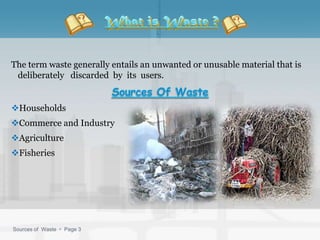
The term waste generally entails an unwanted or unusable material that is
 deliberately discarded by its users.


Households
Commerce and Industry
Agriculture
Fisheries


Sources of Waste  Page 3
Kinds of waste  Page 4
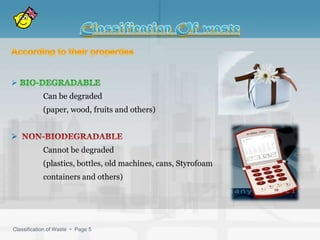

            Can be degraded
            (paper, wood, fruits and others)



            Cannot be degraded
            (plastics, bottles, old machines, cans, Styrofoam
            containers and others)


Classification of Waste  Page 5
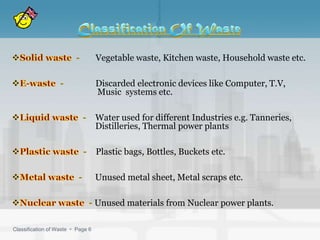
Vegetable waste, Kitchen waste, Household waste etc.

                                   Discarded electronic devices like Computer, T.V,
                                   Music systems etc.

                                   Water used for different Industries e.g. Tanneries,
                                   Distilleries, Thermal power plants

                                   Plastic bags, Bottles, Buckets etc.

                                   Unused metal sheet, Metal scraps etc.

                                   Unused materials from Nuclear power plants.

Classification of Waste  Page 6
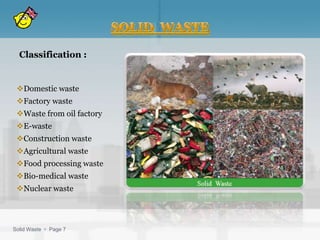
Classification :


 Domestic waste
 Factory waste
 Waste from oil factory
 E-waste
 Construction waste
 Agricultural waste
 Food processing waste
 Bio-medical waste
 Nuclear waste


Solid Waste  Page 7
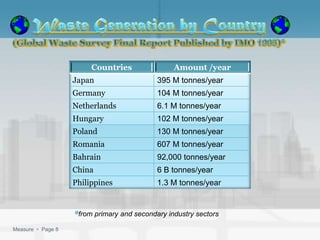
Countries                Amount /year
                   Japan                    395 M tonnes/year
                   Germany                  104 M tonnes/year
                   Netherlands              6.1 M tonnes/year
                   Hungary                  102 M tonnes/year
                   Poland                   130 M tonnes/year
                   Romania                  607 M tonnes/year
                   Bahrain                  92,000 tonnes/year
                   China                    6 B tonnes/year
                   Philippines              1.3 M tonnes/year


                    from primary and secondary industry sectors

Measure  Page 8
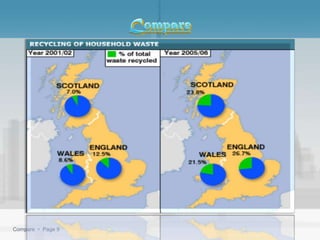
Compare  Page 9
Waste Hierarchy  Page 10
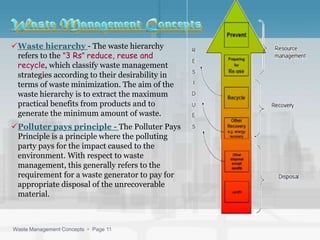
Waste hierarchy - The waste hierarchy
 refers to the "3 Rs" reduce, reuse and
 recycle, which classify waste management
 strategies according to their desirability in
 terms of waste minimization. The aim of the
 waste hierarchy is to extract the maximum
 practical benefits from products and to
 generate the minimum amount of waste.
Polluter pays principle - The Polluter Pays
 Principle is a principle where the polluting
 party pays for the impact caused to the
 environment. With respect to waste
 management, this generally refers to the
 requirement for a waste generator to pay for
 appropriate disposal of the unrecoverable
 material.


Waste Management Concepts  Page 11
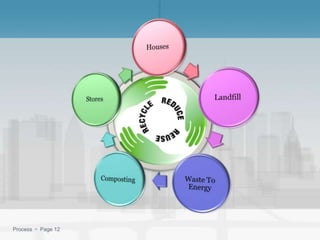
Process  Page 12
Here comes your footer  Page 13
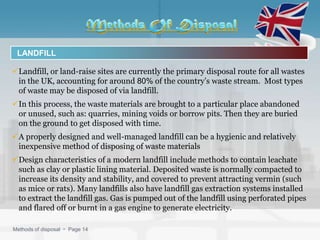
LANDFILL

Landfill, or land-raise sites are currently the primary disposal route for all wastes
 in the UK, accounting for around 80% of the country’s waste stream. Most types
 of waste may be disposed of via landfill.
In this process, the waste materials are brought to a particular place abandoned
 or unused, such as: quarries, mining voids or borrow pits. Then they are buried
 on the ground to get disposed with time.
A properly designed and well-managed landfill can be a hygienic and relatively
 inexpensive method of disposing of waste materials
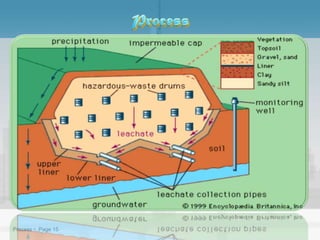
Design characteristics of a modern landfill include methods to contain leachate
 such as clay or plastic lining material. Deposited waste is normally compacted to
 increase its density and stability, and covered to prevent attracting vermin (such
 as mice or rats). Many landfills also have landfill gas extraction systems installed
 to extract the landfill gas. Gas is pumped out of the landfill using perforated pipes
 and flared off or burnt in a gas engine to generate electricity.

Methods of disposal  Page 14
Process  Page 15
Pitsea, Cleanaway Ltd, Essex


                 Mucking, Cory Environmental Ltd, Essex


                 Calvert, Shanks Waste Services Ltd,
                 Buckinghamshire

                 Pilsworth, Viridor Waste Management Ltd,
                 Manchester


                 Packington, SITA, Birmingham


Examples  Page 16
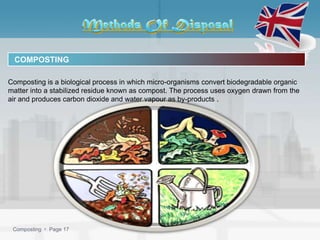
COMPOSTING

Composting is a biological process in which micro-organisms convert biodegradable organic
matter into a stabilized residue known as compost. The process uses oxygen drawn from the
air and produces carbon dioxide and water vapour as by-products .


 Composting  Page 17
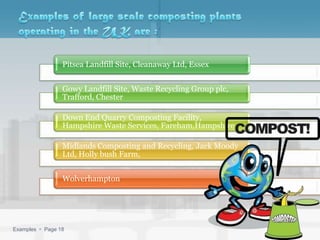
Pitsea Landfill Site, Cleanaway Ltd, Essex


                 Gowy Landfill Site, Waste Recycling Group plc,
                 Trafford, Chester

                 Down End Quarry Composting Facility,
                 Hampshire Waste Services, Fareham,Hampshire

                 Midlands Composting and Recycling, Jack Moody
                 Ltd, Holly bush Farm,


                 Wolverhampton


Examples  Page 18
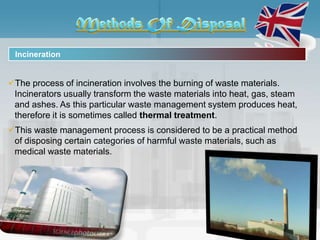
Incineration


The process of incineration involves the burning of waste materials.
 Incinerators usually transform the waste materials into heat, gas, steam
 and ashes. As this particular waste management system produces heat,
 therefore it is sometimes called thermal treatment.
This waste management process is considered to be a practical method
 of disposing certain categories of harmful waste materials, such as
 medical waste materials.


 Here comes your footer  Page 19
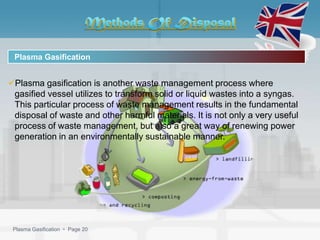
Plasma Gasification


Plasma gasification is another waste management process where
 gasified vessel utilizes to transform solid or liquid wastes into a syngas.
 This particular process of waste management results in the fundamental
 disposal of waste and other harmful materials. It is not only a very useful
 process of waste management, but also a great way of renewing power
 generation in an environmentally sustainable manner.


 Plasma Gasification  Page 20
Here comes your footer  Page 21
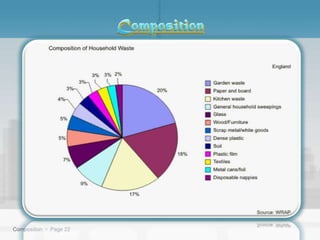
Composition  Page 22
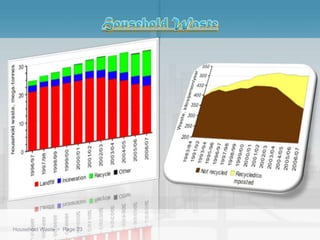
Household Waste  Page 23
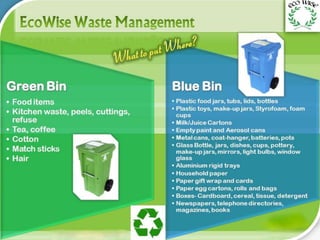
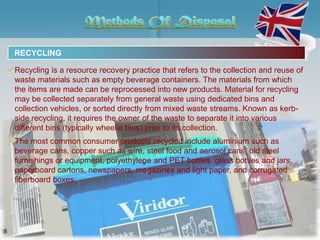
RECYCLING

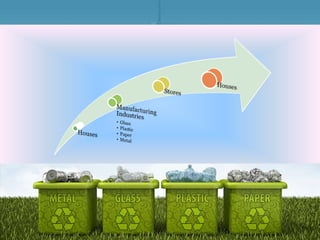
Recycling is a resource recovery practice that refers to the collection and reuse of
 waste materials such as empty beverage containers. The materials from which
 the items are made can be reprocessed into new products. Material for recycling
 may be collected separately from general waste using dedicated bins and
 collection vehicles, or sorted directly from mixed waste streams. Known as kerb-
 side recycling, it requires the owner of the waste to separate it into various
 different bins (typically wheelie bins) prior to its collection.
The most common consumer products recycled include aluminium such as
 beverage cans, copper such as wire, steel food and aerosol cans, old steel
 furnishings or equipment, polyethylene and PET bottles, glass bottles and jars,
 paperboard cartons, newspapers, magazines and light paper, and corrugated
 fiberboard boxes.


 Here comes your footer  Page 24
Here comes your footer  Page 25
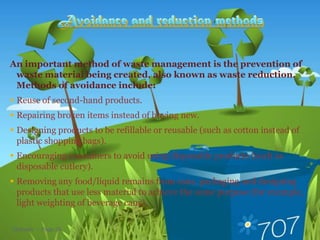
An important method of waste management is the prevention of
 waste material being created, also known as waste reduction.
 Methods of avoidance include:
 Reuse of second-hand products.
 Repairing broken items instead of buying new.
 Designing products to be refillable or reusable (such as cotton instead of
  plastic shopping bags).
 Encouraging consumers to avoid using disposable products (such as
  disposable cutlery).
 Removing any food/liquid remains from cans, packaging and designing
  products that use less material to achieve the same purpose (for example,
  light weighting of beverage cans).

Methods  Page 26
There are a lot of waste management methods available for disposal of
 different kinds of waste materials. While going to dispose these waste
 materials, in order to make the process easy, at first the waste materials
 are sorted out into various categories, such as:
• Waste materials for landfill disposal
• Plasma gasification
• Incineration
• And Recycling
 Depending on the type of material, different methods are used. Among all
 the existing waste management processes, waste management recycling is
 considered to be the best.


Various methods  Page 27
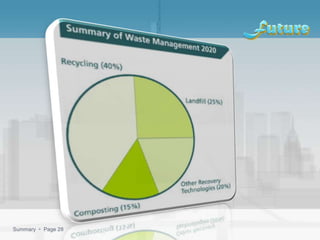
Summary  Page 28
Made By: Savita Verma  Page 29

Waste management and Kinds, concept, methods of disposal, Process, Eco-waste mgt, Measures.

  • 2.
    What is wastemanagement ?  Waste management is the collection, transport, processing or disposal, managing and monitoring of waste materials. The term usually relates to materials produced by human activity, and the process is generally undertaken to reduce their effect on health, the environment.  Waste management practices can differ for developed and developing nations, for urban and rural areas, and for residential and industrial producers. Management for non-hazardous waste residential and institutional waste in metropolitan areas is usually the responsibility of local government authorities, while management for non-hazardous commercial and industrial waste is usually the responsibility of the generator subject to local, national or international controls. Waste Management  Page 2
  • 3.
    The term wastegenerally entails an unwanted or unusable material that is deliberately discarded by its users. Households Commerce and Industry Agriculture Fisheries Sources of Waste  Page 3
  • 4.
    Kinds of waste Page 4
  • 5.
     Can be degraded (paper, wood, fruits and others)  Cannot be degraded (plastics, bottles, old machines, cans, Styrofoam containers and others) Classification of Waste  Page 5
  • 6.
    Vegetable waste, Kitchenwaste, Household waste etc. Discarded electronic devices like Computer, T.V, Music systems etc. Water used for different Industries e.g. Tanneries, Distilleries, Thermal power plants Plastic bags, Bottles, Buckets etc. Unused metal sheet, Metal scraps etc. Unused materials from Nuclear power plants. Classification of Waste  Page 6
  • 7.
    Classification : Domesticwaste Factory waste Waste from oil factory E-waste Construction waste Agricultural waste Food processing waste Bio-medical waste Nuclear waste Solid Waste  Page 7
  • 8.
    Countries Amount /year Japan 395 M tonnes/year Germany 104 M tonnes/year Netherlands 6.1 M tonnes/year Hungary 102 M tonnes/year Poland 130 M tonnes/year Romania 607 M tonnes/year Bahrain 92,000 tonnes/year China 6 B tonnes/year Philippines 1.3 M tonnes/year from primary and secondary industry sectors Measure  Page 8
  • 9.
  • 10.
  • 11.
    Waste hierarchy -The waste hierarchy refers to the "3 Rs" reduce, reuse and recycle, which classify waste management strategies according to their desirability in terms of waste minimization. The aim of the waste hierarchy is to extract the maximum practical benefits from products and to generate the minimum amount of waste. Polluter pays principle - The Polluter Pays Principle is a principle where the polluting party pays for the impact caused to the environment. With respect to waste management, this generally refers to the requirement for a waste generator to pay for appropriate disposal of the unrecoverable material. Waste Management Concepts  Page 11
  • 12.
  • 13.
    Here comes yourfooter  Page 13
  • 14.
    LANDFILL Landfill, or land-raisesites are currently the primary disposal route for all wastes in the UK, accounting for around 80% of the country’s waste stream. Most types of waste may be disposed of via landfill. In this process, the waste materials are brought to a particular place abandoned or unused, such as: quarries, mining voids or borrow pits. Then they are buried on the ground to get disposed with time. A properly designed and well-managed landfill can be a hygienic and relatively inexpensive method of disposing of waste materials Design characteristics of a modern landfill include methods to contain leachate such as clay or plastic lining material. Deposited waste is normally compacted to increase its density and stability, and covered to prevent attracting vermin (such as mice or rats). Many landfills also have landfill gas extraction systems installed to extract the landfill gas. Gas is pumped out of the landfill using perforated pipes and flared off or burnt in a gas engine to generate electricity. Methods of disposal  Page 14
  • 15.
  • 16.
    Pitsea, Cleanaway Ltd,Essex Mucking, Cory Environmental Ltd, Essex Calvert, Shanks Waste Services Ltd, Buckinghamshire Pilsworth, Viridor Waste Management Ltd, Manchester Packington, SITA, Birmingham Examples  Page 16
  • 17.
    COMPOSTING Composting is abiological process in which micro-organisms convert biodegradable organic matter into a stabilized residue known as compost. The process uses oxygen drawn from the air and produces carbon dioxide and water vapour as by-products . Composting  Page 17
  • 18.
    Pitsea Landfill Site,Cleanaway Ltd, Essex Gowy Landfill Site, Waste Recycling Group plc, Trafford, Chester Down End Quarry Composting Facility, Hampshire Waste Services, Fareham,Hampshire Midlands Composting and Recycling, Jack Moody Ltd, Holly bush Farm, Wolverhampton Examples  Page 18
  • 19.
    Incineration The process ofincineration involves the burning of waste materials. Incinerators usually transform the waste materials into heat, gas, steam and ashes. As this particular waste management system produces heat, therefore it is sometimes called thermal treatment. This waste management process is considered to be a practical method of disposing certain categories of harmful waste materials, such as medical waste materials. Here comes your footer  Page 19
  • 20.
    Plasma Gasification Plasma gasificationis another waste management process where gasified vessel utilizes to transform solid or liquid wastes into a syngas. This particular process of waste management results in the fundamental disposal of waste and other harmful materials. It is not only a very useful process of waste management, but also a great way of renewing power generation in an environmentally sustainable manner. Plasma Gasification  Page 20
  • 21.
    Here comes yourfooter  Page 21
  • 22.
  • 23.
  • 24.
    RECYCLING Recycling is aresource recovery practice that refers to the collection and reuse of waste materials such as empty beverage containers. The materials from which the items are made can be reprocessed into new products. Material for recycling may be collected separately from general waste using dedicated bins and collection vehicles, or sorted directly from mixed waste streams. Known as kerb- side recycling, it requires the owner of the waste to separate it into various different bins (typically wheelie bins) prior to its collection. The most common consumer products recycled include aluminium such as beverage cans, copper such as wire, steel food and aerosol cans, old steel furnishings or equipment, polyethylene and PET bottles, glass bottles and jars, paperboard cartons, newspapers, magazines and light paper, and corrugated fiberboard boxes. Here comes your footer  Page 24
  • 25.
    Here comes yourfooter  Page 25
  • 26.
    An important methodof waste management is the prevention of waste material being created, also known as waste reduction. Methods of avoidance include:  Reuse of second-hand products.  Repairing broken items instead of buying new.  Designing products to be refillable or reusable (such as cotton instead of plastic shopping bags).  Encouraging consumers to avoid using disposable products (such as disposable cutlery).  Removing any food/liquid remains from cans, packaging and designing products that use less material to achieve the same purpose (for example, light weighting of beverage cans). Methods  Page 26
  • 27.
    There are alot of waste management methods available for disposal of different kinds of waste materials. While going to dispose these waste materials, in order to make the process easy, at first the waste materials are sorted out into various categories, such as: • Waste materials for landfill disposal • Plasma gasification • Incineration • And Recycling  Depending on the type of material, different methods are used. Among all the existing waste management processes, waste management recycling is considered to be the best. Various methods  Page 27
  • 28.
  • 29.
    Made By: SavitaVerma  Page 29