APUSH Review: Key
Concept 3.3
Everything You Need To Know About Key Concept
3.3 To Succeed In APUSH
www.Apushreview.com
Period 3: 1754 – 1800
Updated for the
2015 revisions
The New Curriculum
Key Concept 3.3 “Migration within North America and
competition over resources, boundaries, and trade
intensified conflicts among peoples and nations. .”
Page 41 of the Curriculum Framework
Big ideas:
What were achievements of the Northwest Land
Ordinance?
How did foreign policy debates impact America
domestically?
What was the message of George Washington’s
Farewell Address?
Key Concept 3.3, I
“In the decades after American
independence, interactions among different
groups resulted in competition for resources,
shifting alliances, and cultural blending. .” - Page
41 of the Curriculum Framework
A) Relations with Natives post-Revolutionary
War
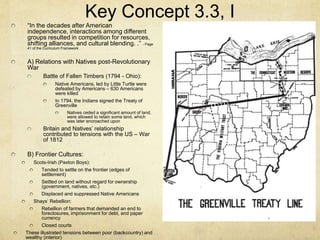
Battle of Fallen Timbers (1794 - Ohio):
Native Americans, led by Little Turtle were
defeated by Americans – 630 Americans
were killed
In 1794, the Indians signed the Treaty of
Greenville
Natives ceded a significant amount of land,
were allowed to retain some land, which
was later encroached upon
Britain and Natives’ relationship
contributed to tensions with the US – War
of 1812
B) Frontier Cultures:
Scots-Irish (Paxton Boys):
Tended to settle on the frontier (edges of
settlement)
Settled on land without regard for ownership
(government, natives, etc.)
Displaced and suppressed Native Americans
Shays’ Rebellion:
Rebellion of farmers that demanded an end to
foreclosures, imprisonment for debt, and paper
currency
Closed courts
These illustrated tensions between poor (backcountry) and
wealthy (interior)
Key Concept 3.3, I
C) Northwest Land Ordinance (1787):
Created a process to admit new states
(once a population of 60,000 was
reached)
Guaranteed freedom of religion and
trial by jury (this was before the Bill of
Rights)
A portion of land sales went to fund
education (16th square mile)
Slavery was abolished in the territory
Protection of private property
D) Government relations with Natives:
In the Constitution, there was NO
mention of treatment/relation with
Natives; did not have representation in
government
This led to issues over land
Treaty of Greenville – Discussed in 3.1,
A
E) Spain expanded settlements into
California (1760s):
Missions, or forts were created and trade
expanded
Many natives died from disease, others were
forced to convert to Christianity
Key Concept 3.3, II“The continued presence of European
powers in North America challenged the
United States to find ways to safeguard its
borders, maintain neutral trading rights, and
promote its economic interests.” - Page 42 of the
Curriculum Framework
A) Diplomatic Initiatives:
Jays’ Treaty (1795):
Treaty with Britain
US received compensation for
damaged ships (upset the
South)
Britain promised to leave
posts (forts)
One cause of the
development of political
parties
Pinckney’s Treaty (1795):
Treaty with Spain
US granted navigation rights
on the Mississippi River
(Right of Deposit) in New
Orleans
Key Concept 3.3, II
B) Impacts of the war between Britain and
France?
Influenced by American Revolution
and Enlightenment ideas
US remained neutral in conflict
between France and Britain
France and Britain both sought to
keep the US from trading with the
other
Impressment – forced taking of soldiers into the
British navy (War of 1812)
Another cause of the emergence of political
parties…..
Democratic-Republicans (Jeffersonians)
tended to support the French
Federalists (led by Hamilton) tended to
support the British
C) Washington’s Farewell Address:
Encouraged national unity
Warned against:
Political parties
Permanent foreign alliances
Make sure you can connect this to the
failed Treaty of Versailles (1919) AND the
US joining NATO after WWII
Beware of
foreign
alliances and
political parties
Viva La
France!
Test Tips
Multiple-Choice and Short Answer Questions:
Washington’s Farewell Address
Northwest Land Ordinance – achievements, how could
it be seen as sectional tension?
Reasons for the development of political parties
Essay Questions:
Issues that led to the creation of political parties

Apush review-key-concept-3.3-revised-20151

  • 1.
    APUSH Review: Key Concept3.3 Everything You Need To Know About Key Concept 3.3 To Succeed In APUSH www.Apushreview.com Period 3: 1754 – 1800 Updated for the 2015 revisions
  • 2.
    The New Curriculum KeyConcept 3.3 “Migration within North America and competition over resources, boundaries, and trade intensified conflicts among peoples and nations. .” Page 41 of the Curriculum Framework Big ideas: What were achievements of the Northwest Land Ordinance? How did foreign policy debates impact America domestically? What was the message of George Washington’s Farewell Address?
  • 3.
    Key Concept 3.3,I “In the decades after American independence, interactions among different groups resulted in competition for resources, shifting alliances, and cultural blending. .” - Page 41 of the Curriculum Framework A) Relations with Natives post-Revolutionary War Battle of Fallen Timbers (1794 - Ohio): Native Americans, led by Little Turtle were defeated by Americans – 630 Americans were killed In 1794, the Indians signed the Treaty of Greenville Natives ceded a significant amount of land, were allowed to retain some land, which was later encroached upon Britain and Natives’ relationship contributed to tensions with the US – War of 1812 B) Frontier Cultures: Scots-Irish (Paxton Boys): Tended to settle on the frontier (edges of settlement) Settled on land without regard for ownership (government, natives, etc.) Displaced and suppressed Native Americans Shays’ Rebellion: Rebellion of farmers that demanded an end to foreclosures, imprisonment for debt, and paper currency Closed courts These illustrated tensions between poor (backcountry) and wealthy (interior)
  • 4.
    Key Concept 3.3,I C) Northwest Land Ordinance (1787): Created a process to admit new states (once a population of 60,000 was reached) Guaranteed freedom of religion and trial by jury (this was before the Bill of Rights) A portion of land sales went to fund education (16th square mile) Slavery was abolished in the territory Protection of private property D) Government relations with Natives: In the Constitution, there was NO mention of treatment/relation with Natives; did not have representation in government This led to issues over land Treaty of Greenville – Discussed in 3.1, A E) Spain expanded settlements into California (1760s): Missions, or forts were created and trade expanded Many natives died from disease, others were forced to convert to Christianity
  • 5.
    Key Concept 3.3,II“The continued presence of European powers in North America challenged the United States to find ways to safeguard its borders, maintain neutral trading rights, and promote its economic interests.” - Page 42 of the Curriculum Framework A) Diplomatic Initiatives: Jays’ Treaty (1795): Treaty with Britain US received compensation for damaged ships (upset the South) Britain promised to leave posts (forts) One cause of the development of political parties Pinckney’s Treaty (1795): Treaty with Spain US granted navigation rights on the Mississippi River (Right of Deposit) in New Orleans
  • 6.
    Key Concept 3.3,II B) Impacts of the war between Britain and France? Influenced by American Revolution and Enlightenment ideas US remained neutral in conflict between France and Britain France and Britain both sought to keep the US from trading with the other Impressment – forced taking of soldiers into the British navy (War of 1812) Another cause of the emergence of political parties….. Democratic-Republicans (Jeffersonians) tended to support the French Federalists (led by Hamilton) tended to support the British C) Washington’s Farewell Address: Encouraged national unity Warned against: Political parties Permanent foreign alliances Make sure you can connect this to the failed Treaty of Versailles (1919) AND the US joining NATO after WWII Beware of foreign alliances and political parties Viva La France!
  • 7.
    Test Tips Multiple-Choice andShort Answer Questions: Washington’s Farewell Address Northwest Land Ordinance – achievements, how could it be seen as sectional tension? Reasons for the development of political parties Essay Questions: Issues that led to the creation of political parties