Example risk assessment for food preparation, cooking and service
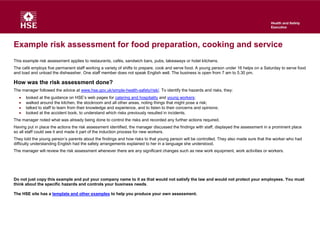
This example risk assessment applies to restaurants, cafés, sandwich bars, pubs, takeaways or hotel kitchens.
The café employs five permanent staff working a variety of shifts to prepare, cook and serve food. A young person under 16 helps on a Saturday to serve food
and load and unload the dishwasher. One staff member does not speak English well. The business is open from 7 am to 5.30 pm.
How was the risk assessment done?
The manager followed the advice at www.hse.gov.uk/simple-health-safety/risk/. To identify the hazards and risks, they:
 looked at the guidance on HSE’s web pages for catering and hospitality and young workers;
 walked around the kitchen, the stockroom and all other areas, noting things that might pose a risk;
 talked to staff to learn from their knowledge and experience, and to listen to their concerns and opinions;
 looked at the accident book, to understand which risks previously resulted in incidents.
The manager noted what was already being done to control the risks and recorded any further actions required.
Having put in place the actions the risk assessment identified, the manager discussed the findings with staff, displayed the assessment in a prominent place
so all staff could see it and made it part of the induction process for new workers.
They told the young person’s parents about the findings and how risks to that young person will be controlled. They also made sure that the worker who had
difficulty understanding English had the safety arrangements explained to her in a language she understood.
The manager will review the risk assessment whenever there are any significant changes such as new work equipment, work activities or workers.
Do not just copy this example and put your company name to it as that would not satisfy the law and would not protect your employees. You must
think about the specific hazards and controls your business needs.
The HSE site has a template and other examples to help you produce your own assessment.
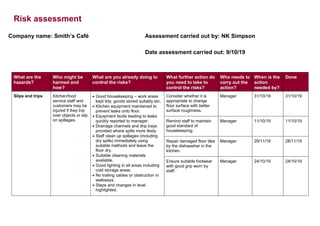
Risk assessment
Company name: Smith’s Café Assessment carried out by: NK Simpson
Date assessment carried out: 9/10/19
What are the
hazards?
Who might be
harmed and
how?
What are you already doing to
control the risks?
What further action do
you need to take to
control the risks?
Who needs to
carry out the
action?
When is the
action
needed by?
Done
Slips and trips Kitchen/food
service staff and
customers may be
injured if they trip
over objects or slip
on spillages.
 Good housekeeping – work areas
kept tidy, goods stored suitably etc.
 Kitchen equipment maintained to
prevent leaks onto floor.
 Equipment faults leading to leaks
quickly reported to manager.
 Drainage channels and drip trays
provided where spills more likely.
 Staff clean up spillages (including
dry spills) immediately using
suitable methods and leave the
floor dry.
 Suitable cleaning materials
available.
 Good lighting in all areas including
cold storage areas.
 No trailing cables or obstruction in
walkways.
 Steps and changes in level
highlighted.
Consider whether it is
appropriate to change
floor surface with better
surface roughness.
Manager 31/10/19 31/10/19
Remind staff to maintain
good standard of
housekeeping.
Manager 11/10/19 11/10/19
Repair damaged floor tiles
by the dishwasher in the
kitchen.
Manager 29/11/19 28/11/19
Ensure suitable footwear
with good grip worn by
staff.
Manager 24/10/19 24/10/19
What are the
hazards?
Who might be
harmed and
how?
What are you already doing to
control the risks?
What further action do
you need to take to
control the risks?
Who needs to
carry out the
action?
When is the
action
needed by?
Done
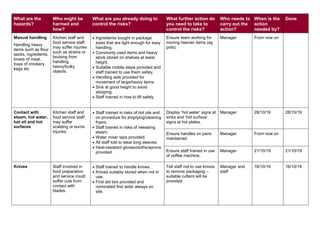
Manual handling
Handling heavy
items such as flour
sacks, ingredients,
boxes of meat,
trays of crockery,
kegs etc
Kitchen staff and
food service staff
may suffer injuries
such as strains or
bruising from
handling
heavy/bulky
objects.
 Ingredients bought in package
sizes that are light enough for easy
handling.
 Commonly used items and heavy
stock stored on shelves at waist
height.
 Suitable mobile steps provided and
staff trained to use them safely.
 Handling aids provided for
movement of large/heavy items.
 Sink at good height to avoid
stooping.
 Staff trained in how to lift safely.
Ensure team working for
moving heavier items (eg
pots).
Manager From now on
Contact with
steam, hot water,
hot oil and hot
surfaces
Kitchen staff and
food service staff
may suffer
scalding or burns
injuries.
 Staff trained in risks of hot oils and
on procedure for emptying/cleaning
fryers.
 Staff trained in risks of releasing
steam.
 Water mixer taps provided.
 All staff told to wear long sleeves.
 Heat-resistant gloves/cloths/aprons
provided.
Display ‘hot water’ signs at
sinks and ‘hot surface’
signs at hot plates.
Manager 28/10/19 28/10/19
Ensure handles on pans
maintained.
Manager From now on
Ensure staff trained in use
of coffee machine.
Manager 21/10/19 21/10/19
Knives Staff involved in
food preparation
and service could
suffer cuts from
contact with
blades.
 Staff trained to handle knives.
 Knives suitably stored when not in
use.
 First aid box provided and
nominated first aider always on
site.
Tell staff not to use knives
to remove packaging –
suitable cutters will be
provided.
Manager and
staff
16/10/19 16/10/19
What are the
hazards?
Who might be
harmed and
how?
What are you already doing to
control the risks?
What further action do
you need to take to
control the risks?
Who needs to
carry out the
action?
When is the
action
needed by?
Done
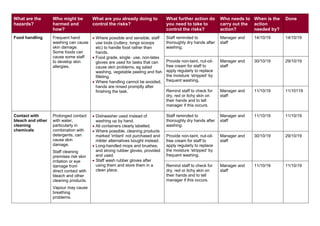
Food handling Frequent hand
washing can cause
skin damage.
Some foods can
cause some staff
to develop skin
allergies.
 Where possible and sensible, staff
use tools (cutlery, tongs scoops
etc) to handle food rather than
hands.
 Food grade, single‑ use, non-latex
gloves are used for tasks that can
cause skin problems, eg salad
washing, vegetable peeling and fish
filleting.
 Where handling cannot be avoided,
hands are rinsed promptly after
finishing the task.
Staff reminded to
thoroughly dry hands after
washing.
Manager and
staff
14/10/19 14/10/19
Provide non-taint, nut-oil-
free cream for staff to
apply regularly to replace
the moisture ‘stripped’ by
frequent washing.
Manager and
staff
30/10/19 29/10/19
Remind staff to check for
dry, red or itchy skin on
their hands and to tell
manager if this occurs.
Manager and
staff
11/10/19 11/10119
Contact with
bleach and other
cleaning
chemicals
Prolonged contact
with water,
particularly in
combination with
detergents, can
cause skin
damage.
Staff cleaning
premises risk skin
irritation or eye
damage from
direct contact with
bleach and other
cleaning products.
Vapour may cause
breathing
problems.
 Dishwasher used instead of
washing up by hand.
 All containers clearly labelled.
 Where possible, cleaning products
marked ‘irritant’ not purchased and
milder alternatives bought instead.
 Long-handled mops and brushes,
and strong rubber gloves, provided
and used.
 Staff wash rubber gloves after
using them and store them in a
clean place.
Staff reminded to
thoroughly dry hands after
washing.
Manager and
staff
11/10/19 11/10/19
Provide non-taint, nut-oil-
free cream for staff to
apply regularly to replace
the moisture ‘stripped’ by
frequent washing.
Manager and
staff
30/10/19 29/10/19
Remind staff to check for
dry, red or itchy skin on
their hands and to tell
manager if this occurs.
Manager and
staff
11/10/19 11/10/19
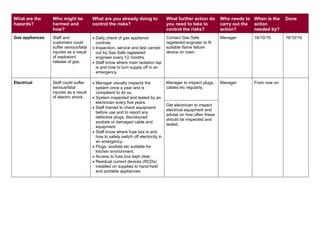
What are the
hazards?
Who might be
harmed and
how?
What are you already doing to
control the risks?
What further action do
you need to take to
control the risks?
Who needs to
carry out the
action?
When is the
action
needed by?
Done
Gas appliances Staff and
customers could
suffer serious/fatal
injuries as a result
of explosion/
release of gas.
 Daily check of gas appliance
controls.
 Inspection, service and test carried
out by Gas Safe registered
engineer every 12 months.
 Staff know where main isolation tap
is and how to turn supply off in an
emergency.
Contact Gas Safe
registered engineer to fit
suitable flame failure
device on oven.
Manager 16/10/19 16/10/19
Electrical Staff could suffer
serious/fatal
injuries as a result
of electric shock.
 Manager visually inspects the
system once a year and is
competent to do so.
 System inspected and tested by an
electrician every five years.
 Staff trained to check equipment
before use and to report any
defective plugs, discoloured
sockets or damaged cable and
equipment.
 Staff know where fuse box is and
how to safely switch off electricity in
an emergency.
 Plugs, sockets etc suitable for
kitchen environment.
 Access to fuse box kept clear.
 Residual current devices (RCDs)
installed on supplies to hand-held
and portable appliances.
Manager to inspect plugs,
cables etc regularly.
Manager From now on
Get electrician to inspect
electrical equipment and
advise on how often these
should be inspected and
tested.
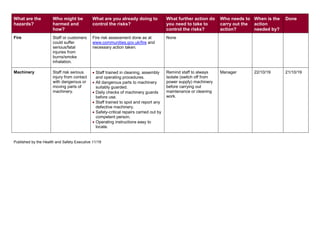
What are the
hazards?
Who might be
harmed and
how?
What are you already doing to
control the risks?
What further action do
you need to take to
control the risks?
Who needs to
carry out the
action?
When is the
action
needed by?
Done
Fire Staff or customers
could suffer
serious/fatal
injuries from
burns/smoke
inhalation.
Fire risk assessment done as at
www.communities.gov.uk/fire and
necessary action taken.
None
Machinery Staff risk serious
injury from contact
with dangerous or
moving parts of
machinery.
 Staff trained in cleaning, assembly
and operating procedures.
 All dangerous parts to machinery
suitably guarded.
 Daily checks of machinery guards
before use.
 Staff trained to spot and report any
defective machinery.
 Safety-critical repairs carried out by
competent person.
 Operating instructions easy to
locate.
Remind staff to always
isolate (switch off from
power supply) machinery
before carrying out
maintenance or cleaning
work.
Manager 22/10/19 21/10/19
Published by the Health and Safety Executive 11/19

Food Preparation Risk Assessment Examples

  • 1.
    Example risk assessmentfor food preparation, cooking and service This example risk assessment applies to restaurants, cafés, sandwich bars, pubs, takeaways or hotel kitchens. The café employs five permanent staff working a variety of shifts to prepare, cook and serve food. A young person under 16 helps on a Saturday to serve food and load and unload the dishwasher. One staff member does not speak English well. The business is open from 7 am to 5.30 pm. How was the risk assessment done? The manager followed the advice at www.hse.gov.uk/simple-health-safety/risk/. To identify the hazards and risks, they:  looked at the guidance on HSE’s web pages for catering and hospitality and young workers;  walked around the kitchen, the stockroom and all other areas, noting things that might pose a risk;  talked to staff to learn from their knowledge and experience, and to listen to their concerns and opinions;  looked at the accident book, to understand which risks previously resulted in incidents. The manager noted what was already being done to control the risks and recorded any further actions required. Having put in place the actions the risk assessment identified, the manager discussed the findings with staff, displayed the assessment in a prominent place so all staff could see it and made it part of the induction process for new workers. They told the young person’s parents about the findings and how risks to that young person will be controlled. They also made sure that the worker who had difficulty understanding English had the safety arrangements explained to her in a language she understood. The manager will review the risk assessment whenever there are any significant changes such as new work equipment, work activities or workers. Do not just copy this example and put your company name to it as that would not satisfy the law and would not protect your employees. You must think about the specific hazards and controls your business needs. The HSE site has a template and other examples to help you produce your own assessment.
  • 2.
    Risk assessment Company name:Smith’s Café Assessment carried out by: NK Simpson Date assessment carried out: 9/10/19 What are the hazards? Who might be harmed and how? What are you already doing to control the risks? What further action do you need to take to control the risks? Who needs to carry out the action? When is the action needed by? Done Slips and trips Kitchen/food service staff and customers may be injured if they trip over objects or slip on spillages.  Good housekeeping – work areas kept tidy, goods stored suitably etc.  Kitchen equipment maintained to prevent leaks onto floor.  Equipment faults leading to leaks quickly reported to manager.  Drainage channels and drip trays provided where spills more likely.  Staff clean up spillages (including dry spills) immediately using suitable methods and leave the floor dry.  Suitable cleaning materials available.  Good lighting in all areas including cold storage areas.  No trailing cables or obstruction in walkways.  Steps and changes in level highlighted. Consider whether it is appropriate to change floor surface with better surface roughness. Manager 31/10/19 31/10/19 Remind staff to maintain good standard of housekeeping. Manager 11/10/19 11/10/19 Repair damaged floor tiles by the dishwasher in the kitchen. Manager 29/11/19 28/11/19 Ensure suitable footwear with good grip worn by staff. Manager 24/10/19 24/10/19
  • 3.
    What are the hazards? Whomight be harmed and how? What are you already doing to control the risks? What further action do you need to take to control the risks? Who needs to carry out the action? When is the action needed by? Done Manual handling Handling heavy items such as flour sacks, ingredients, boxes of meat, trays of crockery, kegs etc Kitchen staff and food service staff may suffer injuries such as strains or bruising from handling heavy/bulky objects.  Ingredients bought in package sizes that are light enough for easy handling.  Commonly used items and heavy stock stored on shelves at waist height.  Suitable mobile steps provided and staff trained to use them safely.  Handling aids provided for movement of large/heavy items.  Sink at good height to avoid stooping.  Staff trained in how to lift safely. Ensure team working for moving heavier items (eg pots). Manager From now on Contact with steam, hot water, hot oil and hot surfaces Kitchen staff and food service staff may suffer scalding or burns injuries.  Staff trained in risks of hot oils and on procedure for emptying/cleaning fryers.  Staff trained in risks of releasing steam.  Water mixer taps provided.  All staff told to wear long sleeves.  Heat-resistant gloves/cloths/aprons provided. Display ‘hot water’ signs at sinks and ‘hot surface’ signs at hot plates. Manager 28/10/19 28/10/19 Ensure handles on pans maintained. Manager From now on Ensure staff trained in use of coffee machine. Manager 21/10/19 21/10/19 Knives Staff involved in food preparation and service could suffer cuts from contact with blades.  Staff trained to handle knives.  Knives suitably stored when not in use.  First aid box provided and nominated first aider always on site. Tell staff not to use knives to remove packaging – suitable cutters will be provided. Manager and staff 16/10/19 16/10/19
  • 4.
    What are the hazards? Whomight be harmed and how? What are you already doing to control the risks? What further action do you need to take to control the risks? Who needs to carry out the action? When is the action needed by? Done Food handling Frequent hand washing can cause skin damage. Some foods can cause some staff to develop skin allergies.  Where possible and sensible, staff use tools (cutlery, tongs scoops etc) to handle food rather than hands.  Food grade, single‑ use, non-latex gloves are used for tasks that can cause skin problems, eg salad washing, vegetable peeling and fish filleting.  Where handling cannot be avoided, hands are rinsed promptly after finishing the task. Staff reminded to thoroughly dry hands after washing. Manager and staff 14/10/19 14/10/19 Provide non-taint, nut-oil- free cream for staff to apply regularly to replace the moisture ‘stripped’ by frequent washing. Manager and staff 30/10/19 29/10/19 Remind staff to check for dry, red or itchy skin on their hands and to tell manager if this occurs. Manager and staff 11/10/19 11/10119 Contact with bleach and other cleaning chemicals Prolonged contact with water, particularly in combination with detergents, can cause skin damage. Staff cleaning premises risk skin irritation or eye damage from direct contact with bleach and other cleaning products. Vapour may cause breathing problems.  Dishwasher used instead of washing up by hand.  All containers clearly labelled.  Where possible, cleaning products marked ‘irritant’ not purchased and milder alternatives bought instead.  Long-handled mops and brushes, and strong rubber gloves, provided and used.  Staff wash rubber gloves after using them and store them in a clean place. Staff reminded to thoroughly dry hands after washing. Manager and staff 11/10/19 11/10/19 Provide non-taint, nut-oil- free cream for staff to apply regularly to replace the moisture ‘stripped’ by frequent washing. Manager and staff 30/10/19 29/10/19 Remind staff to check for dry, red or itchy skin on their hands and to tell manager if this occurs. Manager and staff 11/10/19 11/10/19
  • 5.
    What are the hazards? Whomight be harmed and how? What are you already doing to control the risks? What further action do you need to take to control the risks? Who needs to carry out the action? When is the action needed by? Done Gas appliances Staff and customers could suffer serious/fatal injuries as a result of explosion/ release of gas.  Daily check of gas appliance controls.  Inspection, service and test carried out by Gas Safe registered engineer every 12 months.  Staff know where main isolation tap is and how to turn supply off in an emergency. Contact Gas Safe registered engineer to fit suitable flame failure device on oven. Manager 16/10/19 16/10/19 Electrical Staff could suffer serious/fatal injuries as a result of electric shock.  Manager visually inspects the system once a year and is competent to do so.  System inspected and tested by an electrician every five years.  Staff trained to check equipment before use and to report any defective plugs, discoloured sockets or damaged cable and equipment.  Staff know where fuse box is and how to safely switch off electricity in an emergency.  Plugs, sockets etc suitable for kitchen environment.  Access to fuse box kept clear.  Residual current devices (RCDs) installed on supplies to hand-held and portable appliances. Manager to inspect plugs, cables etc regularly. Manager From now on Get electrician to inspect electrical equipment and advise on how often these should be inspected and tested.
  • 6.
    What are the hazards? Whomight be harmed and how? What are you already doing to control the risks? What further action do you need to take to control the risks? Who needs to carry out the action? When is the action needed by? Done Fire Staff or customers could suffer serious/fatal injuries from burns/smoke inhalation. Fire risk assessment done as at www.communities.gov.uk/fire and necessary action taken. None Machinery Staff risk serious injury from contact with dangerous or moving parts of machinery.  Staff trained in cleaning, assembly and operating procedures.  All dangerous parts to machinery suitably guarded.  Daily checks of machinery guards before use.  Staff trained to spot and report any defective machinery.  Safety-critical repairs carried out by competent person.  Operating instructions easy to locate. Remind staff to always isolate (switch off from power supply) machinery before carrying out maintenance or cleaning work. Manager 22/10/19 21/10/19 Published by the Health and Safety Executive 11/19