Example risk assessment for maintenance work in a factory
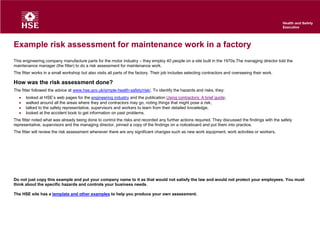
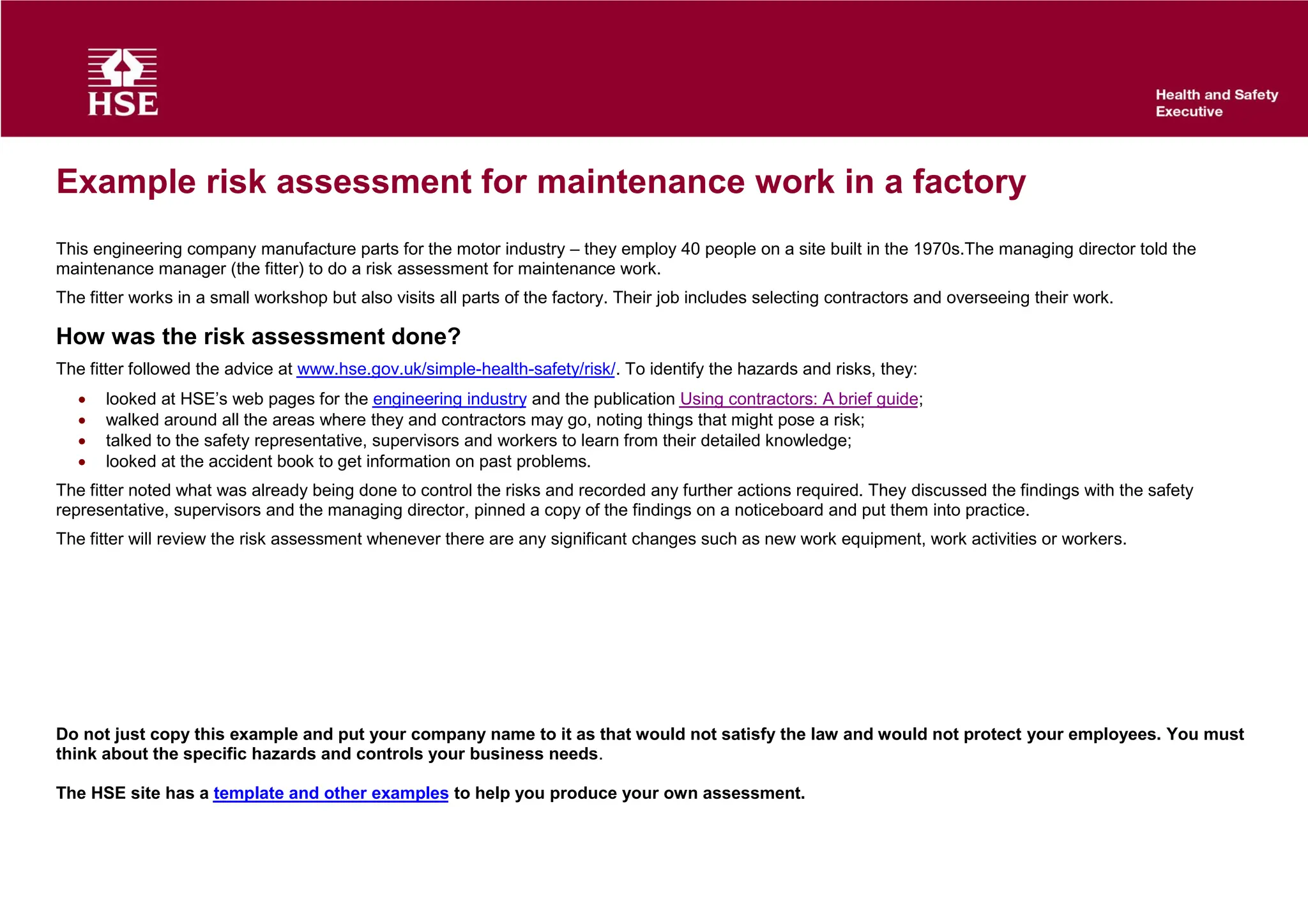
This engineering company manufacture parts for the motor industry – they employ 40 people on a site built in the 1970s.The managing director told the
maintenance manager (the fitter) to do a risk assessment for maintenance work.
The fitter works in a small workshop but also visits all parts of the factory. Their job includes selecting contractors and overseeing their work.
How was the risk assessment done?
The fitter followed the advice at www.hse.gov.uk/simple-health-safety/risk/. To identify the hazards and risks, they:
 looked at HSE’s web pages for the engineering industry and the publication Using contractors: A brief guide;
 walked around all the areas where they and contractors may go, noting things that might pose a risk;
 talked to the safety representative, supervisors and workers to learn from their detailed knowledge;
 looked at the accident book to get information on past problems.
The fitter noted what was already being done to control the risks and recorded any further actions required. They discussed the findings with the safety
representative, supervisors and the managing director, pinned a copy of the findings on a noticeboard and put them into practice.
The fitter will review the risk assessment whenever there are any significant changes such as new work equipment, work activities or workers.
Do not just copy this example and put your company name to it as that would not satisfy the law and would not protect your employees. You must
think about the specific hazards and controls your business needs.
The HSE site has a template and other examples to help you produce your own assessment.
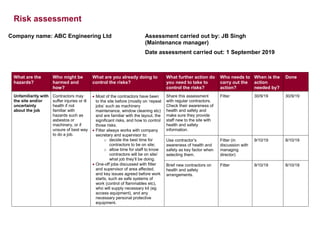
Risk assessment
Company name: ABC Engineering Ltd Assessment carried out by: JB Singh
(Maintenance manager)
Date assessment carried out: 1 September 2019
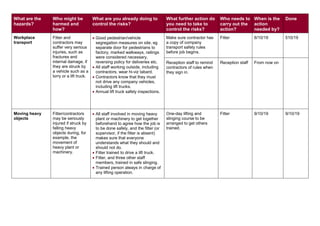
What are the
hazards?
Who might be
harmed and
how?
What are you already doing to
control the risks?
What further action do
you need to take to
control the risks?
Who needs to
carry out the
action?
When is the
action
needed by?
Done
Unfamiliarity with
the site and/or
uncertainty
about the job
Contractors may
suffer injuries or ill
health if not
familiar with
hazards such as
asbestos or
machinery, or if
unsure of best way
to do a job.
 Most of the contractors have been
to the site before (mostly on ‘repeat
jobs’ such as machinery
maintenance, window cleaning etc)
and are familiar with the layout, the
significant risks, and how to control
those risks.
 Fitter always works with company
secretary and supervisor to:
o decide the best time for
contractors to be on site;
o allow time for staff to know
contractors will be on site/
what job they’ll be doing.
 One-off jobs discussed with fitter
and supervisor of area affected,
and key issues agreed before work
starts, such as safe systems of
work (control of flammables etc),
who will supply necessary kit (eg
access equipment), and any
necessary personal protective
equipment.
Share this assessment
with regular contractors.
Check their awareness of
health and safety and
make sure they provide
staff new to the site with
health and safety
information.
Fitter 30/9/19 30/9/19
Use contractor’s
awareness of health and
safety as key factor when
selecting them.
Fitter (in
discussion with
managing
director)
9/10/19 8/10/19
Brief new contractors on
health and safety
arrangements.
Fitter 9/10/19 8/10/19
What are the
hazards?
Who might be
harmed and
how?
What are you already doing to
control the risks?
What further action do
you need to take to
control the risks?
Who needs to
carry out the
action?
When is the
action
needed by?
Done
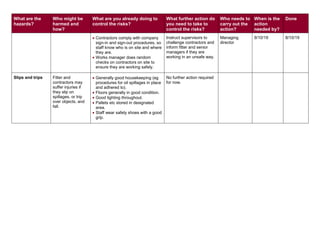
 Contractors comply with company
sign-in and sign-out procedures, so
staff know who is on site and where
they are.
 Works manager does random
checks on contractors on site to
ensure they are working safely.
Instruct supervisors to
challenge contractors and
inform fitter and senior
managers if they are
working in an unsafe way.
Managing
director
9/10/19 8/10/19
Slips and trips Fitter and
contractors may
suffer injuries if
they slip on
spillages, or trip
over objects, and
fall.
 Generally good housekeeping (eg
procedures for oil spillages in place
and adhered to).
 Floors generally in good condition.
 Good lighting throughout.
 Pallets etc stored in designated
area.
 Staff wear safety shoes with a good
grip.
No further action required
for now.
What are the
hazards?
Who might be
harmed and
how?
What are you already doing to
control the risks?
What further action do
you need to take to
control the risks?
Who needs to
carry out the
action?
When is the
action
needed by?
Done
Workplace
transport
Fitter and
contractors may
suffer very serious
injuries, such as
fractures and
internal damage, if
they are struck by
a vehicle such as a
lorry or a lift truck.
 Good pedestrian/vehicle
segregation measures on site, eg
separate door for pedestrians to
factory, marked walkways, railings
were considered necessary,
reversing policy for deliveries etc.
 All staff working outside, including
contractors, wear hi-viz tabard.
 Contractors know that they must
not drive any company vehicles,
including lift trucks.
 Annual lift truck safety inspections.
Make sure contractor has
a copy of company
transport safety rules
before job begins.
Fitter 6/10/19 510/19
Reception staff to remind
contractors of rules when
they sign in.
Reception staff From now on
Moving heavy
objects
Fitter/contractors
may be seriously
injured if struck by
falling heavy
objects during, for
example, the
movement of
heavy plant or
machinery.
 All staff involved in moving heavy
plant or machinery to get together
beforehand to agree how the job is
to be done safely, and the fitter (or
supervisor, if the fitter is absent)
makes sure that everyone
understands what they should and
should not do.
 Fitter trained to drive a lift truck.
 Fitter, and three other staff
members, trained in safe slinging.
 Trained person always in charge of
any lifting operation.
One-day lifting and
slinging course to be
arranged to get others
trained.
Fitter 9/10/19 9/10/19
What are the
hazards?
Who might be
harmed and
how?
What are you already doing to
control the risks?
What further action do
you need to take to
control the risks?
Who needs to
carry out the
action?
When is the
action
needed by?
Done
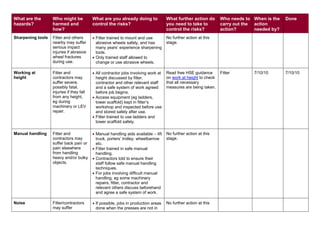
Sharpening tools Fitter and others
nearby may suffer
serious impact
injuries if abrasive
wheel fractures
during use.
 Fitter trained to mount and use
abrasive wheels safely, and has
many years’ experience sharpening
tools.
 Only trained staff allowed to
change or use abrasive wheels.
No further action at this
stage.
Working at
height
Fitter and
contractors may
suffer severe,
possibly fatal,
injuries if they fall
from any height,
eg during
machinery or LEV
repair.
 All contractor jobs involving work at
height discussed by fitter,
contractor and other relevant staff
and a safe system of work agreed
before job begins.
 Access equipment (eg ladders,
tower scaffold) kept in fitter’s
workshop and inspected before use
and stored safely after use.
 Fitter trained to use ladders and
tower scaffold safely.
Read free HSE guidance
on work at height to check
that all necessary
measures are being taken.
Fitter 7/10/10 7/10/10
Manual handling Fitter and
contractors may
suffer back pain or
pain elsewhere
from handling
heavy and/or bulky
objects.
 Manual handling aids available – lift
truck, porters’ trolley, wheelbarrow
etc.
 Fitter trained in safe manual
handling.
 Contractors told to ensure their
staff follow safe manual handling
techniques.
 For jobs involving difficult manual
handling, eg some machinery
repairs, fitter, contractor and
relevant others discuss beforehand
and agree a safe system of work.
No further action at this
stage.
Noise Fitter/contractors
may suffer
 If possible, jobs in production areas
done when the presses are not in
No further action at this
What are the
hazards?
Who might be
harmed and
how?
What are you already doing to
control the risks?
What further action do
you need to take to
control the risks?
Who needs to
carry out the
action?
When is the
action
needed by?
Done
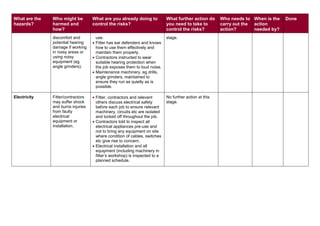
discomfort and
potential hearing
damage if working
in noisy areas or
using noisy
equipment (eg
angle grinders).
use.
 Fitter has ear defenders and knows
how to use them effectively and
maintain them properly.
 Contractors instructed to wear
suitable hearing protection when
the job exposes them to loud noise.
 Maintenance machinery, eg drills,
angle grinders, maintained to
ensure they run as quietly as is
possible.
stage.
Electricity Fitter/contractors
may suffer shock
and burns injuries
from faulty
electrical
equipment or
installation.
 Fitter, contractors and relevant
others discuss electrical safety
before each job to ensure relevant
machinery, circuits etc are isolated
and locked off throughout the job.
 Contractors told to inspect all
electrical appliances pre-use and
not to bring any equipment on site
where condition of cables, switches
etc give rise to concern.
 Electrical installation and all
equipment (including machinery in
fitter’s workshop) is inspected to a
planned schedule.
No further action at this
stage.
What are the
hazards?
Who might be
harmed and
how?
What are you already doing to
control the risks?
What further action do
you need to take to
control the risks?
Who needs to
carry out the
action?
When is the
action
needed by?
Done
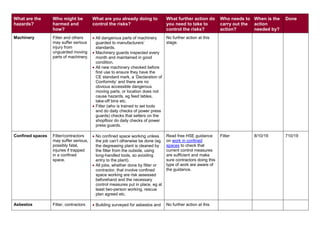
Machinery Fitter and others
may suffer serious
injury from
unguarded moving
parts of machinery.
 All dangerous parts of machinery
guarded to manufacturers’
standards.
 Machinery guards inspected every
month and maintained in good
condition.
 All new machinery checked before
first use to ensure they have the
CE standard mark, a ‘Declaration of
Conformity’ and there are no
obvious accessible dangerous
moving parts, or location does not
cause hazards, eg feed tables,
take-off bins etc.
 Fitter (who is trained to set tools
and do daily checks of power press
guards) checks that setters on the
shopfloor do daily checks of power
press guards.
No further action at this
stage.
Confined spaces Fitter/contractors
may suffer serious,
possibly fatal,
injuries if trapped
in a confined
space.
 No confined space working unless
the job can’t otherwise be done (eg
the degreasing plant is cleaned by
the fitter from the outside, using
long-handled tools, so avoiding
entry to the plant).
 All jobs, whether done by fitter or
contractor, that involve confined
space working are risk assessed
beforehand and the necessary
control measures put in place, eg at
least two-person working, rescue
plan agreed etc.
Read free HSE guidance
on work in confined
spaces to check that
current control measures
are sufficient and make
sure contractors doing this
type of work are aware of
the guidance.
Fitter 8/10/19 710/19
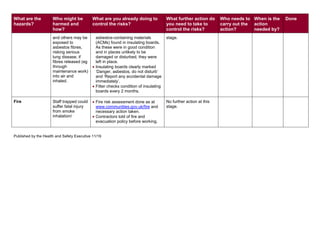
Asbestos Fitter, contractors  Building surveyed for asbestos and No further action at this
What are the
hazards?
Who might be
harmed and
how?
What are you already doing to
control the risks?
What further action do
you need to take to
control the risks?
Who needs to
carry out the
action?
When is the
action
needed by?
Done
and others may be
exposed to
asbestos fibres,
risking serious
lung disease, if
fibres released (eg
through
maintenance work)
into air and
inhaled.
asbestos-containing materials
(ACMs) found in insulating boards.
As these were in good condition
and in places unlikely to be
damaged or disturbed, they were
left in place.
 Insulating boards clearly marked
‘Danger, asbestos, do not disturb’
and ‘Report any accidental damage
immediately’.
 Fitter checks condition of insulating
boards every 2 months.
stage.
Fire Staff trapped could
suffer fatal injury
from smoke
inhalation/
 Fire risk assessment done as at
www.communities.gov.uk/fire and
necessary action taken.
 Contractors told of fire and
evacuation policy before working.
No further action at this
stage.
Published by the Health and Safety Executive 11/19

Factory Risk Assessment for maintenance work

  • 1.
    Example risk assessmentfor maintenance work in a factory This engineering company manufacture parts for the motor industry – they employ 40 people on a site built in the 1970s.The managing director told the maintenance manager (the fitter) to do a risk assessment for maintenance work. The fitter works in a small workshop but also visits all parts of the factory. Their job includes selecting contractors and overseeing their work. How was the risk assessment done? The fitter followed the advice at www.hse.gov.uk/simple-health-safety/risk/. To identify the hazards and risks, they:  looked at HSE’s web pages for the engineering industry and the publication Using contractors: A brief guide;  walked around all the areas where they and contractors may go, noting things that might pose a risk;  talked to the safety representative, supervisors and workers to learn from their detailed knowledge;  looked at the accident book to get information on past problems. The fitter noted what was already being done to control the risks and recorded any further actions required. They discussed the findings with the safety representative, supervisors and the managing director, pinned a copy of the findings on a noticeboard and put them into practice. The fitter will review the risk assessment whenever there are any significant changes such as new work equipment, work activities or workers. Do not just copy this example and put your company name to it as that would not satisfy the law and would not protect your employees. You must think about the specific hazards and controls your business needs. The HSE site has a template and other examples to help you produce your own assessment.
  • 2.
    Risk assessment Company name:ABC Engineering Ltd Assessment carried out by: JB Singh (Maintenance manager) Date assessment carried out: 1 September 2019 What are the hazards? Who might be harmed and how? What are you already doing to control the risks? What further action do you need to take to control the risks? Who needs to carry out the action? When is the action needed by? Done Unfamiliarity with the site and/or uncertainty about the job Contractors may suffer injuries or ill health if not familiar with hazards such as asbestos or machinery, or if unsure of best way to do a job.  Most of the contractors have been to the site before (mostly on ‘repeat jobs’ such as machinery maintenance, window cleaning etc) and are familiar with the layout, the significant risks, and how to control those risks.  Fitter always works with company secretary and supervisor to: o decide the best time for contractors to be on site; o allow time for staff to know contractors will be on site/ what job they’ll be doing.  One-off jobs discussed with fitter and supervisor of area affected, and key issues agreed before work starts, such as safe systems of work (control of flammables etc), who will supply necessary kit (eg access equipment), and any necessary personal protective equipment. Share this assessment with regular contractors. Check their awareness of health and safety and make sure they provide staff new to the site with health and safety information. Fitter 30/9/19 30/9/19 Use contractor’s awareness of health and safety as key factor when selecting them. Fitter (in discussion with managing director) 9/10/19 8/10/19 Brief new contractors on health and safety arrangements. Fitter 9/10/19 8/10/19
  • 3.
    What are the hazards? Whomight be harmed and how? What are you already doing to control the risks? What further action do you need to take to control the risks? Who needs to carry out the action? When is the action needed by? Done  Contractors comply with company sign-in and sign-out procedures, so staff know who is on site and where they are.  Works manager does random checks on contractors on site to ensure they are working safely. Instruct supervisors to challenge contractors and inform fitter and senior managers if they are working in an unsafe way. Managing director 9/10/19 8/10/19 Slips and trips Fitter and contractors may suffer injuries if they slip on spillages, or trip over objects, and fall.  Generally good housekeeping (eg procedures for oil spillages in place and adhered to).  Floors generally in good condition.  Good lighting throughout.  Pallets etc stored in designated area.  Staff wear safety shoes with a good grip. No further action required for now.
  • 4.
    What are the hazards? Whomight be harmed and how? What are you already doing to control the risks? What further action do you need to take to control the risks? Who needs to carry out the action? When is the action needed by? Done Workplace transport Fitter and contractors may suffer very serious injuries, such as fractures and internal damage, if they are struck by a vehicle such as a lorry or a lift truck.  Good pedestrian/vehicle segregation measures on site, eg separate door for pedestrians to factory, marked walkways, railings were considered necessary, reversing policy for deliveries etc.  All staff working outside, including contractors, wear hi-viz tabard.  Contractors know that they must not drive any company vehicles, including lift trucks.  Annual lift truck safety inspections. Make sure contractor has a copy of company transport safety rules before job begins. Fitter 6/10/19 510/19 Reception staff to remind contractors of rules when they sign in. Reception staff From now on Moving heavy objects Fitter/contractors may be seriously injured if struck by falling heavy objects during, for example, the movement of heavy plant or machinery.  All staff involved in moving heavy plant or machinery to get together beforehand to agree how the job is to be done safely, and the fitter (or supervisor, if the fitter is absent) makes sure that everyone understands what they should and should not do.  Fitter trained to drive a lift truck.  Fitter, and three other staff members, trained in safe slinging.  Trained person always in charge of any lifting operation. One-day lifting and slinging course to be arranged to get others trained. Fitter 9/10/19 9/10/19
  • 5.
    What are the hazards? Whomight be harmed and how? What are you already doing to control the risks? What further action do you need to take to control the risks? Who needs to carry out the action? When is the action needed by? Done Sharpening tools Fitter and others nearby may suffer serious impact injuries if abrasive wheel fractures during use.  Fitter trained to mount and use abrasive wheels safely, and has many years’ experience sharpening tools.  Only trained staff allowed to change or use abrasive wheels. No further action at this stage. Working at height Fitter and contractors may suffer severe, possibly fatal, injuries if they fall from any height, eg during machinery or LEV repair.  All contractor jobs involving work at height discussed by fitter, contractor and other relevant staff and a safe system of work agreed before job begins.  Access equipment (eg ladders, tower scaffold) kept in fitter’s workshop and inspected before use and stored safely after use.  Fitter trained to use ladders and tower scaffold safely. Read free HSE guidance on work at height to check that all necessary measures are being taken. Fitter 7/10/10 7/10/10 Manual handling Fitter and contractors may suffer back pain or pain elsewhere from handling heavy and/or bulky objects.  Manual handling aids available – lift truck, porters’ trolley, wheelbarrow etc.  Fitter trained in safe manual handling.  Contractors told to ensure their staff follow safe manual handling techniques.  For jobs involving difficult manual handling, eg some machinery repairs, fitter, contractor and relevant others discuss beforehand and agree a safe system of work. No further action at this stage. Noise Fitter/contractors may suffer  If possible, jobs in production areas done when the presses are not in No further action at this
  • 6.
    What are the hazards? Whomight be harmed and how? What are you already doing to control the risks? What further action do you need to take to control the risks? Who needs to carry out the action? When is the action needed by? Done discomfort and potential hearing damage if working in noisy areas or using noisy equipment (eg angle grinders). use.  Fitter has ear defenders and knows how to use them effectively and maintain them properly.  Contractors instructed to wear suitable hearing protection when the job exposes them to loud noise.  Maintenance machinery, eg drills, angle grinders, maintained to ensure they run as quietly as is possible. stage. Electricity Fitter/contractors may suffer shock and burns injuries from faulty electrical equipment or installation.  Fitter, contractors and relevant others discuss electrical safety before each job to ensure relevant machinery, circuits etc are isolated and locked off throughout the job.  Contractors told to inspect all electrical appliances pre-use and not to bring any equipment on site where condition of cables, switches etc give rise to concern.  Electrical installation and all equipment (including machinery in fitter’s workshop) is inspected to a planned schedule. No further action at this stage.
  • 7.
    What are the hazards? Whomight be harmed and how? What are you already doing to control the risks? What further action do you need to take to control the risks? Who needs to carry out the action? When is the action needed by? Done Machinery Fitter and others may suffer serious injury from unguarded moving parts of machinery.  All dangerous parts of machinery guarded to manufacturers’ standards.  Machinery guards inspected every month and maintained in good condition.  All new machinery checked before first use to ensure they have the CE standard mark, a ‘Declaration of Conformity’ and there are no obvious accessible dangerous moving parts, or location does not cause hazards, eg feed tables, take-off bins etc.  Fitter (who is trained to set tools and do daily checks of power press guards) checks that setters on the shopfloor do daily checks of power press guards. No further action at this stage. Confined spaces Fitter/contractors may suffer serious, possibly fatal, injuries if trapped in a confined space.  No confined space working unless the job can’t otherwise be done (eg the degreasing plant is cleaned by the fitter from the outside, using long-handled tools, so avoiding entry to the plant).  All jobs, whether done by fitter or contractor, that involve confined space working are risk assessed beforehand and the necessary control measures put in place, eg at least two-person working, rescue plan agreed etc. Read free HSE guidance on work in confined spaces to check that current control measures are sufficient and make sure contractors doing this type of work are aware of the guidance. Fitter 8/10/19 710/19 Asbestos Fitter, contractors  Building surveyed for asbestos and No further action at this
  • 8.
    What are the hazards? Whomight be harmed and how? What are you already doing to control the risks? What further action do you need to take to control the risks? Who needs to carry out the action? When is the action needed by? Done and others may be exposed to asbestos fibres, risking serious lung disease, if fibres released (eg through maintenance work) into air and inhaled. asbestos-containing materials (ACMs) found in insulating boards. As these were in good condition and in places unlikely to be damaged or disturbed, they were left in place.  Insulating boards clearly marked ‘Danger, asbestos, do not disturb’ and ‘Report any accidental damage immediately’.  Fitter checks condition of insulating boards every 2 months. stage. Fire Staff trapped could suffer fatal injury from smoke inhalation/  Fire risk assessment done as at www.communities.gov.uk/fire and necessary action taken.  Contractors told of fire and evacuation policy before working. No further action at this stage. Published by the Health and Safety Executive 11/19