Warehousing
Project Plan 2018
Department: HNR Logistic
Presented by: Shamroz Khan
TableofContents
Warehouse and Its Need
•Warehouse Set -Up
–Warehouse Site Selection
–Warehouse Management Processes
–Warehouse Process Flow Schematic
I. Types of Material Flow
II. Types of Inspection
III. Put –Away Process
IV. Types of Storage
V. Picking and Packing Process
–Warehousing Support Needs
•Designing Warehouse
–Warehouse Site Selection and Layout Design -Understanding
Business Needs
–Usual Challenges
–Designing Layout
–Parameters to be considered while designing
–Sample Layout
•Implementation
Warehouse and Its Need
Definition–
A designated place Where Goods are stored to balance demand & supply uncertainty, to serve customers in much better way,
to consolidate upstream flow and distribute down stream flow as per requirement, to do last mile value addition such as
packaging, kitting etc. and to reduce last mile distribution cost.
Types of Warehouses
Manufacturing Support Factory Retail Distribution Catalog Retailer
• Stock room providing raw
material and work in process
items to manufacturing
operations.
• Contains many small orders.
• Only Statistical information
available about order composition.
• Stringent time requirement for
response time.
• Primary focus on response time but
accuracy and cost also are important.
• Interface production with
wholesalers.
• A Comparatively small number
of orders are picked up on
daily basis.
• Advance information about
the order composition is
required.
• High focus on cost and order
accuracy
• Responsiveness heavily
depends on production
schedules .
• Serves a number of captive retail
units.
• Advance info about order
composition is needed.
• Carton and item picking is done from
a forward area .
• More orders per shift than
consolidation/shipping lanes.
• High focus on cost, accuracy, and fill
rate of the packages.
• Responsiveness depends heavily on
truck routing schedules.
• The only critical point is that if the
retails units are not captive then
responsiveness becomes a crucial issue
• Fills orders from catalog
sales.
• A large numbers of small,
frequently single –lines
orders are picked up.
• Item and, sometime, carton
picking .
• Daily compositions of orders
are usually unknown
• Only statistical information
available.
• High focus is on.
Warehouse Site Selection
Key Criteria (Cost vs. Service Reliability)
Cost
(Warehouse
Operations
and
Maintenance )
Serviceability
(Proximity to
Customers or
Ports )
Additional Factors
• Roads
• Power
• Water
• Other utilities
Availability of Transportation
Infrastructure
Availability of Skilled Manpower
Government Regulations
Strategic Factors –monitoring & control, pre-
determined sites, future plans
Environmental Factors
Warehouse Site Selection
Sample comparative analysis of possible Sites for a Customer needing warehouse closer to Zone.
Factors Zone 1 Zone 2 Zone 3 Zone 4 Zone 5
• Infrastructure cost
• Transportation
cost (Inbound ).
• Distance (Market to
Wh.)
• Connectivity
Availability of
Manpower (Other
facilities).
• Market Locations
• Low cost
• Lowest Close
proximity to market.
• 0 km
• Good
• Good
• Lahore
• Higher as compared to
Zone 1 but much lower
than Zone 3,4 and 5.
• Low
• 17 km Inbound
• Very good for Inbound
and Outbound
• Good –due to
warehousing hub
• Kasur
• Higher than
Zone 1 and
2
• Very High attributed
to distance
• 100+KM
• Average
• Average
• Patoki
• Very High
attributed to
high land cost
• High
• 66 km
• Good
• Good due to
warehousing hub
• Hujra Shah
Muqeem
• High cost
as compared
to zone 1 and 2
• High
• 32 km
• Average
• Good
• Chania
Here the comparison is based on few key parameters. Similar analysis can be done taking into consideration critical parameters, as mentioned in the
earlier slide. From the comparative analysis is Zone 2 is the best option and the warehouse can be set up in this Zone to cater to Customer requirement
of having the warehouse strategically closer to the market.
Warehouse Management Processes
1
2
12
1- Inbound
2- Dock/Unload
3- Receipt of goods
4- Create GRN
5- Put away
6- Picklist Creation
7- Order Picking
8- Value – added service
9- Rework
10- Packing Line
11- Dispatch
12- Tracking
13- MIS & Documentation
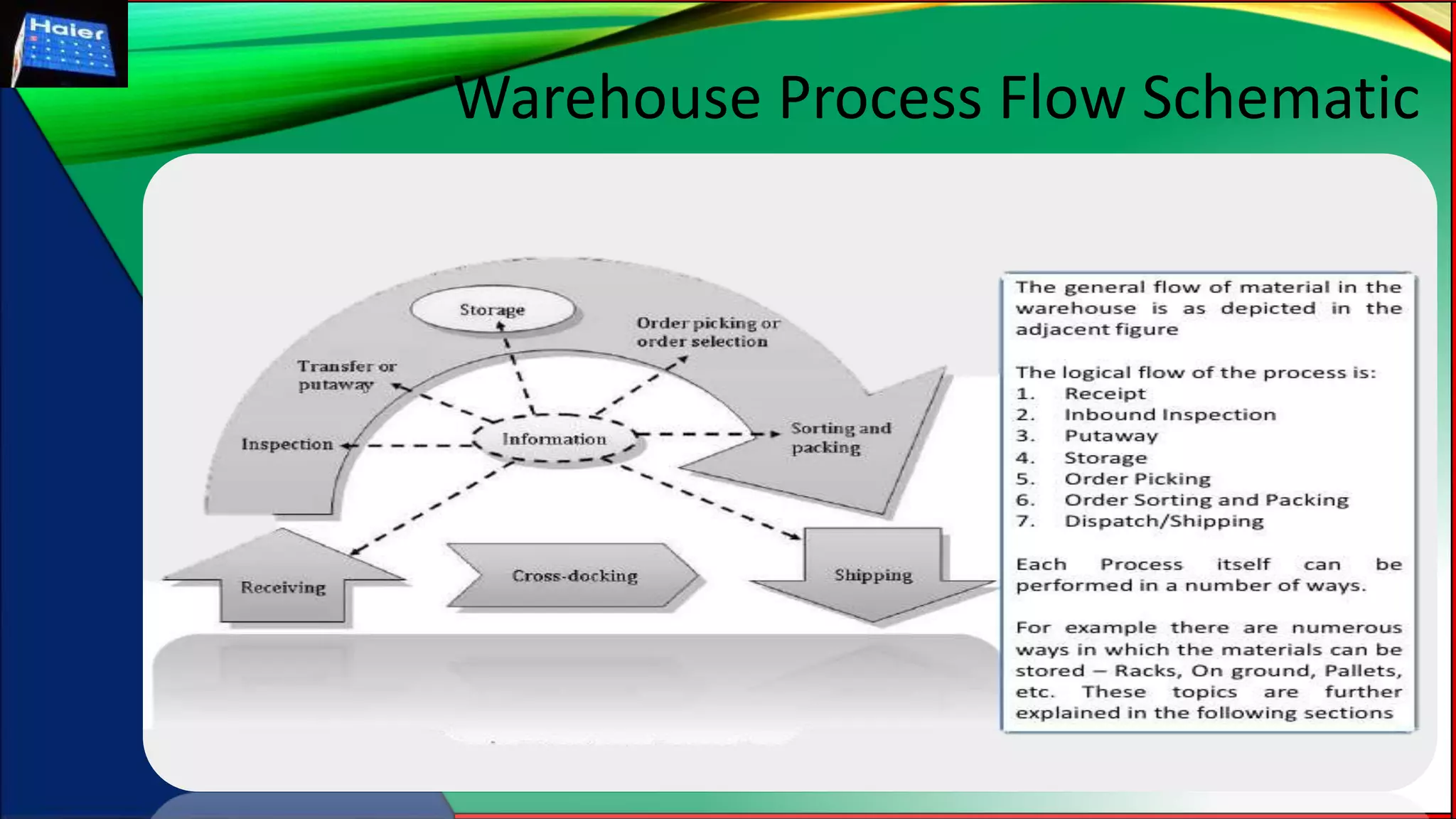
Warehouse Process Flow Schematic
Type of Material Flows: U Flow
A 'U‘ flow occurs when the goods receipt and dispatch functions are located at the same end of a warehouse
building Products flow in at receiving, move into storage at the back of the warehouse, and then to shipping, which
is located adjacent to receiving area, on the same side of the building.
Advantages of 'U‘ Flow
Excellent utilization of dock resources because the
receiving and shipping processes can share dock doors
Facilitating cross-docking because the receiving and
shipping docks are adjacent to one another and
maybe co-mingled Excellent lift truck utilization
because put away and retrieval trips are easily
combined and because the storage locations are
closest to the receiving and shipping docks, they
become natural locations to house fast moving items
Yields excellent security because there is a single side
of the building used for entry and exit.
Types of Material Flow: Straight or Through Flow
Through 'flow happens when separate loading bay facilities are available for Inbound
and shipping are provided, often at opposite ends of warehouse Products flow in at
receiving, move into storage, picking area and then the staging area and dispatch area
in a straight line Items with a higher through put level are located at the center of the
warehouse because the total distance travelled would be shorter.
The major disadvantage of a 'Through‘ flow lay
out is goods need to travel the full length of the
warehouse, even for goods that are fast moving It
is also harder to control and less flexible When is
it better to adopt a 'Through‘ flow? When
there is a risk of interference or confusion
between Goods In and Goods Out When goods
inwards vehicles and dispatch vehicles are very
different; for example differences in platform
height or nature of unit load When the warehouse
is connected to a production Plant.
Types of Storage System
Dedicated Storage:-
Product is assigned a designated slot. With multiple product storage, the space required is the
sum of the max storage requirements for each of the product.
Randomized Storage:-
Product is randomly assigned a storage location close to the input / output point. The space
requirement will be equal to the max of aggregate storage required for the products .D-is the
space location, Summation
Class - Based Storage:-
A mixed policy where products are randomly assigned with in their fixed class. The classification is
done based on the movement of the SKU.
1.The 20% items which have 80% Storage/Retrieval activity are termed as Class A.
2.The next 30% items which have 15% Storage/Retrieval activity are termed as Class B.
3.The next 50% items which have 5% Storage/ Retrieval activity are termed as Class C.
Selection of Storage System
Storage System Selection through Comparative Analysis
Storage Density
Selectivity of Inventory
Type of Goods
Offers high storage density coupled
with selectivity
Ideal for selectivity –up to 400%
improvement in selectivity
Can store a variety of inventory
Can store large amount of inventory in
a smaller area increasing Storage
Density.
Selectivity is sacrificed
Ideal for large amount of similar items
(like seasonal goods) that move
quickly -Not ideal for an inventory of
wide variety
Parameter Push Back Racks Drive Through Racks
Warehousing Operational Needs
Fire Extinguishers CCTVs
SprinklersOffice Space Space for Employee Needs
Material Handling Equipment and Parking Area
Warehouse Site Selection and
Layout Design (Understanding Business Needs)
1.What is the need for the Warehouse?
2.What business is it catering to?
3.Where should the warehouse be located?
4.Is the warehouse location well connected?
5.Is there good telecommunication connection?
6.What should be the size of the Warehouse?
7.What should be the height?
8.How many bays should the Warehouse have?
9.What are the different SKUs expected to be stocked up at the Warehouse?
10.What are the markets or locations that the Warehouse would be catering to?
11.How to segregate the SKUs?
12.What should be the stocking policies?
13.What should be the replenishment policies?
14.What should be the Health and Safety policies?
15.What should be the Security arrangements?
Usual Challenges to be Handled while designing
1.Product information in terms of through put and storage level is uncertain or not available.
2.Need to minimize the existing cost of establishing and operating the warehouse.
3.Setting the Inventory Policy to store and maintain stock of Inventory of all SKUs(Stock Keeping
Unit), ready for distribution, at all time to meet demands of all items.
4.Assemble product batches prior to delivery , to stockpile critical parts , and to facilitate
regional distribution network for quick and cost- efficient delivery.
Designing Layout
Objective:-
1.Ensuring Maximum utilization of space.
2.Maintaining a balance between Service and Operating Cost.
3.Using the most suitable unit load.
4.Minimizing movement.
5.Planning and controlling movement and location.
6.Providing Safe, Secure and Environmentally sound conditions.
Designing Basics:-
In case of existing warehouse:-
•Analyzing current and projected data on the activities in each of the areas of receiving, shipping and
inventory levels.
•The data should be supported by other considerations such as process flows, material handling
equipment, type and styles of racking equipment, special handling requirements, and personnel.
In case the New Warehouse:-
•The designing will start for the Strategy document of the Organization and then further drill down to
the Need and possible benefits of the Warehouse.
• Once this is established only then the designing of the new Warehouse begins.
Parameters to be Planned when Designing
Material Handling Equipment:-
1.Picking Equipment
•Static Shelving
•Carton Flow Rack
•Carousels
•Automatic storage and retrieval system
•Automatic picking machines
•Pick to Light
•Voice directed picking
•Automated Conveyor and Sorting systems
2.Receiving/Shipping Equipment
•Conveyors
•Industrial Vehicles
•Automated Storage and Retrieval Machines
•Automated Guided Vehicles
Number of Docks:-
•Number of Receipts and Shipments
•Type of Loading and Unloading
•Types and sizes of vehicles
•Number and timing of carriers
•Different are as in which materials
will be utilized, stored, prepared for
shipment
Type of Docks :-
•Saw Tooth Dock
•Straight dock
•Open Dock
•Interior dock
Location of Docks:-
•Traditionally at the rear end of
facility and out of sight
•Receiving/ Shipping at the same
area generally
•However Multiple docks drastically
reduce the flow of material with in
a facility
Designed Layout
THANK YOU

Haier Pakistan warehousing(Site Selection ,Process Flow)

  • 1.
    Warehousing Project Plan 2018 Department:HNR Logistic Presented by: Shamroz Khan
  • 2.
    TableofContents Warehouse and ItsNeed •Warehouse Set -Up –Warehouse Site Selection –Warehouse Management Processes –Warehouse Process Flow Schematic I. Types of Material Flow II. Types of Inspection III. Put –Away Process IV. Types of Storage V. Picking and Packing Process –Warehousing Support Needs •Designing Warehouse –Warehouse Site Selection and Layout Design -Understanding Business Needs –Usual Challenges –Designing Layout –Parameters to be considered while designing –Sample Layout •Implementation
  • 3.
    Warehouse and ItsNeed Definition– A designated place Where Goods are stored to balance demand & supply uncertainty, to serve customers in much better way, to consolidate upstream flow and distribute down stream flow as per requirement, to do last mile value addition such as packaging, kitting etc. and to reduce last mile distribution cost. Types of Warehouses Manufacturing Support Factory Retail Distribution Catalog Retailer • Stock room providing raw material and work in process items to manufacturing operations. • Contains many small orders. • Only Statistical information available about order composition. • Stringent time requirement for response time. • Primary focus on response time but accuracy and cost also are important. • Interface production with wholesalers. • A Comparatively small number of orders are picked up on daily basis. • Advance information about the order composition is required. • High focus on cost and order accuracy • Responsiveness heavily depends on production schedules . • Serves a number of captive retail units. • Advance info about order composition is needed. • Carton and item picking is done from a forward area . • More orders per shift than consolidation/shipping lanes. • High focus on cost, accuracy, and fill rate of the packages. • Responsiveness depends heavily on truck routing schedules. • The only critical point is that if the retails units are not captive then responsiveness becomes a crucial issue • Fills orders from catalog sales. • A large numbers of small, frequently single –lines orders are picked up. • Item and, sometime, carton picking . • Daily compositions of orders are usually unknown • Only statistical information available. • High focus is on.
  • 4.
    Warehouse Site Selection KeyCriteria (Cost vs. Service Reliability) Cost (Warehouse Operations and Maintenance ) Serviceability (Proximity to Customers or Ports ) Additional Factors • Roads • Power • Water • Other utilities Availability of Transportation Infrastructure Availability of Skilled Manpower Government Regulations Strategic Factors –monitoring & control, pre- determined sites, future plans Environmental Factors
  • 5.
    Warehouse Site Selection Samplecomparative analysis of possible Sites for a Customer needing warehouse closer to Zone. Factors Zone 1 Zone 2 Zone 3 Zone 4 Zone 5 • Infrastructure cost • Transportation cost (Inbound ). • Distance (Market to Wh.) • Connectivity Availability of Manpower (Other facilities). • Market Locations • Low cost • Lowest Close proximity to market. • 0 km • Good • Good • Lahore • Higher as compared to Zone 1 but much lower than Zone 3,4 and 5. • Low • 17 km Inbound • Very good for Inbound and Outbound • Good –due to warehousing hub • Kasur • Higher than Zone 1 and 2 • Very High attributed to distance • 100+KM • Average • Average • Patoki • Very High attributed to high land cost • High • 66 km • Good • Good due to warehousing hub • Hujra Shah Muqeem • High cost as compared to zone 1 and 2 • High • 32 km • Average • Good • Chania Here the comparison is based on few key parameters. Similar analysis can be done taking into consideration critical parameters, as mentioned in the earlier slide. From the comparative analysis is Zone 2 is the best option and the warehouse can be set up in this Zone to cater to Customer requirement of having the warehouse strategically closer to the market.
  • 6.
    Warehouse Management Processes 1 2 12 1-Inbound 2- Dock/Unload 3- Receipt of goods 4- Create GRN 5- Put away 6- Picklist Creation 7- Order Picking 8- Value – added service 9- Rework 10- Packing Line 11- Dispatch 12- Tracking 13- MIS & Documentation
  • 7.
  • 8.
    Type of MaterialFlows: U Flow A 'U‘ flow occurs when the goods receipt and dispatch functions are located at the same end of a warehouse building Products flow in at receiving, move into storage at the back of the warehouse, and then to shipping, which is located adjacent to receiving area, on the same side of the building. Advantages of 'U‘ Flow Excellent utilization of dock resources because the receiving and shipping processes can share dock doors Facilitating cross-docking because the receiving and shipping docks are adjacent to one another and maybe co-mingled Excellent lift truck utilization because put away and retrieval trips are easily combined and because the storage locations are closest to the receiving and shipping docks, they become natural locations to house fast moving items Yields excellent security because there is a single side of the building used for entry and exit.
  • 9.
    Types of MaterialFlow: Straight or Through Flow Through 'flow happens when separate loading bay facilities are available for Inbound and shipping are provided, often at opposite ends of warehouse Products flow in at receiving, move into storage, picking area and then the staging area and dispatch area in a straight line Items with a higher through put level are located at the center of the warehouse because the total distance travelled would be shorter. The major disadvantage of a 'Through‘ flow lay out is goods need to travel the full length of the warehouse, even for goods that are fast moving It is also harder to control and less flexible When is it better to adopt a 'Through‘ flow? When there is a risk of interference or confusion between Goods In and Goods Out When goods inwards vehicles and dispatch vehicles are very different; for example differences in platform height or nature of unit load When the warehouse is connected to a production Plant.
  • 10.
    Types of StorageSystem Dedicated Storage:- Product is assigned a designated slot. With multiple product storage, the space required is the sum of the max storage requirements for each of the product. Randomized Storage:- Product is randomly assigned a storage location close to the input / output point. The space requirement will be equal to the max of aggregate storage required for the products .D-is the space location, Summation Class - Based Storage:- A mixed policy where products are randomly assigned with in their fixed class. The classification is done based on the movement of the SKU. 1.The 20% items which have 80% Storage/Retrieval activity are termed as Class A. 2.The next 30% items which have 15% Storage/Retrieval activity are termed as Class B. 3.The next 50% items which have 5% Storage/ Retrieval activity are termed as Class C.
  • 11.
    Selection of StorageSystem Storage System Selection through Comparative Analysis Storage Density Selectivity of Inventory Type of Goods Offers high storage density coupled with selectivity Ideal for selectivity –up to 400% improvement in selectivity Can store a variety of inventory Can store large amount of inventory in a smaller area increasing Storage Density. Selectivity is sacrificed Ideal for large amount of similar items (like seasonal goods) that move quickly -Not ideal for an inventory of wide variety Parameter Push Back Racks Drive Through Racks
  • 12.
    Warehousing Operational Needs FireExtinguishers CCTVs SprinklersOffice Space Space for Employee Needs Material Handling Equipment and Parking Area
  • 13.
    Warehouse Site Selectionand Layout Design (Understanding Business Needs) 1.What is the need for the Warehouse? 2.What business is it catering to? 3.Where should the warehouse be located? 4.Is the warehouse location well connected? 5.Is there good telecommunication connection? 6.What should be the size of the Warehouse? 7.What should be the height? 8.How many bays should the Warehouse have? 9.What are the different SKUs expected to be stocked up at the Warehouse? 10.What are the markets or locations that the Warehouse would be catering to? 11.How to segregate the SKUs? 12.What should be the stocking policies? 13.What should be the replenishment policies? 14.What should be the Health and Safety policies? 15.What should be the Security arrangements?
  • 14.
    Usual Challenges tobe Handled while designing 1.Product information in terms of through put and storage level is uncertain or not available. 2.Need to minimize the existing cost of establishing and operating the warehouse. 3.Setting the Inventory Policy to store and maintain stock of Inventory of all SKUs(Stock Keeping Unit), ready for distribution, at all time to meet demands of all items. 4.Assemble product batches prior to delivery , to stockpile critical parts , and to facilitate regional distribution network for quick and cost- efficient delivery.
  • 15.
    Designing Layout Objective:- 1.Ensuring Maximumutilization of space. 2.Maintaining a balance between Service and Operating Cost. 3.Using the most suitable unit load. 4.Minimizing movement. 5.Planning and controlling movement and location. 6.Providing Safe, Secure and Environmentally sound conditions. Designing Basics:- In case of existing warehouse:- •Analyzing current and projected data on the activities in each of the areas of receiving, shipping and inventory levels. •The data should be supported by other considerations such as process flows, material handling equipment, type and styles of racking equipment, special handling requirements, and personnel. In case the New Warehouse:- •The designing will start for the Strategy document of the Organization and then further drill down to the Need and possible benefits of the Warehouse. • Once this is established only then the designing of the new Warehouse begins.
  • 16.
    Parameters to bePlanned when Designing Material Handling Equipment:- 1.Picking Equipment •Static Shelving •Carton Flow Rack •Carousels •Automatic storage and retrieval system •Automatic picking machines •Pick to Light •Voice directed picking •Automated Conveyor and Sorting systems 2.Receiving/Shipping Equipment •Conveyors •Industrial Vehicles •Automated Storage and Retrieval Machines •Automated Guided Vehicles Number of Docks:- •Number of Receipts and Shipments •Type of Loading and Unloading •Types and sizes of vehicles •Number and timing of carriers •Different are as in which materials will be utilized, stored, prepared for shipment Type of Docks :- •Saw Tooth Dock •Straight dock •Open Dock •Interior dock Location of Docks:- •Traditionally at the rear end of facility and out of sight •Receiving/ Shipping at the same area generally •However Multiple docks drastically reduce the flow of material with in a facility
  • 17.
  • 18.