Team Development Strategies:
  “Give       Them What They Need”
                             Presented to:


            Fifth Annual NASA
 Project Management Challenge Conference
                                  by:
       Walter Bowman, PMP, PMI Fellow
                       February 26-27, 2008

    634 Alpha Drive • Pittsburgh, Pennsylvania 15238 • (412) 963-1347
Team Development Strategies


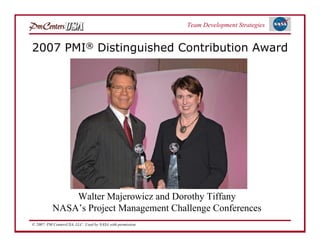
2007 PMI® Distinguished Contribution Award


               Walter Majerowicz and Dorothy Tiffany
           NASA’s Project Management Challenge Conferences
© 2007: PM CentersUSA, LLC: Used by NASA with permission.
Team Development Strategies


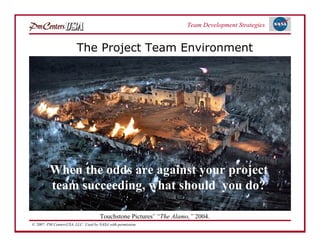
                        The Project Team Environment


         When the odds are against your project
         team succeeding, what should you do?

                                     Touchstone Pictures’ “The Alamo,” 2004.
© 2007: PM CentersUSA, LLC: Used by NASA with permission.
Team Development Strategies


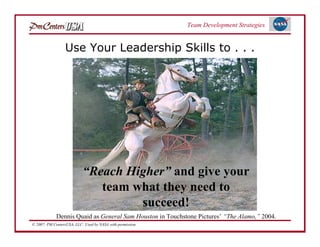
                  Use Your Leadership Skills to . . .


                           “Reach Higher” and give your
                              team what they need to
                                    succeed!
             Dennis Quaid as General Sam Houston in Touchstone Pictures’ “The Alamo,” 2004.
© 2007: PM CentersUSA, LLC: Used by NASA with permission.
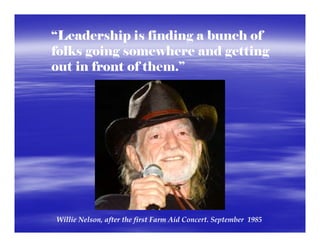
“Leadership is finding a bunch of
folks going somewhere and getting
out in front of them.”


Willie Nelson, after the first Farm Aid Concert. September  1985
Team Development Strategies


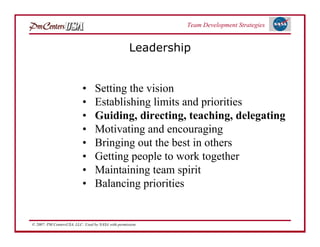
                                                    Leadership


                           •      Setting the vision
                           •      Establishing limits and priorities
                           •      Guiding, directing, teaching, delegating
                           •      Motivating and encouraging
                           •      Bringing out the best in others
                           •      Getting people to work together
                           •      Maintaining team spirit
                           •      Balancing priorities


© 2007: PM CentersUSA, LLC: Used by NASA with permission.
Team Development Strategies


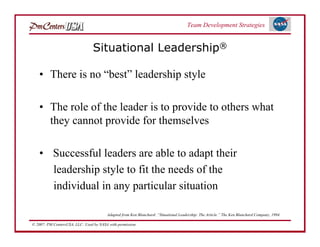
                                 Situational Leadership®

   • There is no “best” leadership style

   • The role of the leader is to provide to others what
     they cannot provide for themselves

   • Successful leaders are able to adapt their
     leadership style to fit the needs of the
     individual in any particular situation

                                         Adapted from Ken Blanchard: “Situational Leadership: The Article.” The Ken Blanchard Company, 1994.

© 2007: PM CentersUSA, LLC: Used by NASA with permission.
Team Development Strategies


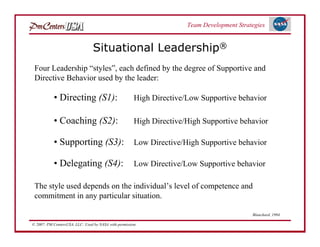
                                 Situational Leadership®
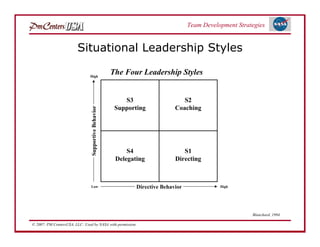
 Four Leadership “styles”, each defined by the degree of Supportive and
 Directive Behavior used by the leader:

           • Directing (S1):                           High Directive/Low Supportive behavior

           • Coaching (S2):                            High Directive/High Supportive behavior

           • Supporting (S3):                          Low Directive/High Supportive behavior

           • Delegating (S4):                          Low Directive/Low Supportive behavior

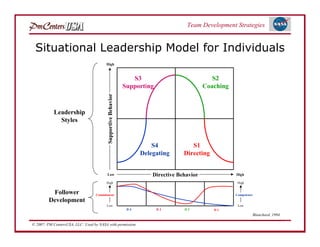
 The style used depends on the individual’s level of competence and
 commitment in any particular situation.

                                                                                            Blanchard, 1994

© 2007: PM CentersUSA, LLC: Used by NASA with permission.
Team Development Strategies


                        Situational Leadership Styles

                               High
                                                      The Four Leadership Styles


                                                          S3                    S2
                                                       Supporting            Coaching
                                Supportive Behavior


                                                           S4                   S1
                                                       Delegating            Directing


                                Low                           Directive Behavior              High


                                                                                                         Blanchard, 1994

© 2007: PM CentersUSA, LLC: Used by NASA with permission.
Team Development Strategies


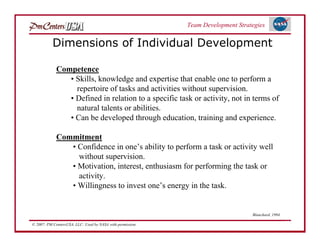
           Dimensions of Individual Development

             Competence
                • Skills, knowledge and expertise that enable one to perform a
                  repertoire of tasks and activities without supervision.
                • Defined in relation to a specific task or activity, not in terms of
                  natural talents or abilities.
                • Can be developed through education, training and experience.

             Commitment
                • Confidence in one’s ability to perform a task or activity well
                  without supervision.
                • Motivation, interest, enthusiasm for performing the task or
                  activity.
                • Willingness to invest one’s energy in the task.

                                                                               Blanchard, 1985
                                                                                    Blanchard, 1994
                                                                                                      1-23
© 2007: PM CentersUSA, LLC: Used by NASA with permission.
Team Development Strategies


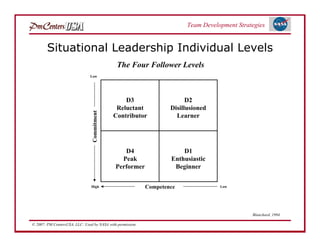
        Situational Leadership Individual Levels
                                               The Four Follower Levels
                               Low


                                                  D3                      D2
                                               Reluctant            Disillusioned
                                 Commitment


                                              Contributor             Learner


                                                 D4                     D1
                                                Peak                Enthusiastic
                                              Performer              Beginner

                                High                        Competence               Low


                                                                                                Blanchard, 1994

© 2007: PM CentersUSA, LLC: Used by NASA with permission.
Team Development Strategies


 Situational Leadership Model for Individuals
                                        High


                                                                  S3                             S2
                                                               Supporting                     Coaching


           Leadership                    Supportive Behavior
             Styles


                                                                         S4             S1
                                                                     Delegating      Directing


                                         Low                             Directive Behavior              High

                                        High                                                              High


          Follower                Commitment                                                             Competence
         Development
                                        Low                                                               Low
                                                                D4          D3       D2          D1
                                                                                                                  Blanchard, 1994
                                                                                                                                    1-28
© 2007: PM CentersUSA, LLC: Used by NASA with permission.
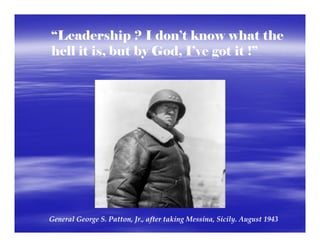
“Leadership ? I don’t know what the
hell it is, but by God, I’ve got it !”


General George S. Patton, Jr., after taking Messina, Sicily. August 1943
Team Development Strategies


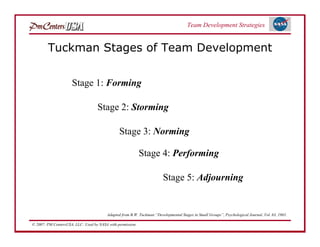
        Tuckman Stages of Team Development


                     Stage 1: Forming

                                   Stage 2: Storming

                                               Stage 3: Norming

                                                            Stage 4: Performing

                                                                        Stage 5: Adjourning


                                         Adapted from B.W. Tuckman:“Developmental Stages in Small Groups”, Psychological Journal, Vol. 63, 1965.

© 2007: PM CentersUSA, LLC: Used by NASA with permission.
Team Development Strategies


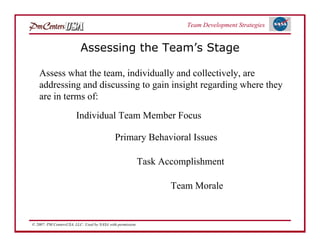
                          Assessing the Team’s Stage

   Assess what the team, individually and collectively, are
   addressing and discussing to gain insight regarding where they
   are in terms of:
                        Individual Team Member Focus

                                             Primary Behavioral Issues

                                                            Task Accomplishment

                                                                   Team Morale


© 2007: PM CentersUSA, LLC: Used by NASA with permission.
Team Development Strategies


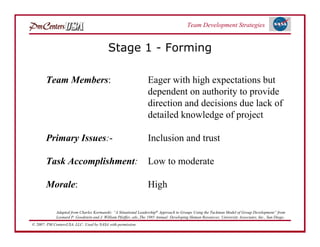
                                           Stage 1 - Forming

       Team Members:                                               Eager with high expectations but
                                                                   dependent on authority to provide
                                                                   direction and decisions due lack of
                                                                   detailed knowledge of project

       Primary Issues:-                                            Inclusion and trust

       Task Accomplishment:                                        Low to moderate

       Morale:                                                     High

             Adapted from Charles Kormanski: “A Situational Leadership® Approach to Groups Using the Tuckman Model of Group Development” from
             Leonard P. Goodstein and J. William Pfeiffer, eds.,The 1985 Annual: Developing Human Resources; University Associates, Inc., San Diego.
© 2007: PM CentersUSA, LLC: Used by NASA with permission.
Team Development Strategies


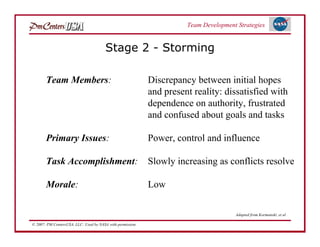
                                        Stage 2 - Storming

       Team Members:                                        Discrepancy between initial hopes
                                                            and present reality: dissatisfied with
                                                            dependence on authority, frustrated
                                                            and confused about goals and tasks

       Primary Issues:                                      Power, control and influence

       Task Accomplishment:                                 Slowly increasing as conflicts resolve

       Morale:                                              Low

                                                                                      Adapted from Kormanski, et al

© 2007: PM CentersUSA, LLC: Used by NASA with permission.
Team Development Strategies


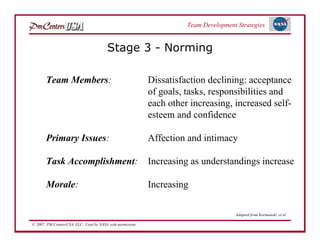
                                         Stage 3 - Norming

       Team Members:                                        Dissatisfaction declining: acceptance
                                                            of goals, tasks, responsibilities and
                                                            each other increasing, increased self-
                                                            esteem and confidence

       Primary Issues:                                      Affection and intimacy

       Task Accomplishment:                                 Increasing as understandings increase

       Morale:                                              Increasing

                                                                                      Adapted from Kormanski, et al

© 2007: PM CentersUSA, LLC: Used by NASA with permission.
Team Development Strategies


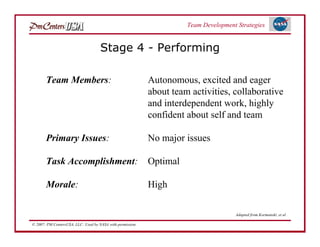
                                     Stage 4 - Performing

       Team Members:                                        Autonomous, excited and eager
                                                            about team activities, collaborative
                                                            and interdependent work, highly
                                                            confident about self and team

       Primary Issues:                                      No major issues

       Task Accomplishment:                                 Optimal

       Morale:                                              High

                                                                                      Adapted from Kormanski, et al

© 2007: PM CentersUSA, LLC: Used by NASA with permission.
Team Development Strategies


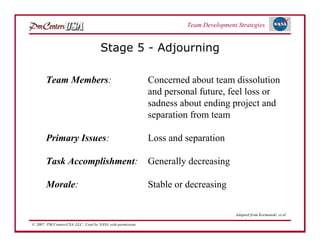
                                     Stage 5 - Adjourning

       Team Members:                                        Concerned about team dissolution
                                                            and personal future, feel loss or
                                                            sadness about ending project and
                                                            separation from team

       Primary Issues:                                      Loss and separation

       Task Accomplishment:                                 Generally decreasing

       Morale:                                              Stable or decreasing

                                                                                      Adapted from Kormanski, et al

© 2007: PM CentersUSA, LLC: Used by NASA with permission.
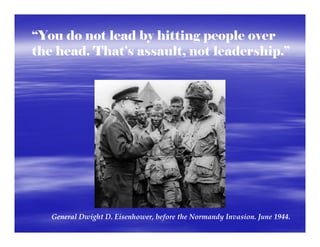
“You do not lead by hitting people over
the head. That’s assault, not leadership.”


   General Dwight D. Eisenhower, before the Normandy Invasion. June 1944.  
Team Development Strategies


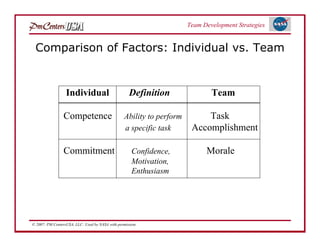
 Comparison of Factors: Individual vs. Team


                  Individual                        Definition                 Team

                 Competence                       Ability to perform        Task
                                                  a specific task       Accomplishment

                 Commitment                           Confidence,            Morale
                                                      Motivation,
                                                      Enthusiasm


© 2007: PM CentersUSA, LLC: Used by NASA with permission.
Team Development Strategies


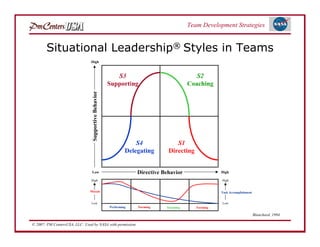
       Situational Leadership® Styles in Teams
                                High


                                                          S3                                 S2
                                                       Supporting                         Coaching
                                 Supportive Behavior


                                                                    S4             S1
                                                                Delegating      Directing


                                Low                                 Directive Behavior                 High

                                High                                                                   High


                               Morale                                                                  Task Accomplishment


                                Low                                                                    Low
                                                       Performing   Norming    Storming      Forming

                                                                                                                             Blanchard, 1994

© 2007: PM CentersUSA, LLC: Used by NASA with permission.
Team Development Strategies


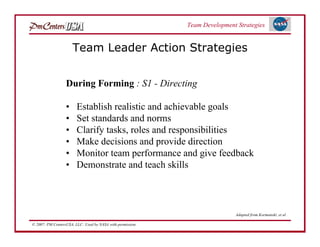
                      Team Leader Action Strategies


                  During Forming : S1 - Directing

                  •     Establish realistic and achievable goals
                  •     Set standards and norms
                  •     Clarify tasks, roles and responsibilities
                  •     Make decisions and provide direction
                  •     Monitor team performance and give feedback
                  •     Demonstrate and teach skills


                                                                            Adapted from Kormanski, et al

© 2007: PM CentersUSA, LLC: Used by NASA with permission.
Team Development Strategies


                      Team Leader Action Strategies


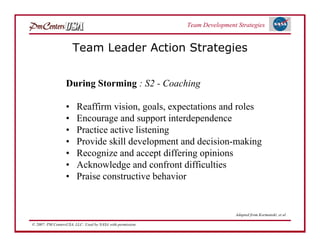
                  During Storming : S2 - Coaching

                  •     Reaffirm vision, goals, expectations and roles
                  •     Encourage and support interdependence
                  •     Practice active listening
                  •     Provide skill development and decision-making
                  •     Recognize and accept differing opinions
                  •     Acknowledge and confront difficulties
                  •     Praise constructive behavior


                                                                            Adapted from Kormanski, et al

© 2007: PM CentersUSA, LLC: Used by NASA with permission.
Team Development Strategies


                      Team Leader Action Strategies


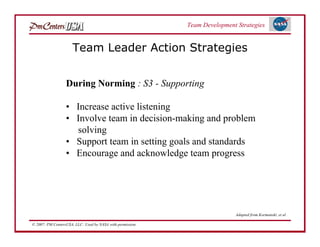
                  During Norming : S3 - Supporting

                  • Increase active listening
                  • Involve team in decision-making and problem
                    solving
                  • Support team in setting goals and standards
                  • Encourage and acknowledge team progress


                                                                            Adapted from Kormanski, et al

© 2007: PM CentersUSA, LLC: Used by NASA with permission.
Team Development Strategies


                      Team Leader Action Strategies


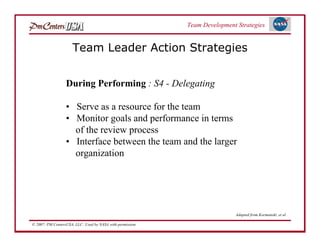
                  During Performing : S4 - Delegating

                  • Serve as a resource for the team
                  • Monitor goals and performance in terms
                    of the review process
                  • Interface between the team and the larger
                    organization


                                                                            Adapted from Kormanski, et al

© 2007: PM CentersUSA, LLC: Used by NASA with permission.
Team Development Strategies


                      Team Leader Action Strategies


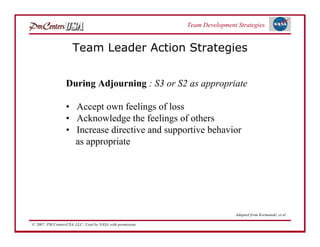
                  During Adjourning : S3 or S2 as appropriate

                  • Accept own feelings of loss
                  • Acknowledge the feelings of others
                  • Increase directive and supportive behavior
                    as appropriate


                                                                            Adapted from Kormanski, et al

© 2007: PM CentersUSA, LLC: Used by NASA with permission.
Team Development Strategies


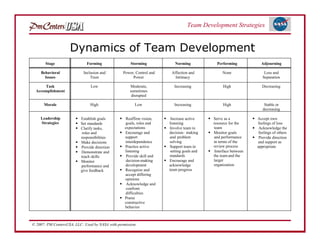
                    Dynamics of Team Development
       Stage                 Forming                 Storming               Norming              Performing             Adjourning

    Behavioral              Inclusion and        Power, Control and       Affection and             None                  Loss and
      Issues                    Trust                 Power                 Intimacy                                     Separation

      Task                      Low                  Moderate,              Increasing              High                Decreasing
  Accomplishment                                     sometimes
                                                      disrupted

      Morale                   High                     Low                 Increasing              High                  Stable or
                                                                                                                         decreasing

    Leadership         • Establish goals       • Reaffirm vision,     •  Increase active     • Serve as a          • Accept own
    Strategies         • Set standards           goals, roles and       listening              resource for the      feelings of loss
                       • Clarify tasks,          expectations         • Involve team in        team                • Acknowledge the
                          roles and            • Encourage and          decision- making     • Monitor goals          feelings of others
                         responsibilities        support                and problem            and performance     • Provide direction
                       • Make decisions          interdependence        solving                in terms of the       and support as
                       • Provide direction     • Practice active      • Support team in        review process        appropriate
                       • Demonstrate and         listening               setting goals and   • Interface between
                         teach skills          • Provide skill and      standards              the team and the
                       • Monitor                  decision-making     • Encourage and          larger
                         performance and         development            acknowledge            organization
                         give feedback         • Recognize and          team progress
                                                 accept differing
                                                 opinions
                                               • Acknowledge and
                                                  confront
                                                 difficulties
                                               • Praise
                                                 constructive
                                                 behavior


© 2007: PM CentersUSA, LLC: Used by NASA with permission.
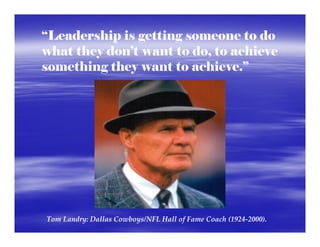
“Leadership is getting someone to do
what they don’t want to do, to achieve
something they want to achieve.”


Tom Landry: Dallas Cowboys/NFL Hall of Fame Coach (1924‐2000).  
Team Development Strategies


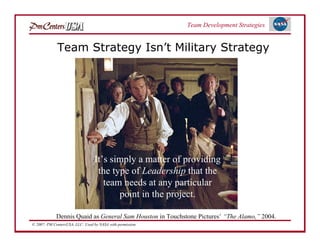
             Team Strategy Isn’t Military Strategy


                                  It’s simply a matter of providing
                                   the type of Leadership that the
                                     team needs at any particular
                                         point in the project.

             Dennis Quaid as General Sam Houston in Touchstone Pictures’ “The Alamo,” 2004.
© 2007: PM CentersUSA, LLC: Used by NASA with permission.
Questions ?


                                                     The mission of the
                                                    PM Centers USA
                         is to provide leadership and objectivity in the
                            area of project management development
                           to facilitate our customers in moving from
                                          vision to reality
                             in creating project driven organizations


    PMI’s 2006 Professional Development Provider of the Year
                         634 Alpha Drive • Pittsburgh, Pennsylvania 15238 • (412) 963-1347
© 2007: PM CentersUSA, LLC: Used by NASA with permission.

Walter.bowman

  • 1.
    Team Development Strategies: “Give Them What They Need” Presented to: Fifth Annual NASA Project Management Challenge Conference by: Walter Bowman, PMP, PMI Fellow February 26-27, 2008 634 Alpha Drive • Pittsburgh, Pennsylvania 15238 • (412) 963-1347
  • 2.
    Team Development Strategies 2007PMI® Distinguished Contribution Award Walter Majerowicz and Dorothy Tiffany NASA’s Project Management Challenge Conferences © 2007: PM CentersUSA, LLC: Used by NASA with permission.
  • 3.
    Team Development Strategies The Project Team Environment When the odds are against your project team succeeding, what should you do? Touchstone Pictures’ “The Alamo,” 2004. © 2007: PM CentersUSA, LLC: Used by NASA with permission.
  • 4.
    Team Development Strategies Use Your Leadership Skills to . . . “Reach Higher” and give your team what they need to succeed! Dennis Quaid as General Sam Houston in Touchstone Pictures’ “The Alamo,” 2004. © 2007: PM CentersUSA, LLC: Used by NASA with permission.
  • 5.
    “Leadership is findinga bunch of folks going somewhere and getting out in front of them.” Willie Nelson, after the first Farm Aid Concert. September  1985
  • 6.
    Team Development Strategies Leadership • Setting the vision • Establishing limits and priorities • Guiding, directing, teaching, delegating • Motivating and encouraging • Bringing out the best in others • Getting people to work together • Maintaining team spirit • Balancing priorities © 2007: PM CentersUSA, LLC: Used by NASA with permission.
  • 7.
    Team Development Strategies Situational Leadership® • There is no “best” leadership style • The role of the leader is to provide to others what they cannot provide for themselves • Successful leaders are able to adapt their leadership style to fit the needs of the individual in any particular situation Adapted from Ken Blanchard: “Situational Leadership: The Article.” The Ken Blanchard Company, 1994. © 2007: PM CentersUSA, LLC: Used by NASA with permission.
  • 8.
    Team Development Strategies Situational Leadership® Four Leadership “styles”, each defined by the degree of Supportive and Directive Behavior used by the leader: • Directing (S1): High Directive/Low Supportive behavior • Coaching (S2): High Directive/High Supportive behavior • Supporting (S3): Low Directive/High Supportive behavior • Delegating (S4): Low Directive/Low Supportive behavior The style used depends on the individual’s level of competence and commitment in any particular situation. Blanchard, 1994 © 2007: PM CentersUSA, LLC: Used by NASA with permission.
  • 9.
    Team Development Strategies Situational Leadership Styles High The Four Leadership Styles S3 S2 Supporting Coaching Supportive Behavior S4 S1 Delegating Directing Low Directive Behavior High Blanchard, 1994 © 2007: PM CentersUSA, LLC: Used by NASA with permission.
  • 10.
    Team Development Strategies Dimensions of Individual Development Competence • Skills, knowledge and expertise that enable one to perform a repertoire of tasks and activities without supervision. • Defined in relation to a specific task or activity, not in terms of natural talents or abilities. • Can be developed through education, training and experience. Commitment • Confidence in one’s ability to perform a task or activity well without supervision. • Motivation, interest, enthusiasm for performing the task or activity. • Willingness to invest one’s energy in the task. Blanchard, 1985 Blanchard, 1994 1-23 © 2007: PM CentersUSA, LLC: Used by NASA with permission.
  • 11.
    Team Development Strategies Situational Leadership Individual Levels The Four Follower Levels Low D3 D2 Reluctant Disillusioned Commitment Contributor Learner D4 D1 Peak Enthusiastic Performer Beginner High Competence Low Blanchard, 1994 © 2007: PM CentersUSA, LLC: Used by NASA with permission.
  • 12.
    Team Development Strategies Situational Leadership Model for Individuals High S3 S2 Supporting Coaching Leadership Supportive Behavior Styles S4 S1 Delegating Directing Low Directive Behavior High High High Follower Commitment Competence Development Low Low D4 D3 D2 D1 Blanchard, 1994 1-28 © 2007: PM CentersUSA, LLC: Used by NASA with permission.
  • 13.
    “Leadership ? Idon’t know what the hell it is, but by God, I’ve got it !” General George S. Patton, Jr., after taking Messina, Sicily. August 1943
  • 14.
    Team Development Strategies Tuckman Stages of Team Development Stage 1: Forming Stage 2: Storming Stage 3: Norming Stage 4: Performing Stage 5: Adjourning Adapted from B.W. Tuckman:“Developmental Stages in Small Groups”, Psychological Journal, Vol. 63, 1965. © 2007: PM CentersUSA, LLC: Used by NASA with permission.
  • 15.
    Team Development Strategies Assessing the Team’s Stage Assess what the team, individually and collectively, are addressing and discussing to gain insight regarding where they are in terms of: Individual Team Member Focus Primary Behavioral Issues Task Accomplishment Team Morale © 2007: PM CentersUSA, LLC: Used by NASA with permission.
  • 16.
    Team Development Strategies Stage 1 - Forming Team Members: Eager with high expectations but dependent on authority to provide direction and decisions due lack of detailed knowledge of project Primary Issues:- Inclusion and trust Task Accomplishment: Low to moderate Morale: High Adapted from Charles Kormanski: “A Situational Leadership® Approach to Groups Using the Tuckman Model of Group Development” from Leonard P. Goodstein and J. William Pfeiffer, eds.,The 1985 Annual: Developing Human Resources; University Associates, Inc., San Diego. © 2007: PM CentersUSA, LLC: Used by NASA with permission.
  • 17.
    Team Development Strategies Stage 2 - Storming Team Members: Discrepancy between initial hopes and present reality: dissatisfied with dependence on authority, frustrated and confused about goals and tasks Primary Issues: Power, control and influence Task Accomplishment: Slowly increasing as conflicts resolve Morale: Low Adapted from Kormanski, et al © 2007: PM CentersUSA, LLC: Used by NASA with permission.
  • 18.
    Team Development Strategies Stage 3 - Norming Team Members: Dissatisfaction declining: acceptance of goals, tasks, responsibilities and each other increasing, increased self- esteem and confidence Primary Issues: Affection and intimacy Task Accomplishment: Increasing as understandings increase Morale: Increasing Adapted from Kormanski, et al © 2007: PM CentersUSA, LLC: Used by NASA with permission.
  • 19.
    Team Development Strategies Stage 4 - Performing Team Members: Autonomous, excited and eager about team activities, collaborative and interdependent work, highly confident about self and team Primary Issues: No major issues Task Accomplishment: Optimal Morale: High Adapted from Kormanski, et al © 2007: PM CentersUSA, LLC: Used by NASA with permission.
  • 20.
    Team Development Strategies Stage 5 - Adjourning Team Members: Concerned about team dissolution and personal future, feel loss or sadness about ending project and separation from team Primary Issues: Loss and separation Task Accomplishment: Generally decreasing Morale: Stable or decreasing Adapted from Kormanski, et al © 2007: PM CentersUSA, LLC: Used by NASA with permission.
  • 21.
    “You do notlead by hitting people over the head. That’s assault, not leadership.” General Dwight D. Eisenhower, before the Normandy Invasion. June 1944.  
  • 22.
    Team Development Strategies Comparison of Factors: Individual vs. Team Individual Definition Team Competence Ability to perform Task a specific task Accomplishment Commitment Confidence, Morale Motivation, Enthusiasm © 2007: PM CentersUSA, LLC: Used by NASA with permission.
  • 23.
    Team Development Strategies Situational Leadership® Styles in Teams High S3 S2 Supporting Coaching Supportive Behavior S4 S1 Delegating Directing Low Directive Behavior High High High Morale Task Accomplishment Low Low Performing Norming Storming Forming Blanchard, 1994 © 2007: PM CentersUSA, LLC: Used by NASA with permission.
  • 24.
    Team Development Strategies Team Leader Action Strategies During Forming : S1 - Directing • Establish realistic and achievable goals • Set standards and norms • Clarify tasks, roles and responsibilities • Make decisions and provide direction • Monitor team performance and give feedback • Demonstrate and teach skills Adapted from Kormanski, et al © 2007: PM CentersUSA, LLC: Used by NASA with permission.
  • 25.
    Team Development Strategies Team Leader Action Strategies During Storming : S2 - Coaching • Reaffirm vision, goals, expectations and roles • Encourage and support interdependence • Practice active listening • Provide skill development and decision-making • Recognize and accept differing opinions • Acknowledge and confront difficulties • Praise constructive behavior Adapted from Kormanski, et al © 2007: PM CentersUSA, LLC: Used by NASA with permission.
  • 26.
    Team Development Strategies Team Leader Action Strategies During Norming : S3 - Supporting • Increase active listening • Involve team in decision-making and problem solving • Support team in setting goals and standards • Encourage and acknowledge team progress Adapted from Kormanski, et al © 2007: PM CentersUSA, LLC: Used by NASA with permission.
  • 27.
    Team Development Strategies Team Leader Action Strategies During Performing : S4 - Delegating • Serve as a resource for the team • Monitor goals and performance in terms of the review process • Interface between the team and the larger organization Adapted from Kormanski, et al © 2007: PM CentersUSA, LLC: Used by NASA with permission.
  • 28.
    Team Development Strategies Team Leader Action Strategies During Adjourning : S3 or S2 as appropriate • Accept own feelings of loss • Acknowledge the feelings of others • Increase directive and supportive behavior as appropriate Adapted from Kormanski, et al © 2007: PM CentersUSA, LLC: Used by NASA with permission.
  • 29.
    Team Development Strategies Dynamics of Team Development Stage Forming Storming Norming Performing Adjourning Behavioral Inclusion and Power, Control and Affection and None Loss and Issues Trust Power Intimacy Separation Task Low Moderate, Increasing High Decreasing Accomplishment sometimes disrupted Morale High Low Increasing High Stable or decreasing Leadership • Establish goals • Reaffirm vision, • Increase active • Serve as a • Accept own Strategies • Set standards goals, roles and listening resource for the feelings of loss • Clarify tasks, expectations • Involve team in team • Acknowledge the roles and • Encourage and decision- making • Monitor goals feelings of others responsibilities support and problem and performance • Provide direction • Make decisions interdependence solving in terms of the and support as • Provide direction • Practice active • Support team in review process appropriate • Demonstrate and listening setting goals and • Interface between teach skills • Provide skill and standards the team and the • Monitor decision-making • Encourage and larger performance and development acknowledge organization give feedback • Recognize and team progress accept differing opinions • Acknowledge and confront difficulties • Praise constructive behavior © 2007: PM CentersUSA, LLC: Used by NASA with permission.
  • 30.
    “Leadership is gettingsomeone to do what they don’t want to do, to achieve something they want to achieve.” Tom Landry: Dallas Cowboys/NFL Hall of Fame Coach (1924‐2000).  
  • 31.
    Team Development Strategies Team Strategy Isn’t Military Strategy It’s simply a matter of providing the type of Leadership that the team needs at any particular point in the project. Dennis Quaid as General Sam Houston in Touchstone Pictures’ “The Alamo,” 2004. © 2007: PM CentersUSA, LLC: Used by NASA with permission.
  • 32.
    Questions ? The mission of the PM Centers USA is to provide leadership and objectivity in the area of project management development to facilitate our customers in moving from vision to reality in creating project driven organizations PMI’s 2006 Professional Development Provider of the Year 634 Alpha Drive • Pittsburgh, Pennsylvania 15238 • (412) 963-1347 © 2007: PM CentersUSA, LLC: Used by NASA with permission.