WHAT IS METAMORPHISM?
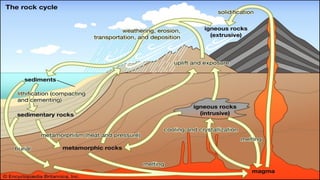
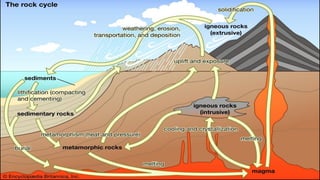
Metamorphism is the transformation of existing rock (the protolith)
to rock with a different mineral composition or texture
( mineralogical and structural adjustments of solid rocks to
physical and chemical conditions differing from those under which
the rocks originally formed. ).
Metamorphism takes place at temperatures in excess of 150 °C
(300 °F), and often also at elevated pressure, or in the presence of
chemically active fluids, but the rock remains mostly solid during
the transformation. Changes produced by surface conditions such
as compaction are usually excluded.
3.
WHAT IS METAMORPHISM?
*(The metamorphic process can occur at almost
any pressure, from near surface pressure (for
contact metamorphism) to pressures in excess of
16 kbar (1600 Mpa).
6.
WHAT ARE ITSMOST IMPORTANT AGENTS?
The most important agents of metamorphism include temperature,
pressure, and fluids.
Equally as significant are changes caused by these that affect the
inner layers that result in three categories of metamorphic
processes:
8.
THE 3 PROCESSESOF METAMORPHISM
1.)Neo Metamorphism, or neocrystallization
2.) Recrystallization
3.) Metasomatism
9.
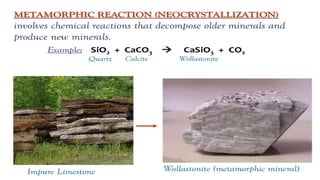
NEO METAMORPHISM, ORNEOCRYSTALLIZATION
Neo Metamorphism, or neocrystallization, is a
metamorphic process that results in the
formation of new minerals. This is seen when
shale that contains clay minerals change to
produce the new mineral garnet
11.
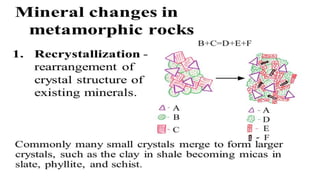
RECRYSTALLIZATION
Recrystallization is themetamorphic process
by which crystals are packed together creating
a new crystal structure. With recrystallization
the mineral's size and shape may change, but
the basic composition remains unchanged.
This is seen when limestone recrystallizes into
marble.
13.
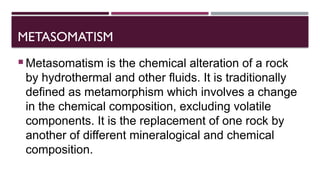
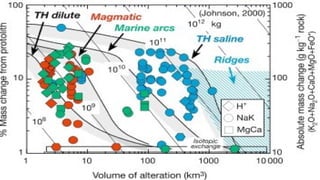
METASOMATISM
Metasomatism isthe chemical alteration of a rock
by hydrothermal and other fluids. It is traditionally
defined as metamorphism which involves a change
in the chemical composition, excluding volatile
components. It is the replacement of one rock by
another of different mineralogical and chemical
composition.
15.
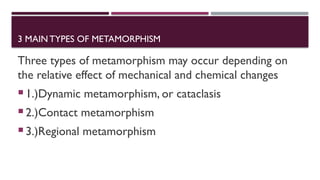
3 MAIN TYPESOF METAMORPHISM
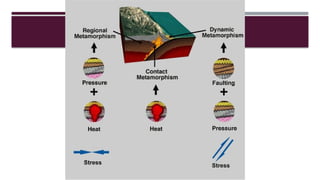
Three types of metamorphism may occur depending on
the relative effect of mechanical and chemical changes
1.)Dynamic metamorphism, or cataclasis
2.)Contact metamorphism
3.)Regional metamorphism
16.
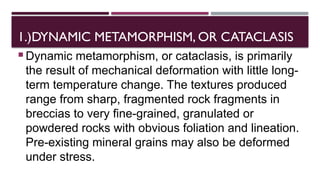
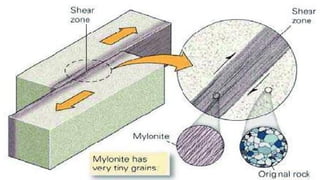
1.)DYNAMIC METAMORPHISM, ORCATACLASIS
Dynamic metamorphism, or cataclasis, is primarily
the result of mechanical deformation with little long-
term temperature change. The textures produced
range from sharp, fragmented rock fragments in
breccias to very fine-grained, granulated or
powdered rocks with obvious foliation and lineation.
Pre-existing mineral grains may also be deformed
under stress.
18.
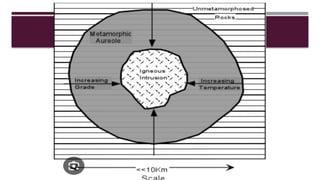
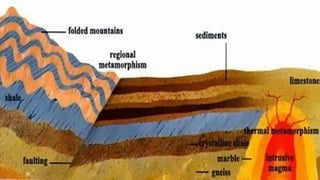
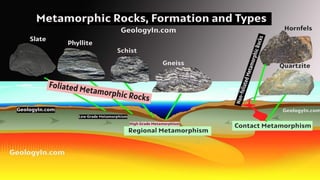
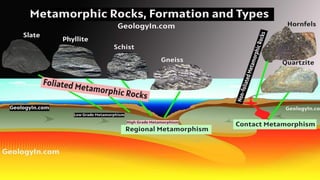
2.)CONTACT METAMORPHISM
Contact metamorphismoccurs due to an increase
in temperature, typically produced adjacent to
igneous intrusions, causing the formation of
concentric zones of different mineral assemblages.
20.
3.)REGIONAL METAMORPHISM
Regional metamorphismis caused by a general increase in
temperature and pressure over a wide area resulting in different
mineral.
Typically caused by large-scale geologic processes, such as the
compressive forces of continental collisions, the thrusting and
folding of the Earth’s crust, and the heating and burial of
sedimentary rocks. .The result of regional metamorphism is the
formation of characteristic mineral assemblages that reflect
both the pressure and temperature conditions.
22.
MINOR TYPES OFMETAMORPHISM
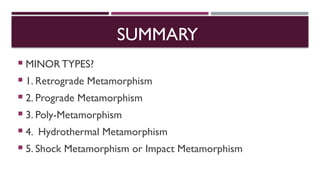
1.)retrograde metamorphism, the response of mineral
assemblages to decreasing temperature and pressure;
2.)prograde metamorphism;the response of mineral
assemblages to increasing temperature and pressure;
3.)poly-metamorphism, the effect of more than one
metamorphic event;
23.
MINOR TYPES OFMETAMORPHISM
4.) hydrothermal metamorphism, the changes that occur in the presence
of water at high temperature and pressure which affect the resulting
mineralogy and rate of reaction.
5.) shock metamorphism’ or ‘impact metamorphism’, refers to the range
of effects produced by the collision of two bodies, e.g., by the collision of
an asteroid with the Earth.
TAKE NOTE:
Various forms of metamorphism exist, including regional, contact, hydrothermal,
shock, and dynamic metamorphism.These differ in the characteristic temperatures,
pressures, and rate at which they take place and in the extent to which reactive fluids
are involved.
24.
WHAT DOES METAMORPHISMFORM?
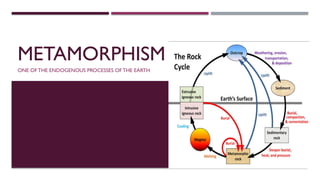
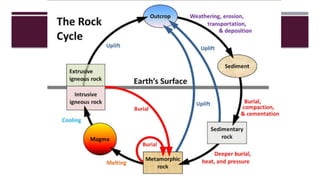
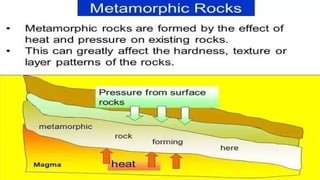
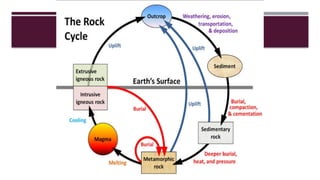
Metamorphic rocks are rocks that had been substantially
changed from their original igneous, sedimentary, or
earlier metamorphic form.
Metamorphic rocks form when rocks are subjected to high
heat, high pressure, hot mineral-rich fluids or, more
commonly, some combination of these factors.
Ex. the Himalayas, Alps, and the Rocky Mountains.
Metamorphic rocks are forming deep in the core of these
mountain ranges.
26.
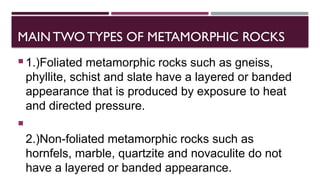
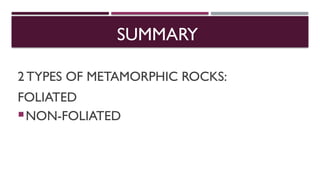
MAIN TWO TYPESOF METAMORPHIC ROCKS
1.)Foliated metamorphic rocks such as gneiss,
phyllite, schist and slate have a layered or banded
appearance that is produced by exposure to heat
and directed pressure.
2.)Non-foliated metamorphic rocks such as
hornfels, marble, quartzite and novaculite do not
have a layered or banded appearance.
HOW IS ITSTUDIED?
Metamorphic petrology is the study of metamorphism.
Metamorphic petrologists rely heavily on statistical mechanics
and experimental petrology to understand metamorphic
processes.
Metamorphic petrology is important for understanding the
processes that take place within the Earth’s interior and the
history of the Earth’s crust. It is also useful for identifying the
sources of minerals and other resources that are found in
metamorphic rocks.
29.
WHY IS METAMORPHISMIMPORTANT?
Geological History: Metamorphic rocks provide valuable insights
into the geological history of a region. They record the conditions
and events that shaped the Earth's crust over millions of years,
helping geologists unravel the complex history of a specific area.
Geological formations and minerals; Metamorphism is a very
important benefactor to the formation of geological formations and
minerals.
Common metamorphic rocks include phyllite, schist, gneiss,
quartzite and marble.
30.
SUMMARY
WHAT?
Metamorphism is thetransformation of existing
rock (the protolith) to rock with a different
mineral composition or texture
31.
SUMMARY
WHERE?
Metamorphism takes placein temperatures excess
of 150 °C (300 °F), often at elevated pressure, or
in the presence of chemically active fluids, but the
rock remains mostly solid during the
transformation.