Title : Transfer of energy through Waves
Lesson objectives
Must be able to understand how the wave transfer
energy and how the waves are classified in terms of
medium.
Lesson goals
I can define and differentiate between transverse and
longitudinal waves ?
I can name those waves which is required/not required
medium to travel ?
I can demonstrate transverse and longitudinal waves
and compare compression and rarefaction.
Starter : Watch a short video then answers the
questions given at the end . Read a short paragraph
then answers the questions given.
Scaffolder practice ( You do)
Students will demonstrate waves using slinky spring then they
will write the answers of the questions as a group task.
I will move around and will be monitoring the task, helping them
and correcting their answers.
Instruction and Modelling (I do/We do)
Short review about transverse , longitudinal , Mechanical
and electromagnetic waves. Demonstrate these waves
using slinky spring and deliver some knowledge about
compression and rarefaction.
Lesson Plan
Vocabulary ;
Transverse/longitudinal Waves , Mechanical and
electromagnetic waves , compression and rarefaction
Checking for understanding
Assessment Worksheet will be given to check the understanding
of the students group wise.
Students will move around at the end to discuss their answers
with peers
Plenary
Exit Ticket ..Students will answer the questions and must have to
write summary at the end..Self mark
Extension Task
Short quiz will be taken individually while making students to sit
in rows and will be marked next day to save the result as a
record.
Title : Transfer of energy in waves
What are we learning today…
Zeeshan Abid
Lesson objectives:
1. Understand how Transverse and longitudinal waves transfer energy in
terms of compression and rarefaction.
2. Identify and differentiate between Transverse and Longitudinal waves.
3. Conduct simple experiments to observe and understand the
difference between these two waves.
4. Discussion about mechanical and electromagnetic waves.
Transfer of energy in Waves
Learning Goals Scientific vocabulary
I can define transverse and longitudinal
waves.
I can define mechanical and electromagnetic waves Transverse and
Longitudinal Waves,
Mechanical and
Electromagnetic
waves, Compression
and Rarefaction
I can differentiate between transverse and
longitudinal waves
I can differentiate between mechanical and
electromagnetic waves.
I can explain by using a slinky spring to
describe the motion of particles and direction
of wave
Transverse and Longitudinal waves:
• Watch the video then answer the questions
given in the next slide.
Starter
Transverse and Longitudinal waves
1.How the waves are produced ?
2.How will you define longitudinal
and transverse waves
while including
at least one example ?
3.Can you please mention the
direction of wave energy
and particles in both cases ?
Starter
Questions
5 Minutes
1.How the waves are produced ?
Ans.1. Due to the vibrations in a medium.
2.How will you define longitudinal
and transverse waves
while including
at least one example ?
Ans.2. The waves where particles vibrate
Parallel to the direction of waves are
called longitudinal waves.e.g
(Sound waves)
The waves where particles vibrate
Perpendicular to the direction of waves are
called Transverse waves.e.g
(Water)
3.Can you please mention the
direction of wave energy
and particles in both cases ?
Ans.3. In longitudinal waves,Direction of wave
is parallel to the particles.
In transverse waves,Direction of wave
is perpendicular to the particles
Starter
Questions
Correct
Your
Mistakes.
Transverse and Longitudinal waves
Read a short paragraph and answer the questions given at the end:
Introduce
(I
Do)
Transverse and Longitudinal waves
Read a short paragraph and answer the questions given at the end:
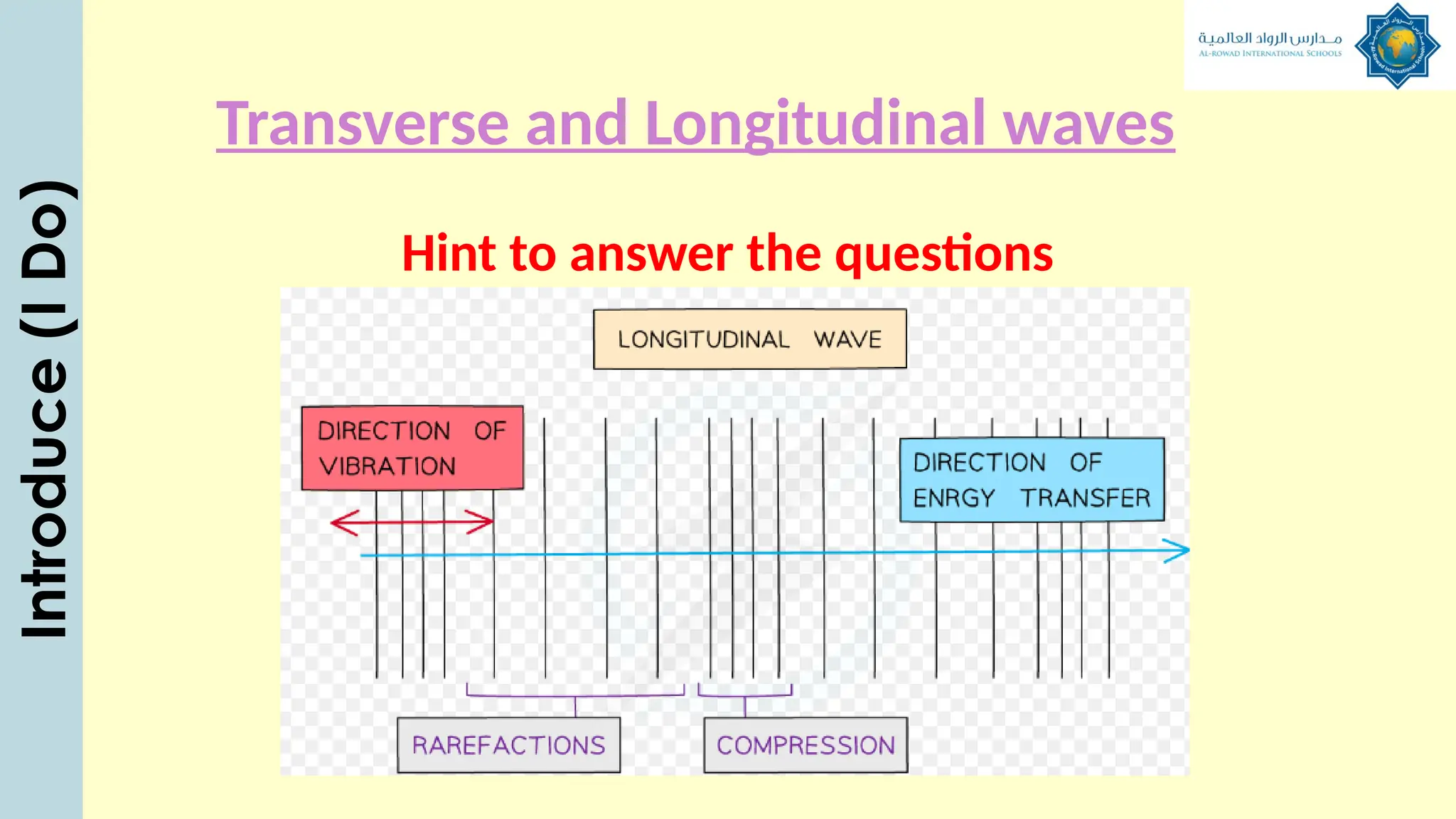
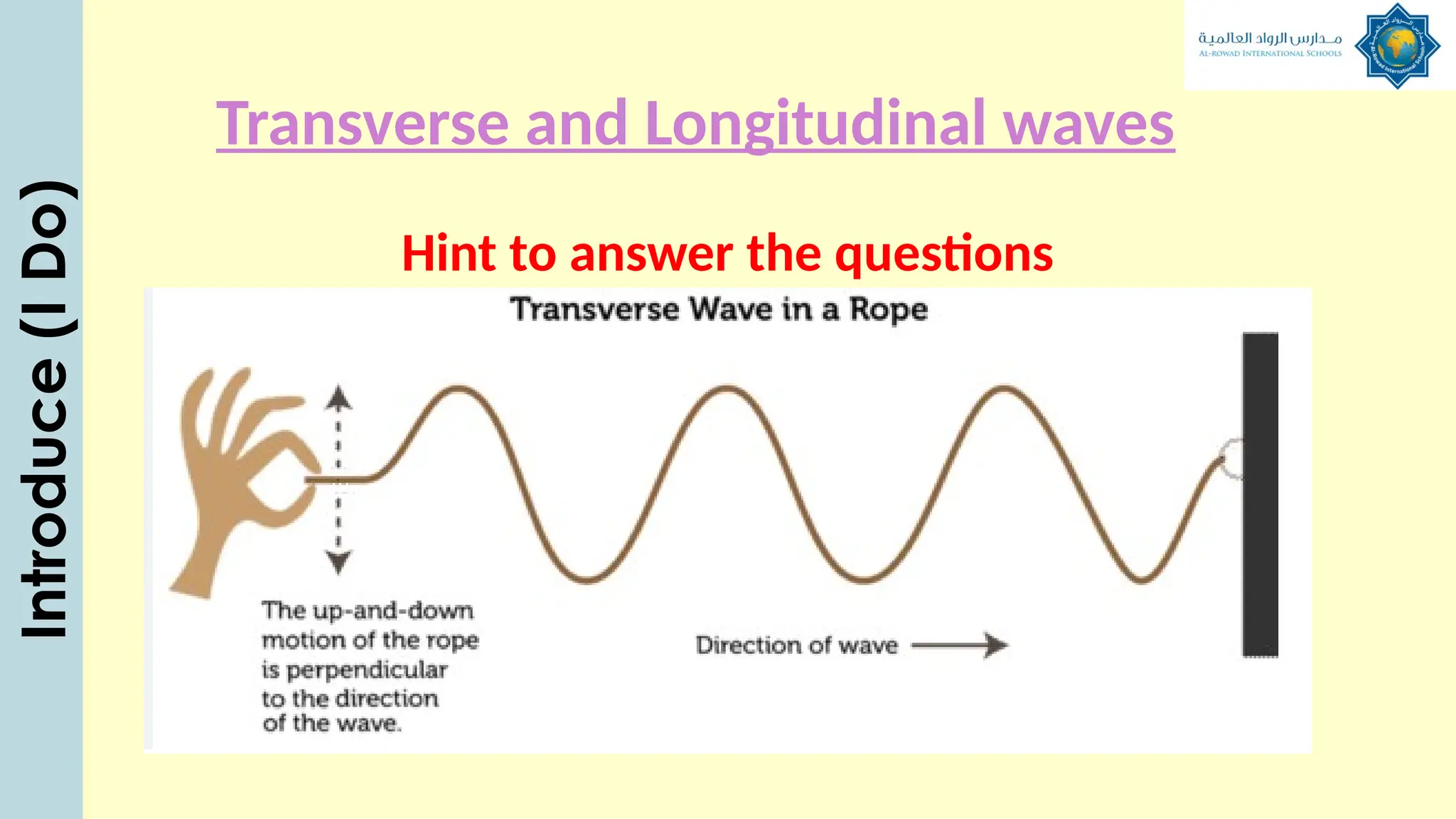
Longitudinal wave is a type of wave where particles vibrate parallel
to the direction of waves but in Transverse waves particles vibrates
at 90 degrees/perpendicular to the direction of waves.
Compression is a part of longitudinal waves where particles are
closed together and in Rarefaction particles stay far apart. The wave
speed always depends on the medium through which the wave is
passing. A Longitudinal and a transverse wave can combine to form
a Surface wave.
Ripples on a pond is an example of surface wave.
Introduce
(I
Do) 3 Minutes
Transverse and Longitudinal waves
Hint to answer the questions
Introduce
(I
Do)
Transverse and Longitudinal waves
Hint to answer the questions
Introduce
(I
Do)
Transverse and Longitudinal waves
Read a short paragraph and answer the questions given at the end:
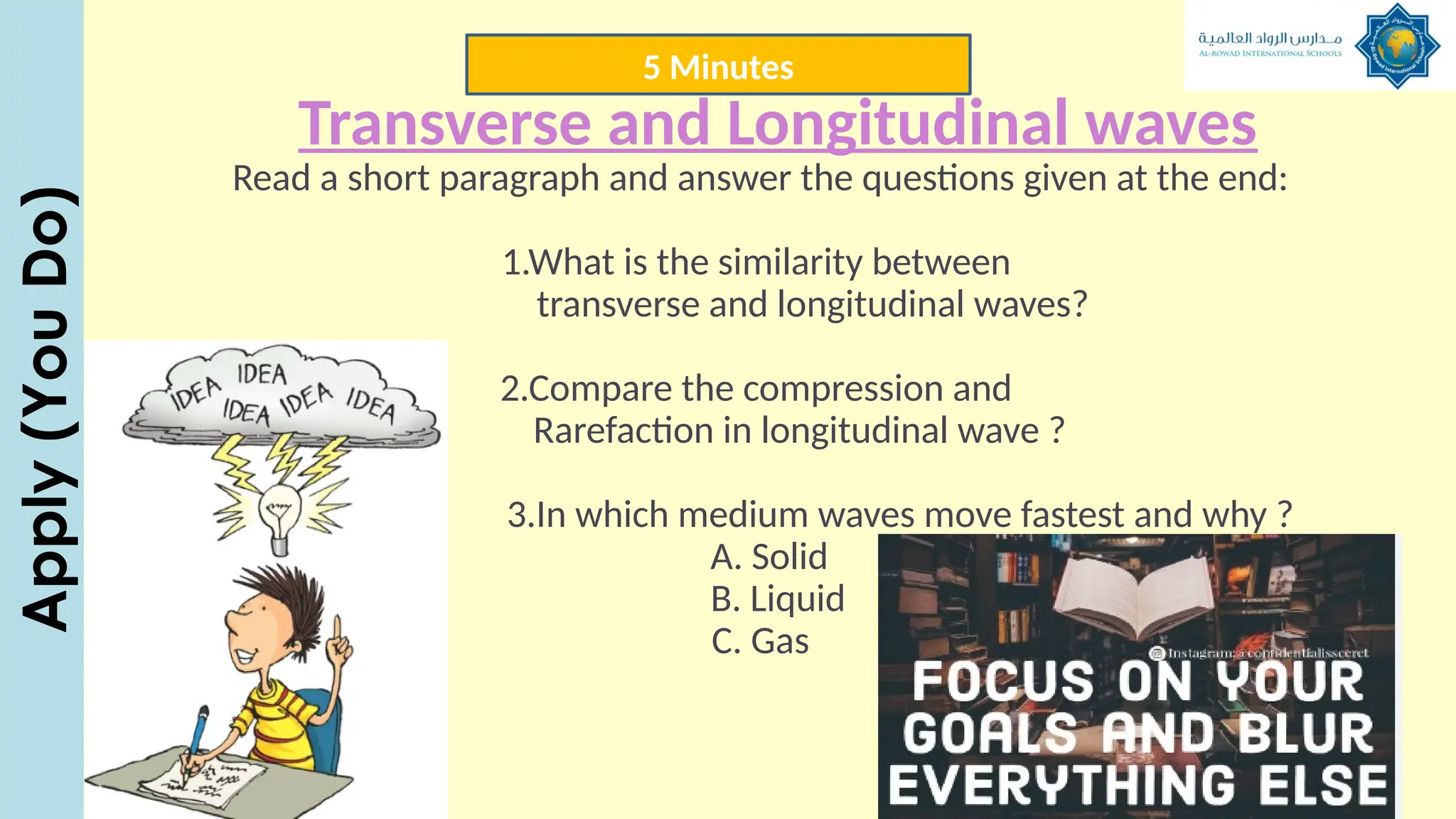
1.What is the similarity between
transverse and longitudinal waves?
2.Compare the compression and
Rarefaction in longitudinal wave ?
3.In which medium waves move fastest and why ?
A. Solid
B. Liquid
C. Gas
Apply
(You
Do) 5 Minutes
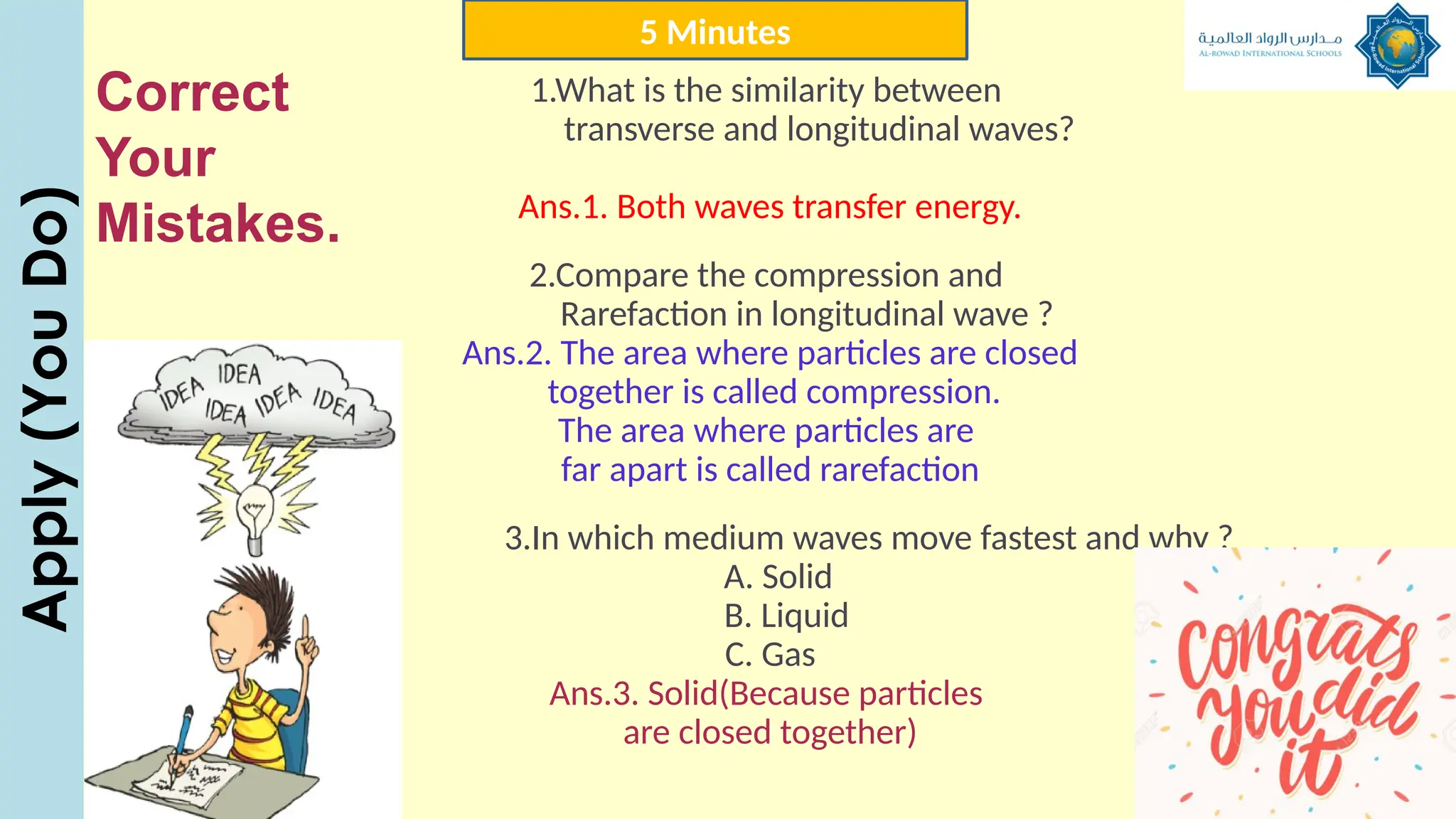
1.What is the similarity between
transverse and longitudinal waves?
Ans.1. Both waves transfer energy.
2.Compare the compression and
Rarefaction in longitudinal wave ?
Ans.2. The area where particles are closed
together is called compression.
The area where particles are
far apart is called rarefaction
3.In which medium waves move fastest and why ?
A. Solid
B. Liquid
C. Gas
Ans.3. Solid(Because particles
are closed together)
Apply
(You
Do) 5 Minutes
Correct
Your
Mistakes.
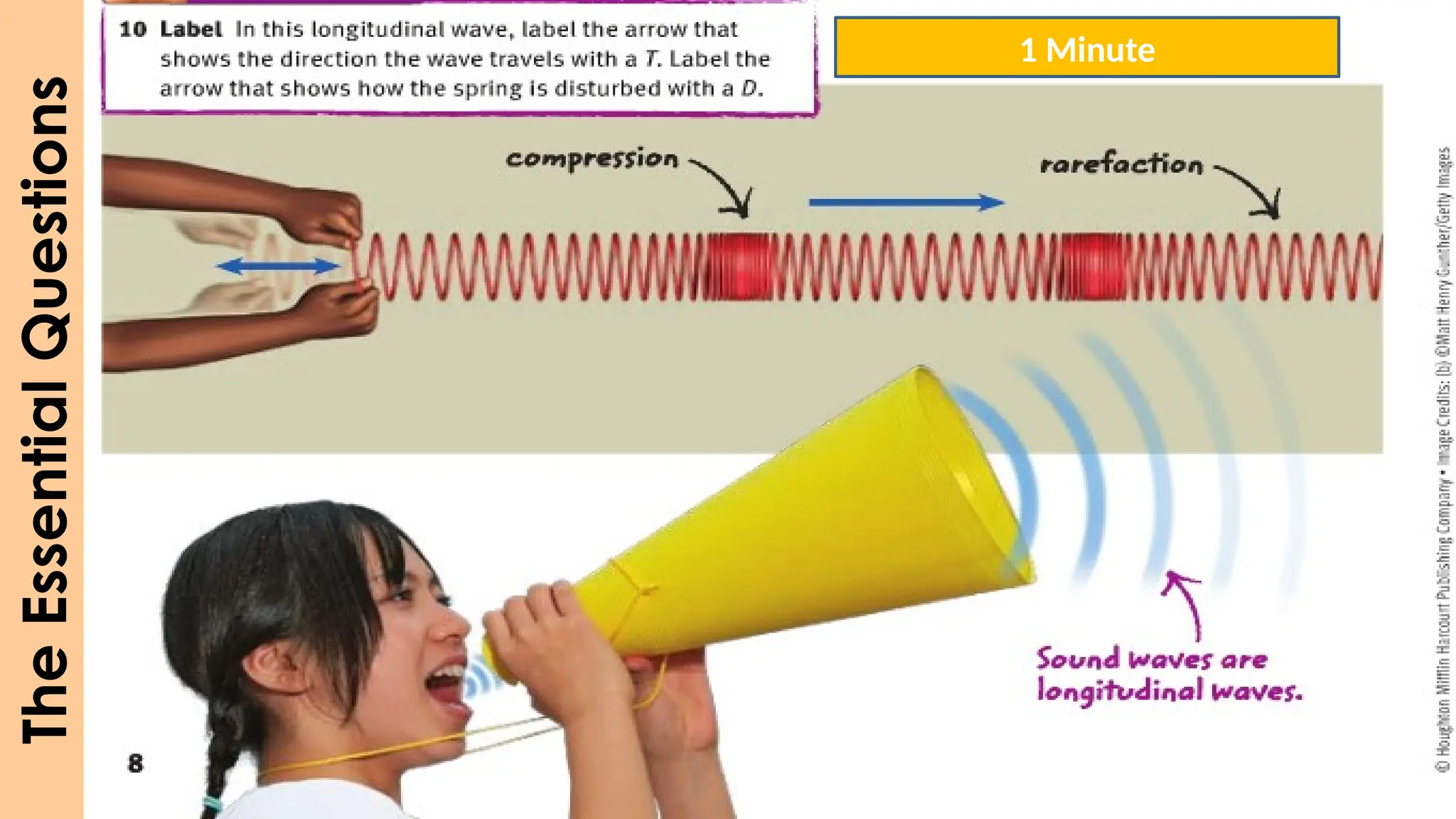
The
Essential
Questions 1 Minute
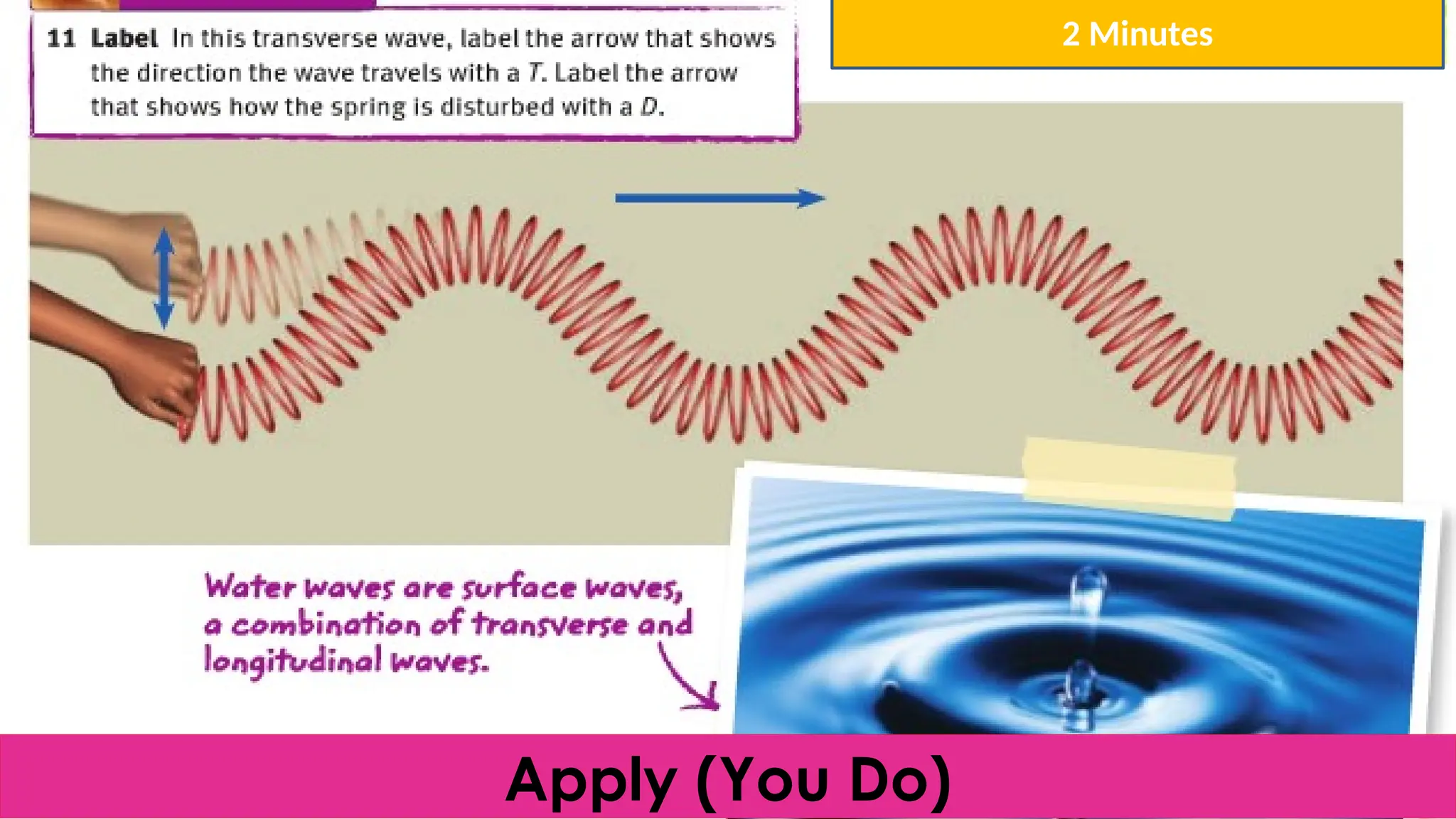
Apply (You Do)
2 Minutes
Apply (You Do)
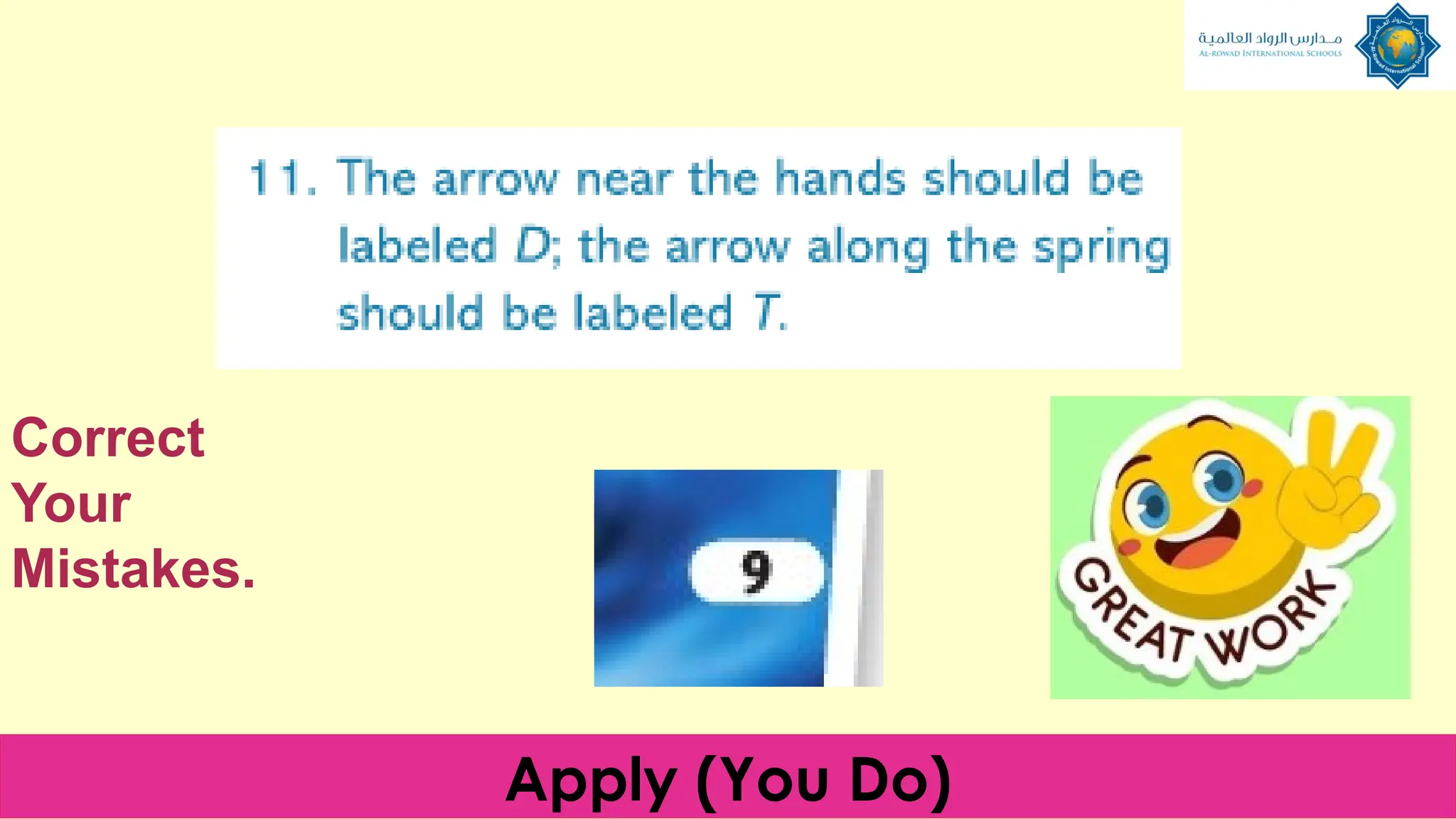
Correct
Your
Mistakes.
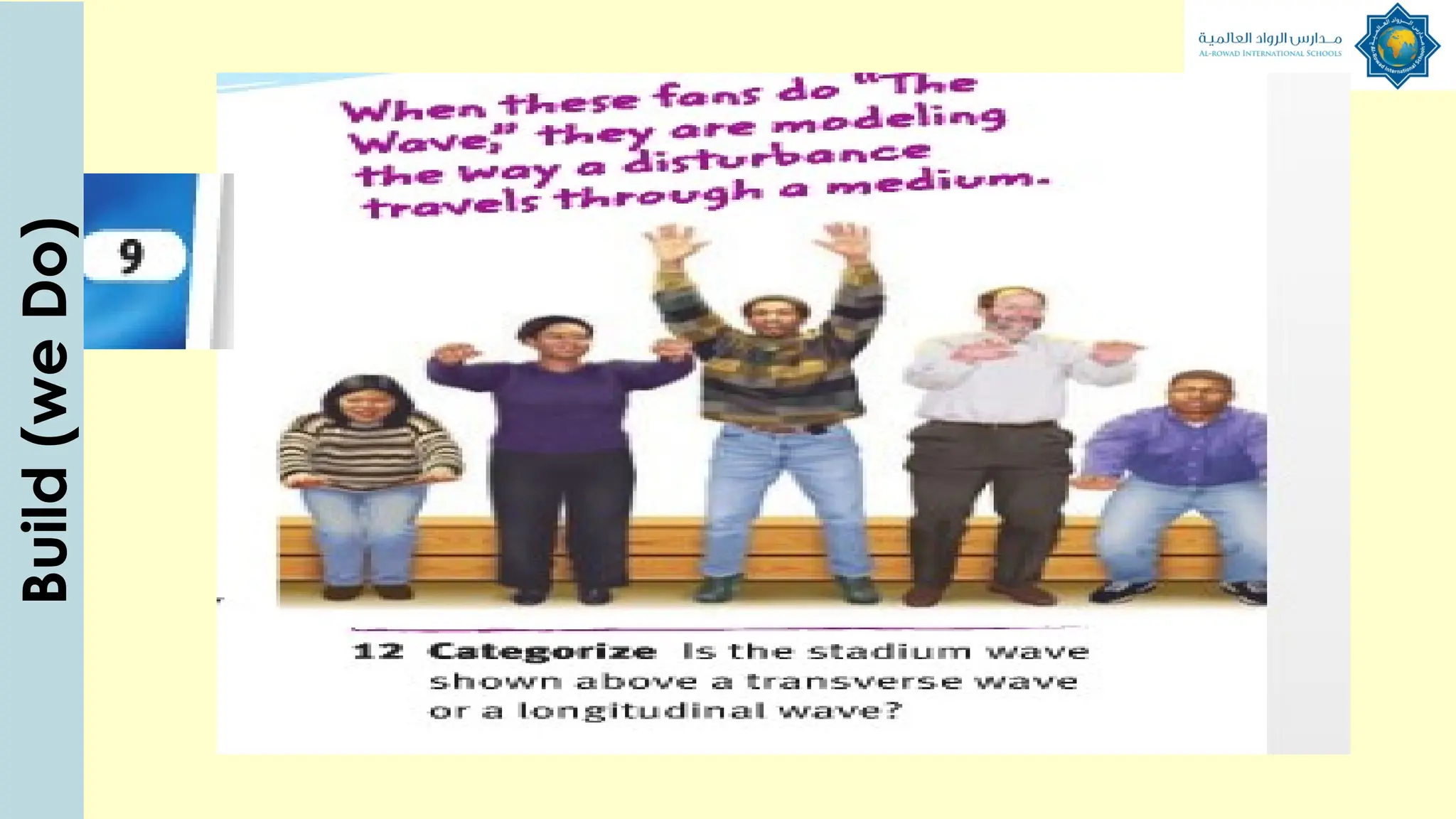
Build
(we
Do)
Build
(we
Do)
How do waves transfer energy?
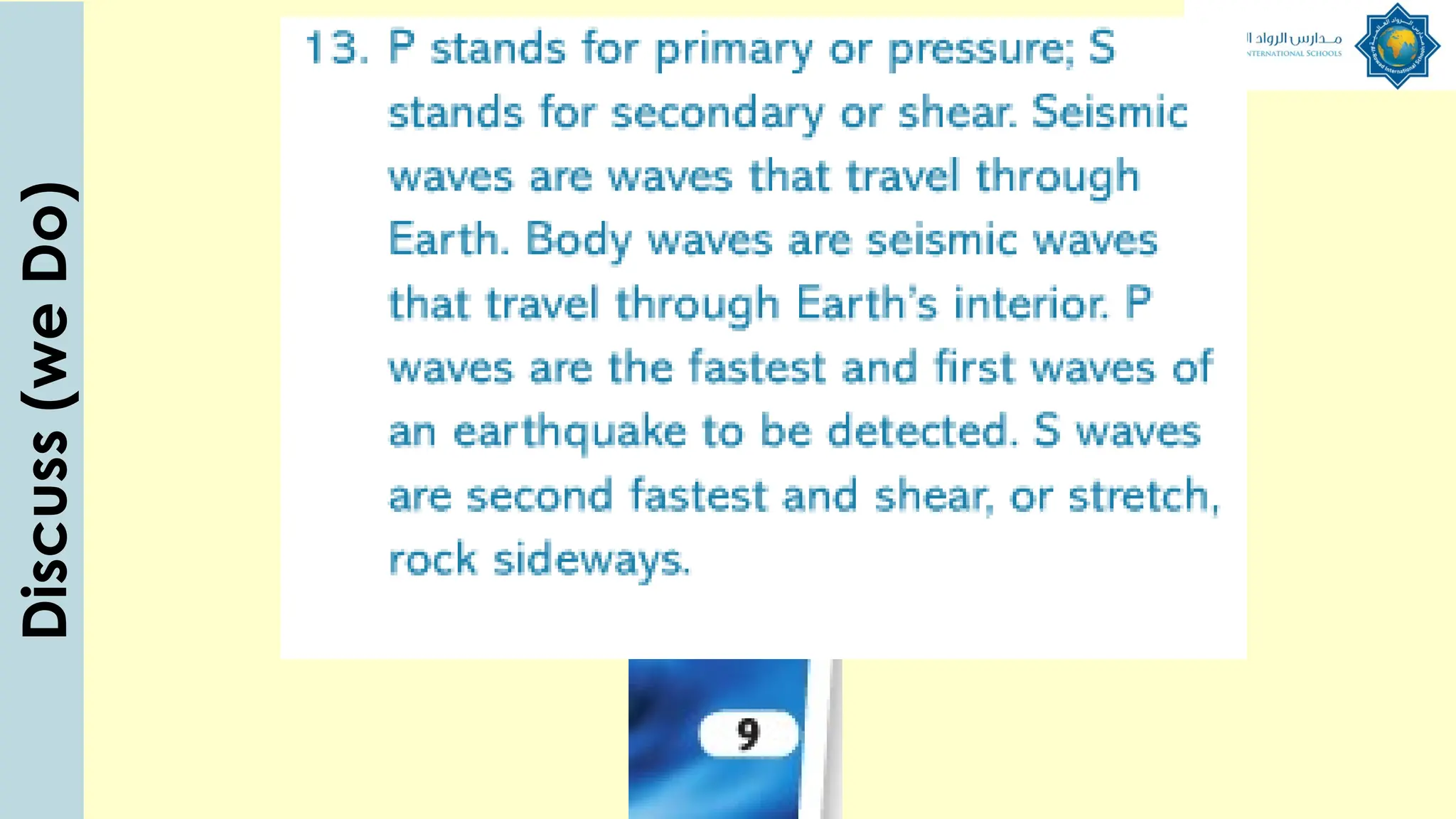
• Earthquakes send out both types of waves.
• Primary waves, called P waves, are longitudinal
waves. They always arrive first.
• Secondary waves, called S waves, are transverse
waves. They always arrive second.
• They can combine to form a surface wave, like
ripples on a pond.
Copyright © Houghton Mifflin Harcourt Publishing Company
Unit 1 Lesson 1 Waves
Introduce
(I
Do)
2 Minutes
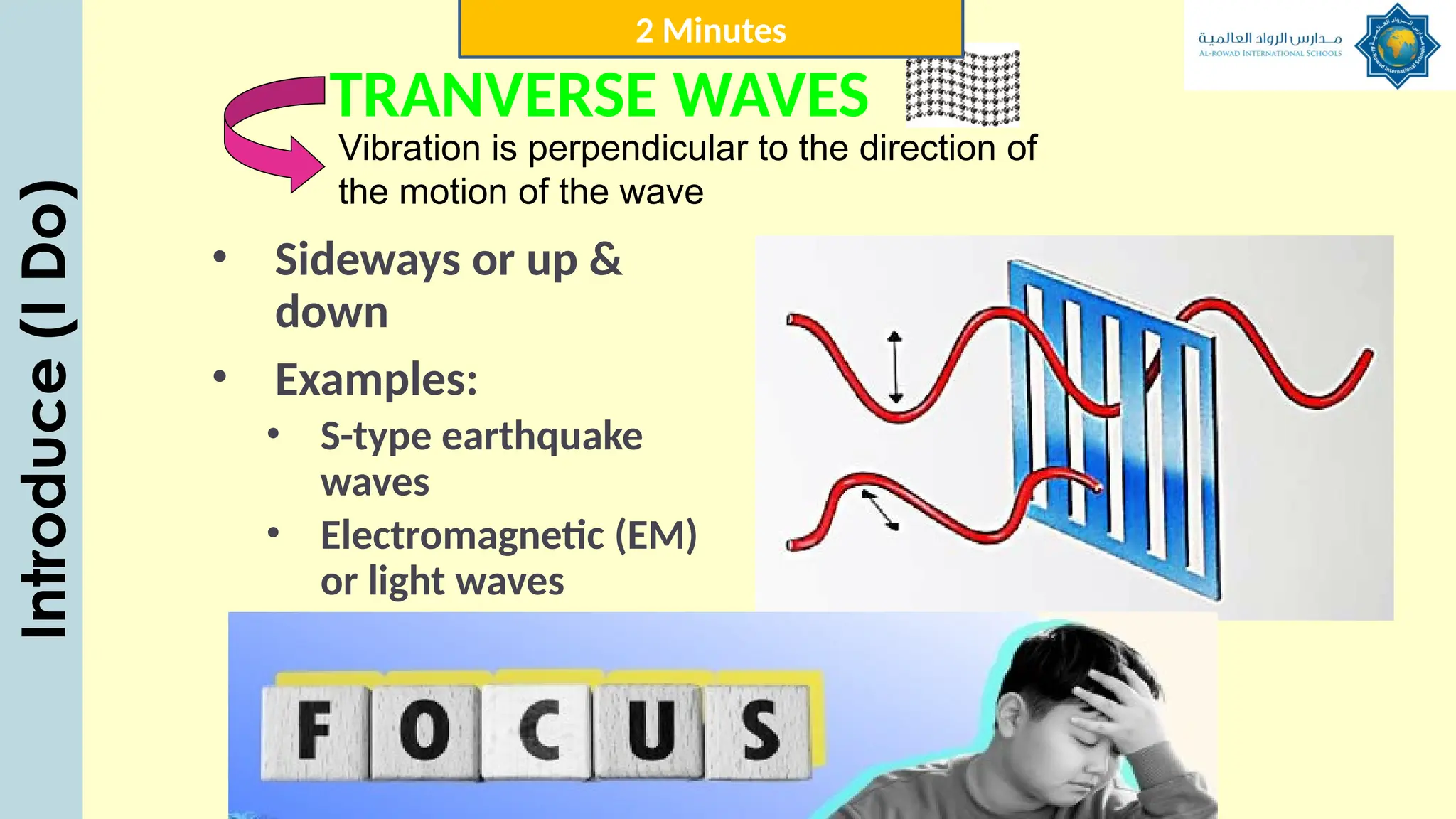
TRANVERSE WAVES
• Sideways or up &
down
• Examples:
• S-type earthquake
waves
• Electromagnetic (EM)
or light waves
Vibration is perpendicular to the direction of
the motion of the wave
Introduce
(I
Do) 2 Minutes
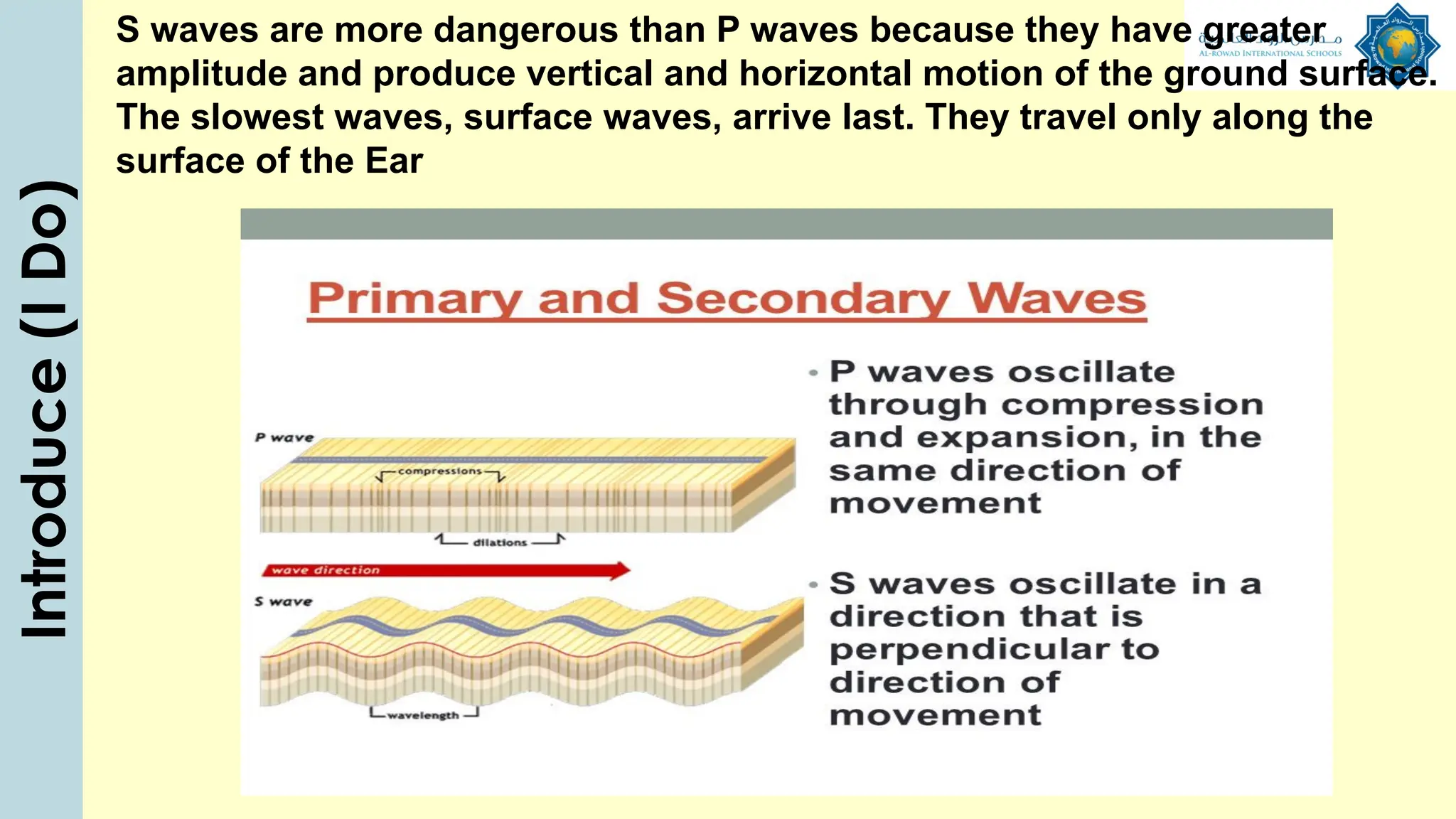
S waves are more dangerous than P waves because they have greater
amplitude and produce vertical and horizontal motion of the ground surface.
The slowest waves, surface waves, arrive last. They travel only along the
surface of the Ear
Introduce
(I
Do)
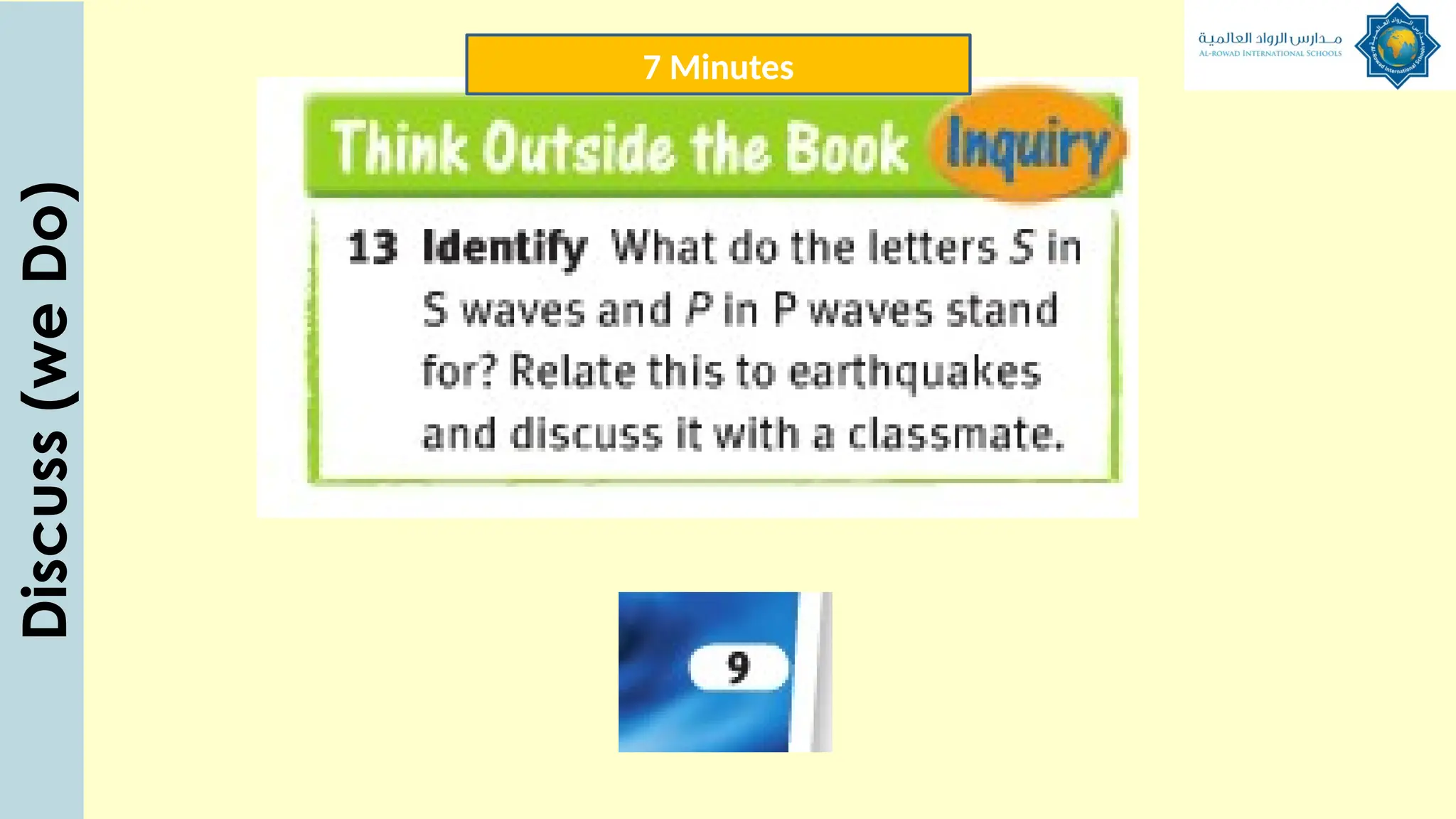
Discuss
(we
Do) 7 Minutes
Discuss
(we
Do) 7 Minutes
Discuss
(we
Do)
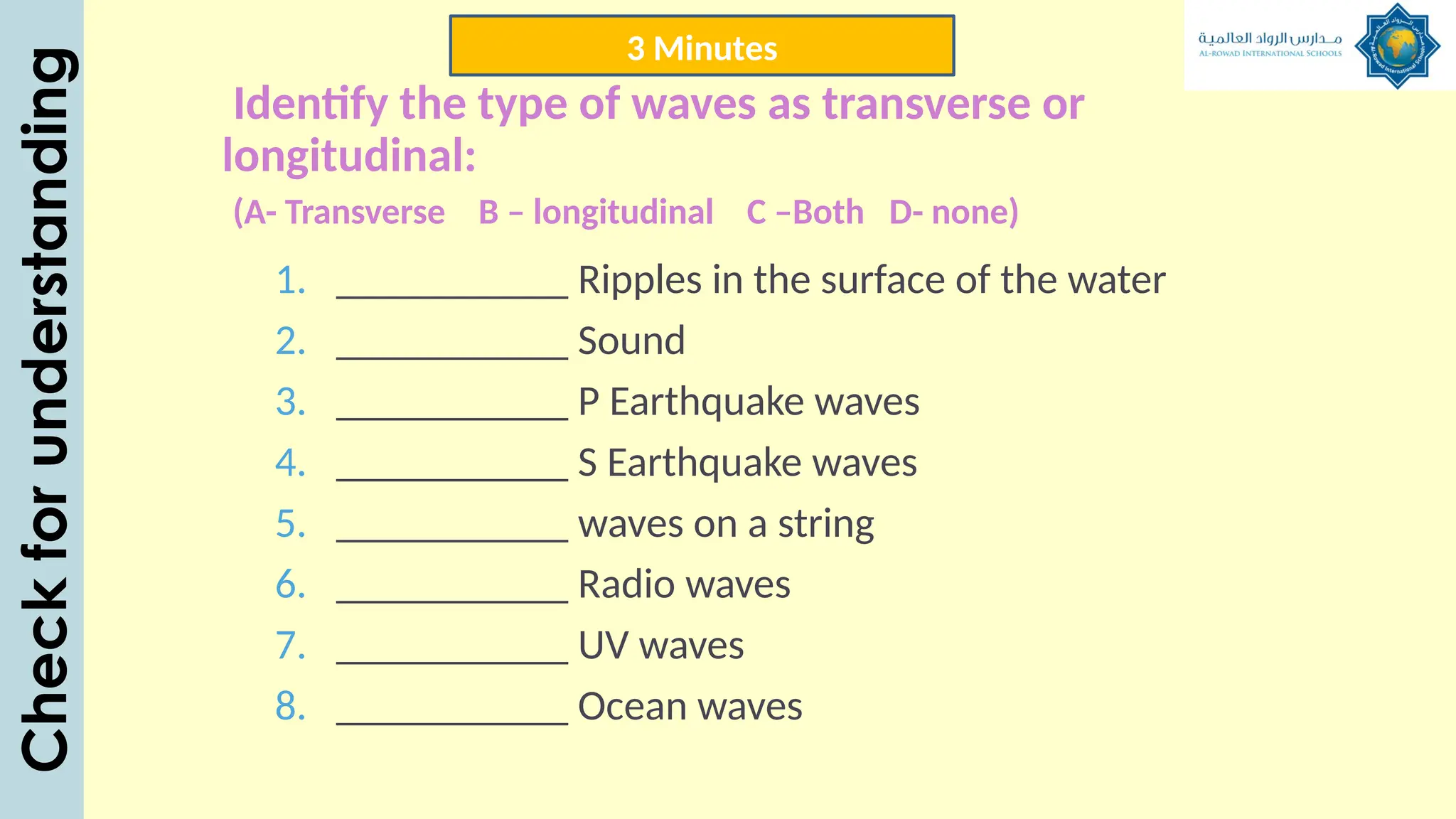
Identify the type of waves as transverse or
longitudinal:
(A- Transverse B – longitudinal C –Both D- none)
1. ___________ Ripples in the surface of the water
2. ___________ Sound
3. ___________ P Earthquake waves
4. ___________ S Earthquake waves
5. ___________ waves on a string
6. ___________ Radio waves
7. ___________ UV waves
8. ___________ Ocean waves
Check
for
understanding 3 Minutes
Identify the type of waves as transverse or
longitudinal:
(A- Transverse B – longitudinal C –Both D- none)
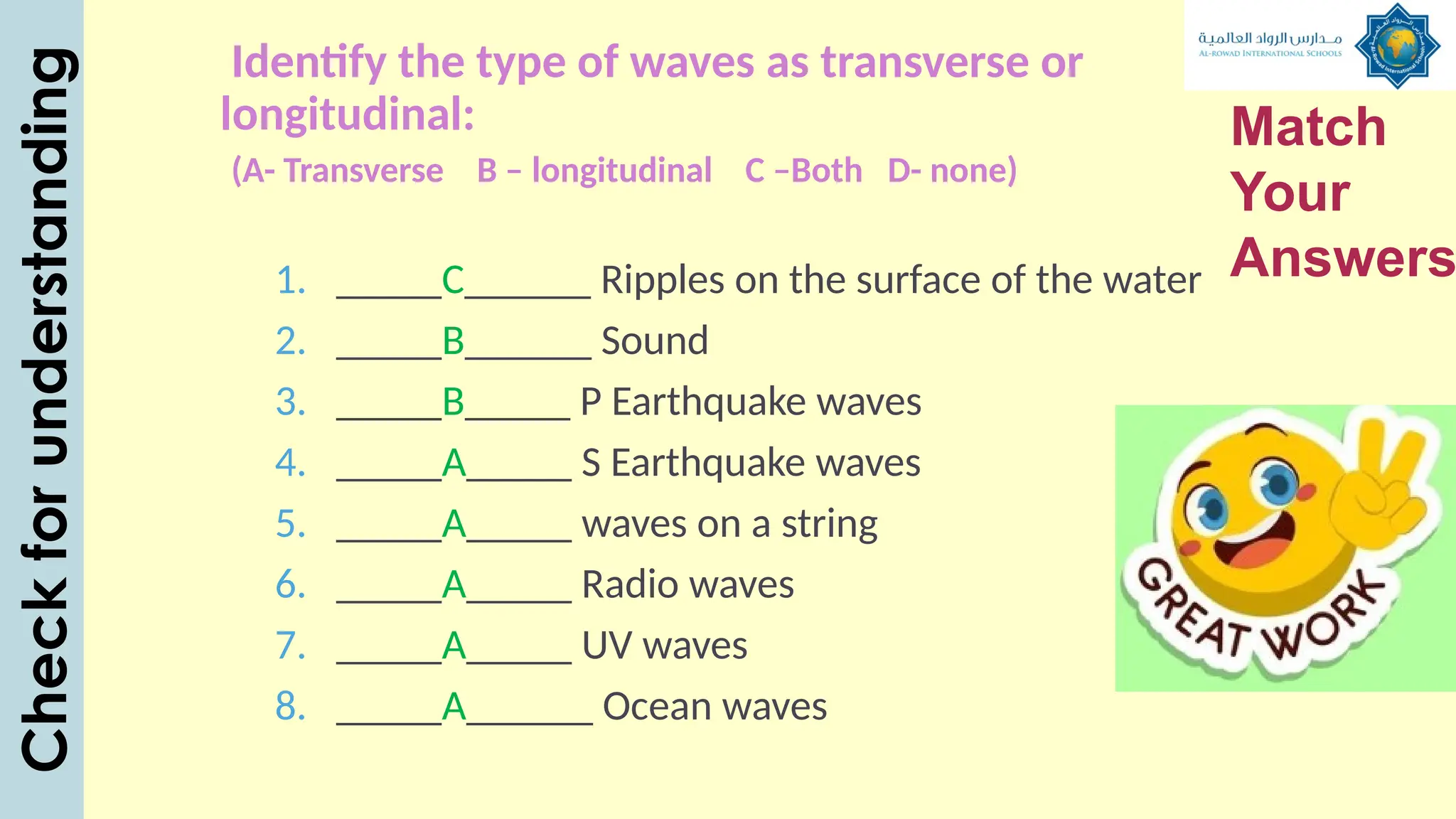
1. _____C______ Ripples on the surface of the water
2. _____B______ Sound
3. _____B_____ P Earthquake waves
4. _____A_____ S Earthquake waves
5. _____A_____ waves on a string
6. _____A_____ Radio waves
7. _____A_____ UV waves
8. _____A______ Ocean waves
Check
for
understanding
Match
Your
Answers
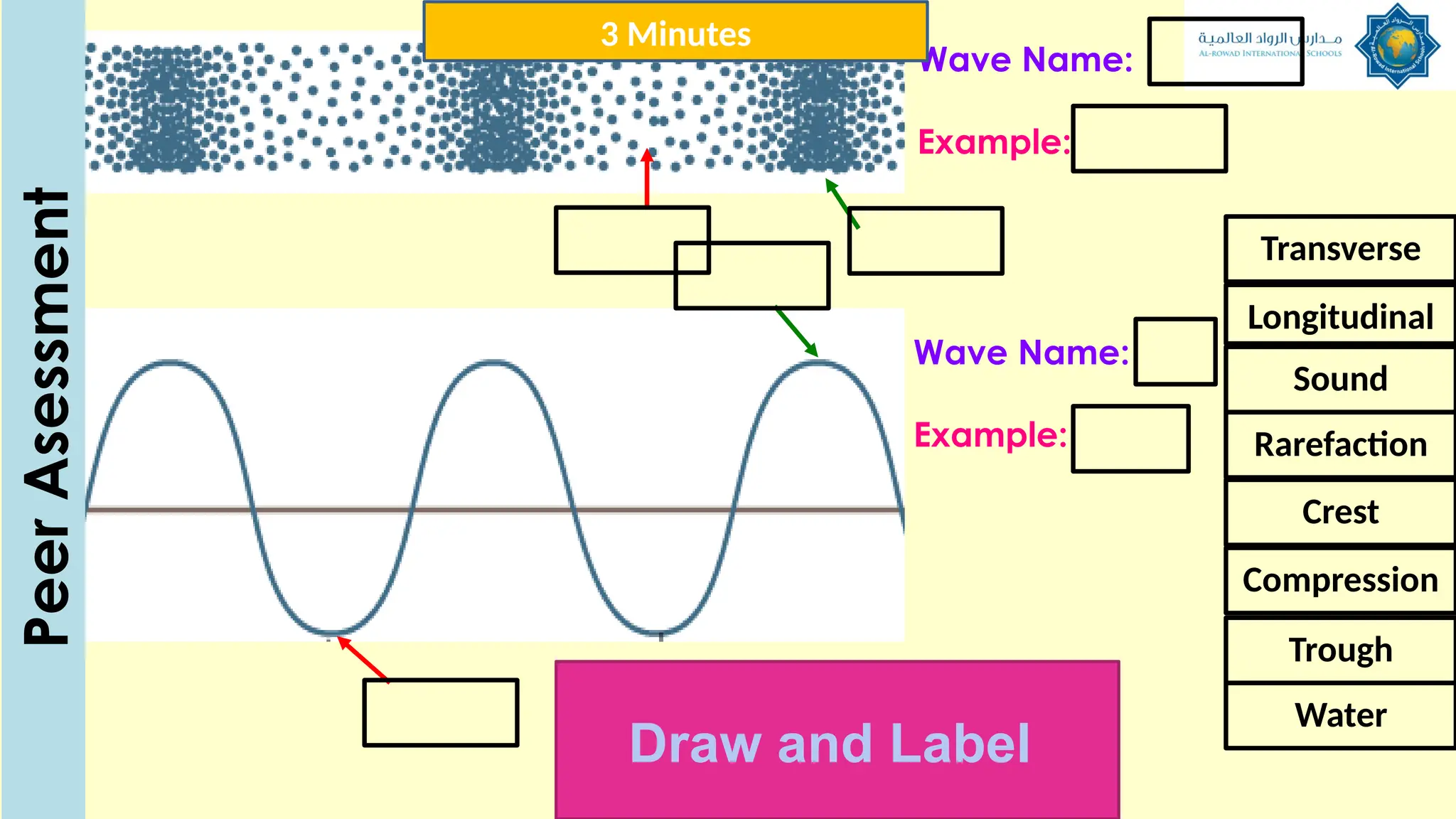
Wave Name:
Example:
Wave Name:
Example:
Transverse
Longitudinal
Compression
Crest
Trough
Water
Rarefaction
Sound
Peer
Asessment
Draw and Label
3 Minutes
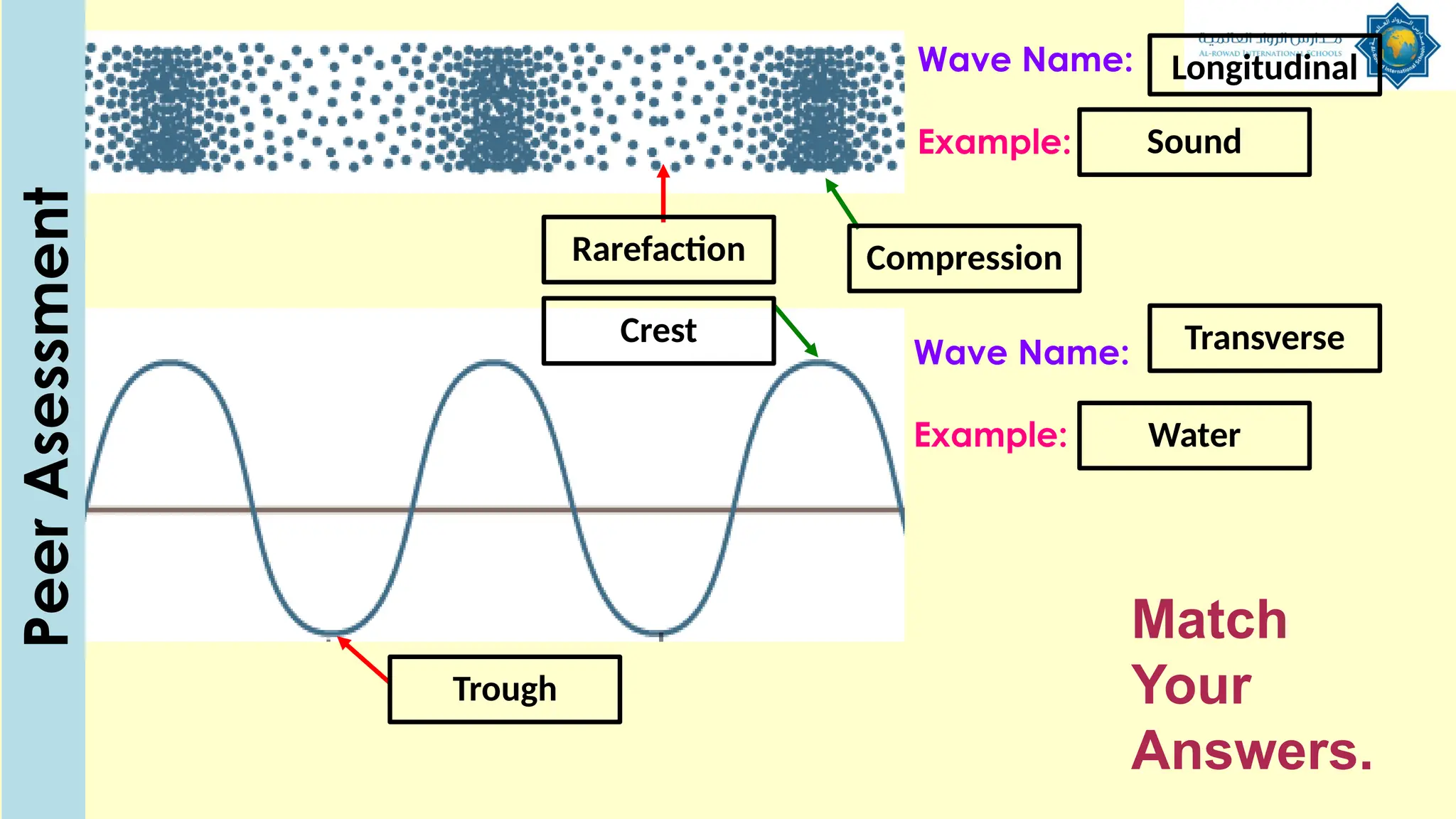
Wave Name:
Example:
Wave Name:
Example:
Transverse
Longitudinal
Compression
Crest
Trough
Water
Rarefaction
Sound
Peer
Asessment
Match
Your
Answers.
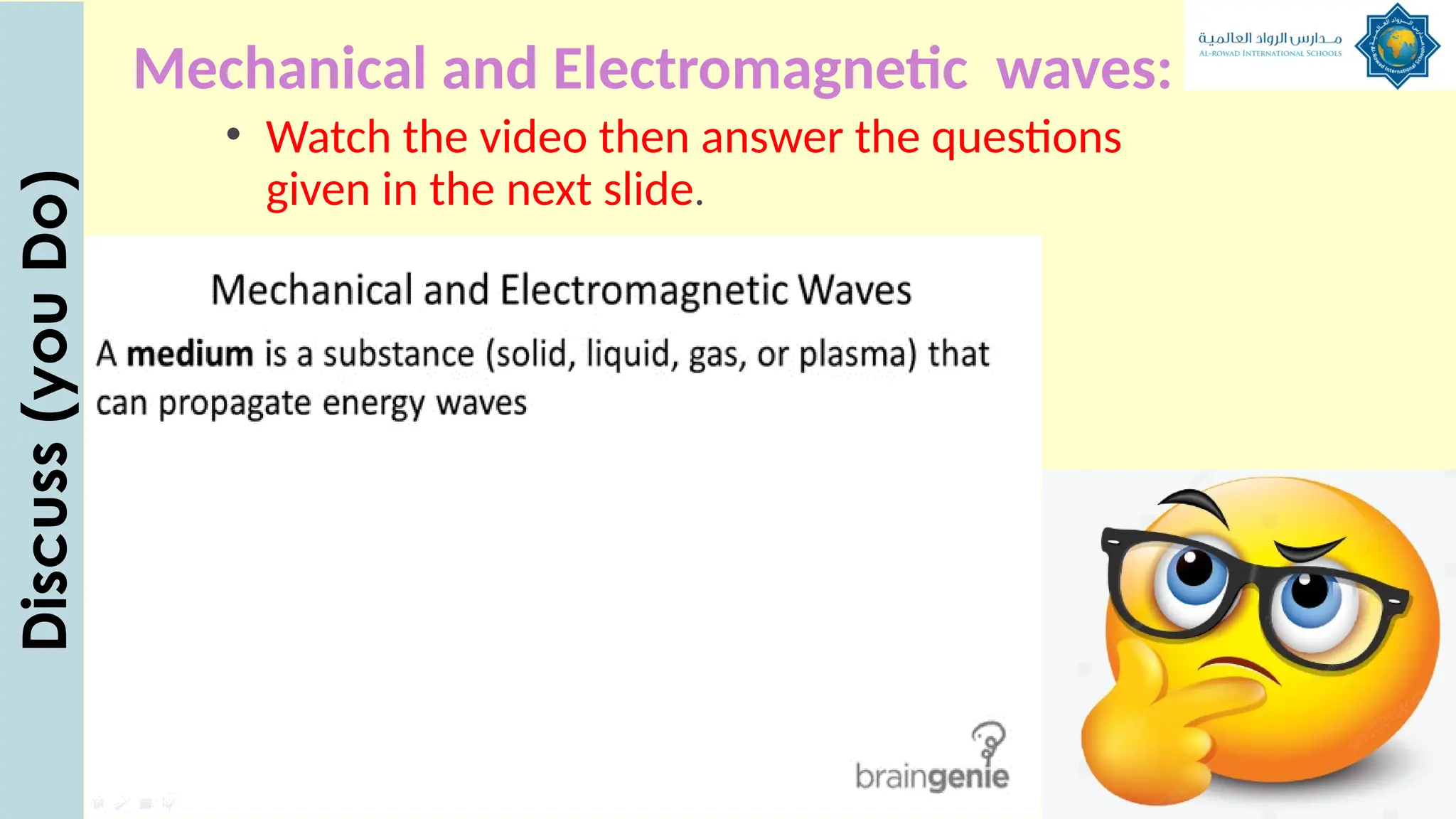
Mechanical and Electromagnetic waves:
• Watch the video then answer the questions
given in the next slide.
Discuss
(you
Do)
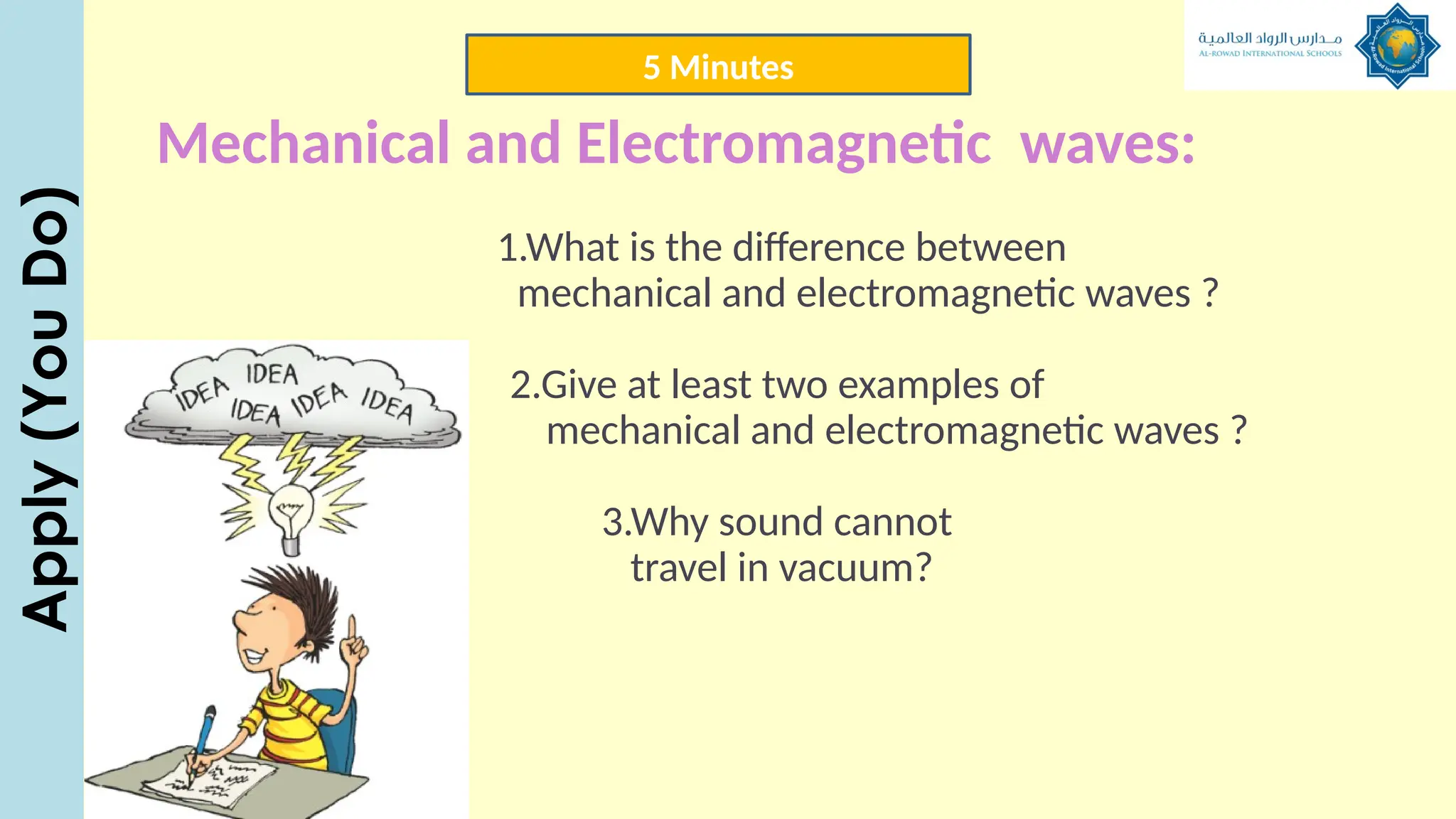
1.What is the difference between
mechanical and electromagnetic waves ?
2.Give at least two examples of
mechanical and electromagnetic waves ?
3.Why sound cannot
travel in vacuum?
Mechanical and Electromagnetic waves:
5 Minutes
Apply
(You
Do)
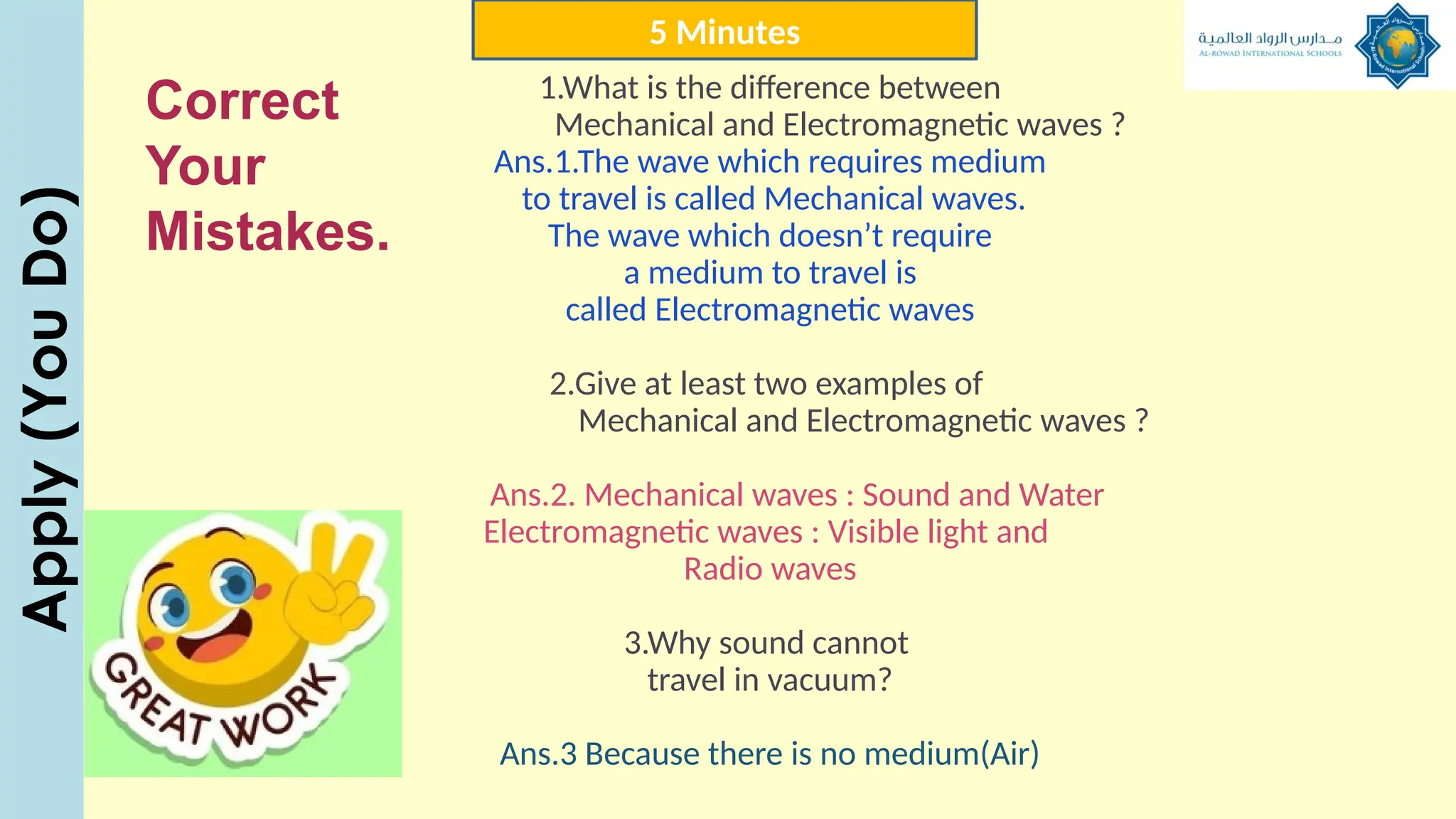
1.What is the difference between
Mechanical and Electromagnetic waves ?
Ans.1.The wave which requires medium
to travel is called Mechanical waves.
The wave which doesn’t require
a medium to travel is
called Electromagnetic waves
2.Give at least two examples of
Mechanical and Electromagnetic waves ?
Ans.2. Mechanical waves : Sound and Water
Electromagnetic waves : Visible light and
Radio waves
3.Why sound cannot
travel in vacuum?
Ans.3 Because there is no medium(Air)
5 Minutes
Apply
(You
Do)
Correct
Your
Mistakes.
Assessment
1.Draw a poster about a situation in which a wave is involved.
Indicate and label the wave featured on your poster and
explain whether the wave is mechanical or electromagnetic.
(2 points)
5 Minutes
Exit Ticket : Question
Write a short summary of today’s
Lesson with at least 40 words ?
Exit
Ticket
Self/Peer Mark with
Red Pens

Lesson ppt for grade 8 regarding transverse and longitudinal waves

  • 1.
    Title : Transferof energy through Waves Lesson objectives Must be able to understand how the wave transfer energy and how the waves are classified in terms of medium. Lesson goals I can define and differentiate between transverse and longitudinal waves ? I can name those waves which is required/not required medium to travel ? I can demonstrate transverse and longitudinal waves and compare compression and rarefaction. Starter : Watch a short video then answers the questions given at the end . Read a short paragraph then answers the questions given. Scaffolder practice ( You do) Students will demonstrate waves using slinky spring then they will write the answers of the questions as a group task. I will move around and will be monitoring the task, helping them and correcting their answers. Instruction and Modelling (I do/We do) Short review about transverse , longitudinal , Mechanical and electromagnetic waves. Demonstrate these waves using slinky spring and deliver some knowledge about compression and rarefaction. Lesson Plan Vocabulary ; Transverse/longitudinal Waves , Mechanical and electromagnetic waves , compression and rarefaction Checking for understanding Assessment Worksheet will be given to check the understanding of the students group wise. Students will move around at the end to discuss their answers with peers Plenary Exit Ticket ..Students will answer the questions and must have to write summary at the end..Self mark Extension Task Short quiz will be taken individually while making students to sit in rows and will be marked next day to save the result as a record.
  • 2.
    Title : Transferof energy in waves What are we learning today… Zeeshan Abid Lesson objectives: 1. Understand how Transverse and longitudinal waves transfer energy in terms of compression and rarefaction. 2. Identify and differentiate between Transverse and Longitudinal waves. 3. Conduct simple experiments to observe and understand the difference between these two waves. 4. Discussion about mechanical and electromagnetic waves.
  • 3.
    Transfer of energyin Waves Learning Goals Scientific vocabulary I can define transverse and longitudinal waves. I can define mechanical and electromagnetic waves Transverse and Longitudinal Waves, Mechanical and Electromagnetic waves, Compression and Rarefaction I can differentiate between transverse and longitudinal waves I can differentiate between mechanical and electromagnetic waves. I can explain by using a slinky spring to describe the motion of particles and direction of wave
  • 4.
    Transverse and Longitudinalwaves: • Watch the video then answer the questions given in the next slide. Starter
  • 5.
    Transverse and Longitudinalwaves 1.How the waves are produced ? 2.How will you define longitudinal and transverse waves while including at least one example ? 3.Can you please mention the direction of wave energy and particles in both cases ? Starter Questions 5 Minutes
  • 6.
    1.How the wavesare produced ? Ans.1. Due to the vibrations in a medium. 2.How will you define longitudinal and transverse waves while including at least one example ? Ans.2. The waves where particles vibrate Parallel to the direction of waves are called longitudinal waves.e.g (Sound waves) The waves where particles vibrate Perpendicular to the direction of waves are called Transverse waves.e.g (Water) 3.Can you please mention the direction of wave energy and particles in both cases ? Ans.3. In longitudinal waves,Direction of wave is parallel to the particles. In transverse waves,Direction of wave is perpendicular to the particles Starter Questions Correct Your Mistakes.
  • 7.
    Transverse and Longitudinalwaves Read a short paragraph and answer the questions given at the end: Introduce (I Do)
  • 8.
    Transverse and Longitudinalwaves Read a short paragraph and answer the questions given at the end: Longitudinal wave is a type of wave where particles vibrate parallel to the direction of waves but in Transverse waves particles vibrates at 90 degrees/perpendicular to the direction of waves. Compression is a part of longitudinal waves where particles are closed together and in Rarefaction particles stay far apart. The wave speed always depends on the medium through which the wave is passing. A Longitudinal and a transverse wave can combine to form a Surface wave. Ripples on a pond is an example of surface wave. Introduce (I Do) 3 Minutes
  • 9.
    Transverse and Longitudinalwaves Hint to answer the questions Introduce (I Do)
  • 10.
    Transverse and Longitudinalwaves Hint to answer the questions Introduce (I Do)
  • 11.
    Transverse and Longitudinalwaves Read a short paragraph and answer the questions given at the end: 1.What is the similarity between transverse and longitudinal waves? 2.Compare the compression and Rarefaction in longitudinal wave ? 3.In which medium waves move fastest and why ? A. Solid B. Liquid C. Gas Apply (You Do) 5 Minutes
  • 12.
    1.What is thesimilarity between transverse and longitudinal waves? Ans.1. Both waves transfer energy. 2.Compare the compression and Rarefaction in longitudinal wave ? Ans.2. The area where particles are closed together is called compression. The area where particles are far apart is called rarefaction 3.In which medium waves move fastest and why ? A. Solid B. Liquid C. Gas Ans.3. Solid(Because particles are closed together) Apply (You Do) 5 Minutes Correct Your Mistakes.
  • 13.
  • 14.
  • 15.
  • 16.
  • 17.
  • 18.
    How do wavestransfer energy? • Earthquakes send out both types of waves. • Primary waves, called P waves, are longitudinal waves. They always arrive first. • Secondary waves, called S waves, are transverse waves. They always arrive second. • They can combine to form a surface wave, like ripples on a pond. Copyright © Houghton Mifflin Harcourt Publishing Company Unit 1 Lesson 1 Waves Introduce (I Do) 2 Minutes
  • 19.
    TRANVERSE WAVES • Sidewaysor up & down • Examples: • S-type earthquake waves • Electromagnetic (EM) or light waves Vibration is perpendicular to the direction of the motion of the wave Introduce (I Do) 2 Minutes
  • 20.
    S waves aremore dangerous than P waves because they have greater amplitude and produce vertical and horizontal motion of the ground surface. The slowest waves, surface waves, arrive last. They travel only along the surface of the Ear Introduce (I Do)
  • 21.
  • 22.
  • 23.
  • 24.
    Identify the typeof waves as transverse or longitudinal: (A- Transverse B – longitudinal C –Both D- none) 1. ___________ Ripples in the surface of the water 2. ___________ Sound 3. ___________ P Earthquake waves 4. ___________ S Earthquake waves 5. ___________ waves on a string 6. ___________ Radio waves 7. ___________ UV waves 8. ___________ Ocean waves Check for understanding 3 Minutes
  • 25.
    Identify the typeof waves as transverse or longitudinal: (A- Transverse B – longitudinal C –Both D- none) 1. _____C______ Ripples on the surface of the water 2. _____B______ Sound 3. _____B_____ P Earthquake waves 4. _____A_____ S Earthquake waves 5. _____A_____ waves on a string 6. _____A_____ Radio waves 7. _____A_____ UV waves 8. _____A______ Ocean waves Check for understanding Match Your Answers
  • 26.
  • 27.
  • 28.
    Mechanical and Electromagneticwaves: • Watch the video then answer the questions given in the next slide. Discuss (you Do)
  • 29.
    1.What is thedifference between mechanical and electromagnetic waves ? 2.Give at least two examples of mechanical and electromagnetic waves ? 3.Why sound cannot travel in vacuum? Mechanical and Electromagnetic waves: 5 Minutes Apply (You Do)
  • 30.
    1.What is thedifference between Mechanical and Electromagnetic waves ? Ans.1.The wave which requires medium to travel is called Mechanical waves. The wave which doesn’t require a medium to travel is called Electromagnetic waves 2.Give at least two examples of Mechanical and Electromagnetic waves ? Ans.2. Mechanical waves : Sound and Water Electromagnetic waves : Visible light and Radio waves 3.Why sound cannot travel in vacuum? Ans.3 Because there is no medium(Air) 5 Minutes Apply (You Do) Correct Your Mistakes.
  • 31.
    Assessment 1.Draw a posterabout a situation in which a wave is involved. Indicate and label the wave featured on your poster and explain whether the wave is mechanical or electromagnetic. (2 points) 5 Minutes
  • 32.
    Exit Ticket :Question Write a short summary of today’s Lesson with at least 40 words ? Exit Ticket Self/Peer Mark with Red Pens

Editor's Notes

  • #5 Short BBC video introduces what the WWW is. Highlight the difference between the WWW & the Internet. 7.4 – Go through the website with them http://www.bbc.co.uk/schools/gcsebitesize/ict/datacomm/0internet_act.shtml
  • #6 Short BBC video introduces what the WWW is. Highlight the difference between the WWW & the Internet. 7.4 – Go through the website with them http://www.bbc.co.uk/schools/gcsebitesize/ict/datacomm/0internet_act.shtml
  • #7 Short BBC video introduces what the WWW is. Highlight the difference between the WWW & the Internet. 7.4 – Go through the website with them http://www.bbc.co.uk/schools/gcsebitesize/ict/datacomm/0internet_act.shtml
  • #8 Short BBC video introduces what the WWW is. Highlight the difference between the WWW & the Internet. 7.4 – Go through the website with them http://www.bbc.co.uk/schools/gcsebitesize/ict/datacomm/0internet_act.shtml
  • #9 Short BBC video introduces what the WWW is. Highlight the difference between the WWW & the Internet. 7.4 – Go through the website with them http://www.bbc.co.uk/schools/gcsebitesize/ict/datacomm/0internet_act.shtml
  • #10 Short BBC video introduces what the WWW is. Highlight the difference between the WWW & the Internet. 7.4 – Go through the website with them http://www.bbc.co.uk/schools/gcsebitesize/ict/datacomm/0internet_act.shtml
  • #11 Short BBC video introduces what the WWW is. Highlight the difference between the WWW & the Internet. 7.4 – Go through the website with them http://www.bbc.co.uk/schools/gcsebitesize/ict/datacomm/0internet_act.shtml
  • #12 Short BBC video introduces what the WWW is. Highlight the difference between the WWW & the Internet. 7.4 – Go through the website with them http://www.bbc.co.uk/schools/gcsebitesize/ict/datacomm/0internet_act.shtml
  • #29 Short BBC video introduces what the WWW is. Highlight the difference between the WWW & the Internet. 7.4 – Go through the website with them http://www.bbc.co.uk/schools/gcsebitesize/ict/datacomm/0internet_act.shtml
  • #30 Short BBC video introduces what the WWW is. Highlight the difference between the WWW & the Internet. 7.4 – Go through the website with them http://www.bbc.co.uk/schools/gcsebitesize/ict/datacomm/0internet_act.shtml
  • #32 Guide students through the process of identifying the actors (the jaw, inside and outside teeth, the brushing direction, the toothpaste, the water etc.) and the actions (picking up, brushing patterns, rinsing, spitting etc.) and how the two work together to create a sequence of instructions.