LEVERS
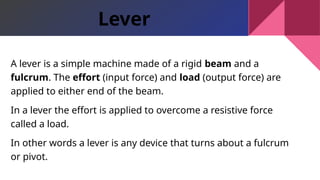
A lever is a simple machine made of a rigid beam and a
fulcrum. The effort (input force) and load (output force) are
applied to either end of the beam.
In a lever the effort is applied to overcome a resistive force
called a load.
In other words a lever is any device that turns about a fulcrum
or pivot.
Lever
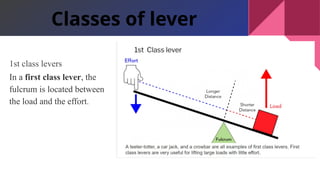
1st class levers
In a first class lever, the
fulcrum is located between
the load and the effort.
Classes of lever
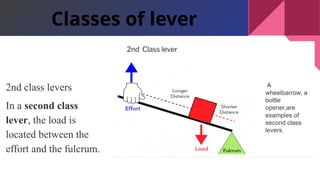
2nd class levers
In a second class
lever, the load is
located between the
effort and the fulcrum.
Classes of lever
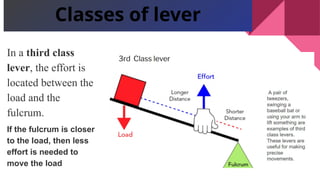
In a third class
lever, the effort is
located between the
load and the
fulcrum.
If the fulcrum is closer
to the load, then less
effort is needed to
move the load
Classes of lever
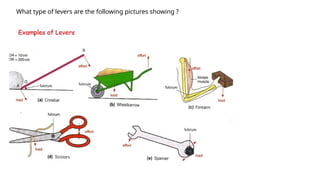
What type of levers are the following pictures showing ?
WAVES
What are waves?
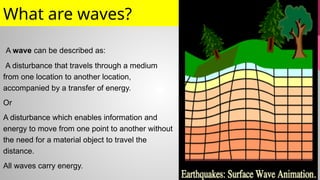
A wave can be described as:
A disturbance that travels through a medium
from one location to another location,
accompanied by a transfer of energy.
Or
A disturbance which enables information and
energy to move from one point to another without
the need for a material object to travel the
distance.
All waves carry energy.
What is medium in terms of waves?
Definition:
A medium is the substance through which a wave can propagate.
Water is the medium of ocean waves. Air is the medium through which we hear sound
waves. The electric and magnetic fields are the medium of light. Earth is the medium
of seismic waves (earthquake waves). Cell membranes are the medium of nerve
impulses. Transmission lines are the medium of alternating current electric power.
Classification of waves
1) By type
2) By motion of the particle
3) By the motion of the wave form
By Type
1) A Mechanical Wave-Waves that exist in a material medium and require the medium for propagation.
Example : Water wave, string or spring waves, sound waves
One most familiar with
2) Electromagnetic waves- require no material medium to exist or to propagate. Can travel through a
vacuum.
Examples: light, radiant heat,radio waves
Always have the same speed in a vacuum
3) Matter wave: Waves associated with atomic particles e.g electrons, protons and other fundamental
particles.
By motion of the wave form
1) Travelling wave- if the wave form moves from one point to another then the wave is a
travelling wave.
We can further discuss between a pulse and a wave train
a) Pulse : a single disturbance which moves through the medium.
b) Wave train: Continuous. A wave consisting of cycles or patterns that are repeated.
2) Standing wave: if the wave form appears to be stationary, i.e, you do not see a propagating wave
it is called a standing wave.
Now that we have been introduced to waves let’s apply some Physics.
By Motion of particles
Consider a mechanical wave on a string or on a spring when the wave
( disturbance) is created and sent through the medium, the displaced
particles of the medium will move about their mean positions as the wave
travels through the medium.
Waves can oscillate in two ways with regards to the motion of disturbance.
1) Transverse waves:
2) Longitudinal wave
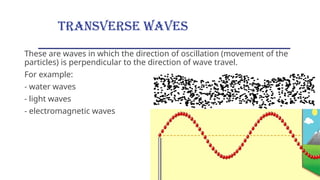
Transverse waves
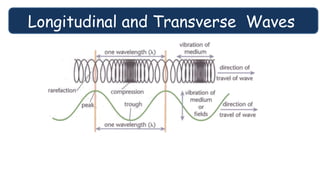
These are waves in which the direction of oscillation (movement of the
particles) is perpendicular to the direction of wave travel.
For example:
- water waves
- light waves
- electromagnetic waves
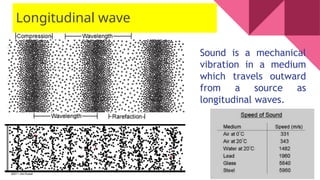
Longitudinal wave
Sound is a mechanical
vibration in a medium
which travels outward
from a source as
longitudinal waves.
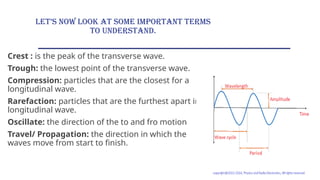
Let’s now look at some important terms
to understand.
Crest : is the peak of the transverse wave.
Trough: the lowest point of the transverse wave.
Compression: particles that are the closest for a
longitudinal wave.
Rarefaction: particles that are the furthest apart in a
longitudinal wave.
Oscillate: the direction of the to and fro motion
Travel/ Propagation: the direction in which the
waves move from start to finish.
Longitudinal and Transverse Waves
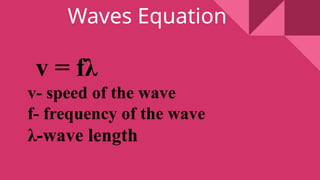
Waves Equation
v = fλ
v- speed of the wave
f- frequency of the wave
λ-wave length
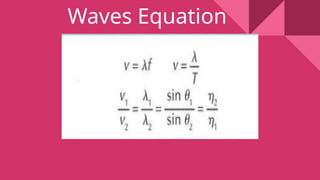
Waves Equation
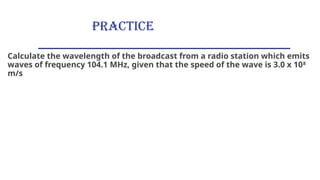
PRACTICE
Calculate the wavelength of the broadcast from a radio station which emits
waves of frequency 104.1 MHz, given that the speed of the wave is 3.0 x 10⁸
m/s
PRACTICE
A water wave has a speed of 3.0 m/s and its crests are 5.0 m apart. It
approaches a reef at an angle of incidence of 60°. On passing over it, the
distance between its crests reduces to 4.0 m.
Determine for the wave:
a the frequency in the deeper water
b the period in the deeper water
c the frequency as it passes over the reef (shallow)
d the period as it passes over the reef
e the speed as it passes over the reef
f the angle of refraction on reaching the reef
g the refractive index on travelling from the deep to the shallow.
Describing a wave
Progressive waves can be represented by two
different kinds of graph.
1. A displacement position graph
2. A displacement time Graph
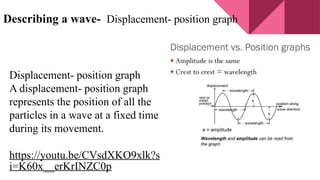
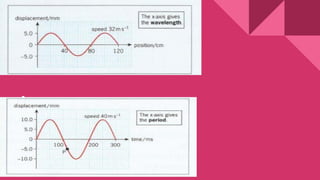
Describing a wave- Displacement- position graph
Displacement- position graph
A displacement- position graph
represents the position of all the
particles in a wave at a fixed time
during its movement.
https://youtu.be/CVsdXKO9xlk?s
i=K60x__erKrINZC0p
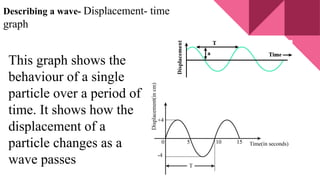
Describing a wave- Displacement- time
graph
This graph shows the
behaviour of a single
particle over a period of
time. It shows how the
displacement of a
particle changes as a
wave passes
.
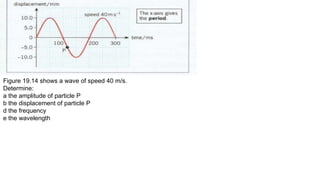
Figure 19.14 shows a wave of speed 40 m/s.
Determine:
a the amplitude of particle P
b the displacement of particle P
d the frequency
e the wavelength
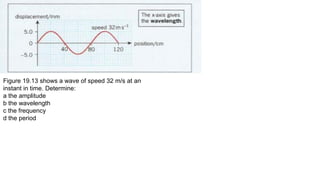
Figure 19.13 shows a wave of speed 32 m/s at an
instant in time. Determine:
a the amplitude
b the wavelength
c the frequency
d the period

Physics Csec Electricity 5th _Waves 2024.pptx

  • 1.
  • 2.
    A lever isa simple machine made of a rigid beam and a fulcrum. The effort (input force) and load (output force) are applied to either end of the beam. In a lever the effort is applied to overcome a resistive force called a load. In other words a lever is any device that turns about a fulcrum or pivot. Lever
  • 3.
    1st class levers Ina first class lever, the fulcrum is located between the load and the effort. Classes of lever
  • 4.
    2nd class levers Ina second class lever, the load is located between the effort and the fulcrum. Classes of lever
  • 5.
    In a thirdclass lever, the effort is located between the load and the fulcrum. If the fulcrum is closer to the load, then less effort is needed to move the load Classes of lever
  • 6.
    What type oflevers are the following pictures showing ?
  • 7.
  • 8.
    What are waves? Awave can be described as: A disturbance that travels through a medium from one location to another location, accompanied by a transfer of energy. Or A disturbance which enables information and energy to move from one point to another without the need for a material object to travel the distance. All waves carry energy.
  • 9.
    What is mediumin terms of waves? Definition: A medium is the substance through which a wave can propagate. Water is the medium of ocean waves. Air is the medium through which we hear sound waves. The electric and magnetic fields are the medium of light. Earth is the medium of seismic waves (earthquake waves). Cell membranes are the medium of nerve impulses. Transmission lines are the medium of alternating current electric power.
  • 10.
    Classification of waves 1)By type 2) By motion of the particle 3) By the motion of the wave form
  • 11.
    By Type 1) AMechanical Wave-Waves that exist in a material medium and require the medium for propagation. Example : Water wave, string or spring waves, sound waves One most familiar with 2) Electromagnetic waves- require no material medium to exist or to propagate. Can travel through a vacuum. Examples: light, radiant heat,radio waves Always have the same speed in a vacuum 3) Matter wave: Waves associated with atomic particles e.g electrons, protons and other fundamental particles.
  • 12.
    By motion ofthe wave form 1) Travelling wave- if the wave form moves from one point to another then the wave is a travelling wave. We can further discuss between a pulse and a wave train a) Pulse : a single disturbance which moves through the medium. b) Wave train: Continuous. A wave consisting of cycles or patterns that are repeated. 2) Standing wave: if the wave form appears to be stationary, i.e, you do not see a propagating wave it is called a standing wave. Now that we have been introduced to waves let’s apply some Physics.
  • 13.
    By Motion ofparticles Consider a mechanical wave on a string or on a spring when the wave ( disturbance) is created and sent through the medium, the displaced particles of the medium will move about their mean positions as the wave travels through the medium. Waves can oscillate in two ways with regards to the motion of disturbance. 1) Transverse waves: 2) Longitudinal wave
  • 14.
    Transverse waves These arewaves in which the direction of oscillation (movement of the particles) is perpendicular to the direction of wave travel. For example: - water waves - light waves - electromagnetic waves
  • 15.
    Longitudinal wave Sound isa mechanical vibration in a medium which travels outward from a source as longitudinal waves.
  • 16.
    Let’s now lookat some important terms to understand. Crest : is the peak of the transverse wave. Trough: the lowest point of the transverse wave. Compression: particles that are the closest for a longitudinal wave. Rarefaction: particles that are the furthest apart in a longitudinal wave. Oscillate: the direction of the to and fro motion Travel/ Propagation: the direction in which the waves move from start to finish.
  • 17.
  • 20.
    Waves Equation v =fλ v- speed of the wave f- frequency of the wave λ-wave length
  • 21.
  • 22.
    PRACTICE Calculate the wavelengthof the broadcast from a radio station which emits waves of frequency 104.1 MHz, given that the speed of the wave is 3.0 x 10⁸ m/s
  • 23.
    PRACTICE A water wavehas a speed of 3.0 m/s and its crests are 5.0 m apart. It approaches a reef at an angle of incidence of 60°. On passing over it, the distance between its crests reduces to 4.0 m. Determine for the wave: a the frequency in the deeper water b the period in the deeper water c the frequency as it passes over the reef (shallow) d the period as it passes over the reef e the speed as it passes over the reef f the angle of refraction on reaching the reef g the refractive index on travelling from the deep to the shallow.
  • 25.
    Describing a wave Progressivewaves can be represented by two different kinds of graph. 1. A displacement position graph 2. A displacement time Graph
  • 26.
    Describing a wave-Displacement- position graph Displacement- position graph A displacement- position graph represents the position of all the particles in a wave at a fixed time during its movement. https://youtu.be/CVsdXKO9xlk?s i=K60x__erKrINZC0p
  • 27.
    Describing a wave-Displacement- time graph This graph shows the behaviour of a single particle over a period of time. It shows how the displacement of a particle changes as a wave passes
  • 28.
  • 29.
    Figure 19.14 showsa wave of speed 40 m/s. Determine: a the amplitude of particle P b the displacement of particle P d the frequency e the wavelength
  • 30.
    Figure 19.13 showsa wave of speed 32 m/s at an instant in time. Determine: a the amplitude b the wavelength c the frequency d the period