OSPF
VXLAN, BGP EVPN without myths and packet capture
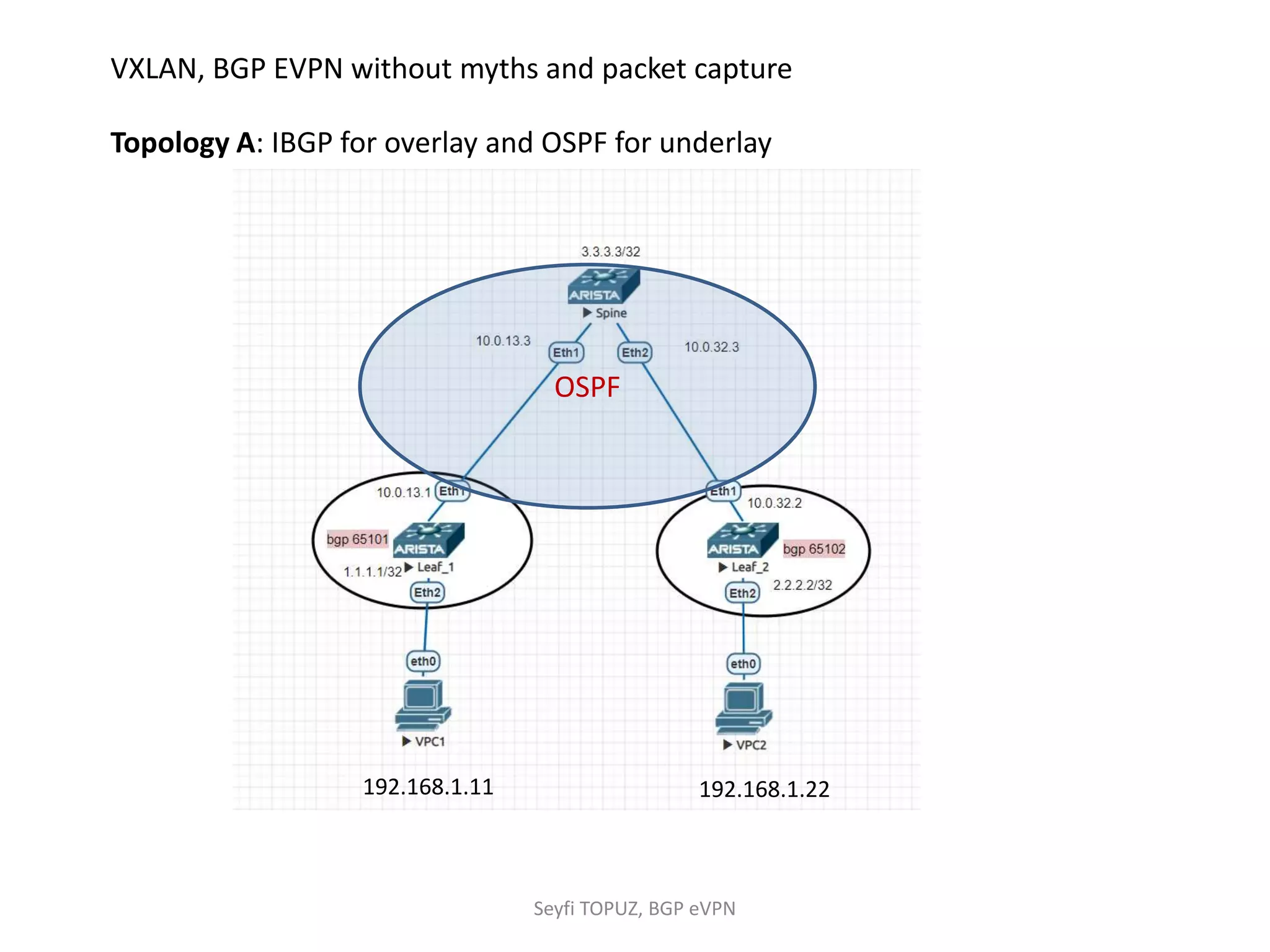
Topology A: IBGP for overlay and OSPF for underlay
192.168.1.11 192.168.1.22
Seyfi TOPUZ, BGP eVPN
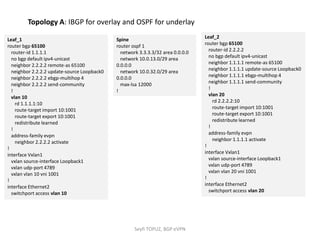
Leaf_1
router bgp 65100
router-id 1.1.1.1
no bgp default ipv4-unicast
neighbor 2.2.2.2 remote-as 65100
neighbor 2.2.2.2 update-source Loopback0
neighbor 2.2.2.2 ebgp-multihop 4
neighbor 2.2.2.2 send-community
!
vlan 10
rd 1.1.1.1:10
route-target import 10:1001
route-target export 10:1001
redistribute learned
!
address-family evpn
neighbor 2.2.2.2 activate
!
interface Vxlan1
vxlan source-interface Loopback1
vxlan udp-port 4789
vxlan vlan 10 vni 1001
!
interface Ethernet2
switchport access vlan 10
Leaf_2
router bgp 65100
router-id 2.2.2.2
no bgp default ipv4-unicast
neighbor 1.1.1.1 remote-as 65100
neighbor 1.1.1.1 update-source Loopback0
neighbor 1.1.1.1 ebgp-multihop 4
neighbor 1.1.1.1 send-community
!
vlan 20
rd 2.2.2.2:10
route-target import 10:1001
route-target export 10:1001
redistribute learned
!
address-family evpn
neighbor 1.1.1.1 activate
!
interface Vxlan1
vxlan source-interface Loopback1
vxlan udp-port 4789
vxlan vlan 20 vni 1001
!
interface Ethernet2
switchport access vlan 20
Spine
router ospf 1
network 3.3.3.3/32 area 0.0.0.0
network 10.0.13.0/29 area
0.0.0.0
network 10.0.32.0/29 area
0.0.0.0
max-lsa 12000
!
Topology A: IBGP for overlay and OSPF for underlay
Seyfi TOPUZ, BGP eVPN
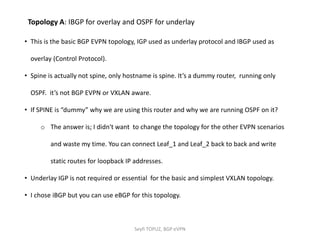
• This is the basic BGP EVPN topology, IGP used as underlay protocol and IBGP used as
overlay (Control Protocol).
• Spine is actually not spine, only hostname is spine. It’s a dummy router, running only
OSPF. it’s not BGP EVPN or VXLAN aware.
• If SPINE is “dummy” why we are using this router and why we are running OSPF on it?
o The answer is; I didn't want to change the topology for the other EVPN scenarios
and waste my time. You can connect Leaf_1 and Leaf_2 back to back and write
static routes for loopback IP addresses.
• Underlay IGP is not required or essential for the basic and simplest VXLAN topology.
• I chose iBGP but you can use eBGP for this topology.
Topology A: IBGP for overlay and OSPF for underlay
Seyfi TOPUZ, BGP eVPN
Leaf_1#sh inte vxl 1
Vxlan1 is up, line protocol is up (connected)
Source interface is Loopback1 and is active with 11.11.11.11
Flood Mode is headend with Flood List Source: EVPN
Remote MAC learning via EVPN
VNI mapping to VLANs
Static VLAN to VNI mapping is [10, 1001]
Headend replication flood vtep list is:
10 22.22.22.22
Leaf_1#sh vx vni
VNI to VLAN Mapping for Vxlan1
VNI VLAN Source Interface 802.1Q Tag
---------- ---------- ------------ --------------- ----------
1001 10 static Ethernet2 untagged
Vxlan1 10
Leaf_2#sh inte vxl 1
Vxlan1 is up, line protocol is up (connected)
Source interface is Loopback1 and is active with 22.22.22.22
Flood Mode is headend with Flood List Source: EVPN
Remote MAC learning via EVPN
VNI mapping to VLANs
Static VLAN to VNI mapping is [20, 1001]
Headend replication flood vtep list is:
20 11.11.11.11
Leaf_2#sh vx vni
VNI to VLAN Mapping for Vxlan1
VNI VLAN Source Interface 802.1Q Tag
---------- ---------- ------------ --------------- ----------
1001 20 static Ethernet2 untagged
Vxlan1 20
Topology A: IBGP for overlay and OSPF for underlay
Seyfi TOPUZ, BGP eVPN
Please note, VLAN 10 and VLAN 20 are in same bridge domain, VNI
Leaf_2#sh bgp evpn route-type mac-ip
Router identifier 2.2.2.2, local AS number 65100
Network Next Hop Metric LocPref Weight Path
* > RD: 1.1.1.1:10 mac-ip 0050.7966.6805
11.11.11.11 - 100 0 i
* > RD: 2.2.2.2:10 mac-ip 0050.7966.6806
- - - 0 i
RD and MAC mathed
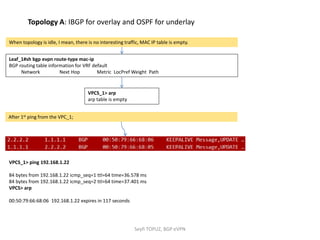
Leaf_1#sh bgp evpn route-type mac-ip
BGP routing table information for VRF default
Network Next Hop Metric LocPref Weight Path
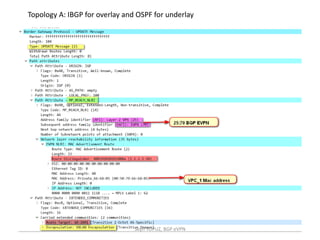
When topology is idle, I mean, there is no interesting traffic, MAC IP table is empty.
After 1st ping from the VPC_1;
VPCS_1> arp
arp table is empty
VPCS_1> ping 192.168.1.22
84 bytes from 192.168.1.22 icmp_seq=1 ttl=64 time=36.578 ms
84 bytes from 192.168.1.22 icmp_seq=2 ttl=64 time=37.401 ms
VPCS> arp
00:50:79:66:68:06 192.168.1.22 expires in 117 seconds
Topology A: IBGP for overlay and OSPF for underlay
Seyfi TOPUZ, BGP eVPN
Topology A: IBGP for overlay and OSPF for underlay
Seyfi TOPUZ, BGP eVPN
Topology A: IBGP for overlay and OSPF for underlay
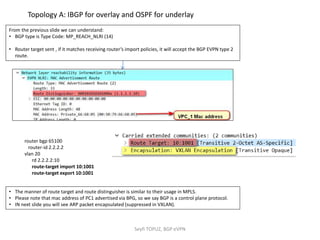
From the previous slide we can understand:
• BGP type is Type Code: MP_REACH_NLRI (14)
• Router target sent , if it matches receiving router’s import policies, it will accept the BGP EVPN type 2
route.
router bgp 65100
router-id 2.2.2.2
vlan 20
rd 2.2.2.2:10
route-target import 10:1001
route-target export 10:1001
• The manner of route target and route distinguisher is similar to their usage in MPLS.
• Please note that mac address of PC1 advertised via BPG, so we say BGP is a control plane protocol.
• IN next slide you will see ARP packet encapsulated (suppressed in VXLAN).
Seyfi TOPUZ, BGP eVPN
Topology A: IBGP for overlay and OSPF for underlay
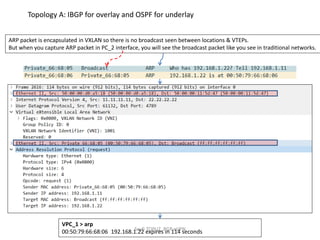
ARP packet is encapsulated in VXLAN so there is no broadcast seen between locations & VTEPs.
But when you capture ARP packet in PC_2 interface, you will see the broadcast packet like you see in traditional networks.
VPC_1 > arp
00:50:79:66:68:06 192.168.1.22 expires in 114 seconds
Seyfi TOPUZ, BGP eVPN
• If underlay routing protocol is not mandatory, why all vendors in all
tutorials use an underlay protocol?
o It’s used for scalability.
• Is the BGP RR required when you are using BGP for underlay routing
protocol ?
o BGP RR is required for iBGP to get rid of full mesh topology.
o If you are establishing eBGP between Spine and Leaf switches
BGP RR is not required.
o Route updates received from iBGP peers do not advertised to
other iBGP routers.
• There is nothing special to BGP EVPN about RR.
Topology A: IBGP for overlay and OSPF for underlay
Seyfi TOPUZ, BGP eVPN

VXLAN, BGP EVPN without myths and packet capture

  • 1.
    OSPF VXLAN, BGP EVPNwithout myths and packet capture Topology A: IBGP for overlay and OSPF for underlay 192.168.1.11 192.168.1.22 Seyfi TOPUZ, BGP eVPN
  • 2.
    Leaf_1 router bgp 65100 router-id1.1.1.1 no bgp default ipv4-unicast neighbor 2.2.2.2 remote-as 65100 neighbor 2.2.2.2 update-source Loopback0 neighbor 2.2.2.2 ebgp-multihop 4 neighbor 2.2.2.2 send-community ! vlan 10 rd 1.1.1.1:10 route-target import 10:1001 route-target export 10:1001 redistribute learned ! address-family evpn neighbor 2.2.2.2 activate ! interface Vxlan1 vxlan source-interface Loopback1 vxlan udp-port 4789 vxlan vlan 10 vni 1001 ! interface Ethernet2 switchport access vlan 10 Leaf_2 router bgp 65100 router-id 2.2.2.2 no bgp default ipv4-unicast neighbor 1.1.1.1 remote-as 65100 neighbor 1.1.1.1 update-source Loopback0 neighbor 1.1.1.1 ebgp-multihop 4 neighbor 1.1.1.1 send-community ! vlan 20 rd 2.2.2.2:10 route-target import 10:1001 route-target export 10:1001 redistribute learned ! address-family evpn neighbor 1.1.1.1 activate ! interface Vxlan1 vxlan source-interface Loopback1 vxlan udp-port 4789 vxlan vlan 20 vni 1001 ! interface Ethernet2 switchport access vlan 20 Spine router ospf 1 network 3.3.3.3/32 area 0.0.0.0 network 10.0.13.0/29 area 0.0.0.0 network 10.0.32.0/29 area 0.0.0.0 max-lsa 12000 ! Topology A: IBGP for overlay and OSPF for underlay Seyfi TOPUZ, BGP eVPN
  • 3.
    • This isthe basic BGP EVPN topology, IGP used as underlay protocol and IBGP used as overlay (Control Protocol). • Spine is actually not spine, only hostname is spine. It’s a dummy router, running only OSPF. it’s not BGP EVPN or VXLAN aware. • If SPINE is “dummy” why we are using this router and why we are running OSPF on it? o The answer is; I didn't want to change the topology for the other EVPN scenarios and waste my time. You can connect Leaf_1 and Leaf_2 back to back and write static routes for loopback IP addresses. • Underlay IGP is not required or essential for the basic and simplest VXLAN topology. • I chose iBGP but you can use eBGP for this topology. Topology A: IBGP for overlay and OSPF for underlay Seyfi TOPUZ, BGP eVPN
  • 4.
    Leaf_1#sh inte vxl1 Vxlan1 is up, line protocol is up (connected) Source interface is Loopback1 and is active with 11.11.11.11 Flood Mode is headend with Flood List Source: EVPN Remote MAC learning via EVPN VNI mapping to VLANs Static VLAN to VNI mapping is [10, 1001] Headend replication flood vtep list is: 10 22.22.22.22 Leaf_1#sh vx vni VNI to VLAN Mapping for Vxlan1 VNI VLAN Source Interface 802.1Q Tag ---------- ---------- ------------ --------------- ---------- 1001 10 static Ethernet2 untagged Vxlan1 10 Leaf_2#sh inte vxl 1 Vxlan1 is up, line protocol is up (connected) Source interface is Loopback1 and is active with 22.22.22.22 Flood Mode is headend with Flood List Source: EVPN Remote MAC learning via EVPN VNI mapping to VLANs Static VLAN to VNI mapping is [20, 1001] Headend replication flood vtep list is: 20 11.11.11.11 Leaf_2#sh vx vni VNI to VLAN Mapping for Vxlan1 VNI VLAN Source Interface 802.1Q Tag ---------- ---------- ------------ --------------- ---------- 1001 20 static Ethernet2 untagged Vxlan1 20 Topology A: IBGP for overlay and OSPF for underlay Seyfi TOPUZ, BGP eVPN Please note, VLAN 10 and VLAN 20 are in same bridge domain, VNI Leaf_2#sh bgp evpn route-type mac-ip Router identifier 2.2.2.2, local AS number 65100 Network Next Hop Metric LocPref Weight Path * > RD: 1.1.1.1:10 mac-ip 0050.7966.6805 11.11.11.11 - 100 0 i * > RD: 2.2.2.2:10 mac-ip 0050.7966.6806 - - - 0 i RD and MAC mathed
  • 5.
    Leaf_1#sh bgp evpnroute-type mac-ip BGP routing table information for VRF default Network Next Hop Metric LocPref Weight Path When topology is idle, I mean, there is no interesting traffic, MAC IP table is empty. After 1st ping from the VPC_1; VPCS_1> arp arp table is empty VPCS_1> ping 192.168.1.22 84 bytes from 192.168.1.22 icmp_seq=1 ttl=64 time=36.578 ms 84 bytes from 192.168.1.22 icmp_seq=2 ttl=64 time=37.401 ms VPCS> arp 00:50:79:66:68:06 192.168.1.22 expires in 117 seconds Topology A: IBGP for overlay and OSPF for underlay Seyfi TOPUZ, BGP eVPN
  • 6.
    Topology A: IBGPfor overlay and OSPF for underlay Seyfi TOPUZ, BGP eVPN
  • 7.
    Topology A: IBGPfor overlay and OSPF for underlay From the previous slide we can understand: • BGP type is Type Code: MP_REACH_NLRI (14) • Router target sent , if it matches receiving router’s import policies, it will accept the BGP EVPN type 2 route. router bgp 65100 router-id 2.2.2.2 vlan 20 rd 2.2.2.2:10 route-target import 10:1001 route-target export 10:1001 • The manner of route target and route distinguisher is similar to their usage in MPLS. • Please note that mac address of PC1 advertised via BPG, so we say BGP is a control plane protocol. • IN next slide you will see ARP packet encapsulated (suppressed in VXLAN). Seyfi TOPUZ, BGP eVPN
  • 8.
    Topology A: IBGPfor overlay and OSPF for underlay ARP packet is encapsulated in VXLAN so there is no broadcast seen between locations & VTEPs. But when you capture ARP packet in PC_2 interface, you will see the broadcast packet like you see in traditional networks. VPC_1 > arp 00:50:79:66:68:06 192.168.1.22 expires in 114 seconds Seyfi TOPUZ, BGP eVPN
  • 9.
    • If underlayrouting protocol is not mandatory, why all vendors in all tutorials use an underlay protocol? o It’s used for scalability. • Is the BGP RR required when you are using BGP for underlay routing protocol ? o BGP RR is required for iBGP to get rid of full mesh topology. o If you are establishing eBGP between Spine and Leaf switches BGP RR is not required. o Route updates received from iBGP peers do not advertised to other iBGP routers. • There is nothing special to BGP EVPN about RR. Topology A: IBGP for overlay and OSPF for underlay Seyfi TOPUZ, BGP eVPN