Virtual Extensible LAN VXLAN A Practical guide
to VXLAN solution Second Edition Toni Pasanen
install download
https://ebookmeta.com/product/virtual-extensible-lan-vxlan-a-
practical-guide-to-vxlan-solution-second-edition-toni-pasanen/
Download more ebook from https://ebookmeta.com
We believe these products will be a great fit for you. Click
the link to download now, or visit ebookmeta.com
to discover even more!
The Fast-Track Guide to VXLAN BGP EVPN Fabrics
Implement Today's Multi-Tenant Software-Defined
Networks 1st Edition Rene Cardona
https://ebookmeta.com/product/the-fast-track-guide-to-vxlan-bgp-
evpn-fabrics-implement-todays-multi-tenant-software-defined-
networks-1st-edition-rene-cardona/
How to Be Sick A Buddhist Inspired Guide for the
Chronically Ill and Their Caregivers Second Edition
Toni Bernhard
https://ebookmeta.com/product/how-to-be-sick-a-buddhist-inspired-
guide-for-the-chronically-ill-and-their-caregivers-second-
edition-toni-bernhard/
Collecting Qualitative Data A Practical Guide to
Textual Media and Virtual Techniques 1st Edition
Virginia Braun
https://ebookmeta.com/product/collecting-qualitative-data-a-
practical-guide-to-textual-media-and-virtual-techniques-1st-
edition-virginia-braun/
International Aspects of Recent Phenomena in Media and
Culture (2022) 1st Edition Martin A. M. Gansinger
https://ebookmeta.com/product/international-aspects-of-recent-
phenomena-in-media-and-culture-2022-1st-edition-martin-a-m-
gansinger/
Wired and Wireless Seamless Access Systems for Public
Infrastructure 1st Edition Tetsuya Kawanishi
https://ebookmeta.com/product/wired-and-wireless-seamless-access-
systems-for-public-infrastructure-1st-edition-tetsuya-kawanishi/
Particles Fields and Forces A Conceptual Guide to
Quantum Field Theory and the Standard Model 2nd Edition
Wouter Schmitz
https://ebookmeta.com/product/particles-fields-and-forces-a-
conceptual-guide-to-quantum-field-theory-and-the-standard-
model-2nd-edition-wouter-schmitz/
Perfect Pending Witches of Gales Haven 1 1st Edition
Lucia Ashta Ashta Lucia
https://ebookmeta.com/product/perfect-pending-witches-of-gales-
haven-1-1st-edition-lucia-ashta-ashta-lucia/
He Is Our Cousin Cousin A Quaker Family s History from
1660 to the Present Day 1st Edition Antony Barlow
https://ebookmeta.com/product/he-is-our-cousin-cousin-a-quaker-
family-s-history-from-1660-to-the-present-day-1st-edition-antony-
barlow/
The Agile Imperative: Teams, Organizations and Society
under Reconstruction? 1st Edition Sabine Pfeiffer
https://ebookmeta.com/product/the-agile-imperative-teams-
organizations-and-society-under-reconstruction-1st-edition-
sabine-pfeiffer/
Modern C++ for Absolute Beginners Slobodan Dmitrovi■
https://ebookmeta.com/product/modern-c-for-absolute-beginners-
slobodan-dmitrovic/
Virtual Extensible LAN (VXLAN)
A Practical guide to VXLAN solution
Toni Pasanen, CCIE 28158
ii
iii
Copyright © Toni Pasanen, All rights reserved.
Revision History
August 2019: First Edition
October 2019: Second Edition
The second edition includes additional chapter 19: “Tenant
Routed Multicast (TRM)”
October 2019: Editing numering of examples and figures (ch. 15-17).
November 2019: Editing numering of examples and figures. (ch. 1-14, 18-19)
iv
About the Author:
Toni Pasanen. CCIE No. 28158 (Routing and Switching), Presales Engineer at Fujitsu
Finland. Toni started his IT-carrier in 1998 at Tieto, where he worked as a Service Desk
Specialist moving via LAN team to Data Center team as a 3rd. Level Network Specialist. Toni
joined Teleware (Cisco Learning partner) in 2004, where he spent two years teaching network
technologies focusing routing/switching and MPLS technologies. Toni joined Tieto again in
2006, where he spent next six years as a Network Architect before joining Fujitsu. In his
current role, Toni work closely with customers helping them in selecting the right network
solutions not only from the technology perspective but also from the business perspective.
Dedications
To my lovely wife Tiina, thanks for pushing me forward when I was about the throw this
procject out of the window (more than twice).
v
vi
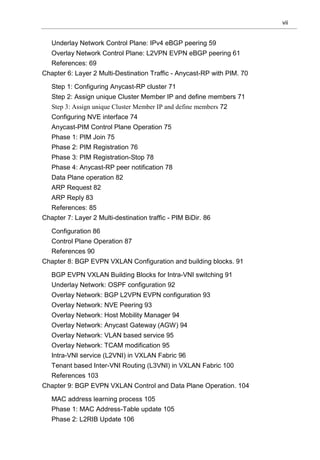
Table of Contents
Chapter 1: Underlay Network – OSPF Operation 1
Introduction 1
OSPF 2
Link-State Database (LSDB) optimization 3
Shortest-Path First (SPF)/Dijkstra Algorithm 8
SPF Run – Phase I: Building a Shortest-Path Tree 9
First iteration round 10
Second iteration round 11
Third iteration round 12
Fourth iteration round 13
Fifth iteration round 14
Sixth iteration round 15
Seventh iteration round 16
SPF Run – Phase II: Adding Leafs to Shortest-Path Tree 17
References: 19
Chapter 2: Underlay Network – Comparison of OSPF and IS-IS 20
Scenario-1: Interface loopback 50 down on Leaf-101 (IS-IS) 22
Scenario-2: Interface loopback 50 down on Leaf-101 (OSPF) 24
Scenario-3: OSPF Incremental SPF – L55 Down on Leaf-101 (Stub) 26
Scenario-4: OSPF Incremental SPF – Interface g0/3 Down on Spine-12 (transit link
does not participate in SPT) 27
Scenario-5: IS-IS SPF – Interface g0/3 Down on Spine-12 (Full SPF computation)
28
Scenario-6: IS-IS Incremental SPF – Interface g0/3 Down on Spine-12 29
(transit link does not participate in SPT) 29
Conclusion 30
Chapter 3: Underlay Network: iBGP in Underlay Network 32
Next-Hop-Self consideration 36
Case-1: Next-hop-self is changed by RR Spine-11. 36
Case-2: RR Spine-11 does not change Next-hop-self. 37
Chapter 4: Underlay Network: Two-AS eBGP 42
Underlay Network Control Plane eBGP 42
Overlay Network Control Plane: eBGP 46
References: 58
Chapter 5: eBGP as an Underlay Network Routing Protocol: Multi-AS eBGP 59
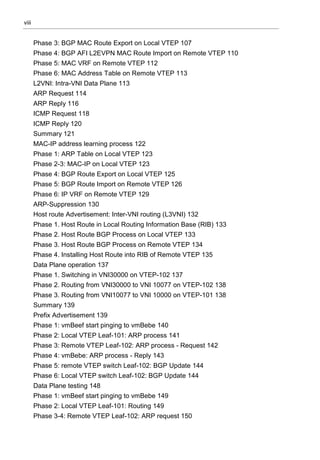
vii
Underlay Network Control Plane: IPv4 eBGP peering 59
Overlay Network Control Plane: L2VPN EVPN eBGP peering 61
References: 69
Chapter 6: Layer 2 Multi-Destination Traffic - Anycast-RP with PIM. 70
Step 1: Configuring Anycast-RP cluster 71
Step 2: Assign unique Cluster Member IP and define members 71
Step 3: Assign unique Cluster Member IP and define members 72
Configuring NVE interface 74
Anycast-PIM Control Plane Operation 75
Phase 1: PIM Join 75
Phase 2: PIM Registration 76
Phase 3: PIM Registration-Stop 78
Phase 4: Anycast-RP peer notification 78
Data Plane operation 82
ARP Request 82
ARP Reply 83
References: 85
Chapter 7: Layer 2 Multi-destination traffic - PIM BiDir. 86
Configuration 86
Control Plane Operation 87
References 90
Chapter 8: BGP EVPN VXLAN Configuration and building blocks. 91
BGP EVPN VXLAN Building Blocks for Intra-VNI switching 91
Underlay Network: OSPF configuration 92
Overlay Network: BGP L2VPN EVPN configuration 93
Overlay Network: NVE Peering 93
Overlay Network: Host Mobility Manager 94
Overlay Network: Anycast Gateway (AGW) 94
Overlay Network: VLAN based service 95
Overlay Network: TCAM modification 95
Intra-VNI service (L2VNI) in VXLAN Fabric 96
Tenant based Inter-VNI Routing (L3VNI) in VXLAN Fabric 100
References 103
Chapter 9: BGP EVPN VXLAN Control and Data Plane Operation. 104
MAC address learning process 105
Phase 1: MAC Address-Table update 105
Phase 2: L2RIB Update 106
viii
Phase 3: BGP MAC Route Export on Local VTEP 107
Phase 4: BGP AFI L2EVPN MAC Route Import on Remote VTEP 110
Phase 5: MAC VRF on Remote VTEP 112
Phase 6: MAC Address Table on Remote VTEP 113
L2VNI: Intra-VNI Data Plane 113
ARP Request 114
ARP Reply 116
ICMP Request 118
ICMP Reply 120
Summary 121
MAC-IP address learning process 122
Phase 1: ARP Table on Local VTEP 123
Phase 2-3: MAC-IP on Local VTEP 123
Phase 4: BGP Route Export on Local VTEP 125
Phase 5: BGP Route Import on Remote VTEP 126
Phase 6: IP VRF on Remote VTEP 129
ARP-Suppression 130
Host route Advertisement: Inter-VNI routing (L3VNI) 132
Phase 1. Host Route in Local Routing Information Base (RIB) 133
Phase 2. Host Route BGP Process on Local VTEP 133
Phase 3. Host Route BGP Process on Remote VTEP 134
Phase 4. Installing Host Route into RIB of Remote VTEP 135
Data Plane operation 137
Phase 1. Switching in VNI30000 on VTEP-102 137
Phase 2. Routing from VNI30000 to VNI 10077 on VTEP-102 138
Phase 3. Routing from VNI10077 to VNI 10000 on VTEP-101 138
Summary 139
Prefix Advertisement 139
Phase 1: vmBeef start pinging to vmBebe 140
Phase 2: Local VTEP Leaf-101: ARP process 141
Phase 3: Remote VTEP Leaf-102: ARP process - Request 142
Phase 4: vmBebe: ARP process - Reply 143
Phase 5: remote VTEP switch Leaf-102: BGP Update 144
Phase 6: Local VTEP switch Leaf-102: BGP Update 144
Data Plane testing 148
Phase 1: vmBeef start pinging to vmBebe 149
Phase 2: Local VTEP Leaf-101: Routing 149
Phase 3-4: Remote VTEP Leaf-102: ARP request 150
ix
Phase 5: vmBebe: ARP Reply 151
Phase 6: Remote VTEP Leaf-102: ICMP Request forwarding 152
Phase 7: vmBebe: ICMP reply 152
Phase 8-9: Remote VTEP Leaf-102: Routing decision and ICMP reply 152
Phase 10-11: Local VTEP Leaf-101: Routing decision and ICMP reply 153
Summary 156
References 157
Chapter 10: VXLAN fabric External Connections 158
eBGP Configuration between Border Leaf-102 and Ext-Ro01 158
Starting point 160
Chapter 11: Multihoming with vPC 190
Virtual Port Channel Configuration 190
Some other consideration for vPC: 197
VTEP redundancy with vPC 198
Advertising Primary IP address 204
References: 210
Chapter 12: Multihoming - vPC and Graceful Insertion and Removal (GIR) operation
211
Loopback addressing 211
Graceful Insertion and Removal (GIR) 212
Verifications. 213
Example-2 summary: BGP EVPN peering and NVE1 using the same Loopback
interface. 218
Conclusion 219
References: 220
Chapter 13: Using vPC Peer Link as an Underlay Backup Path 221
Configuration 222
Verification 223
References: 227
Chapter 14: VXLAN Fabric Firewall Implementation 228
Protected segment 229
Non-Protected segment 230
Connectivity Testing 238
References: 240
Chapter 15: EVPN ESI Multihoming 241
Introduction 241
x
Ethernet Segment Identifier (ESI) and Port-Channel 242
Designated Forwarder (DF) 243
Designated Forwarder 246
References: 248
Chapter 16: EVPN ESI Multihoming - Fast Convergence and Load Balancing 249
Ethernet A-D per ES route - Fast Convergence in the all-Active mode 249
Fast Convergence 254
Load Balancing (Aliasing) 257
Summary 258
References: 259
Chapter 17: EVPN ESI Multihoming - Data Flows and link failures 260
Introduction 260
Intra-VNI (L2VNI): Unicast Traffic 262
Scenario 1: Link E1/2 down on Leaf-102 262
Scenario 2: Core link down on Leaf-102. 265
Intra-VNI (L2VNI): Broadcast, Unknown Unicast and Multicast (BUM) traffic 266
Scenario 1: Traffic flow from Designated Forwarder 266
Scenario 2: Traffic flow from non-Designated Forwarder 267
CHAPTER 18: VXLAN EVPN Multi-Site 269
Shared EVPN domain limitations 269
EVPN Multi-Site Architecture Introduction 270
Intra-Site EVPN Domain (Fabric) 271
Intra-Site NVE peering and VXLAN tunnels 272
Summary 278
Shared Common EVPN Domain Connections 278
Border Gateway setup 279
Multi-Destination traffic forwarding 287
Designated Forwarder 287
Ingress-Replication 293
Fabric Link Failure 299
Normal State 300
Fabric-Link Failure 302
Fabric-Link Recovery 304
DCI-Link Failure 307
Normal State 308
DCI Link Failure 309
DCI Link Recovery 310
xi
References 312
Chapter 19: Tenant Routed Multicast in VXLAN Fabric 313
Underlay Multicast Routing 315
PIM neighbor establishment process 315
Shared Multicast Tree for Intra-VN 316
Joining to Intra-VN Shared Tree 316
Joining to Intra-VN Source-Specific Tree 318
Tenant Routed Multicast (TRM) Configuration 325
Define Anycast-RP 325
Enable TRM on leaf switches 325
Define the tenant-based Multicast group for Multicast traffic. 326
Prevent PIM neighbor establishment within a specific VLAN 326
BGP afi IPv4 MVPN peering (Leaf) 327
BGP afi IPv4 MVPN peering (Spine) 327
Tenant Routed Multicast (TRM) operation 328
Shared/Source-Specific tree for Inter-VN 328
Verification 330
TRM Control Plane operation. 332
IGMP membership report 332
MVPN Source-Active Auto-Discovery 333
Data Plane Operation 340
Ingress leaf operation 340
Spine operation 341
Egress leaf operation 341
Summary 342
References 343
xii
About this book
This book is based on my personal blog "The Network Times" (nwktimes.blogspot.com). The
first quarter of the book focuses on the Underlay Network solutions used in VXLAN fabric. It
starts by explaining the operation of OSPF, focusing on the Dijkstra algorithm and the Shortest
Path Tree calculation process. Then it discusses the differences between the OSPF and IS-IS
routing protocols from the Underlay Network perspective. The first part also introduces three
BGP based Underlay Network routing solutions with Single-AS solution, Dual-AS solution,
and Multi-AS solution. After the Unicast Routing section, this book explains the Multicast
Routing solution used for L2VNI specific L2BUM traffic forwarding by introducing the
Anycast-RP with PIM and the PIM BiDir solutions.
The focus of the second quarter is VXLAN with BGP EVPN Control Plane. This part of the
book explains the basic building blocks and configurations needed for both Layer2 and Layer3
services. It also discusses the BGP EVPN Control Plane operation by showing how a BGP
EVPN NLRI information is advertised within a VXLAN fabric and how this information is
used in Data Plane.
The third quarter discusses a multi-homing solution with vPC by explaining the vPC Multi-
homing, vPC and GIR, and vPC Peer-Link as an Underlay Network Backup Path. In addition
to vPC this section explains how to implement Firewall into VXLAN Fabric.
The Last quarter of this book starts by explains the standard based EVPN ESI Multi-homing
solution. It also discusses the Data Center Interconnect (DCI) solution based on the EVPN
Multi-Site architecture. In addition, this part introduces Tenant Routed Multicast (TRM)
solution.
Each chapter includes various configuration and verification examples as well as traffic
captures. The only physical device used in labs is my personal computer and the example labs
are done by using both Cisco "Virtual Internet Routing Lab" (VIRL) and Emulated Virtual
Environment - Next Generation (EVE-NG).
Disclaimers
The content of this book is based on the authors own experience and testing results. This book
is meant to be neither a Design nor Implementation guide but rather it tries to give to readers a
basic understanding of VXLAN. After reading this book, readers should do their own
technology validation before using it in production environment.
1
Chapter 1: Underlay Network – OSPF Operation
Introduction
The main job for the Underlay Network from the EVPN VXLAN Fabric perspective is to offer
resilient IP connectivity between VXLAN Tunnel End Point (VTEP) devices. It can also be
used for Layer2 BUM (Broadcast, Unknown Unicast, and Multicast) traffic forwarding though
this requires a Multicast Routing on an Underlay Network. The common routing protocol
choices for the Underlay Network are OSPF and IS-IS, which are Link State Protocols and
BGP, which in turn is a Path Vector Protocol.
The reason why this chapter is included in the content of this book is that by understanding the
operation of the Link State Protocol it is hopefully easier to choose between the BGP and IGP
when selecting routing protocol running in an Underlay Network.
This chapter explains the operation of the Dijkstra/Shortest Path First (SPF) algorithm that is
used by Link State Protocols for calculating the Shortest-Path Tree. This chapter also discusses
how the Shortest-Path Tree calculation process can be optimized by disabling the
advertisement of unnecessary LSU information. In addition, this chapter illustrates how
devices exchange the Link State information and based on that how they calculate the Shortest-
Path Tree.
2
OSPF
OSPF router exchanges Link State Update (LSU) packets with adjacent routers. LSU packets
carries the Link State Advertisement (LSA) where router describes its links. After successful
validation of the received LSU, the router stores the Link descriptions into OSPF Link-State
Database (LSDB) and floods it to adjacent routers. This way each router has a common
topology view of an OSPF Area. After the LSDB synchronization process, routers run the
Dijkstra algorithm to find the shortest/best path to each destination. The terms Dijkstra/SPF are
used interchangeably in this chapter.
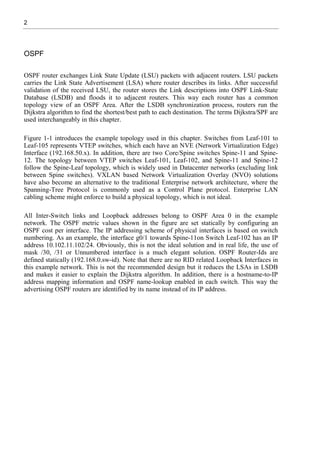
Figure 1-1 introduces the example topology used in this chapter. Switches from Leaf-101 to
Leaf-105 represents VTEP switches, which each have an NVE (Network Virtualization Edge)
Interface (192.168.50.x). In addition, there are two Core/Spine switches Spine-11 and Spine-
12. The topology between VTEP switches Leaf-101, Leaf-102, and Spine-11 and Spine-12
follow the Spine-Leaf topology, which is widely used in Datacenter networks (excluding link
between Spine switches). VXLAN based Network Virtualization Overlay (NVO) solutions
have also become an alternative to the traditional Enterprise network architecture, where the
Spanning-Tree Protocol is commonly used as a Control Plane protocol. Enterprise LAN
cabling scheme might enforce to build a physical topology, which is not ideal.
All Inter-Switch links and Loopback addresses belong to OSPF Area 0 in the example
network. The OSPF metric values shown in the figure are set statically by configuring an
OSPF cost per interface. The IP addressing scheme of physical interfaces is based on switch
numbering. As an example, the interface g0/1 towards Spine-11on Switch Leaf-102 has an IP
address 10.102.11.102/24. Obviously, this is not the ideal solution and in real life, the use of
mask /30, /31 or Unnumbered interface is a much elegant solution. OSPF Router-Ids are
defined statically (192.168.0.sw-id). Note that there are no RID related Loopback Interfaces in
this example network. This is not the recommended design but it reduces the LSAs in LSDB
and makes it easier to explain the Dijkstra algorithm. In addition, there is a hostname-to-IP
address mapping information and OSPF name-lookup enabled in each switch. This way the
advertising OSPF routers are identified by its name instead of its IP address.
3
Figure 1-1: Underlay Network Topology and Interface Addressing.
Link-State Database (LSDB) optimization
The default OSPF network type in the Ethernet link is Broadcast. This means that routers
connected to link select the Designated Router (DR) and Backup-designated Router (BDR)
among themselves. Non-Designated routers send Router LSAs only to DR, which in turn
floods them to other routers in the segment as a Network LSA (Type-2).
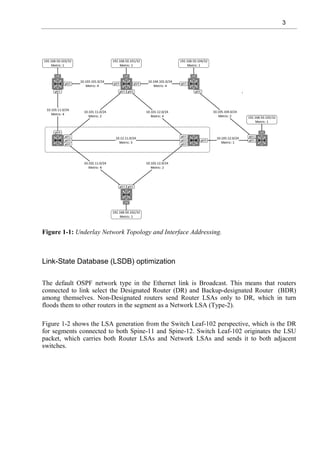
Figure 1-2 shows the LSA generation from the Switch Leaf-102 perspective, which is the DR
for segments connected to both Spine-11 and Spine-12. Switch Leaf-102 originates the LSU
packet, which carries both Router LSAs and Network LSAs and sends it to both adjacent
switches.
4
Figure 1-2: Router LSA and Network LSAs originated by Leaf-102 (DR).
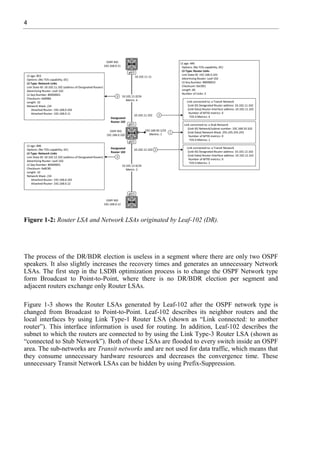
The process of the DR/BDR election is useless in a segment where there are only two OSPF
speakers. It also slightly increases the recovery times and generates an unnecessary Network
LSAs. The first step in the LSDB optimization process is to change the OSPF Network type
form Broadcast to Point-to-Point, where there is no DR/BDR election per segment and
adjacent routers exchange only Router LSAs.
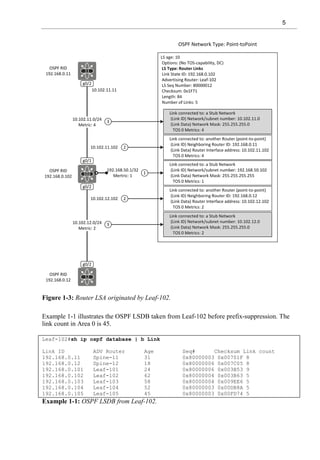
Figure 1-3 shows the Router LSAs generated by Leaf-102 after the OSPF network type is
changed from Broadcast to Point-to-Point. Leaf-102 describes its neighbor routers and the
local interfaces by using Link Type-1 Router LSA (shown as “Link connected: to another
router”). This interface information is used for routing. In addition, Leaf-102 describes the
subnet to which the routers are connected to by using the Link Type-3 Router LSA (shown as
“connected to Stub Network”). Both of these LSAs are flooded to every switch inside an OSPF
area. The sub-networks are Transit networks and are not used for data traffic, which means that
they consume unnecessary hardware resources and decreases the convergence time. These
unnecessary Transit Network LSAs can be hidden by using Prefix-Suppression.
5
Figure 1-3: Router LSA originated by Leaf-102.
Example 1-1 illustrates the OSPF LSDB taken from Leaf-102 before prefix-suppression. The
link count in Area 0 is 45.
Leaf-102#sh ip ospf database | b Link
Link ID ADV Router Age Seq# Checksum Link count
192.168.0.11 Spine-11 31 0x80000003 0x00701F 8
192.168.0.12 Spine-12 18 0x80000006 0x007C05 8
192.168.0.101 Leaf-101 24 0x80000006 0x003B53 9
192.168.0.102 Leaf-102 62 0x80000004 0x003B63 5
192.168.0.103 Leaf-103 58 0x80000004 0x009EE6 5
192.168.0.104 Leaf-104 52 0x80000003 0x00DB8A 5
192.168.0.105 Leaf-105 45 0x80000003 0x00FD74 5
Example 1-1: OSPF LSDB from Leaf-102.
6
Example 1-2 shows the routing table of switch 102 before prefix-suppression. Each Transit
network is learned via OSPF.
Leaf-102#sh ip route ospf
<snipped>
10.0.0.0/8 is variably subnetted, 12 subnets, 2 masks
O 10.12.11.0/24 [110/4] via 10.102.12.12, 00:32:53, GigabitEthernet0/2
O 10.101.11.0/24 [110/6] via 10.102.12.12, 00:33:07, GigabitEthernet0/2
[110/6] via 10.102.11.11, 00:33:07, GigabitEthernet0/1
O 10.101.12.0/24 [110/6] via 10.102.12.12, 00:32:53, GigabitEthernet0/2
O 10.103.11.0/24 [110/8] via 10.102.12.12, 00:33:07, GigabitEthernet0/2
[110/8] via 10.102.11.11, 00:33:07, GigabitEthernet0/1
O 10.103.101.0/24
[110/10] via 10.102.12.12, 00:32:43, GigabitEthernet0/2
[110/10] via 10.102.11.11, 00:32:43, GigabitEthernet0/1
O 10.104.101.0/24
[110/9] via 10.102.12.12, 00:33:31, GigabitEthernet0/2
O 10.105.12.0/24 [110/3] via 10.102.12.12, 00:32:53, GigabitEthernet0/2
O 10.105.104.0/24
[110/5] via 10.102.12.12, 00:33:31, GigabitEthernet0/2
192.168.50.0/32 is subnetted, 5 subnets
O 192.168.50.101 [110/7] via 10.102.12.12, 01:30:05, GigabitEthernet0/2
[110/7] via 10.102.11.11, 01:29:25, GigabitEthernet0/1
O 192.168.50.103 [110/9] via 10.102.11.11, 01:29:25, GigabitEthernet0/1
O 192.168.50.104 [110/6] via 10.102.12.12, 01:29:35, GigabitEthernet0/2
O 192.168.50.105 [110/4] via 10.102.12.12, 01:29:45, GigabitEthernet0/2
Example 1-2: OSPF routes in RIB of Leaf-102.
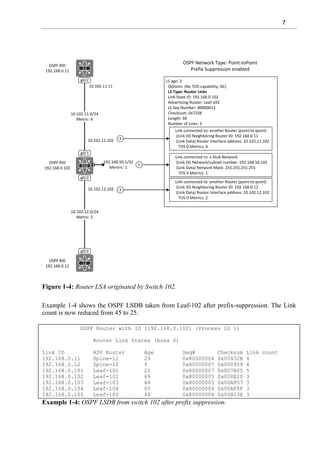
Figure 1-4 shows the LSU packet and LSAs originated by Leaf-102 when the OSPF network
type is changed to Point-to-Point in all Inter-Switch Links and the Transit networks are
excluded from the LSAs by using prefix-suppression option. When these changes are done in
all OSPF switches, the LSDB optimization is ready. Example 1-3 shows the OSPF
configuration related to LSAs optimization.
Leaf-102(config)# interface g0/1
Leaf-102(config-if)# ip ospf network point-to-point
Leaf-102(config-if)# ip ospf prefix-suppression
Example 1-3: Leaf-102 Interface g0/1 configuration.
7
Figure 1-4: Router LSA originated by Switch 102.
Example 1-4 shows the OSPF LSDB taken from Leaf-102 after prefix-suppression. The Link
count is now reduced from 45 to 25.
OSPF Router with ID (192.168.0.102) (Process ID 1)
Router Link States (Area 0)
Link ID ADV Router Age Seq# Checksum Link count
192.168.0.11 Spine-11 29 0x80000004 0x00432B 4
192.168.0.12 Spine-12 9 0x80000007 0x000959 4
192.168.0.101 Leaf-101 21 0x80000007 0x007B05 5
192.168.0.102 Leaf-102 69 0x80000005 0x008E2D 3
192.168.0.103 Leaf-103 68 0x80000005 0x00A857 3
192.168.0.104 Leaf-104 65 0x80000004 0x00AF8F 3
192.168.0.105 Leaf-105 44 0x80000004 0x00B13E 3
Example 1-4: OSPF LSDB from switch 102 after prefix suppression.
8
Example 1-5 shows that there are no Transit networks after the prefix-suppression in Leaf-102
Routing Information Base (RIB). The highlighted portion of example 1-5 shows that even
though the local Transit networks and related IP addresses are hidden from adjacent switches,
they still exist in the local RIB.
Leaf-102#sh ip route ospf
<snipped>
Gateway of last resort is not set
10.0.0.0/8 is variably subnetted, 4 subnets, 2 masks
C 10.102.11.0/24 is directly connected, GigabitEthernet0/1
L 10.102.11.102/32 is directly connected, GigabitEthernet0/1
C 10.102.12.0/24 is directly connected, GigabitEthernet0/2
L 10.102.12.102/32 is directly connected, GigabitEthernet0/2
192.168.50.0/32 is subnetted, 5 subnets
O 192.168.50.101 [110/7] via 10.102.12.12, 00:28:15, GigabitEthernet0/2
[110/7] via 10.102.11.11, 00:27:55, GigabitEthernet0/1
C 192.168.50.102 is directly connected, Loopback50
O 192.168.50.103 [110/9] via 10.102.11.11, 00:27:55, GigabitEthernet0/1
O 192.168.50.104 [110/6] via 10.102.12.12, 00:28:05, GigabitEthernet0/2
O 192.168.50.105 [110/4] via 10.102.12.12, 00:28:05, GigabitEthernet0/2
Example 1-5: Switch 102 Interface g0/1 configuration.
Shortest-Path First (SPF)/Dijkstra Algorithm
Dijkstra/SPF algorithm is used for calculating a Shortest-Path Tree (SPT) topology in OSPF
Area. A router starts the process by setting itself as a root of the tree. At the first stage, the
router builds a Shortest-Path Tree between routers by using the Type-1 Link Description
(point-to-point) which describes links to neighbor routers in Router LSA. When the Shortest-
Path Tree is formed, the router calculates the distance to subnets connected to each router by
using the Link Type-3 (Stub) Link Description in Router LSA.
Routers have two lists related to SPT calculation. The Candidate List (also known as a
Tentative List) is the list that includes all routers that are currently examined by the router. The
Tree List (also called Path or Known List) is the list, which includes all the routers
participating in a final Shortest-Path Tree. In addition, a Link State Database (LSDB) is a
source from where the information is pulled to calculation and actually it is sometimes called
the Unknown List.
The next section describes the SPT calculation process from the switch Leaf-102 perspective.
9
SPF Run – Phase I: Building a Shortest-Path Tree
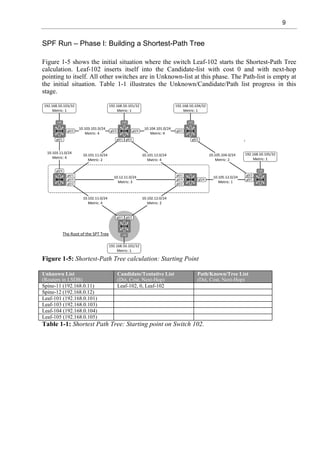
Figure 1-5 shows the initial situation where the switch Leaf-102 starts the Shortest-Path Tree
calculation. Leaf-102 inserts itself into the Candidate-list with cost 0 and with next-hop
pointing to itself. All other switches are in Unknown-list at this phase. The Path-list is empty at
the initial situation. Table 1-1 illustrates the Unknown/Candidate/Path list progress in this
stage.
Figure 1-5: Shortest-Path Tree calculation: Starting Point
Unknown List
(Routers in LSDB)
Candidate/Tentative List
(Dst, Cost, Next-Hop)
Path/Known/Tree List
(Dst, Cost, Next-Hop)
Spine-11 (192.168.0.11) Leaf-102, 0, Leaf-102
Spine-12 (192.168.0.12)
Leaf-101 (192.168.0.101)
Leaf-103 (192.168.0.103)
Leaf-104 (192.168.0.104)
Leaf-105 (192.168.0.105)
Table 1-1: Shortest Path Tree: Starting point on Switch 102.
10
First iteration round
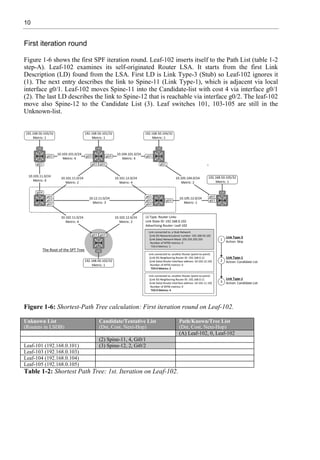
Figure 1-6 shows the first SPF iteration round. Leaf-102 inserts itself to the Path List (table 1-2
step-A). Leaf-102 examines its self-originated Router LSA. It starts from the first Link
Description (LD) found from the LSA. First LD is Link Type-3 (Stub) so Leaf-102 ignores it
(1). The next entry describes the link to Spine-11 (Link Type-1), which is adjacent via local
interface g0/1. Leaf-102 moves Spine-11 into the Candidate-list with cost 4 via interface g0/1
(2). The last LD describes the link to Spine-12 that is reachable via interface g0/2. The leaf-102
move also Spine-12 to the Candidate List (3). Leaf switches 101, 103-105 are still in the
Unknown-list.
Figure 1-6: Shortest-Path Tree calculation: First iteration round on Leaf-102.
Unknown List
(Routers in LSDB)
Candidate/Tentative List
(Dst, Cost, Next-Hop)
Path/Known/Tree List
(Dst, Cost, Next-Hop)
(A) Leaf-102, 0, Leaf-102
(2) Spine-11, 4, Gi0/1
Leaf-101 (192.168.0.101) (3) Spine-12, 2, Gi0/2
Leaf-103 (192.168.0.103)
Leaf-104 (192.168.0.104)
Leaf-105 (192.168.0.105)
Table 1-2: Shortest Path Tree: 1st. Iteration on Leaf-102.
11
Second iteration round
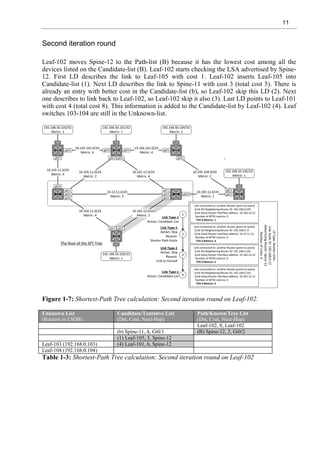
Leaf-102 moves Spine-12 to the Path-list (B) because it has the lowest cost among all the
devices listed on the Candidate-list (B). Leaf-102 starts checking the LSA advertised by Spine-
12. First LD describes the link to Leaf-105 with cost 1. Leaf-102 inserts Leaf-105 into
Candidate-list (1). Next LD describes the link to Spine-11 with cost 3 (total cost 5). There is
already an entry with better cost in the Candidate-list (b), so Leaf-102 skip this LD (2). Next
one describes to link back to Leaf-102, so Leaf-102 skip it also (3). Last LD points to Leaf-101
with cost 4 (total cost 8). This information is added to the Candidate-list by Leaf-102 (4). Leaf
switches 103-104 are still in the Unknown-list.
Figure 1-7: Shortest-Path Tree calculation: Second iteration round on Leaf-102.
Unknown List
(Routers in LSDB)
Candidate/Tentative List
(Dst, Cost, Next-Hop)
Path/Known/Tree List
(Dst, Cost, Next-Hop)
Leaf-102, 0, Leaf-102
(b) Spine-11, 4, Gi0/1 (B) Spine-12, 2, Gi0/2
(1) Leaf-105, 3, Spine-12
Leaf-103 (192.168.0.103) (4) Leaf-101, 6, Spine-12
Leaf-104 (192.168.0.104)
Table 1-3: Shortest-Path Tree calculation: Second iteration round on Leaf-102
12
Third iteration round
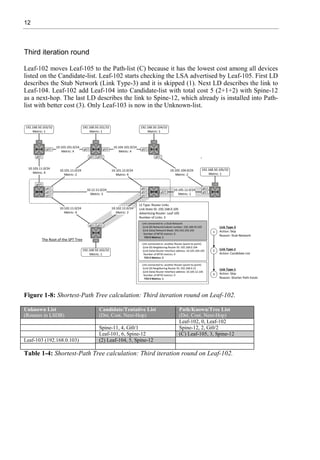
Leaf-102 moves Leaf-105 to the Path-list (C) because it has the lowest cost among all devices
listed on the Candidate-list. Leaf-102 starts checking the LSA advertised by Leaf-105. First LD
describes the Stub Network (Link Type-3) and it is skipped (1). Next LD describes the link to
Leaf-104. Leaf-102 add Leaf-104 into Candidate-list with total cost 5 (2+1+2) with Spine-12
as a next-hop. The last LD describes the link to Spine-12, which already is installed into Path-
list with better cost (3). Only Leaf-103 is now in the Unknown-list.
Figure 1-8: Shortest-Path Tree calculation: Third iteration round on Leaf-102.
Unknown List
(Routers in LSDB)
Candidate/Tentative List
(Dst, Cost, Next-Hop)
Path/Known/Tree List
(Dst, Cost, Next-Hop)
Leaf-102, 0, Leaf-102
Spine-11, 4, Gi0/1 Spine-12, 2, Gi0/2
Leaf-101, 6, Spine-12 (C) Leaf-105, 3, Spine-12
Leaf-103 (192.168.0.103) (2) Leaf-104, 5, Spine-12
Table 1-4: Shortest-Path Tree calculation: Third iteration round on Leaf-102.
13
Fourth iteration round
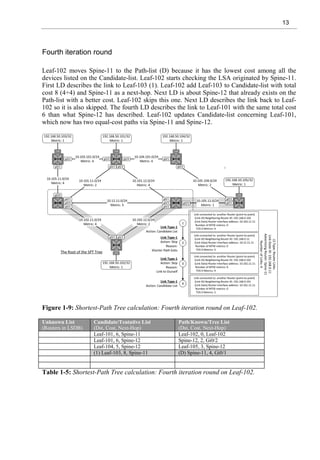
Leaf-102 moves Spine-11 to the Path-list (D) because it has the lowest cost among all the
devices listed on the Candidate-list. Leaf-102 starts checking the LSA originated by Spine-11.
First LD describes the link to Leaf-103 (1). Leaf-102 add Leaf-103 to Candidate-list with total
cost 8 (4+4) and Spine-11 as a next-hop. Next LD is about Spine-12 that already exists on the
Path-list with a better cost. Leaf-102 skips this one. Next LD describes the link back to Leaf-
102 so it is also skipped. The fourth LD describes the link to Leaf-101 with the same total cost
6 than what Spine-12 has described. Leaf-102 updates Candidate-list concerning Leaf-101,
which now has two equal-cost paths via Spine-11 and Spine-12.
Figure 1-9: Shortest-Path Tree calculation: Fourth iteration round on Leaf-102.
Unknown List
(Routers in LSDB)
Candidate/Tentative List
(Dst, Cost, Next-Hop)
Path/Known/Tree List
(Dst, Cost, Next-Hop)
Leaf-101, 6, Spine-11 Leaf-102, 0, Leaf-102
Leaf-101, 6, Spine-12 Spine-12, 2, Gi0/2
Leaf-104, 5, Spine-12 Leaf-105, 3, Spine-12
(1) Leaf-103, 8, Spine-11 (D) Spine-11, 4, Gi0/1
Table 1-5: Shortest-Path Tree calculation: Fourth iteration round on Leaf-102.
14
Fifth iteration round
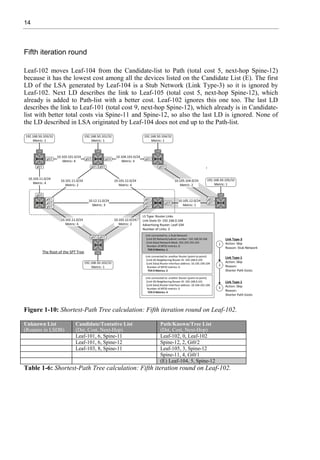
Leaf-102 moves Leaf-104 from the Candidate-list to Path (total cost 5, next-hop Spine-12)
because it has the lowest cost among all the devices listed on the Candidate List (E). The first
LD of the LSA generated by Leaf-104 is a Stub Network (Link Type-3) so it is ignored by
Leaf-102. Next LD describes the link to Leaf-105 (total cost 5, next-hop Spine-12), which
already is added to Path-list with a better cost. Leaf-102 ignores this one too. The last LD
describes the link to Leaf-101 (total cost 9, next-hop Spine-12), which already is in Candidate-
list with better total costs via Spine-11 and Spine-12, so also the last LD is ignored. None of
the LD described in LSA originated by Leaf-104 does not end up to the Path-list.
Figure 1-10: Shortest-Path Tree calculation: Fifth iteration round on Leaf-102.
Unknown List
(Routers in LSDB)
Candidate/Tentative List
(Dst, Cost, Next-Hop)
Path/Known/Tree List
(Dst, Cost, Next-Hop)
Leaf-101, 6, Spine-11 Leaf-102, 0, Leaf-102
Leaf-101, 6, Spine-12 Spine-12, 2, Gi0/2
Leaf-103, 8, Spine-11 Leaf-105, 3, Spine-12
Spine-11, 4, Gi0/1
(E) Leaf-104, 5, Spine-12
Table 1-6: Shortest-Path Tree calculation: Fifth iteration round on Leaf-102.
15
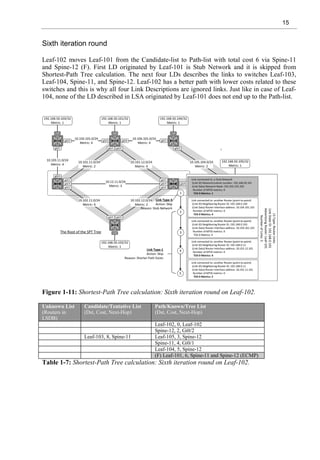
Sixth iteration round
Leaf-102 moves Leaf-101 from the Candidate-list to Path-list with total cost 6 via Spine-11
and Spine-12 (F). First LD originated by Leaf-101 is Stub Network and it is skipped from
Shortest-Path Tree calculation. The next four LDs describes the links to switches Leaf-103,
Leaf-104, Spine-11, and Spine-12. Leaf-102 has a better path with lower costs related to these
switches and this is why all four Link Descriptions are ignored links. Just like in case of Leaf-
104, none of the LD described in LSA originated by Leaf-101 does not end up to the Path-list.
Figure 1-11: Shortest-Path Tree calculation: Sixth iteration round on Leaf-102.
Unknown List
(Routers in
LSDB)
Candidate/Tentative List
(Dst, Cost, Next-Hop)
Path/Known/Tree List
(Dst, Cost, Next-Hop)
Leaf-102, 0, Leaf-102
Spine-12, 2, Gi0/2
Leaf-103, 8, Spine-11 Leaf-105, 3, Spine-12
Spine-11, 4, Gi0/1
Leaf-104, 5, Spine-12
(F) Leaf-101, 6, Spine-11 and Spine-12 (ECMP)
Table 1-7: Shortest-Path Tree calculation: Sixth iteration round on Leaf-102.
16
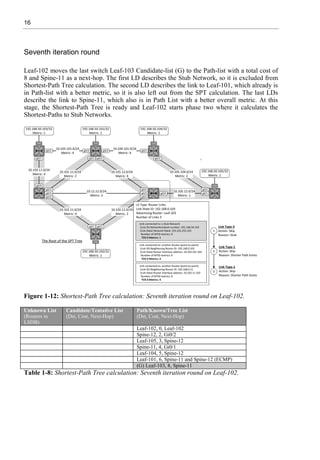
Seventh iteration round
Leaf-102 moves the last switch Leaf-103 Candidate-list (G) to the Path-list with a total cost of
8 and Spine-11 as a next-hop. The first LD describes the Stub Network, so it is excluded from
Shortest-Path Tree calculation. The second LD describes the link to Leaf-101, which already is
in Path-list with a better metric, so it is also left out from the SPT calculation. The last LDs
describe the link to Spine-11, which also is in Path List with a better overall metric. At this
stage, the Shortest-Path Tree is ready and Leaf-102 starts phase two where it calculates the
Shortest-Paths to Stub Networks.
Figure 1-12: Shortest-Path Tree calculation: Seventh iteration round on Leaf-102.
Unknown List
(Routers in
LSDB)
Candidate/Tentative List
(Dst, Cost, Next-Hop)
Path/Known/Tree List
(Dst, Cost, Next-Hop)
Leaf-102, 0, Leaf-102
Spine-12, 2, Gi0/2
Leaf-105, 3, Spine-12
Spine-11, 4, Gi0/1
Leaf-104, 5, Spine-12
Leaf-101, 6, Spine-11 and Spine-12 (ECMP)
(G) Leaf-103, 8, Spine-11
Table 1-8: Shortest-Path Tree calculation: Seventh iteration round on Leaf-102.
17
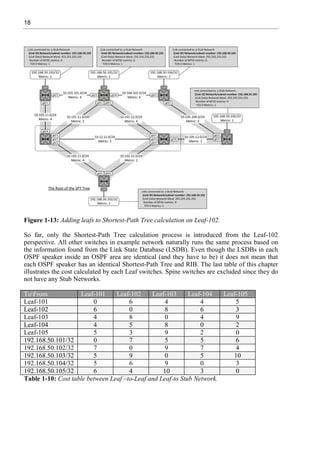
SPF Run – Phase II: Adding Leafs to Shortest-Path Tree
At first phase, Leaf-102 forms a Shortest-Path Tree (SPT) by using the Dijkstra/SPF algorithm.
In the second Phase, Leaf-102 adds Stub Networks (leafs) to SPT. Leaf-102 starts by
examining its self-originated Router LSA where there is a Link Description about Stub
Network 192.168.50.102/32. This Stub Network is moved to Path-list (Path-list updates are not
included in table 1-9 for simplicity). This information is also installed into Routing Information
Base (RIB) as a connected network. Next, Leaf-102 examines the Router LSA originated by
the Spine-12, which is the closest OSPF speaker found from the Path-list. There is no Link
Description about Stub Networks, so neither Path List nor RIB is updated. Leaf-102 moves on
to next closest OSPF speaker found from the Path List and checks the Router LSA originated
by Leaf-105. The Router LSA originated by Leaf-105 includes the Stub Network
192.168.50.105/32. Leaf-102 adds it to Path-list and updates the RIB. Next, OSPF speaker on
the Path-list is Spine-11, which Router LSA does not describe any Stub Network, so Leaf-102
moves on to check the Router LSA originated by Leaf-104. The Router LSA of Leaf-104
includes the Stub Network 192.168.50.104/32 which is inserted into the Path-list and into the
RIB of Leaf-102. After this, Leaf-102 examines the Router LSA originated by Leaf-101. There
is a Link Description about Stub Network 192.168.50.101/32. Leaf-101 is reachable via two
equal-cost paths via Spine-11 and Spine-12 so the Stub Network is added into the Path-list and
into the RIB with two next-hops. The last OSPF speaker listed in the Path List is Leaf-103,
which has Stub Network 192.168.50.103/32 described in its Router LSA. Leaf-102 adds the
Stub Network into its Path-list and into the RIB.
Now the Shortest-Path Tree with its Leafs is ready from the Leaf-102 perspective.
Path/Known/Tree
List
(Dst, Cost, Next-Hop)
Stub Networks
(Router LSA: LT-
3)
Routing Information Base
(Network [AD/C] NH Int, )
1 Leaf-102, 0, Leaf-102 192.168.50.102/32 192.168.50.102/32 directly connected
2 Spine-12, 2, Gi0/2
3 Leaf-105, 3, Spine-12 192.168.50.105/32 192.168.50.105/32 [110/4] 10.102.12.12 via g0/2
4 Spine-11, 4, Gi0/1
5 Leaf-104, 5, Spine-12 192.168.50.104/32 192.168.50.104/32 [110/6] 10.102.12.12 via g0/2
6 Leaf-101, 6, Spine-11
Spine-12
192.168.50.101/32 192.168.50.101/32 [110/5] 10.102.12.12 via g0/1
[110/5] 10.102.12.12 via g0/2
7 Leaf-103, 8, Spine-11 192.168.50.103/32 192.168.50.103/32 [110/9] 10.102.12.11 via g0/1
Table 1-9: Adding leaves to Shortest-Path Tree calculation on Leaf-102.
18
Figure 1-13: Adding leafs to Shortest-Path Tree calculation on Leaf-102.
So far, only the Shortest-Path Tree calculation process is introduced from the Leaf-102
perspective. All other switches in example network naturally runs the same process based on
the information found from the Link State Database (LSDB). Even though the LSDBs in each
OSPF speaker inside an OSPF area are identical (and they have to be) it does not mean that
each OSPF speaker has an identical Shortest-Path Tree and RIB. The last table of this chapter
illustrates the cost calculated by each Leaf switches. Spine switches are excluded since they do
not have any Stub Networks.
ToFrom Leaf-101 Leaf-102 Leaf-103 Leaf-104 Leaf-105
Leaf-101 0 6 4 4 5
Leaf-102 6 0 8 6 3
Leaf-103 4 8 0 4 9
Leaf-104 4 5 8 0 2
Leaf-105 5 3 9 2 0
192.168.50.101/32 0 7 5 5 6
192.168.50.102/32 7 0 9 7 4
192.168.50.103/32 5 9 0 5 10
192.168.50.104/32 5 6 9 0 3
192.168.50.105/32 6 4 10 3 0
Table 1-10: Cost table between Leaf –to-Leaf and Leaf-to Stub Network.
19
References:
[RFC 1195] R. Callon, “Use of OSI IS-IS for Routing in TCP/IP and Dual
Environments”, RFC 1195, December 1990.
[RFC 2328] J. Moy, “OSPF Version 2”, RFC 2328, April 1998.
[RFC 6860] Y. Yang et al., “Hiding Transit-Only Networks in OSPF”, RFC 6860,
January 2013.
[RFC 8365] A. Sajassi et al. “A Network Virtualization Overlay Solution Using Ethernet
VPN (EVPN)”, RFC 8363, March 2018.
[ISIS-OSPF] M. Bhatia et al., “IS-IS and OSPF Difference Discussion”, Draft-bhatia-
manral-isis-ospf-01” January 2006.
20
Chapter 2: Underlay Network – Comparison of OSPF and IS-IS
This chapter discusses the differences between the OSPF and the IS-IS from the Network
Virtualization Overlay (NVO) solution, especially from the VXLAN network perspective.
First, this chapter shortly introduces some of the differences between these two protocols
(terminology, timers, and LSAs). Next, this chapter explains the default behavior of the
Shortest Path First (SPF) by explaining first the IS-IS reaction when Stub Network goes down.
Then the same event is explained from the OSPF perspective. This chapter also introduces the
OSPF reaction when an Incremental SPF (iSPF) is enabled, and the interface on a link that is
not belonging to the Shortest-Path Tree (SPT) goes down. The same event is also discussed
with and without iSPF concerning IS-IS.
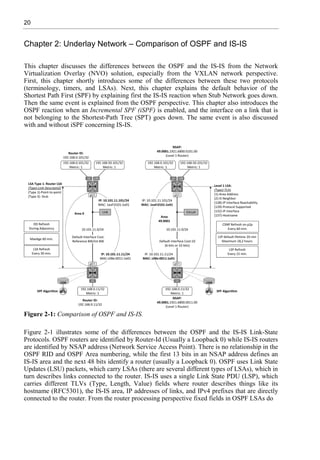
Figure 2-1: Comparison of OSPF and IS-IS.
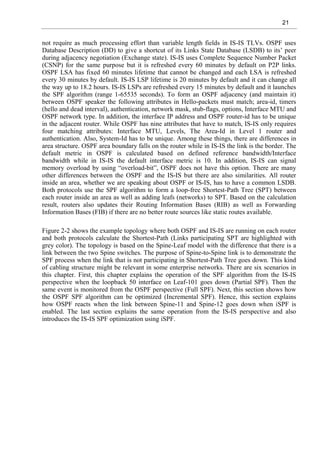
Figure 2-1 illustrates some of the differences between the OSPF and the IS-IS Link-State
Protocols. OSPF routers are identified by Router-Id (Usually a Loopback 0) while IS-IS routers
are identified by NSAP address (Network Service Access Point). There is no relationship in the
OSPF RID and OSPF Area numbering, while the first 13 bits in an NSAP address defines an
IS-IS area and the next 48 bits identify a router (usually a Loopback 0). OSPF uses Link State
Updates (LSU) packets, which carry LSAs (there are several different types of LSAs), which in
turn describes links connected to the router. IS-IS uses a single Link State PDU (LSP), which
carries different TLVs (Type, Length, Value) fields where router describes things like its
hostname (RFC5301), the IS-IS area, IP addresses of links, and IPv4 prefixes that are directly
connected to the router. From the router processing perspective fixed fields in OSPF LSAs do
21
not require as much processing effort than variable length fields in IS-IS TLVs. OSPF uses
Database Description (DD) to give a shortcut of its Links State Database (LSDB) to its’ peer
during adjacency negotiation (Exchange state). IS-IS uses Complete Sequence Number Packet
(CSNP) for the same purpose but it is refreshed every 60 minutes by default on P2P links.
OSPF LSA has fixed 60 minutes lifetime that cannot be changed and each LSA is refreshed
every 30 minutes by default. IS-IS LSP lifetime is 20 minutes by default and it can change all
the way up to 18.2 hours. IS-IS LSPs are refreshed every 15 minutes by default and it launches
the SPF algorithm (range 1-65535 seconds). To form an OSPF adjacency (and maintain it)
between OSPF speaker the following attributes in Hello-packets must match; area-id, timers
(hello and dead interval), authentication, network mask, stub-flags, options, Interface MTU and
OSPF network type. In addition, the interface IP address and OSPF router-id has to be unique
in the adjacent router. While OSPF has nine attributes that have to match, IS-IS only requires
four matching attributes: Interface MTU, Levels, The Area-Id in Level 1 router and
authentication. Also, System-Id has to be unique. Among these things, there are differences in
area structure. OSPF area boundary falls on the router while in IS-IS the link is the border. The
default metric in OSPF is calculated based on defined reference bandwidth/Interface
bandwidth while in IS-IS the default interface metric is 10. In addition, IS-IS can signal
memory overload by using “overload-bit”, OSPF does not have this option. There are many
other differences between the OSPF and the IS-IS but there are also similarities. All router
inside an area, whether we are speaking about OSPF or IS-IS, has to have a common LSDB.
Both protocols use the SPF algorithm to form a loop-free Shortest-Path Tree (SPT) between
each router inside an area as well as adding leafs (networks) to SPT. Based on the calculation
result, routers also updates their Routing Information Bases (RIB) as well as Forwarding
Information Bases (FIB) if there are no better route sources like static routes available.
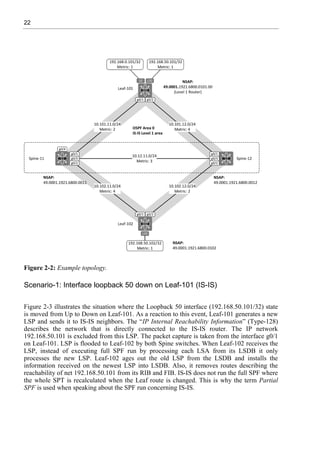
Figure 2-2 shows the example topology where both OSPF and IS-IS are running on each router
and both protocols calculate the Shortest-Path (Links participating SPT are highlighted with
grey color). The topology is based on the Spine-Leaf model with the difference that there is a
link between the two Spine switches. The purpose of Spine-to-Spine link is to demonstrate the
SPF process when the link that is not participating in Shortest-Path Tree goes down. This kind
of cabling structure might be relevant in some enterprise networks. There are six scenarios in
this chapter. First, this chapter explains the operation of the SPF algorithm from the IS-IS
perspective when the loopback 50 interface on Leaf-101 goes down (Partial SPF). Then the
same event is monitored from the OSPF perspective (Full SPF). Next, this section shows how
the OSPF SPF algorithm can be optimized (Incremental SPF). Hence, this section explains
how OSPF reacts when the link between Spine-11 and Spine-12 goes down when iSPF is
enabled. The last section explains the same operation from the IS-IS perspective and also
introduces the IS-IS SPF optimization using iSPF.
22
Figure 2-2: Example topology.
Scenario-1: Interface loopback 50 down on Leaf-101 (IS-IS)
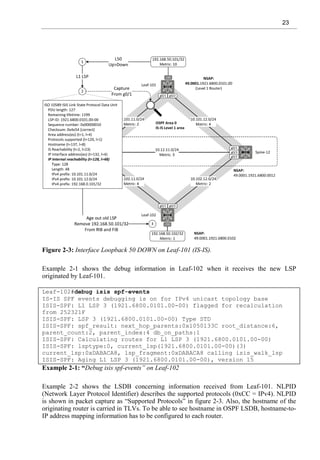
Figure 2-3 illustrates the situation where the Loopback 50 interface (192.168.50.101/32) state
is moved from Up to Down on Leaf-101. As a reaction to this event, Leaf-101 generates a new
LSP and sends it to IS-IS neighbors. The “IP Internal Reachability Information” (Type-128)
describes the network that is directly connected to the IS-IS router. The IP network
192.168.50.101 is excluded from this LSP. The packet capture is taken from the interface g0/1
on Leaf-101. LSP is flooded to Leaf-102 by both Spine switches. When Leaf-102 receives the
LSP, instead of executing full SPF run by processing each LSA from its LSDB it only
processes the new LSP. Leaf-102 ages out the old LSP from the LSDB and installs the
information received on the newest LSP into LSDB. Also, it removes routes describing the
reachability of net 192.168.50.101 from its RIB and FIB. IS-IS does not run the full SPF where
the whole SPT is recalculated when the Leaf route is changed. This is why the term Partial
SPF is used when speaking about the SPF run concerning IS-IS.
23
Figure 2-3: Interface Loopback 50 DOWN on Leaf-101 (IS-IS).
Example 2-1 shows the debug information in Leaf-102 when it receives the new LSP
originated by Leaf-101.
Leaf-102#debug isis spf-events
IS-IS SPF events debugging is on for IPv4 unicast topology base
ISIS-SPF: L1 LSP 3 (1921.6800.0101.00-00) flagged for recalculation
from 252321F
ISIS-SPF: LSP 3 (1921.6800.0101.00-00) Type STD
ISIS-SPF: spf_result: next_hop_parents:0x1050133C root_distance:6,
parent_count:2, parent_index:4 db_on_paths:1
ISIS-SPF: Calculating routes for L1 LSP 3 (1921.6800.0101.00-00)
ISIS-SPF: lsptype:0, current_lsp(1921.6800.0101.00-00)(3)
current_lsp:0xDABACA8, lsp_fragment:0xDABACA8 calling isis_walk_lsp
ISIS-SPF: Aging L1 LSP 3 (1921.6800.0101.00-00), version 15
Example 2-1: “Debug isis spf-events” on Leaf-102
Example 2-2 shows the LSDB concerning information received from Leaf-101. NLPID
(Network Layer Protocol Identifier) describes the supported protocols (0xCC = IPv4). NLPID
is shown in packet capture as “Supported Protocols” in figure 2-3. Also, the hostname of the
originating router is carried in TLVs. To be able to see hostname in OSPF LSDB, hostname-to-
IP address mapping information has to be configured to each router.
24
Leaf-102#show isis database level-1 Leaf-101.00-00 detail
<snipped>
Leaf-101.00-00 0x00000010 0x4E54 1178/1198 0/0/0
Area Address: 49.0001
NLPID: 0xCC
Hostname: Leaf-101
Metric: 4 IS Spine-12.00
Metric: 2 IS Spine-11.00
IP Address: 192.168.0.101
Metric: 2 IP 10.101.11.0 255.255.255.0
Metric: 4 IP 10.101.12.0 255.255.255.0
Metric: 4 IP 10.103.101.0 255.255.255.0
Metric: 0 IP 192.168.0.101 255.255.255.255
Example 2-2: “show isis database level-1 Leaf-101.00-00 detail” on Leaf-102
Scenario-2: Interface loopback 50 down on Leaf-101 (OSPF)
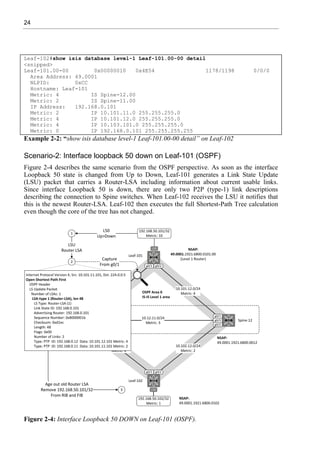
Figure 2-4 describes the same scenario from the OSPF perspective. As soon as the interface
Loopback 50 state is changed from Up to Down, Leaf-101 generates a Link State Update
(LSU) packet that carries a Router-LSA including information about current usable links.
Since interface Loopback 50 is down, there are only two P2P (type-1) link descriptions
describing the connection to Spine switches. When Leaf-102 receives the LSU it notifies that
this is the newest Router-LSA. Leaf-102 then executes the full Shortest-Path Tree calculation
even though the core of the tree has not changed.
Figure 2-4: Interface Loopback 50 DOWN on Leaf-101 (OSPF).
25
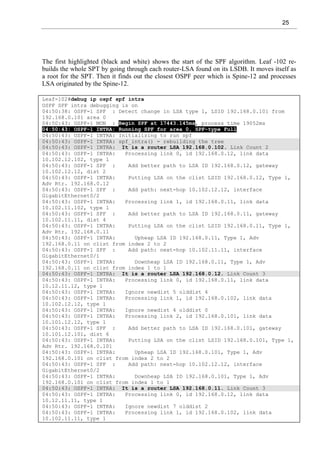
The first highlighted (black and white) shows the start of the SPF algorithm. Leaf -102 re-
builds the whole SPT by going through each router-LSA found on its LSDB. It moves itself as
a root for the SPT. Then it finds out the closest OSPF peer which is Spine-12 and processes
LSA originated by the Spine-12.
Leaf-102#debug ip ospf spf intra
OSPF SPF intra debugging is on
04:50:38: OSPF-1 SPF : Detect change in LSA type 1, LSID 192.168.0.101 from
192.168.0.101 area 0
04:50:43: OSPF-1 MON : Begin SPF at 17443.145ms, process time 19052ms
04:50:43: OSPF-1 INTRA: Running SPF for area 0, SPF-type Full
04:50:43: OSPF-1 INTRA: Initializing to run spf
04:50:43: OSPF-1 INTRA: spf_intra() - rebuilding the tree
04:50:43: OSPF-1 INTRA: It is a router LSA 192.168.0.102. Link Count 2
04:50:43: OSPF-1 INTRA: Processing link 0, id 192.168.0.12, link data
10.102.12.102, type 1
04:50:43: OSPF-1 SPF : Add better path to LSA ID 192.168.0.12, gateway
10.102.12.12, dist 2
04:50:43: OSPF-1 INTRA: Putting LSA on the clist LSID 192.168.0.12, Type 1,
Adv Rtr. 192.168.0.12
04:50:43: OSPF-1 SPF : Add path: next-hop 10.102.12.12, interface
GigabitEthernet0/2
04:50:43: OSPF-1 INTRA: Processing link 1, id 192.168.0.11, link data
10.102.11.102, type 1
04:50:43: OSPF-1 SPF : Add better path to LSA ID 192.168.0.11, gateway
10.102.11.11, dist 4
04:50:43: OSPF-1 INTRA: Putting LSA on the clist LSID 192.168.0.11, Type 1,
Adv Rtr. 192.168.0.11
04:50:43: OSPF-1 INTRA: Upheap LSA ID 192.168.0.11, Type 1, Adv
192.168.0.11 on clist from index 2 to 2
04:50:43: OSPF-1 SPF : Add path: next-hop 10.102.11.11, interface
GigabitEthernet0/1
04:50:43: OSPF-1 INTRA: Downheap LSA ID 192.168.0.11, Type 1, Adv
192.168.0.11 on clist from index 1 to 1
04:50:43: OSPF-1 INTRA: It is a router LSA 192.168.0.12. Link Count 3
04:50:43: OSPF-1 INTRA: Processing link 0, id 192.168.0.11, link data
10.12.11.12, type 1
04:50:43: OSPF-1 INTRA: Ignore newdist 5 olddist 4
04:50:43: OSPF-1 INTRA: Processing link 1, id 192.168.0.102, link data
10.102.12.12, type 1
04:50:43: OSPF-1 INTRA: Ignore newdist 4 olddist 0
04:50:43: OSPF-1 INTRA: Processing link 2, id 192.168.0.101, link data
10.101.12.12, type 1
04:50:43: OSPF-1 SPF : Add better path to LSA ID 192.168.0.101, gateway
10.101.12.101, dist 6
04:50:43: OSPF-1 INTRA: Putting LSA on the clist LSID 192.168.0.101, Type 1,
Adv Rtr. 192.168.0.101
04:50:43: OSPF-1 INTRA: Upheap LSA ID 192.168.0.101, Type 1, Adv
192.168.0.101 on clist from index 2 to 2
04:50:43: OSPF-1 SPF : Add path: next-hop 10.102.12.12, interface
GigabitEthernet0/2
04:50:43: OSPF-1 INTRA: Downheap LSA ID 192.168.0.101, Type 1, Adv
192.168.0.101 on clist from index 1 to 1
04:50:43: OSPF-1 INTRA: It is a router LSA 192.168.0.11. Link Count 3
04:50:43: OSPF-1 INTRA: Processing link 0, id 192.168.0.12, link data
10.12.11.11, type 1
04:50:43: OSPF-1 INTRA: Ignore newdist 7 olddist 2
04:50:43: OSPF-1 INTRA: Processing link 1, id 192.168.0.102, link data
10.102.11.11, type 1
26
04:50:43: OSPF-1 INTRA: Ignore newdist 8 olddist 0
04:50:43: OSPF-1 INTRA: Processing link 2, id 192.168.0.101, link data
10.101.11.11, type 1
04:50:43: OSPF-1 INTRA: Add equal-length path to 192.168.0.101, dist 6
04:50:43: OSPF-1 INTRA: LSA already on the clist LSID 192.168.0.101, Type 1,
Adv Rtr. 192.168.0.101
04:50:43: OSPF-1 SPF : Add path: next-hop 10.102.11.11, interface
GigabitEthernet0/1
04:50:43: OSPF-1 INTRA: Downheap LSA ID 192.168.0.101, Type 1, Adv
192.168.0.101 on clist from index 1 to 1
04:50:43: OSPF-1 INTRA: It is a router LSA 192.168.0.101. Link Count 2
04:50:43: OSPF-1 INTRA: Processing link 0, id 192.168.0.12, link data
10.101.12.101, type 1
04:50:43: OSPF-1 INTRA: Ignore newdist 10 olddist 2
04:50:43: OSPF-1 INTRA: Processing link 1, id 192.168.0.11, link data
10.101.11.101, type 1
04:50:43: OSPF-1 INTRA: Ignore newdist 8 olddist 4
04:50:43: OSPF-1 INTRA: Adding Stub nets
04:50:43: OSPF-1 INTRA: Entered intra-area route sync for area 0
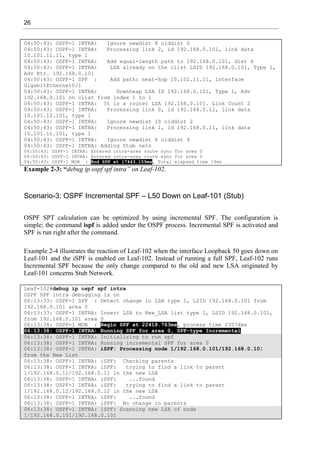
04:50:43: OSPF-1 MON : End SPF at 17443.159ms, Total elapsed time 14ms
Example 2-3: “debug ip ospf spf intra” on Leaf-102.
Scenario-3: OSPF Incremental SPF – L50 Down on Leaf-101 (Stub)
OSPF SPT calculation can be optimized by using incremental SPF. The configuration is
simple; the command ispf is added under the OSPF process. Incremental SPF is activated and
SPF is run right after the command.
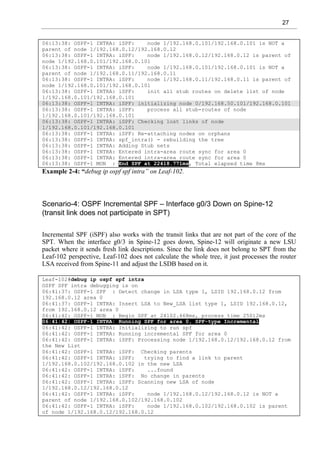
Example 2-4 illustrates the reaction of Leaf-102 when the interface Loopback 50 goes down on
Leaf-101 and the iSPF is enabled on Leaf-102. Instead of running a full SPF, Leaf-102 runs
Incremental SPF because the only change compared to the old and new LSA originated by
Leaf-101 concerns Stub Network.
Leaf-102#debug ip ospf spf intra
OSPF SPF intra debugging is on
06:13:33: OSPF-1 SPF : Detect change in LSA type 1, LSID 192.168.0.101 from
192.168.0.101 area 0
06:13:33: OSPF-1 INTRA: Insert LSA to New_LSA list type 1, LSID 192.168.0.101,
from 192.168.0.101 area 0
06:13:38: OSPF-1 MON : Begin SPF at 22418.763ms, process time 23574ms
06:13:38: OSPF-1 INTRA: Running SPF for area 0, SPF-type Incremental
06:13:38: OSPF-1 INTRA: Initializing to run spf
06:13:38: OSPF-1 INTRA: Running incremental SPF for area 0
06:13:38: OSPF-1 INTRA: iSPF: Processing node 1/192.168.0.101/192.168.0.101
from the New List
06:13:38: OSPF-1 INTRA: iSPF: Checking parents
06:13:38: OSPF-1 INTRA: iSPF: trying to find a link to parent
1/192.168.0.11/192.168.0.11 in the new LSA
06:13:38: OSPF-1 INTRA: iSPF: ...found
06:13:38: OSPF-1 INTRA: iSPF: trying to find a link to parent
1/192.168.0.12/192.168.0.12 in the new LSA
06:13:38: OSPF-1 INTRA: iSPF: ...found
06:13:38: OSPF-1 INTRA: iSPF: No change in parents
06:13:38: OSPF-1 INTRA: iSPF: Scanning new LSA of node
1/192.168.0.101/192.168.0.101
27
06:13:38: OSPF-1 INTRA: iSPF: node 1/192.168.0.101/192.168.0.101 is NOT a
parent of node 1/192.168.0.12/192.168.0.12
06:13:38: OSPF-1 INTRA: iSPF: node 1/192.168.0.12/192.168.0.12 is parent of
node 1/192.168.0.101/192.168.0.101
06:13:38: OSPF-1 INTRA: iSPF: node 1/192.168.0.101/192.168.0.101 is NOT a
parent of node 1/192.168.0.11/192.168.0.11
06:13:38: OSPF-1 INTRA: iSPF: node 1/192.168.0.11/192.168.0.11 is parent of
node 1/192.168.0.101/192.168.0.101
06:13:38: OSPF-1 INTRA: iSPF: init all stub routes on delete list of node
1/192.168.0.101/192.168.0.101
06:13:38: OSPF-1 INTRA: iSPF: initializing node 0/192.168.50.101/192.168.0.101
06:13:38: OSPF-1 INTRA: iSPF: process all stub-routes of node
1/192.168.0.101/192.168.0.101
06:13:38: OSPF-1 INTRA: iSPF: Checking lost links of node
1/192.168.0.101/192.168.0.101
06:13:38: OSPF-1 INTRA: iSPF: Re-attaching nodes on orphans
06:13:38: OSPF-1 INTRA: spf_intra() - rebuilding the tree
06:13:38: OSPF-1 INTRA: Adding Stub nets
06:13:38: OSPF-1 INTRA: Entered intra-area route sync for area 0
06:13:38: OSPF-1 MON : End SPF at 22418.771ms, Total elapsed time 8ms
Example 2-4: “debug ip ospf spf intra” on Leaf-102.
Scenario-4: OSPF Incremental SPF – Interface g0/3 Down on Spine-12
(transit link does not participate in SPT)
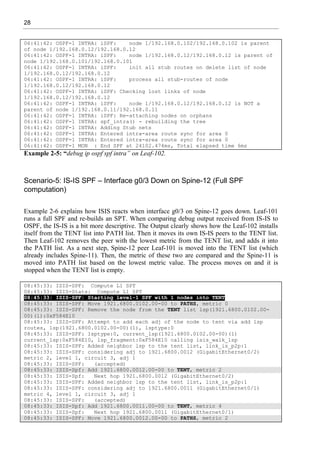
Incremental SPF (iSPF) also works with the transit links that are not part of the core of the
SPT. When the interface g0/3 in Spine-12 goes down, Spine-12 will originate a new LSU
packet where it sends fresh link descriptions. Since the link does not belong to SPT from the
Leaf-102 perspective, Leaf-102 does not calculate the whole tree, it just processes the router
LSA received from Spine-11 and adjust the LSDB based on it.
Leaf-102#debug ip ospf spf intra
OSPF SPF intra debugging is on
06:41:37: OSPF-1 SPF : Detect change in LSA type 1, LSID 192.168.0.12 from
192.168.0.12 area 0
06:41:37: OSPF-1 INTRA: Insert LSA to New_LSA list type 1, LSID 192.168.0.12,
from 192.168.0.12 area 0
06:41:42: OSPF-1 MON : Begin SPF at 24102.468ms, process time 25012ms
06:41:42: OSPF-1 INTRA: Running SPF for area 0, SPF-type Incremental
06:41:42: OSPF-1 INTRA: Initializing to run spf
06:41:42: OSPF-1 INTRA: Running incremental SPF for area 0
06:41:42: OSPF-1 INTRA: iSPF: Processing node 1/192.168.0.12/192.168.0.12 from
the New List
06:41:42: OSPF-1 INTRA: iSPF: Checking parents
06:41:42: OSPF-1 INTRA: iSPF: trying to find a link to parent
1/192.168.0.102/192.168.0.102 in the new LSA
06:41:42: OSPF-1 INTRA: iSPF: ...found
06:41:42: OSPF-1 INTRA: iSPF: No change in parents
06:41:42: OSPF-1 INTRA: iSPF: Scanning new LSA of node
1/192.168.0.12/192.168.0.12
06:41:42: OSPF-1 INTRA: iSPF: node 1/192.168.0.12/192.168.0.12 is NOT a
parent of node 1/192.168.0.102/192.168.0.102
06:41:42: OSPF-1 INTRA: iSPF: node 1/192.168.0.102/192.168.0.102 is parent
of node 1/192.168.0.12/192.168.0.12
28
06:41:42: OSPF-1 INTRA: iSPF: node 1/192.168.0.102/192.168.0.102 is parent
of node 1/192.168.0.12/192.168.0.12
06:41:42: OSPF-1 INTRA: iSPF: node 1/192.168.0.12/192.168.0.12 is parent of
node 1/192.168.0.101/192.168.0.101
06:41:42: OSPF-1 INTRA: iSPF: init all stub routes on delete list of node
1/192.168.0.12/192.168.0.12
06:41:42: OSPF-1 INTRA: iSPF: process all stub-routes of node
1/192.168.0.12/192.168.0.12
06:41:42: OSPF-1 INTRA: iSPF: Checking lost links of node
1/192.168.0.12/192.168.0.12
06:41:42: OSPF-1 INTRA: iSPF: node 1/192.168.0.12/192.168.0.12 is NOT a
parent of node 1/192.168.0.11/192.168.0.11
06:41:42: OSPF-1 INTRA: iSPF: Re-attaching nodes on orphans
06:41:42: OSPF-1 INTRA: spf_intra() - rebuilding the tree
06:41:42: OSPF-1 INTRA: Adding Stub nets
06:41:42: OSPF-1 INTRA: Entered intra-area route sync for area 0
06:41:42: OSPF-1 MON : End SPF at 24102.474ms, Total elapsed time 6ms
Example 2-5: “debug ip ospf spf intra” on Leaf-102.
Scenario-5: IS-IS SPF – Interface g0/3 Down on Spine-12 (Full SPF
computation)
Example 2-6 explains how ISIS reacts when interface g0/3 on Spine-12 goes down. Leaf-101
runs a full SPF and re-builds an SPT. When comparing debug output received from IS-IS to
OSPF, the IS-IS is a bit more descriptive. The Output clearly shows how the Leaf-102 installs
itself from the TENT list into PATH list. Then it moves its own IS-IS peers to the TENT list.
Then Leaf-102 removes the peer with the lowest metric from the TENT list, and adds it into
the PATH list. As a next step, Spine-12 peer Leaf-101 is moved into the TENT list (which
already includes Spine-11). Then, the metric of these two are compared and the Spine-11 is
moved into PATH list based on the lowest metric value. The process moves on and it is
stopped when the TENT list is empty.
08:45:33: ISIS-SPF: Compute L1 SPT
08:45:33: ISIS-Stats: Compute L1 SPT
08:45:33: ISIS-SPF: Starting level-1 SPF with 1 nodes into TENT
08:45:33: ISIS-SPF: Move 1921.6800.0102.00-00 to PATHS, metric 0
08:45:33: ISIS-SPF: Remove the node from the TENT list lsp(1921.6800.0102.00-
00)(1):0xF584E10
08:45:33: ISIS-SPF: Attempt to add each adj of the node to tent via add lsp
routes, lsp(1921.6800.0102.00-00)(1), lsptype:0
08:45:33: ISIS-SPF: lsptype:0, current_lsp(1921.6800.0102.00-00)(1)
current_lsp:0xF584E10, lsp_fragment:0xF584E10 calling isis_walk_lsp
08:45:33: ISIS-SPF: Added neighbor lsp to the tent list, link_is_p2p:1
08:45:33: ISIS-SPF: considering adj to 1921.6800.0012 (GigabitEthernet0/2)
metric 2, level 1, circuit 3, adj 1
08:45:33: ISIS-SPF: (accepted)
08:45:33: ISIS-Spf: Add 1921.6800.0012.00-00 to TENT, metric 2
08:45:33: ISIS-Spf: Next hop 1921.6800.0012 (GigabitEthernet0/2)
08:45:33: ISIS-SPF: Added neighbor lsp to the tent list, link_is_p2p:1
08:45:33: ISIS-SPF: considering adj to 1921.6800.0011 (GigabitEthernet0/1)
metric 4, level 1, circuit 3, adj 1
08:45:33: ISIS-SPF: (accepted)
08:45:33: ISIS-Spf: Add 1921.6800.0011.00-00 to TENT, metric 4
08:45:33: ISIS-Spf: Next hop 1921.6800.0011 (GigabitEthernet0/1)
08:45:33: ISIS-SPF: Move 1921.6800.0012.00-00 to PATHS, metric 2
29
08:45:33: ISIS-SPF: Remove the node from the TENT list lsp(1921.6800.0012.00-
00)(2):0xFEF85C8
08:45:33: ISIS-SPF: Attempt to add each adj of the node to tent via add lsp
routes, lsp(1921.6800.0012.00-00)(2), lsptype:0
08:45:33: ISIS-SPF: lsptype:0, current_lsp(1921.6800.0012.00-00)(2)
current_lsp:0xFEF85C8, lsp_fragment:0xFEF85C8 calling isis_walk_lsp
08:45:33: ISIS-SPF: Failed to add neighbor lsp to the tent list, link_is_p2p:1
08:45:33: ISIS-SPF: Added neighbor lsp to the tent list, link_is_p2p:1
08:45:33: ISIS-Spf: Add 1921.6800.0101.00-00 to TENT, metric 6
08:45:33: ISIS-Spf: Next hop 1921.6800.0012 (GigabitEthernet0/2)
08:45:33: ISIS-SPF: Move 1921.6800.0011.00-00 to PATHS, metric 4
08:45:33: ISIS-SPF: Remove the node from the TENT list lsp(1921.6800.0011.00-
00)(4):0xDABACA8
08:45:33: ISIS-SPF: Attempt to add each adj of the node to tent via add lsp
routes, lsp(1921.6800.0011.00-00)(4), lsptype:0
08:45:33: ISIS-SPF: lsptype:0, current_lsp(1921.6800.0011.00-00)(4)
current_lsp:0xDABACA8, lsp_fragment:0xDABACA8 calling isis_walk_lsp
08:45:33: ISIS-SPF: Added neighbor lsp to the tent list, link_is_p2p:1
08:45:33: ISIS-Spf: Add 1921.6800.0101.00-00 to TENT, metric 6
08:45:33: ISIS-Spf: Next hop 1921.6800.0011 (GigabitEthernet0/1)
08:45:33: ISIS-Spf: Next hop 1921.6800.0012 (GigabitEthernet0/2)
08:45:33: ISIS-SPF: Failed to add neighbor lsp to the tent list, link_is_p2p:1
08:45:33: ISIS-SPF: Move 1921.6800.0101.00-00 to PATHS, metric 6
08:45:33: ISIS-SPF: Remove the node from the TENT list lsp(1921.6800.0101.00-
00)(3):0xDABB208
08:45:33: ISIS-SPF: Attempt to add each adj of the node to tent via add lsp
routes, lsp(1921.6800.0101.00-00)(3), lsptype:0
08:45:33: ISIS-SPF: lsptype:0, current_lsp(1921.6800.0101.00-00)(3)
current_lsp:0xDABB208, lsp_fragment:0xDABB208 calling isis_walk_lsp
08:45:33: ISIS-SPF: Failed to add neighbor lsp to the tent list, link_is_p2p:1
08:45:33: ISIS-SPF: Aging L1 LSP 1 (1921.6800.0102.00-00), version 41
08:45:33: ISIS-SPF: Aging L1 LSP 2 (1921.6800.0012.00-00), version 43
08:45:33: ISIS-SPF: Aging L1 LSP 3 (1921.6800.0101.00-00), version 64
08:45:33: ISIS-SPF: Aging L1 LSP 4 (1921.6800.0011.00-00), version 44
08:45:33: ISIS-Stats: SPF only compute time 0.014
08:45:33: ISIS-Stats: IPv4 RIB only compute time 0.000
08:45:33: ISIS-Stats: Complete L1 SPT,
08:45:33: ISIS-Stats: Compute time 0.014/0.014, 4/0 nodes, 4/0 links, 0
suspends
Example 2-6: debug isis sfp-events on Leaf-102.
Scenario-6: IS-IS Incremental SPF – Interface g0/3 Down on Spine-12
(transit link does not participate in SPT)
It is also possible to optimize the SPF algorithm in IS-IS by using Incremental SPF. The
configuration is simple; add the command ispf level-1 20 under the IS-IS routing process
(default value when beginning iSPF is 120 seconds). Unlike in OSPF, IS-IS configuration
allows the administrator to define when the Incremental SPF is activated (when activated, SPF
is done immediately).
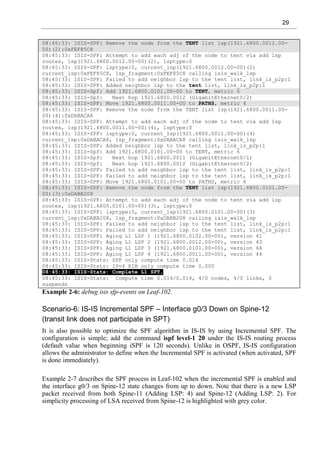
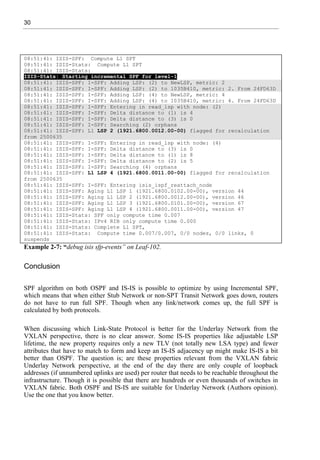
Example 2-7 describes the SPF process in Leaf-102 when the incremental SPF is enabled and
the interface g0/3 on Spine-12 state changes from up to down. Note that there is a new LSP
packet received from both Spine-11 (Adding LSP: 4) and Spine-12 (Adding LSP: 2). For
simplicity processing of LSA received from Spine-12 is highlighted with grey color.
30
08:51:41: ISIS-SPF: Compute L1 SPT
08:51:41: ISIS-Stats: Compute L1 SPT
08:51:41: ISIS-Stats:
ISIS-Stats: Starting incremental SPF for level-1
08:51:41: ISIS-SPF: I-SPF: Adding LSP: (2) to NewLSP, metric: 2
08:51:41: ISIS-SPF: I-SPF: Adding LSP: (2) to 1035B410, metric: 2. From 24FD63D
08:51:41: ISIS-SPF: I-SPF: Adding LSP: (4) to NewLSP, metric: 4
08:51:41: ISIS-SPF: I-SPF: Adding LSP: (4) to 1035B410, metric: 4. From 24FD63D
08:51:41: ISIS-SPF: I-SPF: Entering in read_lsp with node: (2)
08:51:41: ISIS-SPF: I-SPF: Delta distance to (1) is 4
08:51:41: ISIS-SPF: I-SPF: Delta distance to (3) is 0
08:51:41: ISIS-SPF: I-SPF: Searching (2) orphans
08:51:41: ISIS-SPF: L1 LSP 2 (1921.6800.0012.00-00) flagged for recalculation
from 2500635
08:51:41: ISIS-SPF: I-SPF: Entering in read_lsp with node: (4)
08:51:41: ISIS-SPF: I-SPF: Delta distance to (3) is 0
08:51:41: ISIS-SPF: I-SPF: Delta distance to (1) is 8
08:51:41: ISIS-SPF: I-SPF: Delta distance to (2) is 5
08:51:41: ISIS-SPF: I-SPF: Searching (4) orphans
08:51:41: ISIS-SPF: L1 LSP 4 (1921.6800.0011.00-00) flagged for recalculation
from 2500635
08:51:41: ISIS-SPF: I-SPF: Entering isis_ispf_reattach_node
08:51:41: ISIS-SPF: Aging L1 LSP 1 (1921.6800.0102.00-00), version 44
08:51:41: ISIS-SPF: Aging L1 LSP 2 (1921.6800.0012.00-00), version 46
08:51:41: ISIS-SPF: Aging L1 LSP 3 (1921.6800.0101.00-00), version 67
08:51:41: ISIS-SPF: Aging L1 LSP 4 (1921.6800.0011.00-00), version 47
08:51:41: ISIS-Stats: SPF only compute time 0.007
08:51:41: ISIS-Stats: IPv4 RIB only compute time 0.000
08:51:41: ISIS-Stats: Complete L1 SPT,
08:51:41: ISIS-Stats: Compute time 0.007/0.007, 0/0 nodes, 0/0 links, 0
suspends
Example 2-7: “debug isis sfp-events” on Leaf-102.
Conclusion
SPF algorithm on both OSPF and IS-IS is possible to optimize by using Incremental SPF,
which means that when either Stub Network or non-SPT Transit Network goes down, routers
do not have to run full SPF. Though when any link/network comes up, the full SPF is
calculated by both protocols.
When discussing which Link-State Protocol is better for the Underlay Network from the
VXLAN perspective, there is no clear answer. Some IS-IS properties like adjustable LSP
lifetime, the new property requires only a new TLV (not totally new LSA type) and fewer
attributes that have to match to form and keep an IS-IS adjacency up might make IS-IS a bit
better than OSPF. The question is; are these properties relevant from the VXLAN fabric
Underlay Network perspective, at the end of the day there are only couple of loopback
addresses (if unnumbered uplinks are used) per router that needs to be reachable throughout the
infrastructure. Though it is possible that there are hundreds or even thousands of switches in
VXLAN fabric. Both OSPF and IS-IS are suitable for Underlay Network (Authors opinion).
Use the one that you know better.
31
References:
[RFC 1195] R. Callon, “Use of OSI IS-IS for Routing in TCP/IP and Dual
Environments”, RFC 1195, December 1990.
[RFC 2328] J. Moy, “OSPF Version 2”, RFC 2328, April 1998.
[RFC 4970] A. Lindem et al., “Extensions to OSPF for Advertising Optional Router
Capabilities”, RFC 4970, July 2007.
[RFC 5301] D. McPherson et al., “Dynamic Hostname Exchange Mechanism for IS-IS”,
RFC 5301, October 2008.
[RFC 5340] R. Coltun et al., “OSPF for IPv6”, RFC 5340, July 2008.
[RFC 6860] Y. Yang et al., “Hiding Transit-Only Networks in OSPF”, RFC 6860,
January 2013.
[RFC 8365] A. Sajassi et al. “A Network Virtualization Overlay Solution Using Ethernet
VPN (EVPN)”, RFC 8363, March 2018.
[ISIS-OSPF] M. Bhatia et al., “IS-IS and OSPF Difference Discussion”, Draft-bhatia-
manral-isis-ospf-01” January 2006
32
Chapter 3: Underlay Network: iBGP in Underlay Network
Using BGP instead of OSPF or IS-IS for Underlay Network routing in BGP VXLAN fabric
simplifies the Control Plane operation because there is only one routing protocol running on
fabric switches. However, there are some tradeoffs too. The BGP only solution requires a
minimum of two different BGP Address-Families (afi) per switch, one for the Underlay (IPv4
Unicast) and one for the Overlay (L2VPN EVPN). In addition, if Border Leaf switches are
connected to the MPLS network, there is a third BGP afi for VPNv4. In some cases, multi-afi
BGP makes troubleshooting a bit more complex compared to a single-afi solution where BGP
is used only in Overlay Network. The focus of this chapter is VXLAN fabric Underlay
Network with iBGP routing.
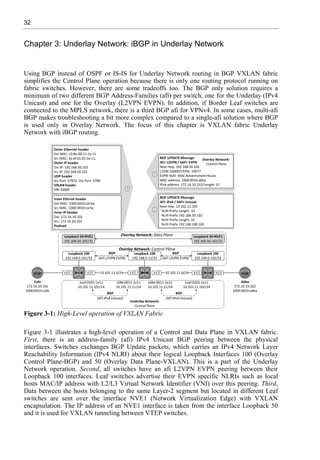
Figure 3-1: High-Level operation of VXLAN Fabric
Figure 3-1 illustrates a high-level operation of a Control and Data Plane in VXLAN fabric.
First, there is an address-family (afi) IPv4 Unicast BGP peering between the physical
interfaces. Switches exchanges BGP Update packets, which carries an IPv4 Network Layer
Reachability Information (IPv4 NLRI) about their logical Loopback Interfaces 100 (Overlay
Control Plane-BGP) and 50 (Overlay Data Plane-VXLAN). This is a part of the Underlay
Network operation. Second, all switches have an afi L2VPN EVPN peering between their
Loopback 100 interfaces. Leaf switches advertise their EVPN specific NLRIs such as local
hosts MAC/IP address with L2/L3 Virtual Network Identifier (VNI) over this peering. Third,
Data between the hosts belonging to the same Layer-2 segment but located in different Leaf
switches are sent over the interface NVE1 (Network Virtualization Edge) with VXLAN
encapsulation. The IP address of an NVE1 interface is taken from the interface Loopback 50
and it is used for VXLAN tunneling between VTEP switches.
33
Route Propagation
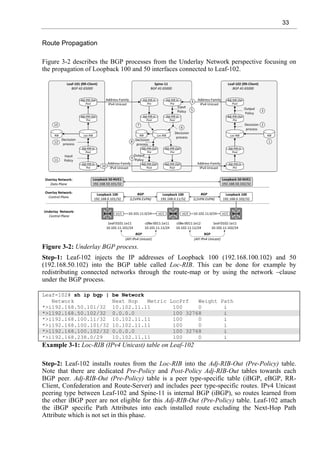
Figure 3-2 describes the BGP processes from the Underlay Network perspective focusing on
the propagation of Loopback 100 and 50 interfaces connected to Leaf-102.
Figure 3-2: Underlay BGP process.
Step-1: Leaf-102 injects the IP addresses of Loopback 100 (192.168.100.102) and 50
(192.168.50.102) into the BGP table called Loc-RIB. This can be done for example by
redistributing connected networks through the route-map or by using the network –clause
under the BGP process.
Leaf-102# sh ip bgp | be Network
Network Next Hop Metric LocPrf Weight Path
*>i192.168.50.101/32 10.102.11.11 100 0 i
*>l192.168.50.102/32 0.0.0.0 100 32768 i
*>i192.168.100.11/32 10.102.11.11 100 0 i
*>i192.168.100.101/32 10.102.11.11 100 0 i
*>l192.168.100.102/32 0.0.0.0 100 32768 i
*>i192.168.238.0/29 10.102.11.11 100 0 i
Example 3-1: Loc-RIB (IPv4 Unicast) table on Leaf-102
Step-2: Leaf-102 installs routes from the Loc-RIB into the Adj-RIB-Out (Pre-Policy) table.
Note that there are dedicated Pre-Policy and Post-Policy Adj-RIB-Out tables towards each
BGP peer. Adj-RIB-Out (Pre-Policy) table is a peer type-specific table (iBGP, eBGP, RR-
Client, Confederation and Route-Server) and includes peer type-specific routes. IPv4 Unicast
peering type between Leaf-102 and Spine-11 is internal BGP (iBGP), so routes learned from
the other iBGP peer are not eligible for this Adj-RIB-Out (Pre-Policy) table. Leaf-102 attach
the iBGP specific Path Attributes into each installed route excluding the Next-Hop Path
Attribute which is not set in this phase.
Random documents with unrelated
content Scribd suggests to you:
The Master of Balliol College, Oxford, one.
The Archdeacon of London, one.
The Duke of Suffolk, one.
The Earl of Shrewsbury, one.
Gwins’ Company, one.
Mercers’ Company, one.
Merchant Taylors’ Company, one.
Mr. Page of Dartford, one.
APPENDIX VI
The “Glossarial Index of Festivals,” published in the Liber
Custumarum, will throw light upon the religious life of London. The
alphabetical table is followed by a yearly table for convenience.
Adventus Domini. The Advent of Our Lord; the four weeks
preceding Christmas, devoted by the Church to preparation for the
Advent of Christ.
Almes. The Feast of All Souls, 2nd November.
Andreae Apostoli, Festum Sancti. The Feast of Saint Andrew, the
Apostle, 30th November.
Ascensio Domini. The Ascension of Our Lord. A movable Festival
held on Thursday in Rogation Week, the week next but one before
Pentecost, or Whitsun, Week.
Barnabae Apostoli, Festum Sancti. The Feast of Saint Barnabas,
the Apostle, 11th June.
Bartholomaei Apostoli, Festum Sancti. The Feast of Saint
Bartholomew, the Apostle, 24th August.
Benedicti, Translatio Sancti. The Translation of Saint Benedict,
11th July.
Carnilevaria. The last day of the Carnival, or season preceding
Lent. Shrove Tuesday.
Carniprivium. The beginning of Lent.
Chaundelour, Chaundeloure, Chaundelure. Candlemas; the
Purification of the Virgin Mary, 2nd February. See Mariae, Purificatio
Sanctae.
Circumcisionis Domini Festum. The Feast of the Circumcision of
Our Lord, 1st January.
Clausum Paschae. The Close of Easter, or Sunday after Easter.
Clementis, Festum Sancti. The Feast of Saint Clement, 23rd
November.
Crucis Sanctae Exaltatio. The Exaltation of the Holy Cross, 14th
September. This Feast commemorated the raising of the Cross on
which Our Saviour suffered, after its Invention, or Discovery, by
Saint Helena, A.D. 307 or 325.
Dies Sabbati. The Sabbath day, Saturday.
Dunstani, Festum Sancti. The Feast of Saint Dunstan, 19th May.
Edmond, le jour Seint; Edmundi Regis, Festum Sancti. The Feast
of Saint Edmund, the King, 20th November.
Edwardi Regis et Confessoris, Translatio Sancti. The Translation of
Saint Edward, King and Confessor, 13th October.
Epiphania Domini. The Epiphany, or Manifestation, of Our Lord,
6th January. See Tiphayne.
Gregorii Papae, Festum (Dies) Sancti. The Feast of Saint Gregory,
the Pope, 12th March.
Hillarie, la Sent; Hillere, la Seint; Hillarii, Festum Sancti. The Feast
of Saint Hillary, 13th January.
Hippolyti Martyris, Natale Sancti. The Nativity of Saint Hippolytus,
the Martyr, 13th and 22nd August; there having been two Martyrs of
this name.
Indictio. A given year of the Indiction; so called from the Edicts of
the Roman Emperors; for as one such Edict was supposed to appear
every fifteen years, the years were reckoned by their distance from
the last Indiction. This mode of reckoning was employed, at Rome
more particularly, from the time of the Nicene Council (A.D. 325),
but was introduced into England so early as the time of King Edgar.
Innocentium Dies (Festum) Sanctorum. The Feast of the Holy
Innocents, Childermas Day, 28th December.
Jacobi Apostoli, Festum Sancti. The Feast of Saint James, the
Apostle, 25th July.
Johan, la Feste Seint: Johannis Baptistae Nativitas. The Nativity of
Saint John the Baptist, Saint John’s day, 24th June.
Johannis Baptistae, Decollatio Sancti. The Decollation of Saint
John, the Baptist, 29th August.
Kalendarum Maii Caput. The beginning (or 18th) of the Calends of
May, 14th April.
Lucae Evangelistae Festum; Lucie, la Feste Seinte. The Feast of
Saint Luke, the Evangelist; 18th October according to the Romish
Calendar, 13th October according to that of Carthage.
Marci Evangelistae, Festum Sancti. The Feast of Saint Mark, the
Evangelist, 25th April.
Margaretae, Festum Sanctae. The Feast of Saint Margaret, 20th
July.
Mariae, Festum Sanctae. The Feast (of the Nativity) of Saint Mary,
8th September.
Mariae, Festum Annuntiationis Beatae. The Feast of the
Annunciation of the Blessed Mary, Lady Day, 25th March. See Nostre
Dame.
Mariae, Purificatio Sanctae (or Beatae). The Purification of Saint
Mary, or Candlemas, 2nd February. See Chaundelour.
Mariae Virginis, Festum Assumptionis Beatae. The Feast of the
Assumption, or ascent into heaven, of the Blessed Virgin Mary, 15th
August.
Mariae Magdalene, Festum Sanctae (or Beatae). The Feast of
Saint Mary Magdalene, 22nd July.
Martin, la Feste Seint; Martini, Festum Sancti. The Feast of Saint
Martin, or Martinmas, 11th November.
Matthiae Apostoli, Festum Sancti. The Feast of Saint Matthias, the
Apostle, 24th February.
Michaelis, Festum Sancti. The Feast of Saint Michael, or
Michaelmas, 29th September (passim).
Michel, les Utaves de Seint. The Octaves of Saint Michael; one
week after Michaelmas. See Octabae.
Natale Domini. The Nativity of Our Lord, Christmas Day, 25th
December.
Nostre Dame (Daume) en Quarenne. (The Feast of) Our Lady in
Lent; Lady Day, or the Feast of the Annunciation. See Mariae,
Festum Annuntiationis.
Nowel. Christmas.
Octabae. The Octave, or Octaves. The eighth day after a festival
inclusively, in other words, that day week. The celebration of the
Octave is said to have arisen in the fact that the early Christians
celebrated their festivals for eight days, but made the last of those
days the one of greatest solemnity, on the authority of Leviticus,
xxiii. 36. Octabas was the A.S. name for the Octave.
Omnium Sanctorum Festum. The Feast of All Saints, or All-
Hallows, 1st November.
Pasche; Pasqe. Easter.
Passionis Festum. The Feast of the Passion. The period between
the fifth Sunday in Lent and Easter Sunday. Since the Reformation,
the term “Passion Week” has been applied solely to the last week in
Lent.
Pauli, Conversio Sancti. The Conversion of Saint Paul, 25th
January.
Pentecoste; Pentecouste. Pentecost, or Whitsuntide.
Perpetuae et Felicitatis, Festum Sanctarum. The Feast of Saints
Perpetua and Felicitas, 7th March. These Saints are said to have
suffered martyrdom in the reign of the Emperor Valerian.
Petri ad Vincula, Festum Sancti. The Feast of Saint Peter’s Chains,
or Saint Peter in Prison, 1st August.
Petri in Cathedra, Festum Sancti. The Feast of Saint Peter’s Chair;
in commemoration of his founding the Cathedra, or Church, of
Antioch, 22nd February.
Petri et Pauli, Festum Apostolorum. The Feast of the Apostles
Peter and Paul, 29th June.
Philippi et Jacobi, Festum Apostolorum. The Feast of the Apostles
Philip and James, 1st May.
Quadragesima; Quareme. Quadragesima, or Lent, the Fast of forty
days before Easter.
Ramis Palmarum, Dominica in. Palm Sunday, the First Sunday
before Easter.
Simonis et Judae, Festum Apostolorum. The Feast of the Apostles
Simon and Jude, 28th October.
Swithini, Dies Sancti. The day (of the Deposition) of Saint Swithun,
or Swithin, 2nd July.
Swithini, Translatio Beati; Swythan, la Feste Seint. The Feast of
the Translation of Saint Swithin, 15th July.
Symonis et Judae, Festum Apostolorum. See Simonis et Judae,
Festum.
Thomae Apostoli, Festum Sancti. The Feast of Saint Thomas, the
Apostle, 21st December.
Thomae Martyris, Festum Beati; Thomae Martyris, Translatio
Sancti. The Translation of Saint Thomas, the Martyr, 7th July. The
Passion of Saint Thomas of Canterbury was 29th December; it is not
clear whether, in the first instance, that or his Translation is meant.
Tiphayne. The Epiphany, 16th January; a corruption of
Theophania, the Manifestation of God. But in the Greek Church the
words θεοφάνεια and ἐπιφάνεια were used as synonymous
expressions for the day of Our Saviour’s Nativity. See Suicer’s
Thesaurus, i. p. 1200, and Hampson’s Med. Ævi Kalendar ii. s.vv.
Epiphania and Theophania.
Trinitatis, Festum Sanctae; Trinite, Feste de la; Jour de la. The
Feast of the Trinity, the Sunday after Pentecost, or Whitsuntide.
Trinitatis Sanctae Octabae. The Octave of the Holy Trinity; the
Sunday after Trinity Sunday.
Valentini, Festum Sancti. The Feast of Saint Valentine. Probably
that celebrated on the 14th February; but there were other festivals
in honour of persons of this name, 16th April, 16th July, 13th
November, and 9th and 16th December.
Vincentii Martyris, Festum Sancti. The Feast of Saint Vincent, the
Martyr, 22nd January.
(Liber Custumarum, Riley, vol. ii. pt. ii. pp. 841-844.)
Jan. 1. Circumcision.
„ 13. St. Hilary.
„ 16. Epiphany.
„ 22. St. Vincent.
„ 25. Conversion of St. Paul.
Feb. 2. Candlemas. Purification of the B. V. M.
„ 14. St. Valentine.
„ 22. Petri in Cathedra Festum.
„ 24. St. Matthias.
Feb. or Mar. Shrove Tuesday and Carniprivium.
Mar. 7. St. Perpetua and Felicitas.
„ 12. St. Gregory.
„ 25. Annunciation.
„ 25. Annunciation.
Mar. or April. Easter. Sunday after Easter (Clausum Paschae).
Apr. 25. St. Mark.
May 1. St. Philip and James.
„ 19. St. Dunstan.
„ 19. St. Dunstan.
May or June. Ascension Day. Whitsun Week. Trinity Sunday.
June 11. St. Barnabas.
„ 24. St. John Baptist.
„ 29. SS. Peter and Paul.
July 2. St. Swithin.
„ 7. St. Thomas Martyr.
„ 11. St. Benedict.
„ 15. Translation of St. Swithin.
„ 22. St. Mary Magdalene.
„ 22. St. Margaret.
„ 25. St. James the Apostle.
Aug. 1. St. Peter at Vincula.
„ 13, 22. St. Hippolyte.
„ 15. Assumption of B. V. M.
„ 24. St. Bartholomew.
„ 29. Beheading of St. John Baptist.
Sept. 8. Nativity of B. V. M.
„ 14. Exaltation of the Cross.
„ 29. St. Michael.
Oct. 13. Translation of Edward the Confessor.
„ 18. St. Luke.
„ 28. SS. Simon and Jude.
Nov. 1. Allhallows.
„ 11. St. Martin.
„ 20. St. Edmund.
„ 23. St. Clement.
Dec. 21. St. Thomas.
„ 25. Christmas Day.
„ 28. Childermas.
APPENDIX VII
AN ANCHORITE’S CELL22
“Soon after the present work was begun a strange hole was
discovered in the chancel wall, just at the turn of the apse on the
north side. It is about 4 feet high and 20 inches wide. There is no
stonework. A roughly rectangular hole has been broken through the
flint wall, and the sides of it plastered to something like a smooth
face. There is no provision for or mark of a door. And it was difficult
to assign any reason for the making of the hole. Yet it was certain
that some reason for it had been. Rough as it is, there is enough
care bestowed on its making to show that it was not one of the
openings sometimes left in the walls of buildings for the convenience
of bringing things in during their construction, and blocked up when
done with. Besides, it is too small for such a use. It was suggested
that it may have been made to bring in a coffin at some funeral. But
it is too small for that also: and it needs to be shown why men
should have broken through the wall to bring in a coffin when it was
much easier to bring it in by a door. Then it was guessed that it
might belong to some extinct stove for warming the church; but
neither the position nor anything in the form of the hole seemed
likely for that use. It is too small to have been the entrance to a
vestry, though the position is a proper one; and certainly there must
have been a door had that been its purpose. Yet if the hole had ever
more than a temporary use, it must have led to some chamber
outside, for the church could not have been used if it were open to
the weather.
Some further light was thrown on the place a few months ago
when a coating of modern cement was stripped off the outside of
the wall. Then was found a second hole about the same size as the
first, but cut only part way through the wall. It is plastered inside
with clay, and was filled up with flints and clay. Rather above these
holes, and east and west of them respectively, are two smaller ones,
such as may have received the ends of timbers. These also were
found stopped with clay. The annexed illustration explains the work
better than any description.
It seems that a little wooden hut has been built at some time
against the wall of the church. The smaller holes give its length from
east to west—about eight feet inside—and perhaps also its greatest
height, about six feet. But this last and the width from north to
south are uncertain, for there is nothing to show what was the
shape of the roof, and if there were ever any foundations they are
not to be found now. The walls were probably of stud and clay
daubing, and the roof thatch.
The place can hardly have been other than an anker’s den. And it
must surely have been one of the least commodious. It is
remarkable that so few such have been identified, for the numbers
of ankers in England must at one time have been considerable.
There is a good deal about them in the second volume of the new
edition of Mr. Bloxam’s Gothic Architecture, and Mr. Bloxam would
assign to ankers most of the habitable chambers attached to
churches, over vestries and porches and elsewhere. Very likely some
such were used by ankers of the easier sort: but I think more were
occupied by secular clerks and chaplains, and the anker’s place was
a hut built outside against the wall, under the eaves of the church,
as is said in the thirteenth-century Ancren Riwle, which tells us more
about ankers than any other book I know of.
A cell was so placed that the anker need not leave it, either for
worship or for any other reason. There was a window opening
through which he might join in the worship at the altar, and at times
receive the sacrament. And there was another window or hatch to
the outside through which necessaries might be received and
conversation held with visitors or servants. A window or squint is
often found from a chamber over a vestry towards the high altar,
and there is sometimes one from a porch chamber: but being on
upper floors they could not well have the other window, so I take
most of them not to have been ankerholds. Though as the degree of
strictness varied much and seems for the most part to have been
fixed only by the anker himself, it is possible that some may have
been so used. The anker of the strictest sort was inclusus—
permanently shut up in his cell which he entered with the license
and blessing of the bishop. Such an one could scarcely have
inhabited an upper chamber. Whether our Bengeo Anker was
inclusus or not is uncertain. The entrance to his cell had no door, but
it may have been blocked, and a squint or loop towards the altar
formed the blocking. If it were open a curtain must have been hung
across it, perhaps a black cloth with a white cross like that ordered
in the Riwle to be put to the ‘parlour’ window.
The recess in the church wall west of the doorway is the anker’s
seat and perhaps his sleeping place. And his bones may lie below:
for it seems to have been a custom for ankers to prepare their own
graves within their cells.”
APPENDIX VIII
THE MONASTIC HOUSES
List of Religious Houses and Parish Churches
The religious Houses and Churches of the City and its suburbs
which existed in the fifteenth century are enumerated in Arnold’s
Chronicle. Arnold, who lived and wrote towards the end of the
fifteenth century, belongs to Mediæval London, which Stow, of a
hundred years later, certainly did not. We shall adopt, therefore,
from Arnold’s list, as a guide to this survey of Mediæval London, the
Churches and ecclesiastical foundations which he considers as
especially belonging to London. His own spelling is followed here.
Seint Martin’s Graunte
Cryst Chirche
The Chartur hous
Elsyngspitel
Seynt Barthū Priory
Seynt Barthū Spitel
Seynt Thom̄ s of Acres
Seint Antonis
Seynt Johēs in Smythfeld
Clerkenwell Nonry
Halywelle Nonry
Barmondsay Abbey
Seint Mary Ouery Priory
Seint Thom̄ s Spitel
Saint Giles in the Felde
Seynt Helen’s Nonry
Seynt Mary Spitel
Seynt Mary at Beethelem
The Menures Nonry
Seynt Anne at the Tourhil
Seynt Katerins
The Crouched Fryers
The Friers Augustines
The Fryours Mynors
The Fryours P’chars
Seynt James in the Wall
The Whit Fryers
Seint Peter at Westm̄ Abbey
Seynt James in the Temple
Seynt Stephenys at Westminster
Seint Thom̄ s Chapel of the Bridge
Seynt James in the Fields
Seynte Mary Magdalene Yeldhall
Seynt Mary Rouncyuale
Seynt Ursula chapel in the Poultry
APPENDIX IX
A DOMINICAN HOUSE
The following Notes are from the Archæolog. Journal:—
“The traditions of the Dominican order required that the buildings
should be arranged quadrilaterally, enclosing a plot of ground which
formed the cloistral cemetery for the deceased of the community,
one side being occupied by the church; but no fixed rule was
adopted for the distribution of the offices. This is apparent from the
plans of several of the English priories founded within the same
period of twenty years. At Gloucester, Bristol, and Stamford, the
church formed the north side of the quadrangle, whilst at Norwich
and Canterbury it was on the south, and at Newcastle-on-Tyne it was
on the east, being probably regulated by the conveniences of the
localities; and even orientation was not uniformly preserved. The
culinary offices at Gloucester were evidently on the south, whilst at
Canterbury they stood on the west.
The early Dominican churches were exceeding simple in
arrangement and severe in details. A good example of them existed
at Canterbury where the choir, nave, and two aisles were all included
under one long unbroken roof, and a porch at the west end afforded
entrance to the congregation. The church at Gloucester, consisting of
choir, nave, north chapel or transept, and north aisle, being rebuilt
about the beginning of the sixteenth century, departed somewhat
from this plan, inasmuch as the chapel was covered with a distinct
transverse roof. It occupied only about three-fourths of the side of
the quadrangle, the rest being completed by monastic buildings. In
the church were three altars; the steeple with two bells and the aisle
have disappeared.
The rest of the buildings which complete the quadrangle, about 73
feet square, are doubtless the original structures of the thirteenth
century. The dormitory forming the second storey of the south side,
with its exterior stairs, is still perfect, even to the stone partitions of
the separate cells. On the ground floor was probably the refectory.
The triplet window in the south gable of the west building is
deserving of notice. But the interiors of all these buildings have been
so much changed and adapted for modern requirements, that it is
difficult to ascertain their monastic destinations. The cellaring is
extensive, but presents little worthy of remark.”
BLACKFRIARS PRIORY
(Survey made ante 1552)
[A Document of the Loseley MSS. at Loseley Hall, Guildford]
Blakfryer Survey.23
Sm̃⁓xlvi li vjs viijd vlt̃ . xiij li vjs. xiijd. de redditibz woodman &
vlt̃ xx li de redd Saunders in toto⁓lxxix li. xiijs. iiijd.
Itm A gallery oũ24 the water cominge owt of the townedyche at
Holbor
ne runynge into the temys abuttynge vpon the highe waye
leadinge from brydwell to the watersyd on the west syd and vpon
the tenemente of James la forheye on the est syd conteyninge that
waye in lengethe xlij fote and abuttinge vpon A payre of stayers and
waye leadinge from the blackfryers to bryd well oư25 the seid diche
on the northe syde and vpon the seide dyche runynge in to the
temys on ye sothe syde conteyninge in breddethe that wage xiiij
fote.
Itm James la fforher broderer holdeth one tenemente abutinge
vpon the seid highe waye on the northe parte & vpon A garden
therto adioyninge vpon the sothe syde conteyninge in bredethe that
waye xiiij fote and abutt vpon the aforseide gallery on the weste syd
and vpon the tenemente of John Taylor on the est syd conteynynge
in length that waye xxxj fote wt A garden adioyninge to the same
tenemente on the northe syd and upon A garden And howse of ... 26
More or Creswell on the sothe syd conteynunge that waye at the
west end abuttinge vpon the seide dyche xxiiij fote and at the est
end abuttinge vpon the garden of the seide tenement of John Taylor
xxxj foote and in lenge from the east ende to the weste end on the
sowthe syde xxix ffoote and on the northe syd xxxj ffoote payinge
therefore by year ... lxvjs. viijd.
John Taylor Carpenter holdeth a tenemente Abuttinge vpon the
tenemente of James la fforheys on the weste syde and vpon the
tenemente of Robt Damanye on the easte syde conteyninge that
waye in lengthe xxx ffote and upon A garden thereto belonginge on
the sowthe syde and vpon the seid highewaye on the northe syd
conteyninge in breddethe that waye xiiij foote wt
A garden to the
seid tenemente adioyninge on the northe syd and upon A garden of
... Mr. Creswells on the sowthe syd conteyninge in breddethe that
waye att the weste ende xxxj fote and at the eeste ende xlv ffoote &
abuttinge v[p]on the garden of the tenemente of James la fforhaye
on the west syde & vpon the garden of the tenement of Robt
Damany on the este syd cont̃ in breddethe yt waye at the northe
end xxx ffoot and at the sowthe ende xxx ffoote payinge ... lxvjs.
xiijd.
Robt Damany bokebynder holdethe A tenemente abutt on the seid
highwaye on the northe syde Conteynynge in lengethe xxiiij foote
and vpon A garden to the same belonginge on the sothe syde
Conteyninge in lengethe xvij ffote and on the weste syd vpon the
seide highe waye vidz27 from the highwaye to the tenement28 of
John Tayler x foote and upon the seide tenemente of John tayler xiiij
ffoo beinge in the hole breddethe at that the weste ende xxiiij foote
and abuttynge on the este syde vpon A tenemente in the tenure of
Maryan Turner in breddethe xiiij ffoote and vpon the garden of the
tenement of the seide Maryan in breddethe x foote beinge in the
hole breddethe at yl
easte ende xxiiij ffoote w29 A garden therto
adioyninge on the northe syde conteyne in lengethe xvij fote and on
the sowthe syde vpon A garden f30 Mr. Creswel xvij ffoote &c. on the
weste syde vpon J. Taylers garden coñ xlv ffoote and on the easte
syde vpon the gardens of the tenementes of Thomas Gemyny and ...
coñ lte31 ffoote payinge therefore ... lxvjs. viijd.
Maryan Turner ffounder holdethe A Tenemente abuttinge vpon the
seid highewaye on the Northe syde and coñ in lengethe that waye xl
foote and on the sowthe syd vpon a garden plott to the same
tenement belonginge & coñ xix foote and vpon A garden of the
tenemente of Nicholas ...32 sadler cont xiiij fote and vpon the
tenement of Robt Damanye vij ffoote in the hole on that syde xlte
ffoote abutinge on the weste syde vpon the tenement of Robt
Damanye & coñ xiiij ffote and on the easte syd vpon the garden of
the tenement of Nicholas ... sadler iij foote and vpon the tenemente
of John de Horse hatmaker xj foote in the hole at that ende xiiij
foote. / wt
A garden therto adioynynge on the northe syde & coñ xix
ffoote and abuttinge vpon the garden of the tenement of ... Taylor
on the sowthe syde & coñ xix foote and vpon the tenem̃ of Robt
Damany on the weste syde coñ x ffoote and vpon the garden of the
tenement of Nicholas ... the sadler on the easte syde coñ ix ffoote. /
payinge therefore ad ijos
Ai Diuios33—— lxvjs. viijd. John de Horse
hattmaker holdethe A tenement abuttinge on the northe syde vpon
the seide highewaye cont xxxj ffoote &c. / on the sowthe syd vpon A
tenement of Nicholas ... sadler coñ xviij ffoote and vpon the garden
of the tenement of the seide Nicholas xiiij f. in the hole on that syde
xxxij ffoote. / abuttd
on the weste vpon the tenement of Maryan
turner coñ xi ffoote & vpon an highewaye leadynge from Ludgate to
the bridge of the blacke ffryers on the easte syde coñ xj ffoote
payinge therefore by yeare ad ijos
Ai diuinos ... lxs.
N̶i̶c̶h̶o̶l̶a̶s̶ ̶ ̶S̶a̶d̶l̶e̶r̶ [erased thus in the MS.].
A bridge and Stayers on the towne diche comynge ffrom Holbor
ne
bride34 and forby Brydewell into the temys abuttyng weste vpon the
highewaye leadinge forby brydewell to the temys coñ x fote brode
abuttinge sothe and northe vpon the seid diche coñ on eache syde
xxxix ffote. / wt
A lane leadinge ffrom the seide bridge to the
highwaye leadinge from ludgate to the black ffryers bridge and abutt
˜ easte upon yt
highewaye coñ ... ffoote and abutt weste vpon the
seide bridge of bridewell coñ xij ffoote abutt sothe vpon all the seide
tenemente of James la fforhaye John Tayler Robt Damany, Maryan
Turner and John de horse. / and abutt northe vpon ... coñ in
lengethe from the easte to the weste Clii foote pased in lv pace. /
Itm the same lane is betwene brydewell bridge and the tenement
of J Damany xix foote brode and lij ffoote longe and betwene yt
tenement and the highe waye leading to the blackfryers bridg x
ffoote brode and Ci35 ffoote longe.
Nicholas ... Sadler holdethe A tenemente abuttinge easte vpon an
highe waye leadinge from Ludgate to the bridge of the blacke fryers
coñ xv ffoote / abuttinge weste vpon A garden belongynge to the
same tenemente coñ xiij foote / abuttinge northe vpon the
tenemente of John de horse coñ xviij foote and sothe vpon the
tenent of Edward Charratt Tayler coñ xxviij ffoote wt
A garden therto
belongynge abutt̃ easte vpon thys seid tenemente coñ xiij foote /
weste vpon the garden of the tenement of Maryan turner coñ x
ffoote sowthe vpon the garden of the tenemt
of Edwr
d Charrat tayler
coñ xij ffoote / and northe vpon the tenement of Maryan turner coñ
xij foote ... lxvj s. viij d.
Edward Sharratt Tayler holdeth A tenement abuttynge easte upon
the high waye leadinge from ludgate to bridge of ye
blackffryers coñ
xxx ffoote / weste upon A garden belonginge to the same tenemente
coñ xxx ffoote Sowthe vpon the tenement Thomas Gemeny coñ xxxv
ffoote and northe vpon the tenement of Nicholas ... con xxviij ffoote
wt
A garden th to adjoininge & abuttinge easte coñ xxxt
ffoote. /
weste vpon the garden of the tenement of Robt Damany coñ xxv
fote / Northe vpon the gardens of the tenemente of Maryan turner
xviij ffoote and Nicholas his garden xiij fote in the hole on that syd
xxxj fote and Sowthe vpon the garden of the tenement of Thomas
gemeny coñ xxiiij ffoot‘ payinge vjli
xiijs. iiijd.
Thomas Gemeny printer holdethe A tenemente Abuttinge easte
vpon the seid highewaye to the blackefryers bridge & coñ xxxiii
ffoote and weste vpon A garden to the same belongynge con xxx
ffoote / Northe vpon the tenemente of Edward Sharrat tayler coñ
xxxvts
foote / and Sowthe vpon A garden of Mr. More or Mr.
Cresswell coñ xxviij ffoote. / wt
A garden thereto adioyninge and
abutt easte coñ xxx ffoote weste vpon ye
garden of ye tenement of
Rbt Damany coñ xxviij ffoote. / Northe vpon the garden of the
tenemente of Edward Charrat tayler coñ xxiiij ffoote and sothe vpon
A garden of one Mr. More or Mr. Cresswell coñ xxviij ffoote payinge
vjli
xiijs. iiijd.
John Potter broderer holdethe A tenemente36 abuttynge weste
vpon the seid high waye to the blackffryers bridge & coñ xxvijt
ffoote. / Easte vpon A garden of Mr. Gernynge
gams in the tenure of
one Thomas Nasshe Capper coñ xxvij ffoote Sowthe vpon A stable of
the same Mr. Gernynghm̃ in the tenure of Sr Thomas Saunders
knighte coñ xviij ffoote and Northe vpon a tenemente of the seide
Mr. gernynghm̃ in the tenure of the seide T. Nasshe coñ xviij ffoote
payinge ad ijos
Ai Diuios eqa
lz [ad duos Anni divisiones equales] liijs.
iiijd.
... Scryven gent holdeth A tenemente abutt northe vpon the seid
highe waye to the blacke fryers bridge coñ xxxts
[37] foote and weste
vpon the same highe waye coñ lts37 ffoote. / Sowthe vpon the
tenemente of Jame ffremounte widowe coñ xxiiij ffoote. / and Easte
vpon A vacante place wch
was the bodie of the Churche coñ lxijts
ffote and vpon the yarde of A howse in ye
tenure of T. ffillyppes xv
ffoote in the hole on that syde lxxvij ffoote wt a lofte saylinge38 oư
the entry of the tenemente of the seide Jame ffremounte widowe. /
being in lengethe xxviij ffoote and in breddethe xij ffoote. / ... viij li.
Jame ffremounte wydowe holdethe A tenemente whereof the
entrye is under the seid tenemente of J (?) ... Scryven and thother39
ioines [joines] under the lodginge of the lord Cobam the hole
abuttinge easte vpon the late body of the churche of the blacke
ffryers xxviij ffoote by est? [estimation] and vpon the late Cloyster of
the same churche xxj ffoote in the hole on that syde xlix ffoote by
estimacion. / weste vpon certen howses one in the tenure of Mr.
Harper coñ xlix foote & vpon ye
seid high waye iiij ffoote beinge the
rome of her dore in the hole liij ffoote. Northe vpon the seid
tenement of ... Scryven xxiiij foote vpon the wall of the seide late
bodie of the churche towarde theste40 syde xx ffoote & upon the
seid howses in the tenure of Mr. harper towards the weste syde xv
ffoote in ye
hole on that syde deductynge seven ffoote of the butt
ageanst Mr. harpers howses wch
is also A pcell of the xxiiij foote
abutted ageanst ... Scryvens tenemente lij ffoote. and on the Sowthe
side abutting vpon certen howses in the tenure of the lorde Cobhm̃
coñ lii ffoote. / payinge by yeare liijs. iiijd.
BLACKFRIARS SURVEY
[A document at Loseley Hall, near Guildhall, relating to the
Blackfriars, 2 Ed. VI.]
[Howesses At the blacke ffryars in London.41
A Survey42 of certen Edifices bildinge and vo[yde] grounde ... [a
word illegible? “&c.”] taken the ... [blank in MS.] of Marche in the ij
yere of the rayne of Kinge Edward the vjth
by ... [blank in MS.].
FFIRSTE A voyde grounde wth
A decayed Galerye theryn and
voyde romes therunder wheryn owlde tymber and carte wheles doe
lye cont in lengeth iiij ∕ xx x viij [i.e. 98] foote abuttinge ageanste
bridewell diche on the weste ende beinge there in breddethe at that
ende lxxiiij foote abuttinge on the este ende to the comune highe
waye and lane that goethe to the comune stayre at the temmes side
⁁ beinge in breddethe at that ende iiij ∕ xx x iiij (94) foote And
abuttinge on the Northe side to the ladie or Mrs. Harpars garden and
to one ffraunsis garden And on the Sowthe syde to Sꝰ [Sir] Xpoffer
Mores garden wch
galery runnethe alonge by the northe side of the
seide voyde grounde from the est ende te the weste ende as it is
above bounded. /
Transcriber’s Note: ⁁ is used for a fish-hook-like symbol that may perhaps represent a
caret mark indicating that “on the este ende” should be transferred to this point from the
line above.
Itm Cutchyn yarde an owlde cutchyn an entree or passage
Joyninge to the same cont in lengethe xx/iiij iiij (84) foote, abuttinge
on the weste syde to the lane aforseide and beinge in breddethe at
that ende lxviij foote / and abuttinge ageanste the owlde buttrye on
the este side beinge there in breddethe at that ende lxxiiij foote
Abuttinge on the sowthe syde to Mr. Portmarys parler nexte the lane
And to my lorde Cobhm̃s brack wall and garden on the Northe syde.
/
Itm an owlde buttery and enterye or passage wth
a greate Stayre
therin wth
Sellers therunder wth
a halle place at the upper ende of
the Stayre and an entree there to the frater over the same butterye
all wch
conteyne in lengethe xxxvts
ffoote / and in breddethe iiij ∕ xx x
v (95) fooet abuttinge to the cloyster on the Easte ende and the
Cutchin aforseide at the weste ende and on the Northe syde to the
lorde Cobhm̃s howse and on the Sowthe syde to A blynde pler that
my lorde43 Warden did claim.
Itm A howse44 called the upper frater [?] in lengethe Cvij foote
and in breddethe lij foote /
Itm vnder the same A hall A pler A lytle Chaumber A litle Cutchen
therunder wth
iiijor
small sellers and darke holes therunder of the
same lengethe and breddethe aforeseide /
Itm A voyde rome cont in lengethe xxxt
foote and in breddethe
xvij foote //
Itm a Chaumber called the Duchie Chaumber wth
a darke loginge
therunder cont in lengethe l45 foote and in breddethe xvj foote.
APPENDIX X
THE PAPEY
“The Hospital of Le Papey was founded in the year 1442, by
Thomas Symminesson, William Cleve, William Barnaby, and John
Stafford, priests in the diocese of London. Symminesson, otherwise
written Symmesson, and Symson, was Rector of All Saints, or All
Hallows, on the Wall; Cleve was priest of the charity of St. John
Baptist in the church of St. Mary Aldermary; Barnaby was a chantry
priest in the Cathedral Church of St. Paul; and of Stafford I know no
more than that he was a priest in the city of London. The Hospital
was founded for those of their own Order whom age or sickness
disabled from the active performance of the duties of their function.”
(Late Rev. Thomas Hugo in London and Midd. Archæological Soc.,
vol. v.)
“The name of the Hospital was derived from that of the church
which, as we shall see, was appropriated to it, ordinarily known as
St. Augustine’s de Papey.” (Ibid. 187.)
“The charter of foundation is as follows. It will supply various
particulars of interest which I have hitherto omitted for the sake of
brevity.
To all the sons of our Holy Mother the Church to whom and to
whose knowledge these letters or the contents of them shall come,
and those whom the writing underneath do touch or shall hereafter
touch, Thomas Symminesson, Parson [vicar or curate, note in
margin] of the Parish Church of All Saints at the Wall of the City of
London, together with the Church of St. Augustine Pappey, of the
same city, by ordinary authority, and for true, lawful, and honest
causes, joined, annexed, and incorporated to the same Church of All
Saints; and William Cleve, chaplain of the Chantry founded at the
altar of St. John Baptist in the Church of the Blessed Mary of
Aldermary Church of London; and William Barnaby, one of the
chaplains of the Chantry in the Cathedral Church of S. Paul in
London; and John Stafford, chaplain of the City of London, send
greeting in our Lord everlasting.
Know you all by these presents that the most excellent prince in
Christ, and our Lord and Master, the famous Henry the Sixth, King of
England and France, and Lord of Ireland, of his special grace, sure
knowledge, and mere motion, by advice and assent of this great
council, by his letters patents, the tenor of which is underwritten, to
us and to others hath graciously granted and given license for him
and his heirs, as much as in him is, that we three, or any two of us,
may begin, make, found, ordain, unite and establish, in the honour
of St. Charity and S. John Evangelist, a certain perpetual Fraternity
of Brotherhood, as well of ourselves and other Chaplains of
Chantries and hirelings [conducts, note in margin] as of other honest
men whatsoever, in some place convenient and honest of the said
City which we shall provide for that purpose, for the relief and
sustaining of poor priests destroyed [decayed, in margin] through
poverty and detained by diseases, having nothing to live on, but, as
well to the great displeasure of God as the reproach to the Clergy
and shame to Holy Church, do miserably beg, to pray devoutly as
well for the healthy state and happy prosperity of our said lord the
king and kingdom of England, and of the nobility and peers, of the
Brethren also and Sisters of the Fraternity aforesaid and also for the
souls of all the Faithful Departed, as in the aforesaid royal letters
patent, to which and the contents of the same we refer you, and
which in the same here inserted is more fully contained.
Wherefore we, William Cleve, William Barnaby, and John Stafford,
the Chaplains aforesaid,—considering that the premises are good,
godly, and meritorious, and firmly minding effectually to perform and
surely to fulfil them, and to found such aforesaid perpetual
Fraternity, in the Name of the Holy and Undivided Trinity, the Father,
the Son, and the Holy Ghost, the Glorious Virgin Mary, St. Charity,
and St. John Evangelist, in whose honour the aforesaid Fraternity by
the King’s license given and granted, as is said, is founded and
ordained [the rights of all and singular persons interested ... in this
part given and conceded], begin and proceed after this order.”
(Ibid.)
“As so little is known of this ancient church and parish of St.
Augustine, I may perhaps be doing some of my readers a service, by
giving them here all the information which is believed to be extant,
in addition to that already included in the present memoir. Stow says
that an Earl of Oxford had his inn within its boundaries, and that the
last will of Agnes, Lady Bardolph, anno 1403, was dated from thence
in these words: ‘Hospitio, &c., from the Inn of the Habitation of the
Earl of Oxford, in the parish of St. Augustine’s de Papey, London.’
When or by whom the church was founded I know not. But the
names of the rectors, so far as they are preserved in the episcopal
registers, are as follows:
Stephen de Benytone, clerk, presented by the prior and convent of
Holy Trinity, Aldgate, xiij Kal. April (20 March), 1321-2.
Roger Oxecumb, ————?
Adam Long, priest, by the death of R. O., presented by the same,
21 October, 1372.
Adam Nunne, chaplain, by the death of A. L., presented by the
same, 19 January, 1395-6.
I presume that he was the last rector. When he died, or otherwise
vacated his benefice, I have no means of determining. But, on his
avoidance, the church seems, as already mentioned, to have been
too poor to be worth accepting, and was incorporated accordingly in
the manner described. May I suggest, though with considerable
hesitation, that the little graveyard still noticeable in Camomile
Street, and once used as a place of sepulture by the neighbouring
but not adjoining parish of St. Martin Outwich, still marks the site of
this ancient church?” (Ibid.)
“The brethren of the hospital were selected for their age and
infirmities. Poor they necessarily were on admission, and the slender
revenues of the house were barely sufficient to supply the common
needs of human existence. With the exception of their home and the
benefactions previously recorded, I know not of any property
belonging to them, save the following:—First, a tenement at
Baynard’s Castle, which is incidentally mentioned in a memorandum
in the Cottonian MS., of which a literal copy here follows:—
Of the vaute in our ten’t at Baynd
castell—
Be it Remembryd that in or
howse at Baynd
Castell ys a drawght of
the which the entry into the vaute. ys. vj. fote fro the Reredoce of
the Chy’ney beneth in the Kechyn and ij. fote & di’ fro the wall-plate
or ground sell of the est syde of the sayd Kechyn.
Then there were six cottages or chambers in Panyer Alley, in the
parish of St. Michael-le-Querne, belonging to them; and two
messuages in the same alley, some particulars of which I have found
in the Patent Roll of the 17th of Elizabeth.” (Ibid.)
“The church was pulled down, and on its site ‘one Grey, an
apothecary, built a stall and a hayloft.’ At the time that Stow wrote
his ‘survey,’ in or about the year 1598, a dwelling-house occupied
the site of the church, and the churchyard was turned into a garden
plot. The priests’ house would appear to have been kept standing,
and the names of Mr. Morris, of Essex, Sir Francis Walsingham, and
Mr. Barrett, also of Essex, are mentioned as those of its tenants.
The last record that I can supply of the outraged and pillaged
brethren, thus banished from their ancient home, is that contained
in the pension book of Cardinal Pole, where four of them are
enumerated as then, 1556, living and receiving pensions:—Robert
Ffoxe, who, it will be remembered, had been the last master,
receiving a yearly pension of lxvj s. viij d.; Richard Bee and George
Stroger, the last wardens, each with a pension of liij s. iiij d.; and
John Mardocke, with one of xl s. Two of the six who witnessed the
suppression of their house, Richard Birchall and John Barrett, had, it
would appear, died during the interval.” (Ibid.)
APPENDIX XI
CHARITABLE ENDOWMENT
I. Almshouses (From Stow)
The following is a list of charitable endowments:—
Those of Sir John Milborne’s, draper, Mayor in 1531, founded in
Woodroffe Lane for 13 poor men and their wives.
Those at Bishopsgate for the Parish Clerks, all that remained of a
suppressed Brotherhood.
Those at Little St. Helen’s for 7 poor persons belonging to the
Leathersellers.
Those in Gresham Street founded by Sir Thomas Gresham, for 8
poor persons.
St. Anthony’s Hospital. A School and Almshouses.
In Spittle Lane or Stodil Lane, the Vintners’ Almshouses for 13
poor people.
In Monkeswell St. those founded by Sir Ambrose Nicholas, Mayor
1575, for 12 poor people.
In White Cross Street the houses a brotherhood used as an
almshouse and suppressed.
In Beech Lane the Drapers’ Company founded almshouses for 8
poor people.
In Golding Lane Richard Gallard’s for 13 poor people.
In Stayning Lane the Haberdashers’ Almshouses for 10 poor
people.
In Bread Street Salters’ Almshouses for 8 poor people.

Virtual Extensible LAN VXLAN A Practical guide to VXLAN solution Second Edition Toni Pasanen
  • 1.
    Virtual Extensible LANVXLAN A Practical guide to VXLAN solution Second Edition Toni Pasanen install download https://ebookmeta.com/product/virtual-extensible-lan-vxlan-a- practical-guide-to-vxlan-solution-second-edition-toni-pasanen/ Download more ebook from https://ebookmeta.com

  • 2.
    We believe theseproducts will be a great fit for you. Click the link to download now, or visit ebookmeta.com to discover even more! The Fast-Track Guide to VXLAN BGP EVPN Fabrics Implement Today's Multi-Tenant Software-Defined Networks 1st Edition Rene Cardona https://ebookmeta.com/product/the-fast-track-guide-to-vxlan-bgp- evpn-fabrics-implement-todays-multi-tenant-software-defined- networks-1st-edition-rene-cardona/ How to Be Sick A Buddhist Inspired Guide for the Chronically Ill and Their Caregivers Second Edition Toni Bernhard https://ebookmeta.com/product/how-to-be-sick-a-buddhist-inspired- guide-for-the-chronically-ill-and-their-caregivers-second- edition-toni-bernhard/ Collecting Qualitative Data A Practical Guide to Textual Media and Virtual Techniques 1st Edition Virginia Braun https://ebookmeta.com/product/collecting-qualitative-data-a- practical-guide-to-textual-media-and-virtual-techniques-1st- edition-virginia-braun/ International Aspects of Recent Phenomena in Media and Culture (2022) 1st Edition Martin A. M. Gansinger https://ebookmeta.com/product/international-aspects-of-recent- phenomena-in-media-and-culture-2022-1st-edition-martin-a-m- gansinger/
  • 3.
    Wired and WirelessSeamless Access Systems for Public Infrastructure 1st Edition Tetsuya Kawanishi https://ebookmeta.com/product/wired-and-wireless-seamless-access- systems-for-public-infrastructure-1st-edition-tetsuya-kawanishi/ Particles Fields and Forces A Conceptual Guide to Quantum Field Theory and the Standard Model 2nd Edition Wouter Schmitz https://ebookmeta.com/product/particles-fields-and-forces-a- conceptual-guide-to-quantum-field-theory-and-the-standard- model-2nd-edition-wouter-schmitz/ Perfect Pending Witches of Gales Haven 1 1st Edition Lucia Ashta Ashta Lucia https://ebookmeta.com/product/perfect-pending-witches-of-gales- haven-1-1st-edition-lucia-ashta-ashta-lucia/ He Is Our Cousin Cousin A Quaker Family s History from 1660 to the Present Day 1st Edition Antony Barlow https://ebookmeta.com/product/he-is-our-cousin-cousin-a-quaker- family-s-history-from-1660-to-the-present-day-1st-edition-antony- barlow/ The Agile Imperative: Teams, Organizations and Society under Reconstruction? 1st Edition Sabine Pfeiffer https://ebookmeta.com/product/the-agile-imperative-teams- organizations-and-society-under-reconstruction-1st-edition- sabine-pfeiffer/
  • 4.
    Modern C++ forAbsolute Beginners Slobodan Dmitrovi■ https://ebookmeta.com/product/modern-c-for-absolute-beginners- slobodan-dmitrovic/
  • 5.
    Virtual Extensible LAN(VXLAN) A Practical guide to VXLAN solution Toni Pasanen, CCIE 28158
  • 6.
  • 7.
    iii Copyright © ToniPasanen, All rights reserved. Revision History August 2019: First Edition October 2019: Second Edition The second edition includes additional chapter 19: “Tenant Routed Multicast (TRM)” October 2019: Editing numering of examples and figures (ch. 15-17). November 2019: Editing numering of examples and figures. (ch. 1-14, 18-19)
  • 8.
    iv About the Author: ToniPasanen. CCIE No. 28158 (Routing and Switching), Presales Engineer at Fujitsu Finland. Toni started his IT-carrier in 1998 at Tieto, where he worked as a Service Desk Specialist moving via LAN team to Data Center team as a 3rd. Level Network Specialist. Toni joined Teleware (Cisco Learning partner) in 2004, where he spent two years teaching network technologies focusing routing/switching and MPLS technologies. Toni joined Tieto again in 2006, where he spent next six years as a Network Architect before joining Fujitsu. In his current role, Toni work closely with customers helping them in selecting the right network solutions not only from the technology perspective but also from the business perspective. Dedications To my lovely wife Tiina, thanks for pushing me forward when I was about the throw this procject out of the window (more than twice).
  • 9.
  • 10.
    vi Table of Contents Chapter1: Underlay Network – OSPF Operation 1 Introduction 1 OSPF 2 Link-State Database (LSDB) optimization 3 Shortest-Path First (SPF)/Dijkstra Algorithm 8 SPF Run – Phase I: Building a Shortest-Path Tree 9 First iteration round 10 Second iteration round 11 Third iteration round 12 Fourth iteration round 13 Fifth iteration round 14 Sixth iteration round 15 Seventh iteration round 16 SPF Run – Phase II: Adding Leafs to Shortest-Path Tree 17 References: 19 Chapter 2: Underlay Network – Comparison of OSPF and IS-IS 20 Scenario-1: Interface loopback 50 down on Leaf-101 (IS-IS) 22 Scenario-2: Interface loopback 50 down on Leaf-101 (OSPF) 24 Scenario-3: OSPF Incremental SPF – L55 Down on Leaf-101 (Stub) 26 Scenario-4: OSPF Incremental SPF – Interface g0/3 Down on Spine-12 (transit link does not participate in SPT) 27 Scenario-5: IS-IS SPF – Interface g0/3 Down on Spine-12 (Full SPF computation) 28 Scenario-6: IS-IS Incremental SPF – Interface g0/3 Down on Spine-12 29 (transit link does not participate in SPT) 29 Conclusion 30 Chapter 3: Underlay Network: iBGP in Underlay Network 32 Next-Hop-Self consideration 36 Case-1: Next-hop-self is changed by RR Spine-11. 36 Case-2: RR Spine-11 does not change Next-hop-self. 37 Chapter 4: Underlay Network: Two-AS eBGP 42 Underlay Network Control Plane eBGP 42 Overlay Network Control Plane: eBGP 46 References: 58 Chapter 5: eBGP as an Underlay Network Routing Protocol: Multi-AS eBGP 59
  • 11.
    vii Underlay Network ControlPlane: IPv4 eBGP peering 59 Overlay Network Control Plane: L2VPN EVPN eBGP peering 61 References: 69 Chapter 6: Layer 2 Multi-Destination Traffic - Anycast-RP with PIM. 70 Step 1: Configuring Anycast-RP cluster 71 Step 2: Assign unique Cluster Member IP and define members 71 Step 3: Assign unique Cluster Member IP and define members 72 Configuring NVE interface 74 Anycast-PIM Control Plane Operation 75 Phase 1: PIM Join 75 Phase 2: PIM Registration 76 Phase 3: PIM Registration-Stop 78 Phase 4: Anycast-RP peer notification 78 Data Plane operation 82 ARP Request 82 ARP Reply 83 References: 85 Chapter 7: Layer 2 Multi-destination traffic - PIM BiDir. 86 Configuration 86 Control Plane Operation 87 References 90 Chapter 8: BGP EVPN VXLAN Configuration and building blocks. 91 BGP EVPN VXLAN Building Blocks for Intra-VNI switching 91 Underlay Network: OSPF configuration 92 Overlay Network: BGP L2VPN EVPN configuration 93 Overlay Network: NVE Peering 93 Overlay Network: Host Mobility Manager 94 Overlay Network: Anycast Gateway (AGW) 94 Overlay Network: VLAN based service 95 Overlay Network: TCAM modification 95 Intra-VNI service (L2VNI) in VXLAN Fabric 96 Tenant based Inter-VNI Routing (L3VNI) in VXLAN Fabric 100 References 103 Chapter 9: BGP EVPN VXLAN Control and Data Plane Operation. 104 MAC address learning process 105 Phase 1: MAC Address-Table update 105 Phase 2: L2RIB Update 106
  • 12.
    viii Phase 3: BGPMAC Route Export on Local VTEP 107 Phase 4: BGP AFI L2EVPN MAC Route Import on Remote VTEP 110 Phase 5: MAC VRF on Remote VTEP 112 Phase 6: MAC Address Table on Remote VTEP 113 L2VNI: Intra-VNI Data Plane 113 ARP Request 114 ARP Reply 116 ICMP Request 118 ICMP Reply 120 Summary 121 MAC-IP address learning process 122 Phase 1: ARP Table on Local VTEP 123 Phase 2-3: MAC-IP on Local VTEP 123 Phase 4: BGP Route Export on Local VTEP 125 Phase 5: BGP Route Import on Remote VTEP 126 Phase 6: IP VRF on Remote VTEP 129 ARP-Suppression 130 Host route Advertisement: Inter-VNI routing (L3VNI) 132 Phase 1. Host Route in Local Routing Information Base (RIB) 133 Phase 2. Host Route BGP Process on Local VTEP 133 Phase 3. Host Route BGP Process on Remote VTEP 134 Phase 4. Installing Host Route into RIB of Remote VTEP 135 Data Plane operation 137 Phase 1. Switching in VNI30000 on VTEP-102 137 Phase 2. Routing from VNI30000 to VNI 10077 on VTEP-102 138 Phase 3. Routing from VNI10077 to VNI 10000 on VTEP-101 138 Summary 139 Prefix Advertisement 139 Phase 1: vmBeef start pinging to vmBebe 140 Phase 2: Local VTEP Leaf-101: ARP process 141 Phase 3: Remote VTEP Leaf-102: ARP process - Request 142 Phase 4: vmBebe: ARP process - Reply 143 Phase 5: remote VTEP switch Leaf-102: BGP Update 144 Phase 6: Local VTEP switch Leaf-102: BGP Update 144 Data Plane testing 148 Phase 1: vmBeef start pinging to vmBebe 149 Phase 2: Local VTEP Leaf-101: Routing 149 Phase 3-4: Remote VTEP Leaf-102: ARP request 150
  • 13.
    ix Phase 5: vmBebe:ARP Reply 151 Phase 6: Remote VTEP Leaf-102: ICMP Request forwarding 152 Phase 7: vmBebe: ICMP reply 152 Phase 8-9: Remote VTEP Leaf-102: Routing decision and ICMP reply 152 Phase 10-11: Local VTEP Leaf-101: Routing decision and ICMP reply 153 Summary 156 References 157 Chapter 10: VXLAN fabric External Connections 158 eBGP Configuration between Border Leaf-102 and Ext-Ro01 158 Starting point 160 Chapter 11: Multihoming with vPC 190 Virtual Port Channel Configuration 190 Some other consideration for vPC: 197 VTEP redundancy with vPC 198 Advertising Primary IP address 204 References: 210 Chapter 12: Multihoming - vPC and Graceful Insertion and Removal (GIR) operation 211 Loopback addressing 211 Graceful Insertion and Removal (GIR) 212 Verifications. 213 Example-2 summary: BGP EVPN peering and NVE1 using the same Loopback interface. 218 Conclusion 219 References: 220 Chapter 13: Using vPC Peer Link as an Underlay Backup Path 221 Configuration 222 Verification 223 References: 227 Chapter 14: VXLAN Fabric Firewall Implementation 228 Protected segment 229 Non-Protected segment 230 Connectivity Testing 238 References: 240 Chapter 15: EVPN ESI Multihoming 241 Introduction 241
  • 14.
    x Ethernet Segment Identifier(ESI) and Port-Channel 242 Designated Forwarder (DF) 243 Designated Forwarder 246 References: 248 Chapter 16: EVPN ESI Multihoming - Fast Convergence and Load Balancing 249 Ethernet A-D per ES route - Fast Convergence in the all-Active mode 249 Fast Convergence 254 Load Balancing (Aliasing) 257 Summary 258 References: 259 Chapter 17: EVPN ESI Multihoming - Data Flows and link failures 260 Introduction 260 Intra-VNI (L2VNI): Unicast Traffic 262 Scenario 1: Link E1/2 down on Leaf-102 262 Scenario 2: Core link down on Leaf-102. 265 Intra-VNI (L2VNI): Broadcast, Unknown Unicast and Multicast (BUM) traffic 266 Scenario 1: Traffic flow from Designated Forwarder 266 Scenario 2: Traffic flow from non-Designated Forwarder 267 CHAPTER 18: VXLAN EVPN Multi-Site 269 Shared EVPN domain limitations 269 EVPN Multi-Site Architecture Introduction 270 Intra-Site EVPN Domain (Fabric) 271 Intra-Site NVE peering and VXLAN tunnels 272 Summary 278 Shared Common EVPN Domain Connections 278 Border Gateway setup 279 Multi-Destination traffic forwarding 287 Designated Forwarder 287 Ingress-Replication 293 Fabric Link Failure 299 Normal State 300 Fabric-Link Failure 302 Fabric-Link Recovery 304 DCI-Link Failure 307 Normal State 308 DCI Link Failure 309 DCI Link Recovery 310
  • 15.
    xi References 312 Chapter 19:Tenant Routed Multicast in VXLAN Fabric 313 Underlay Multicast Routing 315 PIM neighbor establishment process 315 Shared Multicast Tree for Intra-VN 316 Joining to Intra-VN Shared Tree 316 Joining to Intra-VN Source-Specific Tree 318 Tenant Routed Multicast (TRM) Configuration 325 Define Anycast-RP 325 Enable TRM on leaf switches 325 Define the tenant-based Multicast group for Multicast traffic. 326 Prevent PIM neighbor establishment within a specific VLAN 326 BGP afi IPv4 MVPN peering (Leaf) 327 BGP afi IPv4 MVPN peering (Spine) 327 Tenant Routed Multicast (TRM) operation 328 Shared/Source-Specific tree for Inter-VN 328 Verification 330 TRM Control Plane operation. 332 IGMP membership report 332 MVPN Source-Active Auto-Discovery 333 Data Plane Operation 340 Ingress leaf operation 340 Spine operation 341 Egress leaf operation 341 Summary 342 References 343
  • 16.
    xii About this book Thisbook is based on my personal blog "The Network Times" (nwktimes.blogspot.com). The first quarter of the book focuses on the Underlay Network solutions used in VXLAN fabric. It starts by explaining the operation of OSPF, focusing on the Dijkstra algorithm and the Shortest Path Tree calculation process. Then it discusses the differences between the OSPF and IS-IS routing protocols from the Underlay Network perspective. The first part also introduces three BGP based Underlay Network routing solutions with Single-AS solution, Dual-AS solution, and Multi-AS solution. After the Unicast Routing section, this book explains the Multicast Routing solution used for L2VNI specific L2BUM traffic forwarding by introducing the Anycast-RP with PIM and the PIM BiDir solutions. The focus of the second quarter is VXLAN with BGP EVPN Control Plane. This part of the book explains the basic building blocks and configurations needed for both Layer2 and Layer3 services. It also discusses the BGP EVPN Control Plane operation by showing how a BGP EVPN NLRI information is advertised within a VXLAN fabric and how this information is used in Data Plane. The third quarter discusses a multi-homing solution with vPC by explaining the vPC Multi- homing, vPC and GIR, and vPC Peer-Link as an Underlay Network Backup Path. In addition to vPC this section explains how to implement Firewall into VXLAN Fabric. The Last quarter of this book starts by explains the standard based EVPN ESI Multi-homing solution. It also discusses the Data Center Interconnect (DCI) solution based on the EVPN Multi-Site architecture. In addition, this part introduces Tenant Routed Multicast (TRM) solution. Each chapter includes various configuration and verification examples as well as traffic captures. The only physical device used in labs is my personal computer and the example labs are done by using both Cisco "Virtual Internet Routing Lab" (VIRL) and Emulated Virtual Environment - Next Generation (EVE-NG). Disclaimers The content of this book is based on the authors own experience and testing results. This book is meant to be neither a Design nor Implementation guide but rather it tries to give to readers a basic understanding of VXLAN. After reading this book, readers should do their own technology validation before using it in production environment.
  • 17.
    1 Chapter 1: UnderlayNetwork – OSPF Operation Introduction The main job for the Underlay Network from the EVPN VXLAN Fabric perspective is to offer resilient IP connectivity between VXLAN Tunnel End Point (VTEP) devices. It can also be used for Layer2 BUM (Broadcast, Unknown Unicast, and Multicast) traffic forwarding though this requires a Multicast Routing on an Underlay Network. The common routing protocol choices for the Underlay Network are OSPF and IS-IS, which are Link State Protocols and BGP, which in turn is a Path Vector Protocol. The reason why this chapter is included in the content of this book is that by understanding the operation of the Link State Protocol it is hopefully easier to choose between the BGP and IGP when selecting routing protocol running in an Underlay Network. This chapter explains the operation of the Dijkstra/Shortest Path First (SPF) algorithm that is used by Link State Protocols for calculating the Shortest-Path Tree. This chapter also discusses how the Shortest-Path Tree calculation process can be optimized by disabling the advertisement of unnecessary LSU information. In addition, this chapter illustrates how devices exchange the Link State information and based on that how they calculate the Shortest- Path Tree.
  • 18.
    2 OSPF OSPF router exchangesLink State Update (LSU) packets with adjacent routers. LSU packets carries the Link State Advertisement (LSA) where router describes its links. After successful validation of the received LSU, the router stores the Link descriptions into OSPF Link-State Database (LSDB) and floods it to adjacent routers. This way each router has a common topology view of an OSPF Area. After the LSDB synchronization process, routers run the Dijkstra algorithm to find the shortest/best path to each destination. The terms Dijkstra/SPF are used interchangeably in this chapter. Figure 1-1 introduces the example topology used in this chapter. Switches from Leaf-101 to Leaf-105 represents VTEP switches, which each have an NVE (Network Virtualization Edge) Interface (192.168.50.x). In addition, there are two Core/Spine switches Spine-11 and Spine- 12. The topology between VTEP switches Leaf-101, Leaf-102, and Spine-11 and Spine-12 follow the Spine-Leaf topology, which is widely used in Datacenter networks (excluding link between Spine switches). VXLAN based Network Virtualization Overlay (NVO) solutions have also become an alternative to the traditional Enterprise network architecture, where the Spanning-Tree Protocol is commonly used as a Control Plane protocol. Enterprise LAN cabling scheme might enforce to build a physical topology, which is not ideal. All Inter-Switch links and Loopback addresses belong to OSPF Area 0 in the example network. The OSPF metric values shown in the figure are set statically by configuring an OSPF cost per interface. The IP addressing scheme of physical interfaces is based on switch numbering. As an example, the interface g0/1 towards Spine-11on Switch Leaf-102 has an IP address 10.102.11.102/24. Obviously, this is not the ideal solution and in real life, the use of mask /30, /31 or Unnumbered interface is a much elegant solution. OSPF Router-Ids are defined statically (192.168.0.sw-id). Note that there are no RID related Loopback Interfaces in this example network. This is not the recommended design but it reduces the LSAs in LSDB and makes it easier to explain the Dijkstra algorithm. In addition, there is a hostname-to-IP address mapping information and OSPF name-lookup enabled in each switch. This way the advertising OSPF routers are identified by its name instead of its IP address.
  • 19.
    3 Figure 1-1: UnderlayNetwork Topology and Interface Addressing. Link-State Database (LSDB) optimization The default OSPF network type in the Ethernet link is Broadcast. This means that routers connected to link select the Designated Router (DR) and Backup-designated Router (BDR) among themselves. Non-Designated routers send Router LSAs only to DR, which in turn floods them to other routers in the segment as a Network LSA (Type-2). Figure 1-2 shows the LSA generation from the Switch Leaf-102 perspective, which is the DR for segments connected to both Spine-11 and Spine-12. Switch Leaf-102 originates the LSU packet, which carries both Router LSAs and Network LSAs and sends it to both adjacent switches.
  • 20.
    4 Figure 1-2: RouterLSA and Network LSAs originated by Leaf-102 (DR). The process of the DR/BDR election is useless in a segment where there are only two OSPF speakers. It also slightly increases the recovery times and generates an unnecessary Network LSAs. The first step in the LSDB optimization process is to change the OSPF Network type form Broadcast to Point-to-Point, where there is no DR/BDR election per segment and adjacent routers exchange only Router LSAs. Figure 1-3 shows the Router LSAs generated by Leaf-102 after the OSPF network type is changed from Broadcast to Point-to-Point. Leaf-102 describes its neighbor routers and the local interfaces by using Link Type-1 Router LSA (shown as “Link connected: to another router”). This interface information is used for routing. In addition, Leaf-102 describes the subnet to which the routers are connected to by using the Link Type-3 Router LSA (shown as “connected to Stub Network”). Both of these LSAs are flooded to every switch inside an OSPF area. The sub-networks are Transit networks and are not used for data traffic, which means that they consume unnecessary hardware resources and decreases the convergence time. These unnecessary Transit Network LSAs can be hidden by using Prefix-Suppression.
  • 21.
    5 Figure 1-3: RouterLSA originated by Leaf-102. Example 1-1 illustrates the OSPF LSDB taken from Leaf-102 before prefix-suppression. The link count in Area 0 is 45. Leaf-102#sh ip ospf database | b Link Link ID ADV Router Age Seq# Checksum Link count 192.168.0.11 Spine-11 31 0x80000003 0x00701F 8 192.168.0.12 Spine-12 18 0x80000006 0x007C05 8 192.168.0.101 Leaf-101 24 0x80000006 0x003B53 9 192.168.0.102 Leaf-102 62 0x80000004 0x003B63 5 192.168.0.103 Leaf-103 58 0x80000004 0x009EE6 5 192.168.0.104 Leaf-104 52 0x80000003 0x00DB8A 5 192.168.0.105 Leaf-105 45 0x80000003 0x00FD74 5 Example 1-1: OSPF LSDB from Leaf-102.
  • 22.
    6 Example 1-2 showsthe routing table of switch 102 before prefix-suppression. Each Transit network is learned via OSPF. Leaf-102#sh ip route ospf <snipped> 10.0.0.0/8 is variably subnetted, 12 subnets, 2 masks O 10.12.11.0/24 [110/4] via 10.102.12.12, 00:32:53, GigabitEthernet0/2 O 10.101.11.0/24 [110/6] via 10.102.12.12, 00:33:07, GigabitEthernet0/2 [110/6] via 10.102.11.11, 00:33:07, GigabitEthernet0/1 O 10.101.12.0/24 [110/6] via 10.102.12.12, 00:32:53, GigabitEthernet0/2 O 10.103.11.0/24 [110/8] via 10.102.12.12, 00:33:07, GigabitEthernet0/2 [110/8] via 10.102.11.11, 00:33:07, GigabitEthernet0/1 O 10.103.101.0/24 [110/10] via 10.102.12.12, 00:32:43, GigabitEthernet0/2 [110/10] via 10.102.11.11, 00:32:43, GigabitEthernet0/1 O 10.104.101.0/24 [110/9] via 10.102.12.12, 00:33:31, GigabitEthernet0/2 O 10.105.12.0/24 [110/3] via 10.102.12.12, 00:32:53, GigabitEthernet0/2 O 10.105.104.0/24 [110/5] via 10.102.12.12, 00:33:31, GigabitEthernet0/2 192.168.50.0/32 is subnetted, 5 subnets O 192.168.50.101 [110/7] via 10.102.12.12, 01:30:05, GigabitEthernet0/2 [110/7] via 10.102.11.11, 01:29:25, GigabitEthernet0/1 O 192.168.50.103 [110/9] via 10.102.11.11, 01:29:25, GigabitEthernet0/1 O 192.168.50.104 [110/6] via 10.102.12.12, 01:29:35, GigabitEthernet0/2 O 192.168.50.105 [110/4] via 10.102.12.12, 01:29:45, GigabitEthernet0/2 Example 1-2: OSPF routes in RIB of Leaf-102. Figure 1-4 shows the LSU packet and LSAs originated by Leaf-102 when the OSPF network type is changed to Point-to-Point in all Inter-Switch Links and the Transit networks are excluded from the LSAs by using prefix-suppression option. When these changes are done in all OSPF switches, the LSDB optimization is ready. Example 1-3 shows the OSPF configuration related to LSAs optimization. Leaf-102(config)# interface g0/1 Leaf-102(config-if)# ip ospf network point-to-point Leaf-102(config-if)# ip ospf prefix-suppression Example 1-3: Leaf-102 Interface g0/1 configuration.
  • 23.
    7 Figure 1-4: RouterLSA originated by Switch 102. Example 1-4 shows the OSPF LSDB taken from Leaf-102 after prefix-suppression. The Link count is now reduced from 45 to 25. OSPF Router with ID (192.168.0.102) (Process ID 1) Router Link States (Area 0) Link ID ADV Router Age Seq# Checksum Link count 192.168.0.11 Spine-11 29 0x80000004 0x00432B 4 192.168.0.12 Spine-12 9 0x80000007 0x000959 4 192.168.0.101 Leaf-101 21 0x80000007 0x007B05 5 192.168.0.102 Leaf-102 69 0x80000005 0x008E2D 3 192.168.0.103 Leaf-103 68 0x80000005 0x00A857 3 192.168.0.104 Leaf-104 65 0x80000004 0x00AF8F 3 192.168.0.105 Leaf-105 44 0x80000004 0x00B13E 3 Example 1-4: OSPF LSDB from switch 102 after prefix suppression.
  • 24.
    8 Example 1-5 showsthat there are no Transit networks after the prefix-suppression in Leaf-102 Routing Information Base (RIB). The highlighted portion of example 1-5 shows that even though the local Transit networks and related IP addresses are hidden from adjacent switches, they still exist in the local RIB. Leaf-102#sh ip route ospf <snipped> Gateway of last resort is not set 10.0.0.0/8 is variably subnetted, 4 subnets, 2 masks C 10.102.11.0/24 is directly connected, GigabitEthernet0/1 L 10.102.11.102/32 is directly connected, GigabitEthernet0/1 C 10.102.12.0/24 is directly connected, GigabitEthernet0/2 L 10.102.12.102/32 is directly connected, GigabitEthernet0/2 192.168.50.0/32 is subnetted, 5 subnets O 192.168.50.101 [110/7] via 10.102.12.12, 00:28:15, GigabitEthernet0/2 [110/7] via 10.102.11.11, 00:27:55, GigabitEthernet0/1 C 192.168.50.102 is directly connected, Loopback50 O 192.168.50.103 [110/9] via 10.102.11.11, 00:27:55, GigabitEthernet0/1 O 192.168.50.104 [110/6] via 10.102.12.12, 00:28:05, GigabitEthernet0/2 O 192.168.50.105 [110/4] via 10.102.12.12, 00:28:05, GigabitEthernet0/2 Example 1-5: Switch 102 Interface g0/1 configuration. Shortest-Path First (SPF)/Dijkstra Algorithm Dijkstra/SPF algorithm is used for calculating a Shortest-Path Tree (SPT) topology in OSPF Area. A router starts the process by setting itself as a root of the tree. At the first stage, the router builds a Shortest-Path Tree between routers by using the Type-1 Link Description (point-to-point) which describes links to neighbor routers in Router LSA. When the Shortest- Path Tree is formed, the router calculates the distance to subnets connected to each router by using the Link Type-3 (Stub) Link Description in Router LSA. Routers have two lists related to SPT calculation. The Candidate List (also known as a Tentative List) is the list that includes all routers that are currently examined by the router. The Tree List (also called Path or Known List) is the list, which includes all the routers participating in a final Shortest-Path Tree. In addition, a Link State Database (LSDB) is a source from where the information is pulled to calculation and actually it is sometimes called the Unknown List. The next section describes the SPT calculation process from the switch Leaf-102 perspective.
  • 25.
    9 SPF Run –Phase I: Building a Shortest-Path Tree Figure 1-5 shows the initial situation where the switch Leaf-102 starts the Shortest-Path Tree calculation. Leaf-102 inserts itself into the Candidate-list with cost 0 and with next-hop pointing to itself. All other switches are in Unknown-list at this phase. The Path-list is empty at the initial situation. Table 1-1 illustrates the Unknown/Candidate/Path list progress in this stage. Figure 1-5: Shortest-Path Tree calculation: Starting Point Unknown List (Routers in LSDB) Candidate/Tentative List (Dst, Cost, Next-Hop) Path/Known/Tree List (Dst, Cost, Next-Hop) Spine-11 (192.168.0.11) Leaf-102, 0, Leaf-102 Spine-12 (192.168.0.12) Leaf-101 (192.168.0.101) Leaf-103 (192.168.0.103) Leaf-104 (192.168.0.104) Leaf-105 (192.168.0.105) Table 1-1: Shortest Path Tree: Starting point on Switch 102.
  • 26.
    10 First iteration round Figure1-6 shows the first SPF iteration round. Leaf-102 inserts itself to the Path List (table 1-2 step-A). Leaf-102 examines its self-originated Router LSA. It starts from the first Link Description (LD) found from the LSA. First LD is Link Type-3 (Stub) so Leaf-102 ignores it (1). The next entry describes the link to Spine-11 (Link Type-1), which is adjacent via local interface g0/1. Leaf-102 moves Spine-11 into the Candidate-list with cost 4 via interface g0/1 (2). The last LD describes the link to Spine-12 that is reachable via interface g0/2. The leaf-102 move also Spine-12 to the Candidate List (3). Leaf switches 101, 103-105 are still in the Unknown-list. Figure 1-6: Shortest-Path Tree calculation: First iteration round on Leaf-102. Unknown List (Routers in LSDB) Candidate/Tentative List (Dst, Cost, Next-Hop) Path/Known/Tree List (Dst, Cost, Next-Hop) (A) Leaf-102, 0, Leaf-102 (2) Spine-11, 4, Gi0/1 Leaf-101 (192.168.0.101) (3) Spine-12, 2, Gi0/2 Leaf-103 (192.168.0.103) Leaf-104 (192.168.0.104) Leaf-105 (192.168.0.105) Table 1-2: Shortest Path Tree: 1st. Iteration on Leaf-102.
  • 27.
    11 Second iteration round Leaf-102moves Spine-12 to the Path-list (B) because it has the lowest cost among all the devices listed on the Candidate-list (B). Leaf-102 starts checking the LSA advertised by Spine- 12. First LD describes the link to Leaf-105 with cost 1. Leaf-102 inserts Leaf-105 into Candidate-list (1). Next LD describes the link to Spine-11 with cost 3 (total cost 5). There is already an entry with better cost in the Candidate-list (b), so Leaf-102 skip this LD (2). Next one describes to link back to Leaf-102, so Leaf-102 skip it also (3). Last LD points to Leaf-101 with cost 4 (total cost 8). This information is added to the Candidate-list by Leaf-102 (4). Leaf switches 103-104 are still in the Unknown-list. Figure 1-7: Shortest-Path Tree calculation: Second iteration round on Leaf-102. Unknown List (Routers in LSDB) Candidate/Tentative List (Dst, Cost, Next-Hop) Path/Known/Tree List (Dst, Cost, Next-Hop) Leaf-102, 0, Leaf-102 (b) Spine-11, 4, Gi0/1 (B) Spine-12, 2, Gi0/2 (1) Leaf-105, 3, Spine-12 Leaf-103 (192.168.0.103) (4) Leaf-101, 6, Spine-12 Leaf-104 (192.168.0.104) Table 1-3: Shortest-Path Tree calculation: Second iteration round on Leaf-102
  • 28.
    12 Third iteration round Leaf-102moves Leaf-105 to the Path-list (C) because it has the lowest cost among all devices listed on the Candidate-list. Leaf-102 starts checking the LSA advertised by Leaf-105. First LD describes the Stub Network (Link Type-3) and it is skipped (1). Next LD describes the link to Leaf-104. Leaf-102 add Leaf-104 into Candidate-list with total cost 5 (2+1+2) with Spine-12 as a next-hop. The last LD describes the link to Spine-12, which already is installed into Path- list with better cost (3). Only Leaf-103 is now in the Unknown-list. Figure 1-8: Shortest-Path Tree calculation: Third iteration round on Leaf-102. Unknown List (Routers in LSDB) Candidate/Tentative List (Dst, Cost, Next-Hop) Path/Known/Tree List (Dst, Cost, Next-Hop) Leaf-102, 0, Leaf-102 Spine-11, 4, Gi0/1 Spine-12, 2, Gi0/2 Leaf-101, 6, Spine-12 (C) Leaf-105, 3, Spine-12 Leaf-103 (192.168.0.103) (2) Leaf-104, 5, Spine-12 Table 1-4: Shortest-Path Tree calculation: Third iteration round on Leaf-102.
  • 29.
    13 Fourth iteration round Leaf-102moves Spine-11 to the Path-list (D) because it has the lowest cost among all the devices listed on the Candidate-list. Leaf-102 starts checking the LSA originated by Spine-11. First LD describes the link to Leaf-103 (1). Leaf-102 add Leaf-103 to Candidate-list with total cost 8 (4+4) and Spine-11 as a next-hop. Next LD is about Spine-12 that already exists on the Path-list with a better cost. Leaf-102 skips this one. Next LD describes the link back to Leaf- 102 so it is also skipped. The fourth LD describes the link to Leaf-101 with the same total cost 6 than what Spine-12 has described. Leaf-102 updates Candidate-list concerning Leaf-101, which now has two equal-cost paths via Spine-11 and Spine-12. Figure 1-9: Shortest-Path Tree calculation: Fourth iteration round on Leaf-102. Unknown List (Routers in LSDB) Candidate/Tentative List (Dst, Cost, Next-Hop) Path/Known/Tree List (Dst, Cost, Next-Hop) Leaf-101, 6, Spine-11 Leaf-102, 0, Leaf-102 Leaf-101, 6, Spine-12 Spine-12, 2, Gi0/2 Leaf-104, 5, Spine-12 Leaf-105, 3, Spine-12 (1) Leaf-103, 8, Spine-11 (D) Spine-11, 4, Gi0/1 Table 1-5: Shortest-Path Tree calculation: Fourth iteration round on Leaf-102.
  • 30.
    14 Fifth iteration round Leaf-102moves Leaf-104 from the Candidate-list to Path (total cost 5, next-hop Spine-12) because it has the lowest cost among all the devices listed on the Candidate List (E). The first LD of the LSA generated by Leaf-104 is a Stub Network (Link Type-3) so it is ignored by Leaf-102. Next LD describes the link to Leaf-105 (total cost 5, next-hop Spine-12), which already is added to Path-list with a better cost. Leaf-102 ignores this one too. The last LD describes the link to Leaf-101 (total cost 9, next-hop Spine-12), which already is in Candidate- list with better total costs via Spine-11 and Spine-12, so also the last LD is ignored. None of the LD described in LSA originated by Leaf-104 does not end up to the Path-list. Figure 1-10: Shortest-Path Tree calculation: Fifth iteration round on Leaf-102. Unknown List (Routers in LSDB) Candidate/Tentative List (Dst, Cost, Next-Hop) Path/Known/Tree List (Dst, Cost, Next-Hop) Leaf-101, 6, Spine-11 Leaf-102, 0, Leaf-102 Leaf-101, 6, Spine-12 Spine-12, 2, Gi0/2 Leaf-103, 8, Spine-11 Leaf-105, 3, Spine-12 Spine-11, 4, Gi0/1 (E) Leaf-104, 5, Spine-12 Table 1-6: Shortest-Path Tree calculation: Fifth iteration round on Leaf-102.
  • 31.
    15 Sixth iteration round Leaf-102moves Leaf-101 from the Candidate-list to Path-list with total cost 6 via Spine-11 and Spine-12 (F). First LD originated by Leaf-101 is Stub Network and it is skipped from Shortest-Path Tree calculation. The next four LDs describes the links to switches Leaf-103, Leaf-104, Spine-11, and Spine-12. Leaf-102 has a better path with lower costs related to these switches and this is why all four Link Descriptions are ignored links. Just like in case of Leaf- 104, none of the LD described in LSA originated by Leaf-101 does not end up to the Path-list. Figure 1-11: Shortest-Path Tree calculation: Sixth iteration round on Leaf-102. Unknown List (Routers in LSDB) Candidate/Tentative List (Dst, Cost, Next-Hop) Path/Known/Tree List (Dst, Cost, Next-Hop) Leaf-102, 0, Leaf-102 Spine-12, 2, Gi0/2 Leaf-103, 8, Spine-11 Leaf-105, 3, Spine-12 Spine-11, 4, Gi0/1 Leaf-104, 5, Spine-12 (F) Leaf-101, 6, Spine-11 and Spine-12 (ECMP) Table 1-7: Shortest-Path Tree calculation: Sixth iteration round on Leaf-102.
  • 32.
    16 Seventh iteration round Leaf-102moves the last switch Leaf-103 Candidate-list (G) to the Path-list with a total cost of 8 and Spine-11 as a next-hop. The first LD describes the Stub Network, so it is excluded from Shortest-Path Tree calculation. The second LD describes the link to Leaf-101, which already is in Path-list with a better metric, so it is also left out from the SPT calculation. The last LDs describe the link to Spine-11, which also is in Path List with a better overall metric. At this stage, the Shortest-Path Tree is ready and Leaf-102 starts phase two where it calculates the Shortest-Paths to Stub Networks. Figure 1-12: Shortest-Path Tree calculation: Seventh iteration round on Leaf-102. Unknown List (Routers in LSDB) Candidate/Tentative List (Dst, Cost, Next-Hop) Path/Known/Tree List (Dst, Cost, Next-Hop) Leaf-102, 0, Leaf-102 Spine-12, 2, Gi0/2 Leaf-105, 3, Spine-12 Spine-11, 4, Gi0/1 Leaf-104, 5, Spine-12 Leaf-101, 6, Spine-11 and Spine-12 (ECMP) (G) Leaf-103, 8, Spine-11 Table 1-8: Shortest-Path Tree calculation: Seventh iteration round on Leaf-102.
  • 33.
    17 SPF Run –Phase II: Adding Leafs to Shortest-Path Tree At first phase, Leaf-102 forms a Shortest-Path Tree (SPT) by using the Dijkstra/SPF algorithm. In the second Phase, Leaf-102 adds Stub Networks (leafs) to SPT. Leaf-102 starts by examining its self-originated Router LSA where there is a Link Description about Stub Network 192.168.50.102/32. This Stub Network is moved to Path-list (Path-list updates are not included in table 1-9 for simplicity). This information is also installed into Routing Information Base (RIB) as a connected network. Next, Leaf-102 examines the Router LSA originated by the Spine-12, which is the closest OSPF speaker found from the Path-list. There is no Link Description about Stub Networks, so neither Path List nor RIB is updated. Leaf-102 moves on to next closest OSPF speaker found from the Path List and checks the Router LSA originated by Leaf-105. The Router LSA originated by Leaf-105 includes the Stub Network 192.168.50.105/32. Leaf-102 adds it to Path-list and updates the RIB. Next, OSPF speaker on the Path-list is Spine-11, which Router LSA does not describe any Stub Network, so Leaf-102 moves on to check the Router LSA originated by Leaf-104. The Router LSA of Leaf-104 includes the Stub Network 192.168.50.104/32 which is inserted into the Path-list and into the RIB of Leaf-102. After this, Leaf-102 examines the Router LSA originated by Leaf-101. There is a Link Description about Stub Network 192.168.50.101/32. Leaf-101 is reachable via two equal-cost paths via Spine-11 and Spine-12 so the Stub Network is added into the Path-list and into the RIB with two next-hops. The last OSPF speaker listed in the Path List is Leaf-103, which has Stub Network 192.168.50.103/32 described in its Router LSA. Leaf-102 adds the Stub Network into its Path-list and into the RIB. Now the Shortest-Path Tree with its Leafs is ready from the Leaf-102 perspective. Path/Known/Tree List (Dst, Cost, Next-Hop) Stub Networks (Router LSA: LT- 3) Routing Information Base (Network [AD/C] NH Int, ) 1 Leaf-102, 0, Leaf-102 192.168.50.102/32 192.168.50.102/32 directly connected 2 Spine-12, 2, Gi0/2 3 Leaf-105, 3, Spine-12 192.168.50.105/32 192.168.50.105/32 [110/4] 10.102.12.12 via g0/2 4 Spine-11, 4, Gi0/1 5 Leaf-104, 5, Spine-12 192.168.50.104/32 192.168.50.104/32 [110/6] 10.102.12.12 via g0/2 6 Leaf-101, 6, Spine-11 Spine-12 192.168.50.101/32 192.168.50.101/32 [110/5] 10.102.12.12 via g0/1 [110/5] 10.102.12.12 via g0/2 7 Leaf-103, 8, Spine-11 192.168.50.103/32 192.168.50.103/32 [110/9] 10.102.12.11 via g0/1 Table 1-9: Adding leaves to Shortest-Path Tree calculation on Leaf-102.
  • 34.
    18 Figure 1-13: Addingleafs to Shortest-Path Tree calculation on Leaf-102. So far, only the Shortest-Path Tree calculation process is introduced from the Leaf-102 perspective. All other switches in example network naturally runs the same process based on the information found from the Link State Database (LSDB). Even though the LSDBs in each OSPF speaker inside an OSPF area are identical (and they have to be) it does not mean that each OSPF speaker has an identical Shortest-Path Tree and RIB. The last table of this chapter illustrates the cost calculated by each Leaf switches. Spine switches are excluded since they do not have any Stub Networks. ToFrom Leaf-101 Leaf-102 Leaf-103 Leaf-104 Leaf-105 Leaf-101 0 6 4 4 5 Leaf-102 6 0 8 6 3 Leaf-103 4 8 0 4 9 Leaf-104 4 5 8 0 2 Leaf-105 5 3 9 2 0 192.168.50.101/32 0 7 5 5 6 192.168.50.102/32 7 0 9 7 4 192.168.50.103/32 5 9 0 5 10 192.168.50.104/32 5 6 9 0 3 192.168.50.105/32 6 4 10 3 0 Table 1-10: Cost table between Leaf –to-Leaf and Leaf-to Stub Network.
  • 35.
    19 References: [RFC 1195] R.Callon, “Use of OSI IS-IS for Routing in TCP/IP and Dual Environments”, RFC 1195, December 1990. [RFC 2328] J. Moy, “OSPF Version 2”, RFC 2328, April 1998. [RFC 6860] Y. Yang et al., “Hiding Transit-Only Networks in OSPF”, RFC 6860, January 2013. [RFC 8365] A. Sajassi et al. “A Network Virtualization Overlay Solution Using Ethernet VPN (EVPN)”, RFC 8363, March 2018. [ISIS-OSPF] M. Bhatia et al., “IS-IS and OSPF Difference Discussion”, Draft-bhatia- manral-isis-ospf-01” January 2006.
  • 36.
    20 Chapter 2: UnderlayNetwork – Comparison of OSPF and IS-IS This chapter discusses the differences between the OSPF and the IS-IS from the Network Virtualization Overlay (NVO) solution, especially from the VXLAN network perspective. First, this chapter shortly introduces some of the differences between these two protocols (terminology, timers, and LSAs). Next, this chapter explains the default behavior of the Shortest Path First (SPF) by explaining first the IS-IS reaction when Stub Network goes down. Then the same event is explained from the OSPF perspective. This chapter also introduces the OSPF reaction when an Incremental SPF (iSPF) is enabled, and the interface on a link that is not belonging to the Shortest-Path Tree (SPT) goes down. The same event is also discussed with and without iSPF concerning IS-IS. Figure 2-1: Comparison of OSPF and IS-IS. Figure 2-1 illustrates some of the differences between the OSPF and the IS-IS Link-State Protocols. OSPF routers are identified by Router-Id (Usually a Loopback 0) while IS-IS routers are identified by NSAP address (Network Service Access Point). There is no relationship in the OSPF RID and OSPF Area numbering, while the first 13 bits in an NSAP address defines an IS-IS area and the next 48 bits identify a router (usually a Loopback 0). OSPF uses Link State Updates (LSU) packets, which carry LSAs (there are several different types of LSAs), which in turn describes links connected to the router. IS-IS uses a single Link State PDU (LSP), which carries different TLVs (Type, Length, Value) fields where router describes things like its hostname (RFC5301), the IS-IS area, IP addresses of links, and IPv4 prefixes that are directly connected to the router. From the router processing perspective fixed fields in OSPF LSAs do
  • 37.
    21 not require asmuch processing effort than variable length fields in IS-IS TLVs. OSPF uses Database Description (DD) to give a shortcut of its Links State Database (LSDB) to its’ peer during adjacency negotiation (Exchange state). IS-IS uses Complete Sequence Number Packet (CSNP) for the same purpose but it is refreshed every 60 minutes by default on P2P links. OSPF LSA has fixed 60 minutes lifetime that cannot be changed and each LSA is refreshed every 30 minutes by default. IS-IS LSP lifetime is 20 minutes by default and it can change all the way up to 18.2 hours. IS-IS LSPs are refreshed every 15 minutes by default and it launches the SPF algorithm (range 1-65535 seconds). To form an OSPF adjacency (and maintain it) between OSPF speaker the following attributes in Hello-packets must match; area-id, timers (hello and dead interval), authentication, network mask, stub-flags, options, Interface MTU and OSPF network type. In addition, the interface IP address and OSPF router-id has to be unique in the adjacent router. While OSPF has nine attributes that have to match, IS-IS only requires four matching attributes: Interface MTU, Levels, The Area-Id in Level 1 router and authentication. Also, System-Id has to be unique. Among these things, there are differences in area structure. OSPF area boundary falls on the router while in IS-IS the link is the border. The default metric in OSPF is calculated based on defined reference bandwidth/Interface bandwidth while in IS-IS the default interface metric is 10. In addition, IS-IS can signal memory overload by using “overload-bit”, OSPF does not have this option. There are many other differences between the OSPF and the IS-IS but there are also similarities. All router inside an area, whether we are speaking about OSPF or IS-IS, has to have a common LSDB. Both protocols use the SPF algorithm to form a loop-free Shortest-Path Tree (SPT) between each router inside an area as well as adding leafs (networks) to SPT. Based on the calculation result, routers also updates their Routing Information Bases (RIB) as well as Forwarding Information Bases (FIB) if there are no better route sources like static routes available. Figure 2-2 shows the example topology where both OSPF and IS-IS are running on each router and both protocols calculate the Shortest-Path (Links participating SPT are highlighted with grey color). The topology is based on the Spine-Leaf model with the difference that there is a link between the two Spine switches. The purpose of Spine-to-Spine link is to demonstrate the SPF process when the link that is not participating in Shortest-Path Tree goes down. This kind of cabling structure might be relevant in some enterprise networks. There are six scenarios in this chapter. First, this chapter explains the operation of the SPF algorithm from the IS-IS perspective when the loopback 50 interface on Leaf-101 goes down (Partial SPF). Then the same event is monitored from the OSPF perspective (Full SPF). Next, this section shows how the OSPF SPF algorithm can be optimized (Incremental SPF). Hence, this section explains how OSPF reacts when the link between Spine-11 and Spine-12 goes down when iSPF is enabled. The last section explains the same operation from the IS-IS perspective and also introduces the IS-IS SPF optimization using iSPF.
  • 38.
    22 Figure 2-2: Exampletopology. Scenario-1: Interface loopback 50 down on Leaf-101 (IS-IS) Figure 2-3 illustrates the situation where the Loopback 50 interface (192.168.50.101/32) state is moved from Up to Down on Leaf-101. As a reaction to this event, Leaf-101 generates a new LSP and sends it to IS-IS neighbors. The “IP Internal Reachability Information” (Type-128) describes the network that is directly connected to the IS-IS router. The IP network 192.168.50.101 is excluded from this LSP. The packet capture is taken from the interface g0/1 on Leaf-101. LSP is flooded to Leaf-102 by both Spine switches. When Leaf-102 receives the LSP, instead of executing full SPF run by processing each LSA from its LSDB it only processes the new LSP. Leaf-102 ages out the old LSP from the LSDB and installs the information received on the newest LSP into LSDB. Also, it removes routes describing the reachability of net 192.168.50.101 from its RIB and FIB. IS-IS does not run the full SPF where the whole SPT is recalculated when the Leaf route is changed. This is why the term Partial SPF is used when speaking about the SPF run concerning IS-IS.
  • 39.
    23 Figure 2-3: InterfaceLoopback 50 DOWN on Leaf-101 (IS-IS). Example 2-1 shows the debug information in Leaf-102 when it receives the new LSP originated by Leaf-101. Leaf-102#debug isis spf-events IS-IS SPF events debugging is on for IPv4 unicast topology base ISIS-SPF: L1 LSP 3 (1921.6800.0101.00-00) flagged for recalculation from 252321F ISIS-SPF: LSP 3 (1921.6800.0101.00-00) Type STD ISIS-SPF: spf_result: next_hop_parents:0x1050133C root_distance:6, parent_count:2, parent_index:4 db_on_paths:1 ISIS-SPF: Calculating routes for L1 LSP 3 (1921.6800.0101.00-00) ISIS-SPF: lsptype:0, current_lsp(1921.6800.0101.00-00)(3) current_lsp:0xDABACA8, lsp_fragment:0xDABACA8 calling isis_walk_lsp ISIS-SPF: Aging L1 LSP 3 (1921.6800.0101.00-00), version 15 Example 2-1: “Debug isis spf-events” on Leaf-102 Example 2-2 shows the LSDB concerning information received from Leaf-101. NLPID (Network Layer Protocol Identifier) describes the supported protocols (0xCC = IPv4). NLPID is shown in packet capture as “Supported Protocols” in figure 2-3. Also, the hostname of the originating router is carried in TLVs. To be able to see hostname in OSPF LSDB, hostname-to- IP address mapping information has to be configured to each router.
  • 40.
    24 Leaf-102#show isis databaselevel-1 Leaf-101.00-00 detail <snipped> Leaf-101.00-00 0x00000010 0x4E54 1178/1198 0/0/0 Area Address: 49.0001 NLPID: 0xCC Hostname: Leaf-101 Metric: 4 IS Spine-12.00 Metric: 2 IS Spine-11.00 IP Address: 192.168.0.101 Metric: 2 IP 10.101.11.0 255.255.255.0 Metric: 4 IP 10.101.12.0 255.255.255.0 Metric: 4 IP 10.103.101.0 255.255.255.0 Metric: 0 IP 192.168.0.101 255.255.255.255 Example 2-2: “show isis database level-1 Leaf-101.00-00 detail” on Leaf-102 Scenario-2: Interface loopback 50 down on Leaf-101 (OSPF) Figure 2-4 describes the same scenario from the OSPF perspective. As soon as the interface Loopback 50 state is changed from Up to Down, Leaf-101 generates a Link State Update (LSU) packet that carries a Router-LSA including information about current usable links. Since interface Loopback 50 is down, there are only two P2P (type-1) link descriptions describing the connection to Spine switches. When Leaf-102 receives the LSU it notifies that this is the newest Router-LSA. Leaf-102 then executes the full Shortest-Path Tree calculation even though the core of the tree has not changed. Figure 2-4: Interface Loopback 50 DOWN on Leaf-101 (OSPF).
  • 41.
    25 The first highlighted(black and white) shows the start of the SPF algorithm. Leaf -102 re- builds the whole SPT by going through each router-LSA found on its LSDB. It moves itself as a root for the SPT. Then it finds out the closest OSPF peer which is Spine-12 and processes LSA originated by the Spine-12. Leaf-102#debug ip ospf spf intra OSPF SPF intra debugging is on 04:50:38: OSPF-1 SPF : Detect change in LSA type 1, LSID 192.168.0.101 from 192.168.0.101 area 0 04:50:43: OSPF-1 MON : Begin SPF at 17443.145ms, process time 19052ms 04:50:43: OSPF-1 INTRA: Running SPF for area 0, SPF-type Full 04:50:43: OSPF-1 INTRA: Initializing to run spf 04:50:43: OSPF-1 INTRA: spf_intra() - rebuilding the tree 04:50:43: OSPF-1 INTRA: It is a router LSA 192.168.0.102. Link Count 2 04:50:43: OSPF-1 INTRA: Processing link 0, id 192.168.0.12, link data 10.102.12.102, type 1 04:50:43: OSPF-1 SPF : Add better path to LSA ID 192.168.0.12, gateway 10.102.12.12, dist 2 04:50:43: OSPF-1 INTRA: Putting LSA on the clist LSID 192.168.0.12, Type 1, Adv Rtr. 192.168.0.12 04:50:43: OSPF-1 SPF : Add path: next-hop 10.102.12.12, interface GigabitEthernet0/2 04:50:43: OSPF-1 INTRA: Processing link 1, id 192.168.0.11, link data 10.102.11.102, type 1 04:50:43: OSPF-1 SPF : Add better path to LSA ID 192.168.0.11, gateway 10.102.11.11, dist 4 04:50:43: OSPF-1 INTRA: Putting LSA on the clist LSID 192.168.0.11, Type 1, Adv Rtr. 192.168.0.11 04:50:43: OSPF-1 INTRA: Upheap LSA ID 192.168.0.11, Type 1, Adv 192.168.0.11 on clist from index 2 to 2 04:50:43: OSPF-1 SPF : Add path: next-hop 10.102.11.11, interface GigabitEthernet0/1 04:50:43: OSPF-1 INTRA: Downheap LSA ID 192.168.0.11, Type 1, Adv 192.168.0.11 on clist from index 1 to 1 04:50:43: OSPF-1 INTRA: It is a router LSA 192.168.0.12. Link Count 3 04:50:43: OSPF-1 INTRA: Processing link 0, id 192.168.0.11, link data 10.12.11.12, type 1 04:50:43: OSPF-1 INTRA: Ignore newdist 5 olddist 4 04:50:43: OSPF-1 INTRA: Processing link 1, id 192.168.0.102, link data 10.102.12.12, type 1 04:50:43: OSPF-1 INTRA: Ignore newdist 4 olddist 0 04:50:43: OSPF-1 INTRA: Processing link 2, id 192.168.0.101, link data 10.101.12.12, type 1 04:50:43: OSPF-1 SPF : Add better path to LSA ID 192.168.0.101, gateway 10.101.12.101, dist 6 04:50:43: OSPF-1 INTRA: Putting LSA on the clist LSID 192.168.0.101, Type 1, Adv Rtr. 192.168.0.101 04:50:43: OSPF-1 INTRA: Upheap LSA ID 192.168.0.101, Type 1, Adv 192.168.0.101 on clist from index 2 to 2 04:50:43: OSPF-1 SPF : Add path: next-hop 10.102.12.12, interface GigabitEthernet0/2 04:50:43: OSPF-1 INTRA: Downheap LSA ID 192.168.0.101, Type 1, Adv 192.168.0.101 on clist from index 1 to 1 04:50:43: OSPF-1 INTRA: It is a router LSA 192.168.0.11. Link Count 3 04:50:43: OSPF-1 INTRA: Processing link 0, id 192.168.0.12, link data 10.12.11.11, type 1 04:50:43: OSPF-1 INTRA: Ignore newdist 7 olddist 2 04:50:43: OSPF-1 INTRA: Processing link 1, id 192.168.0.102, link data 10.102.11.11, type 1
  • 42.
    26 04:50:43: OSPF-1 INTRA:Ignore newdist 8 olddist 0 04:50:43: OSPF-1 INTRA: Processing link 2, id 192.168.0.101, link data 10.101.11.11, type 1 04:50:43: OSPF-1 INTRA: Add equal-length path to 192.168.0.101, dist 6 04:50:43: OSPF-1 INTRA: LSA already on the clist LSID 192.168.0.101, Type 1, Adv Rtr. 192.168.0.101 04:50:43: OSPF-1 SPF : Add path: next-hop 10.102.11.11, interface GigabitEthernet0/1 04:50:43: OSPF-1 INTRA: Downheap LSA ID 192.168.0.101, Type 1, Adv 192.168.0.101 on clist from index 1 to 1 04:50:43: OSPF-1 INTRA: It is a router LSA 192.168.0.101. Link Count 2 04:50:43: OSPF-1 INTRA: Processing link 0, id 192.168.0.12, link data 10.101.12.101, type 1 04:50:43: OSPF-1 INTRA: Ignore newdist 10 olddist 2 04:50:43: OSPF-1 INTRA: Processing link 1, id 192.168.0.11, link data 10.101.11.101, type 1 04:50:43: OSPF-1 INTRA: Ignore newdist 8 olddist 4 04:50:43: OSPF-1 INTRA: Adding Stub nets 04:50:43: OSPF-1 INTRA: Entered intra-area route sync for area 0 04:50:43: OSPF-1 INTRA: Entered intra-area route sync for area 0 04:50:43: OSPF-1 MON : End SPF at 17443.159ms, Total elapsed time 14ms Example 2-3: “debug ip ospf spf intra” on Leaf-102. Scenario-3: OSPF Incremental SPF – L50 Down on Leaf-101 (Stub) OSPF SPT calculation can be optimized by using incremental SPF. The configuration is simple; the command ispf is added under the OSPF process. Incremental SPF is activated and SPF is run right after the command. Example 2-4 illustrates the reaction of Leaf-102 when the interface Loopback 50 goes down on Leaf-101 and the iSPF is enabled on Leaf-102. Instead of running a full SPF, Leaf-102 runs Incremental SPF because the only change compared to the old and new LSA originated by Leaf-101 concerns Stub Network. Leaf-102#debug ip ospf spf intra OSPF SPF intra debugging is on 06:13:33: OSPF-1 SPF : Detect change in LSA type 1, LSID 192.168.0.101 from 192.168.0.101 area 0 06:13:33: OSPF-1 INTRA: Insert LSA to New_LSA list type 1, LSID 192.168.0.101, from 192.168.0.101 area 0 06:13:38: OSPF-1 MON : Begin SPF at 22418.763ms, process time 23574ms 06:13:38: OSPF-1 INTRA: Running SPF for area 0, SPF-type Incremental 06:13:38: OSPF-1 INTRA: Initializing to run spf 06:13:38: OSPF-1 INTRA: Running incremental SPF for area 0 06:13:38: OSPF-1 INTRA: iSPF: Processing node 1/192.168.0.101/192.168.0.101 from the New List 06:13:38: OSPF-1 INTRA: iSPF: Checking parents 06:13:38: OSPF-1 INTRA: iSPF: trying to find a link to parent 1/192.168.0.11/192.168.0.11 in the new LSA 06:13:38: OSPF-1 INTRA: iSPF: ...found 06:13:38: OSPF-1 INTRA: iSPF: trying to find a link to parent 1/192.168.0.12/192.168.0.12 in the new LSA 06:13:38: OSPF-1 INTRA: iSPF: ...found 06:13:38: OSPF-1 INTRA: iSPF: No change in parents 06:13:38: OSPF-1 INTRA: iSPF: Scanning new LSA of node 1/192.168.0.101/192.168.0.101
  • 43.
    27 06:13:38: OSPF-1 INTRA:iSPF: node 1/192.168.0.101/192.168.0.101 is NOT a parent of node 1/192.168.0.12/192.168.0.12 06:13:38: OSPF-1 INTRA: iSPF: node 1/192.168.0.12/192.168.0.12 is parent of node 1/192.168.0.101/192.168.0.101 06:13:38: OSPF-1 INTRA: iSPF: node 1/192.168.0.101/192.168.0.101 is NOT a parent of node 1/192.168.0.11/192.168.0.11 06:13:38: OSPF-1 INTRA: iSPF: node 1/192.168.0.11/192.168.0.11 is parent of node 1/192.168.0.101/192.168.0.101 06:13:38: OSPF-1 INTRA: iSPF: init all stub routes on delete list of node 1/192.168.0.101/192.168.0.101 06:13:38: OSPF-1 INTRA: iSPF: initializing node 0/192.168.50.101/192.168.0.101 06:13:38: OSPF-1 INTRA: iSPF: process all stub-routes of node 1/192.168.0.101/192.168.0.101 06:13:38: OSPF-1 INTRA: iSPF: Checking lost links of node 1/192.168.0.101/192.168.0.101 06:13:38: OSPF-1 INTRA: iSPF: Re-attaching nodes on orphans 06:13:38: OSPF-1 INTRA: spf_intra() - rebuilding the tree 06:13:38: OSPF-1 INTRA: Adding Stub nets 06:13:38: OSPF-1 INTRA: Entered intra-area route sync for area 0 06:13:38: OSPF-1 INTRA: Entered intra-area route sync for area 0 06:13:38: OSPF-1 MON : End SPF at 22418.771ms, Total elapsed time 8ms Example 2-4: “debug ip ospf spf intra” on Leaf-102. Scenario-4: OSPF Incremental SPF – Interface g0/3 Down on Spine-12 (transit link does not participate in SPT) Incremental SPF (iSPF) also works with the transit links that are not part of the core of the SPT. When the interface g0/3 in Spine-12 goes down, Spine-12 will originate a new LSU packet where it sends fresh link descriptions. Since the link does not belong to SPT from the Leaf-102 perspective, Leaf-102 does not calculate the whole tree, it just processes the router LSA received from Spine-11 and adjust the LSDB based on it. Leaf-102#debug ip ospf spf intra OSPF SPF intra debugging is on 06:41:37: OSPF-1 SPF : Detect change in LSA type 1, LSID 192.168.0.12 from 192.168.0.12 area 0 06:41:37: OSPF-1 INTRA: Insert LSA to New_LSA list type 1, LSID 192.168.0.12, from 192.168.0.12 area 0 06:41:42: OSPF-1 MON : Begin SPF at 24102.468ms, process time 25012ms 06:41:42: OSPF-1 INTRA: Running SPF for area 0, SPF-type Incremental 06:41:42: OSPF-1 INTRA: Initializing to run spf 06:41:42: OSPF-1 INTRA: Running incremental SPF for area 0 06:41:42: OSPF-1 INTRA: iSPF: Processing node 1/192.168.0.12/192.168.0.12 from the New List 06:41:42: OSPF-1 INTRA: iSPF: Checking parents 06:41:42: OSPF-1 INTRA: iSPF: trying to find a link to parent 1/192.168.0.102/192.168.0.102 in the new LSA 06:41:42: OSPF-1 INTRA: iSPF: ...found 06:41:42: OSPF-1 INTRA: iSPF: No change in parents 06:41:42: OSPF-1 INTRA: iSPF: Scanning new LSA of node 1/192.168.0.12/192.168.0.12 06:41:42: OSPF-1 INTRA: iSPF: node 1/192.168.0.12/192.168.0.12 is NOT a parent of node 1/192.168.0.102/192.168.0.102 06:41:42: OSPF-1 INTRA: iSPF: node 1/192.168.0.102/192.168.0.102 is parent of node 1/192.168.0.12/192.168.0.12
  • 44.
    28 06:41:42: OSPF-1 INTRA:iSPF: node 1/192.168.0.102/192.168.0.102 is parent of node 1/192.168.0.12/192.168.0.12 06:41:42: OSPF-1 INTRA: iSPF: node 1/192.168.0.12/192.168.0.12 is parent of node 1/192.168.0.101/192.168.0.101 06:41:42: OSPF-1 INTRA: iSPF: init all stub routes on delete list of node 1/192.168.0.12/192.168.0.12 06:41:42: OSPF-1 INTRA: iSPF: process all stub-routes of node 1/192.168.0.12/192.168.0.12 06:41:42: OSPF-1 INTRA: iSPF: Checking lost links of node 1/192.168.0.12/192.168.0.12 06:41:42: OSPF-1 INTRA: iSPF: node 1/192.168.0.12/192.168.0.12 is NOT a parent of node 1/192.168.0.11/192.168.0.11 06:41:42: OSPF-1 INTRA: iSPF: Re-attaching nodes on orphans 06:41:42: OSPF-1 INTRA: spf_intra() - rebuilding the tree 06:41:42: OSPF-1 INTRA: Adding Stub nets 06:41:42: OSPF-1 INTRA: Entered intra-area route sync for area 0 06:41:42: OSPF-1 INTRA: Entered intra-area route sync for area 0 06:41:42: OSPF-1 MON : End SPF at 24102.474ms, Total elapsed time 6ms Example 2-5: “debug ip ospf spf intra” on Leaf-102. Scenario-5: IS-IS SPF – Interface g0/3 Down on Spine-12 (Full SPF computation) Example 2-6 explains how ISIS reacts when interface g0/3 on Spine-12 goes down. Leaf-101 runs a full SPF and re-builds an SPT. When comparing debug output received from IS-IS to OSPF, the IS-IS is a bit more descriptive. The Output clearly shows how the Leaf-102 installs itself from the TENT list into PATH list. Then it moves its own IS-IS peers to the TENT list. Then Leaf-102 removes the peer with the lowest metric from the TENT list, and adds it into the PATH list. As a next step, Spine-12 peer Leaf-101 is moved into the TENT list (which already includes Spine-11). Then, the metric of these two are compared and the Spine-11 is moved into PATH list based on the lowest metric value. The process moves on and it is stopped when the TENT list is empty. 08:45:33: ISIS-SPF: Compute L1 SPT 08:45:33: ISIS-Stats: Compute L1 SPT 08:45:33: ISIS-SPF: Starting level-1 SPF with 1 nodes into TENT 08:45:33: ISIS-SPF: Move 1921.6800.0102.00-00 to PATHS, metric 0 08:45:33: ISIS-SPF: Remove the node from the TENT list lsp(1921.6800.0102.00- 00)(1):0xF584E10 08:45:33: ISIS-SPF: Attempt to add each adj of the node to tent via add lsp routes, lsp(1921.6800.0102.00-00)(1), lsptype:0 08:45:33: ISIS-SPF: lsptype:0, current_lsp(1921.6800.0102.00-00)(1) current_lsp:0xF584E10, lsp_fragment:0xF584E10 calling isis_walk_lsp 08:45:33: ISIS-SPF: Added neighbor lsp to the tent list, link_is_p2p:1 08:45:33: ISIS-SPF: considering adj to 1921.6800.0012 (GigabitEthernet0/2) metric 2, level 1, circuit 3, adj 1 08:45:33: ISIS-SPF: (accepted) 08:45:33: ISIS-Spf: Add 1921.6800.0012.00-00 to TENT, metric 2 08:45:33: ISIS-Spf: Next hop 1921.6800.0012 (GigabitEthernet0/2) 08:45:33: ISIS-SPF: Added neighbor lsp to the tent list, link_is_p2p:1 08:45:33: ISIS-SPF: considering adj to 1921.6800.0011 (GigabitEthernet0/1) metric 4, level 1, circuit 3, adj 1 08:45:33: ISIS-SPF: (accepted) 08:45:33: ISIS-Spf: Add 1921.6800.0011.00-00 to TENT, metric 4 08:45:33: ISIS-Spf: Next hop 1921.6800.0011 (GigabitEthernet0/1) 08:45:33: ISIS-SPF: Move 1921.6800.0012.00-00 to PATHS, metric 2
  • 45.
    29 08:45:33: ISIS-SPF: Removethe node from the TENT list lsp(1921.6800.0012.00- 00)(2):0xFEF85C8 08:45:33: ISIS-SPF: Attempt to add each adj of the node to tent via add lsp routes, lsp(1921.6800.0012.00-00)(2), lsptype:0 08:45:33: ISIS-SPF: lsptype:0, current_lsp(1921.6800.0012.00-00)(2) current_lsp:0xFEF85C8, lsp_fragment:0xFEF85C8 calling isis_walk_lsp 08:45:33: ISIS-SPF: Failed to add neighbor lsp to the tent list, link_is_p2p:1 08:45:33: ISIS-SPF: Added neighbor lsp to the tent list, link_is_p2p:1 08:45:33: ISIS-Spf: Add 1921.6800.0101.00-00 to TENT, metric 6 08:45:33: ISIS-Spf: Next hop 1921.6800.0012 (GigabitEthernet0/2) 08:45:33: ISIS-SPF: Move 1921.6800.0011.00-00 to PATHS, metric 4 08:45:33: ISIS-SPF: Remove the node from the TENT list lsp(1921.6800.0011.00- 00)(4):0xDABACA8 08:45:33: ISIS-SPF: Attempt to add each adj of the node to tent via add lsp routes, lsp(1921.6800.0011.00-00)(4), lsptype:0 08:45:33: ISIS-SPF: lsptype:0, current_lsp(1921.6800.0011.00-00)(4) current_lsp:0xDABACA8, lsp_fragment:0xDABACA8 calling isis_walk_lsp 08:45:33: ISIS-SPF: Added neighbor lsp to the tent list, link_is_p2p:1 08:45:33: ISIS-Spf: Add 1921.6800.0101.00-00 to TENT, metric 6 08:45:33: ISIS-Spf: Next hop 1921.6800.0011 (GigabitEthernet0/1) 08:45:33: ISIS-Spf: Next hop 1921.6800.0012 (GigabitEthernet0/2) 08:45:33: ISIS-SPF: Failed to add neighbor lsp to the tent list, link_is_p2p:1 08:45:33: ISIS-SPF: Failed to add neighbor lsp to the tent list, link_is_p2p:1 08:45:33: ISIS-SPF: Move 1921.6800.0101.00-00 to PATHS, metric 6 08:45:33: ISIS-SPF: Remove the node from the TENT list lsp(1921.6800.0101.00- 00)(3):0xDABB208 08:45:33: ISIS-SPF: Attempt to add each adj of the node to tent via add lsp routes, lsp(1921.6800.0101.00-00)(3), lsptype:0 08:45:33: ISIS-SPF: lsptype:0, current_lsp(1921.6800.0101.00-00)(3) current_lsp:0xDABB208, lsp_fragment:0xDABB208 calling isis_walk_lsp 08:45:33: ISIS-SPF: Failed to add neighbor lsp to the tent list, link_is_p2p:1 08:45:33: ISIS-SPF: Failed to add neighbor lsp to the tent list, link_is_p2p:1 08:45:33: ISIS-SPF: Aging L1 LSP 1 (1921.6800.0102.00-00), version 41 08:45:33: ISIS-SPF: Aging L1 LSP 2 (1921.6800.0012.00-00), version 43 08:45:33: ISIS-SPF: Aging L1 LSP 3 (1921.6800.0101.00-00), version 64 08:45:33: ISIS-SPF: Aging L1 LSP 4 (1921.6800.0011.00-00), version 44 08:45:33: ISIS-Stats: SPF only compute time 0.014 08:45:33: ISIS-Stats: IPv4 RIB only compute time 0.000 08:45:33: ISIS-Stats: Complete L1 SPT, 08:45:33: ISIS-Stats: Compute time 0.014/0.014, 4/0 nodes, 4/0 links, 0 suspends Example 2-6: debug isis sfp-events on Leaf-102. Scenario-6: IS-IS Incremental SPF – Interface g0/3 Down on Spine-12 (transit link does not participate in SPT) It is also possible to optimize the SPF algorithm in IS-IS by using Incremental SPF. The configuration is simple; add the command ispf level-1 20 under the IS-IS routing process (default value when beginning iSPF is 120 seconds). Unlike in OSPF, IS-IS configuration allows the administrator to define when the Incremental SPF is activated (when activated, SPF is done immediately). Example 2-7 describes the SPF process in Leaf-102 when the incremental SPF is enabled and the interface g0/3 on Spine-12 state changes from up to down. Note that there is a new LSP packet received from both Spine-11 (Adding LSP: 4) and Spine-12 (Adding LSP: 2). For simplicity processing of LSA received from Spine-12 is highlighted with grey color.
  • 46.
    30 08:51:41: ISIS-SPF: ComputeL1 SPT 08:51:41: ISIS-Stats: Compute L1 SPT 08:51:41: ISIS-Stats: ISIS-Stats: Starting incremental SPF for level-1 08:51:41: ISIS-SPF: I-SPF: Adding LSP: (2) to NewLSP, metric: 2 08:51:41: ISIS-SPF: I-SPF: Adding LSP: (2) to 1035B410, metric: 2. From 24FD63D 08:51:41: ISIS-SPF: I-SPF: Adding LSP: (4) to NewLSP, metric: 4 08:51:41: ISIS-SPF: I-SPF: Adding LSP: (4) to 1035B410, metric: 4. From 24FD63D 08:51:41: ISIS-SPF: I-SPF: Entering in read_lsp with node: (2) 08:51:41: ISIS-SPF: I-SPF: Delta distance to (1) is 4 08:51:41: ISIS-SPF: I-SPF: Delta distance to (3) is 0 08:51:41: ISIS-SPF: I-SPF: Searching (2) orphans 08:51:41: ISIS-SPF: L1 LSP 2 (1921.6800.0012.00-00) flagged for recalculation from 2500635 08:51:41: ISIS-SPF: I-SPF: Entering in read_lsp with node: (4) 08:51:41: ISIS-SPF: I-SPF: Delta distance to (3) is 0 08:51:41: ISIS-SPF: I-SPF: Delta distance to (1) is 8 08:51:41: ISIS-SPF: I-SPF: Delta distance to (2) is 5 08:51:41: ISIS-SPF: I-SPF: Searching (4) orphans 08:51:41: ISIS-SPF: L1 LSP 4 (1921.6800.0011.00-00) flagged for recalculation from 2500635 08:51:41: ISIS-SPF: I-SPF: Entering isis_ispf_reattach_node 08:51:41: ISIS-SPF: Aging L1 LSP 1 (1921.6800.0102.00-00), version 44 08:51:41: ISIS-SPF: Aging L1 LSP 2 (1921.6800.0012.00-00), version 46 08:51:41: ISIS-SPF: Aging L1 LSP 3 (1921.6800.0101.00-00), version 67 08:51:41: ISIS-SPF: Aging L1 LSP 4 (1921.6800.0011.00-00), version 47 08:51:41: ISIS-Stats: SPF only compute time 0.007 08:51:41: ISIS-Stats: IPv4 RIB only compute time 0.000 08:51:41: ISIS-Stats: Complete L1 SPT, 08:51:41: ISIS-Stats: Compute time 0.007/0.007, 0/0 nodes, 0/0 links, 0 suspends Example 2-7: “debug isis sfp-events” on Leaf-102. Conclusion SPF algorithm on both OSPF and IS-IS is possible to optimize by using Incremental SPF, which means that when either Stub Network or non-SPT Transit Network goes down, routers do not have to run full SPF. Though when any link/network comes up, the full SPF is calculated by both protocols. When discussing which Link-State Protocol is better for the Underlay Network from the VXLAN perspective, there is no clear answer. Some IS-IS properties like adjustable LSP lifetime, the new property requires only a new TLV (not totally new LSA type) and fewer attributes that have to match to form and keep an IS-IS adjacency up might make IS-IS a bit better than OSPF. The question is; are these properties relevant from the VXLAN fabric Underlay Network perspective, at the end of the day there are only couple of loopback addresses (if unnumbered uplinks are used) per router that needs to be reachable throughout the infrastructure. Though it is possible that there are hundreds or even thousands of switches in VXLAN fabric. Both OSPF and IS-IS are suitable for Underlay Network (Authors opinion). Use the one that you know better.
  • 47.
    31 References: [RFC 1195] R.Callon, “Use of OSI IS-IS for Routing in TCP/IP and Dual Environments”, RFC 1195, December 1990. [RFC 2328] J. Moy, “OSPF Version 2”, RFC 2328, April 1998. [RFC 4970] A. Lindem et al., “Extensions to OSPF for Advertising Optional Router Capabilities”, RFC 4970, July 2007. [RFC 5301] D. McPherson et al., “Dynamic Hostname Exchange Mechanism for IS-IS”, RFC 5301, October 2008. [RFC 5340] R. Coltun et al., “OSPF for IPv6”, RFC 5340, July 2008. [RFC 6860] Y. Yang et al., “Hiding Transit-Only Networks in OSPF”, RFC 6860, January 2013. [RFC 8365] A. Sajassi et al. “A Network Virtualization Overlay Solution Using Ethernet VPN (EVPN)”, RFC 8363, March 2018. [ISIS-OSPF] M. Bhatia et al., “IS-IS and OSPF Difference Discussion”, Draft-bhatia- manral-isis-ospf-01” January 2006
  • 48.
    32 Chapter 3: UnderlayNetwork: iBGP in Underlay Network Using BGP instead of OSPF or IS-IS for Underlay Network routing in BGP VXLAN fabric simplifies the Control Plane operation because there is only one routing protocol running on fabric switches. However, there are some tradeoffs too. The BGP only solution requires a minimum of two different BGP Address-Families (afi) per switch, one for the Underlay (IPv4 Unicast) and one for the Overlay (L2VPN EVPN). In addition, if Border Leaf switches are connected to the MPLS network, there is a third BGP afi for VPNv4. In some cases, multi-afi BGP makes troubleshooting a bit more complex compared to a single-afi solution where BGP is used only in Overlay Network. The focus of this chapter is VXLAN fabric Underlay Network with iBGP routing. Figure 3-1: High-Level operation of VXLAN Fabric Figure 3-1 illustrates a high-level operation of a Control and Data Plane in VXLAN fabric. First, there is an address-family (afi) IPv4 Unicast BGP peering between the physical interfaces. Switches exchanges BGP Update packets, which carries an IPv4 Network Layer Reachability Information (IPv4 NLRI) about their logical Loopback Interfaces 100 (Overlay Control Plane-BGP) and 50 (Overlay Data Plane-VXLAN). This is a part of the Underlay Network operation. Second, all switches have an afi L2VPN EVPN peering between their Loopback 100 interfaces. Leaf switches advertise their EVPN specific NLRIs such as local hosts MAC/IP address with L2/L3 Virtual Network Identifier (VNI) over this peering. Third, Data between the hosts belonging to the same Layer-2 segment but located in different Leaf switches are sent over the interface NVE1 (Network Virtualization Edge) with VXLAN encapsulation. The IP address of an NVE1 interface is taken from the interface Loopback 50 and it is used for VXLAN tunneling between VTEP switches.
  • 49.
    33 Route Propagation Figure 3-2describes the BGP processes from the Underlay Network perspective focusing on the propagation of Loopback 100 and 50 interfaces connected to Leaf-102. Figure 3-2: Underlay BGP process. Step-1: Leaf-102 injects the IP addresses of Loopback 100 (192.168.100.102) and 50 (192.168.50.102) into the BGP table called Loc-RIB. This can be done for example by redistributing connected networks through the route-map or by using the network –clause under the BGP process. Leaf-102# sh ip bgp | be Network Network Next Hop Metric LocPrf Weight Path *>i192.168.50.101/32 10.102.11.11 100 0 i *>l192.168.50.102/32 0.0.0.0 100 32768 i *>i192.168.100.11/32 10.102.11.11 100 0 i *>i192.168.100.101/32 10.102.11.11 100 0 i *>l192.168.100.102/32 0.0.0.0 100 32768 i *>i192.168.238.0/29 10.102.11.11 100 0 i Example 3-1: Loc-RIB (IPv4 Unicast) table on Leaf-102 Step-2: Leaf-102 installs routes from the Loc-RIB into the Adj-RIB-Out (Pre-Policy) table. Note that there are dedicated Pre-Policy and Post-Policy Adj-RIB-Out tables towards each BGP peer. Adj-RIB-Out (Pre-Policy) table is a peer type-specific table (iBGP, eBGP, RR- Client, Confederation and Route-Server) and includes peer type-specific routes. IPv4 Unicast peering type between Leaf-102 and Spine-11 is internal BGP (iBGP), so routes learned from the other iBGP peer are not eligible for this Adj-RIB-Out (Pre-Policy) table. Leaf-102 attach the iBGP specific Path Attributes into each installed route excluding the Next-Hop Path Attribute which is not set in this phase.
  • 50.
    Random documents withunrelated content Scribd suggests to you:
  • 51.
    The Master ofBalliol College, Oxford, one. The Archdeacon of London, one. The Duke of Suffolk, one. The Earl of Shrewsbury, one. Gwins’ Company, one. Mercers’ Company, one. Merchant Taylors’ Company, one. Mr. Page of Dartford, one.
  • 52.
    APPENDIX VI The “GlossarialIndex of Festivals,” published in the Liber Custumarum, will throw light upon the religious life of London. The alphabetical table is followed by a yearly table for convenience. Adventus Domini. The Advent of Our Lord; the four weeks preceding Christmas, devoted by the Church to preparation for the Advent of Christ. Almes. The Feast of All Souls, 2nd November. Andreae Apostoli, Festum Sancti. The Feast of Saint Andrew, the Apostle, 30th November. Ascensio Domini. The Ascension of Our Lord. A movable Festival held on Thursday in Rogation Week, the week next but one before Pentecost, or Whitsun, Week. Barnabae Apostoli, Festum Sancti. The Feast of Saint Barnabas, the Apostle, 11th June. Bartholomaei Apostoli, Festum Sancti. The Feast of Saint Bartholomew, the Apostle, 24th August. Benedicti, Translatio Sancti. The Translation of Saint Benedict, 11th July. Carnilevaria. The last day of the Carnival, or season preceding Lent. Shrove Tuesday. Carniprivium. The beginning of Lent. Chaundelour, Chaundeloure, Chaundelure. Candlemas; the Purification of the Virgin Mary, 2nd February. See Mariae, Purificatio Sanctae.
  • 53.
    Circumcisionis Domini Festum.The Feast of the Circumcision of Our Lord, 1st January. Clausum Paschae. The Close of Easter, or Sunday after Easter. Clementis, Festum Sancti. The Feast of Saint Clement, 23rd November. Crucis Sanctae Exaltatio. The Exaltation of the Holy Cross, 14th September. This Feast commemorated the raising of the Cross on which Our Saviour suffered, after its Invention, or Discovery, by Saint Helena, A.D. 307 or 325. Dies Sabbati. The Sabbath day, Saturday. Dunstani, Festum Sancti. The Feast of Saint Dunstan, 19th May. Edmond, le jour Seint; Edmundi Regis, Festum Sancti. The Feast of Saint Edmund, the King, 20th November. Edwardi Regis et Confessoris, Translatio Sancti. The Translation of Saint Edward, King and Confessor, 13th October. Epiphania Domini. The Epiphany, or Manifestation, of Our Lord, 6th January. See Tiphayne. Gregorii Papae, Festum (Dies) Sancti. The Feast of Saint Gregory, the Pope, 12th March. Hillarie, la Sent; Hillere, la Seint; Hillarii, Festum Sancti. The Feast of Saint Hillary, 13th January. Hippolyti Martyris, Natale Sancti. The Nativity of Saint Hippolytus, the Martyr, 13th and 22nd August; there having been two Martyrs of this name. Indictio. A given year of the Indiction; so called from the Edicts of the Roman Emperors; for as one such Edict was supposed to appear every fifteen years, the years were reckoned by their distance from the last Indiction. This mode of reckoning was employed, at Rome
  • 54.
    more particularly, fromthe time of the Nicene Council (A.D. 325), but was introduced into England so early as the time of King Edgar. Innocentium Dies (Festum) Sanctorum. The Feast of the Holy Innocents, Childermas Day, 28th December. Jacobi Apostoli, Festum Sancti. The Feast of Saint James, the Apostle, 25th July. Johan, la Feste Seint: Johannis Baptistae Nativitas. The Nativity of Saint John the Baptist, Saint John’s day, 24th June. Johannis Baptistae, Decollatio Sancti. The Decollation of Saint John, the Baptist, 29th August. Kalendarum Maii Caput. The beginning (or 18th) of the Calends of May, 14th April. Lucae Evangelistae Festum; Lucie, la Feste Seinte. The Feast of Saint Luke, the Evangelist; 18th October according to the Romish Calendar, 13th October according to that of Carthage. Marci Evangelistae, Festum Sancti. The Feast of Saint Mark, the Evangelist, 25th April. Margaretae, Festum Sanctae. The Feast of Saint Margaret, 20th July. Mariae, Festum Sanctae. The Feast (of the Nativity) of Saint Mary, 8th September. Mariae, Festum Annuntiationis Beatae. The Feast of the Annunciation of the Blessed Mary, Lady Day, 25th March. See Nostre Dame. Mariae, Purificatio Sanctae (or Beatae). The Purification of Saint Mary, or Candlemas, 2nd February. See Chaundelour. Mariae Virginis, Festum Assumptionis Beatae. The Feast of the Assumption, or ascent into heaven, of the Blessed Virgin Mary, 15th
  • 55.
    August. Mariae Magdalene, FestumSanctae (or Beatae). The Feast of Saint Mary Magdalene, 22nd July. Martin, la Feste Seint; Martini, Festum Sancti. The Feast of Saint Martin, or Martinmas, 11th November. Matthiae Apostoli, Festum Sancti. The Feast of Saint Matthias, the Apostle, 24th February. Michaelis, Festum Sancti. The Feast of Saint Michael, or Michaelmas, 29th September (passim). Michel, les Utaves de Seint. The Octaves of Saint Michael; one week after Michaelmas. See Octabae. Natale Domini. The Nativity of Our Lord, Christmas Day, 25th December. Nostre Dame (Daume) en Quarenne. (The Feast of) Our Lady in Lent; Lady Day, or the Feast of the Annunciation. See Mariae, Festum Annuntiationis. Nowel. Christmas. Octabae. The Octave, or Octaves. The eighth day after a festival inclusively, in other words, that day week. The celebration of the Octave is said to have arisen in the fact that the early Christians celebrated their festivals for eight days, but made the last of those days the one of greatest solemnity, on the authority of Leviticus, xxiii. 36. Octabas was the A.S. name for the Octave. Omnium Sanctorum Festum. The Feast of All Saints, or All- Hallows, 1st November. Pasche; Pasqe. Easter. Passionis Festum. The Feast of the Passion. The period between the fifth Sunday in Lent and Easter Sunday. Since the Reformation,
  • 56.
    the term “PassionWeek” has been applied solely to the last week in Lent. Pauli, Conversio Sancti. The Conversion of Saint Paul, 25th January. Pentecoste; Pentecouste. Pentecost, or Whitsuntide. Perpetuae et Felicitatis, Festum Sanctarum. The Feast of Saints Perpetua and Felicitas, 7th March. These Saints are said to have suffered martyrdom in the reign of the Emperor Valerian. Petri ad Vincula, Festum Sancti. The Feast of Saint Peter’s Chains, or Saint Peter in Prison, 1st August. Petri in Cathedra, Festum Sancti. The Feast of Saint Peter’s Chair; in commemoration of his founding the Cathedra, or Church, of Antioch, 22nd February. Petri et Pauli, Festum Apostolorum. The Feast of the Apostles Peter and Paul, 29th June. Philippi et Jacobi, Festum Apostolorum. The Feast of the Apostles Philip and James, 1st May. Quadragesima; Quareme. Quadragesima, or Lent, the Fast of forty days before Easter. Ramis Palmarum, Dominica in. Palm Sunday, the First Sunday before Easter. Simonis et Judae, Festum Apostolorum. The Feast of the Apostles Simon and Jude, 28th October. Swithini, Dies Sancti. The day (of the Deposition) of Saint Swithun, or Swithin, 2nd July. Swithini, Translatio Beati; Swythan, la Feste Seint. The Feast of the Translation of Saint Swithin, 15th July.
  • 57.
    Symonis et Judae,Festum Apostolorum. See Simonis et Judae, Festum. Thomae Apostoli, Festum Sancti. The Feast of Saint Thomas, the Apostle, 21st December. Thomae Martyris, Festum Beati; Thomae Martyris, Translatio Sancti. The Translation of Saint Thomas, the Martyr, 7th July. The Passion of Saint Thomas of Canterbury was 29th December; it is not clear whether, in the first instance, that or his Translation is meant. Tiphayne. The Epiphany, 16th January; a corruption of Theophania, the Manifestation of God. But in the Greek Church the words θεοφάνεια and ἐπιφάνεια were used as synonymous expressions for the day of Our Saviour’s Nativity. See Suicer’s Thesaurus, i. p. 1200, and Hampson’s Med. Ævi Kalendar ii. s.vv. Epiphania and Theophania. Trinitatis, Festum Sanctae; Trinite, Feste de la; Jour de la. The Feast of the Trinity, the Sunday after Pentecost, or Whitsuntide. Trinitatis Sanctae Octabae. The Octave of the Holy Trinity; the Sunday after Trinity Sunday. Valentini, Festum Sancti. The Feast of Saint Valentine. Probably that celebrated on the 14th February; but there were other festivals in honour of persons of this name, 16th April, 16th July, 13th November, and 9th and 16th December. Vincentii Martyris, Festum Sancti. The Feast of Saint Vincent, the Martyr, 22nd January. (Liber Custumarum, Riley, vol. ii. pt. ii. pp. 841-844.) Jan. 1. Circumcision. „ 13. St. Hilary. „ 16. Epiphany. „ 22. St. Vincent. „ 25. Conversion of St. Paul. Feb. 2. Candlemas. Purification of the B. V. M.
  • 58.
    „ 14. St.Valentine. „ 22. Petri in Cathedra Festum. „ 24. St. Matthias. Feb. or Mar. Shrove Tuesday and Carniprivium. Mar. 7. St. Perpetua and Felicitas. „ 12. St. Gregory. „ 25. Annunciation. „ 25. Annunciation. Mar. or April. Easter. Sunday after Easter (Clausum Paschae). Apr. 25. St. Mark. May 1. St. Philip and James. „ 19. St. Dunstan. „ 19. St. Dunstan. May or June. Ascension Day. Whitsun Week. Trinity Sunday. June 11. St. Barnabas. „ 24. St. John Baptist. „ 29. SS. Peter and Paul. July 2. St. Swithin. „ 7. St. Thomas Martyr. „ 11. St. Benedict. „ 15. Translation of St. Swithin. „ 22. St. Mary Magdalene. „ 22. St. Margaret. „ 25. St. James the Apostle. Aug. 1. St. Peter at Vincula. „ 13, 22. St. Hippolyte. „ 15. Assumption of B. V. M. „ 24. St. Bartholomew. „ 29. Beheading of St. John Baptist. Sept. 8. Nativity of B. V. M. „ 14. Exaltation of the Cross. „ 29. St. Michael. Oct. 13. Translation of Edward the Confessor. „ 18. St. Luke. „ 28. SS. Simon and Jude. Nov. 1. Allhallows. „ 11. St. Martin. „ 20. St. Edmund. „ 23. St. Clement. Dec. 21. St. Thomas. „ 25. Christmas Day. „ 28. Childermas.
  • 60.
    APPENDIX VII AN ANCHORITE’SCELL22 “Soon after the present work was begun a strange hole was discovered in the chancel wall, just at the turn of the apse on the north side. It is about 4 feet high and 20 inches wide. There is no stonework. A roughly rectangular hole has been broken through the flint wall, and the sides of it plastered to something like a smooth face. There is no provision for or mark of a door. And it was difficult to assign any reason for the making of the hole. Yet it was certain that some reason for it had been. Rough as it is, there is enough care bestowed on its making to show that it was not one of the openings sometimes left in the walls of buildings for the convenience of bringing things in during their construction, and blocked up when done with. Besides, it is too small for such a use. It was suggested that it may have been made to bring in a coffin at some funeral. But it is too small for that also: and it needs to be shown why men should have broken through the wall to bring in a coffin when it was much easier to bring it in by a door. Then it was guessed that it might belong to some extinct stove for warming the church; but neither the position nor anything in the form of the hole seemed likely for that use. It is too small to have been the entrance to a vestry, though the position is a proper one; and certainly there must have been a door had that been its purpose. Yet if the hole had ever more than a temporary use, it must have led to some chamber outside, for the church could not have been used if it were open to the weather. Some further light was thrown on the place a few months ago when a coating of modern cement was stripped off the outside of the wall. Then was found a second hole about the same size as the first, but cut only part way through the wall. It is plastered inside with clay, and was filled up with flints and clay. Rather above these holes, and east and west of them respectively, are two smaller ones,
  • 61.
    such as mayhave received the ends of timbers. These also were found stopped with clay. The annexed illustration explains the work better than any description. It seems that a little wooden hut has been built at some time against the wall of the church. The smaller holes give its length from east to west—about eight feet inside—and perhaps also its greatest height, about six feet. But this last and the width from north to south are uncertain, for there is nothing to show what was the shape of the roof, and if there were ever any foundations they are not to be found now. The walls were probably of stud and clay daubing, and the roof thatch. The place can hardly have been other than an anker’s den. And it must surely have been one of the least commodious. It is remarkable that so few such have been identified, for the numbers of ankers in England must at one time have been considerable. There is a good deal about them in the second volume of the new edition of Mr. Bloxam’s Gothic Architecture, and Mr. Bloxam would assign to ankers most of the habitable chambers attached to churches, over vestries and porches and elsewhere. Very likely some such were used by ankers of the easier sort: but I think more were occupied by secular clerks and chaplains, and the anker’s place was a hut built outside against the wall, under the eaves of the church, as is said in the thirteenth-century Ancren Riwle, which tells us more about ankers than any other book I know of. A cell was so placed that the anker need not leave it, either for worship or for any other reason. There was a window opening through which he might join in the worship at the altar, and at times receive the sacrament. And there was another window or hatch to the outside through which necessaries might be received and conversation held with visitors or servants. A window or squint is often found from a chamber over a vestry towards the high altar, and there is sometimes one from a porch chamber: but being on upper floors they could not well have the other window, so I take most of them not to have been ankerholds. Though as the degree of
  • 62.
    strictness varied muchand seems for the most part to have been fixed only by the anker himself, it is possible that some may have been so used. The anker of the strictest sort was inclusus— permanently shut up in his cell which he entered with the license and blessing of the bishop. Such an one could scarcely have inhabited an upper chamber. Whether our Bengeo Anker was inclusus or not is uncertain. The entrance to his cell had no door, but it may have been blocked, and a squint or loop towards the altar formed the blocking. If it were open a curtain must have been hung across it, perhaps a black cloth with a white cross like that ordered in the Riwle to be put to the ‘parlour’ window. The recess in the church wall west of the doorway is the anker’s seat and perhaps his sleeping place. And his bones may lie below: for it seems to have been a custom for ankers to prepare their own graves within their cells.”
  • 63.
    APPENDIX VIII THE MONASTICHOUSES List of Religious Houses and Parish Churches The religious Houses and Churches of the City and its suburbs which existed in the fifteenth century are enumerated in Arnold’s Chronicle. Arnold, who lived and wrote towards the end of the fifteenth century, belongs to Mediæval London, which Stow, of a hundred years later, certainly did not. We shall adopt, therefore, from Arnold’s list, as a guide to this survey of Mediæval London, the Churches and ecclesiastical foundations which he considers as especially belonging to London. His own spelling is followed here. Seint Martin’s Graunte Cryst Chirche The Chartur hous Elsyngspitel Seynt Barthū Priory Seynt Barthū Spitel Seynt Thom̄ s of Acres Seint Antonis Seynt Johēs in Smythfeld Clerkenwell Nonry Halywelle Nonry Barmondsay Abbey Seint Mary Ouery Priory Seint Thom̄ s Spitel Saint Giles in the Felde Seynt Helen’s Nonry Seynt Mary Spitel Seynt Mary at Beethelem The Menures Nonry Seynt Anne at the Tourhil
  • 64.
    Seynt Katerins The CrouchedFryers The Friers Augustines The Fryours Mynors The Fryours P’chars Seynt James in the Wall The Whit Fryers Seint Peter at Westm̄ Abbey Seynt James in the Temple Seynt Stephenys at Westminster Seint Thom̄ s Chapel of the Bridge Seynt James in the Fields Seynte Mary Magdalene Yeldhall Seynt Mary Rouncyuale Seynt Ursula chapel in the Poultry
  • 65.
    APPENDIX IX A DOMINICANHOUSE The following Notes are from the Archæolog. Journal:— “The traditions of the Dominican order required that the buildings should be arranged quadrilaterally, enclosing a plot of ground which formed the cloistral cemetery for the deceased of the community, one side being occupied by the church; but no fixed rule was adopted for the distribution of the offices. This is apparent from the plans of several of the English priories founded within the same period of twenty years. At Gloucester, Bristol, and Stamford, the church formed the north side of the quadrangle, whilst at Norwich and Canterbury it was on the south, and at Newcastle-on-Tyne it was on the east, being probably regulated by the conveniences of the localities; and even orientation was not uniformly preserved. The culinary offices at Gloucester were evidently on the south, whilst at Canterbury they stood on the west. The early Dominican churches were exceeding simple in arrangement and severe in details. A good example of them existed at Canterbury where the choir, nave, and two aisles were all included under one long unbroken roof, and a porch at the west end afforded entrance to the congregation. The church at Gloucester, consisting of choir, nave, north chapel or transept, and north aisle, being rebuilt about the beginning of the sixteenth century, departed somewhat from this plan, inasmuch as the chapel was covered with a distinct transverse roof. It occupied only about three-fourths of the side of the quadrangle, the rest being completed by monastic buildings. In the church were three altars; the steeple with two bells and the aisle have disappeared. The rest of the buildings which complete the quadrangle, about 73 feet square, are doubtless the original structures of the thirteenth century. The dormitory forming the second storey of the south side,
  • 66.
    with its exteriorstairs, is still perfect, even to the stone partitions of the separate cells. On the ground floor was probably the refectory. The triplet window in the south gable of the west building is deserving of notice. But the interiors of all these buildings have been so much changed and adapted for modern requirements, that it is difficult to ascertain their monastic destinations. The cellaring is extensive, but presents little worthy of remark.” BLACKFRIARS PRIORY (Survey made ante 1552) [A Document of the Loseley MSS. at Loseley Hall, Guildford] Blakfryer Survey.23 Sm̃⁓xlvi li vjs viijd vlt̃ . xiij li vjs. xiijd. de redditibz woodman & vlt̃ xx li de redd Saunders in toto⁓lxxix li. xiijs. iiijd. Itm A gallery oũ24 the water cominge owt of the townedyche at Holbor ne runynge into the temys abuttynge vpon the highe waye leadinge from brydwell to the watersyd on the west syd and vpon the tenemente of James la forheye on the est syd conteyninge that waye in lengethe xlij fote and abuttinge vpon A payre of stayers and waye leadinge from the blackfryers to bryd well oư25 the seid diche on the northe syde and vpon the seide dyche runynge in to the temys on ye sothe syde conteyninge in breddethe that wage xiiij fote. Itm James la fforher broderer holdeth one tenemente abutinge vpon the seid highe waye on the northe parte & vpon A garden therto adioyninge vpon the sothe syde conteyninge in bredethe that waye xiiij fote and abutt vpon the aforseide gallery on the weste syd and vpon the tenemente of John Taylor on the est syd conteynynge in length that waye xxxj fote wt A garden adioyninge to the same tenemente on the northe syd and upon A garden And howse of ... 26 More or Creswell on the sothe syd conteynunge that waye at the
  • 67.
    west end abuttingevpon the seide dyche xxiiij fote and at the est end abuttinge vpon the garden of the seide tenement of John Taylor xxxj foote and in lenge from the east ende to the weste end on the sowthe syde xxix ffoote and on the northe syd xxxj ffoote payinge therefore by year ... lxvjs. viijd. John Taylor Carpenter holdeth a tenemente Abuttinge vpon the tenemente of James la fforheys on the weste syde and vpon the tenemente of Robt Damanye on the easte syde conteyninge that waye in lengthe xxx ffote and upon A garden thereto belonginge on the sowthe syde and vpon the seid highewaye on the northe syd conteyninge in breddethe that waye xiiij foote wt A garden to the seid tenemente adioyninge on the northe syd and upon A garden of ... Mr. Creswells on the sowthe syd conteyninge in breddethe that waye att the weste ende xxxj fote and at the eeste ende xlv ffoote & abuttinge v[p]on the garden of the tenemente of James la fforhaye on the west syde & vpon the garden of the tenement of Robt Damany on the este syd cont̃ in breddethe yt waye at the northe end xxx ffoot and at the sowthe ende xxx ffoote payinge ... lxvjs. xiijd. Robt Damany bokebynder holdethe A tenemente abutt on the seid highwaye on the northe syde Conteynynge in lengethe xxiiij foote and vpon A garden to the same belonginge on the sothe syde Conteyninge in lengethe xvij ffote and on the weste syd vpon the seide highe waye vidz27 from the highwaye to the tenement28 of John Tayler x foote and upon the seide tenemente of John tayler xiiij ffoo beinge in the hole breddethe at that the weste ende xxiiij foote and abuttynge on the este syde vpon A tenemente in the tenure of Maryan Turner in breddethe xiiij ffoote and vpon the garden of the tenement of the seide Maryan in breddethe x foote beinge in the hole breddethe at yl easte ende xxiiij ffoote w29 A garden therto adioyninge on the northe syde conteyne in lengethe xvij fote and on the sowthe syde vpon A garden f30 Mr. Creswel xvij ffoote &c. on the weste syde vpon J. Taylers garden coñ xlv ffoote and on the easte
  • 68.
    syde vpon thegardens of the tenementes of Thomas Gemyny and ... coñ lte31 ffoote payinge therefore ... lxvjs. viijd. Maryan Turner ffounder holdethe A Tenemente abuttinge vpon the seid highewaye on the Northe syde and coñ in lengethe that waye xl foote and on the sowthe syd vpon a garden plott to the same tenement belonginge & coñ xix foote and vpon A garden of the tenemente of Nicholas ...32 sadler cont xiiij fote and vpon the tenement of Robt Damanye vij ffoote in the hole on that syde xlte ffoote abutinge on the weste syde vpon the tenement of Robt Damanye & coñ xiiij ffote and on the easte syd vpon the garden of the tenement of Nicholas ... sadler iij foote and vpon the tenemente of John de Horse hatmaker xj foote in the hole at that ende xiiij foote. / wt A garden therto adioynynge on the northe syde & coñ xix ffoote and abuttinge vpon the garden of the tenement of ... Taylor on the sowthe syde & coñ xix foote and vpon the tenem̃ of Robt Damany on the weste syde coñ x ffoote and vpon the garden of the tenement of Nicholas ... the sadler on the easte syde coñ ix ffoote. / payinge therefore ad ijos Ai Diuios33—— lxvjs. viijd. John de Horse hattmaker holdethe A tenement abuttinge on the northe syde vpon the seide highewaye cont xxxj ffoote &c. / on the sowthe syd vpon A tenement of Nicholas ... sadler coñ xviij ffoote and vpon the garden of the tenement of the seide Nicholas xiiij f. in the hole on that syde xxxij ffoote. / abuttd on the weste vpon the tenement of Maryan turner coñ xi ffoote & vpon an highewaye leadynge from Ludgate to the bridge of the blacke ffryers on the easte syde coñ xj ffoote payinge therefore by yeare ad ijos Ai diuinos ... lxs. N̶i̶c̶h̶o̶l̶a̶s̶ ̶ ̶S̶a̶d̶l̶e̶r̶ [erased thus in the MS.]. A bridge and Stayers on the towne diche comynge ffrom Holbor ne bride34 and forby Brydewell into the temys abuttyng weste vpon the highewaye leadinge forby brydewell to the temys coñ x fote brode abuttinge sothe and northe vpon the seid diche coñ on eache syde xxxix ffote. / wt A lane leadinge ffrom the seide bridge to the
  • 69.
    highwaye leadinge fromludgate to the black ffryers bridge and abutt ˜ easte upon yt highewaye coñ ... ffoote and abutt weste vpon the seide bridge of bridewell coñ xij ffoote abutt sothe vpon all the seide tenemente of James la fforhaye John Tayler Robt Damany, Maryan Turner and John de horse. / and abutt northe vpon ... coñ in lengethe from the easte to the weste Clii foote pased in lv pace. / Itm the same lane is betwene brydewell bridge and the tenement of J Damany xix foote brode and lij ffoote longe and betwene yt tenement and the highe waye leading to the blackfryers bridg x ffoote brode and Ci35 ffoote longe. Nicholas ... Sadler holdethe A tenemente abuttinge easte vpon an highe waye leadinge from Ludgate to the bridge of the blacke fryers coñ xv ffoote / abuttinge weste vpon A garden belongynge to the same tenemente coñ xiij foote / abuttinge northe vpon the tenemente of John de horse coñ xviij foote and sothe vpon the tenent of Edward Charratt Tayler coñ xxviij ffoote wt A garden therto belongynge abutt̃ easte vpon thys seid tenemente coñ xiij foote / weste vpon the garden of the tenement of Maryan turner coñ x ffoote sowthe vpon the garden of the tenemt of Edwr d Charrat tayler coñ xij ffoote / and northe vpon the tenement of Maryan turner coñ xij foote ... lxvj s. viij d. Edward Sharratt Tayler holdeth A tenement abuttynge easte upon the high waye leadinge from ludgate to bridge of ye blackffryers coñ xxx ffoote / weste upon A garden belonginge to the same tenemente coñ xxx ffoote Sowthe vpon the tenement Thomas Gemeny coñ xxxv ffoote and northe vpon the tenement of Nicholas ... con xxviij ffoote wt A garden th to adjoininge & abuttinge easte coñ xxxt ffoote. / weste vpon the garden of the tenement of Robt Damany coñ xxv fote / Northe vpon the gardens of the tenemente of Maryan turner xviij ffoote and Nicholas his garden xiij fote in the hole on that syd xxxj fote and Sowthe vpon the garden of the tenement of Thomas gemeny coñ xxiiij ffoot‘ payinge vjli xiijs. iiijd.
  • 70.
    Thomas Gemeny printerholdethe A tenemente Abuttinge easte vpon the seid highewaye to the blackefryers bridge & coñ xxxiii ffoote and weste vpon A garden to the same belongynge con xxx ffoote / Northe vpon the tenemente of Edward Sharrat tayler coñ xxxvts foote / and Sowthe vpon A garden of Mr. More or Mr. Cresswell coñ xxviij ffoote. / wt A garden thereto adioyninge and abutt easte coñ xxx ffoote weste vpon ye garden of ye tenement of Rbt Damany coñ xxviij ffoote. / Northe vpon the garden of the tenemente of Edward Charrat tayler coñ xxiiij ffoote and sothe vpon A garden of one Mr. More or Mr. Cresswell coñ xxviij ffoote payinge vjli xiijs. iiijd. John Potter broderer holdethe A tenemente36 abuttynge weste vpon the seid high waye to the blackffryers bridge & coñ xxvijt ffoote. / Easte vpon A garden of Mr. Gernynge gams in the tenure of one Thomas Nasshe Capper coñ xxvij ffoote Sowthe vpon A stable of the same Mr. Gernynghm̃ in the tenure of Sr Thomas Saunders knighte coñ xviij ffoote and Northe vpon a tenemente of the seide Mr. gernynghm̃ in the tenure of the seide T. Nasshe coñ xviij ffoote payinge ad ijos Ai Diuios eqa lz [ad duos Anni divisiones equales] liijs. iiijd. ... Scryven gent holdeth A tenemente abutt northe vpon the seid highe waye to the blacke fryers bridge coñ xxxts [37] foote and weste vpon the same highe waye coñ lts37 ffoote. / Sowthe vpon the tenemente of Jame ffremounte widowe coñ xxiiij ffoote. / and Easte vpon A vacante place wch was the bodie of the Churche coñ lxijts ffote and vpon the yarde of A howse in ye tenure of T. ffillyppes xv ffoote in the hole on that syde lxxvij ffoote wt a lofte saylinge38 oư the entry of the tenemente of the seide Jame ffremounte widowe. / being in lengethe xxviij ffoote and in breddethe xij ffoote. / ... viij li. Jame ffremounte wydowe holdethe A tenemente whereof the entrye is under the seid tenemente of J (?) ... Scryven and thother39 ioines [joines] under the lodginge of the lord Cobam the hole
  • 71.
    abuttinge easte vponthe late body of the churche of the blacke ffryers xxviij ffoote by est? [estimation] and vpon the late Cloyster of the same churche xxj ffoote in the hole on that syde xlix ffoote by estimacion. / weste vpon certen howses one in the tenure of Mr. Harper coñ xlix foote & vpon ye seid high waye iiij ffoote beinge the rome of her dore in the hole liij ffoote. Northe vpon the seid tenement of ... Scryven xxiiij foote vpon the wall of the seide late bodie of the churche towarde theste40 syde xx ffoote & upon the seid howses in the tenure of Mr. harper towards the weste syde xv ffoote in ye hole on that syde deductynge seven ffoote of the butt ageanst Mr. harpers howses wch is also A pcell of the xxiiij foote abutted ageanst ... Scryvens tenemente lij ffoote. and on the Sowthe side abutting vpon certen howses in the tenure of the lorde Cobhm̃ coñ lii ffoote. / payinge by yeare liijs. iiijd. BLACKFRIARS SURVEY [A document at Loseley Hall, near Guildhall, relating to the Blackfriars, 2 Ed. VI.] [Howesses At the blacke ffryars in London.41 A Survey42 of certen Edifices bildinge and vo[yde] grounde ... [a word illegible? “&c.”] taken the ... [blank in MS.] of Marche in the ij yere of the rayne of Kinge Edward the vjth by ... [blank in MS.]. FFIRSTE A voyde grounde wth A decayed Galerye theryn and voyde romes therunder wheryn owlde tymber and carte wheles doe lye cont in lengeth iiij ∕ xx x viij [i.e. 98] foote abuttinge ageanste bridewell diche on the weste ende beinge there in breddethe at that ende lxxiiij foote abuttinge on the este ende to the comune highe waye and lane that goethe to the comune stayre at the temmes side ⁁ beinge in breddethe at that ende iiij ∕ xx x iiij (94) foote And abuttinge on the Northe side to the ladie or Mrs. Harpars garden and to one ffraunsis garden And on the Sowthe syde to Sꝰ [Sir] Xpoffer Mores garden wch galery runnethe alonge by the northe side of the
  • 72.
    seide voyde groundefrom the est ende te the weste ende as it is above bounded. / Transcriber’s Note: ⁁ is used for a fish-hook-like symbol that may perhaps represent a caret mark indicating that “on the este ende” should be transferred to this point from the line above. Itm Cutchyn yarde an owlde cutchyn an entree or passage Joyninge to the same cont in lengethe xx/iiij iiij (84) foote, abuttinge on the weste syde to the lane aforseide and beinge in breddethe at that ende lxviij foote / and abuttinge ageanste the owlde buttrye on the este side beinge there in breddethe at that ende lxxiiij foote Abuttinge on the sowthe syde to Mr. Portmarys parler nexte the lane And to my lorde Cobhm̃s brack wall and garden on the Northe syde. / Itm an owlde buttery and enterye or passage wth a greate Stayre therin wth Sellers therunder wth a halle place at the upper ende of the Stayre and an entree there to the frater over the same butterye all wch conteyne in lengethe xxxvts ffoote / and in breddethe iiij ∕ xx x v (95) fooet abuttinge to the cloyster on the Easte ende and the Cutchin aforseide at the weste ende and on the Northe syde to the lorde Cobhm̃s howse and on the Sowthe syde to A blynde pler that my lorde43 Warden did claim. Itm A howse44 called the upper frater [?] in lengethe Cvij foote and in breddethe lij foote / Itm vnder the same A hall A pler A lytle Chaumber A litle Cutchen therunder wth iiijor small sellers and darke holes therunder of the same lengethe and breddethe aforeseide / Itm A voyde rome cont in lengethe xxxt foote and in breddethe xvij foote //
  • 73.
    Itm a Chaumbercalled the Duchie Chaumber wth a darke loginge therunder cont in lengethe l45 foote and in breddethe xvj foote.
  • 74.
    APPENDIX X THE PAPEY “TheHospital of Le Papey was founded in the year 1442, by Thomas Symminesson, William Cleve, William Barnaby, and John Stafford, priests in the diocese of London. Symminesson, otherwise written Symmesson, and Symson, was Rector of All Saints, or All Hallows, on the Wall; Cleve was priest of the charity of St. John Baptist in the church of St. Mary Aldermary; Barnaby was a chantry priest in the Cathedral Church of St. Paul; and of Stafford I know no more than that he was a priest in the city of London. The Hospital was founded for those of their own Order whom age or sickness disabled from the active performance of the duties of their function.” (Late Rev. Thomas Hugo in London and Midd. Archæological Soc., vol. v.) “The name of the Hospital was derived from that of the church which, as we shall see, was appropriated to it, ordinarily known as St. Augustine’s de Papey.” (Ibid. 187.) “The charter of foundation is as follows. It will supply various particulars of interest which I have hitherto omitted for the sake of brevity. To all the sons of our Holy Mother the Church to whom and to whose knowledge these letters or the contents of them shall come, and those whom the writing underneath do touch or shall hereafter touch, Thomas Symminesson, Parson [vicar or curate, note in margin] of the Parish Church of All Saints at the Wall of the City of London, together with the Church of St. Augustine Pappey, of the same city, by ordinary authority, and for true, lawful, and honest causes, joined, annexed, and incorporated to the same Church of All Saints; and William Cleve, chaplain of the Chantry founded at the altar of St. John Baptist in the Church of the Blessed Mary of Aldermary Church of London; and William Barnaby, one of the
  • 75.
    chaplains of theChantry in the Cathedral Church of S. Paul in London; and John Stafford, chaplain of the City of London, send greeting in our Lord everlasting. Know you all by these presents that the most excellent prince in Christ, and our Lord and Master, the famous Henry the Sixth, King of England and France, and Lord of Ireland, of his special grace, sure knowledge, and mere motion, by advice and assent of this great council, by his letters patents, the tenor of which is underwritten, to us and to others hath graciously granted and given license for him and his heirs, as much as in him is, that we three, or any two of us, may begin, make, found, ordain, unite and establish, in the honour of St. Charity and S. John Evangelist, a certain perpetual Fraternity of Brotherhood, as well of ourselves and other Chaplains of Chantries and hirelings [conducts, note in margin] as of other honest men whatsoever, in some place convenient and honest of the said City which we shall provide for that purpose, for the relief and sustaining of poor priests destroyed [decayed, in margin] through poverty and detained by diseases, having nothing to live on, but, as well to the great displeasure of God as the reproach to the Clergy and shame to Holy Church, do miserably beg, to pray devoutly as well for the healthy state and happy prosperity of our said lord the king and kingdom of England, and of the nobility and peers, of the Brethren also and Sisters of the Fraternity aforesaid and also for the souls of all the Faithful Departed, as in the aforesaid royal letters patent, to which and the contents of the same we refer you, and which in the same here inserted is more fully contained. Wherefore we, William Cleve, William Barnaby, and John Stafford, the Chaplains aforesaid,—considering that the premises are good, godly, and meritorious, and firmly minding effectually to perform and surely to fulfil them, and to found such aforesaid perpetual Fraternity, in the Name of the Holy and Undivided Trinity, the Father, the Son, and the Holy Ghost, the Glorious Virgin Mary, St. Charity, and St. John Evangelist, in whose honour the aforesaid Fraternity by the King’s license given and granted, as is said, is founded and
  • 76.
    ordained [the rightsof all and singular persons interested ... in this part given and conceded], begin and proceed after this order.” (Ibid.) “As so little is known of this ancient church and parish of St. Augustine, I may perhaps be doing some of my readers a service, by giving them here all the information which is believed to be extant, in addition to that already included in the present memoir. Stow says that an Earl of Oxford had his inn within its boundaries, and that the last will of Agnes, Lady Bardolph, anno 1403, was dated from thence in these words: ‘Hospitio, &c., from the Inn of the Habitation of the Earl of Oxford, in the parish of St. Augustine’s de Papey, London.’ When or by whom the church was founded I know not. But the names of the rectors, so far as they are preserved in the episcopal registers, are as follows: Stephen de Benytone, clerk, presented by the prior and convent of Holy Trinity, Aldgate, xiij Kal. April (20 March), 1321-2. Roger Oxecumb, ————? Adam Long, priest, by the death of R. O., presented by the same, 21 October, 1372. Adam Nunne, chaplain, by the death of A. L., presented by the same, 19 January, 1395-6. I presume that he was the last rector. When he died, or otherwise vacated his benefice, I have no means of determining. But, on his avoidance, the church seems, as already mentioned, to have been too poor to be worth accepting, and was incorporated accordingly in the manner described. May I suggest, though with considerable hesitation, that the little graveyard still noticeable in Camomile Street, and once used as a place of sepulture by the neighbouring but not adjoining parish of St. Martin Outwich, still marks the site of this ancient church?” (Ibid.)
  • 77.
    “The brethren ofthe hospital were selected for their age and infirmities. Poor they necessarily were on admission, and the slender revenues of the house were barely sufficient to supply the common needs of human existence. With the exception of their home and the benefactions previously recorded, I know not of any property belonging to them, save the following:—First, a tenement at Baynard’s Castle, which is incidentally mentioned in a memorandum in the Cottonian MS., of which a literal copy here follows:— Of the vaute in our ten’t at Baynd castell— Be it Remembryd that in or howse at Baynd Castell ys a drawght of the which the entry into the vaute. ys. vj. fote fro the Reredoce of the Chy’ney beneth in the Kechyn and ij. fote & di’ fro the wall-plate or ground sell of the est syde of the sayd Kechyn. Then there were six cottages or chambers in Panyer Alley, in the parish of St. Michael-le-Querne, belonging to them; and two messuages in the same alley, some particulars of which I have found in the Patent Roll of the 17th of Elizabeth.” (Ibid.) “The church was pulled down, and on its site ‘one Grey, an apothecary, built a stall and a hayloft.’ At the time that Stow wrote his ‘survey,’ in or about the year 1598, a dwelling-house occupied the site of the church, and the churchyard was turned into a garden plot. The priests’ house would appear to have been kept standing, and the names of Mr. Morris, of Essex, Sir Francis Walsingham, and Mr. Barrett, also of Essex, are mentioned as those of its tenants. The last record that I can supply of the outraged and pillaged brethren, thus banished from their ancient home, is that contained in the pension book of Cardinal Pole, where four of them are enumerated as then, 1556, living and receiving pensions:—Robert Ffoxe, who, it will be remembered, had been the last master, receiving a yearly pension of lxvj s. viij d.; Richard Bee and George Stroger, the last wardens, each with a pension of liij s. iiij d.; and John Mardocke, with one of xl s. Two of the six who witnessed the
  • 78.
    suppression of theirhouse, Richard Birchall and John Barrett, had, it would appear, died during the interval.” (Ibid.)
  • 79.
    APPENDIX XI CHARITABLE ENDOWMENT I.Almshouses (From Stow) The following is a list of charitable endowments:— Those of Sir John Milborne’s, draper, Mayor in 1531, founded in Woodroffe Lane for 13 poor men and their wives. Those at Bishopsgate for the Parish Clerks, all that remained of a suppressed Brotherhood. Those at Little St. Helen’s for 7 poor persons belonging to the Leathersellers. Those in Gresham Street founded by Sir Thomas Gresham, for 8 poor persons. St. Anthony’s Hospital. A School and Almshouses. In Spittle Lane or Stodil Lane, the Vintners’ Almshouses for 13 poor people. In Monkeswell St. those founded by Sir Ambrose Nicholas, Mayor 1575, for 12 poor people. In White Cross Street the houses a brotherhood used as an almshouse and suppressed. In Beech Lane the Drapers’ Company founded almshouses for 8 poor people. In Golding Lane Richard Gallard’s for 13 poor people. In Stayning Lane the Haberdashers’ Almshouses for 10 poor people. In Bread Street Salters’ Almshouses for 8 poor people.