UNDERSTANDING CYBER
RESILIENCE: PEOPLE,
PROCESS, TECHNOLOGY,
FACILITIES
CHRISTOPHE FOULON
ABOUT ME I focus on helping to secure
people and process with a
solid understanding of the
technology involved. I have
10+ years as an experienced
Information Security Manager
and Cybersecurity Strategist
with a passion for customer
service, process improvement
and information security.
AGENDA:
UNDERSTANDING CYBER
RESILIENCE: PEOPLE, PROCESS,
TECHNOLOGY, FACILITIES
•Definition
•Important Concepts
•Cybersecurity vs Cyber resilience
•Frameworks aimed at achieving cyber
resilience
CYBER RESILIENCE - DEFINITION
“the ability to
continuously deliver
the intended outcome
despite adverse cyber
events” (Stockholm
University, 2018)
CYBER RESILIENCE - DEFINITION
“is the ability to anticipate, withstand,
recover from, and adapt to adverse
conditions, stresses, attacks, or
compromises on systems that use or
are enabled by cyber resources
regardless of the source” (NIST 800-
160v2 2018).
IMPORTANT
CONCEPTS
•It involves the close
collaboration of people,
processes, technology and
facilities to delivery true
resilience.
•The ability to continuously
deliver, intended outcome,
adverse cyber events
An outcome (service) cannot be
delivered without the below
components
•people to operate and monitor the service
•information and data to feed the process
and to be produced by the service
•technology to automate and support the
service
CYBERSECURITY VS CYBER
RESILIENCE
Cybersecurity focuses on
protecting information
systems through people,
processes or technologies to
reduce or minimize the
impact of cyber attacks.
CYBERSECURITY VS CYBER
RESILIENCE
Cyber Resilience focuses on
ensuring that there is a
combination of cyber security
and business resilience
processes to reduce or
minimize the impact on
services or systems and
ensuring that they continue to
CYBERSECURITY VS CYBER
RESILIENCE
•Or another way to describe it:
•Security Vs Security and keeping things
running!
THE ABILITY TO CONTINUOUSLY
DELIVER
To achieve this outcome
organizations/governments
must designs systems in a
manner in which they are able
to “continuously change or
modify these delivery
mechanisms” (Stockholm
University, 2018) and…
THE ABILITY TO
CONTINUOUSLY
DELIVER
… can “withstand cyber-
attacks, faults, and
failures and continue to
operate even in a
degraded or debilitated
state” (NIST 800-160v2
2018).
THE ABILITY TO
CONTINUOUSLY
DELIVER
People:
•Do the people have the
needed skills to perform
their duties?
•Do you have sufficient
staff to do deliver the
THE ABILITY TO CONTINUOUSLY
DELIVER
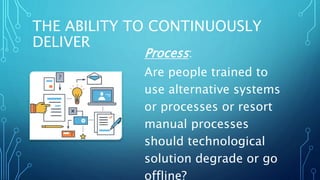
Process:
Are people trained to
use alternative systems
or processes or resort
manual processes
should technological
solution degrade or go
offline?
THE ABILITY TO
CONTINUOUSLY
DELIVER
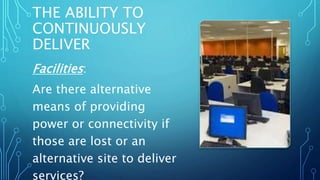
Facilities:
Are there alternative
means of providing
power or connectivity if
those are lost or an
alternative site to deliver
services?
•Is there load balancing
and/or auto-scaling of
services to cope with
demand changes or attacks?
•Is there ability to switch
between systems which
provide the services which
THE ABILITY TO CONTINUOUSLY
DELIVER
Technolo
gy:
INTENDED OUTCOME
To achieve this result,
the
organizations/govern
ments must be able to
provide access to the
needed system or
service.
INTENDED OUTCOME
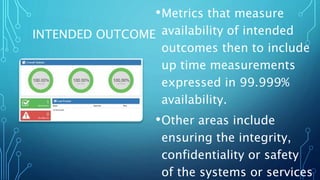
•Metrics that measure
availability of intended
outcomes then to include
up time measurements
expressed in 99.999%
availability.
•Other areas include
ensuring the integrity,
confidentiality or safety
of the systems or services
ADVERSE CYBER
EVENTS
The definition of
adverse cyber
events can include
both natural
disasters/disturbanc
es or human-caused
disasters/disturbanc
es
ADVERSE CYBER
EVENTS
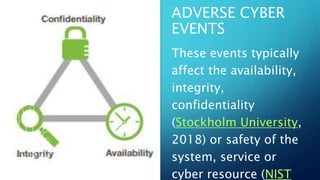
These events typically
affect the availability,
integrity,
confidentiality
(Stockholm University,
2018) or safety of the
system, service or
cyber resource (NIST
TECHNOLOGY:
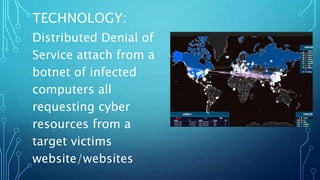
Distributed Denial of
Service attach from a
botnet of infected
computers all
requesting cyber
resources from a
target victims
website/websites
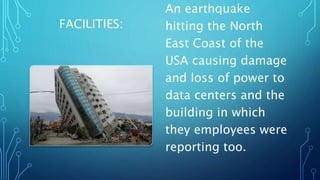
FACILITIES:
An earthquake
hitting the North
East Coast of the
USA causing damage
and loss of power to
data centers and the
building in which
they employees were
reporting too.
Overall Example
•The Intended Outcome: To deliver Social Security
benefits to recipients
•Adverse Cyber event: Distributed Denial of Service
Attack on Social Security Website and recourses
•Ability to continually deliver: Social Security delivery
utilize Content Delivery Networks to cache majority
of content, while using their security to segregate
out legitimate users needed additional access from
the Social Security website
FRAMEWORKS FOR ACHIEVING
CYBER RESILIENCE
We will discuss different frameworks geared at
assessing or increasing cyber resiliency with
different approaches.
•NIST SP 800-160 v2 (NIST 2018) - Systems
perspective
•DHS Cyber Resilience Framework (US-CERT
2018) – Operational readiness perspective
•MITRE Cyber Resiliency Engineering Framework
HOW THESE FRAMEWORKS HELP?
Why is there a cyber security framework
(CSF)?
•They help organize the various concepts
in to meaningful patterns
•Provide an overview and guidelines for
implementation
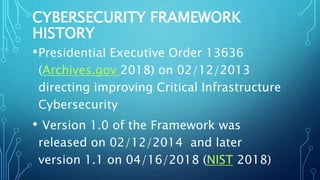
CYBERSECURITY FRAMEWORK
HISTORY
•Presidential Executive Order 13636
(Archives.gov 2018) on 02/12/2013
directing improving Critical Infrastructure
Cybersecurity
• Version 1.0 of the Framework was
released on 02/12/2014 and later
version 1.1 on 04/16/2018 (NIST 2018)
NIST SP 800-160 V2 (NIST 2018)
SYSTEMS SECURITY ENGINEERING CYBER
RESILIENCY CONSIDERATIONS FOR THE
ENGINEERING OF TRUSTWORTHY SECURE
SYSTEMS
•Focuses on the property of Cyber Resiliency
which exists at the intersection of security and
resilience (NIST 800-160v2 2018).
•Provides a definition of what cyber resilience is
and how to achieve it through frameworks for
implementing cyber resilience risk models,
solution frameworks and constructs (NIST 800-
160v2 2018).
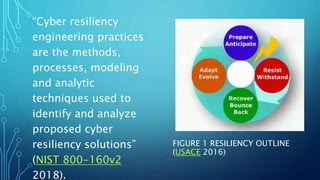
FIGURE 1 RESILIENCY OUTLINE
(USACE 2016)
“Cyber resiliency
engineering practices
are the methods,
processes, modeling
and analytic
techniques used to
identify and analyze
proposed cyber
resiliency solutions”
(NIST 800-160v2
2018).
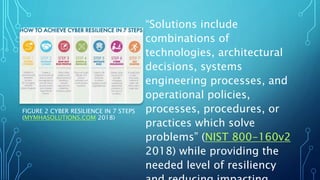
“Solutions include
combinations of
technologies, architectural
decisions, systems
engineering processes, and
operational policies,
processes, procedures, or
practices which solve
problems” (NIST 800-160v2
2018) while providing the
needed level of resiliency
FIGURE 2 CYBER RESILIENCE IN 7 STEPS
(MYMHASOLUTIONS.COM 2018)
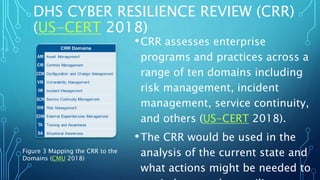
DHS CYBER RESILIENCE REVIEW (CRR)
(US-CERT 2018)
•CRR assesses enterprise
programs and practices across a
range of ten domains including
risk management, incident
management, service continuity,
and others (US-CERT 2018).
•The CRR would be used in the
analysis of the current state and
what actions might be needed to
Figure 3 Mapping the CRR to the
Domains (CMU 2018)
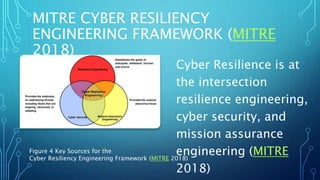
MITRE CYBER RESILIENCY
ENGINEERING FRAMEWORK (MITRE
2018)
Cyber Resilience is at
the intersection
resilience engineering,
cyber security, and
mission assurance
engineering (MITRE
2018)
Figure 4 Key Sources for the
Cyber Resiliency Engineering Framework (MITRE 2018)
Cyber resiliency
goals:
•Anticipate
•Withstand
•Recover
•Evolve
(MITRE 2018)
Figure 5 Cyber Resiliency Goals and Objectives
(MITRE 2018)
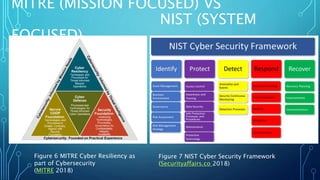
MITRE (MISSION FOCUSED) VS
NIST (SYSTEM
FOCUSED)
Figure 6 MITRE Cyber Resiliency as
part of Cybersecurity
(MITRE 2018)
Figure 7 NIST Cyber Security Framework
(Securityaffairs.co 2018)
WHEN YOU USE WHICH
FRAMEWORK?
NIST - Government Agencies and those
working with them, or adopt a similar
standardized framework
WHEN YOU USE WHICH FRAMEWORK?
DHS CRR – designed for business to use to
help assess their resilience in the current
state and take the needed steps to mature
to their desired future state
WHEN YOU USE WHICH
FRAMEWORK?
MITRE – geared at system designers who
want to incorporate MITRE approach on
resiliency, which is presented in a more
truncated fashion that the more extensive
NIST guidelines
QUESTIONS?

Understanding cyber resilience

  • 1.
    UNDERSTANDING CYBER RESILIENCE: PEOPLE, PROCESS,TECHNOLOGY, FACILITIES CHRISTOPHE FOULON
  • 2.
    ABOUT ME Ifocus on helping to secure people and process with a solid understanding of the technology involved. I have 10+ years as an experienced Information Security Manager and Cybersecurity Strategist with a passion for customer service, process improvement and information security.
  • 3.
    AGENDA: UNDERSTANDING CYBER RESILIENCE: PEOPLE,PROCESS, TECHNOLOGY, FACILITIES •Definition •Important Concepts •Cybersecurity vs Cyber resilience •Frameworks aimed at achieving cyber resilience
  • 4.
    CYBER RESILIENCE -DEFINITION “the ability to continuously deliver the intended outcome despite adverse cyber events” (Stockholm University, 2018)
  • 5.
    CYBER RESILIENCE -DEFINITION “is the ability to anticipate, withstand, recover from, and adapt to adverse conditions, stresses, attacks, or compromises on systems that use or are enabled by cyber resources regardless of the source” (NIST 800- 160v2 2018).
  • 6.
    IMPORTANT CONCEPTS •It involves theclose collaboration of people, processes, technology and facilities to delivery true resilience. •The ability to continuously deliver, intended outcome, adverse cyber events
  • 7.
    An outcome (service)cannot be delivered without the below components •people to operate and monitor the service •information and data to feed the process and to be produced by the service •technology to automate and support the service
  • 8.
    CYBERSECURITY VS CYBER RESILIENCE Cybersecurityfocuses on protecting information systems through people, processes or technologies to reduce or minimize the impact of cyber attacks.

  • 9.
    CYBERSECURITY VS CYBER RESILIENCE CyberResilience focuses on ensuring that there is a combination of cyber security and business resilience processes to reduce or minimize the impact on services or systems and ensuring that they continue to
  • 10.
    CYBERSECURITY VS CYBER RESILIENCE •Oranother way to describe it: •Security Vs Security and keeping things running!
  • 11.
    THE ABILITY TOCONTINUOUSLY DELIVER To achieve this outcome organizations/governments must designs systems in a manner in which they are able to “continuously change or modify these delivery mechanisms” (Stockholm University, 2018) and…
  • 12.
    THE ABILITY TO CONTINUOUSLY DELIVER …can “withstand cyber- attacks, faults, and failures and continue to operate even in a degraded or debilitated state” (NIST 800-160v2 2018).
  • 13.
    THE ABILITY TO CONTINUOUSLY DELIVER People: •Dothe people have the needed skills to perform their duties? •Do you have sufficient staff to do deliver the
  • 14.
    THE ABILITY TOCONTINUOUSLY DELIVER Process: Are people trained to use alternative systems or processes or resort manual processes should technological solution degrade or go offline?
  • 15.
    THE ABILITY TO CONTINUOUSLY DELIVER Facilities: Arethere alternative means of providing power or connectivity if those are lost or an alternative site to deliver services?
  • 16.
    •Is there loadbalancing and/or auto-scaling of services to cope with demand changes or attacks? •Is there ability to switch between systems which provide the services which THE ABILITY TO CONTINUOUSLY DELIVER Technolo gy:
  • 17.
    INTENDED OUTCOME To achievethis result, the organizations/govern ments must be able to provide access to the needed system or service.
  • 18.
    INTENDED OUTCOME •Metrics thatmeasure availability of intended outcomes then to include up time measurements expressed in 99.999% availability. •Other areas include ensuring the integrity, confidentiality or safety of the systems or services
  • 19.
    ADVERSE CYBER EVENTS The definitionof adverse cyber events can include both natural disasters/disturbanc es or human-caused disasters/disturbanc es
  • 20.
    ADVERSE CYBER EVENTS These eventstypically affect the availability, integrity, confidentiality (Stockholm University, 2018) or safety of the system, service or cyber resource (NIST
  • 21.
    TECHNOLOGY: Distributed Denial of Serviceattach from a botnet of infected computers all requesting cyber resources from a target victims website/websites
  • 22.
    FACILITIES: An earthquake hitting theNorth East Coast of the USA causing damage and loss of power to data centers and the building in which they employees were reporting too.
  • 23.
    Overall Example •The IntendedOutcome: To deliver Social Security benefits to recipients •Adverse Cyber event: Distributed Denial of Service Attack on Social Security Website and recourses •Ability to continually deliver: Social Security delivery utilize Content Delivery Networks to cache majority of content, while using their security to segregate out legitimate users needed additional access from the Social Security website
  • 24.
    FRAMEWORKS FOR ACHIEVING CYBERRESILIENCE We will discuss different frameworks geared at assessing or increasing cyber resiliency with different approaches. •NIST SP 800-160 v2 (NIST 2018) - Systems perspective •DHS Cyber Resilience Framework (US-CERT 2018) – Operational readiness perspective •MITRE Cyber Resiliency Engineering Framework
  • 25.
    HOW THESE FRAMEWORKSHELP? Why is there a cyber security framework (CSF)? •They help organize the various concepts in to meaningful patterns •Provide an overview and guidelines for implementation
  • 26.
    CYBERSECURITY FRAMEWORK HISTORY •Presidential ExecutiveOrder 13636 (Archives.gov 2018) on 02/12/2013 directing improving Critical Infrastructure Cybersecurity • Version 1.0 of the Framework was released on 02/12/2014 and later version 1.1 on 04/16/2018 (NIST 2018)
  • 27.
    NIST SP 800-160V2 (NIST 2018) SYSTEMS SECURITY ENGINEERING CYBER RESILIENCY CONSIDERATIONS FOR THE ENGINEERING OF TRUSTWORTHY SECURE SYSTEMS •Focuses on the property of Cyber Resiliency which exists at the intersection of security and resilience (NIST 800-160v2 2018). •Provides a definition of what cyber resilience is and how to achieve it through frameworks for implementing cyber resilience risk models, solution frameworks and constructs (NIST 800- 160v2 2018).
  • 28.
    FIGURE 1 RESILIENCYOUTLINE (USACE 2016) “Cyber resiliency engineering practices are the methods, processes, modeling and analytic techniques used to identify and analyze proposed cyber resiliency solutions” (NIST 800-160v2 2018).
  • 29.
    “Solutions include combinations of technologies,architectural decisions, systems engineering processes, and operational policies, processes, procedures, or practices which solve problems” (NIST 800-160v2 2018) while providing the needed level of resiliency FIGURE 2 CYBER RESILIENCE IN 7 STEPS (MYMHASOLUTIONS.COM 2018)
  • 30.
    DHS CYBER RESILIENCEREVIEW (CRR) (US-CERT 2018) •CRR assesses enterprise programs and practices across a range of ten domains including risk management, incident management, service continuity, and others (US-CERT 2018). •The CRR would be used in the analysis of the current state and what actions might be needed to Figure 3 Mapping the CRR to the Domains (CMU 2018)
  • 31.
    MITRE CYBER RESILIENCY ENGINEERINGFRAMEWORK (MITRE 2018) Cyber Resilience is at the intersection resilience engineering, cyber security, and mission assurance engineering (MITRE 2018) Figure 4 Key Sources for the Cyber Resiliency Engineering Framework (MITRE 2018)
  • 32.
  • 33.
    MITRE (MISSION FOCUSED)VS NIST (SYSTEM FOCUSED) Figure 6 MITRE Cyber Resiliency as part of Cybersecurity (MITRE 2018) Figure 7 NIST Cyber Security Framework (Securityaffairs.co 2018)
  • 34.
    WHEN YOU USEWHICH FRAMEWORK? NIST - Government Agencies and those working with them, or adopt a similar standardized framework
  • 35.
    WHEN YOU USEWHICH FRAMEWORK? DHS CRR – designed for business to use to help assess their resilience in the current state and take the needed steps to mature to their desired future state
  • 36.
    WHEN YOU USEWHICH FRAMEWORK? MITRE – geared at system designers who want to incorporate MITRE approach on resiliency, which is presented in a more truncated fashion that the more extensive NIST guidelines
  • 37.

Editor's Notes

  • #5 The ability to continue business operations even during a adverse cyber event.
  • #6 anticipate, withstand, recover from, and adapt to changing conditions and deliver the intended outcome
  • #7 Making sure you understand your business before you can focus on cyber resilience.
  • #14 This is where the cyber skills gaps comes into play.
  • #15 Think Ransomware, DDoS, Fibercuts, etc
  • #18 You need to understand what the intended state of business operations, in order to know what you will need deliver
  • #25 One Reason that NIST SP800-160 v2 is only focused on the System Perspective is that is a subset of a larger framework of NIST guidelines