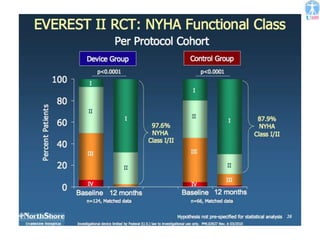
SICCH 2010, Technocollege
percutaneous mitral repair
F. Maisano MD, FESC
San Raffaele Institute
Milano, Italy
…The Truth
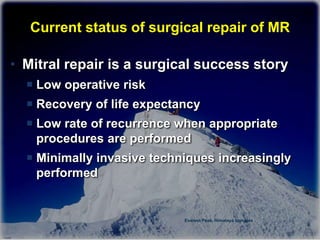
Current status of surgical repair of MR
• Mitral repair is a surgical success story
 Low operative risk
 Recovery of life expectancy
 Low rate of recurrence when appropriate
procedures are performed
 Minimally invasive techniques increasingly
performed
Everest Peak, Himalaya complex
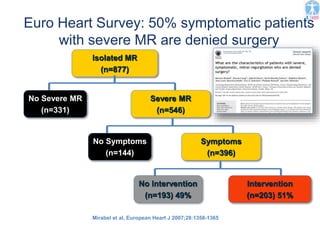
Euro Heart Survey: 50% symptomatic patients
with severe MR are denied surgery
Isolated MR
(n=877)
Severe MR
(n=546)
No Severe MR
(n=331)
No Symptoms
(n=144)
Symptoms
(n=396)
No Intervention
(n=193) 49%
Intervention
(n=203) 51%
Mirabel et al, European Heart J 2007;28:1358-1365
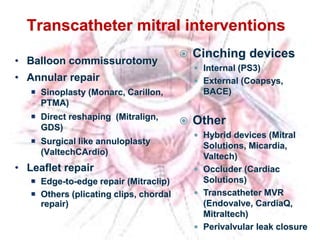
Transcatheter mitral interventions
• Balloon commissurotomy
• Annular repair
 Sinoplasty (Monarc, Carillon,
PTMA)
 Direct reshaping (Mitralign,
GDS)
 Surgical like annuloplasty
(ValtechCArdio)
• Leaflet repair
 Edge-to-edge repair (Mitraclip)
 Others (plicating clips, chordal
repair)
 Cinching devices
 Internal (PS3)
 External (Coapsys,
BACE)
 Other
 Hybrid devices (Mitral
Solutions, Micardia,
Valtech)
 Occluder (Cardiac
Solutions)
 Transcatheter MVR
(Endovalve, CardiaQ,
Mitraltech)
 Perivalvular leak closure
From surgery to catheter interventions
Surgical E2E, open heart, sternotomy
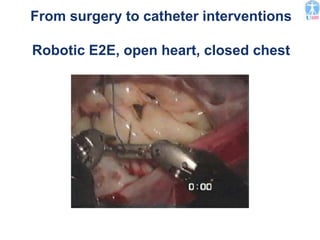
From surgery to catheter interventions
Robotic E2E, open heart, closed chest
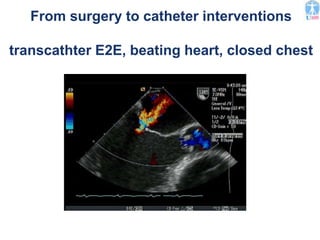
From surgery to catheter interventions
transcathter E2E, beating heart, closed chest
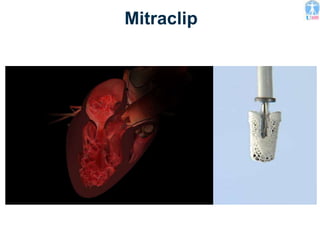
Mitraclip
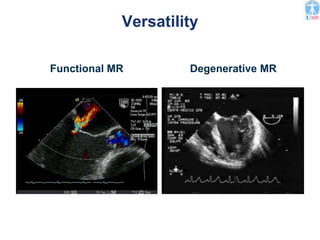
Versatility
Functional MR Degenerative MR
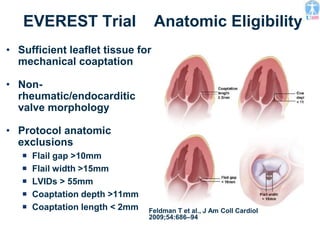
EVEREST Trial Anatomic Eligibility
• Sufficient leaflet tissue for
mechanical coaptation
• Non-
rheumatic/endocarditic
valve morphology
• Protocol anatomic
exclusions
 Flail gap >10mm
 Flail width >15mm
 LVIDs > 55mm
 Coaptation depth >11mm
 Coaptation length < 2mm Feldman T et al., J Am Coll Cardiol
2009;54:686–94
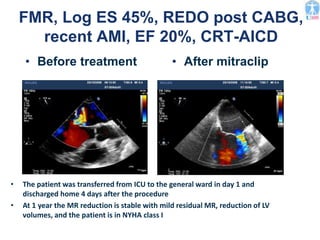
FMR, Log ES 45%, REDO post CABG,
recent AMI, EF 20%, CRT-AICD
• Before treatment • After mitraclip
• The patient was transferred from ICU to the general ward in day 1 and
discharged home 4 days after the procedure
• At 1 year the MR reduction is stable with mild residual MR, reduction of LV
volumes, and the patient is in NYHA class I
Confidential
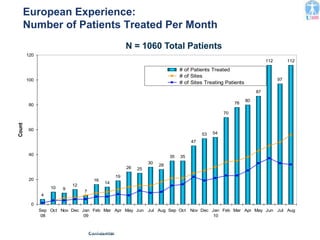
European Experience:
Number of Patients Treated Per Month
4
10 9
12
7
16
14
19
26 25
30
28
35 35
47
53 54
70
78
80
87
112
97
112
0
20
40
60
80
100
120
Sep
08
Oct Nov Dec Jan
09
Feb Mar Apr May Jun Jul Aug Sep Oct Nov Dec Jan
10
Feb Mar Apr May Jun Jul Aug
Count
# of Patients Treated
# of Sites
# of Sites Treating Patients
* Includes first-time procedures only – not 2nd Clip interventions
*Data as of 8/31/2010. Source: EU Case Observation Reports
N = 1060 Total Patients
GISE Mitraclip User Meeting
22
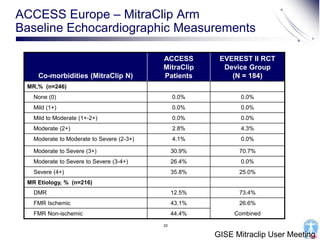
ACCESS Europe – MitraClip Arm
Baseline Echocardiographic Measurements
Co-morbidities (MitraClip N)
ACCESS
MitraClip
Patients
EVEREST II RCT
Device Group
(N = 184)
MR,% (n=246)
None (0) 0.0% 0.0%
Mild (1+) 0.0% 0.0%
Mild to Moderate (1+-2+) 0.0% 0.0%
Moderate (2+) 2.8% 4.3%
Moderate to Moderate to Severe (2-3+) 4.1% 0.0%
Moderate to Severe (3+) 30.9% 70.7%
Moderate to Severe to Severe (3-4+) 26.4% 0.0%
Severe (4+) 35.8% 25.0%
MR Etiology, % (n=216)
DMR 12.5% 73.4%
FMR Ischemic 43.1% 26.6%
CombinedFMR Non-ischemic 44.4%
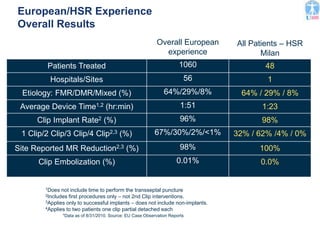
European/HSR Experience
Overall Results
*Data as of 8/31/2010. Source: EU Case Observation Reports
Overall European
experience
All Patients – HSR
Milan
Patients Treated 1060 48
Hospitals/Sites 56 1
Etiology: FMR/DMR/Mixed (%) 64%/29%/8% 64% / 29% / 8%
Average Device Time1,2 (hr:min) 1:51 1:23
Clip Implant Rate2 (%) 96% 98%
1 Clip/2 Clip/3 Clip/4 Clip2,3 (%) 67%/30%/2%/<1% 32% / 62% /4% / 0%
Site Reported MR Reduction2,3 (%) 98% 100%
Clip Embolization (%) 0.01% 0.0%
1Does not include time to perform the transseptal puncture
2Includes first procedures only – not 2nd Clip interventions.
3Applies only to successful implants – does not include non-implants.
4Applies to two patients one clip partial detached each
24
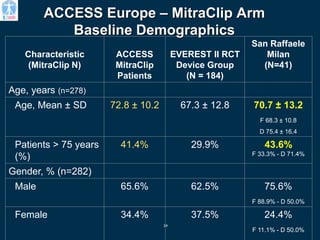
ACCESS Europe – MitraClip Arm
Baseline Demographics
Characteristic
(MitraClip N)
ACCESS
MitraClip
Patients
EVEREST II RCT
Device Group
(N = 184)
San Raffaele
Milan
(N=41)
Age, years (n=278)
Age, Mean ± SD 72.8 ± 10.2 67.3 ± 12.8 70.7 ± 13.2
F 68.3 ± 10.8
D 75.4 ± 16.4
Patients > 75 years
(%)
41.4% 29.9% 43.6%
F 33.3% - D 71.4%
Gender, % (n=282)
Male 65.6% 62.5% 75.6%
F 88.9% - D 50.0%
Female 34.4% 37.5% 24.4%
F 11.1% - D 50.0%
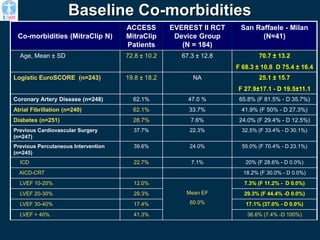
Baseline Co-morbidities
Co-morbidities (MitraClip N)
ACCESS
MitraClip
Patients
EVEREST II RCT
Device Group
(N = 184)
San Raffaele - Milan
(N=41)
Age, Mean ± SD 72.8 ± 10.2 67.3 ± 12.8 70.7 ± 13.2
F 68.3 ± 10.8 D 75.4 ± 16.4
Logistic EuroSCORE (n=243) 19.8 ± 18.2 NA 25.1 ± 15.7
F 27.9±17.1 - D 19.5±11.1
Coronary Artery Disease (n=248) 62.1% 47.0 % 65.8% (F 81.5% - D 35.7%)
Atrial Fibrillation (n=240) 62.1% 33.7% 41.9% (F 50% - D 27.3%)
Diabetes (n=251) 28.7% 7.6% 24.0% (F 29.4% - D 12.5%)
Previous Cardiovascular Surgery
(n=247)
37.7% 22.3% 32.5% (F 33.4% - D 30.1%)
Previous Percutaneous Intervention
(n=245)
39.6% 24.0% 55.0% (F 70.4% - D 23.1%)
ICD 22.7% 7.1% 20% (F 28.6% - D 0.0%)
AICD-CRT 18.2% (F 30.0% - D 0.0%)
LVEF 10-20% 12.0%
Mean EF
60.0%
7.3% (F 11.2% - D 0.0%)
LVEF 20-30% 29.3% 29.3% (F 44.4% -D 0.0%)
LVEF 30-40% 17.4% 17.1% (37.0% - D 0.0%)
LVEF > 40% 41.3% 36.6% (7.4% -D 100%)
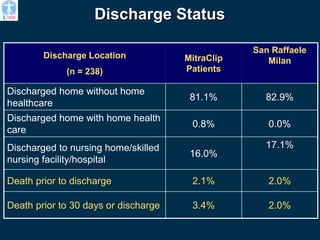
Discharge Status
26
Discharge Location
(n = 238)
MitraClip
Patients
San Raffaele
Milan
Discharged home without home
healthcare
81.1% 82.9%
Discharged home with home health
care
0.8% 0.0%
Discharged to nursing home/skilled
nursing facility/hospital
16.0%
17.1%
Death prior to discharge 2.1% 2.0%
Death prior to 30 days or discharge 3.4% 2.0%
27
Degenerative
(n = 14)
Functional
(n = 26)
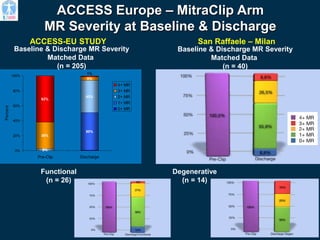
ACCESS Europe – MitraClip Arm
MR Severity at Baseline & Discharge
50%
43%
36%
2%
5%
1%
62%
0%
20%
40%
60%
80%
100%
Pre-Clip Discharge
Percent
4+ MR
3+ MR
2+ MR
1+ MR
0+ MR
Baseline & Discharge MR Severity
Matched Data
(n = 205)
Baseline & Discharge MR Severity
Matched Data
(n = 40)
San Raffaele – MilanACCESS-EU STUDY
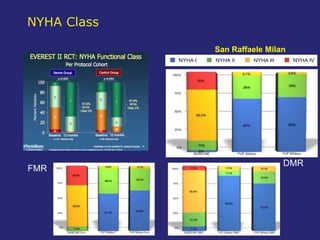
NYHA Class
Functional
DMR
San Raffaele Milan
FMR
Beyond Mitraclip - Annuloplasty
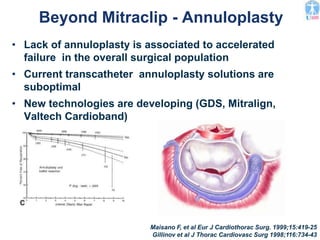
• Lack of annuloplasty is associated to accelerated
failure in the overall surgical population
• Current transcatheter annuloplasty solutions are
suboptimal
• New technologies are developing (GDS, Mitralign,
Valtech Cardioband)
Maisano F, et al Eur J Cardiothorac Surg. 1999;15:419-25
Gillinov et al J Thorac Cardiovasc Surg 1998;116:734-43
Transcatheter annuloplasty
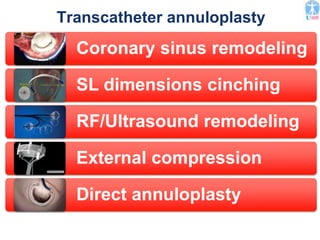
Coronary sinus remodeling
SL dimensions cinching
RF/Ultrasound remodeling
External compression
Direct annuloplasty
Direct annular remodeling
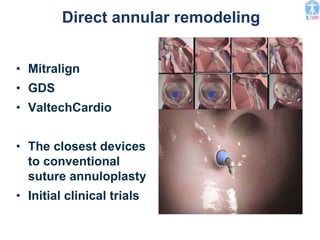
• Mitralign
• GDS
• ValtechCardio
• The closest devices
to conventional
suture annuloplasty
• Initial clinical trials
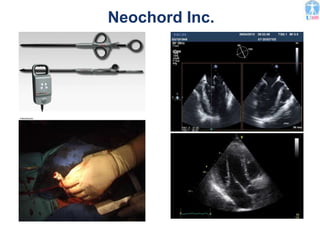
Neochord Inc.
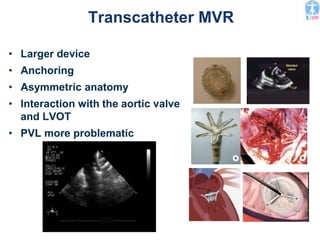
Transcatheter MVR
• Larger device
• Anchoring
• Asymmetric anatomy
• Interaction with the aortic valve
and LVOT
• PVL more problematic
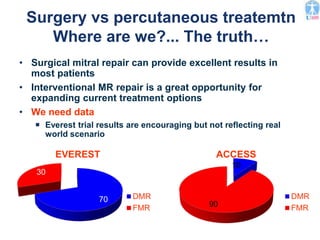
Surgery vs percutaneous treatemtn
Where are we?... The truth…
• Surgical mitral repair can provide excellent results in
most patients
• Interventional MR repair is a great opportunity for
expanding current treatment options
• We need data
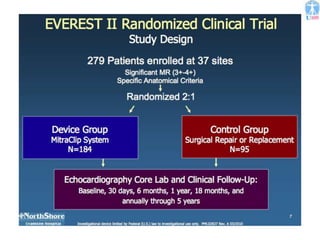
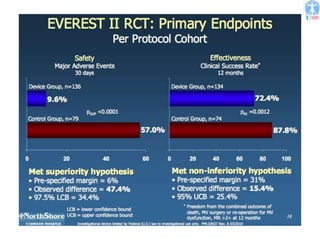
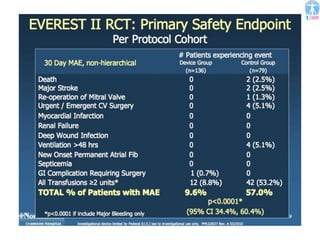
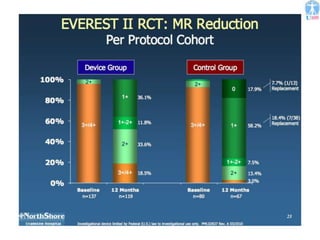
 Everest trial results are encouraging but not reflecting real
world scenario
70
30
EVEREST
DMR
FMR
10
90
ACCESS
DMR
FMR
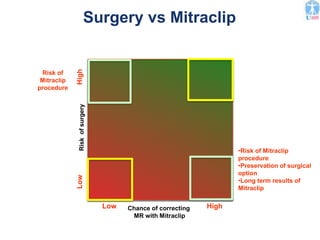
Surgery vs Mitraclip
Chance of correcting
MR with Mitraclip
RiskofsurgeryLowHigh
Low High
Risk of
Mitraclip
procedure
•Risk of Mitraclip
procedure
•Preservation of surgical
option
•Long term results of
Mitraclip
Individualize the therapy
• Anatomy and function
• Comorbidities, Life expectancy
• Compare risk and probability of
success
• Preservation of surgical option
• Patient informed consent for
therapy
• Transcatheter mitral repair is here
to stay
• Surgeons will do procedures
We need
data !!!

Percutaneous Mitral Repair The Truth

  • 1.
    SICCH 2010, Technocollege percutaneousmitral repair F. Maisano MD, FESC San Raffaele Institute Milano, Italy …The Truth
  • 2.
    Current status ofsurgical repair of MR • Mitral repair is a surgical success story  Low operative risk  Recovery of life expectancy  Low rate of recurrence when appropriate procedures are performed  Minimally invasive techniques increasingly performed Everest Peak, Himalaya complex
  • 3.
    Euro Heart Survey:50% symptomatic patients with severe MR are denied surgery Isolated MR (n=877) Severe MR (n=546) No Severe MR (n=331) No Symptoms (n=144) Symptoms (n=396) No Intervention (n=193) 49% Intervention (n=203) 51% Mirabel et al, European Heart J 2007;28:1358-1365
  • 4.
    Transcatheter mitral interventions •Balloon commissurotomy • Annular repair  Sinoplasty (Monarc, Carillon, PTMA)  Direct reshaping (Mitralign, GDS)  Surgical like annuloplasty (ValtechCArdio) • Leaflet repair  Edge-to-edge repair (Mitraclip)  Others (plicating clips, chordal repair)  Cinching devices  Internal (PS3)  External (Coapsys, BACE)  Other  Hybrid devices (Mitral Solutions, Micardia, Valtech)  Occluder (Cardiac Solutions)  Transcatheter MVR (Endovalve, CardiaQ, Mitraltech)  Perivalvular leak closure
  • 5.
    From surgery tocatheter interventions Surgical E2E, open heart, sternotomy
  • 6.
    From surgery tocatheter interventions Robotic E2E, open heart, closed chest
  • 7.
    From surgery tocatheter interventions transcathter E2E, beating heart, closed chest
  • 8.
  • 9.
  • 10.
    EVEREST Trial AnatomicEligibility • Sufficient leaflet tissue for mechanical coaptation • Non- rheumatic/endocarditic valve morphology • Protocol anatomic exclusions  Flail gap >10mm  Flail width >15mm  LVIDs > 55mm  Coaptation depth >11mm  Coaptation length < 2mm Feldman T et al., J Am Coll Cardiol 2009;54:686–94
  • 14.
    FMR, Log ES45%, REDO post CABG, recent AMI, EF 20%, CRT-AICD • Before treatment • After mitraclip • The patient was transferred from ICU to the general ward in day 1 and discharged home 4 days after the procedure • At 1 year the MR reduction is stable with mild residual MR, reduction of LV volumes, and the patient is in NYHA class I
  • 21.
    Confidential European Experience: Number ofPatients Treated Per Month 4 10 9 12 7 16 14 19 26 25 30 28 35 35 47 53 54 70 78 80 87 112 97 112 0 20 40 60 80 100 120 Sep 08 Oct Nov Dec Jan 09 Feb Mar Apr May Jun Jul Aug Sep Oct Nov Dec Jan 10 Feb Mar Apr May Jun Jul Aug Count # of Patients Treated # of Sites # of Sites Treating Patients * Includes first-time procedures only – not 2nd Clip interventions *Data as of 8/31/2010. Source: EU Case Observation Reports N = 1060 Total Patients
  • 22.
    GISE Mitraclip UserMeeting 22 ACCESS Europe – MitraClip Arm Baseline Echocardiographic Measurements Co-morbidities (MitraClip N) ACCESS MitraClip Patients EVEREST II RCT Device Group (N = 184) MR,% (n=246) None (0) 0.0% 0.0% Mild (1+) 0.0% 0.0% Mild to Moderate (1+-2+) 0.0% 0.0% Moderate (2+) 2.8% 4.3% Moderate to Moderate to Severe (2-3+) 4.1% 0.0% Moderate to Severe (3+) 30.9% 70.7% Moderate to Severe to Severe (3-4+) 26.4% 0.0% Severe (4+) 35.8% 25.0% MR Etiology, % (n=216) DMR 12.5% 73.4% FMR Ischemic 43.1% 26.6% CombinedFMR Non-ischemic 44.4%
  • 23.
    European/HSR Experience Overall Results *Dataas of 8/31/2010. Source: EU Case Observation Reports Overall European experience All Patients – HSR Milan Patients Treated 1060 48 Hospitals/Sites 56 1 Etiology: FMR/DMR/Mixed (%) 64%/29%/8% 64% / 29% / 8% Average Device Time1,2 (hr:min) 1:51 1:23 Clip Implant Rate2 (%) 96% 98% 1 Clip/2 Clip/3 Clip/4 Clip2,3 (%) 67%/30%/2%/<1% 32% / 62% /4% / 0% Site Reported MR Reduction2,3 (%) 98% 100% Clip Embolization (%) 0.01% 0.0% 1Does not include time to perform the transseptal puncture 2Includes first procedures only – not 2nd Clip interventions. 3Applies only to successful implants – does not include non-implants. 4Applies to two patients one clip partial detached each
  • 24.
    24 ACCESS Europe –MitraClip Arm Baseline Demographics Characteristic (MitraClip N) ACCESS MitraClip Patients EVEREST II RCT Device Group (N = 184) San Raffaele Milan (N=41) Age, years (n=278) Age, Mean ± SD 72.8 ± 10.2 67.3 ± 12.8 70.7 ± 13.2 F 68.3 ± 10.8 D 75.4 ± 16.4 Patients > 75 years (%) 41.4% 29.9% 43.6% F 33.3% - D 71.4% Gender, % (n=282) Male 65.6% 62.5% 75.6% F 88.9% - D 50.0% Female 34.4% 37.5% 24.4% F 11.1% - D 50.0%
  • 25.
    Baseline Co-morbidities Co-morbidities (MitraClipN) ACCESS MitraClip Patients EVEREST II RCT Device Group (N = 184) San Raffaele - Milan (N=41) Age, Mean ± SD 72.8 ± 10.2 67.3 ± 12.8 70.7 ± 13.2 F 68.3 ± 10.8 D 75.4 ± 16.4 Logistic EuroSCORE (n=243) 19.8 ± 18.2 NA 25.1 ± 15.7 F 27.9±17.1 - D 19.5±11.1 Coronary Artery Disease (n=248) 62.1% 47.0 % 65.8% (F 81.5% - D 35.7%) Atrial Fibrillation (n=240) 62.1% 33.7% 41.9% (F 50% - D 27.3%) Diabetes (n=251) 28.7% 7.6% 24.0% (F 29.4% - D 12.5%) Previous Cardiovascular Surgery (n=247) 37.7% 22.3% 32.5% (F 33.4% - D 30.1%) Previous Percutaneous Intervention (n=245) 39.6% 24.0% 55.0% (F 70.4% - D 23.1%) ICD 22.7% 7.1% 20% (F 28.6% - D 0.0%) AICD-CRT 18.2% (F 30.0% - D 0.0%) LVEF 10-20% 12.0% Mean EF 60.0% 7.3% (F 11.2% - D 0.0%) LVEF 20-30% 29.3% 29.3% (F 44.4% -D 0.0%) LVEF 30-40% 17.4% 17.1% (37.0% - D 0.0%) LVEF > 40% 41.3% 36.6% (7.4% -D 100%)
  • 26.
    Discharge Status 26 Discharge Location (n= 238) MitraClip Patients San Raffaele Milan Discharged home without home healthcare 81.1% 82.9% Discharged home with home health care 0.8% 0.0% Discharged to nursing home/skilled nursing facility/hospital 16.0% 17.1% Death prior to discharge 2.1% 2.0% Death prior to 30 days or discharge 3.4% 2.0%
  • 27.
    27 Degenerative (n = 14) Functional (n= 26) ACCESS Europe – MitraClip Arm MR Severity at Baseline & Discharge 50% 43% 36% 2% 5% 1% 62% 0% 20% 40% 60% 80% 100% Pre-Clip Discharge Percent 4+ MR 3+ MR 2+ MR 1+ MR 0+ MR Baseline & Discharge MR Severity Matched Data (n = 205) Baseline & Discharge MR Severity Matched Data (n = 40) San Raffaele – MilanACCESS-EU STUDY
  • 28.
  • 29.
    Beyond Mitraclip -Annuloplasty • Lack of annuloplasty is associated to accelerated failure in the overall surgical population • Current transcatheter annuloplasty solutions are suboptimal • New technologies are developing (GDS, Mitralign, Valtech Cardioband) Maisano F, et al Eur J Cardiothorac Surg. 1999;15:419-25 Gillinov et al J Thorac Cardiovasc Surg 1998;116:734-43
  • 30.
    Transcatheter annuloplasty Coronary sinusremodeling SL dimensions cinching RF/Ultrasound remodeling External compression Direct annuloplasty
  • 31.
    Direct annular remodeling •Mitralign • GDS • ValtechCardio • The closest devices to conventional suture annuloplasty • Initial clinical trials
  • 32.
  • 33.
    Transcatheter MVR • Largerdevice • Anchoring • Asymmetric anatomy • Interaction with the aortic valve and LVOT • PVL more problematic
  • 34.
    Surgery vs percutaneoustreatemtn Where are we?... The truth… • Surgical mitral repair can provide excellent results in most patients • Interventional MR repair is a great opportunity for expanding current treatment options • We need data  Everest trial results are encouraging but not reflecting real world scenario 70 30 EVEREST DMR FMR 10 90 ACCESS DMR FMR
  • 35.
    Surgery vs Mitraclip Chanceof correcting MR with Mitraclip RiskofsurgeryLowHigh Low High Risk of Mitraclip procedure •Risk of Mitraclip procedure •Preservation of surgical option •Long term results of Mitraclip
  • 36.
    Individualize the therapy •Anatomy and function • Comorbidities, Life expectancy • Compare risk and probability of success • Preservation of surgical option • Patient informed consent for therapy • Transcatheter mitral repair is here to stay • Surgeons will do procedures We need data !!!