Editorial Slides
VP Watch – December 18, 2002 - Volume 2, Issue 50
Is CT-Based Characterization Of CoronaryIs CT-Based Characterization Of Coronary
Plaque/Artery Possible?Plaque/Artery Possible?
Provided by:
P.J. de Feijter, M.D.
Department of Cardiology and Radiology, Erasmus University
Rotterdam, The Netherlands
MS-CT : Goal
Visualizing and characterizing the diseased coronary
arterial wall in living patients. To evaluate:
- progression / regression
- risk factor modification
- coronary plaque treatment
- vulnerability to rupture
- site and extent of coronary obstruction
Milestones in Coronary Plaque
Imaging with (MS)-CT
- First EBCT coronary angiography
Achenbach NEJM 1998;339:1964
Rensing Circulation 1998; 98:2509
- First 4 slice MS-CT coronary angiography
Nieman Lancet 2001; 357: 599
- First in vivo 4 slice MS-CT coronary plaque imaging
Schroeder S. et al JACC 2001;37:1430-5
- First 16 slice MS-CT coronary angiography
Nieman Circulation 2002; 106: 2051
- Preliminary results 16 slice MS-CT
coronary plaque imaging
Coronary Plaque Imaging :
the “extreme” challenge
- small caliber vessels
- small size of plaques
- continuous cardiac and respiratory motion
- calcification (obscures underlying structures)
- modest attenuation variation between lipid-rich
and fibrous tissue components
16 Slice MS-CT Coronary
Angiography
Suspected CAD : 58 subjects (53 male; 58 ± 12 yrs)
Average heart rate : 56 ± 6 b.p.m. (with additional ß-blocker)
Detection of ≥ 50% stenosis in all coronary vessels > 2.0mm
No exclusion of vessels (or segments)
Sensitivity : 95% Pos.Pred.Value : 80%
Specificity : 86% Neg.Pred.Value : 97%
Nieman Circulation 2002;106:2051
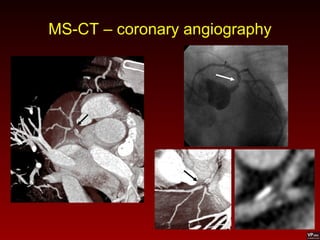
MS-CT – coronary angiography
Diagnostic Accuracy MS-CT
coronary angiography
4 slice MS-CT
Achenbach
Circulation 2001
4 slice MS-CT
Nieman
Heart 2002
16 slice MS-CT
Nieman
Circulation 2002
Detection of >50% diameter obstruction without exclusion of
coronary vessels or segments due to suboptimal image quality
Sensitivity 55% 65% 95%
MS-CT : Plaque Characterization
- Morphology
* presence, location,
distribution
* plaque size
* vessel remodeling
- Plaque composition
* Lipid
* fibrous tissue
* calcium
- Inflammation
MS - CT
+
+
Soft ( 0 – 30 HU )
Hard ( 31 – 130 HU )
Calcific ( >130 HU )
Coronary Plaque Imaging
- Examples
Normal
Calcific spots Calcium & stenosis
Severe stenosis
Total occlusion
70
300 150
500
600
300
200
30
MS-CT Coronary Plaque Imaging
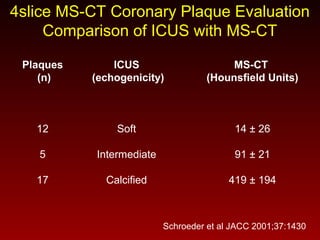
4slice MS-CT Coronary Plaque Evaluation
Comparison of ICUS with MS-CT
Plaques
(n)
12
5
17
ICUS
(echogenicity)
Soft
Intermediate
Calcified
MS-CT
(Hounsfield Units)
14 ± 26
91 ± 21
419 ± 194
Schroeder et al JACC 2001;37:1430
280HU
280HU80HU
30HU
450HU
MS-CT Coronary Plaque Imaging
Work-Up High Risk Patients
Clinical presentation
< 60 yrs old Diabetes Acute coronary syndrome
Biochemical markers
Elevated C-PR
Non-invasive MS-CT
Localization of plaque Characterization of plaque
Invasive techniques
IVUS Palpography Thermography OCT
 As reported in this week’s VP
Watch, Teichholz et al. showed
quantitative assessment of
atherosclerosis by EBT.
Teichholz LE, Petrillo S, Larson AJ, Klig V. Quantitative assessment of atherosclerosis by electron beam tomography.
Am J Cardiol. 2002 Dec 15;90(12):1416-9.
 They showed 3 new EBT parameters for
a region of interest (ROI):
 Mean value of Hounsfield Units (HU) within
the ROI
 Standard deviation (SD) of HU within the
ROI
 Percent of voxels with HU < 0 within the ROI
Teichholz LE, Petrillo S, Larson AJ, Klig V. Quantitative assessment of atherosclerosis by electron beam tomography.
Am J Cardiol. 2002 Dec 15;90(12):1416-9.
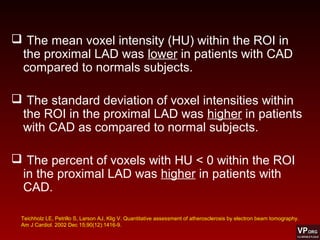
 The mean voxel intensity (HU) within the ROI in
the proximal LAD was lower in patients with CAD
compared to normals subjects.
 The standard deviation of voxel intensities within
the ROI in the proximal LAD was higher in patients
with CAD as compared to normal subjects.
 The percent of voxels with HU < 0 within the ROI
in the proximal LAD was higher in patients with
CAD.
Teichholz LE, Petrillo S, Larson AJ, Klig V. Quantitative assessment of atherosclerosis by electron beam tomography.
Am J Cardiol. 2002 Dec 15;90(12):1416-9.
0
5
10
15
20
25
30
35
40
Normal
CAD
(p<0.005)
HU
Mean Voxel Intensity (HU) in LAD
Teichholz LE, Petrillo S, Larson AJ, Klig V. Quantitative assessment of atherosclerosis by electron beam tomography.
Am J Cardiol. 2002 Dec 15;90(12):1416-9.
• 16 MS-CT Coronary Imaging:
– A reliable non-invasive technique to detect
coronary obstructions if combined with intensive
heart rate control to <65 b.p.m.
– Can be used for identification of soft, intermediate
and calcific plaques.
– Offers great potential as an initial non-invasive
technique to identify vulnerable plaque / artery in
at risk population
Conclusion:
Conclusion:
• Growing body of evidence suggest
that CT-based characterization of
coronary plaques and/or artery is
possible, and this technology may
serve as the first line imaging tool for
screening vulnerable patients.
• Combination of CT with serum
markers of vulnerability may provide a
much more powerful predictive value.
Department of Cardiology1
and
Radiology2
Erasmus University
Rotterdam, The Netherlands
P.J. de Feijter1, 2
K. Nieman1 2
N.R.A. Mollet1 2
R. Raaijmakers2
F. Cademartiri2
J. Ligthart1
P. Lemos1
P.Pattynama2
P.W. Serruys1
Most of the Editorial Slides of this week were provided
by Dr de Feijter and his colleagues:

Es v2n50

  • 1.
    Editorial Slides VP Watch– December 18, 2002 - Volume 2, Issue 50 Is CT-Based Characterization Of CoronaryIs CT-Based Characterization Of Coronary Plaque/Artery Possible?Plaque/Artery Possible? Provided by: P.J. de Feijter, M.D. Department of Cardiology and Radiology, Erasmus University Rotterdam, The Netherlands
  • 2.
    MS-CT : Goal Visualizingand characterizing the diseased coronary arterial wall in living patients. To evaluate: - progression / regression - risk factor modification - coronary plaque treatment - vulnerability to rupture - site and extent of coronary obstruction
  • 3.
    Milestones in CoronaryPlaque Imaging with (MS)-CT - First EBCT coronary angiography Achenbach NEJM 1998;339:1964 Rensing Circulation 1998; 98:2509 - First 4 slice MS-CT coronary angiography Nieman Lancet 2001; 357: 599 - First in vivo 4 slice MS-CT coronary plaque imaging Schroeder S. et al JACC 2001;37:1430-5 - First 16 slice MS-CT coronary angiography Nieman Circulation 2002; 106: 2051 - Preliminary results 16 slice MS-CT coronary plaque imaging
  • 4.
    Coronary Plaque Imaging: the “extreme” challenge - small caliber vessels - small size of plaques - continuous cardiac and respiratory motion - calcification (obscures underlying structures) - modest attenuation variation between lipid-rich and fibrous tissue components
  • 5.
    16 Slice MS-CTCoronary Angiography Suspected CAD : 58 subjects (53 male; 58 ± 12 yrs) Average heart rate : 56 ± 6 b.p.m. (with additional ß-blocker) Detection of ≥ 50% stenosis in all coronary vessels > 2.0mm No exclusion of vessels (or segments) Sensitivity : 95% Pos.Pred.Value : 80% Specificity : 86% Neg.Pred.Value : 97% Nieman Circulation 2002;106:2051
  • 6.
    MS-CT – coronaryangiography
  • 7.
    Diagnostic Accuracy MS-CT coronaryangiography 4 slice MS-CT Achenbach Circulation 2001 4 slice MS-CT Nieman Heart 2002 16 slice MS-CT Nieman Circulation 2002 Detection of >50% diameter obstruction without exclusion of coronary vessels or segments due to suboptimal image quality Sensitivity 55% 65% 95%
  • 8.
    MS-CT : PlaqueCharacterization - Morphology * presence, location, distribution * plaque size * vessel remodeling - Plaque composition * Lipid * fibrous tissue * calcium - Inflammation MS - CT + + Soft ( 0 – 30 HU ) Hard ( 31 – 130 HU ) Calcific ( >130 HU )
  • 9.
    Coronary Plaque Imaging -Examples Normal Calcific spots Calcium & stenosis Severe stenosis Total occlusion
  • 10.
  • 11.
    4slice MS-CT CoronaryPlaque Evaluation Comparison of ICUS with MS-CT Plaques (n) 12 5 17 ICUS (echogenicity) Soft Intermediate Calcified MS-CT (Hounsfield Units) 14 ± 26 91 ± 21 419 ± 194 Schroeder et al JACC 2001;37:1430
  • 12.
  • 13.
    Work-Up High RiskPatients Clinical presentation < 60 yrs old Diabetes Acute coronary syndrome Biochemical markers Elevated C-PR Non-invasive MS-CT Localization of plaque Characterization of plaque Invasive techniques IVUS Palpography Thermography OCT
  • 14.
     As reportedin this week’s VP Watch, Teichholz et al. showed quantitative assessment of atherosclerosis by EBT. Teichholz LE, Petrillo S, Larson AJ, Klig V. Quantitative assessment of atherosclerosis by electron beam tomography. Am J Cardiol. 2002 Dec 15;90(12):1416-9.
  • 15.
     They showed3 new EBT parameters for a region of interest (ROI):  Mean value of Hounsfield Units (HU) within the ROI  Standard deviation (SD) of HU within the ROI  Percent of voxels with HU < 0 within the ROI Teichholz LE, Petrillo S, Larson AJ, Klig V. Quantitative assessment of atherosclerosis by electron beam tomography. Am J Cardiol. 2002 Dec 15;90(12):1416-9.
  • 16.
     The meanvoxel intensity (HU) within the ROI in the proximal LAD was lower in patients with CAD compared to normals subjects.  The standard deviation of voxel intensities within the ROI in the proximal LAD was higher in patients with CAD as compared to normal subjects.  The percent of voxels with HU < 0 within the ROI in the proximal LAD was higher in patients with CAD. Teichholz LE, Petrillo S, Larson AJ, Klig V. Quantitative assessment of atherosclerosis by electron beam tomography. Am J Cardiol. 2002 Dec 15;90(12):1416-9.
  • 17.
    0 5 10 15 20 25 30 35 40 Normal CAD (p<0.005) HU Mean Voxel Intensity(HU) in LAD Teichholz LE, Petrillo S, Larson AJ, Klig V. Quantitative assessment of atherosclerosis by electron beam tomography. Am J Cardiol. 2002 Dec 15;90(12):1416-9.
  • 18.
    • 16 MS-CTCoronary Imaging: – A reliable non-invasive technique to detect coronary obstructions if combined with intensive heart rate control to <65 b.p.m. – Can be used for identification of soft, intermediate and calcific plaques. – Offers great potential as an initial non-invasive technique to identify vulnerable plaque / artery in at risk population Conclusion:
  • 19.
    Conclusion: • Growing bodyof evidence suggest that CT-based characterization of coronary plaques and/or artery is possible, and this technology may serve as the first line imaging tool for screening vulnerable patients. • Combination of CT with serum markers of vulnerability may provide a much more powerful predictive value.
  • 20.
    Department of Cardiology1 and Radiology2 ErasmusUniversity Rotterdam, The Netherlands P.J. de Feijter1, 2 K. Nieman1 2 N.R.A. Mollet1 2 R. Raaijmakers2 F. Cademartiri2 J. Ligthart1 P. Lemos1 P.Pattynama2 P.W. Serruys1 Most of the Editorial Slides of this week were provided by Dr de Feijter and his colleagues: