Submitted by: Dona Sumi Sunny
Pharm D intern
KLE College of Pharmacy
Belagavi
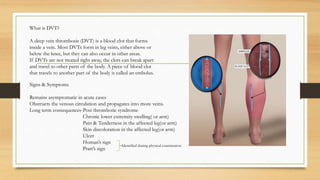
What is DVT?
A deep vein thrombosis (DVT) is a blood clot that forms
inside a vein. Most DVTs form in leg veins, either above or
below the knee, but they can also occur in other areas.
If DVTs are not treated right away, the clots can break apart
and travel to other parts of the body. A piece of blood clot
that travels to another part of the body is called an embolus.
Signs & Symptoms
Remains asymptomatic in acute cases
Obstructs the venous circulation and propagates into more veins.
Long term consequences-Post thrombotic syndrome
Chronic lower extremity swelling( or arm)
Pain & Tenderness in the affected leg(or arm)
Skin discoloration in the affected leg(or arm)
Ulcer
Homan’s sign
Pratt’s sign
Identified during physical examination
Aeitology / Risk Factors:
Abnormalities of Blood flow
Hypercoagulability
Endothelial damage
Atrial fibrillation
Left ventricular dysfunction
Ischemic/ idiopathic cardiomyopathy
CHF
MI
Bed rest/Paralysis
Venous obstruction from tumor/obesity/pregnancy
Hereditary: Factor V Leiden
Prothrombin G20210A
Protein C & S Defi.
Acquired: Cancer and Chemo
OCR/HRT
HIT
Arteriosclerosis
H/o VTE
Anti phospholipid antibodies
:Dysfunction
Smoking
HTN
Polycythemia
: Damage
Surgery
Catheter(PICC line)
Central venous catheter
Trauma
VIRCHOW’S TRIAD
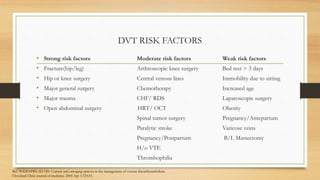
DVT RISK FACTORS
• Strong risk factors Moderate risk factors Weak risk factors
• Fracture(hip/leg) Arthroscopic knee surgery Bed rest > 3 days
• Hip or knee surgery Central venous lines Immobility due to sitting
• Major general surgery Chemotherapy Increased age
• Major trauma CHF/ RDS Laparoscopic surgery
• Open abdominal surgery HRT/ OCT Obesity
Spinal tumor surgery Pregnancy/Antepartum
Paralytic stroke Varicose veins
Pregnancy/Postpartum B/L Mastectomy
H/o VTE
Thrombophilia
Ref: WIDESPREAD OD. Current and emerging options in the management of venous thromboembolism.
Cleveland Clinic journal of medicine. 2005 Apr 1;72:S15.
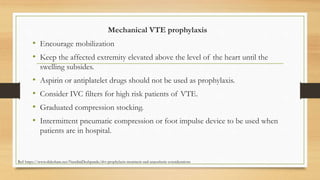
Mechanical VTE prophylaxis
• Encourage mobilization
• Keep the affected extremity elevated above the level of the heart until the
swelling subsides.
• Aspirin or antiplatelet drugs should not be used as prophylaxis.
• Consider IVC filters for high risk patients of VTE.
• Graduated compression stocking.
• Intermittent pneumatic compression or foot impulse device to be used when
patients are in hospital.
Ref: https://www.slideshare.net/NandiniDeshpande/dvt-prophylaxis-treatment-and-anaesthetic-considerations
Pharmacological prophylaxis
• Anticoagulants prevent the thrombus propagation and allow endogenous
lytic system to operate.
• Factors that affect the selection of anticoagulant for VTE
1. BMI/Weight
2. Cr. Clearance
• Contraindications:
1. Recent surgery to eye or CNS
2. Pre existing hemorrhagic state like liver disease, renal failure, hemophilia
and thrombocytopenia.
3. Pre-existing structural lesions like peptic ulcer.
4. Recent cerebral hemorrhage.
Ref: https://www.slideshare.net/NandiniDeshpande/dvt-prophylaxis-treatment-and-anaesthetic-considerations
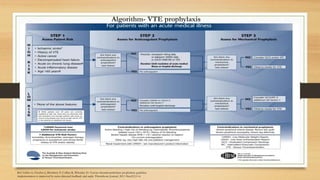
Algorithm- VTE prophylaxis
Ref: Gibbs H, Fletcher J, Blombery P, Collins R, Wheatley D. Venous thromboembolism prophylaxis guideline
implementation is improved by nurse directed feedback and audit. Thrombosis Journal. 2011 Dec;9(1):1-6.
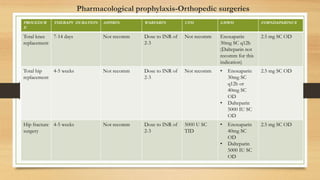
Pharmacological prophylaxis-Orthopedic surgeries
PROCEDUR
E
THERAPY DURATION ASPIRIN WARFARIN UFH LMWH FORNDAPARINUX
Total knee
replacement
7-14 days Not recomm Dose to INR of
2-3
Not recomm Enoxaparin
30mg SC q12h
(Dalteparin not
recomm for this
indication)
2.5 mg SC OD
Total hip
replacement
4-5 weeks Not recomm Dose to INR of
2-3
Not recomm • Enoxaparin
30mg SC
q12h or
40mg SC
OD
• Dalteparin
5000 IU SC
OD
2.5 mg SC OD
Hip fracture
surgery
4-5 weeks Not recomm Dose to INR of
2-3
5000 U SC
TID
• Enoxaparin
40mg SC
OD
• Dalteparin
5000 IU SC
OD
2.5 mg SC OD
PROCEDURE THERAPY
DURATION
ASPIRIN WARFARIN UFH LMWH FORNDAPARINUX
Ortho surgery
for malignancy
7-14 days Not recomm Dose to INR of
2-3
Not recomm 1st line:
Enoxaparin
30mg SC q12h
2nd line:
Enoxaparin
40mg SC q24h
Arthroscopy Need for pharmacologic prophylaxis should be assessed solely on the basis of the patient’s individual
risk factors for VTE independent of arthroscopy
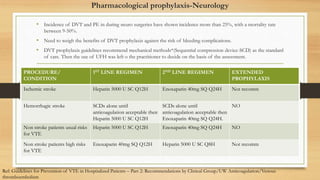
• Incidence of DVT and PE in during neuro surgeries have shown incidence more than 25%, with a mortality rate
between 9-50%.
• Need to weigh the benefits of DVT prophylaxis against the risk of bleeding complications.
• DVT prophylaxis guidelines recommend mechanical methods*(Sequential compression device-SCD) as the standard
of care. Then the use of UFH was left o the practitioner to decide on the basis of the assessment.
Pharmacological prophylaxis-Neurology
PROCEDURE/
CONDITION
1ST LINE REGIMEN 2ND LINE REGIMEN EXTENDED
PROPHYLAXIS
Ischemic stroke Heparin 5000 U SC Q12H Enoxaparin 40mg SQ Q24H Not recomm
Hemorrhagic stroke SCDs alone until
anticoagulation acceptable then
Heparin 5000 U SC Q12H
SCDs alone until
anticoagulation acceptable then
Enoxaparin 40mg SQ Q24H.
NO
Non stroke patients usual risks
for VTE
Heparin 5000 U SC Q12H Enoxaparin 40mg SQ Q24H NO
Non stroke patients high risks
for VTE
Enoxaparin 40mg SQ Q12H Heparin 5000 U SC Q8H Not recomm
Ref: Guidelines for Prevention of VTE in Hospitalized Patients – Part 2: Recommendations by Clinical Group/UW Anticoagulation/Venous
thromboembolism
PROCEDURE/
CONDITION
1ST LINE REGIMEN 2ND LINE REGIMEN EXTENDED
PROPHYLAXIS
Spinal surgery Offer mechanical VTE
prophylaxis on admission to
people undergoing elective
spinal surgery.
Continue for 30 days or until
the person is mobile or
discharged, whichever is
sooner.
Enoxaparin 30mg SC Q12H Post operative- Enoxaparin
30mg SC Q24H
Craniotomy SCDs alone for 30 days or
until the person is mobile or
discharged, whichever is
sooner.
Consider adding
pre-operative
pharmacological VTE
prophylaxis with LMWH.
Give the last dose no less
than 24 hours before surgery
for people undergoing
cranial surgery whose risk of
VTE outweighs their risk of
bleeding
Post operative- Consider
adding pharmacological
VTE prophylaxis with
LMWH, starting 24 to 48
hours after surgery for
people undergoing cranial
surgery whose risk of VTE
outweighs their risk of
bleeding. Continue for a
minimum of 7 days.
Pharmacological prophylaxis-Neuro surgery
Ref: Venous thromboembolism in over 16s: reducing the risk of hospital-acquired deep vein thrombosis or pulmonary embolism /NICE guideline [NG89]
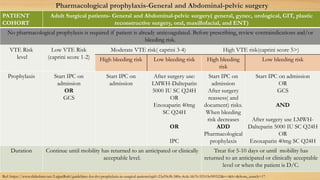
Pharmacological prophylaxis-General and Abdominal-pelvic surgery
PATIENT
COHORT
Adult Surgical patients- General and Abdominal-pelvic surgery( general, gynec, urological, GIT, plastic
reconstructive surgery, oral, maxillofacial, and ENT)
No pharmacological prophylaxis is required if patient is already anticoagulated. Before prescribing, review contraindications and/or
bleeding risk.
VTE Risk
level
Low VTE Risk
(caprini score 1-2)
Moderate VTE risk( caprini 3-4) High VTE risk(caprini score 5>)
High bleeding risk Low bleeding risk High bleeding
risk
Low bleeding risk
Prophylaxis Start IPC on
admission
OR
GCS
Start IPC on
admission
After surgery use:
LMWH-Dalteparin
5000 IU SC Q24H
OR
Enoxaparin 40mg
SC Q24H
OR
IPC
Start IPC on
admission
After surgery
reassess( and
document) risks.
When bleeding
risk decreases
ADD
Pharmacological
prophylaxis
Start IPC on admission
OR
GCS
AND
After surgery use LMWH-
Dalteparin 5000 IU SC Q24H
OR
Enoxaparin 40mg SC Q24H
Duration Continue until mobility has returned to an anticipated or clinically
acceptable level.
Treat for 5-10 days or until mobility has
returned to an anticipated or clinically acceptable
level or when the patient is D/C.
Ref: https://www.slideshare.net/LajpatRai6/guidelines-for-dvt-prophylaxis-in-surgical-patients?qid=23a59cf8-580a-4cdc-bb76-92103e9f0522&v=&b=&from_search=17
• Renal failure (CrCl < 30):Dose adjustments not necessary for heparin;
enoxaparin 30 mg SQ Q24H; fondaparinux contraindicated; heparin
preferred in dialysis
• History of HIT: Consider fondaparinux 2.5 mg SQ daily (contraindicated if
CrCl < 60)
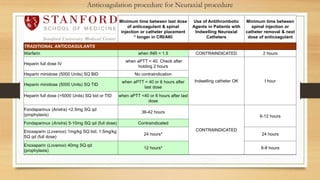
Anticoagulation procedure for Neuraxial procedure
Minimum time between last dose
of anticoagulant & spinal
injection or catheter placement
* longer in CRI/AKI
Use of Antithrombotic
Agents in Patients with
Indwelling Neuraxial
Catheters
Minimum time between
spinal injection or
catheter removal & next
dose of anticoagulant
TRADITIONAL ANTICOAGULANTS
Warfarin when INR < 1.5 CONTRAINDICATED 2 hours
Heparin full dose IV
when aPTT < 40. Check after
holding 2 hours
Indwelling catheter OK I hour
Heparin minidose (5000 Units) SQ BID No contraindication
Heparin minidose (5000 Units) SQ TID
when aPTT < 40 or 6 hours after
last dose
Heparin full dose (>5000 Units) SQ bid or TID when aPTT <40 or 6 hours after last
dose
Fondaparinux (Arixtra) <2.5mg SQ qd
(prophylaxis)
36-42 hours
CONTRAINDICATED
6-12 hours
Fondaparinux (Arixtra) 5-10mg SQ qd (full dose) Contraindicated
Enoxaparin (Lovenox) 1mg/kg SQ bid; 1.5mg/kg
SQ qd (full dose)
24 hours* 24 hours
Enoxaparin (Lovenox) 40mg SQ qd
(prophylaxis)
12 hours* 6-8 hours
DIRECT THROMBIN INHIBITORS
Argatroban
unknown orwhen DTI assay < 40 or
aPTT < 40 CONTRAINDICATED
while catheter in place
unknown
Bivalirudin (Angiomax)
Lepirudin (Refludan)
Dabigatran (Pradaxa) 7 days
ORAL ANTIPLATELET AGENTS
Aspirin/NSAIDS May be given, No time restrictions
Clopidogrel (Plavix) Prasugrel
(Effient)
7 days CONTRAINDICATED
while catheter in place
2 hours
Ticlopidine (Ticlid) 14 days
GP IIB/IIIA INHIBITORS
Abxicimab (Reopro) 48 hours
CONTRAINDICATED
while catheter in place
2 hours
Eptifibatide (Integrilin) 8 hours*
Tirofiban (Aggrastat) 8 hours*
THROMBOLYTIC AGENTS
Alteplase (TPA) Full dose for stroke, MI, etc 10 days
CONTRAINDICATED
while catheter in place
10 days
Alteplase (TPA) 2mg dose for catheter clearance May be given, No time restrictions (maximum dose 4mg/24 hrs)
NEW AGENTS
Apixaban (Eliquis) unknown for neuraxial procedures but hold 48 hours for surgery
THANK YOU

DVT PROPHYLAXIS FOR SURGERIES-dona.pptx

  • 1.
    Submitted by: DonaSumi Sunny Pharm D intern KLE College of Pharmacy Belagavi
  • 2.
    What is DVT? Adeep vein thrombosis (DVT) is a blood clot that forms inside a vein. Most DVTs form in leg veins, either above or below the knee, but they can also occur in other areas. If DVTs are not treated right away, the clots can break apart and travel to other parts of the body. A piece of blood clot that travels to another part of the body is called an embolus. Signs & Symptoms Remains asymptomatic in acute cases Obstructs the venous circulation and propagates into more veins. Long term consequences-Post thrombotic syndrome Chronic lower extremity swelling( or arm) Pain & Tenderness in the affected leg(or arm) Skin discoloration in the affected leg(or arm) Ulcer Homan’s sign Pratt’s sign Identified during physical examination
  • 3.
    Aeitology / RiskFactors: Abnormalities of Blood flow Hypercoagulability Endothelial damage Atrial fibrillation Left ventricular dysfunction Ischemic/ idiopathic cardiomyopathy CHF MI Bed rest/Paralysis Venous obstruction from tumor/obesity/pregnancy Hereditary: Factor V Leiden Prothrombin G20210A Protein C & S Defi. Acquired: Cancer and Chemo OCR/HRT HIT Arteriosclerosis H/o VTE Anti phospholipid antibodies :Dysfunction Smoking HTN Polycythemia : Damage Surgery Catheter(PICC line) Central venous catheter Trauma VIRCHOW’S TRIAD
  • 4.
    DVT RISK FACTORS •Strong risk factors Moderate risk factors Weak risk factors • Fracture(hip/leg) Arthroscopic knee surgery Bed rest > 3 days • Hip or knee surgery Central venous lines Immobility due to sitting • Major general surgery Chemotherapy Increased age • Major trauma CHF/ RDS Laparoscopic surgery • Open abdominal surgery HRT/ OCT Obesity Spinal tumor surgery Pregnancy/Antepartum Paralytic stroke Varicose veins Pregnancy/Postpartum B/L Mastectomy H/o VTE Thrombophilia Ref: WIDESPREAD OD. Current and emerging options in the management of venous thromboembolism. Cleveland Clinic journal of medicine. 2005 Apr 1;72:S15.
  • 6.
    Mechanical VTE prophylaxis •Encourage mobilization • Keep the affected extremity elevated above the level of the heart until the swelling subsides. • Aspirin or antiplatelet drugs should not be used as prophylaxis. • Consider IVC filters for high risk patients of VTE. • Graduated compression stocking. • Intermittent pneumatic compression or foot impulse device to be used when patients are in hospital. Ref: https://www.slideshare.net/NandiniDeshpande/dvt-prophylaxis-treatment-and-anaesthetic-considerations
  • 7.
    Pharmacological prophylaxis • Anticoagulantsprevent the thrombus propagation and allow endogenous lytic system to operate. • Factors that affect the selection of anticoagulant for VTE 1. BMI/Weight 2. Cr. Clearance • Contraindications: 1. Recent surgery to eye or CNS 2. Pre existing hemorrhagic state like liver disease, renal failure, hemophilia and thrombocytopenia. 3. Pre-existing structural lesions like peptic ulcer. 4. Recent cerebral hemorrhage. Ref: https://www.slideshare.net/NandiniDeshpande/dvt-prophylaxis-treatment-and-anaesthetic-considerations
  • 8.
    Algorithm- VTE prophylaxis Ref:Gibbs H, Fletcher J, Blombery P, Collins R, Wheatley D. Venous thromboembolism prophylaxis guideline implementation is improved by nurse directed feedback and audit. Thrombosis Journal. 2011 Dec;9(1):1-6.
  • 9.
    Pharmacological prophylaxis-Orthopedic surgeries PROCEDUR E THERAPYDURATION ASPIRIN WARFARIN UFH LMWH FORNDAPARINUX Total knee replacement 7-14 days Not recomm Dose to INR of 2-3 Not recomm Enoxaparin 30mg SC q12h (Dalteparin not recomm for this indication) 2.5 mg SC OD Total hip replacement 4-5 weeks Not recomm Dose to INR of 2-3 Not recomm • Enoxaparin 30mg SC q12h or 40mg SC OD • Dalteparin 5000 IU SC OD 2.5 mg SC OD Hip fracture surgery 4-5 weeks Not recomm Dose to INR of 2-3 5000 U SC TID • Enoxaparin 40mg SC OD • Dalteparin 5000 IU SC OD 2.5 mg SC OD
  • 10.
    PROCEDURE THERAPY DURATION ASPIRIN WARFARINUFH LMWH FORNDAPARINUX Ortho surgery for malignancy 7-14 days Not recomm Dose to INR of 2-3 Not recomm 1st line: Enoxaparin 30mg SC q12h 2nd line: Enoxaparin 40mg SC q24h Arthroscopy Need for pharmacologic prophylaxis should be assessed solely on the basis of the patient’s individual risk factors for VTE independent of arthroscopy
  • 11.
    • Incidence ofDVT and PE in during neuro surgeries have shown incidence more than 25%, with a mortality rate between 9-50%. • Need to weigh the benefits of DVT prophylaxis against the risk of bleeding complications. • DVT prophylaxis guidelines recommend mechanical methods*(Sequential compression device-SCD) as the standard of care. Then the use of UFH was left o the practitioner to decide on the basis of the assessment. Pharmacological prophylaxis-Neurology PROCEDURE/ CONDITION 1ST LINE REGIMEN 2ND LINE REGIMEN EXTENDED PROPHYLAXIS Ischemic stroke Heparin 5000 U SC Q12H Enoxaparin 40mg SQ Q24H Not recomm Hemorrhagic stroke SCDs alone until anticoagulation acceptable then Heparin 5000 U SC Q12H SCDs alone until anticoagulation acceptable then Enoxaparin 40mg SQ Q24H. NO Non stroke patients usual risks for VTE Heparin 5000 U SC Q12H Enoxaparin 40mg SQ Q24H NO Non stroke patients high risks for VTE Enoxaparin 40mg SQ Q12H Heparin 5000 U SC Q8H Not recomm Ref: Guidelines for Prevention of VTE in Hospitalized Patients – Part 2: Recommendations by Clinical Group/UW Anticoagulation/Venous thromboembolism
  • 12.
    PROCEDURE/ CONDITION 1ST LINE REGIMEN2ND LINE REGIMEN EXTENDED PROPHYLAXIS Spinal surgery Offer mechanical VTE prophylaxis on admission to people undergoing elective spinal surgery. Continue for 30 days or until the person is mobile or discharged, whichever is sooner. Enoxaparin 30mg SC Q12H Post operative- Enoxaparin 30mg SC Q24H Craniotomy SCDs alone for 30 days or until the person is mobile or discharged, whichever is sooner. Consider adding pre-operative pharmacological VTE prophylaxis with LMWH. Give the last dose no less than 24 hours before surgery for people undergoing cranial surgery whose risk of VTE outweighs their risk of bleeding Post operative- Consider adding pharmacological VTE prophylaxis with LMWH, starting 24 to 48 hours after surgery for people undergoing cranial surgery whose risk of VTE outweighs their risk of bleeding. Continue for a minimum of 7 days. Pharmacological prophylaxis-Neuro surgery Ref: Venous thromboembolism in over 16s: reducing the risk of hospital-acquired deep vein thrombosis or pulmonary embolism /NICE guideline [NG89]
  • 13.
    Pharmacological prophylaxis-General andAbdominal-pelvic surgery PATIENT COHORT Adult Surgical patients- General and Abdominal-pelvic surgery( general, gynec, urological, GIT, plastic reconstructive surgery, oral, maxillofacial, and ENT) No pharmacological prophylaxis is required if patient is already anticoagulated. Before prescribing, review contraindications and/or bleeding risk. VTE Risk level Low VTE Risk (caprini score 1-2) Moderate VTE risk( caprini 3-4) High VTE risk(caprini score 5>) High bleeding risk Low bleeding risk High bleeding risk Low bleeding risk Prophylaxis Start IPC on admission OR GCS Start IPC on admission After surgery use: LMWH-Dalteparin 5000 IU SC Q24H OR Enoxaparin 40mg SC Q24H OR IPC Start IPC on admission After surgery reassess( and document) risks. When bleeding risk decreases ADD Pharmacological prophylaxis Start IPC on admission OR GCS AND After surgery use LMWH- Dalteparin 5000 IU SC Q24H OR Enoxaparin 40mg SC Q24H Duration Continue until mobility has returned to an anticipated or clinically acceptable level. Treat for 5-10 days or until mobility has returned to an anticipated or clinically acceptable level or when the patient is D/C. Ref: https://www.slideshare.net/LajpatRai6/guidelines-for-dvt-prophylaxis-in-surgical-patients?qid=23a59cf8-580a-4cdc-bb76-92103e9f0522&v=&b=&from_search=17
  • 14.
    • Renal failure(CrCl < 30):Dose adjustments not necessary for heparin; enoxaparin 30 mg SQ Q24H; fondaparinux contraindicated; heparin preferred in dialysis • History of HIT: Consider fondaparinux 2.5 mg SQ daily (contraindicated if CrCl < 60)
  • 15.
    Anticoagulation procedure forNeuraxial procedure Minimum time between last dose of anticoagulant & spinal injection or catheter placement * longer in CRI/AKI Use of Antithrombotic Agents in Patients with Indwelling Neuraxial Catheters Minimum time between spinal injection or catheter removal & next dose of anticoagulant TRADITIONAL ANTICOAGULANTS Warfarin when INR < 1.5 CONTRAINDICATED 2 hours Heparin full dose IV when aPTT < 40. Check after holding 2 hours Indwelling catheter OK I hour Heparin minidose (5000 Units) SQ BID No contraindication Heparin minidose (5000 Units) SQ TID when aPTT < 40 or 6 hours after last dose Heparin full dose (>5000 Units) SQ bid or TID when aPTT <40 or 6 hours after last dose Fondaparinux (Arixtra) <2.5mg SQ qd (prophylaxis) 36-42 hours CONTRAINDICATED 6-12 hours Fondaparinux (Arixtra) 5-10mg SQ qd (full dose) Contraindicated Enoxaparin (Lovenox) 1mg/kg SQ bid; 1.5mg/kg SQ qd (full dose) 24 hours* 24 hours Enoxaparin (Lovenox) 40mg SQ qd (prophylaxis) 12 hours* 6-8 hours
  • 16.
    DIRECT THROMBIN INHIBITORS Argatroban unknownorwhen DTI assay < 40 or aPTT < 40 CONTRAINDICATED while catheter in place unknown Bivalirudin (Angiomax) Lepirudin (Refludan) Dabigatran (Pradaxa) 7 days ORAL ANTIPLATELET AGENTS Aspirin/NSAIDS May be given, No time restrictions Clopidogrel (Plavix) Prasugrel (Effient) 7 days CONTRAINDICATED while catheter in place 2 hours Ticlopidine (Ticlid) 14 days GP IIB/IIIA INHIBITORS Abxicimab (Reopro) 48 hours CONTRAINDICATED while catheter in place 2 hours Eptifibatide (Integrilin) 8 hours* Tirofiban (Aggrastat) 8 hours* THROMBOLYTIC AGENTS Alteplase (TPA) Full dose for stroke, MI, etc 10 days CONTRAINDICATED while catheter in place 10 days Alteplase (TPA) 2mg dose for catheter clearance May be given, No time restrictions (maximum dose 4mg/24 hrs) NEW AGENTS Apixaban (Eliquis) unknown for neuraxial procedures but hold 48 hours for surgery
  • 17.