Valencian Summer School in Machine Learning
3rd edition
September 14-15, 2017
BigML, Inc 2Time Series / Deepnets
Time Series Analysis
BigML, Inc 3Time Series / Deepnets
Beyond Supervision
• Traditional machine learning data is assumed to
be IID
• Independent (points have no information about each
other’s class) and
• Identically distributed (come from the same distribution)
• But what if you want to predict just the next value
in a sequence? Is all lost?
• Applications
• Predicting battery life from change-discharge cycles
• Predicting sales for the next day/week/month
BigML, Inc 4Time Series / Deepnets
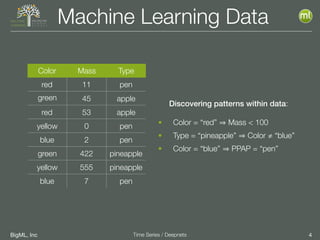
Machine Learning Data
Color Mass Type
red 11 pen
green 45 apple
red 53 apple
yellow 0 pen
blue 2 pen
green 422 pineapple
yellow 555 pineapple
blue 7 pen
Discovering patterns within data:
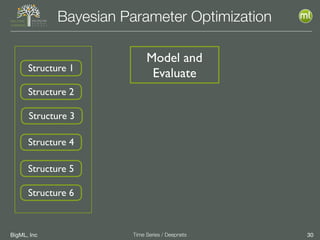
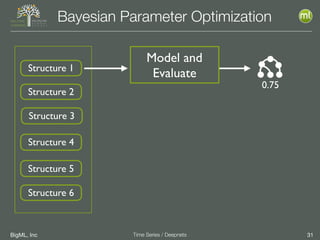
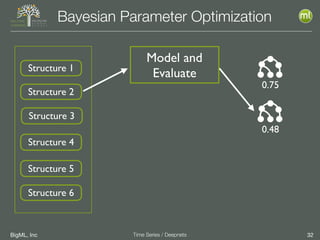
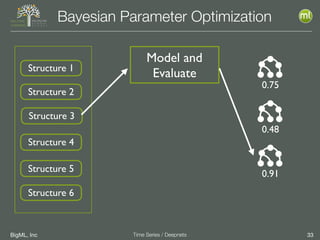
• Color = “red” Mass < 100
• Type = “pineapple” Color ≠ “blue”
• Color = “blue” PPAP = “pen”
BigML, Inc 5Time Series / Deepnets
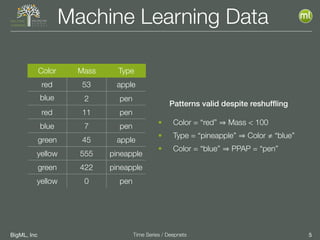
Machine Learning Data
Color Mass Type
red 53 apple
blue 2 pen
red 11 pen
blue 7 pen
green 45 apple
yellow 555 pineapple
green 422 pineapple
yellow 0 pen
Patterns valid despite reshuffling
• Color = “red” Mass < 100
• Type = “pineapple” Color ≠ “blue”
• Color = “blue” PPAP = “pen”
BigML, Inc 6Time Series / Deepnets
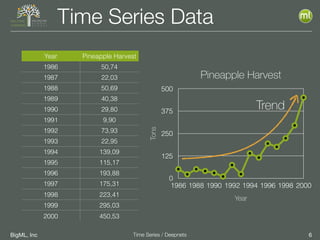
Time Series Data
Year Pineapple Harvest
1986 50,74
1987 22,03
1988 50,69
1989 40,38
1990 29,80
1991 9,90
1992 73,93
1993 22,95
1994 139,09
1995 115,17
1996 193,88
1997 175,31
1998 223,41
1999 295,03
2000 450,53
Pineapple Harvest
Tons
0
125
250
375
500
Year
1986 1988 1990 1992 1994 1996 1998 2000
Trend
BigML, Inc 7Time Series / Deepnets
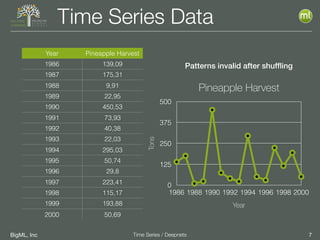
Time Series Data
Year Pineapple Harvest
1986 139,09
1987 175,31
1988 9,91
1989 22,95
1990 450,53
1991 73,93
1992 40,38
1993 22,03
1994 295,03
1995 50,74
1996 29,8
1997 223,41
1998 115,17
1999 193,88
2000 50,69
Pineapple Harvest
Tons
0
125
250
375
500
Year
1986 1988 1990 1992 1994 1996 1998 2000
Patterns invalid after shuffling
BigML, Inc 8Time Series / Deepnets
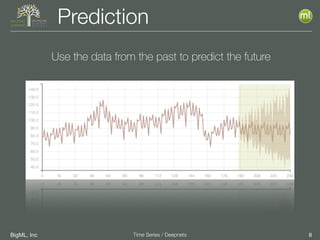
Prediction
Use the data from the past to predict the future
BigML, Inc 9Time Series / Deepnets
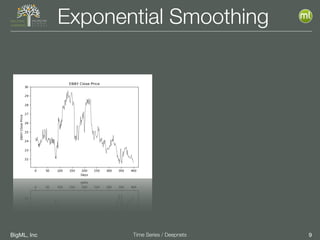
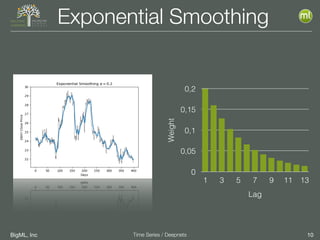
Exponential Smoothing
BigML, Inc 10Time Series / Deepnets
Exponential Smoothing
Weight 0
0,05
0,1
0,15
0,2
Lag
1 3 5 7 9 11 13
BigML, Inc 11Time Series / Deepnets
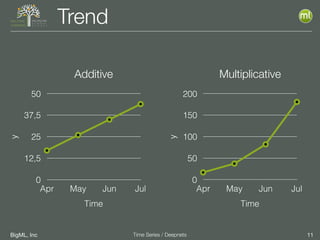
Trendy
0
12,5
25
37,5
50
Time
Apr May Jun Jul
y
0
50
100
150
200
Time
Apr May Jun Jul
Additive Multiplicative
BigML, Inc 12Time Series / Deepnets
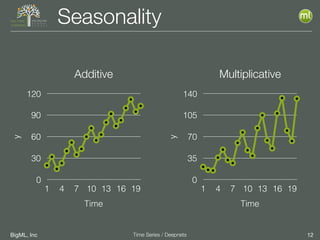
Seasonalityy
0
30
60
90
120
Time
1 4 7 10 13 16 19
y
0
35
70
105
140
Time
1 4 7 10 13 16 19
Additive Multiplicative
BigML, Inc 13Time Series / Deepnets
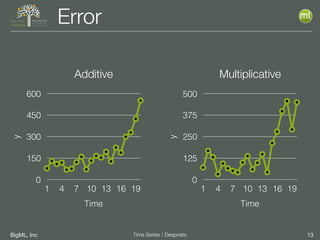
Errory
0
150
300
450
600
Time
1 4 7 10 13 16 19
y
0
125
250
375
500
Time
1 4 7 10 13 16 19
Additive Multiplicative
BigML, Inc 14Time Series / Deepnets
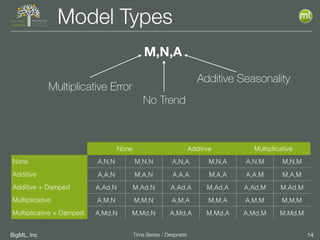
Model Types
None Additive Multiplicative
None A,N,N M,N,N A,N,A M,N,A A,N,M M,N,M
Additive A,A,N M,A,N A,A,A M,A,A A,A,M M,A,M
Additive + Damped A,Ad,N M,Ad,N A,Ad,A M,Ad,A A,Ad,M M,Ad,M
Multiplicative A,M,N M,M,N A,M,A M,M,A A,M,M M,M,M
Multiplicative + Damped A,Md,N M,Md,N A,Md,A M,Md,A A,Md,M M,Md,M
M,N,A
Multiplicative Error
No Trend
Additive Seasonality
BigML, Inc 15Time Series / Deepnets
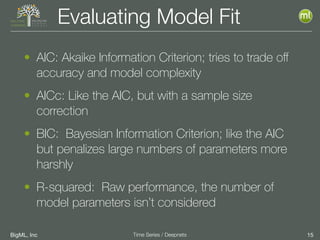
Evaluating Model Fit
• AIC: Akaike Information Criterion; tries to trade off
accuracy and model complexity
• AICc: Like the AIC, but with a sample size
correction
• BIC: Bayesian Information Criterion; like the AIC
but penalizes large numbers of parameters more
harshly
• R-squared: Raw performance, the number of
model parameters isn’t considered
BigML, Inc 16Time Series / Deepnets
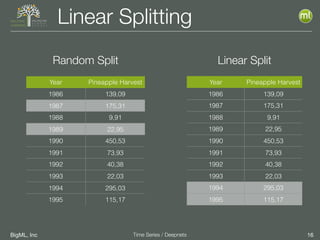
Linear Splitting
Year Pineapple Harvest
1986 139,09
1987 175,31
1988 9,91
1989 22,95
1990 450,53
1991 73,93
1992 40,38
1993 22,03
1994 295,03
1995 115,17
Random Split
Year Pineapple Harvest
1986 139,09
1987 175,31
1988 9,91
1989 22,95
1990 450,53
1991 73,93
1992 40,38
1993 22,03
1994 295,03
1995 115,17
Linear Split
BigML, Inc 17Time Series / Deepnets
Deep Neural Networks
BigML, Inc 18Time Series / Deepnets
BigML Deepnets
• Not Done Yet!
• I’m the tech lead, so I’m the reason we don’t have a demo for
this (sorry).
• Check out our next release webinar!
• Let’s Still Have a Chat
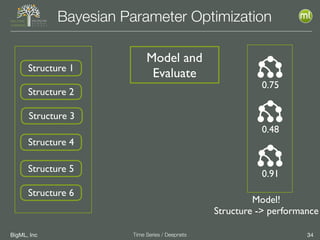
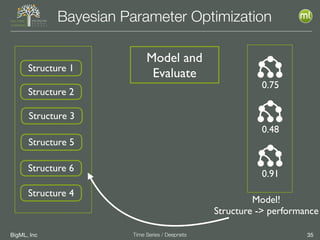
• Deep learning is regarded in the media as some sort of strange
robot messiah, destined to either save or destroy us all
• What’s good about deep learning and why is it so popular
now?
• How much is hype and what are some of the major issues with
it?
BigML, Inc 19Time Series / Deepnets
Going Further
• Trees
• Pro: Massive representational power that expands as the data
gets larger; efficient search through this space
• Con: Difficult to represent smooth functions and functions of
many variables
• Ensembles mitigate some of these difficulties
• Logistic Regression
• Pro: Some smooth, multivariate, functions are not a problem;
fast optimization of chosen
• Con: Parametric - If decision boundary is nonlinear, tough luck
• Can these be mitigated?
BigML, Inc 20Time Series / Deepnets
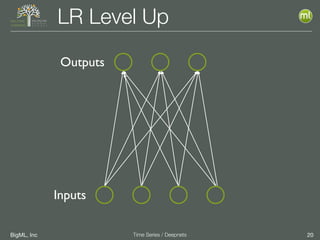
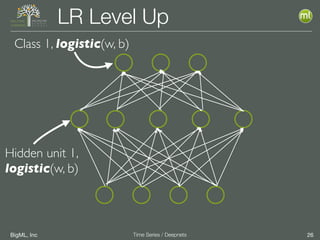
LR Level Up
Outputs
Inputs
BigML, Inc 21Time Series / Deepnets
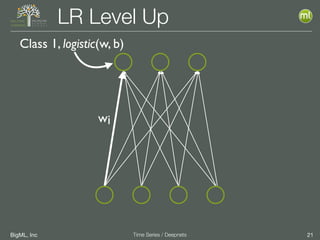
LR Level Up
wi
Class 1, logistic(w, b)
BigML, Inc 22Time Series / Deepnets
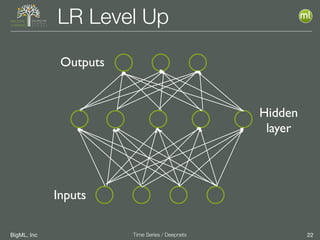
LR Level Up
Outputs
Inputs
Hidden
layer
BigML, Inc 23Time Series / Deepnets
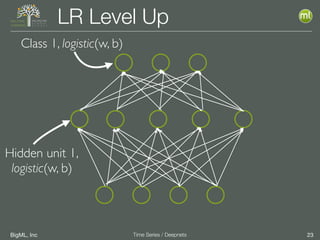
LR Level Up
Class 1, logistic(w, b)
Hidden unit 1,
logistic(w, b)
BigML, Inc 24Time Series / Deepnets
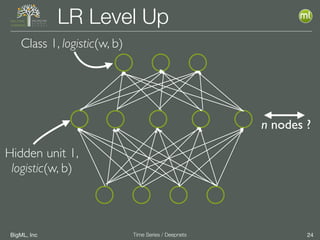
LR Level Up
Class 1, logistic(w, b)
Hidden unit 1,
logistic(w, b)
n nodes ?
BigML, Inc 25Time Series / Deepnets
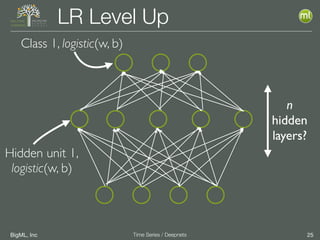
LR Level Up
Class 1, logistic(w, b)
Hidden unit 1,
logistic(w, b)
n
hidden
layers?
BigML, Inc 26Time Series / Deepnets
LR Level Up
Class 1, logistic(w, b)
Hidden unit 1,
logistic(w, b)
BigML, Inc 27Time Series / Deepnets
Why?
• This isn’t new. Why the sudden interest?
• Scale
• Massive parameter space <=> Massive data
• Abundance of compute power + GPUs
• Frameworks for computational graph composition
(TensorFlow, Theano, Torch, Caffe)
• “Compiles” the network architecture into a highly
optimized set of commands that run quickly and with
maximum parallelism
• Symbolically differentiates the objective for gradient
descent
BigML, Inc 28Time Series / Deepnets
Deep Networks
• Like Trees / Ensembles, we have arbitrary
representational power by modifying the structure
• Like logistic regression, smooth, multivariate
objectives aren’t a problem (provided we have the
right structure)
• So what have we lost?
BigML, Inc 29Time Series / Deepnets
Deep Network Cons
• Efficiency
• The right structure for given data is not easily found,
and most structures are bad
• Solution: Try a bunch of them, and be clever about
how you do it
• Interpretability
• We’ve gotten quite far away from the interpretability of
trees
• Solution: Use sampling and tree induction to create
decision tree-like explanations for predictions
BigML, Inc 30Time Series / Deepnets
Bayesian Parameter Optimization
Model and
EvaluateStructure 1
Structure 2
Structure 3
Structure 4
Structure 5
Structure 6
BigML, Inc 31Time Series / Deepnets
Bayesian Parameter Optimization
Model and
EvaluateStructure 1
Structure 2
Structure 3
Structure 4
Structure 5
Structure 6
0.75
BigML, Inc 32Time Series / Deepnets
Bayesian Parameter Optimization
Model and
EvaluateStructure 1
Structure 2
Structure 3
Structure 4
Structure 5
Structure 6
0.75
0.48
BigML, Inc 33Time Series / Deepnets
Bayesian Parameter Optimization
Model and
EvaluateStructure 1
Structure 2
Structure 3
Structure 4
Structure 5
Structure 6
0.75
0.48
0.91
BigML, Inc 34Time Series / Deepnets
Bayesian Parameter Optimization
Structure 1
Structure 2
Structure 3
Structure 4
Structure 5
Structure 6
0.75
0.48
0.91
Model!
Structure -> performance
Model and
Evaluate
BigML, Inc 35Time Series / Deepnets
Bayesian Parameter Optimization
Structure 1
Structure 2
Structure 3
Structure 4
Structure 5
Structure 6
0.75
0.48
0.91
Model!
Structure -> performance
Model and
Evaluate
BigML, Inc 36Time Series / Deepnets
Should I use it?
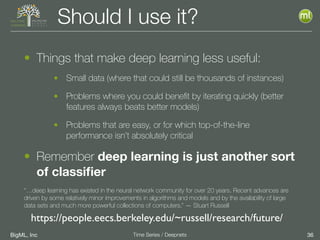
• Things that make deep learning less useful:
• Small data (where that could still be thousands of instances)
• Problems where you could benefit by iterating quickly (better
features always beats better models)
• Problems that are easy, or for which top-of-the-line
performance isn’t absolutely critical
• Remember deep learning is just another sort
of classifier
“…deep learning has existed in the neural network community for over 20 years. Recent advances are
driven by some relatively minor improvements in algorithms and models and by the availability of large
data sets and much more powerful collections of computers.” — Stuart Russell
https://people.eecs.berkeley.edu/~russell/research/future/
VSSML17 L6. Time Series and Deepnets

VSSML17 L6. Time Series and Deepnets

  • 1.
    Valencian Summer Schoolin Machine Learning 3rd edition September 14-15, 2017
  • 2.
    BigML, Inc 2TimeSeries / Deepnets Time Series Analysis
  • 3.
    BigML, Inc 3TimeSeries / Deepnets Beyond Supervision • Traditional machine learning data is assumed to be IID • Independent (points have no information about each other’s class) and • Identically distributed (come from the same distribution) • But what if you want to predict just the next value in a sequence? Is all lost? • Applications • Predicting battery life from change-discharge cycles • Predicting sales for the next day/week/month
  • 4.
    BigML, Inc 4TimeSeries / Deepnets Machine Learning Data Color Mass Type red 11 pen green 45 apple red 53 apple yellow 0 pen blue 2 pen green 422 pineapple yellow 555 pineapple blue 7 pen Discovering patterns within data: • Color = “red” Mass < 100 • Type = “pineapple” Color ≠ “blue” • Color = “blue” PPAP = “pen”
  • 5.
    BigML, Inc 5TimeSeries / Deepnets Machine Learning Data Color Mass Type red 53 apple blue 2 pen red 11 pen blue 7 pen green 45 apple yellow 555 pineapple green 422 pineapple yellow 0 pen Patterns valid despite reshuffling • Color = “red” Mass < 100 • Type = “pineapple” Color ≠ “blue” • Color = “blue” PPAP = “pen”
  • 6.
    BigML, Inc 6TimeSeries / Deepnets Time Series Data Year Pineapple Harvest 1986 50,74 1987 22,03 1988 50,69 1989 40,38 1990 29,80 1991 9,90 1992 73,93 1993 22,95 1994 139,09 1995 115,17 1996 193,88 1997 175,31 1998 223,41 1999 295,03 2000 450,53 Pineapple Harvest Tons 0 125 250 375 500 Year 1986 1988 1990 1992 1994 1996 1998 2000 Trend
  • 7.
    BigML, Inc 7TimeSeries / Deepnets Time Series Data Year Pineapple Harvest 1986 139,09 1987 175,31 1988 9,91 1989 22,95 1990 450,53 1991 73,93 1992 40,38 1993 22,03 1994 295,03 1995 50,74 1996 29,8 1997 223,41 1998 115,17 1999 193,88 2000 50,69 Pineapple Harvest Tons 0 125 250 375 500 Year 1986 1988 1990 1992 1994 1996 1998 2000 Patterns invalid after shuffling
  • 8.
    BigML, Inc 8TimeSeries / Deepnets Prediction Use the data from the past to predict the future
  • 9.
    BigML, Inc 9TimeSeries / Deepnets Exponential Smoothing
  • 10.
    BigML, Inc 10TimeSeries / Deepnets Exponential Smoothing Weight 0 0,05 0,1 0,15 0,2 Lag 1 3 5 7 9 11 13
  • 11.
    BigML, Inc 11TimeSeries / Deepnets Trendy 0 12,5 25 37,5 50 Time Apr May Jun Jul y 0 50 100 150 200 Time Apr May Jun Jul Additive Multiplicative
  • 12.
    BigML, Inc 12TimeSeries / Deepnets Seasonalityy 0 30 60 90 120 Time 1 4 7 10 13 16 19 y 0 35 70 105 140 Time 1 4 7 10 13 16 19 Additive Multiplicative
  • 13.
    BigML, Inc 13TimeSeries / Deepnets Errory 0 150 300 450 600 Time 1 4 7 10 13 16 19 y 0 125 250 375 500 Time 1 4 7 10 13 16 19 Additive Multiplicative
  • 14.
    BigML, Inc 14TimeSeries / Deepnets Model Types None Additive Multiplicative None A,N,N M,N,N A,N,A M,N,A A,N,M M,N,M Additive A,A,N M,A,N A,A,A M,A,A A,A,M M,A,M Additive + Damped A,Ad,N M,Ad,N A,Ad,A M,Ad,A A,Ad,M M,Ad,M Multiplicative A,M,N M,M,N A,M,A M,M,A A,M,M M,M,M Multiplicative + Damped A,Md,N M,Md,N A,Md,A M,Md,A A,Md,M M,Md,M M,N,A Multiplicative Error No Trend Additive Seasonality
  • 15.
    BigML, Inc 15TimeSeries / Deepnets Evaluating Model Fit • AIC: Akaike Information Criterion; tries to trade off accuracy and model complexity • AICc: Like the AIC, but with a sample size correction • BIC: Bayesian Information Criterion; like the AIC but penalizes large numbers of parameters more harshly • R-squared: Raw performance, the number of model parameters isn’t considered
  • 16.
    BigML, Inc 16TimeSeries / Deepnets Linear Splitting Year Pineapple Harvest 1986 139,09 1987 175,31 1988 9,91 1989 22,95 1990 450,53 1991 73,93 1992 40,38 1993 22,03 1994 295,03 1995 115,17 Random Split Year Pineapple Harvest 1986 139,09 1987 175,31 1988 9,91 1989 22,95 1990 450,53 1991 73,93 1992 40,38 1993 22,03 1994 295,03 1995 115,17 Linear Split
  • 17.
    BigML, Inc 17TimeSeries / Deepnets Deep Neural Networks
  • 18.
    BigML, Inc 18TimeSeries / Deepnets BigML Deepnets • Not Done Yet! • I’m the tech lead, so I’m the reason we don’t have a demo for this (sorry). • Check out our next release webinar! • Let’s Still Have a Chat • Deep learning is regarded in the media as some sort of strange robot messiah, destined to either save or destroy us all • What’s good about deep learning and why is it so popular now? • How much is hype and what are some of the major issues with it?
  • 19.
    BigML, Inc 19TimeSeries / Deepnets Going Further • Trees • Pro: Massive representational power that expands as the data gets larger; efficient search through this space • Con: Difficult to represent smooth functions and functions of many variables • Ensembles mitigate some of these difficulties • Logistic Regression • Pro: Some smooth, multivariate, functions are not a problem; fast optimization of chosen • Con: Parametric - If decision boundary is nonlinear, tough luck • Can these be mitigated?
  • 20.
    BigML, Inc 20TimeSeries / Deepnets LR Level Up Outputs Inputs
  • 21.
    BigML, Inc 21TimeSeries / Deepnets LR Level Up wi Class 1, logistic(w, b)
  • 22.
    BigML, Inc 22TimeSeries / Deepnets LR Level Up Outputs Inputs Hidden layer
  • 23.
    BigML, Inc 23TimeSeries / Deepnets LR Level Up Class 1, logistic(w, b) Hidden unit 1, logistic(w, b)
  • 24.
    BigML, Inc 24TimeSeries / Deepnets LR Level Up Class 1, logistic(w, b) Hidden unit 1, logistic(w, b) n nodes ?
  • 25.
    BigML, Inc 25TimeSeries / Deepnets LR Level Up Class 1, logistic(w, b) Hidden unit 1, logistic(w, b) n hidden layers?
  • 26.
    BigML, Inc 26TimeSeries / Deepnets LR Level Up Class 1, logistic(w, b) Hidden unit 1, logistic(w, b)
  • 27.
    BigML, Inc 27TimeSeries / Deepnets Why? • This isn’t new. Why the sudden interest? • Scale • Massive parameter space <=> Massive data • Abundance of compute power + GPUs • Frameworks for computational graph composition (TensorFlow, Theano, Torch, Caffe) • “Compiles” the network architecture into a highly optimized set of commands that run quickly and with maximum parallelism • Symbolically differentiates the objective for gradient descent
  • 28.
    BigML, Inc 28TimeSeries / Deepnets Deep Networks • Like Trees / Ensembles, we have arbitrary representational power by modifying the structure • Like logistic regression, smooth, multivariate objectives aren’t a problem (provided we have the right structure) • So what have we lost?
  • 29.
    BigML, Inc 29TimeSeries / Deepnets Deep Network Cons • Efficiency • The right structure for given data is not easily found, and most structures are bad • Solution: Try a bunch of them, and be clever about how you do it • Interpretability • We’ve gotten quite far away from the interpretability of trees • Solution: Use sampling and tree induction to create decision tree-like explanations for predictions
  • 30.
    BigML, Inc 30TimeSeries / Deepnets Bayesian Parameter Optimization Model and EvaluateStructure 1 Structure 2 Structure 3 Structure 4 Structure 5 Structure 6
  • 31.
    BigML, Inc 31TimeSeries / Deepnets Bayesian Parameter Optimization Model and EvaluateStructure 1 Structure 2 Structure 3 Structure 4 Structure 5 Structure 6 0.75
  • 32.
    BigML, Inc 32TimeSeries / Deepnets Bayesian Parameter Optimization Model and EvaluateStructure 1 Structure 2 Structure 3 Structure 4 Structure 5 Structure 6 0.75 0.48
  • 33.
    BigML, Inc 33TimeSeries / Deepnets Bayesian Parameter Optimization Model and EvaluateStructure 1 Structure 2 Structure 3 Structure 4 Structure 5 Structure 6 0.75 0.48 0.91
  • 34.
    BigML, Inc 34TimeSeries / Deepnets Bayesian Parameter Optimization Structure 1 Structure 2 Structure 3 Structure 4 Structure 5 Structure 6 0.75 0.48 0.91 Model! Structure -> performance Model and Evaluate
  • 35.
    BigML, Inc 35TimeSeries / Deepnets Bayesian Parameter Optimization Structure 1 Structure 2 Structure 3 Structure 4 Structure 5 Structure 6 0.75 0.48 0.91 Model! Structure -> performance Model and Evaluate
  • 36.
    BigML, Inc 36TimeSeries / Deepnets Should I use it? • Things that make deep learning less useful: • Small data (where that could still be thousands of instances) • Problems where you could benefit by iterating quickly (better features always beats better models) • Problems that are easy, or for which top-of-the-line performance isn’t absolutely critical • Remember deep learning is just another sort of classifier “…deep learning has existed in the neural network community for over 20 years. Recent advances are driven by some relatively minor improvements in algorithms and models and by the availability of large data sets and much more powerful collections of computers.” — Stuart Russell https://people.eecs.berkeley.edu/~russell/research/future/