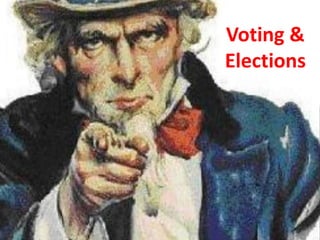
Voting &
Elections
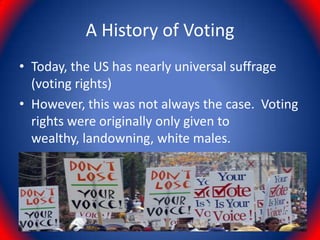
A History of Voting
• Today, the US has nearly universal suffrage
  (voting rights)
• However, this was not always the case. Voting
  rights were originally only given to
  wealthy, landowning, white males.
Gaining Suffrage
• African Americans were given the right to vote
  after the Civil War (15th Amendment)
• Even with this, they faced many obstacles
  such as taxes, literacy tests, or threats until
  the 1960’s
• Women lobbied for more than 50 years before
  being allowed to vote (19th Amendment)
• In response to the Vietnam War, the voting
  age was lowered to 18 (26th Amendment)
American Voters
• Voter turnout in the US is lower than most
  democracies (Only about 50%)
                      WHY?
• People don’t like candidates
• Don’t think their vote counts
• Have trouble getting to the polls
• Lazy/No interest in politics or government
• Complicated Registration Process
Who Votes
• Typical voters share these characteristics
  – More educated than non-voters
  – Make more $$ than non-voters
  – They are older than non-voters
  – They have voted before
Who Cannot Vote
• Some people living in the US are ineligible to
  vote
  – Most convicted felons
  – Legal immigrants who are not yet citizens
  – People who have not registered
How Voters Decide
• Voters base their decision on a number of
  factors when casting their ballot.
  1. Your Personal Background – Factors such as
     Age, Race, Gender, Religion will impact your
     vote.
  2. Party Loyalty – There are 3 types of party
     voters…Loyal members, people who lean
     towards 1 party, independents
  3. The Issues – These change each election and are
     often unpredictable. Things like gas
     prices, security, etc.
How Voters Decide
4. A Candidates Image – Americans look at a
   candidates physical
   appearance, trustworthiness, character, etc.
5. Propaganda & Media – Candidates will spend
   millions on propaganda designed to attack their
   opponents and build themselves up.
Propaganda Tactics
Political ads can take many forms. There are
positive ads, attack ads, issues, character, etc.
All of them are carefully designed to influence
your vote. There are a few tactics that
consistently show up in these ads…
1. Labeling – Using name-calling to define a
    candidate (extremist, patriot, out-of-
    touch, indecisive, etc.)
Propaganda Tactics
2. Glittering Generality – making a point without
   giving you any facts or evidence (“Has a plan for
   the economy” or “Weak on defense”)
3. Card Stacking – Giving only 1 side of the facts, or
   taking only facts that help you cause.
   Sometimes misleading
4. Transfer – A picture is worth a 1000 words.
   Using an image or symbol to associate with a
   candidate.
Propaganda Tactics
5. Plain Folks – Portraying themselves as a
   common man, one of the people, etc.
6. Testimonial – Using a celebrity or well known
   figure to speak about a candidate
7. Bandwagon – Highlighting poll
   numbers, newspaper endorsements, etc. to
   convince you

Voting & elections

  • 1.
  • 2.
    A History ofVoting • Today, the US has nearly universal suffrage (voting rights) • However, this was not always the case. Voting rights were originally only given to wealthy, landowning, white males.
  • 3.
    Gaining Suffrage • AfricanAmericans were given the right to vote after the Civil War (15th Amendment) • Even with this, they faced many obstacles such as taxes, literacy tests, or threats until the 1960’s • Women lobbied for more than 50 years before being allowed to vote (19th Amendment) • In response to the Vietnam War, the voting age was lowered to 18 (26th Amendment)
  • 4.
    American Voters • Voterturnout in the US is lower than most democracies (Only about 50%) WHY? • People don’t like candidates • Don’t think their vote counts • Have trouble getting to the polls • Lazy/No interest in politics or government • Complicated Registration Process
  • 5.
    Who Votes • Typicalvoters share these characteristics – More educated than non-voters – Make more $$ than non-voters – They are older than non-voters – They have voted before
  • 6.
    Who Cannot Vote •Some people living in the US are ineligible to vote – Most convicted felons – Legal immigrants who are not yet citizens – People who have not registered
  • 7.
    How Voters Decide •Voters base their decision on a number of factors when casting their ballot. 1. Your Personal Background – Factors such as Age, Race, Gender, Religion will impact your vote. 2. Party Loyalty – There are 3 types of party voters…Loyal members, people who lean towards 1 party, independents 3. The Issues – These change each election and are often unpredictable. Things like gas prices, security, etc.
  • 8.
    How Voters Decide 4.A Candidates Image – Americans look at a candidates physical appearance, trustworthiness, character, etc. 5. Propaganda & Media – Candidates will spend millions on propaganda designed to attack their opponents and build themselves up.
  • 9.
    Propaganda Tactics Political adscan take many forms. There are positive ads, attack ads, issues, character, etc. All of them are carefully designed to influence your vote. There are a few tactics that consistently show up in these ads… 1. Labeling – Using name-calling to define a candidate (extremist, patriot, out-of- touch, indecisive, etc.)
  • 10.
    Propaganda Tactics 2. GlitteringGenerality – making a point without giving you any facts or evidence (“Has a plan for the economy” or “Weak on defense”) 3. Card Stacking – Giving only 1 side of the facts, or taking only facts that help you cause. Sometimes misleading 4. Transfer – A picture is worth a 1000 words. Using an image or symbol to associate with a candidate.
  • 11.
    Propaganda Tactics 5. PlainFolks – Portraying themselves as a common man, one of the people, etc. 6. Testimonial – Using a celebrity or well known figure to speak about a candidate 7. Bandwagon – Highlighting poll numbers, newspaper endorsements, etc. to convince you