 Fungal infections remain a significant cause of morbidity and
mortality despite advances in medicine and the emergence of new
antifungal agents.
 Immunocompromised patients are particularly at risk of developing
these infections, with Candida and Aspergillus spp. being the mycoses
most commonly identified.
 Patients who develop candidemia have a greater chance of prolonged
hospitalization and have a mortality rate as high as 60%.
 In addition, the prevalence of Candida spp. that are resistant to
triazole antifungal agents is increasing, making treatment options a
concern.
 Aspergillosis carries a 100% mortality rate if left untreated.
 Although there are numerous treatment options, no broad-spectrum
antifungal agents with an acceptable safety profile and with both
intravenous and oral formulations are available at this time.
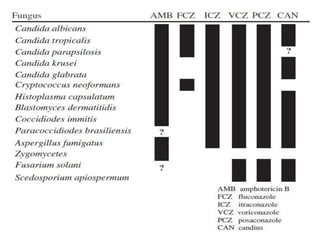
 Amphotericin B
 Liposomal amphotericin B
 ECHINOCANDINS
 Azole compounds
 Amphotericin B is currently the drug of choice for the treatment of
systemic infections caused by Aspergillus and Candida spp.
However, the high incidence of toxicity associated with amphotericin
B has limited its use in many patients.
 Lipid formulations of amphotericin B are better tolerated than
conventional amphotericin B and have similar efficacy. However,
these agents are costly and are generally reserved for second-line
therapy in patients who did not respond to or could not tolerate
conventional amphotericin B therapy.
 Broad spectrum triazole antifungal
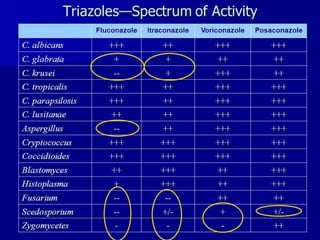
 Structure related to that of fluconazole and a spectrum of activity
comparable to that of itraconazole.
 Voriconazole was approved by the Food and Drug Administration in
May 2002.(VFEND, Pfizer)
 Available in oral and intravenous form
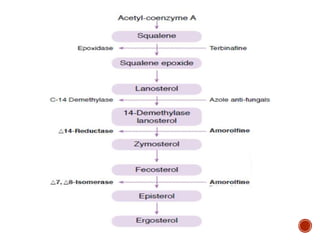
 Like the other triazole antifungals, voriconazole exerts its
antifungal activity by inhibition of 14-alpha-lanosterol
demethylation, which is mediated by fungal cytochrome P450
enzymes.
 The accumulation of 14-alphamethyl sterols results in a decrease
in ergosterol, which is an essential component of fungal cell wall
formation.
 The resulting cell wall abnormalities are thought to be responsible
for voriconazole’s antifungal activity.
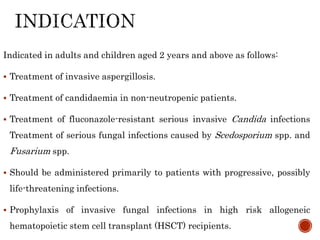
Indicated in adults and children aged 2 years and above as follows:
 Treatment of invasive aspergillosis.
 Treatment of candidaemia in non-neutropenic patients.
 Treatment of fluconazole-resistant serious invasive Candida infections
Treatment of serious fungal infections caused by Scedosporium spp. and
Fusarium spp.
 Should be administered primarily to patients with progressive, possibly
life-threatening infections.
 Prophylaxis of invasive fungal infections in high risk allogeneic
hematopoietic stem cell transplant (HSCT) recipients.
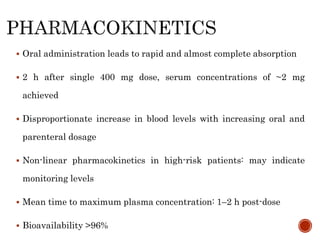
 Oral administration leads to rapid and almost complete absorption
 2 h after single 400 mg dose, serum concentrations of ~2 mg
achieved
 Disproportionate increase in blood levels with increasing oral and
parenteral dosage
 Non-linear pharmacokinetics in high-risk patients: may indicate
monitoring levels
 Mean time to maximum plasma concentration: 1–2 h post-dose
 Bioavailability >96%
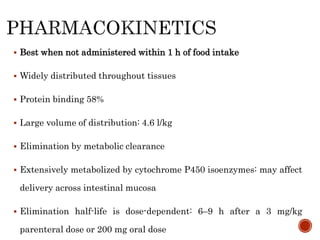
 Best when not administered within 1 h of food intake
 Widely distributed throughout tissues
 Protein binding 58%
 Large volume of distribution: 4.6 l/kg
 Elimination by metabolic clearance
 Extensively metabolized by cytochrome P450 isoenzymes: may affect
delivery across intestinal mucosa
 Elimination half-life is dose-dependent: 6–9 h after a 3 mg/kg
parenteral dose or 200 mg oral dose
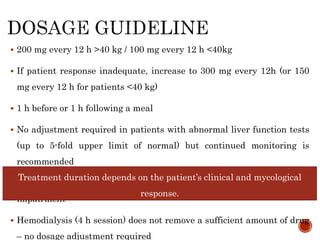
 200 mg every 12 h >40 kg / 100 mg every 12 h <40kg
 If patient response inadequate, increase to 300 mg every 12h (or 150
mg every 12 h for patients <40 kg)
 1 h before or 1 h following a meal
 No adjustment required in patients with abnormal liver function tests
(up to 5-fold upper limit of normal) but continued monitoring is
recommended
 No adjustment of oral dose required for patients with renal
impairment
 Hemodialysis (4 h session) does not remove a sufficient amount of drug
– no dosage adjustment required
Treatment duration depends on the patient’s clinical and mycological
response.
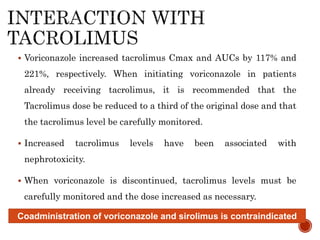
 Voriconazole increased tacrolimus Cmax and AUCs by 117% and
221%, respectively. When initiating voriconazole in patients
already receiving tacrolimus, it is recommended that the
Tacrolimus dose be reduced to a third of the original dose and that
the tacrolimus level be carefully monitored.
 Increased tacrolimus levels have been associated with
nephrotoxicity.
 When voriconazole is discontinued, tacrolimus levels must be
carefully monitored and the dose increased as necessary.
Coadministration of voriconazole and sirolimus is contraindicated
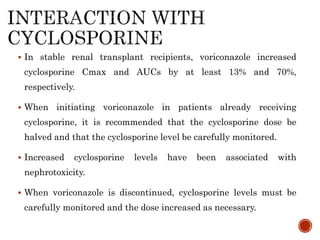
 In stable renal transplant recipients, voriconazole increased
cyclosporine Cmax and AUCs by at least 13% and 70%,
respectively.
 When initiating voriconazole in patients already receiving
cyclosporine, it is recommended that the cyclosporine dose be
halved and that the cyclosporine level be carefully monitored.
 Increased cyclosporine levels have been associated with
nephrotoxicity.
 When voriconazole is discontinued, cyclosporine levels must be
carefully monitored and the dose increased as necessary.
 >30% transient visual disturbances, but no anatomical
correlates of the disturbances
 Headache
 Gastrointestinal upset
 Rare cases of severe exfoliative cutaneous reactions, eg.
Stevens–Johnson syndrome
 Elevation in liver function tests in ~13% patients
 An open, non-comparative study of 116 patients with invasive
aspergillosis resulted in an overall efficacy of 48% (56 complete
⁄ partial responses)
 Fifty (60%) of the 84 patients with pulmonary infection
responded well to treatment with voriconazole, 6 mg⁄ kg twice
a day on the first day, followed by 3 mg⁄ kg twice daily for 6–27
days and 200 mg twice daily, given orally for up to 24 weeks.
 A 12 week comparative study on 391 patients between voriconazole
(two 6 mg⁄ kg infusions 12 h apart on the first day, followed by 4 mg⁄ kg
every 12 h for at least 7 days, after which treatment could be
continued orally 200 mg every 12 h) and intravenous amphotericin B
(1–1.5 mg⁄ kg ⁄ day).
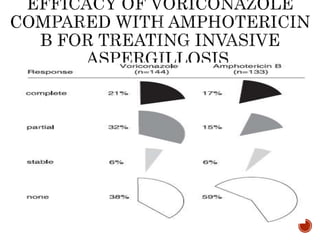
 A satisfactory response (complete or partial resolution of all
attributable symptoms and signs and of radiographic or bronchoscopic
abnormalities present at baseline) was recorded for 76 (53%) of the 144
patients treated with voriconazole but only for 42 (32%) of the 133
patients treated with amphotericin B
 The 12-week survival rate was also higher for the voriconazole
group (71%, compared with 58%for amphotericin B group).
 More than twice as many patients (29%) randomised to
amphotericin B died from invasive aspergillosis as those
randomised to voriconazole (13%).
 Treatment with voriconazole was sustained longer, with a
median duration of 77 days (range 2–84 days), compared with 10
days (range 1–84 days) for patients receiving amphotericin B.
 Fewer adverse events compared to ampho. B arm
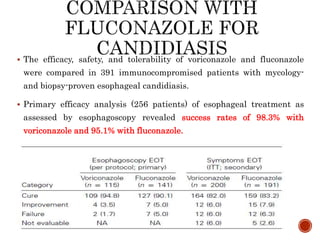
 The efficacy, safety, and tolerability of voriconazole and fluconazole
were compared in 391 immunocompromised patients with mycology-
and biopsy-proven esophageal candidiasis.
 Primary efficacy analysis (256 patients) of esophageal treatment as
assessed by esophagoscopy revealed success rates of 98.3% with
voriconazole and 95.1% with fluconazole.
Voriconazole (200 mg, b.i.d.) was shown to be at least as effective as
fluconazole in the treatment of biopsy proven esophageal candidiasis in
immunocompromised patients.
 Prospective, multicentre, open-labelled, randomized, controlled trial, renal
transplant recipients with invasive fungal infections in china for 2 years
 65 patients, of whom 31 were treated with micafungin, and 34 with voriconazole.
 There was no significant difference between the two groups in terms of efficacy,
survival beyond 10 days and discontinuation of treatment because of lack of
efficacy.
 Mortality rates in the micafungin and voriconazole groups were 9.7% (3/31) and
12.1% (4/33), respectively.
 Rates of adverse effects in the two groups were 41.9% and 51.6%, respectively.
This is the first comparison of micafungin and voriconazole in renal
transplant patients. Study shows that the effectiveness of micafungin was
similar to that of voriconazole in patients.
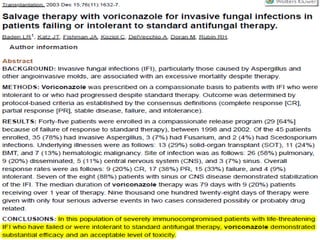
Salvage=who have failed or were intolerant to standard antifungal therapy
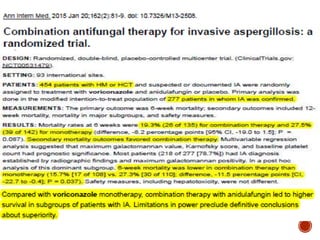
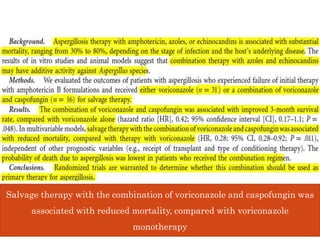
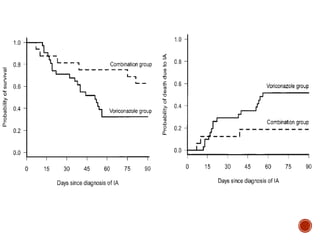
Salvage therapy with the combination of voriconazole and caspofungin was
associated with reduced mortality, compared with voriconazole
monotherapy
 Drug of choice for invasive aspergilosis
 Available as oral and intravenous form
 Established superiority over amphotericin B in terms of both efficacy
and patient survival.
 Life-saving drug for patients with infections caused by less-common
fungal pathogens.
 Can be used in combination with echinocandins in refractory cases
 Salvage therapy

Voriconazole 200 mg tablet

  • 2.
     Fungal infectionsremain a significant cause of morbidity and mortality despite advances in medicine and the emergence of new antifungal agents.  Immunocompromised patients are particularly at risk of developing these infections, with Candida and Aspergillus spp. being the mycoses most commonly identified.  Patients who develop candidemia have a greater chance of prolonged hospitalization and have a mortality rate as high as 60%.
  • 3.
     In addition,the prevalence of Candida spp. that are resistant to triazole antifungal agents is increasing, making treatment options a concern.  Aspergillosis carries a 100% mortality rate if left untreated.  Although there are numerous treatment options, no broad-spectrum antifungal agents with an acceptable safety profile and with both intravenous and oral formulations are available at this time.
  • 4.
     Amphotericin B Liposomal amphotericin B  ECHINOCANDINS  Azole compounds
  • 5.
     Amphotericin Bis currently the drug of choice for the treatment of systemic infections caused by Aspergillus and Candida spp. However, the high incidence of toxicity associated with amphotericin B has limited its use in many patients.  Lipid formulations of amphotericin B are better tolerated than conventional amphotericin B and have similar efficacy. However, these agents are costly and are generally reserved for second-line therapy in patients who did not respond to or could not tolerate conventional amphotericin B therapy.
  • 6.
     Broad spectrumtriazole antifungal  Structure related to that of fluconazole and a spectrum of activity comparable to that of itraconazole.  Voriconazole was approved by the Food and Drug Administration in May 2002.(VFEND, Pfizer)  Available in oral and intravenous form
  • 8.
     Like theother triazole antifungals, voriconazole exerts its antifungal activity by inhibition of 14-alpha-lanosterol demethylation, which is mediated by fungal cytochrome P450 enzymes.  The accumulation of 14-alphamethyl sterols results in a decrease in ergosterol, which is an essential component of fungal cell wall formation.  The resulting cell wall abnormalities are thought to be responsible for voriconazole’s antifungal activity.
  • 9.
    Indicated in adultsand children aged 2 years and above as follows:  Treatment of invasive aspergillosis.  Treatment of candidaemia in non-neutropenic patients.  Treatment of fluconazole-resistant serious invasive Candida infections Treatment of serious fungal infections caused by Scedosporium spp. and Fusarium spp.  Should be administered primarily to patients with progressive, possibly life-threatening infections.  Prophylaxis of invasive fungal infections in high risk allogeneic hematopoietic stem cell transplant (HSCT) recipients.
  • 12.
     Oral administrationleads to rapid and almost complete absorption  2 h after single 400 mg dose, serum concentrations of ~2 mg achieved  Disproportionate increase in blood levels with increasing oral and parenteral dosage  Non-linear pharmacokinetics in high-risk patients: may indicate monitoring levels  Mean time to maximum plasma concentration: 1–2 h post-dose  Bioavailability >96%
  • 13.
     Best whennot administered within 1 h of food intake  Widely distributed throughout tissues  Protein binding 58%  Large volume of distribution: 4.6 l/kg  Elimination by metabolic clearance  Extensively metabolized by cytochrome P450 isoenzymes: may affect delivery across intestinal mucosa  Elimination half-life is dose-dependent: 6–9 h after a 3 mg/kg parenteral dose or 200 mg oral dose
  • 14.
     200 mgevery 12 h >40 kg / 100 mg every 12 h <40kg  If patient response inadequate, increase to 300 mg every 12h (or 150 mg every 12 h for patients <40 kg)  1 h before or 1 h following a meal  No adjustment required in patients with abnormal liver function tests (up to 5-fold upper limit of normal) but continued monitoring is recommended  No adjustment of oral dose required for patients with renal impairment  Hemodialysis (4 h session) does not remove a sufficient amount of drug – no dosage adjustment required Treatment duration depends on the patient’s clinical and mycological response.
  • 15.
     Voriconazole increasedtacrolimus Cmax and AUCs by 117% and 221%, respectively. When initiating voriconazole in patients already receiving tacrolimus, it is recommended that the Tacrolimus dose be reduced to a third of the original dose and that the tacrolimus level be carefully monitored.  Increased tacrolimus levels have been associated with nephrotoxicity.  When voriconazole is discontinued, tacrolimus levels must be carefully monitored and the dose increased as necessary. Coadministration of voriconazole and sirolimus is contraindicated
  • 16.
     In stablerenal transplant recipients, voriconazole increased cyclosporine Cmax and AUCs by at least 13% and 70%, respectively.  When initiating voriconazole in patients already receiving cyclosporine, it is recommended that the cyclosporine dose be halved and that the cyclosporine level be carefully monitored.  Increased cyclosporine levels have been associated with nephrotoxicity.  When voriconazole is discontinued, cyclosporine levels must be carefully monitored and the dose increased as necessary.
  • 17.
     >30% transientvisual disturbances, but no anatomical correlates of the disturbances  Headache  Gastrointestinal upset  Rare cases of severe exfoliative cutaneous reactions, eg. Stevens–Johnson syndrome  Elevation in liver function tests in ~13% patients
  • 18.
     An open,non-comparative study of 116 patients with invasive aspergillosis resulted in an overall efficacy of 48% (56 complete ⁄ partial responses)  Fifty (60%) of the 84 patients with pulmonary infection responded well to treatment with voriconazole, 6 mg⁄ kg twice a day on the first day, followed by 3 mg⁄ kg twice daily for 6–27 days and 200 mg twice daily, given orally for up to 24 weeks.
  • 19.
     A 12week comparative study on 391 patients between voriconazole (two 6 mg⁄ kg infusions 12 h apart on the first day, followed by 4 mg⁄ kg every 12 h for at least 7 days, after which treatment could be continued orally 200 mg every 12 h) and intravenous amphotericin B (1–1.5 mg⁄ kg ⁄ day).  A satisfactory response (complete or partial resolution of all attributable symptoms and signs and of radiographic or bronchoscopic abnormalities present at baseline) was recorded for 76 (53%) of the 144 patients treated with voriconazole but only for 42 (32%) of the 133 patients treated with amphotericin B
  • 21.
     The 12-weeksurvival rate was also higher for the voriconazole group (71%, compared with 58%for amphotericin B group).  More than twice as many patients (29%) randomised to amphotericin B died from invasive aspergillosis as those randomised to voriconazole (13%).  Treatment with voriconazole was sustained longer, with a median duration of 77 days (range 2–84 days), compared with 10 days (range 1–84 days) for patients receiving amphotericin B.  Fewer adverse events compared to ampho. B arm
  • 22.
     The efficacy,safety, and tolerability of voriconazole and fluconazole were compared in 391 immunocompromised patients with mycology- and biopsy-proven esophageal candidiasis.  Primary efficacy analysis (256 patients) of esophageal treatment as assessed by esophagoscopy revealed success rates of 98.3% with voriconazole and 95.1% with fluconazole.
  • 23.
    Voriconazole (200 mg,b.i.d.) was shown to be at least as effective as fluconazole in the treatment of biopsy proven esophageal candidiasis in immunocompromised patients.
  • 24.
     Prospective, multicentre,open-labelled, randomized, controlled trial, renal transplant recipients with invasive fungal infections in china for 2 years  65 patients, of whom 31 were treated with micafungin, and 34 with voriconazole.  There was no significant difference between the two groups in terms of efficacy, survival beyond 10 days and discontinuation of treatment because of lack of efficacy.  Mortality rates in the micafungin and voriconazole groups were 9.7% (3/31) and 12.1% (4/33), respectively.  Rates of adverse effects in the two groups were 41.9% and 51.6%, respectively. This is the first comparison of micafungin and voriconazole in renal transplant patients. Study shows that the effectiveness of micafungin was similar to that of voriconazole in patients.
  • 27.
    Salvage=who have failedor were intolerant to standard antifungal therapy
  • 29.
    Salvage therapy withthe combination of voriconazole and caspofungin was associated with reduced mortality, compared with voriconazole monotherapy
  • 31.
     Drug ofchoice for invasive aspergilosis  Available as oral and intravenous form  Established superiority over amphotericin B in terms of both efficacy and patient survival.  Life-saving drug for patients with infections caused by less-common fungal pathogens.  Can be used in combination with echinocandins in refractory cases  Salvage therapy