Echinocandins in Invasive Fungal
Infections:
Clinical Review
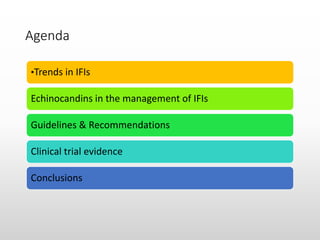
Agenda
•Trends in IFIs
Echinocandins in the management of IFIs
Guidelines & Recommendations
Clinical trial evidence
Conclusions
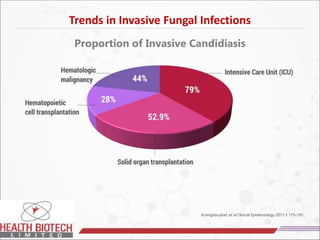
Trends in Invasive Fungal Infections
Proportion of Invasive Candidiasis
Kriengkauykiat et al Clinical Epidemiology 2011:3 175–191.
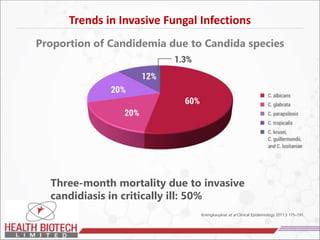
Proportion of Candidemia due to Candida species
Kriengkauykiat et al Clinical Epidemiology 2011:3 175–191.
Three-month mortality due to invasive
candidiasis in critically ill: 50%
Trends in Invasive Fungal Infections
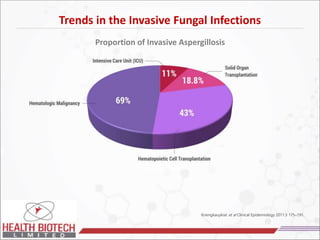
Trends in the Invasive Fungal Infections
Proportion of Invasive Aspergillosis
Kriengkauykiat et al Clinical Epidemiology 2011:3 175–191.
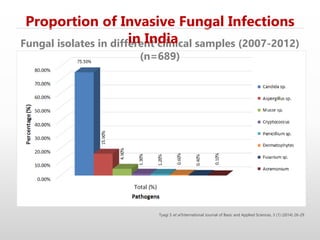
Fungal isolates in different clinical samples (2007-2012)
(n=689)
Proportion of Invasive Fungal Infections
in India
Tyagi S et al International Journal of Basic and Applied Sciences, 3 (1) (2014) 26-29
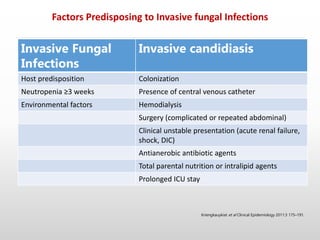
ICU, intensive care unit; DIC Disseminated intravascular coagulation
Factors Predisposing to Invasive fungal Infections
Invasive Fungal
Infections
Invasive candidiasis
Host predisposition Colonization
Neutropenia ≥3 weeks Presence of central venous catheter
Environmental factors Hemodialysis
Surgery (complicated or repeated abdominal)
Clinical unstable presentation (acute renal failure,
shock, DIC)
Antianerobic antibiotic agents
Total parental nutrition or intralipid agents
Prolonged ICU stay
Kriengkauykiat et al Clinical Epidemiology 2011:3 175–191.
Developed in
response to
the need for
safe and
effective
antifungals
Inhibits 1,3-
beta-d-glucan
synthase
Favorable
activity in
vitro against
yeasts and
select moulds
Favorable
safety profile
Place of Echinocandins in the Management of Invasive Fungal
Infections
Turner MS et al Expert Opin Emerg Drugs. 2006 May;11(2):231-50.
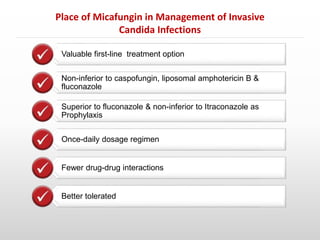
Valuable first-line treatment option
Non-inferior to caspofungin, liposomal amphotericin B &
fluconazole
Superior to fluconazole & non-inferior to Itraconazole as
Prophylaxis
Once-daily dosage regimen
Fewer drug-drug interactions
Better tolerated
Place of Micafungin in Management of Invasive
Candida Infections
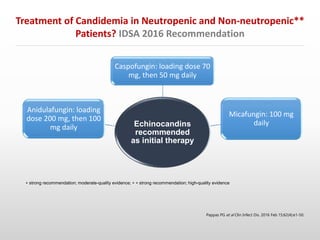
Echinocandins
recommended
as initial therapy
Caspofungin: loading dose 70
mg, then 50 mg daily
Micafungin: 100 mg
daily
Anidulafungin: loading
dose 200 mg, then 100
mg daily
 strong recommendation; moderate-quality evidence;   strong recommendation; high-quality evidence
Treatment of Candidemia in Neutropenic and Non-neutropenic**
Patients? IDSA 2016 Recommendation
Pappas PG et al Clin Infect Dis. 2016 Feb 15;62(4):e1-50.
Treatment of candidemia/invasive
candidiasis in Non-neutropenia:
Recommendations from Various Guidelines
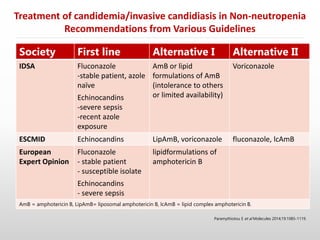
Society First line Alternative I Alternative II
IDSA Fluconazole
-stable patient, azole
naïve
Echinocandins
-severe sepsis
-recent azole
exposure
AmB or lipid
formulations of AmB
(intolerance to others
or limited availability)
Voriconazole
ESCMID Echinocandins LipAmB, voriconazole fluconazole, lcAmB
European
Expert Opinion
Fluconazole
- stable patient
- susceptible isolate
Echinocandins
- severe sepsis
lipidformulations of
amphotericin B
AmB = amphotericin B, LipAmB= liposomal amphotericin B, lcAmB = lipid complex amphotericin B.
Treatment of candidemia/invasive candidiasis in Non-neutropenia
Recommendations from Various Guidelines
Paramythiotou E et al Molecules 2014;19:1085-1119.
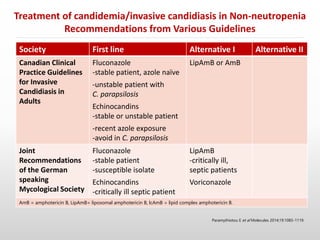
Society First line Alternative I Alternative II
Canadian Clinical
Practice Guidelines
for Invasive
Candidiasis in
Adults
Fluconazole
-stable patient, azole naïve
-unstable patient with
C. parapsilosis
Echinocandins
-stable or unstable patient
-recent azole exposure
-avoid in C. parapsilosis
LipAmB or AmB
Joint
Recommendations
of the German
speaking
Mycological Society
Fluconazole
-stable patient
-susceptible isolate
Echinocandins
-critically ill septic patient
LipAmB
-critically ill,
septic patients
Voriconazole
AmB = amphotericin B, LipAmB= liposomal amphotericin B, lcAmB = lipid complex amphotericin B.
Treatment of candidemia/invasive candidiasis in Non-neutropenia
Recommendations from Various Guidelines
Paramythiotou E et al Molecules 2014;19:1085-1119.
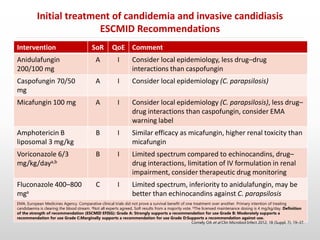
Intervention SoR QoE Comment
Anidulafungin
200/100 mg
A I Consider local epidemiology, less drug–drug
interactions than caspofungin
Caspofungin 70/50
mg
A I Consider local epidemiology (C. parapsilosis)
Micafungin 100 mg A I Consider local epidemiology (C. parapsilosis), less drug–
drug interactions than caspofungin, consider EMA
warning label
Amphotericin B
liposomal 3 mg/kg
B I Similar efficacy as micafungin, higher renal toxicity than
micafungin
Voriconazole 6/3
mg/kg/daya,b
B I Limited spectrum compared to echinocandins, drug–
drug interactions, limitation of IV formulation in renal
impairment, consider therapeutic drug monitoring
Fluconazole 400–800
mga
C I Limited spectrum, inferiority to anidulafungin, may be
better than echinocandins against C. parapsilosis
EMA, European Medicines Agency. Comparative clinical trials did not prove a survival benefit of one treatment over another. Primary intention of treating
candidaemia is clearing the blood stream. aNot all experts agreed, SoR results from a majority vote. bThe licensed maintenance dosing is 4 mg/kg/day. Definition
of the strength of recommendation (ESCMID EFISG): Grade A: Strongly supports a recommendation for use Grade B: Moderately supports a
recommendation for use Grade C:Marginally supports a recommendation for use Grade D:Supports a recommendation against use.
Initial treatment of candidemia and invasive candidiasis
ESCMID Recommendations
Cornely OA et al Clin Microbiol Infect 2012; 18 (Suppl. 7): 19–37.
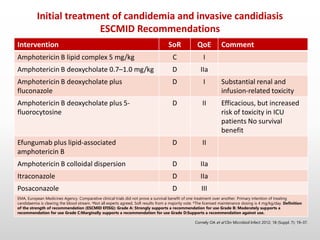
Intervention SoR QoE Comment
Amphotericin B lipid complex 5 mg/kg C I
Amphotericin B deoxycholate 0.7–1.0 mg/kg D IIa
Amphotericin B deoxycholate plus
fluconazole
D I Substantial renal and
infusion-related toxicity
Amphotericin B deoxycholate plus 5-
fluorocytosine
D II Efficacious, but increased
risk of toxicity in ICU
patients No survival
benefit
Efungumab plus lipid-associated
amphotericin B
D II
Amphotericin B colloidal dispersion D IIa
Itraconazole D IIa
Posaconazole D III
EMA, European Medicines Agency. Comparative clinical trials did not prove a survival benefit of one treatment over another. Primary intention of treating
candidaemia is clearing the blood stream. aNot all experts agreed, SoR results from a majority vote. bThe licensed maintenance dosing is 4 mg/kg/day. Definition
of the strength of recommendation (ESCMID EFISG): Grade A: Strongly supports a recommendation for use Grade B: Moderately supports a
recommendation for use Grade C:Marginally supports a recommendation for use Grade D:Supports a recommendation against use.
Initial treatment of candidemia and invasive candidiasis
ESCMID Recommendations
Cornely OA et al Clin Microbiol Infect 2012; 18 (Suppl. 7): 19–37.
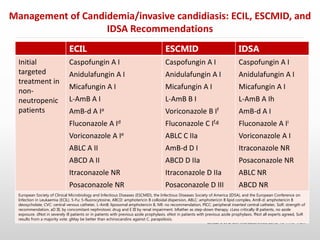
Management of Candidemia/invasive candidiasis: ECIL, ESCMID, and
IDSA Recommendations
Leroux S et al Clin Microbiol Infect 2013; 19: 1115–1121.
ECIL ESCMID IDSA
Initial
targeted
treatment in
non-
neutropenic
patients
Caspofungin A I
Anidulafungin A I
Micafungin A I
L-AmB A I
AmB-d A Ia
Fluconazole A Id
Voriconazole A Ie
ABLC A II
ABCD A II
Itraconazole NR
Posaconazole NR
Caspofungin A I
Anidulafungin A I
Micafungin A I
L-AmB B I
Voriconazole B If
Fluconazole C If,g
ABLC C IIa
AmB-d D I
ABCD D IIa
Itraconazole D IIa
Posaconazole D III
Caspofungin A I
Anidulafungin A I
Micafungin A I
L-AmB A Ih
AmB-d A I
Fluconazole A Ii
Voriconazole A I
Itraconazole NR
Posaconazole NR
ABLC NR
ABCD NR
European Society of Clinical Microbiology and Infectious Diseases (ESCMID), the Infectious Diseases Society of America (IDSA), and the European Conference on
Infection in Leukaemia (ECIL). 5-Fu: 5-fluorocytosine, ABCD: amphotericin B colloidal dispersion, ABLC: amphotericin B lipid complex, AmB-d: amphotericin B
deoxycholate, CVC: central venous catheter, L-AmB: liposomal amphotericin B, NR: no recommendation, PICC: peripheral inserted central catheter, SoR: strength of
recommendation. aD III, by concomitant nephrotoxic drug and E III by renal impairment. bRather as step-down therapy. cLess critically ill patients, no azole
exposure. dNot in severely ill patients or in patients with previous azole prophylaxis. eNot in patients with previous azole prophylaxis. fNot all experts agreed, SoR
results from a majority vote. gMay be better than echinocandins against C. parapsilosis.
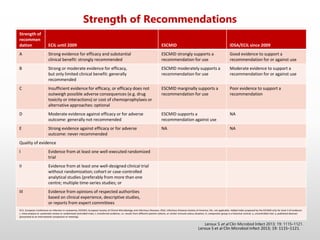
Strength of
recommen
dation ECIL until 2009 ESCMID IDSA/ECIL since 2009
A Strong evidence for efficacy and substantial
clinical benefit: strongly recommended
ESCMID strongly supports a
recommendation for use
Good evidence to support a
recommendation for or against use
B Strong or moderate evidence for efficacy,
but only limited clinical benefit: generally
recommended
ESCMID moderately supports a
recommendation for use
Moderate evidence to support a
recommendation for or against use
C Insufficient evidence for efficacy, or efficacy does not
outweigh possible adverse consequences (e.g. drug
toxicity or interactions) or cost of chemoprophylaxis or
alternative approaches: optional
ESCMID marginally supports a
recommendation for use
Poor evidence to support a
recommendation
D Moderate evidence against efficacy or for adverse
outcome: generally not recommended
ESCMID supports a
recommendation against use
NA
E Strong evidence against efficacy or for adverse
outcome: never recommended
NA NA
Quality of evidence
I Evidence from at least one well-executed randomized
trial
II Evidence from at least one well-designed clinical trial
without randomization; cohort or case-controlled
analytical studies (preferably from more than one
centre; multiple time-series studies; or
III Evidence from opinions of respected authorities
based on clinical experience, descriptive studies,
or reports from expert committees
ECIL, European Conference on Infection in Leukaemia; ESCMID, European Society of Clinical Microbiology and Infectious Diseases; IDSA, Infectious Diseases Society of America; NA, not applicable. Added Index proposed by the ESCMID only for level II of evidence:
r, meta-analysis or systematic review or randomized controlled trials; t, transferred evidence, i.e. results from different patient cohorts, or similar immune-status situation; h, comparator group is a historical control; u, uncontrolled trial; a, published abstract
(presented at an international symposium or meeting).
Leroux S et al Clin Microbiol Infect 2013; 19: 1115–1121.
Strength of Recommendations
Leroux S et al Clin Microbiol Infect 2013; 19: 1115–1121.
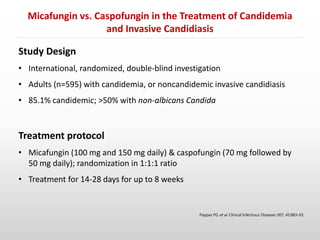
Study Design
• International, randomized, double-blind investigation
• Adults (n=595) with candidemia, or noncandidemic invasive candidiasis
• 85.1% candidemic; >50% with non-albicans Candida
Treatment protocol
• Micafungin (100 mg and 150 mg daily) & caspofungin (70 mg followed by
50 mg daily); randomization in 1:1:1 ratio
• Treatment for 14-28 days for up to 8 weeks
Pappas PG et al. Clinical Infectious Diseases 007; 45:883–93.
Micafungin vs. Caspofungin in the Treatment of Candidemia
and Invasive Candidiasis
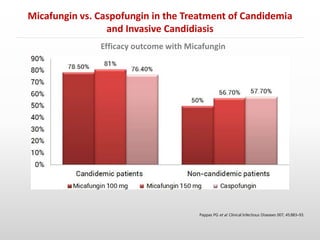
Micafungin vs. Caspofungin in the Treatment of Candidemia
and Invasive Candidiasis
Efficacy outcome with Micafungin
Pappas PG et al. Clinical Infectious Diseases 007; 45:883–93.
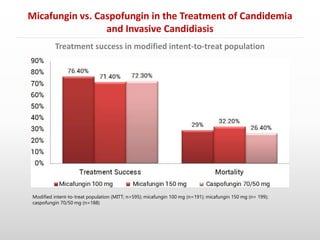
Modified intent-to-treat population (MITT; n=595); micafungin 100 mg (n=191); micafungin 150 mg (n= 199);
caspofungin 70/50 mg (n=188)
Treatment success in modified intent-to-treat population
Micafungin vs. Caspofungin in the Treatment of Candidemia
and Invasive Candidiasis
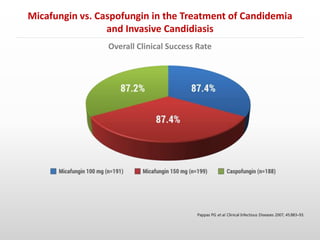
Overall Clinical Success Rate
Micafungin vs. Caspofungin in the Treatment of Candidemia
and Invasive Candidiasis
Pappas PG et al. Clinical Infectious Diseases 2007; 45:883–93.
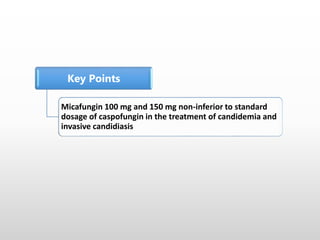
Key Points
Micafungin 100 mg and 150 mg non-inferior to standard
dosage of caspofungin in the treatment of candidemia and
invasive candidiasis
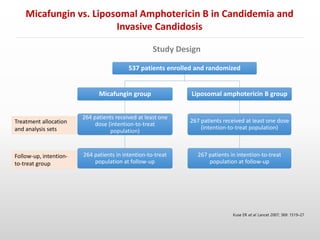
537 patients enrolled and randomized
Micafungin group
264 patients received at least one
dose (intention-to-treat
population)
264 patients in intention-to-treat
population at follow-up
Liposomal amphotericin B group
267 patients received at least one dose
(intention-to-treat population)
267 patients in intention-to-treat
population at follow-up
Treatment allocation
and analysis sets
Follow-up, intention-
to-treat group
Study Design
Kuse ER et al. Lancet 2007; 369: 1519–27
Micafungin vs. Liposomal Amphotericin B in Candidemia and

Invasive Candidosis
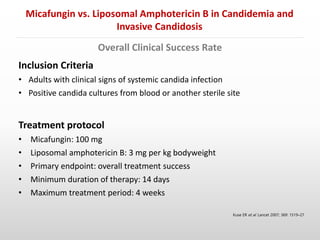
Overall Clinical Success Rate
Kuse ER et al. Lancet 2007; 369: 1519–27
Inclusion Criteria
• Adults with clinical signs of systemic candida infection
• Positive candida cultures from blood or another sterile site
Treatment protocol
• Micafungin: 100 mg
• Liposomal amphotericin B: 3 mg per kg bodyweight
• Primary endpoint: overall treatment success
• Minimum duration of therapy: 14 days
• Maximum treatment period: 4 weeks
Micafungin vs. Liposomal Amphotericin B in Candidemia and
Invasive Candidosis
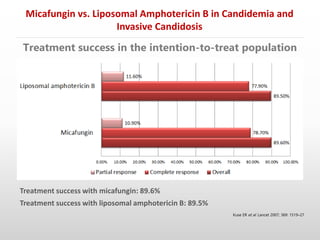
Treatment success in the intention-to-treat population
Kuse ER et al. Lancet 2007; 369: 1519–27
Treatment success with micafungin: 89.6%
Treatment success with liposomal amphotericin B: 89.5%
Micafungin vs. Liposomal Amphotericin B in Candidemia and
Invasive Candidosis
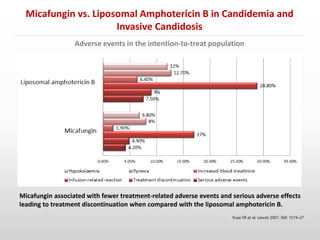
Adverse events in the intention-to-treat population
Micafungin vs. Liposomal Amphotericin B in Candidemia and
Invasive Candidosis
Kuse ER et al. Lancet 2007; 369: 1519–27
Micafungin associated with fewer treatment-related adverse events and serious adverse effects
leading to treatment discontinuation when compared with the liposomal amphotericin B.
Kuse ER et al. Lancet 2007; 369: 1519–27
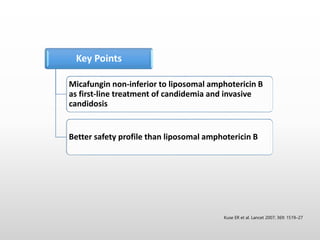
Key Points
Micafungin non-inferior to liposomal amphotericin B
as first-line treatment of candidemia and invasive
candidosis
Better safety profile than liposomal amphotericin B
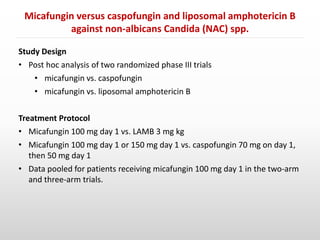
Micafungin versus caspofungin and liposomal amphotericin B
against non-albicans Candida (NAC) spp.
Study Design
• Post hoc analysis of two randomized phase III trials
• micafungin vs. caspofungin
• micafungin vs. liposomal amphotericin B
Treatment Protocol
• Micafungin 100 mg day 1 vs. LAMB 3 mg kg
• Micafungin 100 mg day 1 or 150 mg day 1 vs. caspofungin 70 mg on day 1,
then 50 mg day 1
• Data pooled for patients receiving micafungin 100 mg day 1 in the two-arm
and three-arm trials.
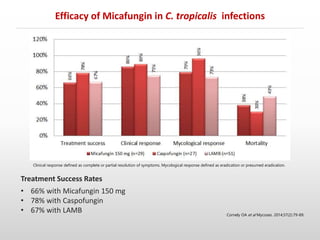
Clinical response defined as complete or partial resolution of symptoms. Mycological response defined as eradication or presumed eradication.
Treatment Success Rates
• 66% with Micafungin 150 mg
• 78% with Caspofungin
• 67% with LAMB Cornely OA et al Mycoses. 2014;57(2):79-89.
Efficacy of Micafungin in C. tropicalis infections
Cornely OA et al Mycoses. 2014;57(2):79-89.
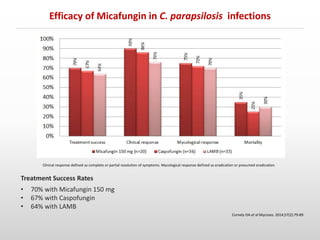
Efficacy of Micafungin in C. parapsilosis infections
Clinical response defined as complete or partial resolution of symptoms. Mycological response defined as eradication or presumed eradication.
Treatment Success Rates
• 70% with Micafungin 150 mg
• 67% with Caspofungin
• 64% with LAMB
Cornely OA et al Mycoses. 2014;57(2):79-89.
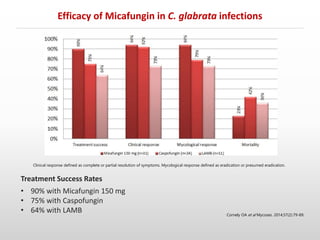
Efficacy of Micafungin in C. glabrata infections
Clinical response defined as complete or partial resolution of symptoms. Mycological response defined as eradication or presumed eradication.
Treatment Success Rates
• 90% with Micafungin 150 mg
• 75% with Caspofungin
• 64% with LAMB
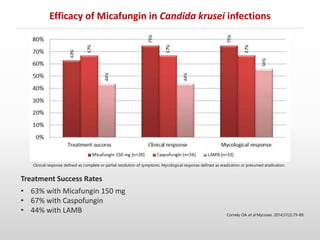
Efficacy of Micafungin in Candida krusei infections
Cornely OA et al Mycoses. 2014;57(2):79-89.
Clinical response defined as complete or partial resolution of symptoms. Mycological response defined as eradication or presumed eradication.
Treatment Success Rates
• 63% with Micafungin 150 mg
• 67% with Caspofungin
• 44% with LAMB
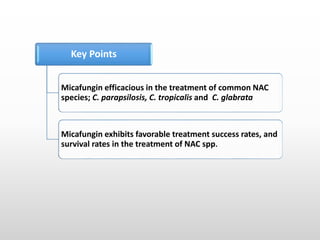
Key Points
Micafungin efficacious in the treatment of common NAC
species; C. parapsilosis, C. tropicalis and C. glabrata
Micafungin exhibits favorable treatment success rates, and
survival rates in the treatment of NAC spp.
Prevalence of Invasive fungal infections
• Candida species remain relevant cause of IFIs
Place of Echinocandins in invasive fungal infections
• Fungicidal against yeast
• Limited toxicity & minimal drug-drug interactions
Place of Micafungin in invasive fungal infections
• Efficacy & safety supported by comparative, randomized clinical trials
• Recommended in many clinical practice guidelines
Conclusion
Micafungin is an effective and safe
therapy in invasive fungal infections,
supported by randomized clinical trials,
and recommended by various guidelines
Take-Home Message
Thank you

Micafungin CME C-2.pptx

  • 1.
    Echinocandins in InvasiveFungal Infections: Clinical Review
  • 2.
    Agenda •Trends in IFIs Echinocandinsin the management of IFIs Guidelines & Recommendations Clinical trial evidence Conclusions
  • 3.
    Trends in InvasiveFungal Infections Proportion of Invasive Candidiasis Kriengkauykiat et al Clinical Epidemiology 2011:3 175–191.
  • 4.
    Proportion of Candidemiadue to Candida species Kriengkauykiat et al Clinical Epidemiology 2011:3 175–191. Three-month mortality due to invasive candidiasis in critically ill: 50% Trends in Invasive Fungal Infections
  • 5.
    Trends in theInvasive Fungal Infections Proportion of Invasive Aspergillosis Kriengkauykiat et al Clinical Epidemiology 2011:3 175–191.
  • 6.
    Fungal isolates indifferent clinical samples (2007-2012) (n=689) Proportion of Invasive Fungal Infections in India Tyagi S et al International Journal of Basic and Applied Sciences, 3 (1) (2014) 26-29
  • 7.
    ICU, intensive careunit; DIC Disseminated intravascular coagulation Factors Predisposing to Invasive fungal Infections Invasive Fungal Infections Invasive candidiasis Host predisposition Colonization Neutropenia ≥3 weeks Presence of central venous catheter Environmental factors Hemodialysis Surgery (complicated or repeated abdominal) Clinical unstable presentation (acute renal failure, shock, DIC) Antianerobic antibiotic agents Total parental nutrition or intralipid agents Prolonged ICU stay Kriengkauykiat et al Clinical Epidemiology 2011:3 175–191.
  • 8.
    Developed in response to theneed for safe and effective antifungals Inhibits 1,3- beta-d-glucan synthase Favorable activity in vitro against yeasts and select moulds Favorable safety profile Place of Echinocandins in the Management of Invasive Fungal Infections Turner MS et al Expert Opin Emerg Drugs. 2006 May;11(2):231-50.
  • 9.
    Valuable first-line treatmentoption Non-inferior to caspofungin, liposomal amphotericin B & fluconazole Superior to fluconazole & non-inferior to Itraconazole as Prophylaxis Once-daily dosage regimen Fewer drug-drug interactions Better tolerated Place of Micafungin in Management of Invasive Candida Infections
  • 10.
    Echinocandins recommended as initial therapy Caspofungin:loading dose 70 mg, then 50 mg daily Micafungin: 100 mg daily Anidulafungin: loading dose 200 mg, then 100 mg daily  strong recommendation; moderate-quality evidence;   strong recommendation; high-quality evidence Treatment of Candidemia in Neutropenic and Non-neutropenic** Patients? IDSA 2016 Recommendation Pappas PG et al Clin Infect Dis. 2016 Feb 15;62(4):e1-50.
  • 11.
    Treatment of candidemia/invasive candidiasisin Non-neutropenia: Recommendations from Various Guidelines
  • 12.
    Society First lineAlternative I Alternative II IDSA Fluconazole -stable patient, azole naïve Echinocandins -severe sepsis -recent azole exposure AmB or lipid formulations of AmB (intolerance to others or limited availability) Voriconazole ESCMID Echinocandins LipAmB, voriconazole fluconazole, lcAmB European Expert Opinion Fluconazole - stable patient - susceptible isolate Echinocandins - severe sepsis lipidformulations of amphotericin B AmB = amphotericin B, LipAmB= liposomal amphotericin B, lcAmB = lipid complex amphotericin B. Treatment of candidemia/invasive candidiasis in Non-neutropenia Recommendations from Various Guidelines Paramythiotou E et al Molecules 2014;19:1085-1119.
  • 13.
    Society First lineAlternative I Alternative II Canadian Clinical Practice Guidelines for Invasive Candidiasis in Adults Fluconazole -stable patient, azole naïve -unstable patient with C. parapsilosis Echinocandins -stable or unstable patient -recent azole exposure -avoid in C. parapsilosis LipAmB or AmB Joint Recommendations of the German speaking Mycological Society Fluconazole -stable patient -susceptible isolate Echinocandins -critically ill septic patient LipAmB -critically ill, septic patients Voriconazole AmB = amphotericin B, LipAmB= liposomal amphotericin B, lcAmB = lipid complex amphotericin B. Treatment of candidemia/invasive candidiasis in Non-neutropenia Recommendations from Various Guidelines Paramythiotou E et al Molecules 2014;19:1085-1119.
  • 14.
    Intervention SoR QoEComment Anidulafungin 200/100 mg A I Consider local epidemiology, less drug–drug interactions than caspofungin Caspofungin 70/50 mg A I Consider local epidemiology (C. parapsilosis) Micafungin 100 mg A I Consider local epidemiology (C. parapsilosis), less drug– drug interactions than caspofungin, consider EMA warning label Amphotericin B liposomal 3 mg/kg B I Similar efficacy as micafungin, higher renal toxicity than micafungin Voriconazole 6/3 mg/kg/daya,b B I Limited spectrum compared to echinocandins, drug– drug interactions, limitation of IV formulation in renal impairment, consider therapeutic drug monitoring Fluconazole 400–800 mga C I Limited spectrum, inferiority to anidulafungin, may be better than echinocandins against C. parapsilosis EMA, European Medicines Agency. Comparative clinical trials did not prove a survival benefit of one treatment over another. Primary intention of treating candidaemia is clearing the blood stream. aNot all experts agreed, SoR results from a majority vote. bThe licensed maintenance dosing is 4 mg/kg/day. Definition of the strength of recommendation (ESCMID EFISG): Grade A: Strongly supports a recommendation for use Grade B: Moderately supports a recommendation for use Grade C:Marginally supports a recommendation for use Grade D:Supports a recommendation against use. Initial treatment of candidemia and invasive candidiasis ESCMID Recommendations Cornely OA et al Clin Microbiol Infect 2012; 18 (Suppl. 7): 19–37.
  • 15.
    Intervention SoR QoEComment Amphotericin B lipid complex 5 mg/kg C I Amphotericin B deoxycholate 0.7–1.0 mg/kg D IIa Amphotericin B deoxycholate plus fluconazole D I Substantial renal and infusion-related toxicity Amphotericin B deoxycholate plus 5- fluorocytosine D II Efficacious, but increased risk of toxicity in ICU patients No survival benefit Efungumab plus lipid-associated amphotericin B D II Amphotericin B colloidal dispersion D IIa Itraconazole D IIa Posaconazole D III EMA, European Medicines Agency. Comparative clinical trials did not prove a survival benefit of one treatment over another. Primary intention of treating candidaemia is clearing the blood stream. aNot all experts agreed, SoR results from a majority vote. bThe licensed maintenance dosing is 4 mg/kg/day. Definition of the strength of recommendation (ESCMID EFISG): Grade A: Strongly supports a recommendation for use Grade B: Moderately supports a recommendation for use Grade C:Marginally supports a recommendation for use Grade D:Supports a recommendation against use. Initial treatment of candidemia and invasive candidiasis ESCMID Recommendations Cornely OA et al Clin Microbiol Infect 2012; 18 (Suppl. 7): 19–37.
  • 16.
    Management of Candidemia/invasivecandidiasis: ECIL, ESCMID, and IDSA Recommendations Leroux S et al Clin Microbiol Infect 2013; 19: 1115–1121. ECIL ESCMID IDSA Initial targeted treatment in non- neutropenic patients Caspofungin A I Anidulafungin A I Micafungin A I L-AmB A I AmB-d A Ia Fluconazole A Id Voriconazole A Ie ABLC A II ABCD A II Itraconazole NR Posaconazole NR Caspofungin A I Anidulafungin A I Micafungin A I L-AmB B I Voriconazole B If Fluconazole C If,g ABLC C IIa AmB-d D I ABCD D IIa Itraconazole D IIa Posaconazole D III Caspofungin A I Anidulafungin A I Micafungin A I L-AmB A Ih AmB-d A I Fluconazole A Ii Voriconazole A I Itraconazole NR Posaconazole NR ABLC NR ABCD NR European Society of Clinical Microbiology and Infectious Diseases (ESCMID), the Infectious Diseases Society of America (IDSA), and the European Conference on Infection in Leukaemia (ECIL). 5-Fu: 5-fluorocytosine, ABCD: amphotericin B colloidal dispersion, ABLC: amphotericin B lipid complex, AmB-d: amphotericin B deoxycholate, CVC: central venous catheter, L-AmB: liposomal amphotericin B, NR: no recommendation, PICC: peripheral inserted central catheter, SoR: strength of recommendation. aD III, by concomitant nephrotoxic drug and E III by renal impairment. bRather as step-down therapy. cLess critically ill patients, no azole exposure. dNot in severely ill patients or in patients with previous azole prophylaxis. eNot in patients with previous azole prophylaxis. fNot all experts agreed, SoR results from a majority vote. gMay be better than echinocandins against C. parapsilosis.
  • 17.
    Strength of recommen dation ECILuntil 2009 ESCMID IDSA/ECIL since 2009 A Strong evidence for efficacy and substantial clinical benefit: strongly recommended ESCMID strongly supports a recommendation for use Good evidence to support a recommendation for or against use B Strong or moderate evidence for efficacy, but only limited clinical benefit: generally recommended ESCMID moderately supports a recommendation for use Moderate evidence to support a recommendation for or against use C Insufficient evidence for efficacy, or efficacy does not outweigh possible adverse consequences (e.g. drug toxicity or interactions) or cost of chemoprophylaxis or alternative approaches: optional ESCMID marginally supports a recommendation for use Poor evidence to support a recommendation D Moderate evidence against efficacy or for adverse outcome: generally not recommended ESCMID supports a recommendation against use NA E Strong evidence against efficacy or for adverse outcome: never recommended NA NA Quality of evidence I Evidence from at least one well-executed randomized trial II Evidence from at least one well-designed clinical trial without randomization; cohort or case-controlled analytical studies (preferably from more than one centre; multiple time-series studies; or III Evidence from opinions of respected authorities based on clinical experience, descriptive studies, or reports from expert committees ECIL, European Conference on Infection in Leukaemia; ESCMID, European Society of Clinical Microbiology and Infectious Diseases; IDSA, Infectious Diseases Society of America; NA, not applicable. Added Index proposed by the ESCMID only for level II of evidence: r, meta-analysis or systematic review or randomized controlled trials; t, transferred evidence, i.e. results from different patient cohorts, or similar immune-status situation; h, comparator group is a historical control; u, uncontrolled trial; a, published abstract (presented at an international symposium or meeting). Leroux S et al Clin Microbiol Infect 2013; 19: 1115–1121. Strength of Recommendations Leroux S et al Clin Microbiol Infect 2013; 19: 1115–1121.
  • 18.
    Study Design • International,randomized, double-blind investigation • Adults (n=595) with candidemia, or noncandidemic invasive candidiasis • 85.1% candidemic; >50% with non-albicans Candida Treatment protocol • Micafungin (100 mg and 150 mg daily) & caspofungin (70 mg followed by 50 mg daily); randomization in 1:1:1 ratio • Treatment for 14-28 days for up to 8 weeks Pappas PG et al. Clinical Infectious Diseases 007; 45:883–93. Micafungin vs. Caspofungin in the Treatment of Candidemia and Invasive Candidiasis
  • 19.
    Micafungin vs. Caspofunginin the Treatment of Candidemia and Invasive Candidiasis Efficacy outcome with Micafungin Pappas PG et al. Clinical Infectious Diseases 007; 45:883–93.
  • 20.
    Modified intent-to-treat population(MITT; n=595); micafungin 100 mg (n=191); micafungin 150 mg (n= 199); caspofungin 70/50 mg (n=188) Treatment success in modified intent-to-treat population Micafungin vs. Caspofungin in the Treatment of Candidemia and Invasive Candidiasis
  • 21.
    Overall Clinical SuccessRate Micafungin vs. Caspofungin in the Treatment of Candidemia and Invasive Candidiasis Pappas PG et al. Clinical Infectious Diseases 2007; 45:883–93.
  • 22.
    Key Points Micafungin 100mg and 150 mg non-inferior to standard dosage of caspofungin in the treatment of candidemia and invasive candidiasis
  • 23.
    537 patients enrolledand randomized Micafungin group 264 patients received at least one dose (intention-to-treat population) 264 patients in intention-to-treat population at follow-up Liposomal amphotericin B group 267 patients received at least one dose (intention-to-treat population) 267 patients in intention-to-treat population at follow-up Treatment allocation and analysis sets Follow-up, intention- to-treat group Study Design Kuse ER et al. Lancet 2007; 369: 1519–27 Micafungin vs. Liposomal Amphotericin B in Candidemia and Invasive Candidosis
  • 24.
    Overall Clinical SuccessRate Kuse ER et al. Lancet 2007; 369: 1519–27 Inclusion Criteria • Adults with clinical signs of systemic candida infection • Positive candida cultures from blood or another sterile site Treatment protocol • Micafungin: 100 mg • Liposomal amphotericin B: 3 mg per kg bodyweight • Primary endpoint: overall treatment success • Minimum duration of therapy: 14 days • Maximum treatment period: 4 weeks Micafungin vs. Liposomal Amphotericin B in Candidemia and Invasive Candidosis
  • 25.
    Treatment success inthe intention-to-treat population Kuse ER et al. Lancet 2007; 369: 1519–27 Treatment success with micafungin: 89.6% Treatment success with liposomal amphotericin B: 89.5% Micafungin vs. Liposomal Amphotericin B in Candidemia and Invasive Candidosis
  • 26.
    Adverse events inthe intention-to-treat population Micafungin vs. Liposomal Amphotericin B in Candidemia and Invasive Candidosis Kuse ER et al. Lancet 2007; 369: 1519–27 Micafungin associated with fewer treatment-related adverse events and serious adverse effects leading to treatment discontinuation when compared with the liposomal amphotericin B.
  • 27.
    Kuse ER etal. Lancet 2007; 369: 1519–27 Key Points Micafungin non-inferior to liposomal amphotericin B as first-line treatment of candidemia and invasive candidosis Better safety profile than liposomal amphotericin B
  • 28.
    Micafungin versus caspofunginand liposomal amphotericin B against non-albicans Candida (NAC) spp. Study Design • Post hoc analysis of two randomized phase III trials • micafungin vs. caspofungin • micafungin vs. liposomal amphotericin B Treatment Protocol • Micafungin 100 mg day 1 vs. LAMB 3 mg kg • Micafungin 100 mg day 1 or 150 mg day 1 vs. caspofungin 70 mg on day 1, then 50 mg day 1 • Data pooled for patients receiving micafungin 100 mg day 1 in the two-arm and three-arm trials.
  • 29.
    Clinical response definedas complete or partial resolution of symptoms. Mycological response defined as eradication or presumed eradication. Treatment Success Rates • 66% with Micafungin 150 mg • 78% with Caspofungin • 67% with LAMB Cornely OA et al Mycoses. 2014;57(2):79-89. Efficacy of Micafungin in C. tropicalis infections
  • 30.
    Cornely OA etal Mycoses. 2014;57(2):79-89. Efficacy of Micafungin in C. parapsilosis infections Clinical response defined as complete or partial resolution of symptoms. Mycological response defined as eradication or presumed eradication. Treatment Success Rates • 70% with Micafungin 150 mg • 67% with Caspofungin • 64% with LAMB
  • 31.
    Cornely OA etal Mycoses. 2014;57(2):79-89. Efficacy of Micafungin in C. glabrata infections Clinical response defined as complete or partial resolution of symptoms. Mycological response defined as eradication or presumed eradication. Treatment Success Rates • 90% with Micafungin 150 mg • 75% with Caspofungin • 64% with LAMB
  • 32.
    Efficacy of Micafunginin Candida krusei infections Cornely OA et al Mycoses. 2014;57(2):79-89. Clinical response defined as complete or partial resolution of symptoms. Mycological response defined as eradication or presumed eradication. Treatment Success Rates • 63% with Micafungin 150 mg • 67% with Caspofungin • 44% with LAMB
  • 33.
    Key Points Micafungin efficaciousin the treatment of common NAC species; C. parapsilosis, C. tropicalis and C. glabrata Micafungin exhibits favorable treatment success rates, and survival rates in the treatment of NAC spp.
  • 34.
    Prevalence of Invasivefungal infections • Candida species remain relevant cause of IFIs Place of Echinocandins in invasive fungal infections • Fungicidal against yeast • Limited toxicity & minimal drug-drug interactions Place of Micafungin in invasive fungal infections • Efficacy & safety supported by comparative, randomized clinical trials • Recommended in many clinical practice guidelines Conclusion
  • 35.
    Micafungin is aneffective and safe therapy in invasive fungal infections, supported by randomized clinical trials, and recommended by various guidelines Take-Home Message
  • 36.

Editor's Notes

  • #8 Hoff H et al nternational Journal of Infectious Diseases 14 (2010) e458–e459.