Volumes Of Solids.
14cm
5 cm
7cm
4cm
6cm
10cm
3cm
4cm
8m
5m
What Is Volume ?
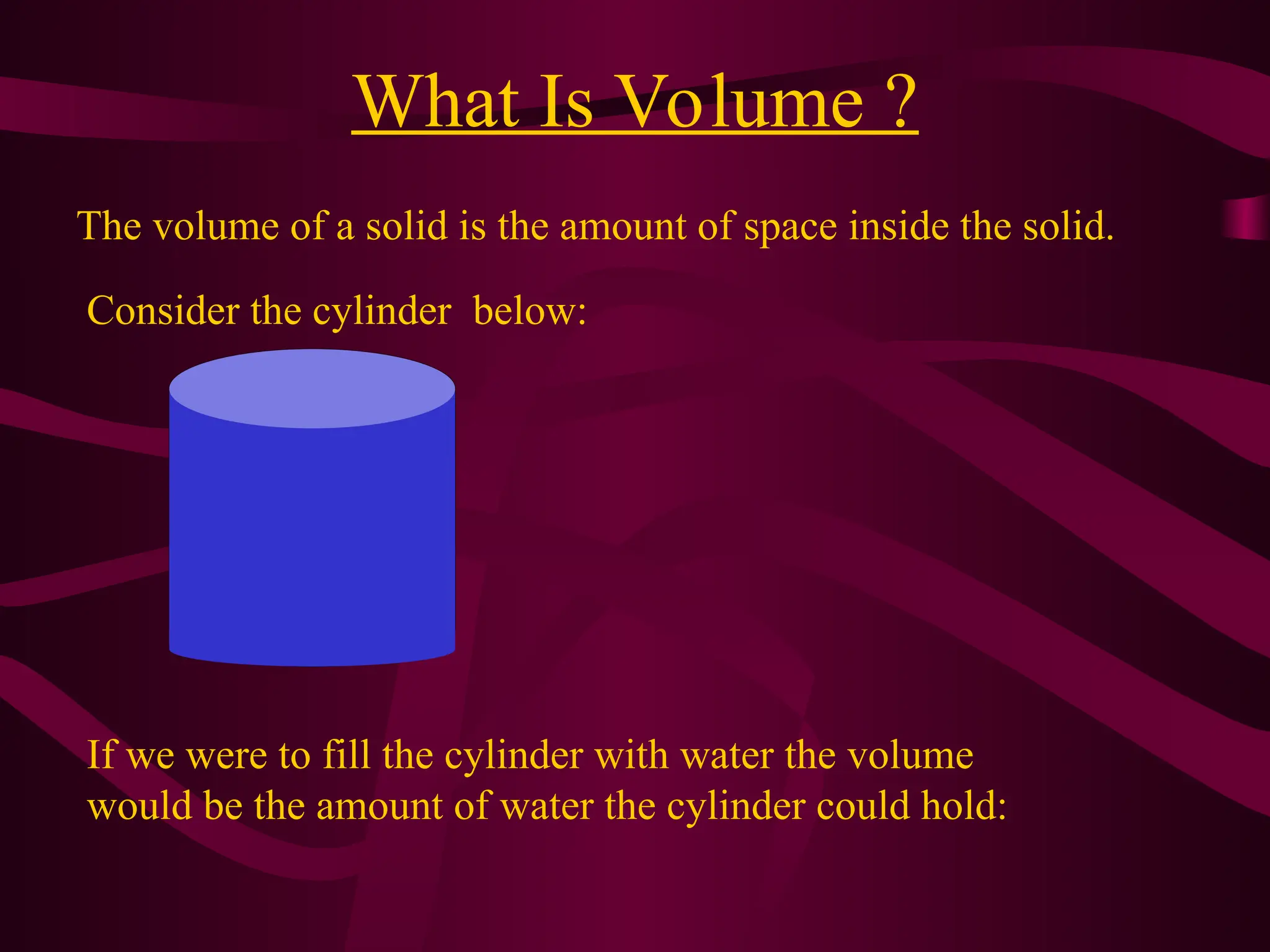
The volume of a solid is the amount of space inside the solid.
Consider the cylinder below:
If we were to fill the cylinder with water the volume
would be the amount of water the cylinder could hold:
Measuring Volume.
Volume is measured in cubic centimetres (also called centimetre
cubed).
Here is a cubic centimetre
It is a cube which measures
1cm in all directions.
1cm
1cm
1cm
We will now see how to calculate the volume of various shapes.
Volumes Of Cuboids.
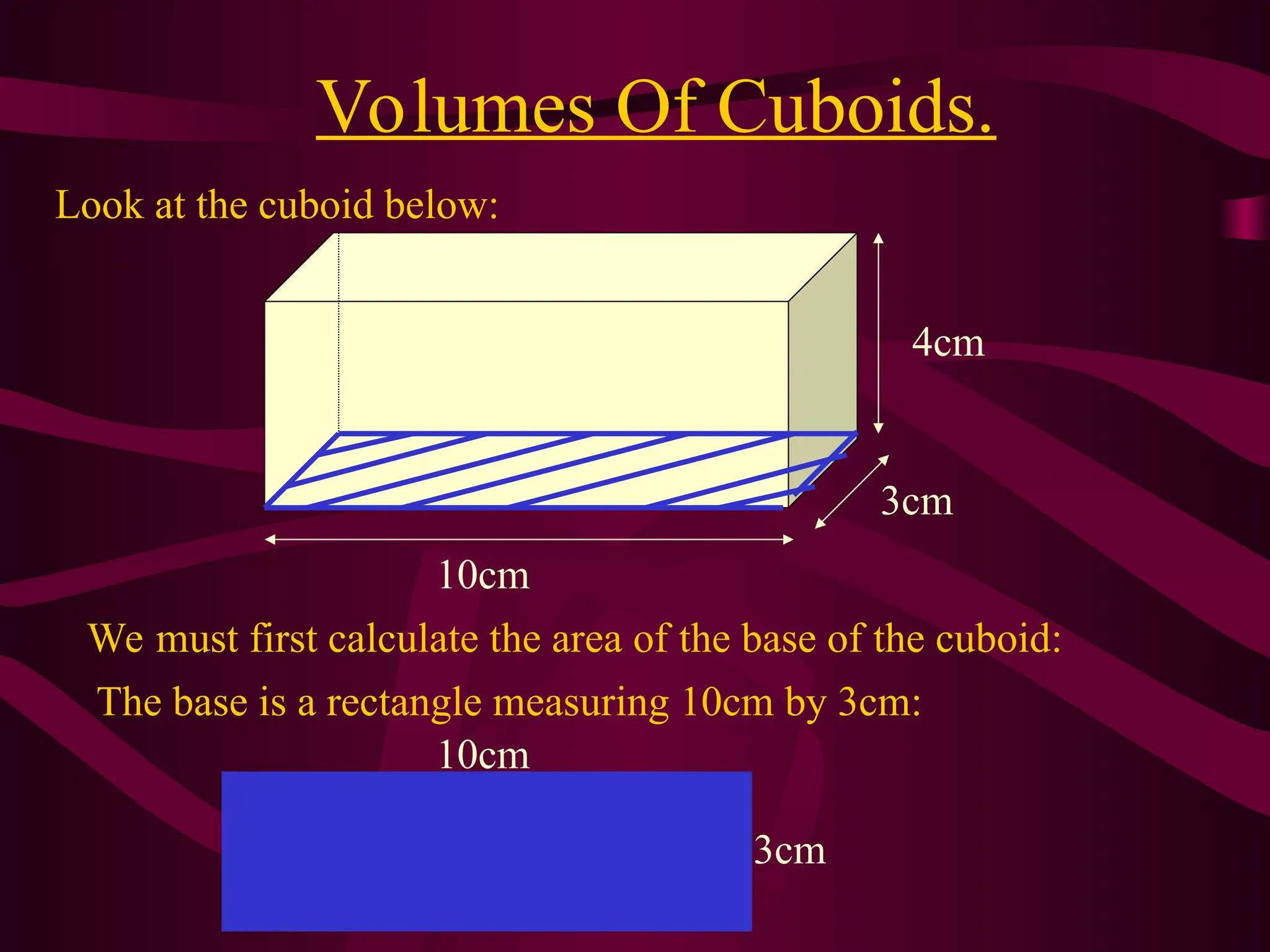
Look at the cuboid below:
10cm
3cm
4cm
We must first calculate the area of the base of the cuboid:
The base is a rectangle measuring 10cm by 3cm:
3cm
10cm
10cm
3cm
4cm
3cm
10cm
Area of a rectangle = length x breadth
Area = 10 x 3
Area = 30cm2
We now know we can place 30 centimetre squares on the base of
the cuboid. But we can also place 30 cubic centimetres on the base:
10cm
3cm
4cm
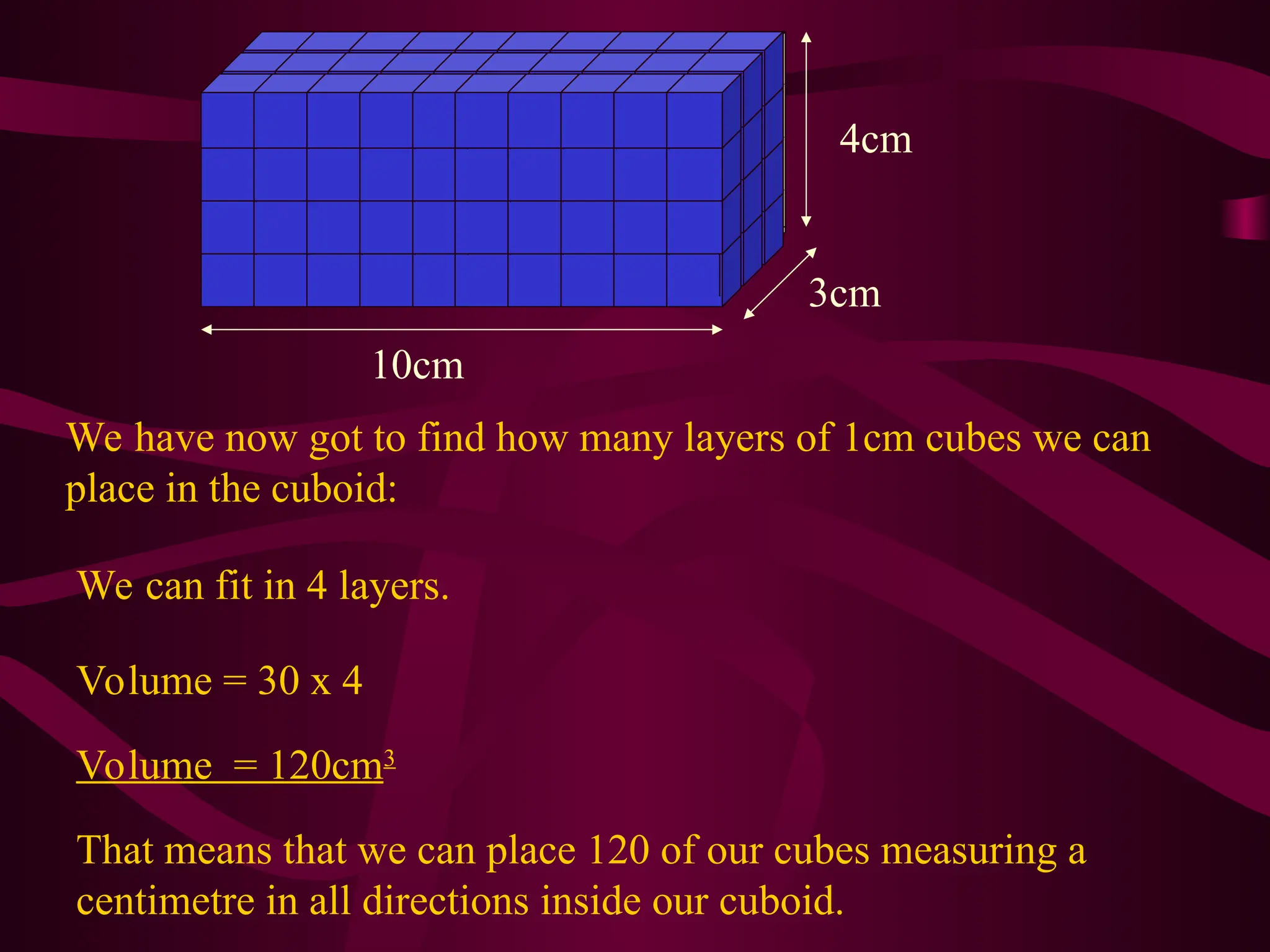
We have now got to find how many layers of 1cm cubes we can
place in the cuboid:
We can fit in 4 layers.
Volume = 30 x 4
Volume = 120cm3
That means that we can place 120 of our cubes measuring a
centimetre in all directions inside our cuboid.
10cm
3cm
4cm
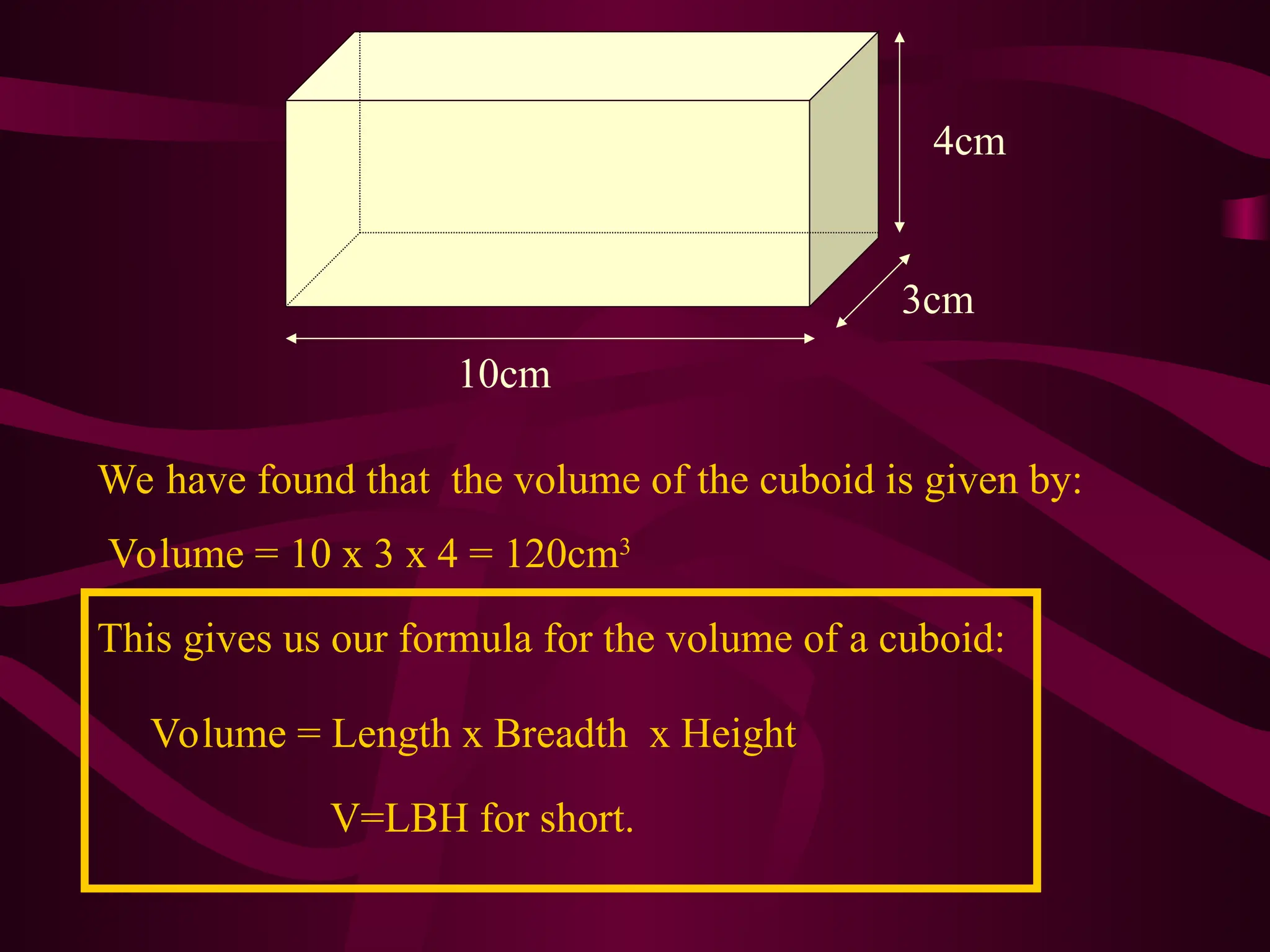
We have found that the volume of the cuboid is given by:
Volume = 10 x 3 x 4 = 120cm3
This gives us our formula for the volume of a cuboid:
Volume = Length x Breadth x Height
V=LBH for short.
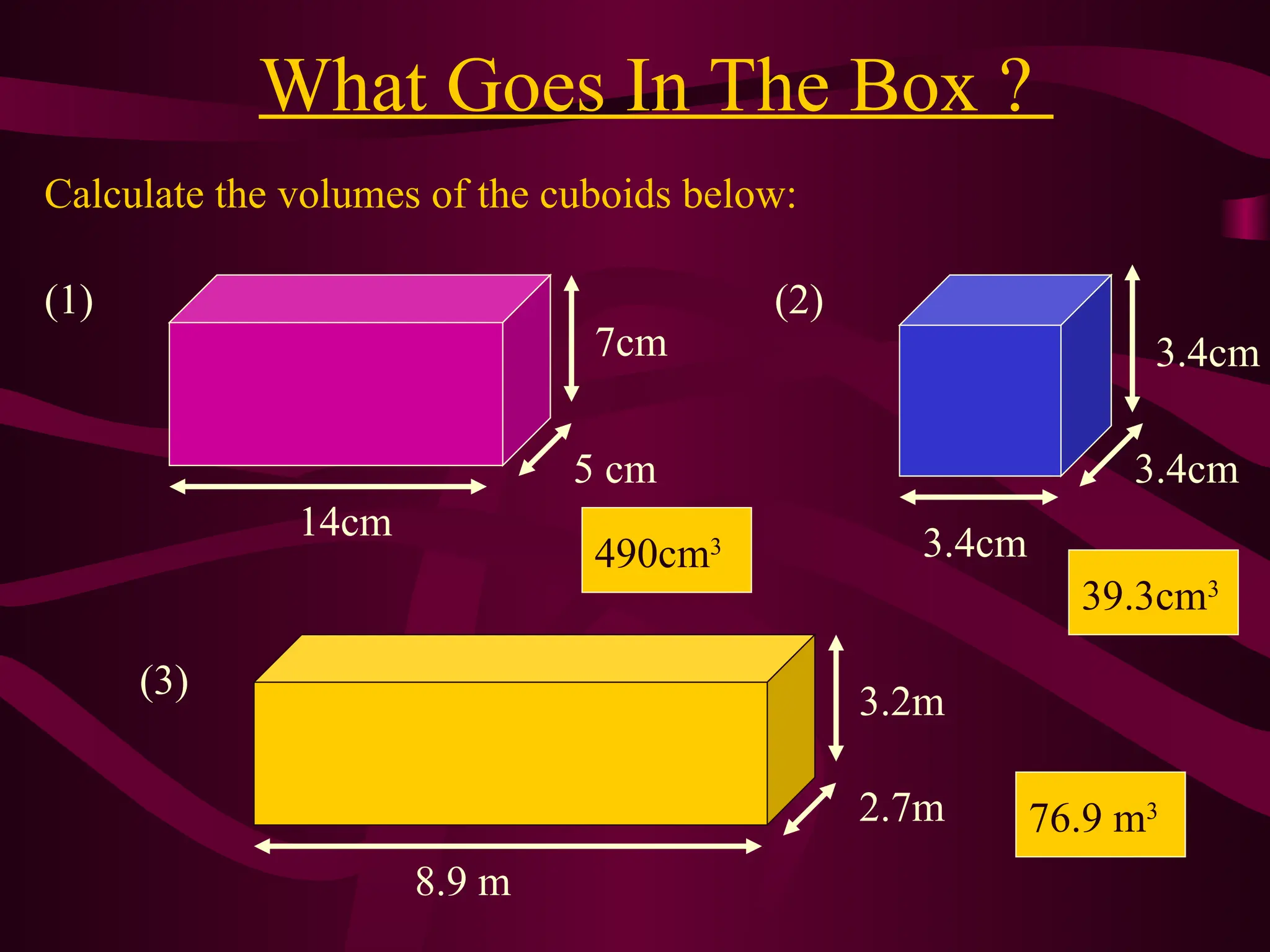
What Goes In The Box ?
Calculate the volumes of the cuboids below:
(1)
14cm
5 cm
7cm
(2)
3.4cm
3.4cm
3.4cm
(3)
8.9 m
2.7m
3.2m
490cm3
39.3cm3
76.9 m3
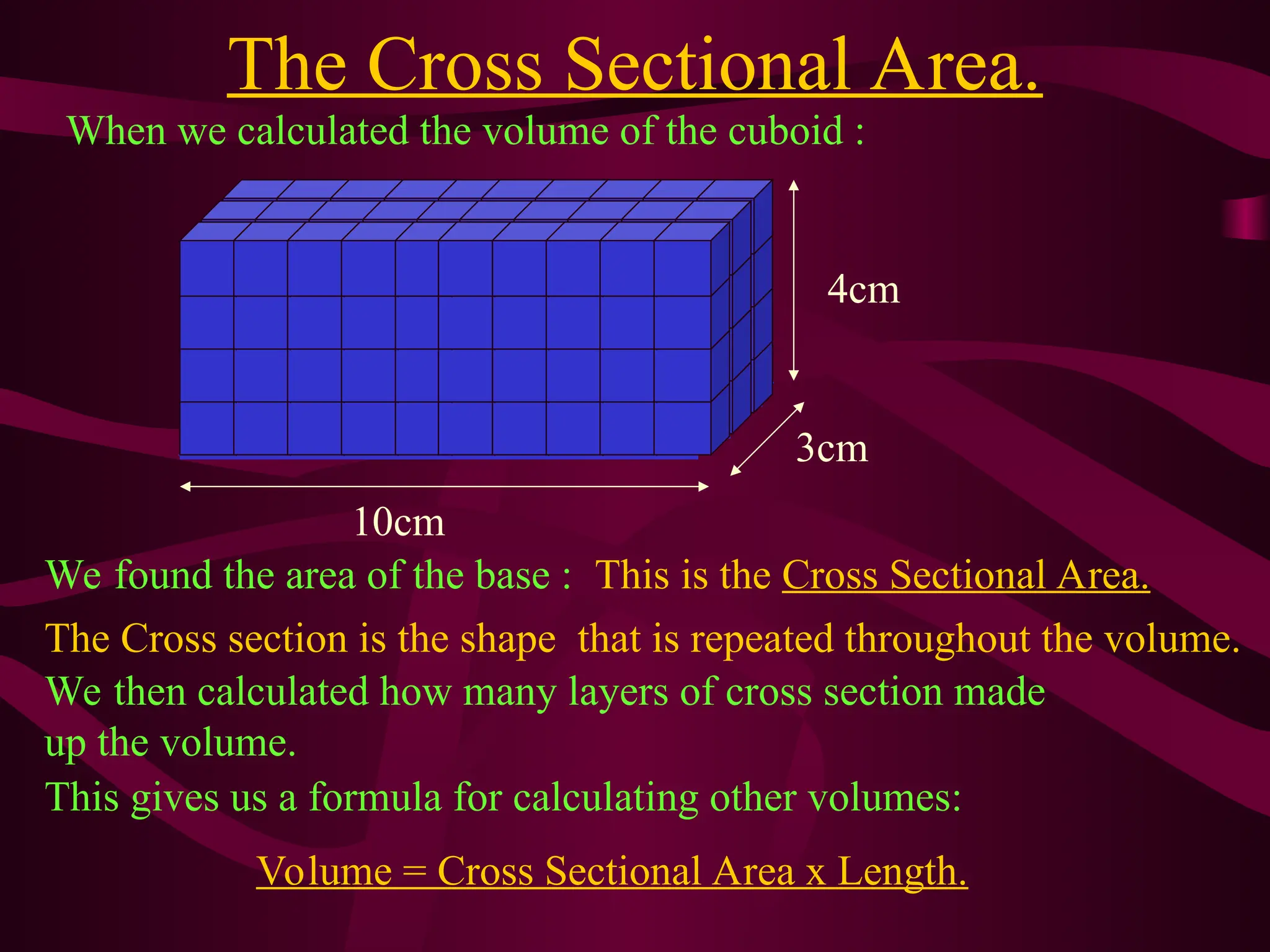
The Cross Sectional Area.
When we calculated the volume of the cuboid :
10cm
3cm
4cm
We found the area of the base : This is the Cross Sectional Area.
The Cross section is the shape that is repeated throughout the volume.
We then calculated how many layers of cross section made
up the volume.
This gives us a formula for calculating other volumes:
Volume = Cross Sectional Area x Length.
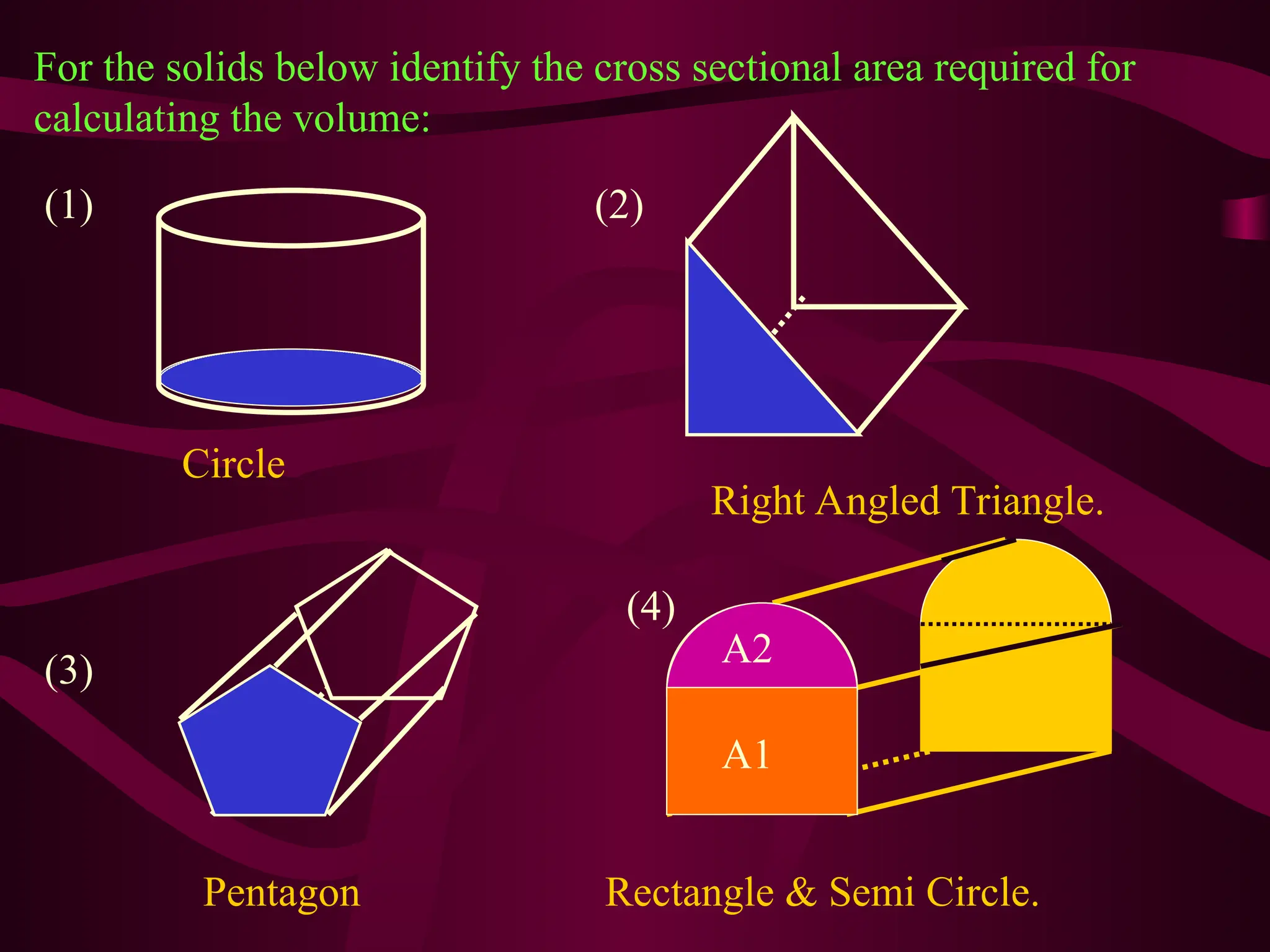
For the solids below identify the cross sectional area required for
calculating the volume:
Circle
(2)
Right Angled Triangle.
(3)
Pentagon
(4)
A2
A1
Rectangle & Semi Circle.
(1)
The Volume Of A Cylinder.
Consider the cylinder below:
4cm
6cm
It has a height of 6cm .
What is the size of the radius ?
2cm
Volume = cross section x height
What shape is the cross section?
Circle
Calculate the area of the circle:
A =  r 2
A = 3.14 x 2 x 2
A = 12.56 cm2
Calculate the volume:
V =  r 2
x h
V = 12.56 x 6
V = 75.36 cm3
The formula for the
volume of a cylinder is:
V =  r 2
h
r = radius h = height.
The Volume Of A Triangular Prism.
Consider the triangular prism below:
Volume = Cross Section x Height
What shape is the cross section ?
Triangle.
Calculate the area of the triangle:
5cm
8cm
5cm
A = ½ x base x height
A = 0.5 x 5 x 5
A = 12.5cm2
Calculate the volume:
Volume = Cross Section x Length
V = 12.5 x 8
V = 100 cm3
The formula for the volume of a
triangular prism is :
V = ½ b h l
B= base h = height l = length
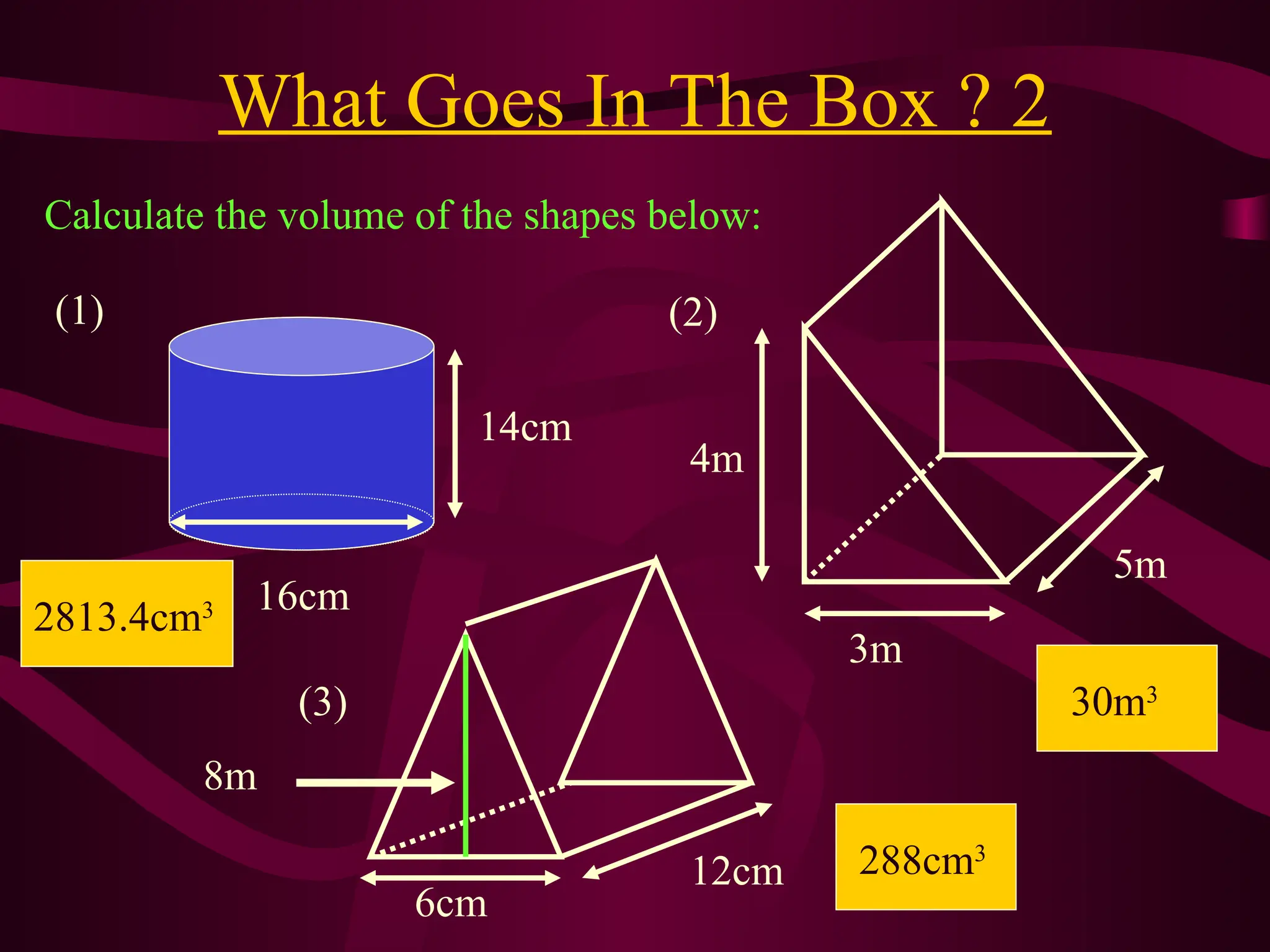
What Goes In The Box ? 2
Calculate the volume of the shapes below:
(1)
16cm
14cm
(2)
3m
4m
5m
(3)
6cm
12cm
8m
2813.4cm3
30m3
288cm3
More Complex Shapes.
Calculate the volume of the shape below:
20m
23m
16m
12m
Calculate the cross sectional area:
A1
A2
Area = A1 + A2
Area = (12 x 16) + ( ½ x (20 –12) x 16)
Area = 192 + 64
Area = 256m2
Calculate the volume:
Volume = Cross sectional area x length.
V = 256 x 23
V = 2888m3
Calculate the volume of the shape below:
12cm
18cm
10cm
Calculate the cross sectional area:
A2
A1
Area = A1 + A2
Area = (12 x 10) + ( ½ x  x 6 x 6 )
Area = 120 +56.52
Area = 176.52cm2
Calculate the volume.
Volume = cross sectional area x Length
V = 176.52 x 18
V = 3177.36cm3
Example 2.
What Goes In The Box ? 3
18m
22m
14m
11m
(1)
23cm
32cm
17cm
(2)
4466m3
19156.2cm3
Volume Of A Cone.
Consider the cylinder and cone shown below:
The diameter (D) of the
top of the cone and the
cylinder are equal.
D D
The height (H) of the
cone and the cylinder are
equal.
H H
If you filled the cone with water and emptied it into the cylinder,
how many times would you have to fill the cone to completely fill
the cylinder to the top ?
3 times. This shows that the cylinder has three times the
volume of a cone with the same height and radius.
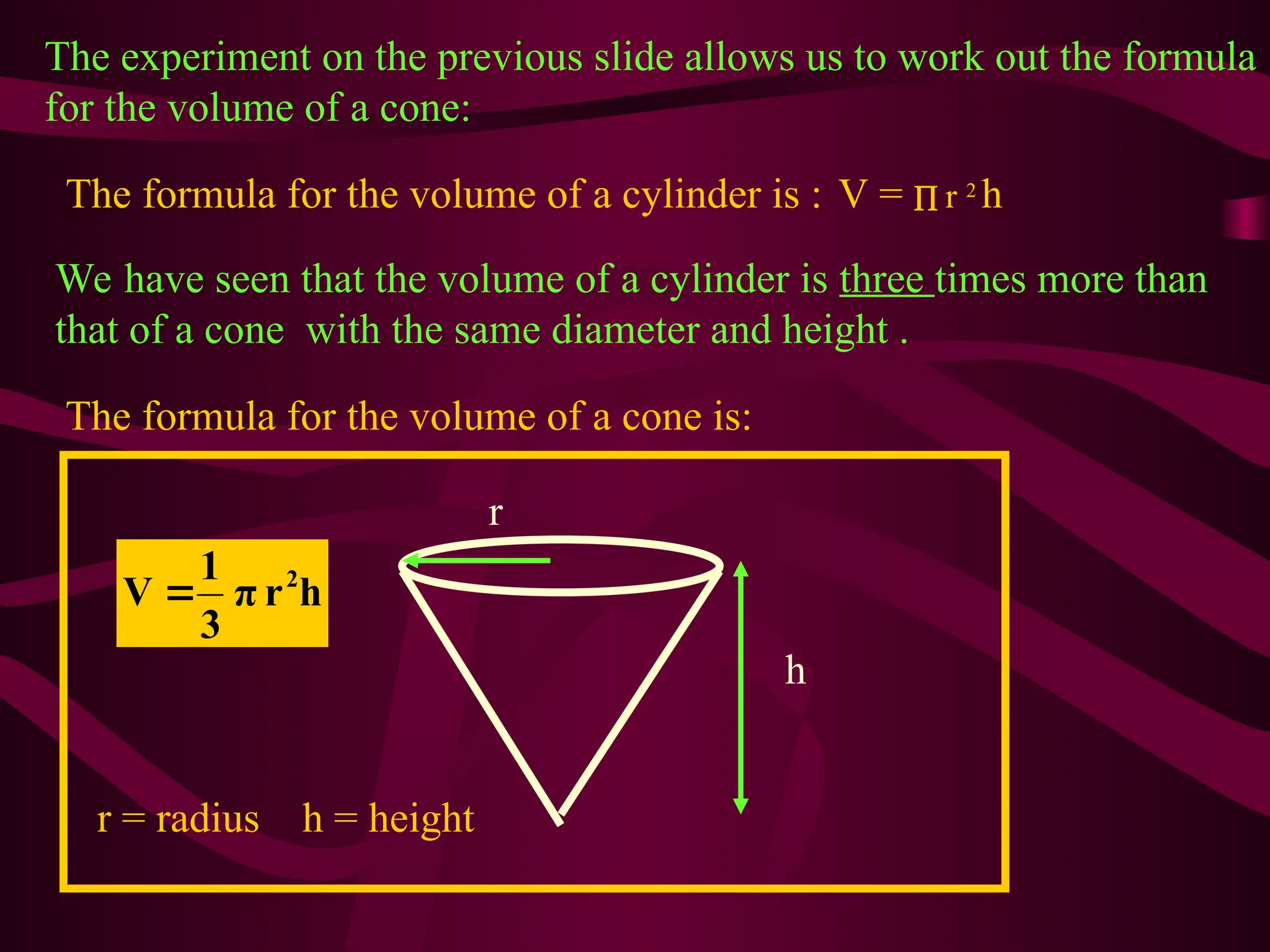
The experiment on the previous slide allows us to work out the formula
for the volume of a cone:
The formula for the volume of a cylinder is : V =  r 2
h
We have seen that the volume of a cylinder is three times more than
that of a cone with the same diameter and height .
The formula for the volume of a cone is:
h
r
π
3
1
V 2

h
r
r = radius h = height
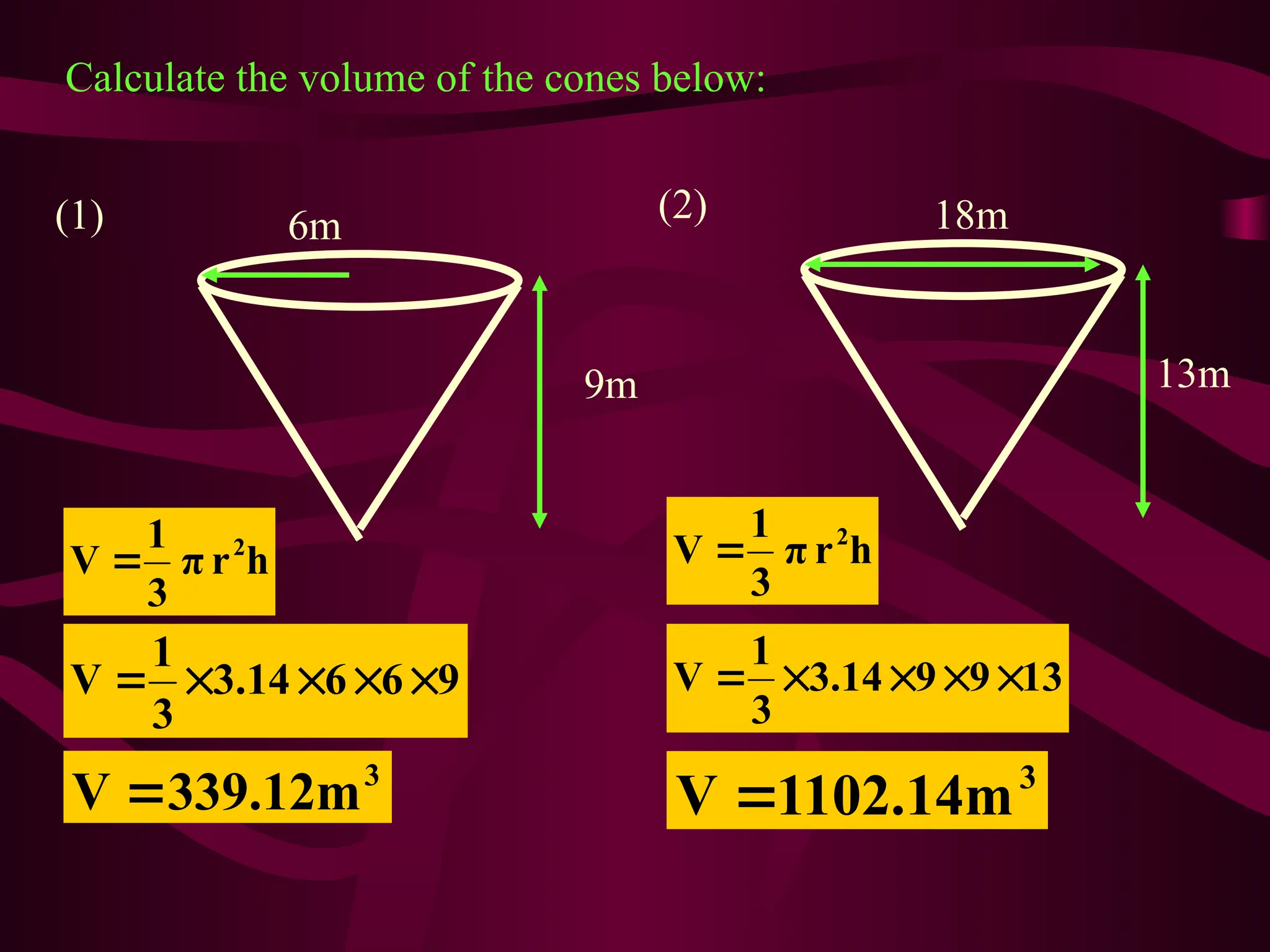
Calculate the volume of the cones below:
h
r
π
3
1
V 2

13m
18m
(2)
9
6
6
3.14
3
1
V 




9m
6m
(1)
h
r
π
3
1
V 2

13
9
9
14
.
3
3
1
V 




3
1102.14m
V 
3
339.12m
V 
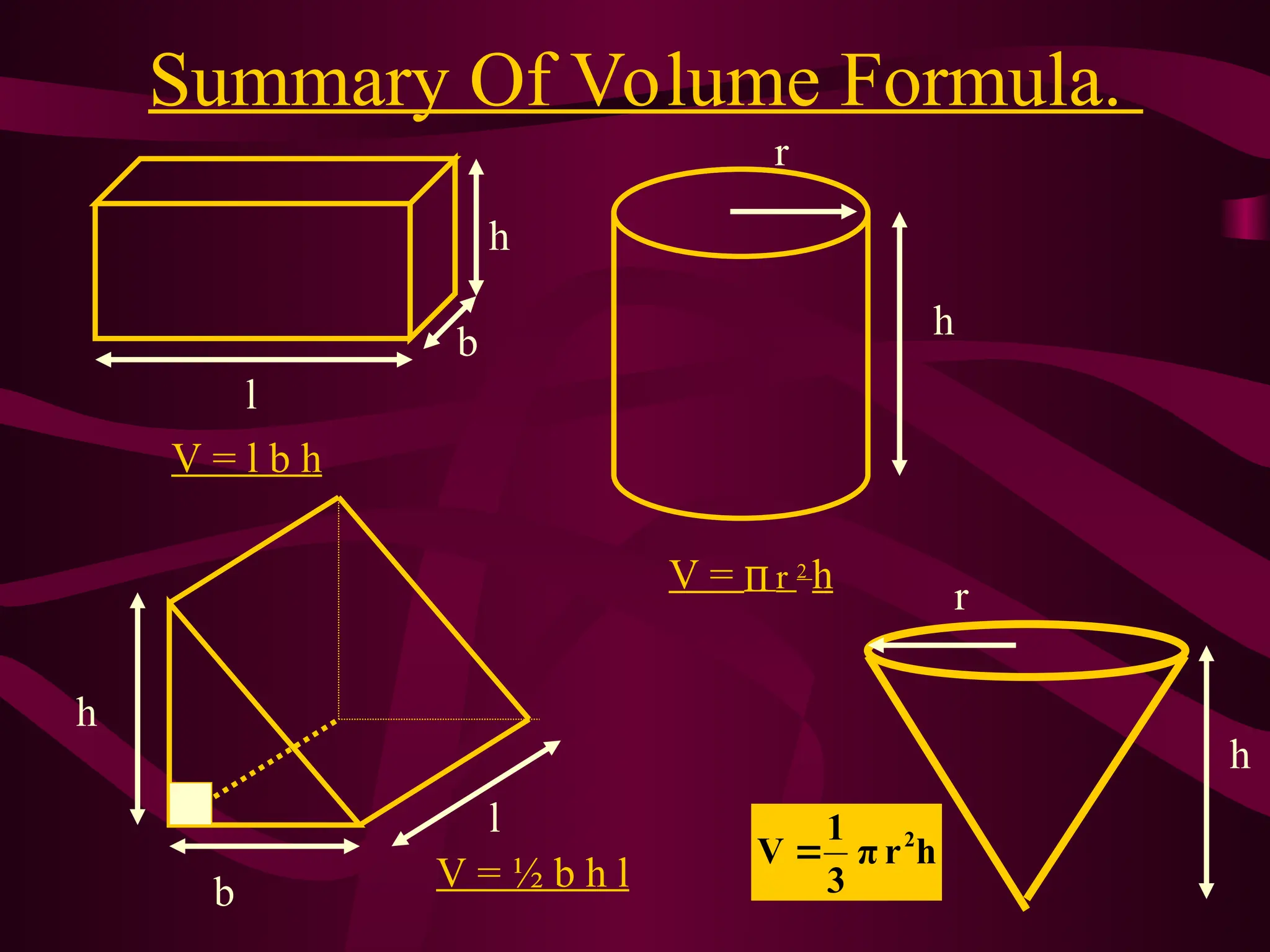
Summary Of Volume Formula.
l
b
h
V = l b h
r
h
V =  r 2
h
b
l
h
V = ½ b h l
h
r
π
3
1
V 2

h
r

Volumes-Of-Solid Figures and 3D Figure Shapes

  • 1.
    Volumes Of Solids. 14cm 5cm 7cm 4cm 6cm 10cm 3cm 4cm 8m 5m
  • 2.
    What Is Volume? The volume of a solid is the amount of space inside the solid. Consider the cylinder below: If we were to fill the cylinder with water the volume would be the amount of water the cylinder could hold:
  • 3.
    Measuring Volume. Volume ismeasured in cubic centimetres (also called centimetre cubed). Here is a cubic centimetre It is a cube which measures 1cm in all directions. 1cm 1cm 1cm We will now see how to calculate the volume of various shapes.
  • 4.
    Volumes Of Cuboids. Lookat the cuboid below: 10cm 3cm 4cm We must first calculate the area of the base of the cuboid: The base is a rectangle measuring 10cm by 3cm: 3cm 10cm
  • 5.
    10cm 3cm 4cm 3cm 10cm Area of arectangle = length x breadth Area = 10 x 3 Area = 30cm2 We now know we can place 30 centimetre squares on the base of the cuboid. But we can also place 30 cubic centimetres on the base:
  • 6.
    10cm 3cm 4cm We have nowgot to find how many layers of 1cm cubes we can place in the cuboid: We can fit in 4 layers. Volume = 30 x 4 Volume = 120cm3 That means that we can place 120 of our cubes measuring a centimetre in all directions inside our cuboid.
  • 7.
    10cm 3cm 4cm We have foundthat the volume of the cuboid is given by: Volume = 10 x 3 x 4 = 120cm3 This gives us our formula for the volume of a cuboid: Volume = Length x Breadth x Height V=LBH for short.
  • 8.
    What Goes InThe Box ? Calculate the volumes of the cuboids below: (1) 14cm 5 cm 7cm (2) 3.4cm 3.4cm 3.4cm (3) 8.9 m 2.7m 3.2m 490cm3 39.3cm3 76.9 m3
  • 9.
    The Cross SectionalArea. When we calculated the volume of the cuboid : 10cm 3cm 4cm We found the area of the base : This is the Cross Sectional Area. The Cross section is the shape that is repeated throughout the volume. We then calculated how many layers of cross section made up the volume. This gives us a formula for calculating other volumes: Volume = Cross Sectional Area x Length.
  • 10.
    For the solidsbelow identify the cross sectional area required for calculating the volume: Circle (2) Right Angled Triangle. (3) Pentagon (4) A2 A1 Rectangle & Semi Circle. (1)
  • 11.
    The Volume OfA Cylinder. Consider the cylinder below: 4cm 6cm It has a height of 6cm . What is the size of the radius ? 2cm Volume = cross section x height What shape is the cross section? Circle Calculate the area of the circle: A =  r 2 A = 3.14 x 2 x 2 A = 12.56 cm2 Calculate the volume: V =  r 2 x h V = 12.56 x 6 V = 75.36 cm3 The formula for the volume of a cylinder is: V =  r 2 h r = radius h = height.
  • 12.
    The Volume OfA Triangular Prism. Consider the triangular prism below: Volume = Cross Section x Height What shape is the cross section ? Triangle. Calculate the area of the triangle: 5cm 8cm 5cm A = ½ x base x height A = 0.5 x 5 x 5 A = 12.5cm2 Calculate the volume: Volume = Cross Section x Length V = 12.5 x 8 V = 100 cm3 The formula for the volume of a triangular prism is : V = ½ b h l B= base h = height l = length
  • 13.
    What Goes InThe Box ? 2 Calculate the volume of the shapes below: (1) 16cm 14cm (2) 3m 4m 5m (3) 6cm 12cm 8m 2813.4cm3 30m3 288cm3
  • 14.
    More Complex Shapes. Calculatethe volume of the shape below: 20m 23m 16m 12m Calculate the cross sectional area: A1 A2 Area = A1 + A2 Area = (12 x 16) + ( ½ x (20 –12) x 16) Area = 192 + 64 Area = 256m2 Calculate the volume: Volume = Cross sectional area x length. V = 256 x 23 V = 2888m3
  • 15.
    Calculate the volumeof the shape below: 12cm 18cm 10cm Calculate the cross sectional area: A2 A1 Area = A1 + A2 Area = (12 x 10) + ( ½ x  x 6 x 6 ) Area = 120 +56.52 Area = 176.52cm2 Calculate the volume. Volume = cross sectional area x Length V = 176.52 x 18 V = 3177.36cm3 Example 2.
  • 16.
    What Goes InThe Box ? 3 18m 22m 14m 11m (1) 23cm 32cm 17cm (2) 4466m3 19156.2cm3
  • 17.
    Volume Of ACone. Consider the cylinder and cone shown below: The diameter (D) of the top of the cone and the cylinder are equal. D D The height (H) of the cone and the cylinder are equal. H H If you filled the cone with water and emptied it into the cylinder, how many times would you have to fill the cone to completely fill the cylinder to the top ? 3 times. This shows that the cylinder has three times the volume of a cone with the same height and radius.
  • 18.
    The experiment onthe previous slide allows us to work out the formula for the volume of a cone: The formula for the volume of a cylinder is : V =  r 2 h We have seen that the volume of a cylinder is three times more than that of a cone with the same diameter and height . The formula for the volume of a cone is: h r π 3 1 V 2  h r r = radius h = height
  • 19.
    Calculate the volumeof the cones below: h r π 3 1 V 2  13m 18m (2) 9 6 6 3.14 3 1 V      9m 6m (1) h r π 3 1 V 2  13 9 9 14 . 3 3 1 V      3 1102.14m V  3 339.12m V 
  • 20.
    Summary Of VolumeFormula. l b h V = l b h r h V =  r 2 h b l h V = ½ b h l h r π 3 1 V 2  h r