VOLTAGE STABILITY
ENHANCEMENT
IN TRANSMISSIONM LINE

Project Guide:Prof. Sourabh Kothari

By
Vartika Shrivastava (0832EX101060)
Anirudh Sharma (0832EX101008)
Rajendra Thakur (0832EX101044)
Rahul Soni(0832EX101043)
ABSTRACT
 The main aim of this project is to provide security to the
power system.
 And this need is largely due to the recent trends towards
operating systems under stressed conditions as a result of
increasing system load without sufficient generation
enhancement.
 In this project we are controlling the voltage instability by
considering both aspects that is static and dynamic stability.
 By using one of the FACT device that is SVC and with the help
of which we are trying to measure even minute variations in
the voltage magnitude.

10/24/2013
CONTENT
Introduction
Research Objective
Summary of previous seminar
Preface
Summary of Fourth coming seminar
References

10/24/2013
INTRODUCTION
 The continuing interconnections of bulk power system has led to an
increasing complex system.
 Electric utilities are reluctant to build new transmission lines for
economic consideration.
 Hence it is very necessary to stable the voltage magnitude by
considering its both static and dynamic stability aspects.
 Major power system breakdowns are caused by problems related to
the systems static as well as dynamics responses.
 Control centre operators observe none of the critical advance warning
since voltage magnitudes remains normal until large changes.
 Hence it is very important to observe and control very minute
variations coming in voltage magnitude.

10/24/2013
INTRODUCTION
For controlling such kind of variations we use
FACT(Flexible AC transmission) controllers that
provide fast and reliable control over the
transmission system parameters such as
voltage, Phase angle and line impedance.
And here we are using SVC(static VAR
compensator) one of the FACT device for
controlling voltage instability.
10/24/2013
Bus Admittance Matrix or Ybus
 First step in solving the power flow is to create what
is known as the bus admittance matrix, often call the
Ybus.
 The Ybus gives the relationships between all the bus
current injections, I, and all the bus voltages, V,
I = Ybus V
 The Ybus is developed by applying KCL at each bus in
the system to relate the bus current injections, the
bus voltages, and the branch impedances and
admittances
 Calculate the bus admittance matrix for the network
with the help of Newton-Raphson Method .
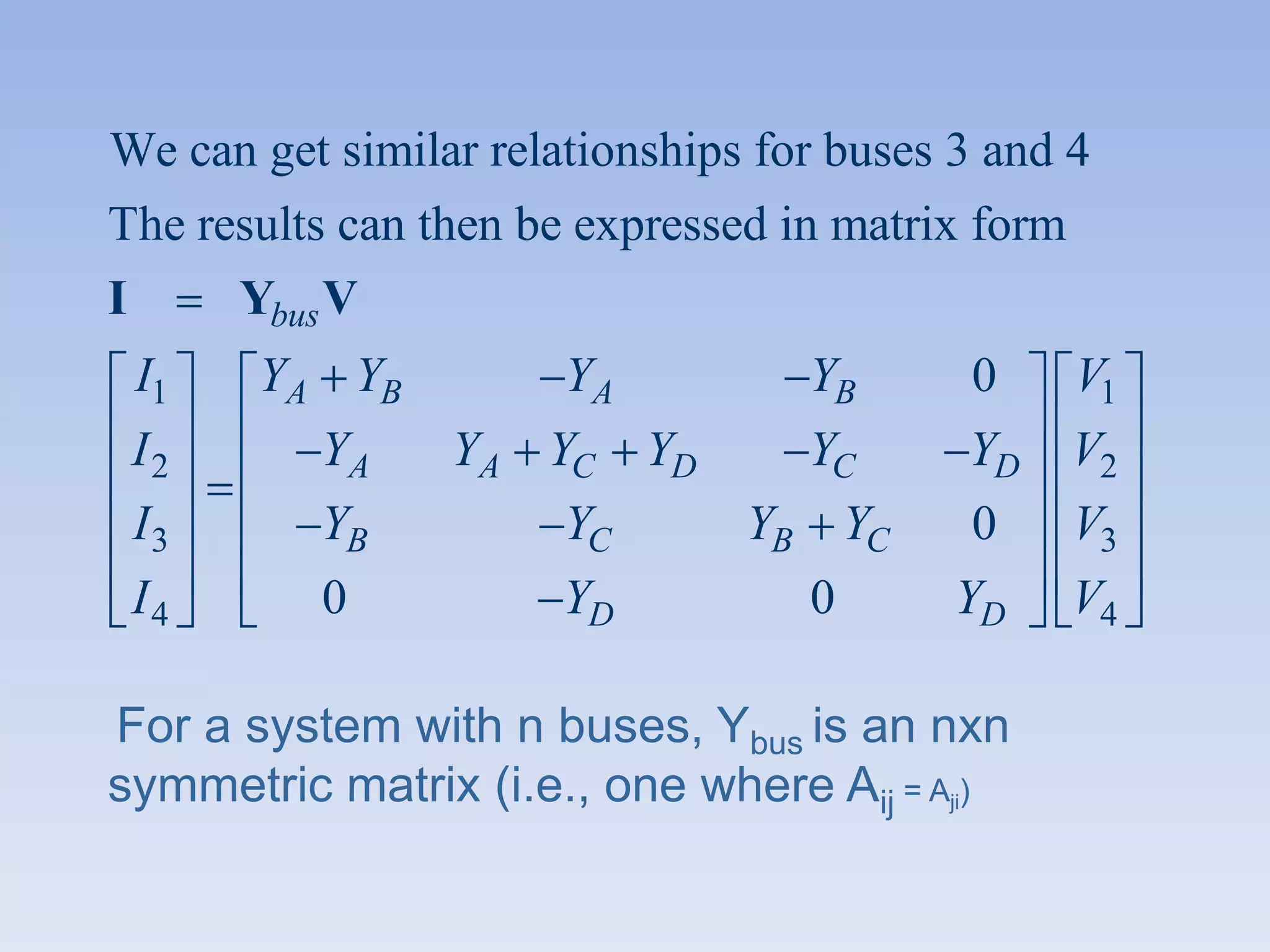
We can get similar relationships for buses 3 and 4
The results can then be expressed in matrix form
I

Ybus V
I1

YA YB

YA
YA YC

YB
YD

0

V1

YC

YD

V2

I2

YA

I3

YB

YC

YB YC

0

V3

I4

0

YD

0

YD

V4

For a system with n buses, Ybus is an nxn
symmetric matrix (i.e., one where Aij = Aji)
Ybus General Form
The diagonal terms, Yii, are the self admittance
terms, equal to the sum of the admittances of all
devices incident to bus i.
 The off-diagonal terms, Yij, are equal to the
negative of the sum of the admittances joining the
two buses.
With large systems Ybus is a sparse matrix (that
is, most entries are zero).
Shunt terms, such as with the line model, only
affect the diagonal terms.

10/24/2013
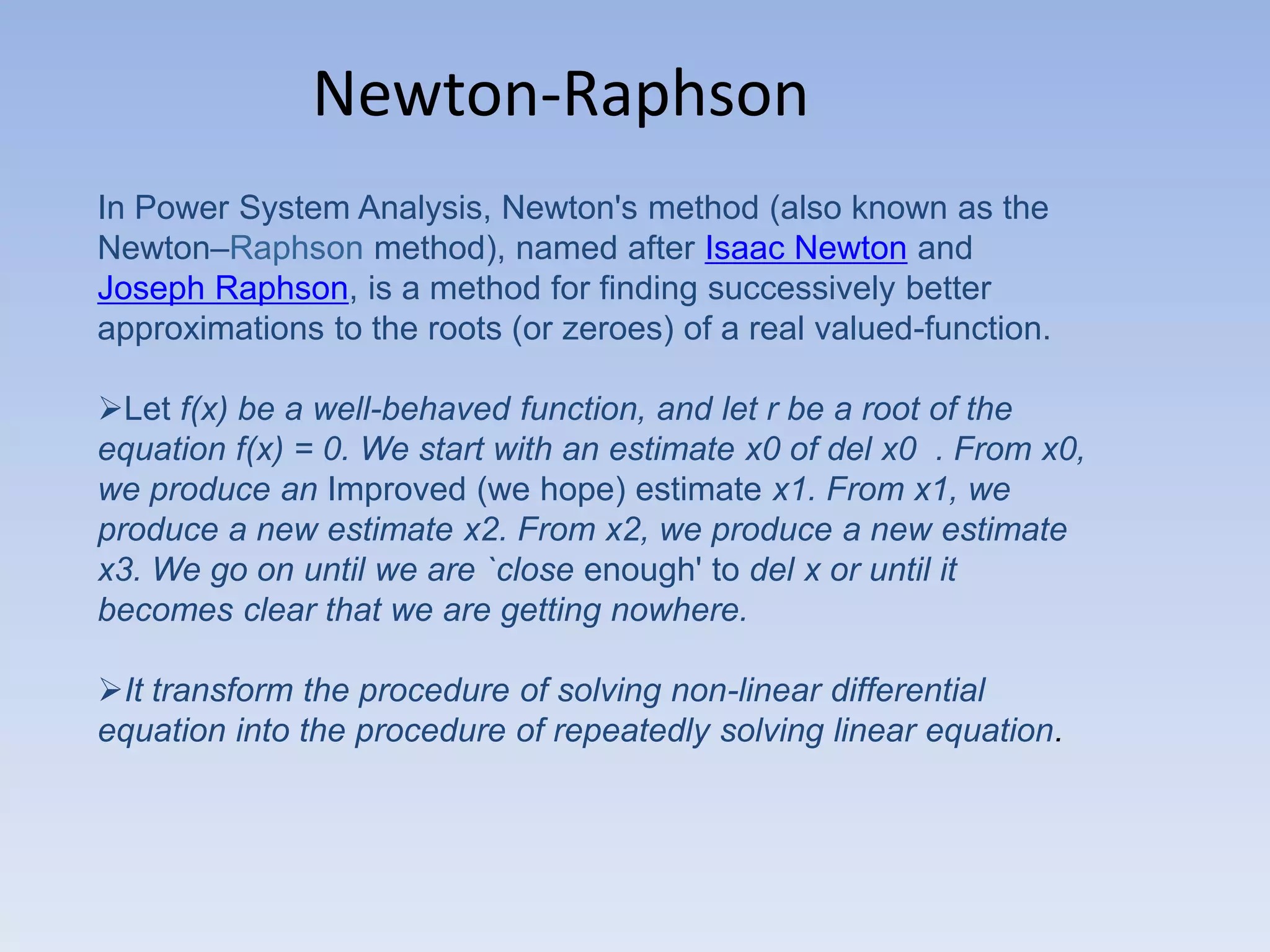
Newton-Raphson
In Power System Analysis, Newton's method (also known as the
Newton–Raphson method), named after Isaac Newton and
Joseph Raphson, is a method for finding successively better
approximations to the roots (or zeroes) of a real valued-function.
Let f(x) be a well-behaved function, and let r be a root of the
equation f(x) = 0. We start with an estimate x0 of del x0 . From x0,
we produce an Improved (we hope) estimate x1. From x1, we
produce a new estimate x2. From x2, we produce a new estimate
x3. We go on until we are `close enough' to del x or until it
becomes clear that we are getting nowhere.
It transform the procedure of solving non-linear differential
equation into the procedure of repeatedly solving linear equation.
Newton-Raphson
Advantages
– fast convergence as long as initial guess is
close to solution
– large region of convergence

Disadvantages
– each iteration takes much longer than a
Gauss-Seidel iteration
– more complicated to code, particularly when
implementing sparse matrix algorithms.
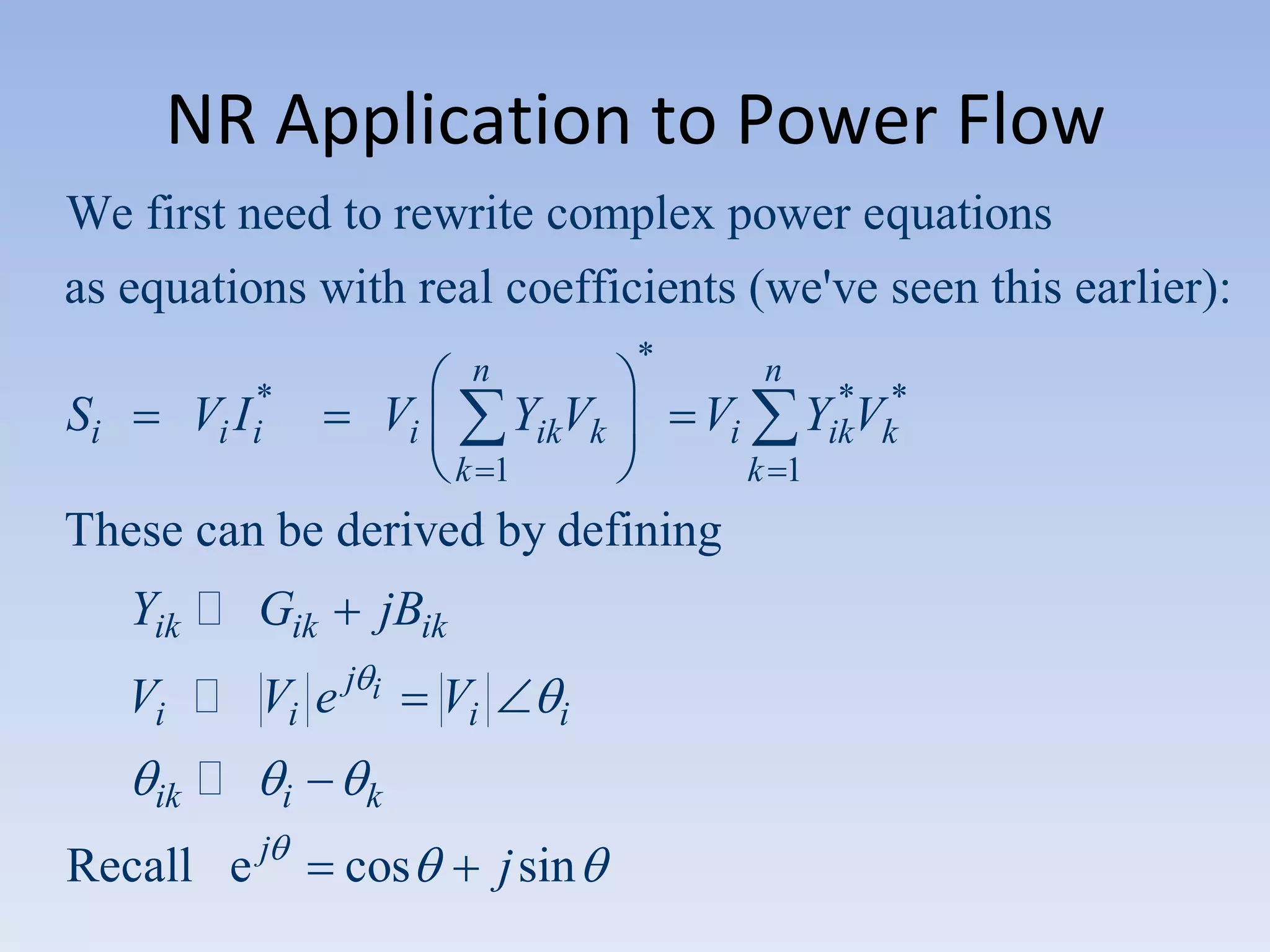
NR Application to Power Flow
We first need to rewrite complex power equations
as equations with real coefficients (we've seen this earlier):
Vi I i*

Si

*

n

Vi

YikVk

n

Vi

k 1

k 1

These can be derived by defining
Yik  Gik

jBik

Vi  Vi e j

i

ik



Recall e j

i

Vi

i

k

cos

*
YikVk*

j sin
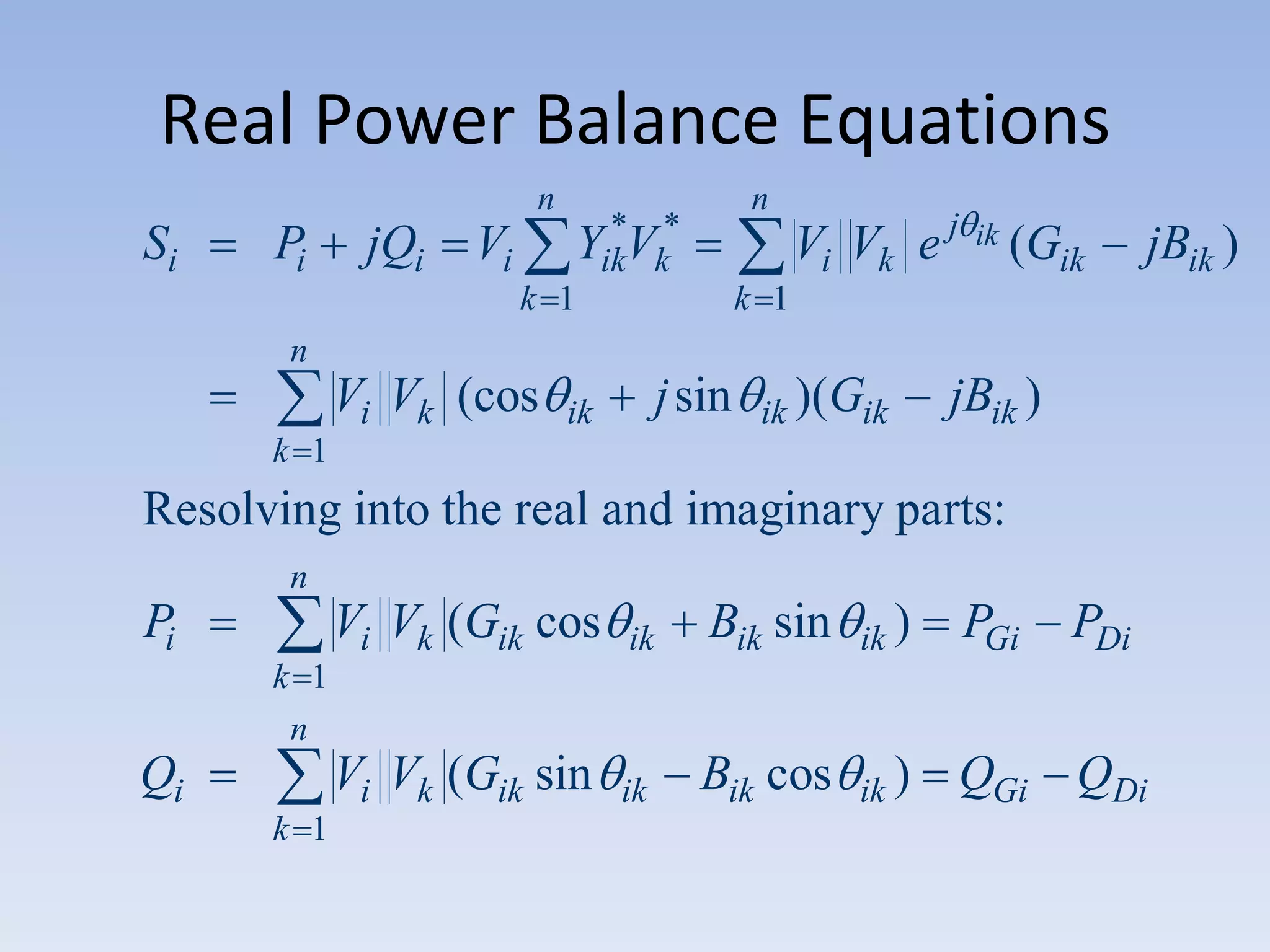
Real Power Balance Equations
n

Si

Pi

jQi

Vi

n

*
YikVk*

k 1

Vi Vk e j

ik

(Gik

jBik )

k 1

n

Vi Vk (cos

j sin

ik

ik )(Gik

jBik )

k 1

Resolving into the real and imaginary parts:
n

Pi

Vi Vk (Gik cos

ik

Bik sin

ik )

PGi

PDi

Vi Vk (Gik sin

ik

Bik cos

ik )

QGi QDi

k 1
n

Qi
k 1
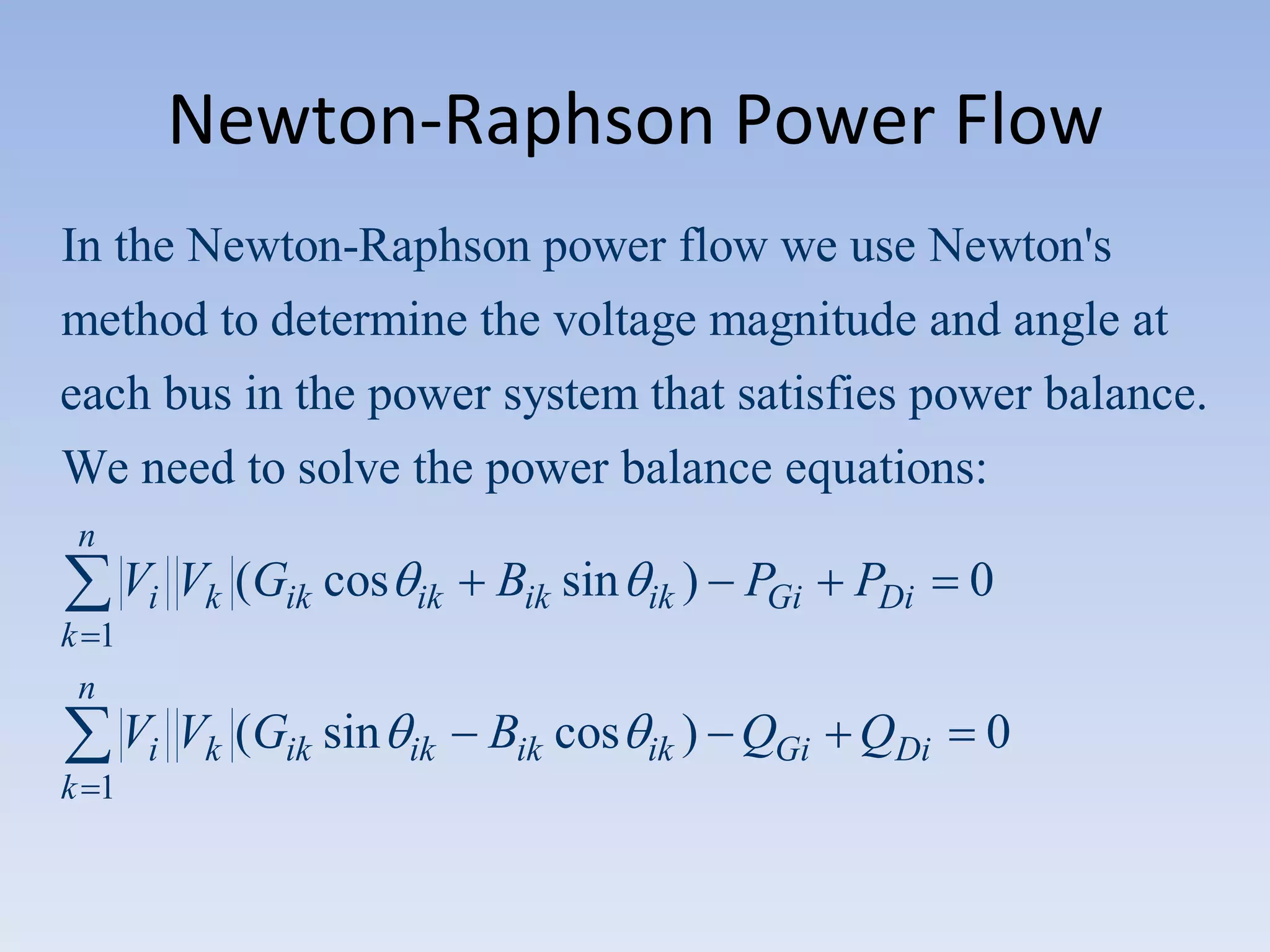
Newton-Raphson Power Flow
In the Newton-Raphson power flow we use Newton's
method to determine the voltage magnitude and angle at
each bus in the power system that satisfies power balance.
We need to solve the power balance equations:
n

Vi Vk (Gik cos

ik

Bik sin

ik )

PGi

PDi

Vi Vk (Gik sin

ik

Bik cos

ik )

QGi QDi

0

k 1
n
k 1

0
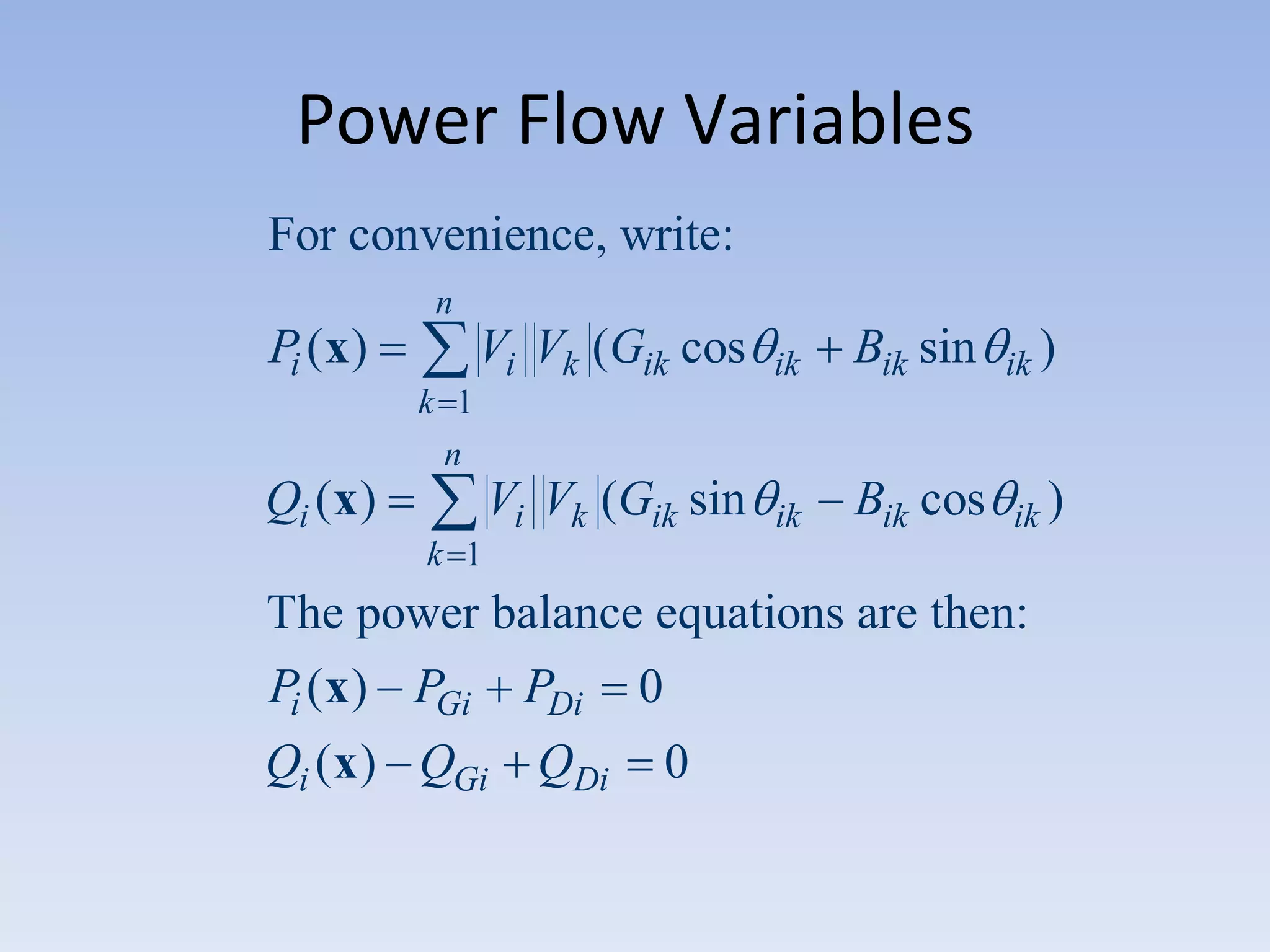
Power Flow Variables
For convenience, write:
n

Pi ( x )

Vi Vk (Gik cos

ik

Bik sin

ik )

Vi Vk (Gik sin

ik

Bik cos

ik )

k 1
n

Qi ( x )
k 1

The power balance equations are then:
Pi ( x ) PGi PDi 0
Qi ( x ) QGi QDi

0
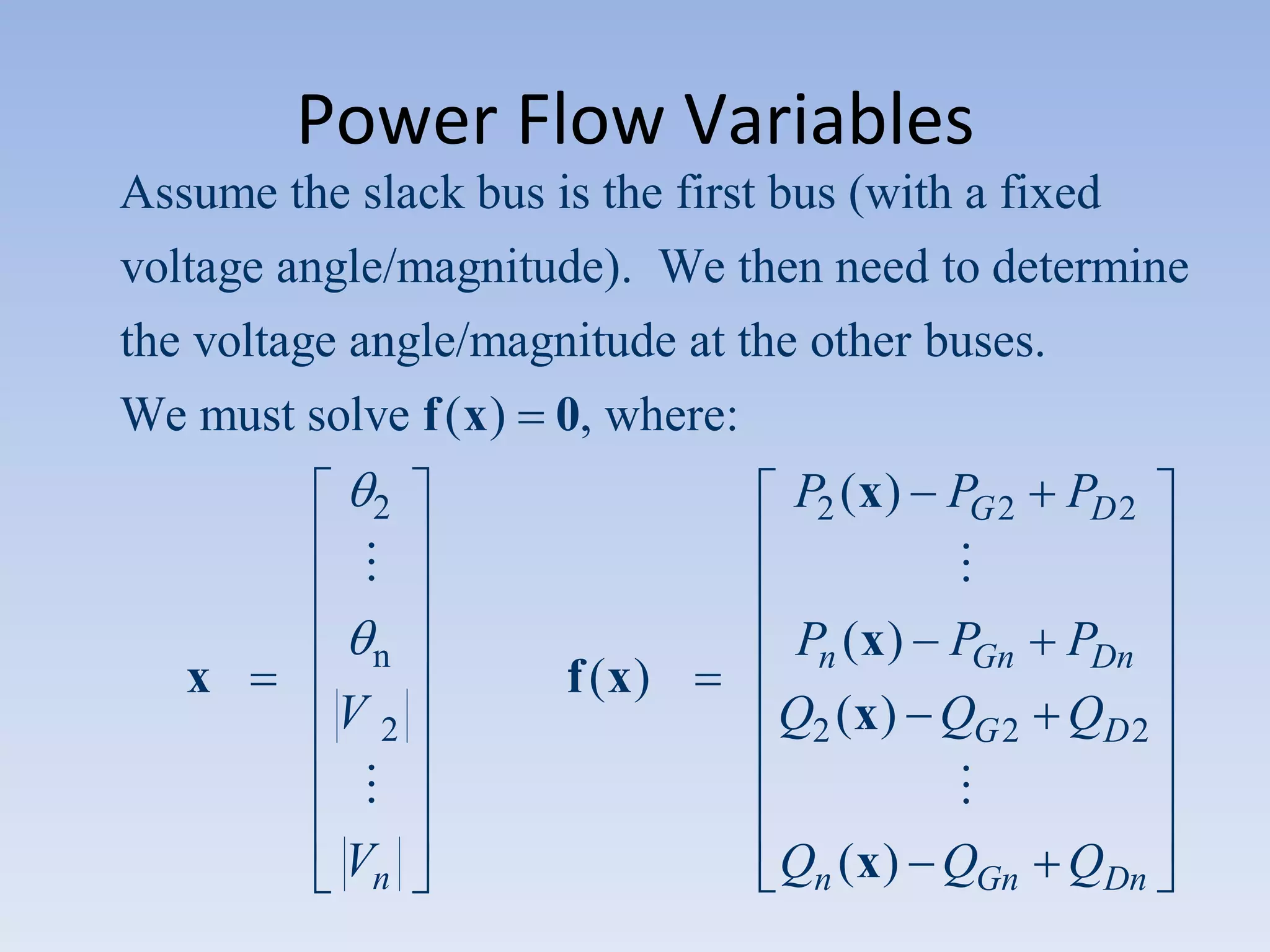
Power Flow Variables
Assume the slack bus is the first bus (with a fixed
voltage angle/magnitude). We then need to determine
the voltage angle/magnitude at the other buses.
We must solve f ( x ) 0, where:
P2 ( x ) PG 2

2


x

n

V2

Vn

f (x)

PD 2


Pn ( x ) PGn PDn
Q2 ( x ) QG 2 QD 2

Qn ( x ) QGn QDn
N-R Power Flow Solution
The power flow is solved using the same procedure
discussed previously for general equations:
0; make an initial guess of x, x ( v )

For v

While f (x ( v ) )
x(v
v
End

1)

Do

x ( v ) [ J ( x ( v ) )] 1 f ( x ( v ) )
v 1
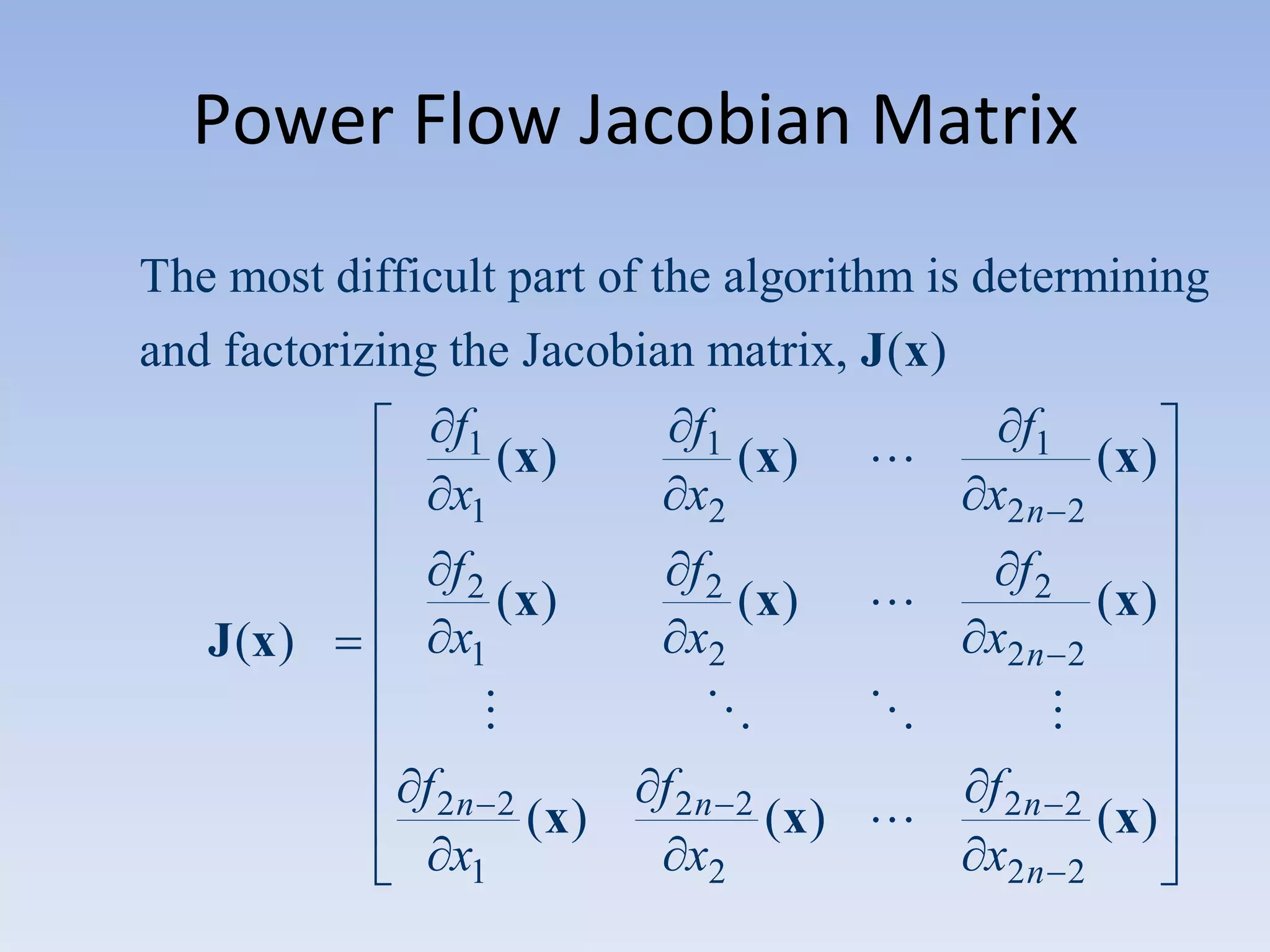
Power Flow Jacobian Matrix
The most difficult part of the algorithm is determining
and factorizing the Jacobian matrix, J (x)
f1
(x)
x1
J (x )

f1
(x)
x2

f2
(x)
x1

f2
(x)
x2









f 2n 2
(x)
x1



f 2n 2
(x) 
x2

f1

(x)

x2 n

2

f2

(x)

x2 n

2


f 2n
x2 n

2
2

(x)
Power Flow Jacobian Matrix, cont’d
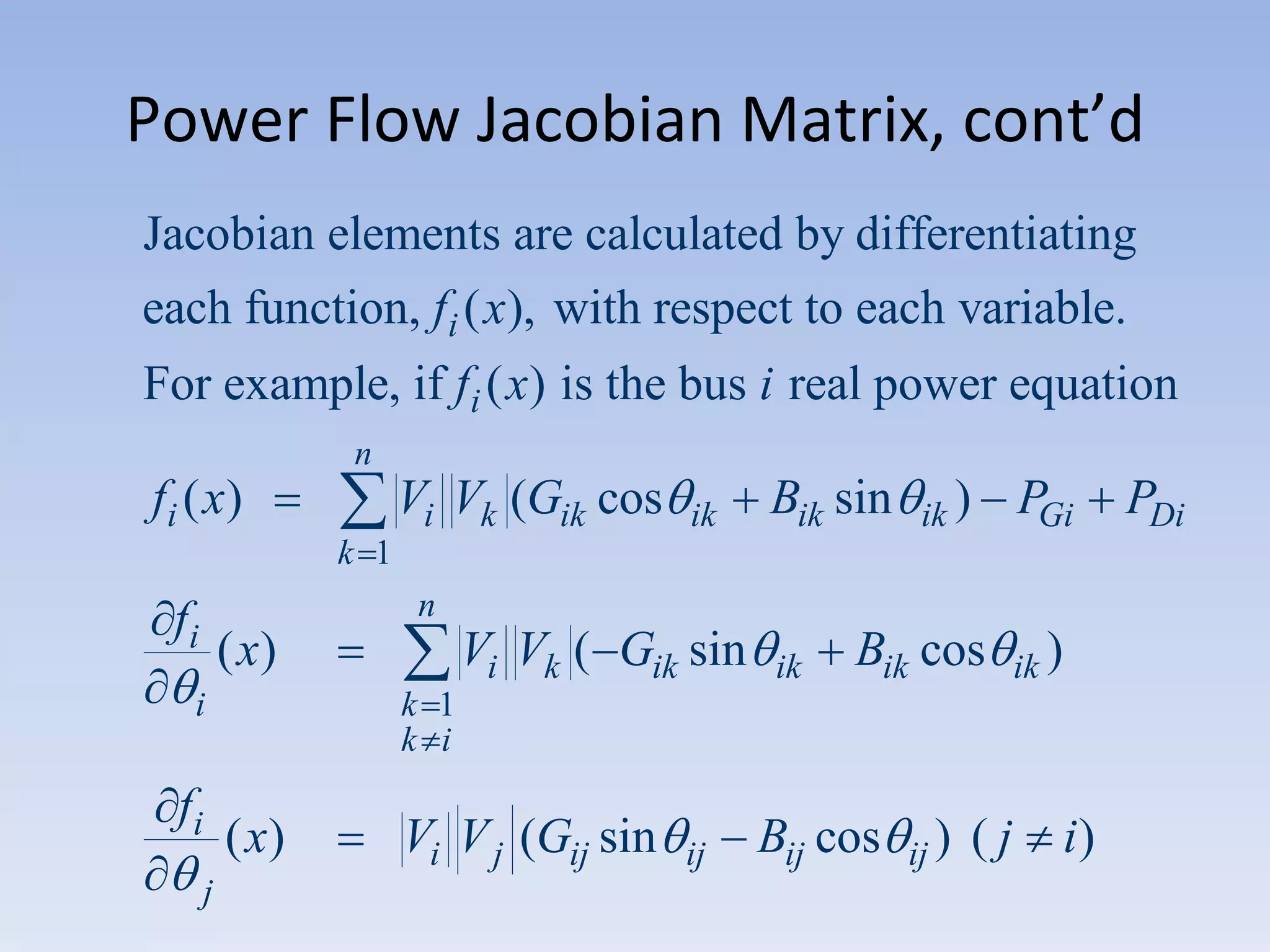
Jacobian elements are calculated by differentiating
each function, fi ( x), with respect to each variable.
For example, if fi ( x) is the bus i real power equation
n

fi ( x)

Vi Vk (Gik cos

ik

Bik sin

ik )

PGi

k 1
n

fi

( x)

i

fi

ik

Bik cos

ik )

k 1
k i

( x)
j

Vi Vk ( Gik sin

Vi V j (Gij sin

ij

Bij cos

ij )

(j

i)

PDi
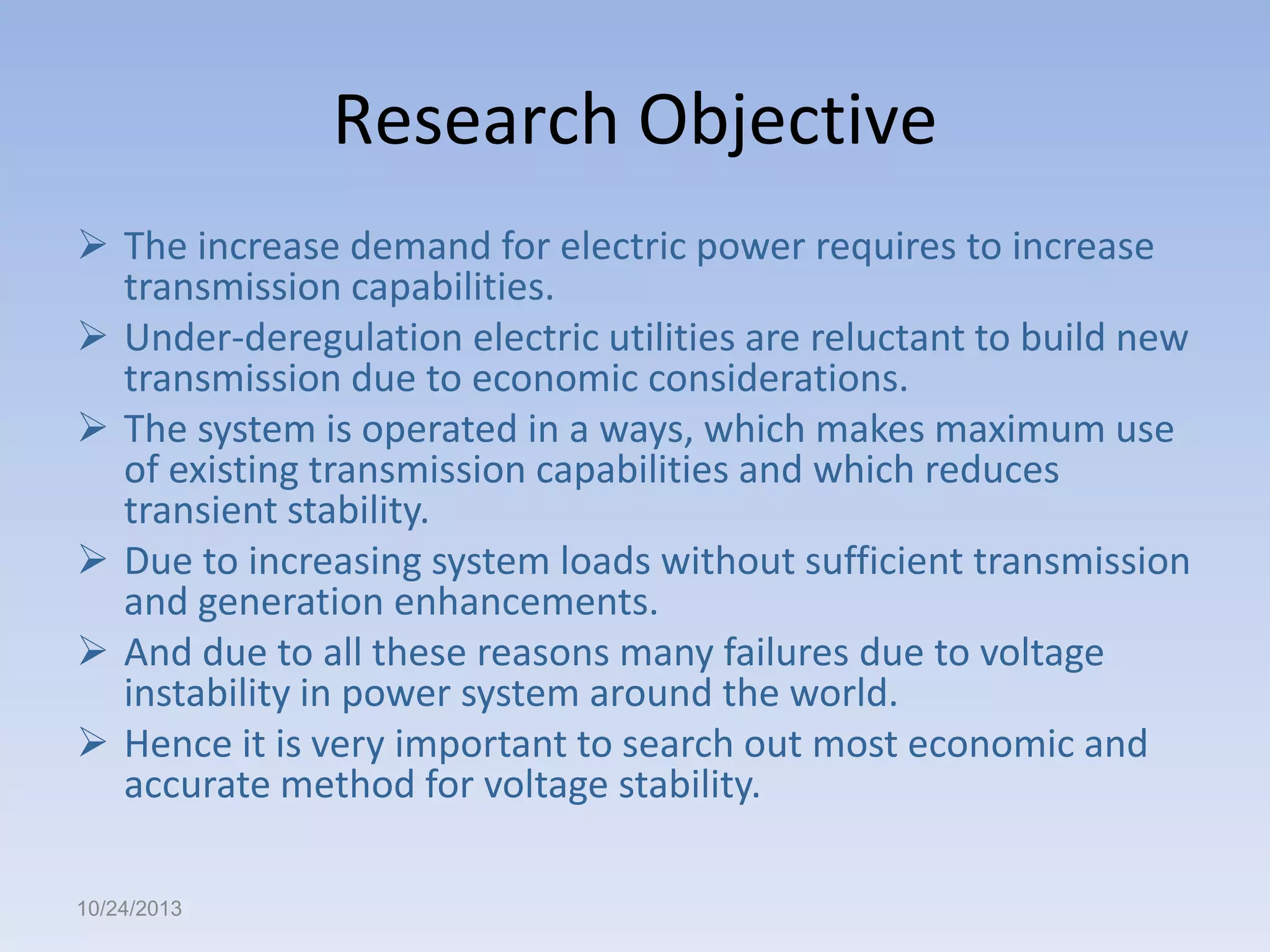
Research Objective
 The increase demand for electric power requires to increase
transmission capabilities.
 Under-deregulation electric utilities are reluctant to build new
transmission due to economic considerations.
 The system is operated in a ways, which makes maximum use
of existing transmission capabilities and which reduces
transient stability.
 Due to increasing system loads without sufficient transmission
and generation enhancements.
 And due to all these reasons many failures due to voltage
instability in power system around the world.
 Hence it is very important to search out most economic and
accurate method for voltage stability.
10/24/2013
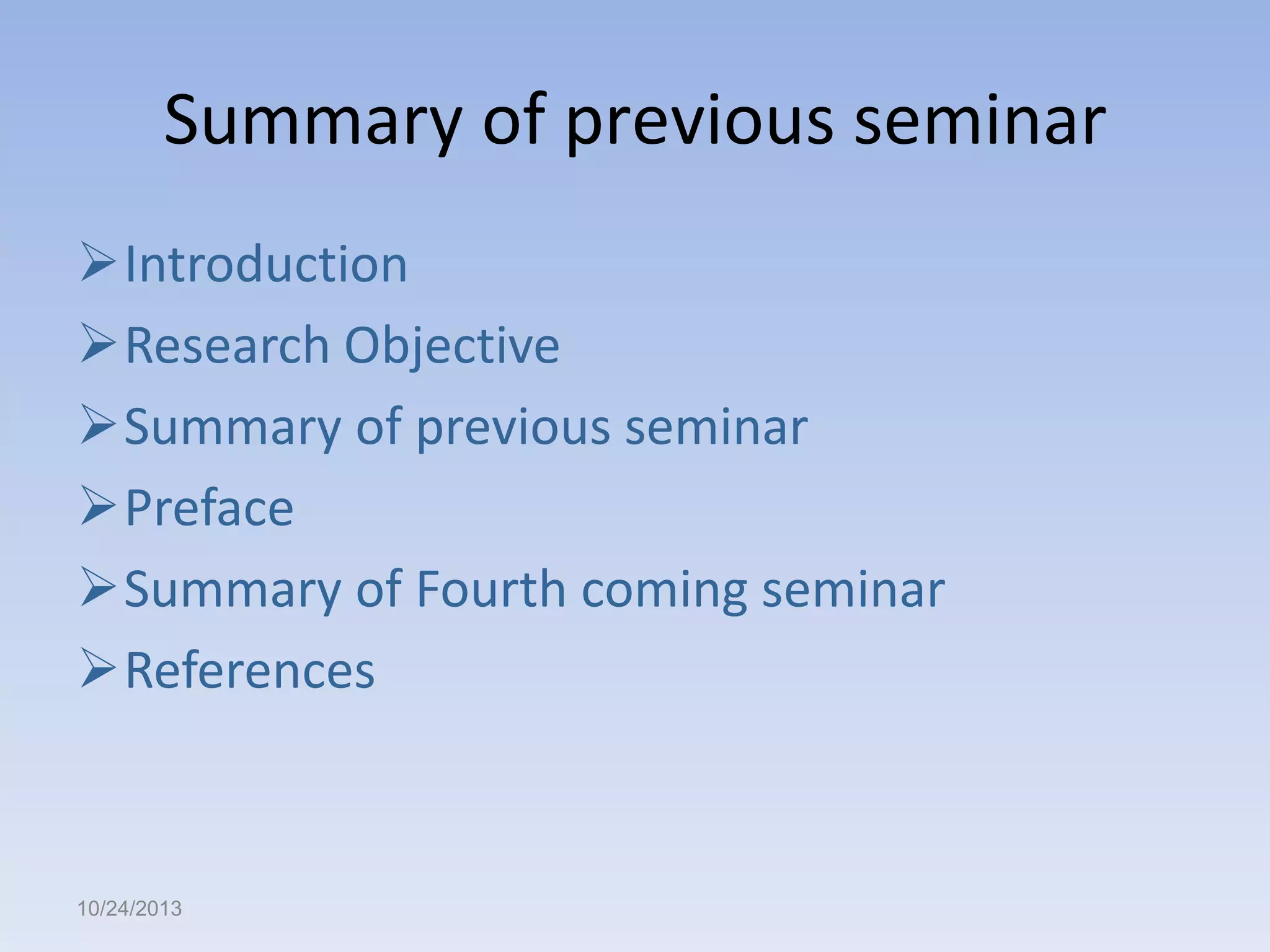
Summary of previous seminar
Introduction
Research Objective
Summary of previous seminar
Preface
Summary of Fourth coming seminar
References

10/24/2013
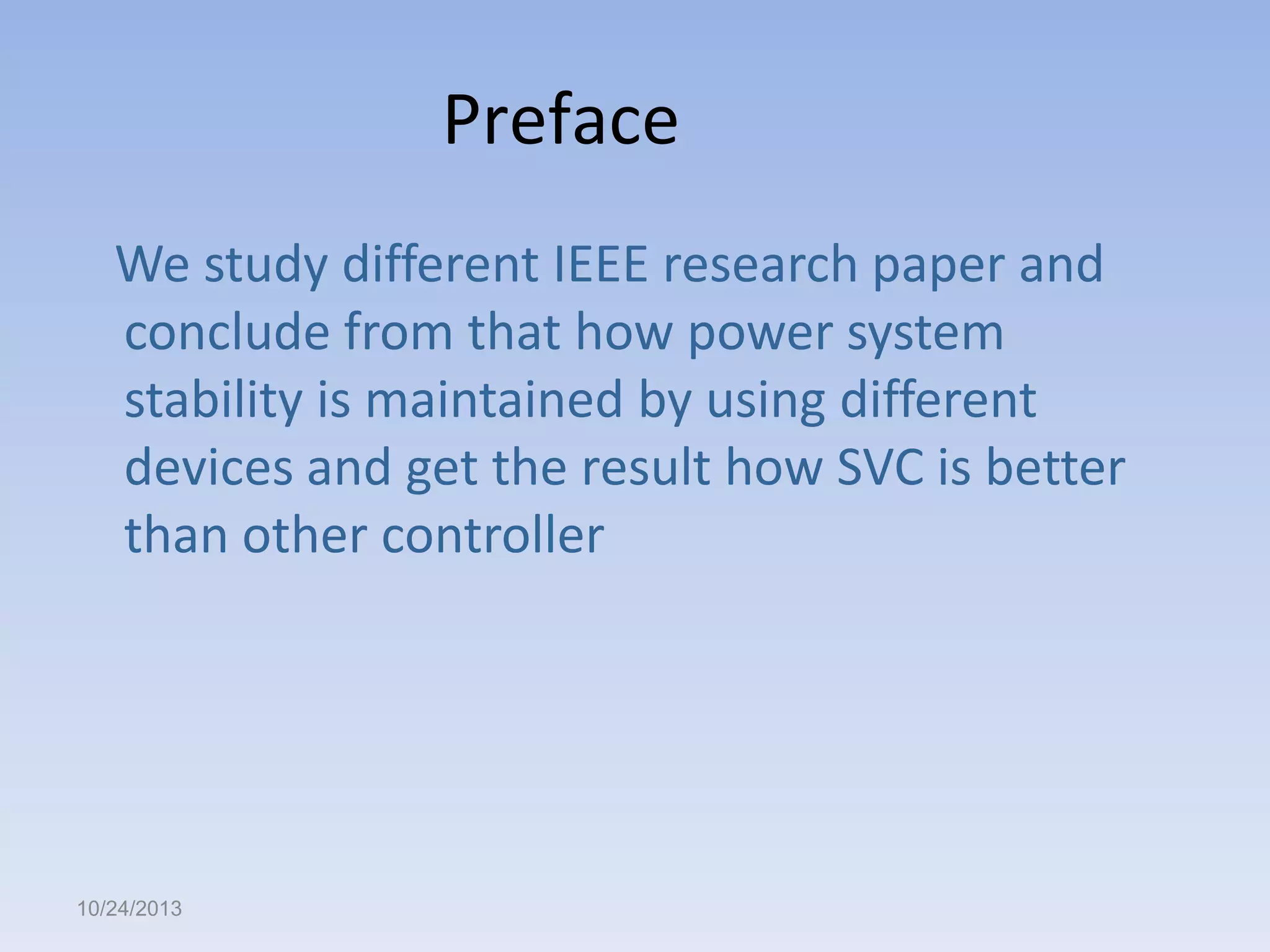
Preface
We study different IEEE research paper and
conclude from that how power system
stability is maintained by using different
devices and get the result how SVC is better
than other controller

10/24/2013
Summary of fourth coming seminar
To study more IEEE research paper
Basic Knowledge about the circuit
Modelling in matlab

10/24/2013

Voltage stability enhancement of a Transmission Line

  • 1.
    VOLTAGE STABILITY ENHANCEMENT IN TRANSMISSIONMLINE Project Guide:Prof. Sourabh Kothari By Vartika Shrivastava (0832EX101060) Anirudh Sharma (0832EX101008) Rajendra Thakur (0832EX101044) Rahul Soni(0832EX101043)
  • 2.
    ABSTRACT  The mainaim of this project is to provide security to the power system.  And this need is largely due to the recent trends towards operating systems under stressed conditions as a result of increasing system load without sufficient generation enhancement.  In this project we are controlling the voltage instability by considering both aspects that is static and dynamic stability.  By using one of the FACT device that is SVC and with the help of which we are trying to measure even minute variations in the voltage magnitude. 10/24/2013
  • 3.
    CONTENT Introduction Research Objective Summary ofprevious seminar Preface Summary of Fourth coming seminar References 10/24/2013
  • 4.
    INTRODUCTION  The continuinginterconnections of bulk power system has led to an increasing complex system.  Electric utilities are reluctant to build new transmission lines for economic consideration.  Hence it is very necessary to stable the voltage magnitude by considering its both static and dynamic stability aspects.  Major power system breakdowns are caused by problems related to the systems static as well as dynamics responses.  Control centre operators observe none of the critical advance warning since voltage magnitudes remains normal until large changes.  Hence it is very important to observe and control very minute variations coming in voltage magnitude. 10/24/2013
  • 5.
    INTRODUCTION For controlling suchkind of variations we use FACT(Flexible AC transmission) controllers that provide fast and reliable control over the transmission system parameters such as voltage, Phase angle and line impedance. And here we are using SVC(static VAR compensator) one of the FACT device for controlling voltage instability. 10/24/2013
  • 6.
    Bus Admittance Matrixor Ybus  First step in solving the power flow is to create what is known as the bus admittance matrix, often call the Ybus.  The Ybus gives the relationships between all the bus current injections, I, and all the bus voltages, V, I = Ybus V  The Ybus is developed by applying KCL at each bus in the system to relate the bus current injections, the bus voltages, and the branch impedances and admittances  Calculate the bus admittance matrix for the network with the help of Newton-Raphson Method .
  • 7.
    We can getsimilar relationships for buses 3 and 4 The results can then be expressed in matrix form I Ybus V I1 YA YB YA YA YC YB YD 0 V1 YC YD V2 I2 YA I3 YB YC YB YC 0 V3 I4 0 YD 0 YD V4 For a system with n buses, Ybus is an nxn symmetric matrix (i.e., one where Aij = Aji)
  • 8.
    Ybus General Form Thediagonal terms, Yii, are the self admittance terms, equal to the sum of the admittances of all devices incident to bus i.  The off-diagonal terms, Yij, are equal to the negative of the sum of the admittances joining the two buses. With large systems Ybus is a sparse matrix (that is, most entries are zero). Shunt terms, such as with the line model, only affect the diagonal terms. 10/24/2013
  • 9.
    Newton-Raphson In Power SystemAnalysis, Newton's method (also known as the Newton–Raphson method), named after Isaac Newton and Joseph Raphson, is a method for finding successively better approximations to the roots (or zeroes) of a real valued-function. Let f(x) be a well-behaved function, and let r be a root of the equation f(x) = 0. We start with an estimate x0 of del x0 . From x0, we produce an Improved (we hope) estimate x1. From x1, we produce a new estimate x2. From x2, we produce a new estimate x3. We go on until we are `close enough' to del x or until it becomes clear that we are getting nowhere. It transform the procedure of solving non-linear differential equation into the procedure of repeatedly solving linear equation.
  • 10.
    Newton-Raphson Advantages – fast convergenceas long as initial guess is close to solution – large region of convergence Disadvantages – each iteration takes much longer than a Gauss-Seidel iteration – more complicated to code, particularly when implementing sparse matrix algorithms.
  • 11.
    NR Application toPower Flow We first need to rewrite complex power equations as equations with real coefficients (we've seen this earlier): Vi I i* Si * n Vi YikVk n Vi k 1 k 1 These can be derived by defining Yik  Gik jBik Vi  Vi e j i ik  Recall e j i Vi i k cos * YikVk* j sin
  • 12.
    Real Power BalanceEquations n Si Pi jQi Vi n * YikVk* k 1 Vi Vk e j ik (Gik jBik ) k 1 n Vi Vk (cos j sin ik ik )(Gik jBik ) k 1 Resolving into the real and imaginary parts: n Pi Vi Vk (Gik cos ik Bik sin ik ) PGi PDi Vi Vk (Gik sin ik Bik cos ik ) QGi QDi k 1 n Qi k 1
  • 13.
    Newton-Raphson Power Flow Inthe Newton-Raphson power flow we use Newton's method to determine the voltage magnitude and angle at each bus in the power system that satisfies power balance. We need to solve the power balance equations: n Vi Vk (Gik cos ik Bik sin ik ) PGi PDi Vi Vk (Gik sin ik Bik cos ik ) QGi QDi 0 k 1 n k 1 0
  • 14.
    Power Flow Variables Forconvenience, write: n Pi ( x ) Vi Vk (Gik cos ik Bik sin ik ) Vi Vk (Gik sin ik Bik cos ik ) k 1 n Qi ( x ) k 1 The power balance equations are then: Pi ( x ) PGi PDi 0 Qi ( x ) QGi QDi 0
  • 15.
    Power Flow Variables Assumethe slack bus is the first bus (with a fixed voltage angle/magnitude). We then need to determine the voltage angle/magnitude at the other buses. We must solve f ( x ) 0, where: P2 ( x ) PG 2 2  x n V2  Vn f (x) PD 2  Pn ( x ) PGn PDn Q2 ( x ) QG 2 QD 2  Qn ( x ) QGn QDn
  • 16.
    N-R Power FlowSolution The power flow is solved using the same procedure discussed previously for general equations: 0; make an initial guess of x, x ( v ) For v While f (x ( v ) ) x(v v End 1) Do x ( v ) [ J ( x ( v ) )] 1 f ( x ( v ) ) v 1
  • 17.
    Power Flow JacobianMatrix The most difficult part of the algorithm is determining and factorizing the Jacobian matrix, J (x) f1 (x) x1 J (x ) f1 (x) x2 f2 (x) x1 f2 (x) x2     f 2n 2 (x) x1  f 2n 2 (x)  x2 f1 (x) x2 n 2 f2 (x) x2 n 2  f 2n x2 n 2 2 (x)
  • 18.
    Power Flow JacobianMatrix, cont’d Jacobian elements are calculated by differentiating each function, fi ( x), with respect to each variable. For example, if fi ( x) is the bus i real power equation n fi ( x) Vi Vk (Gik cos ik Bik sin ik ) PGi k 1 n fi ( x) i fi ik Bik cos ik ) k 1 k i ( x) j Vi Vk ( Gik sin Vi V j (Gij sin ij Bij cos ij ) (j i) PDi
  • 19.
    Research Objective  Theincrease demand for electric power requires to increase transmission capabilities.  Under-deregulation electric utilities are reluctant to build new transmission due to economic considerations.  The system is operated in a ways, which makes maximum use of existing transmission capabilities and which reduces transient stability.  Due to increasing system loads without sufficient transmission and generation enhancements.  And due to all these reasons many failures due to voltage instability in power system around the world.  Hence it is very important to search out most economic and accurate method for voltage stability. 10/24/2013
  • 20.
    Summary of previousseminar Introduction Research Objective Summary of previous seminar Preface Summary of Fourth coming seminar References 10/24/2013
  • 21.
    Preface We study differentIEEE research paper and conclude from that how power system stability is maintained by using different devices and get the result how SVC is better than other controller 10/24/2013
  • 22.
    Summary of fourthcoming seminar To study more IEEE research paper Basic Knowledge about the circuit Modelling in matlab 10/24/2013