Probability models for predictive
analytics: Markov chains
Laura Albert
Badger Bracketology
@lauraalbertphd
@badgerbrackets
http://bracketology.engr.wisc.edu/
2
Volleyball scoring scheme where teams A and B play
Two scoring schemes:
- Classic “sideout” scoring: the only team that can score points is the team that
serves the ball
- Rally scoring: a point is awarded after each play
https://www.reference.com/sports-active-lifestyle/volleyball-scoring-system-207607d9d3d262ae#
Questions:
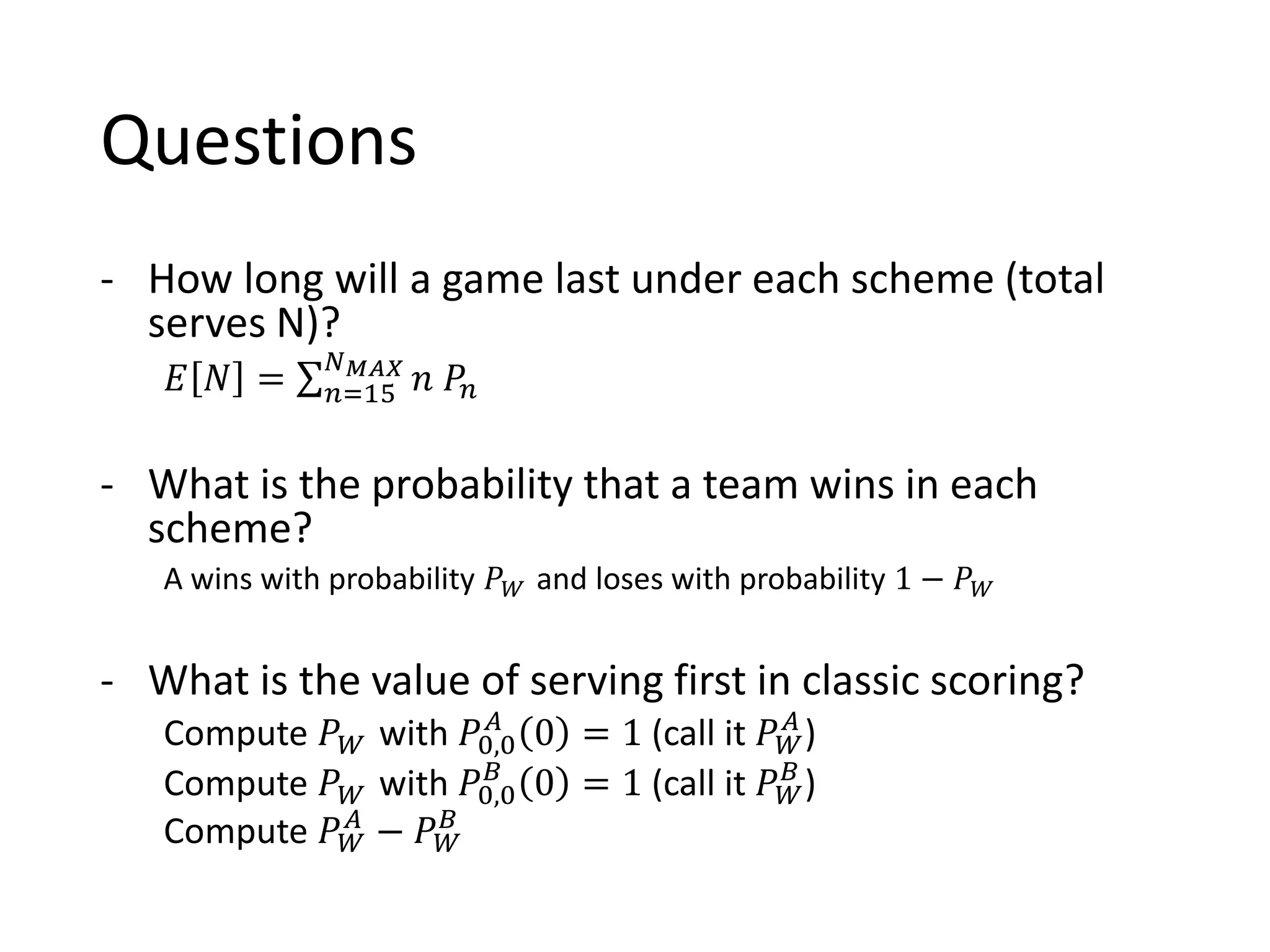
- How long will a game last under each scheme (total serves N)?
- What is the probability that a team wins in each scheme?
- What is the value of serving first in classic scoring?
Let’s consider a model called a Markov chain to help us answer these questions.
3
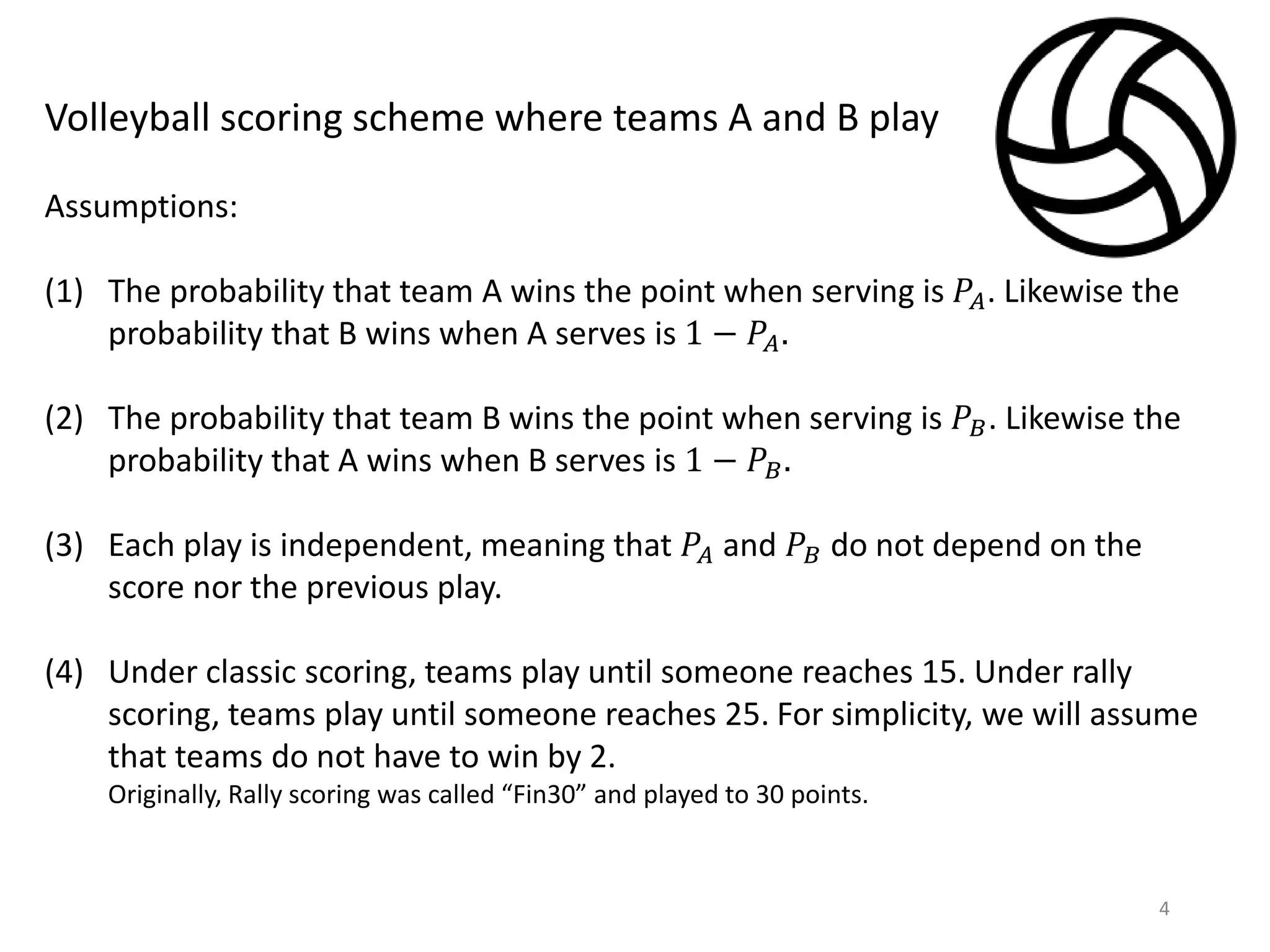
Consider a stochastic process {𝑋 𝑛, 𝑛 = 0,1,2, … } that can assume a finite or
countably infinite number of values, say Ω = {0,1,2, … }.
Therefore, {𝑋 𝑛 = 𝑖} means that the process is in state 𝑖 at time (index) 𝑛.
Suppose that the probability the process moves from state 𝑖 to state 𝑗 is
𝑃𝑖𝑗 = 𝑃(𝑋 𝑛+1 = 𝑗|𝑋 𝑛 = 𝑖, 𝑋 𝑛−1 = 𝑖 𝑛−1, … , 𝑋1 = 𝑖1, 𝑋0 = 𝑖0)
= 𝑃(𝑋 𝑛+1 = 𝑗|𝑋 𝑛 = 𝑖)
This process is called a (discrete-time) Markov Chain.
X0 = i0 X1 = i1 X2 = i2 X3 = i3 … Xn = i Xn+1 = j
𝑃𝑖𝑗
Xn-1 = in-1
Past history is irrelevant
4
Volleyball scoring scheme where teams A and B play
Assumptions:
(1) The probability that team A wins the point when serving is 𝑃𝐴. Likewise the
probability that B wins when A serves is 1 − 𝑃𝐴.
(2) The probability that team B wins the point when serving is 𝑃𝐵. Likewise the
probability that A wins when B serves is 1 − 𝑃𝐵.
(3) Each play is independent, meaning that 𝑃𝐴 and 𝑃𝐵 do not depend on the
score nor the previous play.
(4) Under classic scoring, teams play until someone reaches 15. Under rally
scoring, teams play until someone reaches 25. For simplicity, we will assume
that teams do not have to win by 2.
Originally, Rally scoring was called “Fin30” and played to 30 points.
Volleyball as a Markov chain
We have to describe the state of the system
It has these components:
(a) Score (𝑖, 𝑗) where team A has 𝑖 points and team B has 𝑗 points
(b) Serving team (A or B)
Note: we have to keep track of the number of serves 𝑛
We only need to keep track of N to compute 𝐸[𝑁]
Transition probabilities: 𝑃𝑖𝑗
𝐴
or 𝑃𝑖𝑗
𝐵
= the probability that team A has 𝑖 points and team B
has 𝑗 points and team A (or B) is serving.
The state is (𝑖, 𝑗, 𝐴/𝐵) for 𝑖 = 0,1, … .15 𝑜𝑟 25 and 𝑗 = 0,1, … 15 𝑜𝑟 25
Either 𝑖 or 𝑗 is capped (except for the requirement to win by 2)
We assume 𝑃𝑖𝑗
𝐴
or 𝑃𝑖𝑗
𝐵
are stationary across 𝑛.
Starting state:
𝑃00
𝐴
0 = 1 if A serves first
𝑃00
𝐵
0 = 1 if B serves first.
𝑃00
𝐴
0 = 𝑃00
𝐵
0 = 0.5 if we consider an “average” game
Volleyball as a Markov chain
We assume 𝑃𝑖𝑗
𝐴
or 𝑃𝑖𝑗
𝐵
are stationary across 𝑛.
Let 𝑃𝑖𝑗
𝐴
(𝑛) or 𝑃𝑖𝑗
𝐵
(𝑛) capture the probability that the score is
𝑖, 𝑗 with A (or B) serving first after 𝑛 servers.
Starting state:
𝑋0 = (0,0, 𝐴) or (0,0, 𝐵) based on who is serving first.
In other words:
𝑃00
𝐴
0 = 1 if A serves first
𝑃00
𝐵
0 = 1 if B serves first.
𝑃00
𝐴
0 = 𝑃00
𝐵
0 = 0.5 if we consider an “average” game
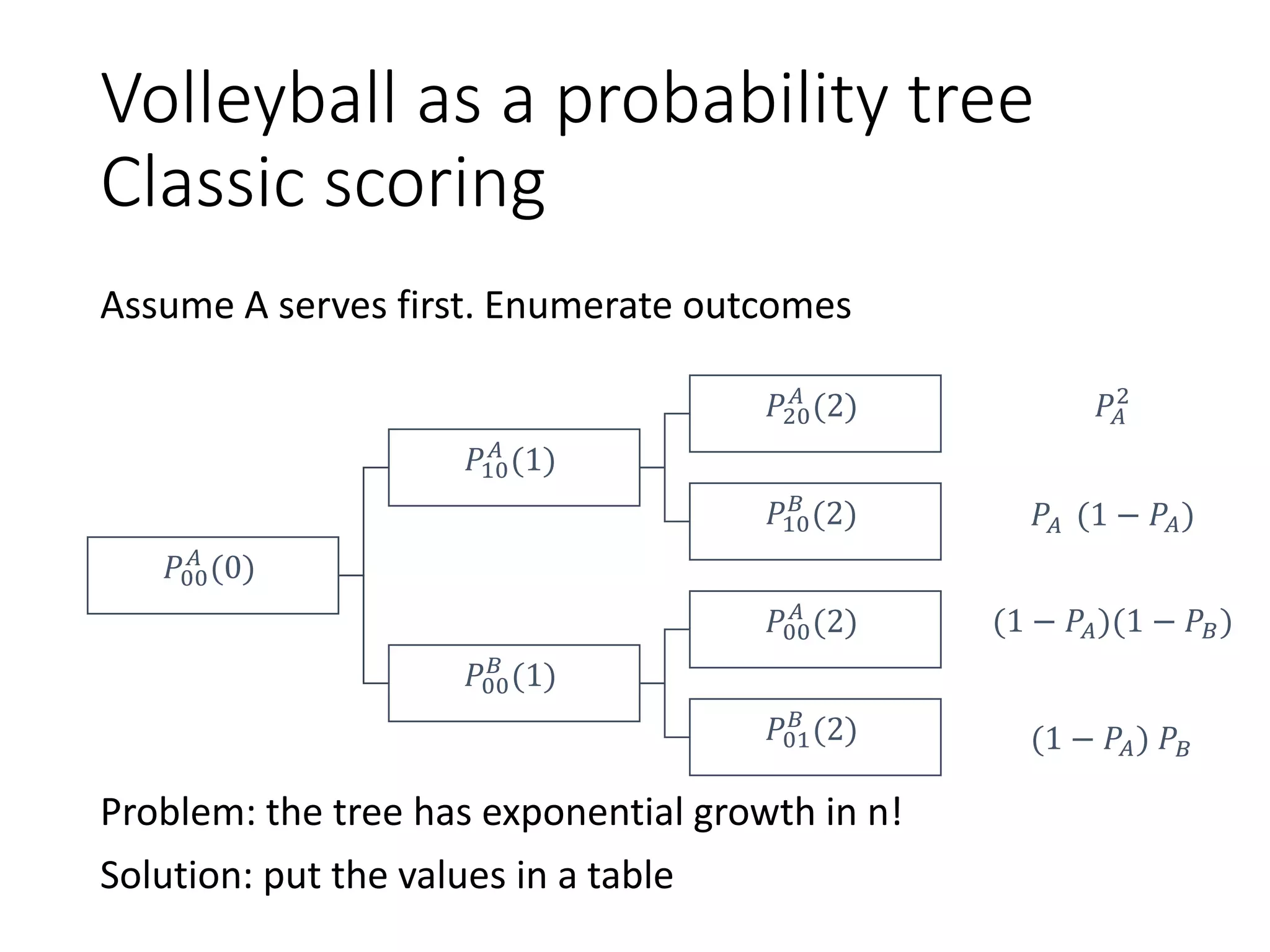
Volleyball as a probability tree
Classic scoring
Assume A serves first. Enumerate outcomes
Problem: the tree has exponential growth in n!
Solution: put the values in a table
𝑃00
𝐴
(0)
𝑃10
𝐴
(1)
𝑃20
𝐴
(2) 𝑃𝐴
2
𝑃10
𝐵
(2) 𝑃𝐴 (1 − 𝑃𝐴)
𝑃00
𝐵
(1)
𝑃00
𝐴
(2) (1 − 𝑃𝐴)(1 − 𝑃𝐵)
𝑃01
𝐵
(2) (1 − 𝑃𝐴) 𝑃𝐵
Volleyball as a probability tree
Classic scoring
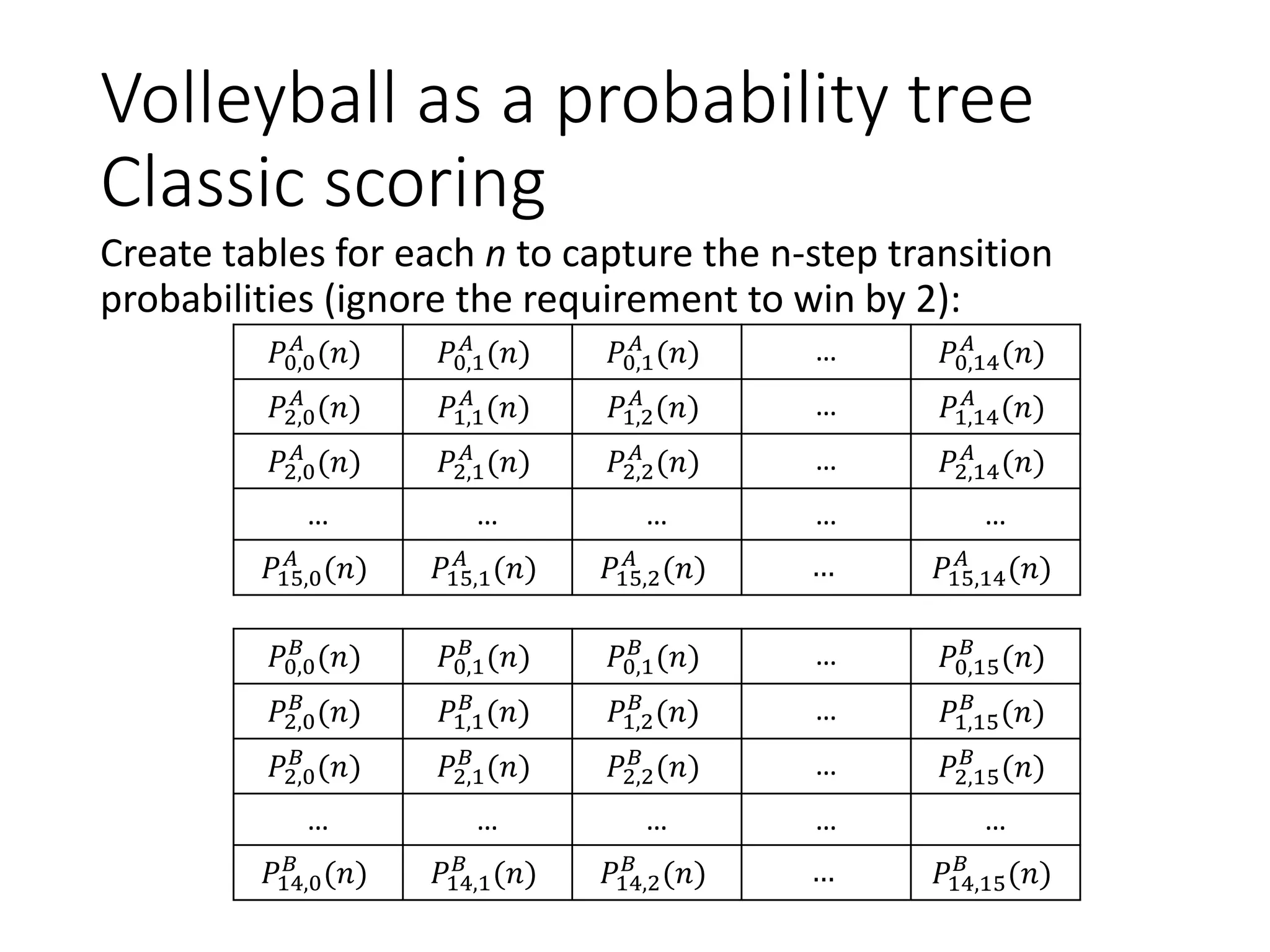
Create tables for each n to capture the n-step transition
probabilities (ignore the requirement to win by 2):
𝑃0,0
𝐴
(𝑛) 𝑃0,1
𝐴
(𝑛) 𝑃0,1
𝐴
(𝑛) … 𝑃0,14
𝐴
(𝑛)
𝑃2,0
𝐴
(𝑛) 𝑃1,1
𝐴
(𝑛) 𝑃1,2
𝐴
(𝑛) … 𝑃1,14
𝐴
(𝑛)
𝑃2,0
𝐴
(𝑛) 𝑃2,1
𝐴
(𝑛) 𝑃2,2
𝐴
(𝑛) … 𝑃2,14
𝐴
(𝑛)
… … … … …
𝑃15,0
𝐴
(𝑛) 𝑃15,1
𝐴
(𝑛) 𝑃15,2
𝐴
(𝑛) … 𝑃15,14
𝐴
(𝑛)
𝑃0,0
𝐵
(𝑛) 𝑃0,1
𝐵
(𝑛) 𝑃0,1
𝐵
(𝑛) … 𝑃0,15
𝐵
(𝑛)
𝑃2,0
𝐵
(𝑛) 𝑃1,1
𝐵
(𝑛) 𝑃1,2
𝐵
(𝑛) … 𝑃1,15
𝐵
(𝑛)
𝑃2,0
𝐵
(𝑛) 𝑃2,1
𝐵
(𝑛) 𝑃2,2
𝐵
(𝑛) … 𝑃2,15
𝐵
(𝑛)
… … … … …
𝑃14,0
𝐵
(𝑛) 𝑃14,1
𝐵
(𝑛) 𝑃14,2
𝐵
(𝑛) … 𝑃14,15
𝐵
(𝑛)
Volleyball as a probability tree
Classic scoring
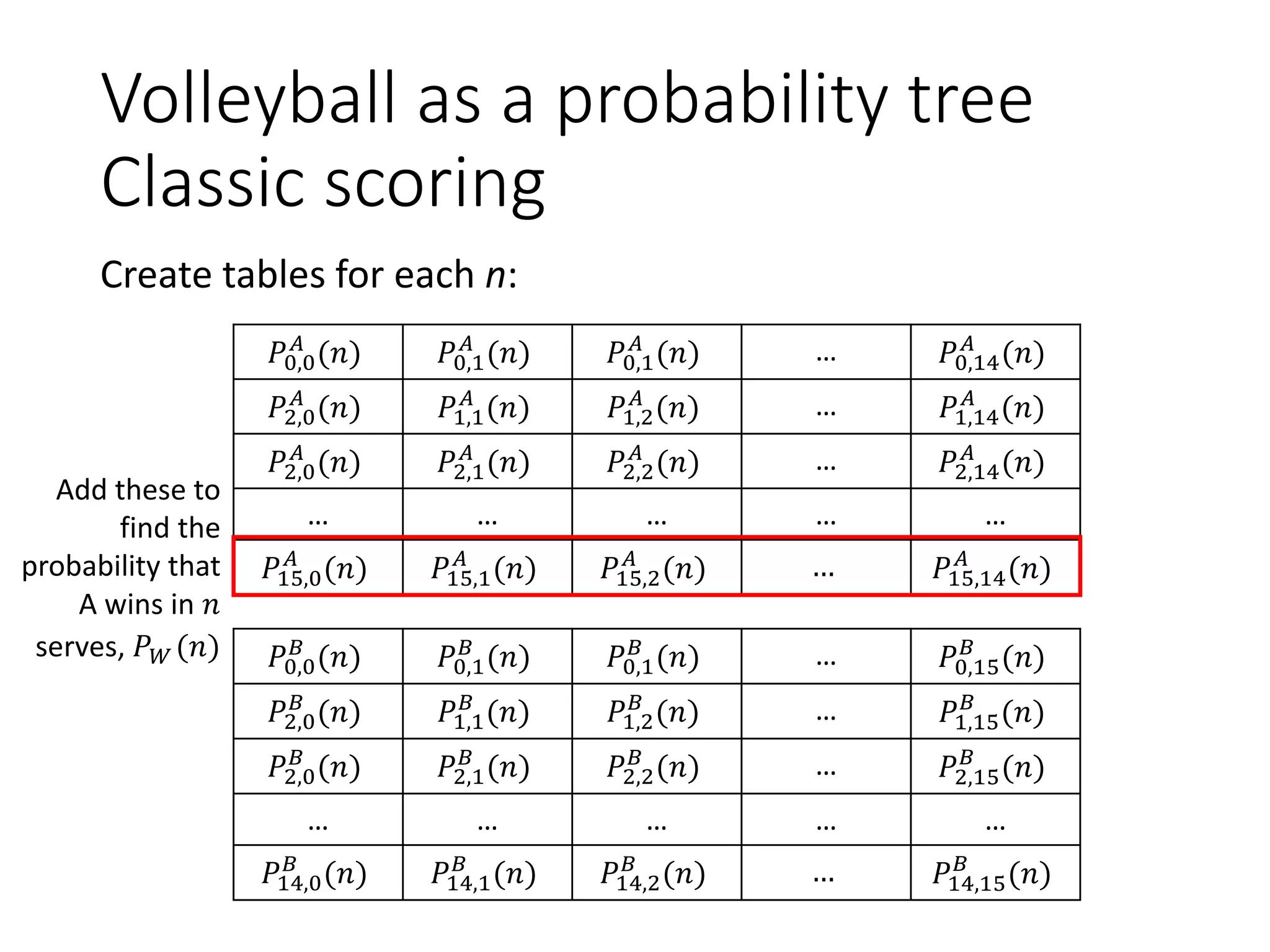
Create tables for each n:
𝑃0,0
𝐴
(𝑛) 𝑃0,1
𝐴
(𝑛) 𝑃0,1
𝐴
(𝑛) … 𝑃0,14
𝐴
(𝑛)
𝑃2,0
𝐴
(𝑛) 𝑃1,1
𝐴
(𝑛) 𝑃1,2
𝐴
(𝑛) … 𝑃1,14
𝐴
(𝑛)
𝑃2,0
𝐴
(𝑛) 𝑃2,1
𝐴
(𝑛) 𝑃2,2
𝐴
(𝑛) … 𝑃2,14
𝐴
(𝑛)
… … … … …
𝑃15,0
𝐴
(𝑛) 𝑃15,1
𝐴
(𝑛) 𝑃15,2
𝐴
(𝑛) … 𝑃15,14
𝐴
(𝑛)
𝑃0,0
𝐵
(𝑛) 𝑃0,1
𝐵
(𝑛) 𝑃0,1
𝐵
(𝑛) … 𝑃0,15
𝐵
(𝑛)
𝑃2,0
𝐵
(𝑛) 𝑃1,1
𝐵
(𝑛) 𝑃1,2
𝐵
(𝑛) … 𝑃1,15
𝐵
(𝑛)
𝑃2,0
𝐵
(𝑛) 𝑃2,1
𝐵
(𝑛) 𝑃2,2
𝐵
(𝑛) … 𝑃2,15
𝐵
(𝑛)
… … … … …
𝑃14,0
𝐵
(𝑛) 𝑃14,1
𝐵
(𝑛) 𝑃14,2
𝐵
(𝑛) … 𝑃14,15
𝐵
(𝑛)
Add these to
find the
probability that
A wins in 𝑛
serves, 𝑃 𝑊 (𝑛)
Volleyball as a probability tree
Classic scoring
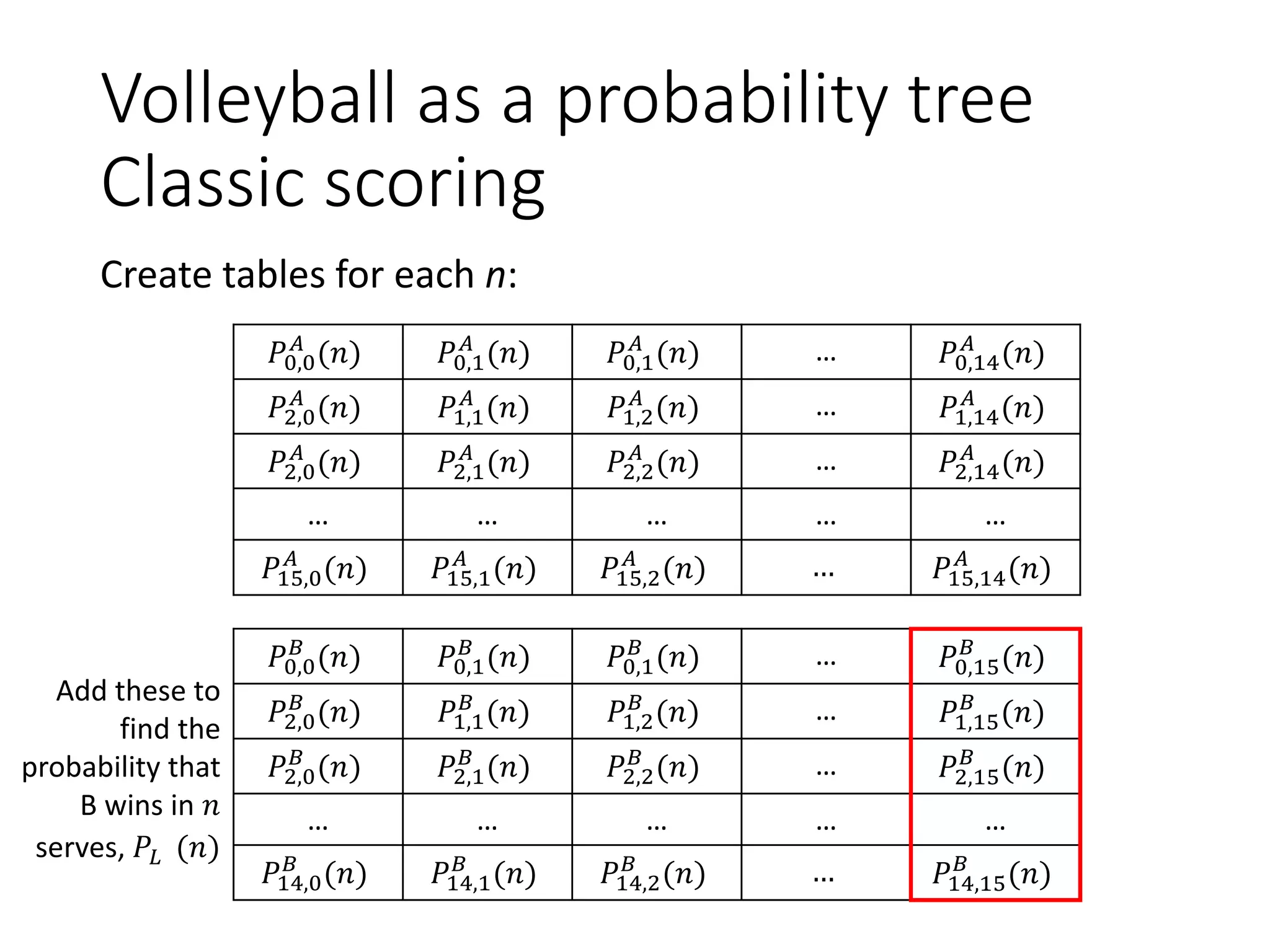
Create tables for each n:
𝑃0,0
𝐴
(𝑛) 𝑃0,1
𝐴
(𝑛) 𝑃0,1
𝐴
(𝑛) … 𝑃0,14
𝐴
(𝑛)
𝑃2,0
𝐴
(𝑛) 𝑃1,1
𝐴
(𝑛) 𝑃1,2
𝐴
(𝑛) … 𝑃1,14
𝐴
(𝑛)
𝑃2,0
𝐴
(𝑛) 𝑃2,1
𝐴
(𝑛) 𝑃2,2
𝐴
(𝑛) … 𝑃2,14
𝐴
(𝑛)
… … … … …
𝑃15,0
𝐴
(𝑛) 𝑃15,1
𝐴
(𝑛) 𝑃15,2
𝐴
(𝑛) … 𝑃15,14
𝐴
(𝑛)
𝑃0,0
𝐵
(𝑛) 𝑃0,1
𝐵
(𝑛) 𝑃0,1
𝐵
(𝑛) … 𝑃0,15
𝐵
(𝑛)
𝑃2,0
𝐵
(𝑛) 𝑃1,1
𝐵
(𝑛) 𝑃1,2
𝐵
(𝑛) … 𝑃1,15
𝐵
(𝑛)
𝑃2,0
𝐵
(𝑛) 𝑃2,1
𝐵
(𝑛) 𝑃2,2
𝐵
(𝑛) … 𝑃2,15
𝐵
(𝑛)
… … … … …
𝑃14,0
𝐵
(𝑛) 𝑃14,1
𝐵
(𝑛) 𝑃14,2
𝐵
(𝑛) … 𝑃14,15
𝐵
(𝑛)
Add these to
find the
probability that
B wins in 𝑛
serves, 𝑃𝐿 (𝑛)
Volleyball as a probability tree
Classic scoring
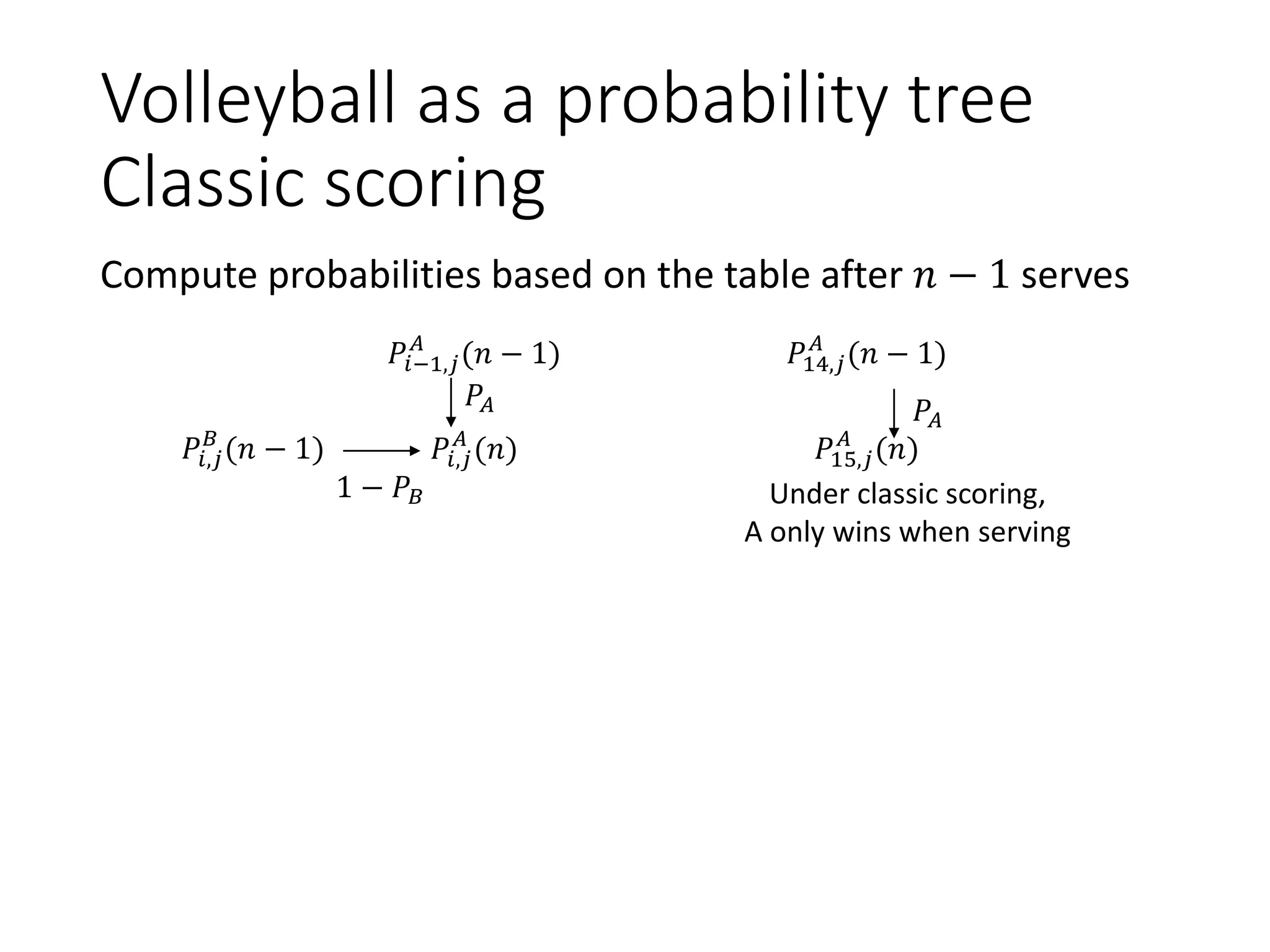
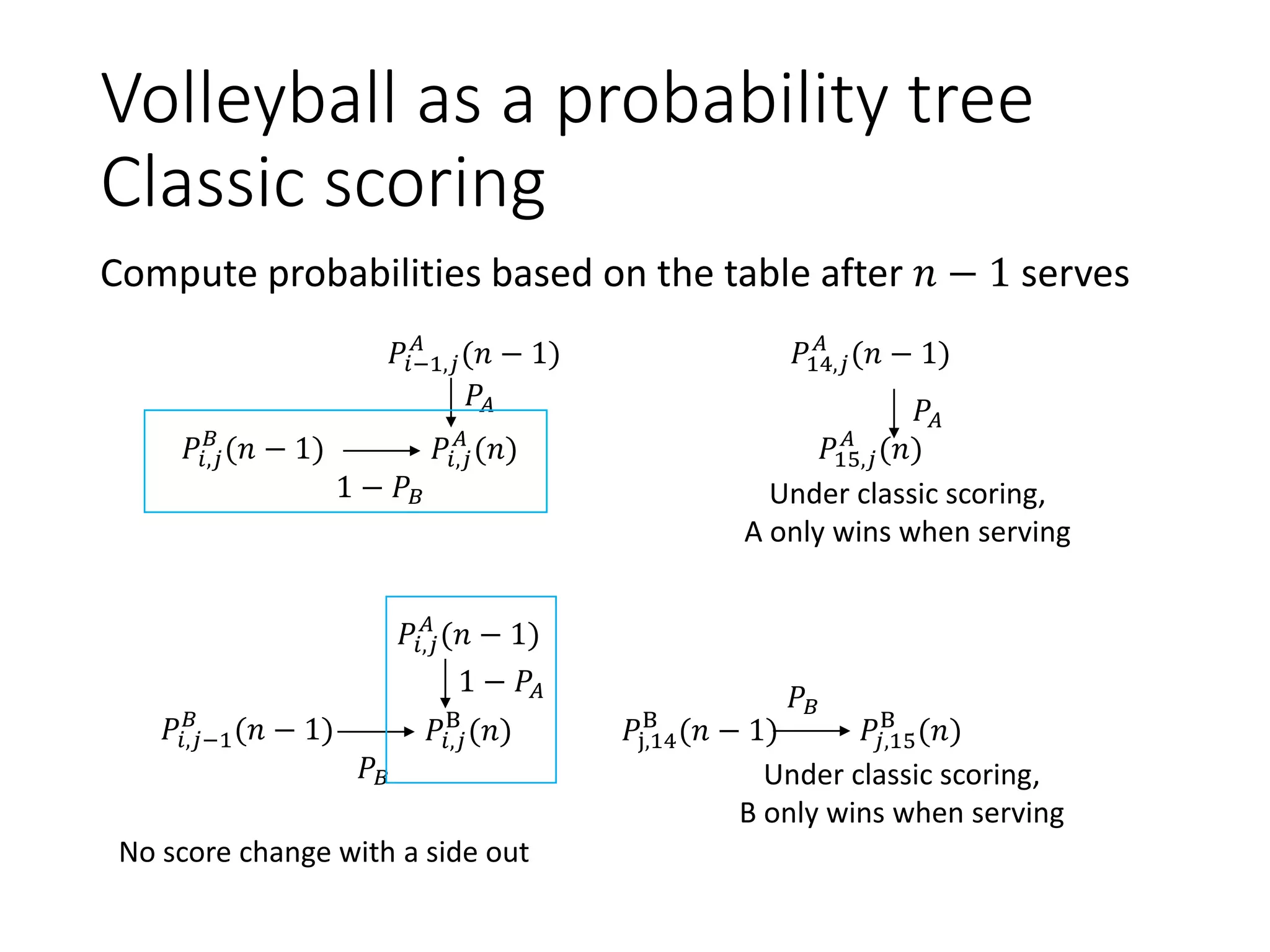
Compute probabilities based on the table after 𝑛 − 1 serves
𝑃𝑖−1,𝑗
𝐴
(𝑛 − 1) 𝑃14,𝑗
𝐴
(𝑛 − 1)
𝑃𝑖,𝑗
𝐵
(𝑛 − 1) 𝑃𝑖,𝑗
𝐴
(𝑛) 𝑃15,𝑗
𝐴
(𝑛)
𝑃𝐴
1 − 𝑃𝐵
𝑃𝐴
Under classic scoring,
A only wins when serving
Volleyball as a probability tree
Classic scoring
Compute probabilities based on the table after 𝑛 − 1 serves
𝑃𝑖−1,𝑗
𝐴
(𝑛 − 1) 𝑃14,𝑗
𝐴
(𝑛 − 1)
𝑃𝑖,𝑗
𝐵
(𝑛 − 1) 𝑃𝑖,𝑗
𝐴
(𝑛) 𝑃15,𝑗
𝐴
(𝑛)
𝑃𝐴
1 − 𝑃𝐵
𝑃𝐴
Under classic scoring,
A only wins when serving
𝑃𝑖,𝑗
𝐴
(𝑛 − 1)
𝑃𝑖,𝑗−1
𝐵
(𝑛 − 1) 𝑃𝑖,𝑗
B
(𝑛) 𝑃j,14
B
(𝑛 − 1) 𝑃𝑗,15
B
(𝑛)
1 − 𝑃𝐴
𝑃𝐵
𝑃𝐵
Under classic scoring,
B only wins when serving
No score change with a side out
Volleyball as a probability tree
Classic scoring
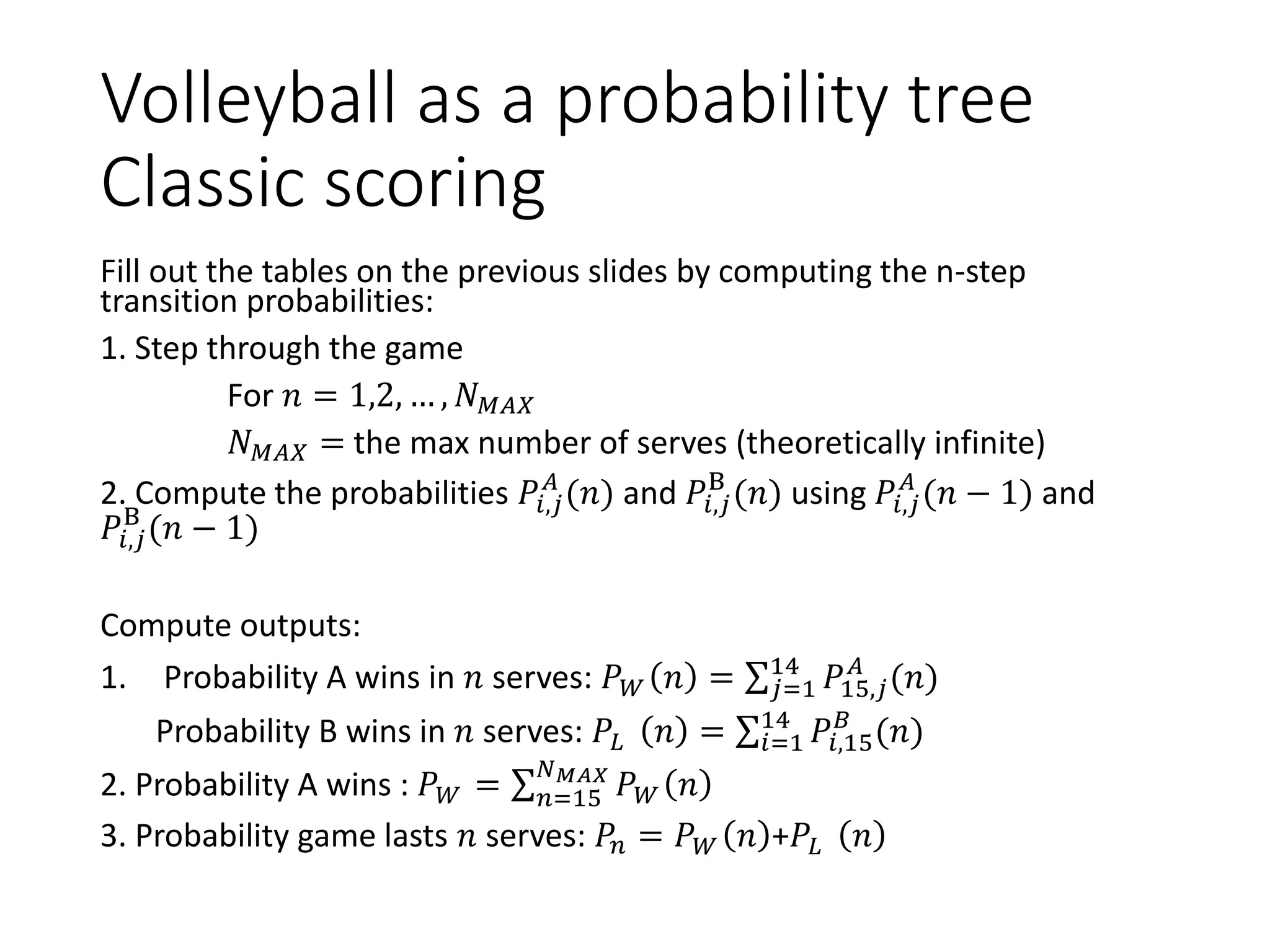
Fill out the tables on the previous slides by computing the n-step
transition probabilities:
1. Step through the game
For 𝑛 = 1,2, … , 𝑁 𝑀𝐴𝑋
𝑁 𝑀𝐴𝑋 = the max number of serves (theoretically infinite)
2. Compute the probabilities 𝑃𝑖,𝑗
𝐴
(𝑛) and 𝑃𝑖,𝑗
B
(𝑛) using 𝑃𝑖,𝑗
𝐴
(𝑛 − 1) and
𝑃𝑖,𝑗
B
(𝑛 − 1)
Compute outputs:
1. Probability A wins in 𝑛 serves: 𝑃 𝑊 𝑛 = σ 𝑗=1
14
𝑃15,𝑗
𝐴
(𝑛)
Probability B wins in 𝑛 serves: 𝑃𝐿 𝑛 = σ𝑖=1
14
𝑃𝑖,15
𝐵
(𝑛)
2. Probability A wins : 𝑃 𝑊 = σ 𝑛=15
𝑁 𝑀𝐴𝑋
𝑃 𝑊 𝑛
3. Probability game lasts 𝑛 serves: 𝑃𝑛 = 𝑃 𝑊 𝑛 +𝑃𝐿 𝑛
Volleyball as a probability tree
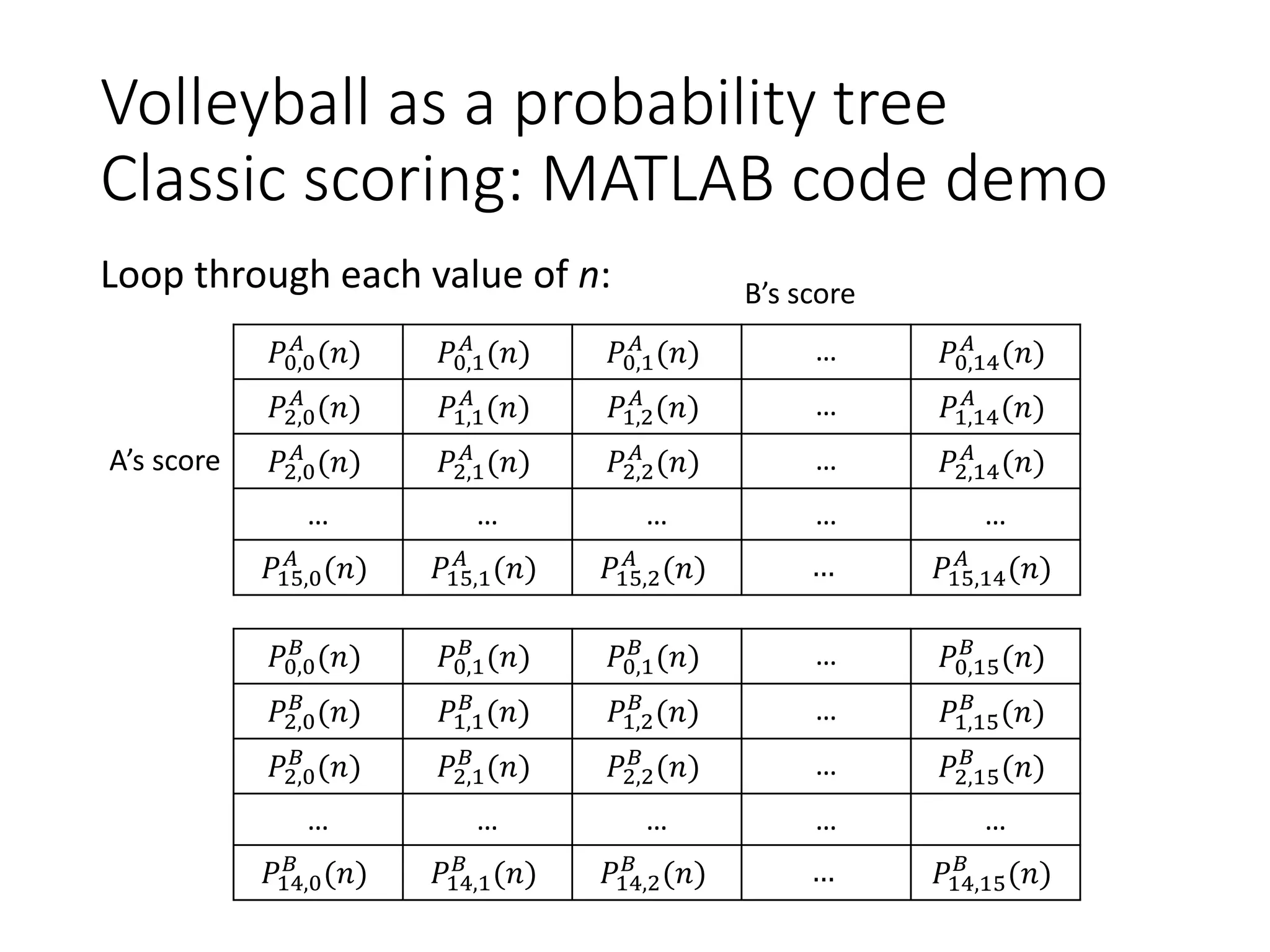
Classic scoring: MATLAB code demo
Loop through each value of n:
𝑃0,0
𝐴
(𝑛) 𝑃0,1
𝐴
(𝑛) 𝑃0,1
𝐴
(𝑛) … 𝑃0,14
𝐴
(𝑛)
𝑃2,0
𝐴
(𝑛) 𝑃1,1
𝐴
(𝑛) 𝑃1,2
𝐴
(𝑛) … 𝑃1,14
𝐴
(𝑛)
𝑃2,0
𝐴
(𝑛) 𝑃2,1
𝐴
(𝑛) 𝑃2,2
𝐴
(𝑛) … 𝑃2,14
𝐴
(𝑛)
… … … … …
𝑃15,0
𝐴
(𝑛) 𝑃15,1
𝐴
(𝑛) 𝑃15,2
𝐴
(𝑛) … 𝑃15,14
𝐴
(𝑛)
𝑃0,0
𝐵
(𝑛) 𝑃0,1
𝐵
(𝑛) 𝑃0,1
𝐵
(𝑛) … 𝑃0,15
𝐵
(𝑛)
𝑃2,0
𝐵
(𝑛) 𝑃1,1
𝐵
(𝑛) 𝑃1,2
𝐵
(𝑛) … 𝑃1,15
𝐵
(𝑛)
𝑃2,0
𝐵
(𝑛) 𝑃2,1
𝐵
(𝑛) 𝑃2,2
𝐵
(𝑛) … 𝑃2,15
𝐵
(𝑛)
… … … … …
𝑃14,0
𝐵
(𝑛) 𝑃14,1
𝐵
(𝑛) 𝑃14,2
𝐵
(𝑛) … 𝑃14,15
𝐵
(𝑛)
A’s score
B’s score
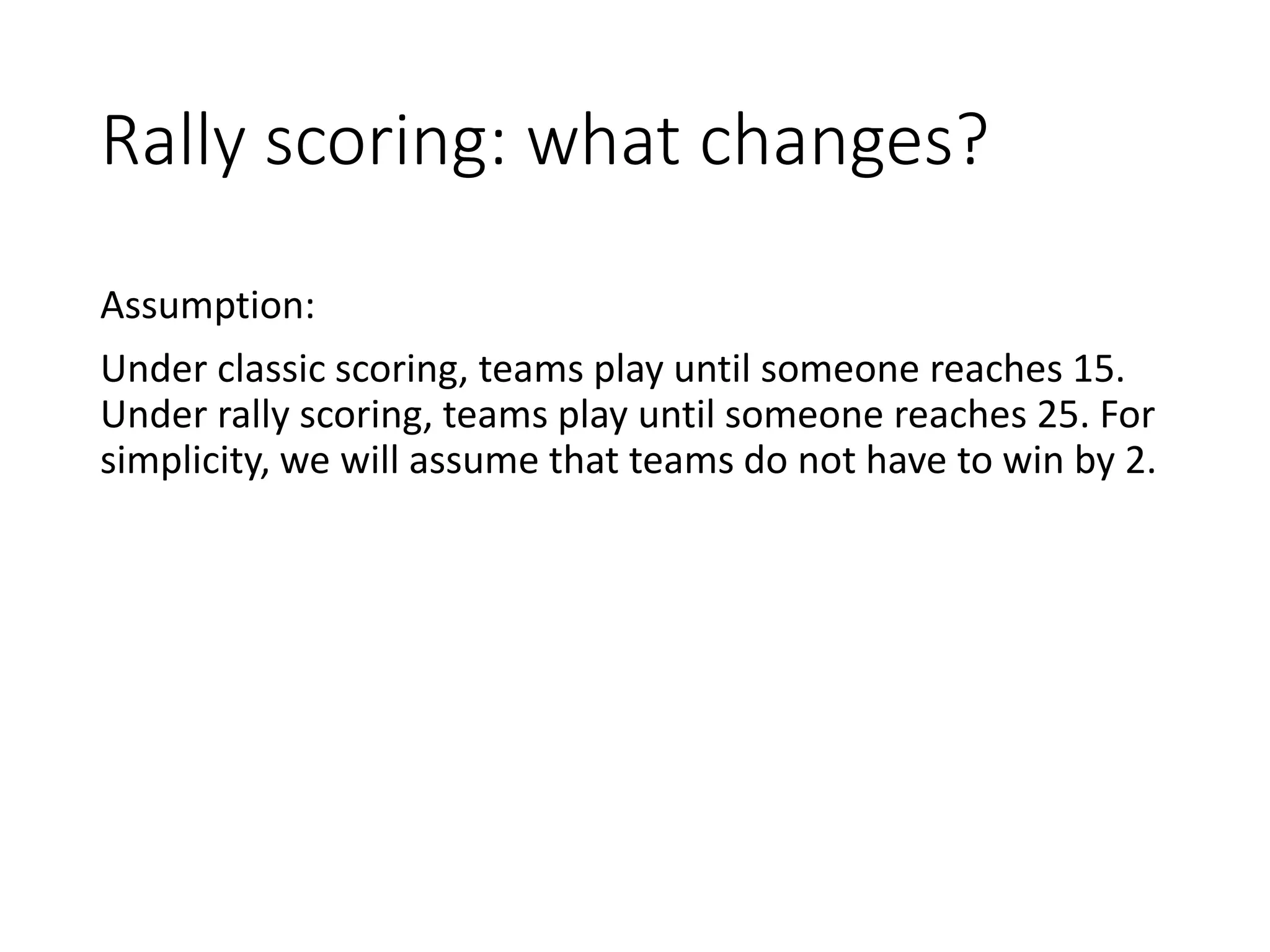
Rally scoring: what changes?
Assumption:
Under classic scoring, teams play until someone reaches 15.
Under rally scoring, teams play until someone reaches 25. For
simplicity, we will assume that teams do not have to win by 2.
Volleyball as a probability tree
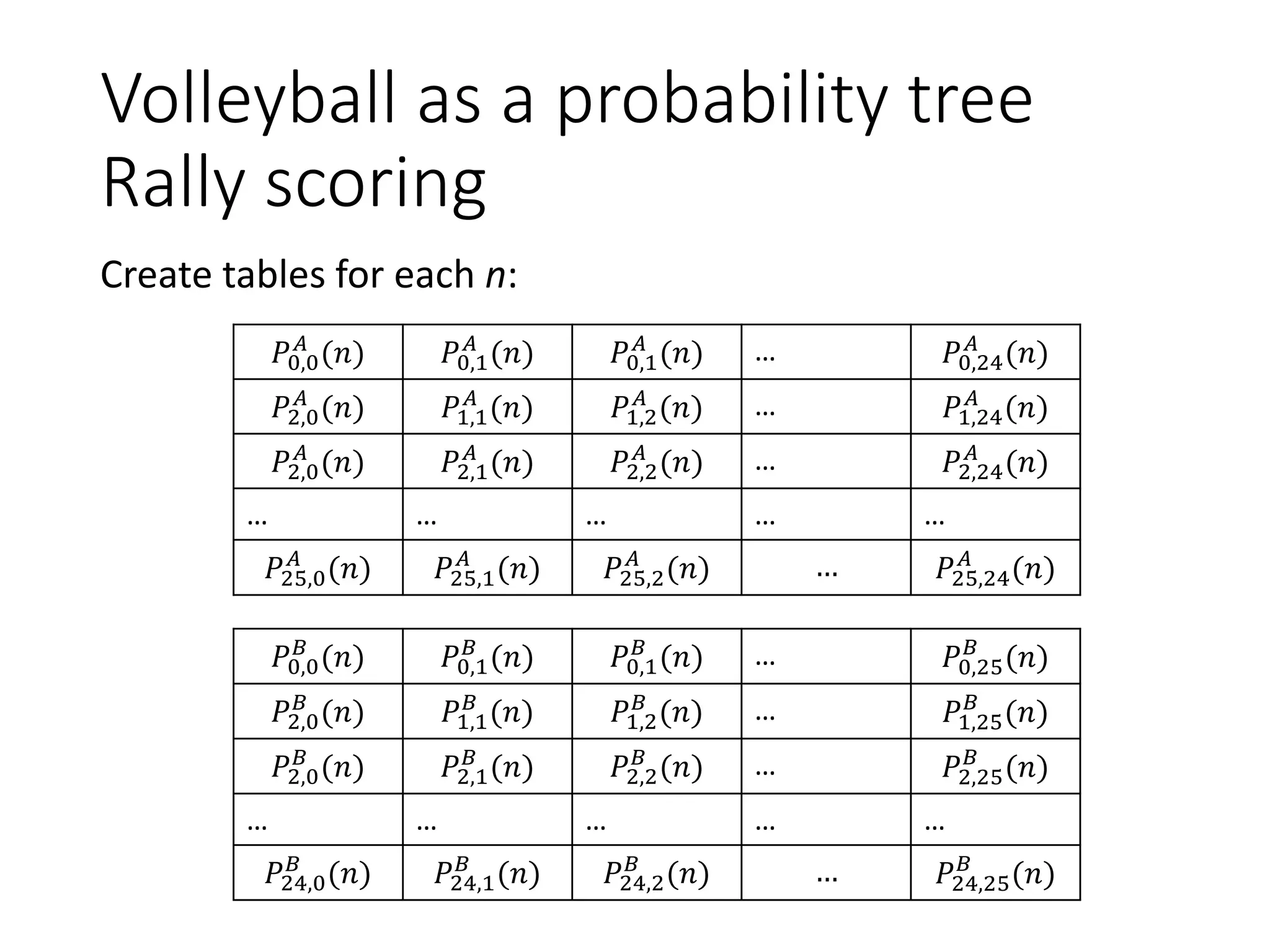
Rally scoring
Create tables for each n:
𝑃0,0
𝐴
(𝑛) 𝑃0,1
𝐴
(𝑛) 𝑃0,1
𝐴
(𝑛) … 𝑃0,24
𝐴
(𝑛)
𝑃2,0
𝐴
(𝑛) 𝑃1,1
𝐴
(𝑛) 𝑃1,2
𝐴
(𝑛) … 𝑃1,24
𝐴
(𝑛)
𝑃2,0
𝐴
(𝑛) 𝑃2,1
𝐴
(𝑛) 𝑃2,2
𝐴
(𝑛) … 𝑃2,24
𝐴
(𝑛)
… … … … …
𝑃25,0
𝐴
(𝑛) 𝑃25,1
𝐴
(𝑛) 𝑃25,2
𝐴
(𝑛) … 𝑃25,24
𝐴
(𝑛)
𝑃0,0
𝐵
(𝑛) 𝑃0,1
𝐵
(𝑛) 𝑃0,1
𝐵
(𝑛) … 𝑃0,25
𝐵
(𝑛)
𝑃2,0
𝐵
(𝑛) 𝑃1,1
𝐵
(𝑛) 𝑃1,2
𝐵
(𝑛) … 𝑃1,25
𝐵
(𝑛)
𝑃2,0
𝐵
(𝑛) 𝑃2,1
𝐵
(𝑛) 𝑃2,2
𝐵
(𝑛) … 𝑃2,25
𝐵
(𝑛)
… … … … …
𝑃24,0
𝐵
(𝑛) 𝑃24,1
𝐵
(𝑛) 𝑃24,2
𝐵
(𝑛) … 𝑃24,25
𝐵
(𝑛)
Volleyball as a probability tree
Rally scoring
Create tables for each n:
𝑃0,0
𝐴
(𝑛) 𝑃0,1
𝐴
(𝑛) 𝑃0,1
𝐴
(𝑛) … 𝑃0,24
𝐴
(𝑛)
𝑃2,0
𝐴
(𝑛) 𝑃1,1
𝐴
(𝑛) 𝑃1,2
𝐴
(𝑛) … 𝑃1,24
𝐴
(𝑛)
𝑃2,0
𝐴
(𝑛) 𝑃2,1
𝐴
(𝑛) 𝑃2,2
𝐴
(𝑛) … 𝑃2,24
𝐴
(𝑛)
… … … … …
𝑃25,0
𝐴
(𝑛) 𝑃25,1
𝐴
(𝑛) 𝑃25,2
𝐴
(𝑛) … 𝑃25,24
𝐴
(𝑛)
𝑃0,0
𝐵
(𝑛) 𝑃0,1
𝐵
(𝑛) 𝑃0,1
𝐵
(𝑛) … 𝑃0,25
𝐵
(𝑛)
𝑃2,0
𝐵
(𝑛) 𝑃1,1
𝐵
(𝑛) 𝑃1,2
𝐵
(𝑛) … 𝑃1,25
𝐵
(𝑛)
𝑃2,0
𝐵
(𝑛) 𝑃2,1
𝐵
(𝑛) 𝑃2,2
𝐵
(𝑛) … 𝑃2,25
𝐵
(𝑛)
… … … … …
𝑃24,0
𝐵
(𝑛) 𝑃24,1
𝐵
(𝑛) 𝑃24,2
𝐵
(𝑛) … 𝑃24,25
𝐵
(𝑛)
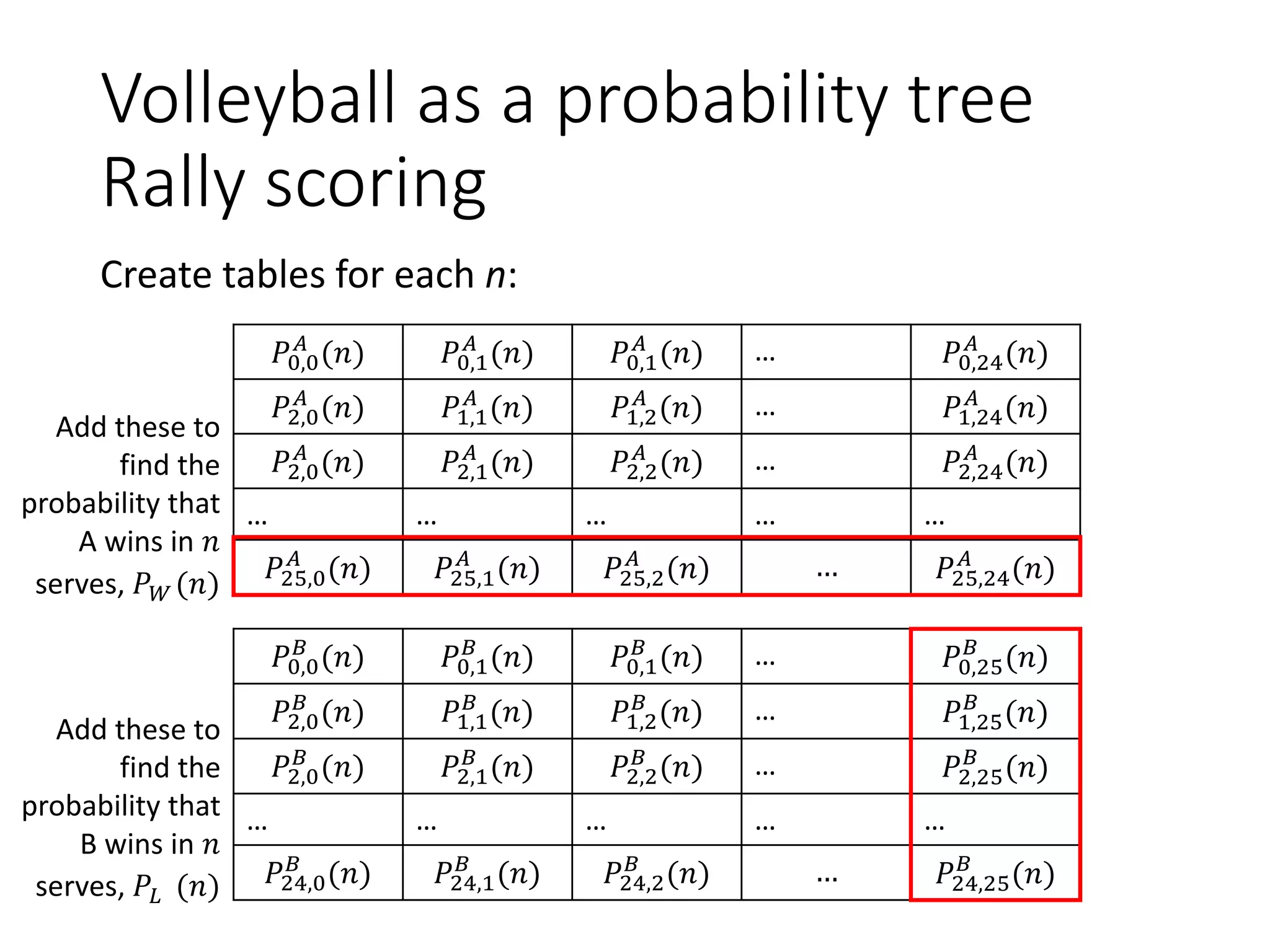
Add these to
find the
probability that
A wins in 𝑛
serves, 𝑃 𝑊 (𝑛)
Add these to
find the
probability that
B wins in 𝑛
serves, 𝑃𝐿 (𝑛)
Volleyball as a probability tree
Rally scoring
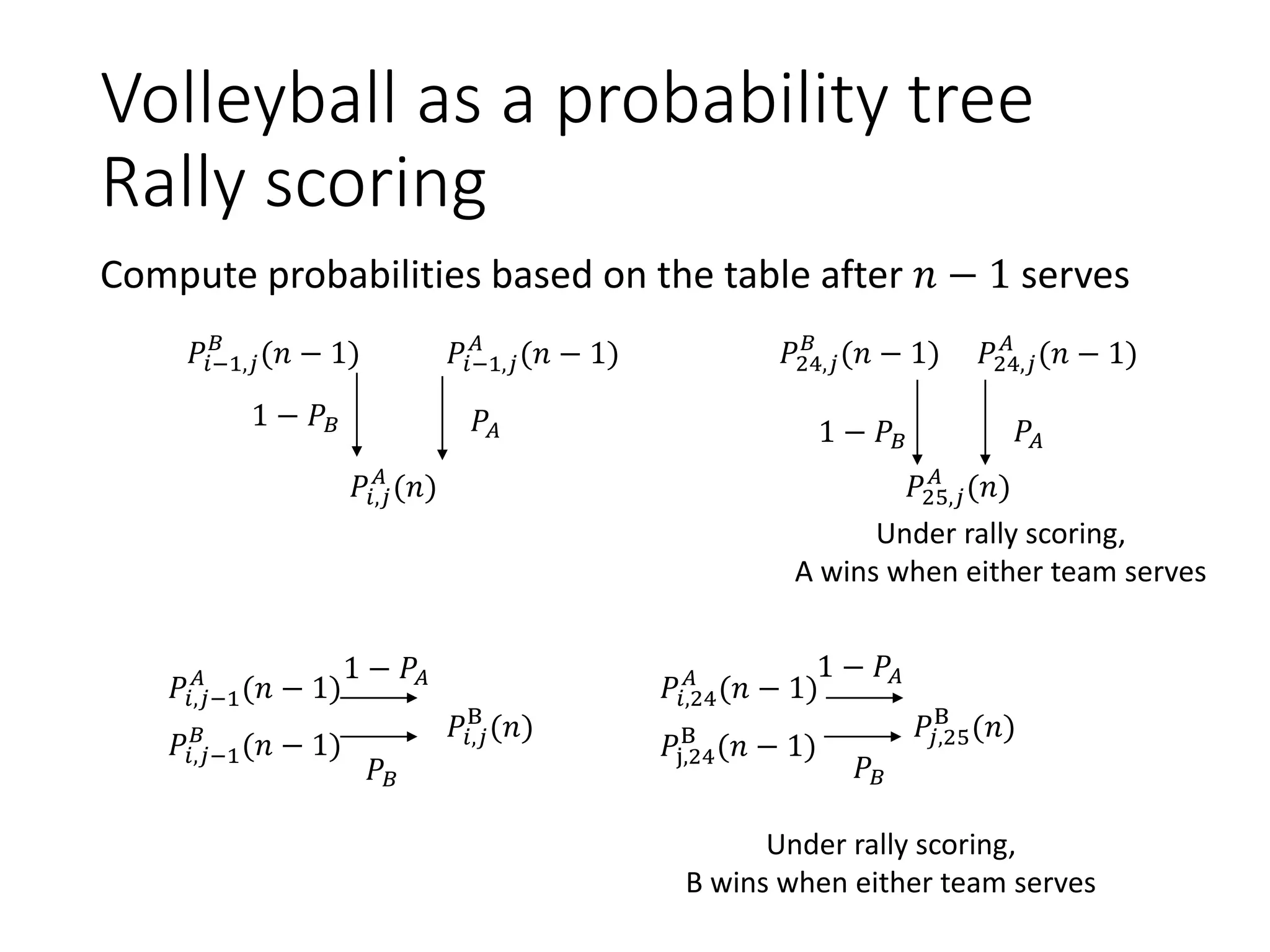
Compute probabilities based on the table after 𝑛 − 1 serves
𝑃𝑖−1,𝑗
𝐵
(𝑛 − 1) 𝑃𝑖−1,𝑗
𝐴
(𝑛 − 1) 𝑃24,𝑗
𝐵
(𝑛 − 1) 𝑃24,𝑗
𝐴
(𝑛 − 1)
𝑃𝑖,𝑗
𝐴
(𝑛) 𝑃25,𝑗
𝐴
(𝑛)
𝑃𝐴
1 − 𝑃𝐵 𝑃𝐴
Under rally scoring,
A wins when either team serves
1 − 𝑃𝐵
𝑃𝑖,𝑗−1
𝐴
(𝑛 − 1)
𝑃𝑖,𝑗
B
(𝑛)
𝑃𝑖,24
𝐴
(𝑛 − 1)
𝑃𝑗,25
B
(𝑛)
𝑃𝑖,𝑗−1
𝐵
(𝑛 − 1) 𝑃j,24
B
(𝑛 − 1)
1 − 𝑃𝐴
𝑃𝐵 𝑃𝐵
Under rally scoring,
B wins when either team serves
1 − 𝑃𝐴
Volleyball as a probability tree
Rally scoring
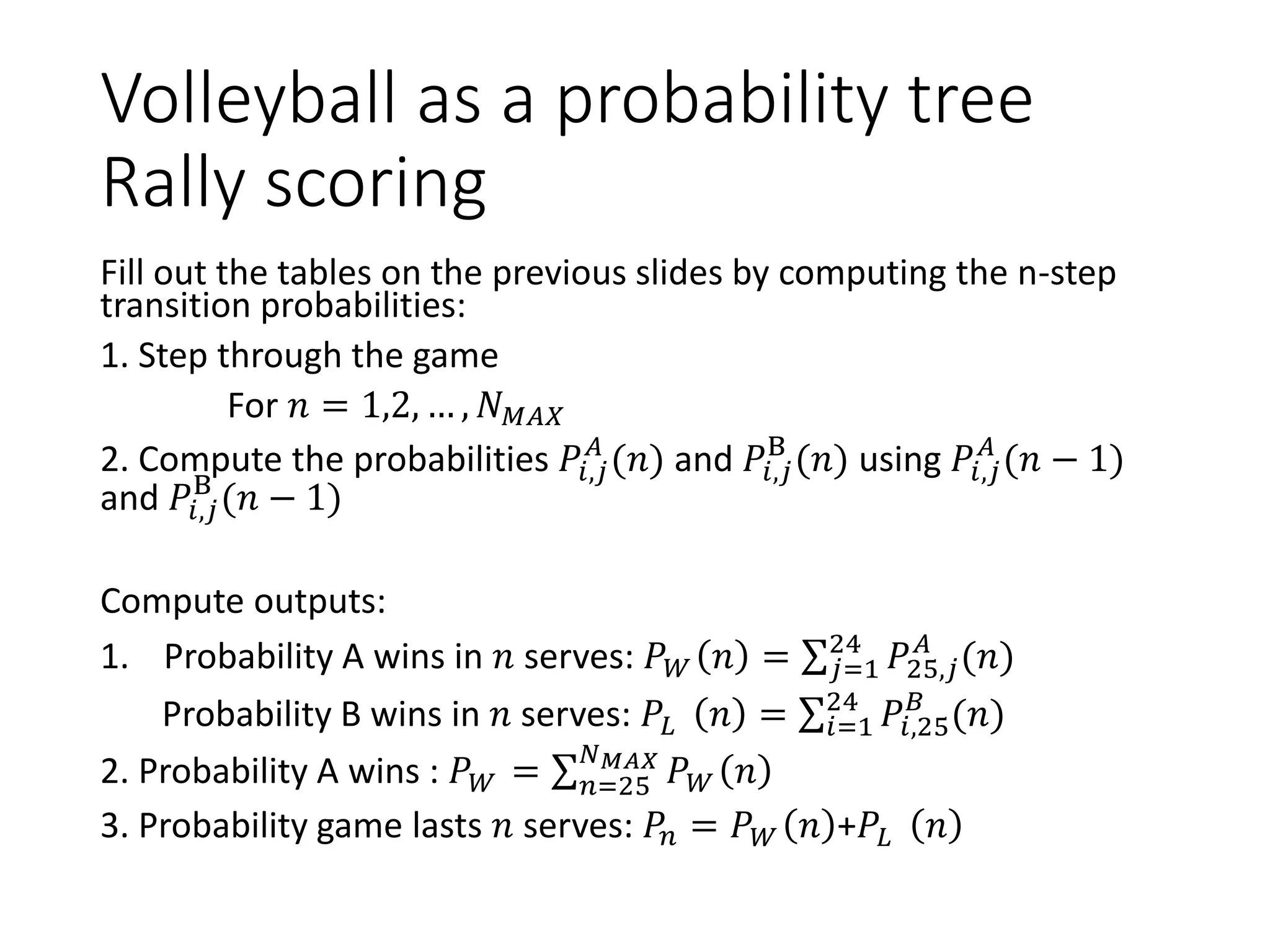
Fill out the tables on the previous slides by computing the n-step
transition probabilities:
1. Step through the game
For 𝑛 = 1,2, … , 𝑁 𝑀𝐴𝑋
2. Compute the probabilities 𝑃𝑖,𝑗
𝐴
(𝑛) and 𝑃𝑖,𝑗
B
(𝑛) using 𝑃𝑖,𝑗
𝐴
(𝑛 − 1)
and 𝑃𝑖,𝑗
B
(𝑛 − 1)
Compute outputs:
1. Probability A wins in 𝑛 serves: 𝑃 𝑊 𝑛 = σ 𝑗=1
24
𝑃25,𝑗
𝐴
(𝑛)
Probability B wins in 𝑛 serves: 𝑃𝐿 𝑛 = σ𝑖=1
24
𝑃𝑖,25
𝐵
(𝑛)
2. Probability A wins : 𝑃 𝑊 = σ 𝑛=25
𝑁 𝑀𝐴𝑋
𝑃 𝑊 𝑛
3. Probability game lasts 𝑛 serves: 𝑃𝑛 = 𝑃 𝑊 𝑛 +𝑃𝐿 𝑛
Questions
- How long will a game last under each scheme (total
serves N)?
𝐸 𝑁 = σ 𝑛=15
𝑁 𝑀𝐴𝑋
𝑛 𝑃𝑛
- What is the probability that a team wins in each
scheme?
A wins with probability 𝑃 𝑊 and loses with probability 1 − 𝑃 𝑊
- What is the value of serving first in classic scoring?
Compute 𝑃 𝑊 with 𝑃0,0
𝐴
0 = 1 (call it 𝑃 𝑊
𝐴
)
Compute 𝑃 𝑊 with 𝑃0,0
𝐵
0 = 1 (call it 𝑃 𝑊
𝐵
)
Compute 𝑃 𝑊
𝐴
− 𝑃 𝑊
𝐵
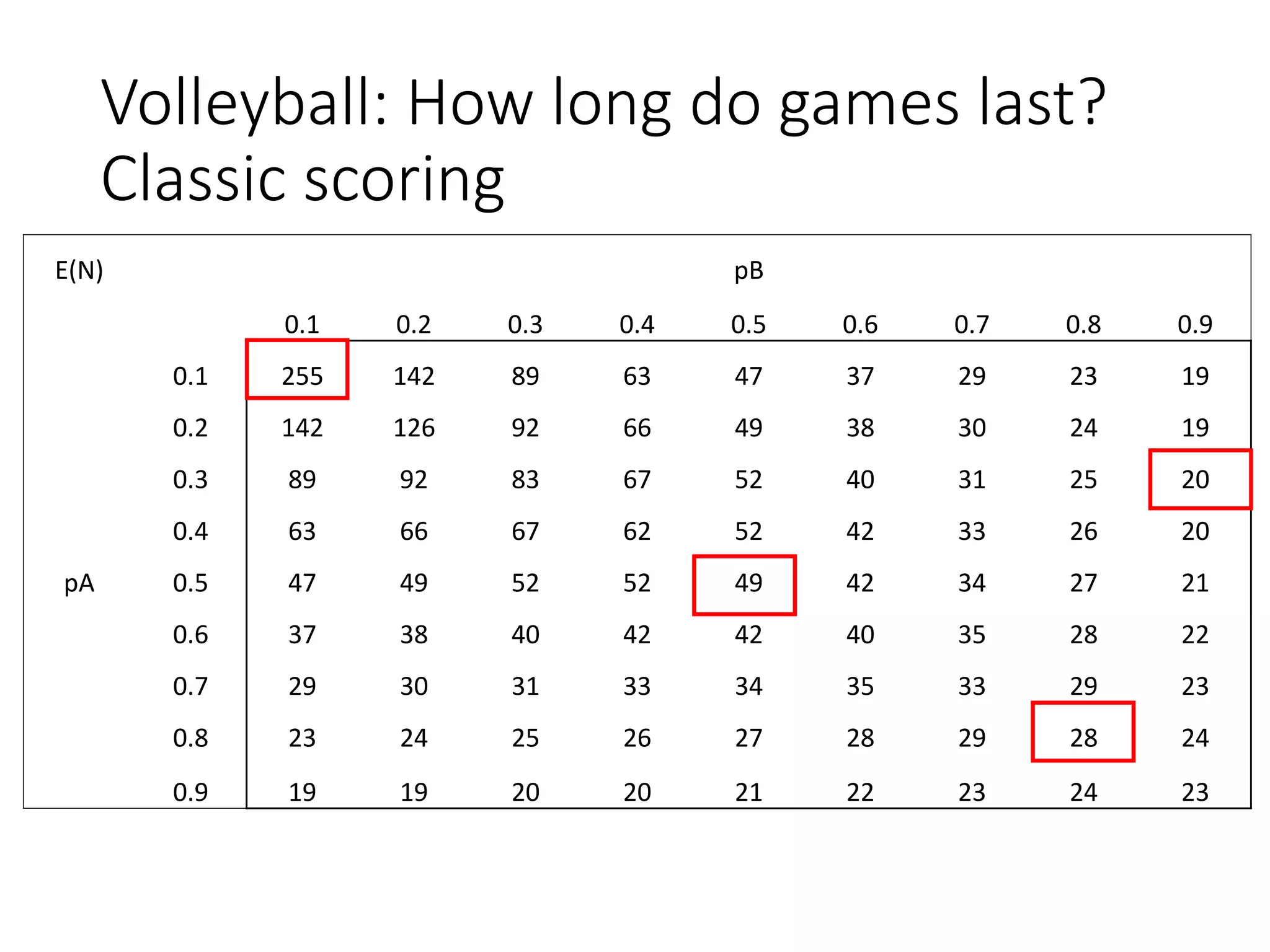
Volleyball: How long do games last?
Classic scoring
E(N) pB
0.1 0.2 0.3 0.4 0.5 0.6 0.7 0.8 0.9
0.1 255 142 89 63 47 37 29 23 19
0.2 142 126 92 66 49 38 30 24 19
0.3 89 92 83 67 52 40 31 25 20
0.4 63 66 67 62 52 42 33 26 20
pA 0.5 47 49 52 52 49 42 34 27 21
0.6 37 38 40 42 42 40 35 28 22
0.7 29 30 31 33 34 35 33 29 23
0.8 23 24 25 26 27 28 29 28 24
0.9 19 19 20 20 21 22 23 24 23
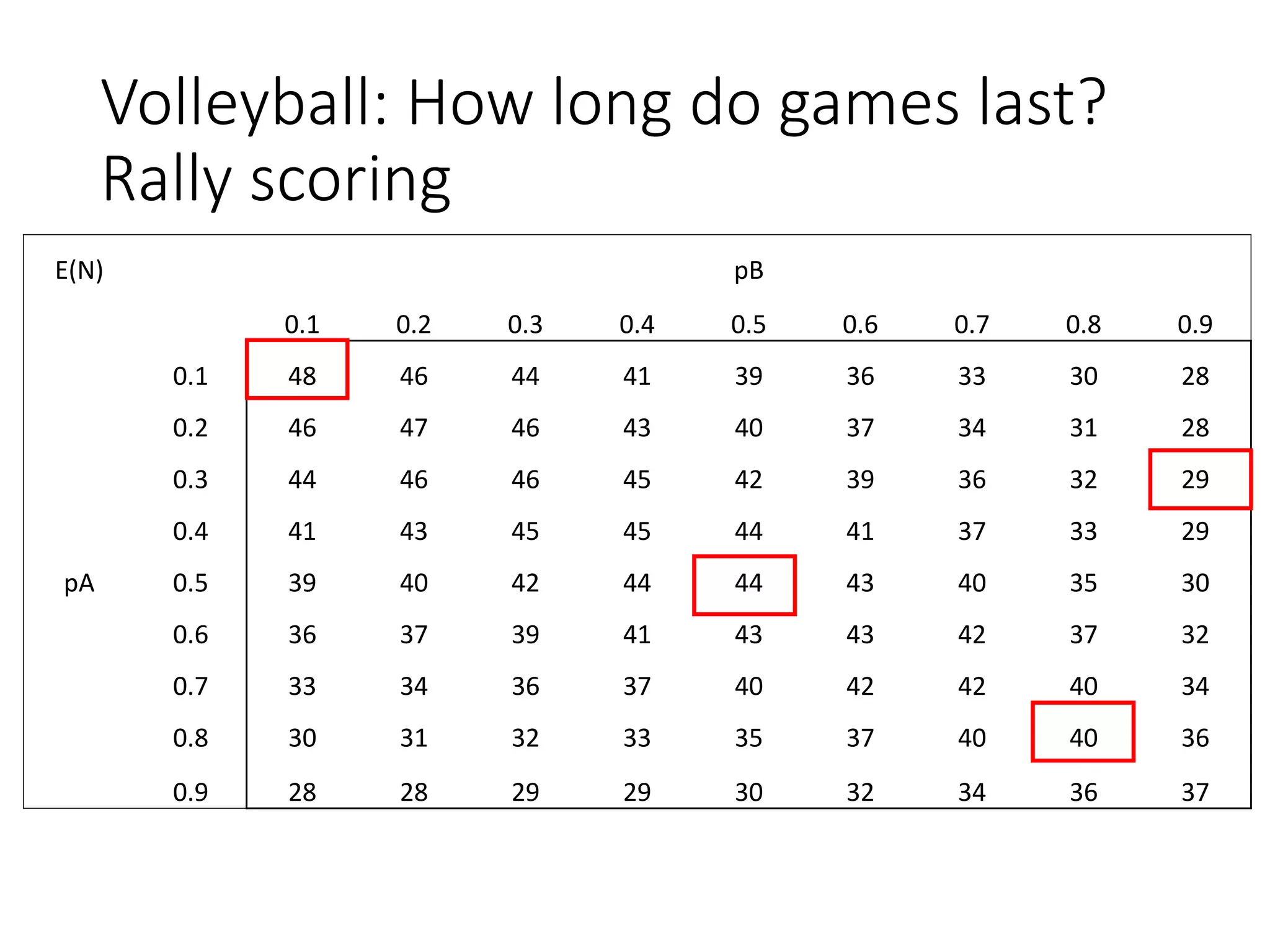
Volleyball: How long do games last?
Rally scoring
E(N) pB
0.1 0.2 0.3 0.4 0.5 0.6 0.7 0.8 0.9
0.1 48 46 44 41 39 36 33 30 28
0.2 46 47 46 43 40 37 34 31 28
0.3 44 46 46 45 42 39 36 32 29
0.4 41 43 45 45 44 41 37 33 29
pA 0.5 39 40 42 44 44 43 40 35 30
0.6 36 37 39 41 43 43 42 37 32
0.7 33 34 36 37 40 42 42 40 34
0.8 30 31 32 33 35 37 40 40 36
0.9 28 28 29 29 30 32 34 36 37
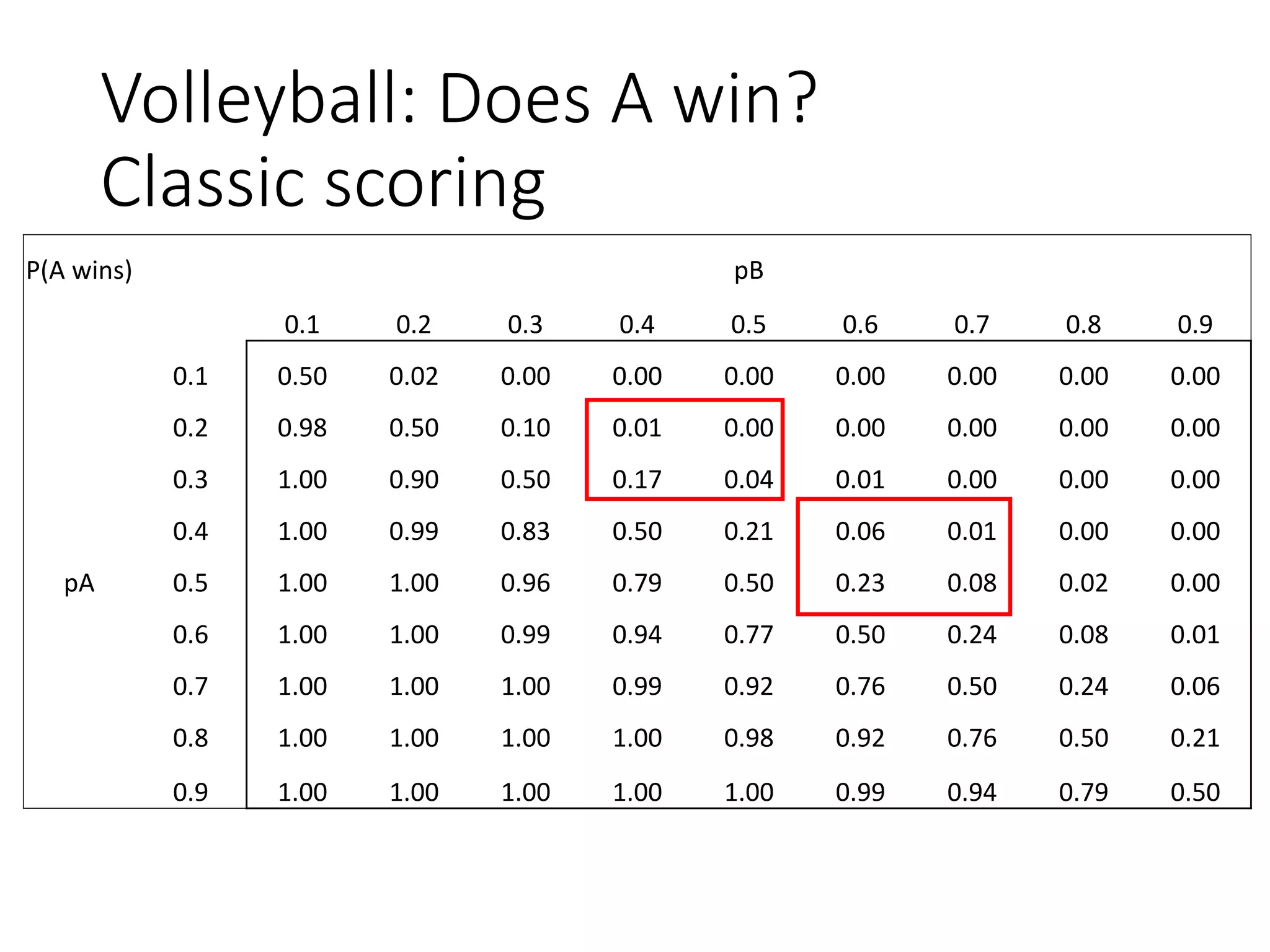
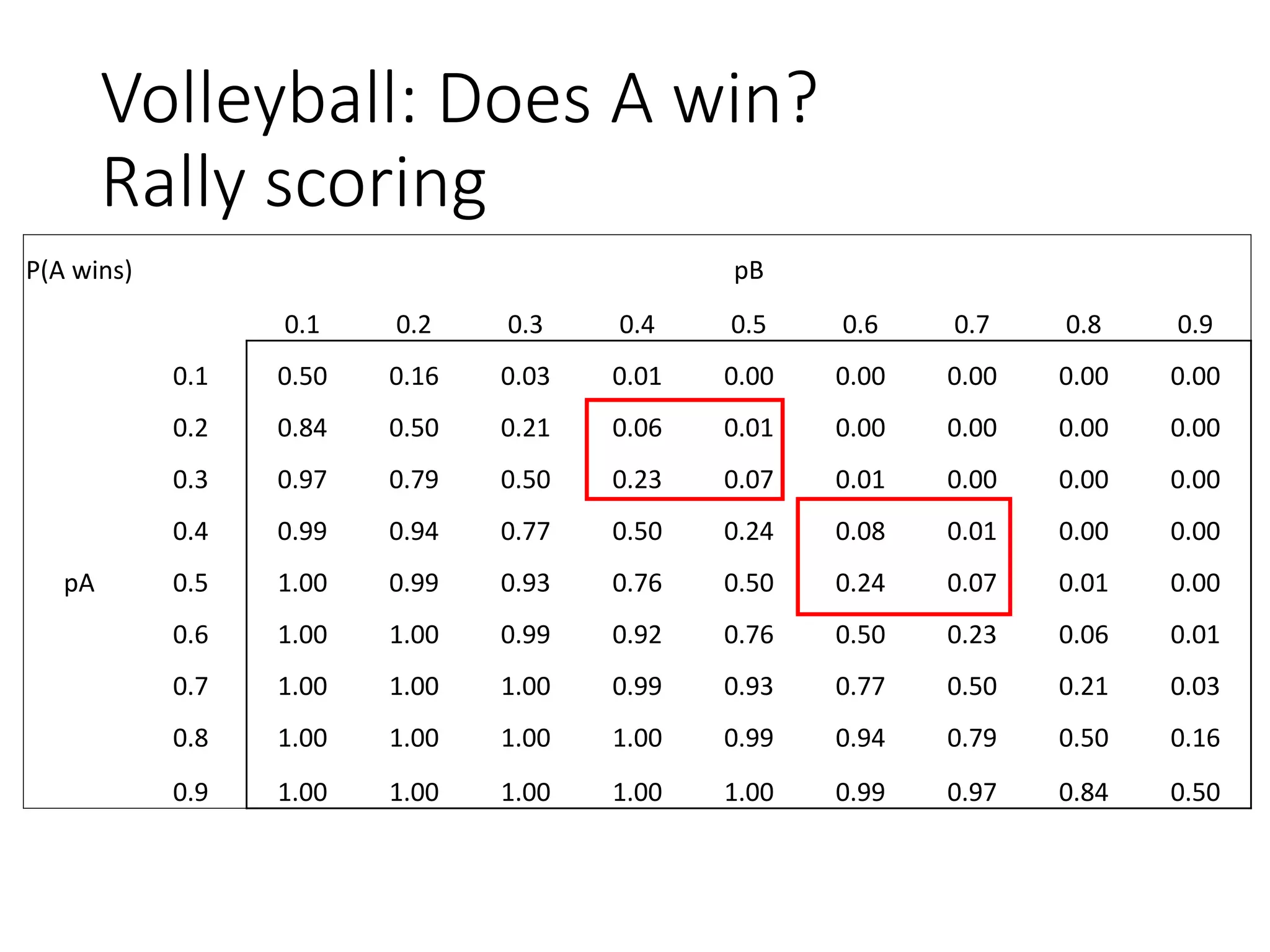
Volleyball: Does A win?
Classic scoring
P(A wins) pB
0.1 0.2 0.3 0.4 0.5 0.6 0.7 0.8 0.9
0.1 0.50 0.02 0.00 0.00 0.00 0.00 0.00 0.00 0.00
0.2 0.98 0.50 0.10 0.01 0.00 0.00 0.00 0.00 0.00
0.3 1.00 0.90 0.50 0.17 0.04 0.01 0.00 0.00 0.00
0.4 1.00 0.99 0.83 0.50 0.21 0.06 0.01 0.00 0.00
pA 0.5 1.00 1.00 0.96 0.79 0.50 0.23 0.08 0.02 0.00
0.6 1.00 1.00 0.99 0.94 0.77 0.50 0.24 0.08 0.01
0.7 1.00 1.00 1.00 0.99 0.92 0.76 0.50 0.24 0.06
0.8 1.00 1.00 1.00 1.00 0.98 0.92 0.76 0.50 0.21
0.9 1.00 1.00 1.00 1.00 1.00 0.99 0.94 0.79 0.50
Volleyball: Does A win?
Rally scoring
P(A wins) pB
0.1 0.2 0.3 0.4 0.5 0.6 0.7 0.8 0.9
0.1 0.50 0.16 0.03 0.01 0.00 0.00 0.00 0.00 0.00
0.2 0.84 0.50 0.21 0.06 0.01 0.00 0.00 0.00 0.00
0.3 0.97 0.79 0.50 0.23 0.07 0.01 0.00 0.00 0.00
0.4 0.99 0.94 0.77 0.50 0.24 0.08 0.01 0.00 0.00
pA 0.5 1.00 0.99 0.93 0.76 0.50 0.24 0.07 0.01 0.00
0.6 1.00 1.00 0.99 0.92 0.76 0.50 0.23 0.06 0.01
0.7 1.00 1.00 1.00 0.99 0.93 0.77 0.50 0.21 0.03
0.8 1.00 1.00 1.00 1.00 0.99 0.94 0.79 0.50 0.16
0.9 1.00 1.00 1.00 1.00 1.00 0.99 0.97 0.84 0.50
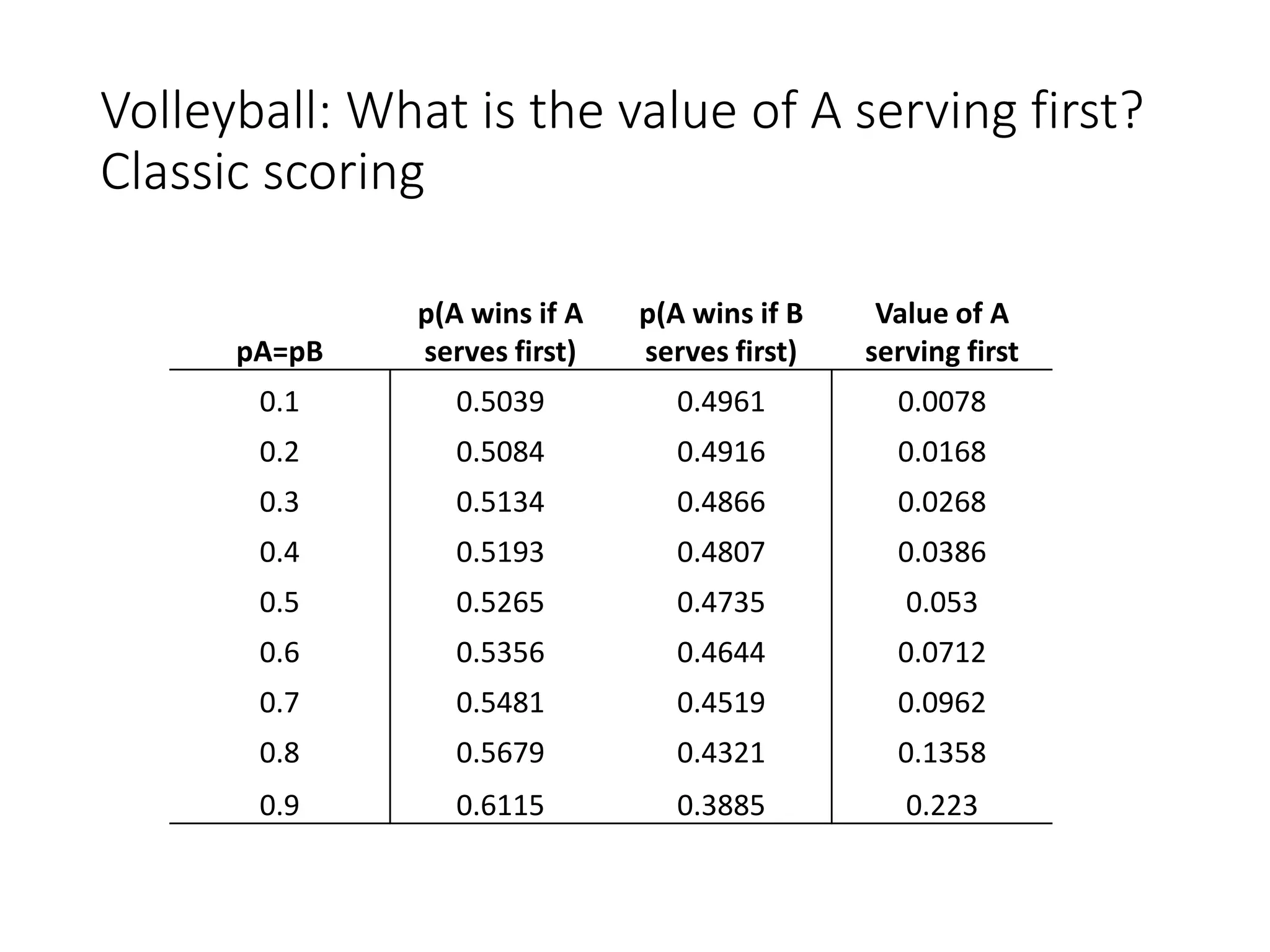
Volleyball: What is the value of A serving first?
Classic scoring
pA=pB
p(A wins if A
serves first)
p(A wins if B
serves first)
Value of A
serving first
0.1 0.5039 0.4961 0.0078
0.2 0.5084 0.4916 0.0168
0.3 0.5134 0.4866 0.0268
0.4 0.5193 0.4807 0.0386
0.5 0.5265 0.4735 0.053
0.6 0.5356 0.4644 0.0712
0.7 0.5481 0.4519 0.0962
0.8 0.5679 0.4321 0.1358
0.9 0.6115 0.3885 0.223
What are other sports that can
benefit from this analysis?
• Badminton
• Tennis
What are other applications that can
benefit from this analysis?
For more reading
• P. E. Pfeifer and S. J. Deutsch, 1981. “A probabilistic model
for evaluation of volleyball scoring systems, Research
Quarterly for Exercise and Sport 52(3), 330 – 338.

Volleyball analytics: Modeling volleyball using Markov chains

  • 1.
    Probability models forpredictive analytics: Markov chains Laura Albert Badger Bracketology @lauraalbertphd @badgerbrackets http://bracketology.engr.wisc.edu/
  • 2.
    2 Volleyball scoring schemewhere teams A and B play Two scoring schemes: - Classic “sideout” scoring: the only team that can score points is the team that serves the ball - Rally scoring: a point is awarded after each play https://www.reference.com/sports-active-lifestyle/volleyball-scoring-system-207607d9d3d262ae# Questions: - How long will a game last under each scheme (total serves N)? - What is the probability that a team wins in each scheme? - What is the value of serving first in classic scoring? Let’s consider a model called a Markov chain to help us answer these questions.
  • 3.
    3 Consider a stochasticprocess {𝑋 𝑛, 𝑛 = 0,1,2, … } that can assume a finite or countably infinite number of values, say Ω = {0,1,2, … }. Therefore, {𝑋 𝑛 = 𝑖} means that the process is in state 𝑖 at time (index) 𝑛. Suppose that the probability the process moves from state 𝑖 to state 𝑗 is 𝑃𝑖𝑗 = 𝑃(𝑋 𝑛+1 = 𝑗|𝑋 𝑛 = 𝑖, 𝑋 𝑛−1 = 𝑖 𝑛−1, … , 𝑋1 = 𝑖1, 𝑋0 = 𝑖0) = 𝑃(𝑋 𝑛+1 = 𝑗|𝑋 𝑛 = 𝑖) This process is called a (discrete-time) Markov Chain. X0 = i0 X1 = i1 X2 = i2 X3 = i3 … Xn = i Xn+1 = j 𝑃𝑖𝑗 Xn-1 = in-1 Past history is irrelevant
  • 4.
    4 Volleyball scoring schemewhere teams A and B play Assumptions: (1) The probability that team A wins the point when serving is 𝑃𝐴. Likewise the probability that B wins when A serves is 1 − 𝑃𝐴. (2) The probability that team B wins the point when serving is 𝑃𝐵. Likewise the probability that A wins when B serves is 1 − 𝑃𝐵. (3) Each play is independent, meaning that 𝑃𝐴 and 𝑃𝐵 do not depend on the score nor the previous play. (4) Under classic scoring, teams play until someone reaches 15. Under rally scoring, teams play until someone reaches 25. For simplicity, we will assume that teams do not have to win by 2. Originally, Rally scoring was called “Fin30” and played to 30 points.
  • 5.
    Volleyball as aMarkov chain We have to describe the state of the system It has these components: (a) Score (𝑖, 𝑗) where team A has 𝑖 points and team B has 𝑗 points (b) Serving team (A or B) Note: we have to keep track of the number of serves 𝑛 We only need to keep track of N to compute 𝐸[𝑁] Transition probabilities: 𝑃𝑖𝑗 𝐴 or 𝑃𝑖𝑗 𝐵 = the probability that team A has 𝑖 points and team B has 𝑗 points and team A (or B) is serving. The state is (𝑖, 𝑗, 𝐴/𝐵) for 𝑖 = 0,1, … .15 𝑜𝑟 25 and 𝑗 = 0,1, … 15 𝑜𝑟 25 Either 𝑖 or 𝑗 is capped (except for the requirement to win by 2) We assume 𝑃𝑖𝑗 𝐴 or 𝑃𝑖𝑗 𝐵 are stationary across 𝑛. Starting state: 𝑃00 𝐴 0 = 1 if A serves first 𝑃00 𝐵 0 = 1 if B serves first. 𝑃00 𝐴 0 = 𝑃00 𝐵 0 = 0.5 if we consider an “average” game
  • 6.
    Volleyball as aMarkov chain We assume 𝑃𝑖𝑗 𝐴 or 𝑃𝑖𝑗 𝐵 are stationary across 𝑛. Let 𝑃𝑖𝑗 𝐴 (𝑛) or 𝑃𝑖𝑗 𝐵 (𝑛) capture the probability that the score is 𝑖, 𝑗 with A (or B) serving first after 𝑛 servers. Starting state: 𝑋0 = (0,0, 𝐴) or (0,0, 𝐵) based on who is serving first. In other words: 𝑃00 𝐴 0 = 1 if A serves first 𝑃00 𝐵 0 = 1 if B serves first. 𝑃00 𝐴 0 = 𝑃00 𝐵 0 = 0.5 if we consider an “average” game
  • 7.
    Volleyball as aprobability tree Classic scoring Assume A serves first. Enumerate outcomes Problem: the tree has exponential growth in n! Solution: put the values in a table 𝑃00 𝐴 (0) 𝑃10 𝐴 (1) 𝑃20 𝐴 (2) 𝑃𝐴 2 𝑃10 𝐵 (2) 𝑃𝐴 (1 − 𝑃𝐴) 𝑃00 𝐵 (1) 𝑃00 𝐴 (2) (1 − 𝑃𝐴)(1 − 𝑃𝐵) 𝑃01 𝐵 (2) (1 − 𝑃𝐴) 𝑃𝐵
  • 8.
    Volleyball as aprobability tree Classic scoring Create tables for each n to capture the n-step transition probabilities (ignore the requirement to win by 2): 𝑃0,0 𝐴 (𝑛) 𝑃0,1 𝐴 (𝑛) 𝑃0,1 𝐴 (𝑛) … 𝑃0,14 𝐴 (𝑛) 𝑃2,0 𝐴 (𝑛) 𝑃1,1 𝐴 (𝑛) 𝑃1,2 𝐴 (𝑛) … 𝑃1,14 𝐴 (𝑛) 𝑃2,0 𝐴 (𝑛) 𝑃2,1 𝐴 (𝑛) 𝑃2,2 𝐴 (𝑛) … 𝑃2,14 𝐴 (𝑛) … … … … … 𝑃15,0 𝐴 (𝑛) 𝑃15,1 𝐴 (𝑛) 𝑃15,2 𝐴 (𝑛) … 𝑃15,14 𝐴 (𝑛) 𝑃0,0 𝐵 (𝑛) 𝑃0,1 𝐵 (𝑛) 𝑃0,1 𝐵 (𝑛) … 𝑃0,15 𝐵 (𝑛) 𝑃2,0 𝐵 (𝑛) 𝑃1,1 𝐵 (𝑛) 𝑃1,2 𝐵 (𝑛) … 𝑃1,15 𝐵 (𝑛) 𝑃2,0 𝐵 (𝑛) 𝑃2,1 𝐵 (𝑛) 𝑃2,2 𝐵 (𝑛) … 𝑃2,15 𝐵 (𝑛) … … … … … 𝑃14,0 𝐵 (𝑛) 𝑃14,1 𝐵 (𝑛) 𝑃14,2 𝐵 (𝑛) … 𝑃14,15 𝐵 (𝑛)
  • 9.
    Volleyball as aprobability tree Classic scoring Create tables for each n: 𝑃0,0 𝐴 (𝑛) 𝑃0,1 𝐴 (𝑛) 𝑃0,1 𝐴 (𝑛) … 𝑃0,14 𝐴 (𝑛) 𝑃2,0 𝐴 (𝑛) 𝑃1,1 𝐴 (𝑛) 𝑃1,2 𝐴 (𝑛) … 𝑃1,14 𝐴 (𝑛) 𝑃2,0 𝐴 (𝑛) 𝑃2,1 𝐴 (𝑛) 𝑃2,2 𝐴 (𝑛) … 𝑃2,14 𝐴 (𝑛) … … … … … 𝑃15,0 𝐴 (𝑛) 𝑃15,1 𝐴 (𝑛) 𝑃15,2 𝐴 (𝑛) … 𝑃15,14 𝐴 (𝑛) 𝑃0,0 𝐵 (𝑛) 𝑃0,1 𝐵 (𝑛) 𝑃0,1 𝐵 (𝑛) … 𝑃0,15 𝐵 (𝑛) 𝑃2,0 𝐵 (𝑛) 𝑃1,1 𝐵 (𝑛) 𝑃1,2 𝐵 (𝑛) … 𝑃1,15 𝐵 (𝑛) 𝑃2,0 𝐵 (𝑛) 𝑃2,1 𝐵 (𝑛) 𝑃2,2 𝐵 (𝑛) … 𝑃2,15 𝐵 (𝑛) … … … … … 𝑃14,0 𝐵 (𝑛) 𝑃14,1 𝐵 (𝑛) 𝑃14,2 𝐵 (𝑛) … 𝑃14,15 𝐵 (𝑛) Add these to find the probability that A wins in 𝑛 serves, 𝑃 𝑊 (𝑛)
  • 10.
    Volleyball as aprobability tree Classic scoring Create tables for each n: 𝑃0,0 𝐴 (𝑛) 𝑃0,1 𝐴 (𝑛) 𝑃0,1 𝐴 (𝑛) … 𝑃0,14 𝐴 (𝑛) 𝑃2,0 𝐴 (𝑛) 𝑃1,1 𝐴 (𝑛) 𝑃1,2 𝐴 (𝑛) … 𝑃1,14 𝐴 (𝑛) 𝑃2,0 𝐴 (𝑛) 𝑃2,1 𝐴 (𝑛) 𝑃2,2 𝐴 (𝑛) … 𝑃2,14 𝐴 (𝑛) … … … … … 𝑃15,0 𝐴 (𝑛) 𝑃15,1 𝐴 (𝑛) 𝑃15,2 𝐴 (𝑛) … 𝑃15,14 𝐴 (𝑛) 𝑃0,0 𝐵 (𝑛) 𝑃0,1 𝐵 (𝑛) 𝑃0,1 𝐵 (𝑛) … 𝑃0,15 𝐵 (𝑛) 𝑃2,0 𝐵 (𝑛) 𝑃1,1 𝐵 (𝑛) 𝑃1,2 𝐵 (𝑛) … 𝑃1,15 𝐵 (𝑛) 𝑃2,0 𝐵 (𝑛) 𝑃2,1 𝐵 (𝑛) 𝑃2,2 𝐵 (𝑛) … 𝑃2,15 𝐵 (𝑛) … … … … … 𝑃14,0 𝐵 (𝑛) 𝑃14,1 𝐵 (𝑛) 𝑃14,2 𝐵 (𝑛) … 𝑃14,15 𝐵 (𝑛) Add these to find the probability that B wins in 𝑛 serves, 𝑃𝐿 (𝑛)
  • 11.
    Volleyball as aprobability tree Classic scoring Compute probabilities based on the table after 𝑛 − 1 serves 𝑃𝑖−1,𝑗 𝐴 (𝑛 − 1) 𝑃14,𝑗 𝐴 (𝑛 − 1) 𝑃𝑖,𝑗 𝐵 (𝑛 − 1) 𝑃𝑖,𝑗 𝐴 (𝑛) 𝑃15,𝑗 𝐴 (𝑛) 𝑃𝐴 1 − 𝑃𝐵 𝑃𝐴 Under classic scoring, A only wins when serving
  • 12.
    Volleyball as aprobability tree Classic scoring Compute probabilities based on the table after 𝑛 − 1 serves 𝑃𝑖−1,𝑗 𝐴 (𝑛 − 1) 𝑃14,𝑗 𝐴 (𝑛 − 1) 𝑃𝑖,𝑗 𝐵 (𝑛 − 1) 𝑃𝑖,𝑗 𝐴 (𝑛) 𝑃15,𝑗 𝐴 (𝑛) 𝑃𝐴 1 − 𝑃𝐵 𝑃𝐴 Under classic scoring, A only wins when serving 𝑃𝑖,𝑗 𝐴 (𝑛 − 1) 𝑃𝑖,𝑗−1 𝐵 (𝑛 − 1) 𝑃𝑖,𝑗 B (𝑛) 𝑃j,14 B (𝑛 − 1) 𝑃𝑗,15 B (𝑛) 1 − 𝑃𝐴 𝑃𝐵 𝑃𝐵 Under classic scoring, B only wins when serving No score change with a side out
  • 13.
    Volleyball as aprobability tree Classic scoring Fill out the tables on the previous slides by computing the n-step transition probabilities: 1. Step through the game For 𝑛 = 1,2, … , 𝑁 𝑀𝐴𝑋 𝑁 𝑀𝐴𝑋 = the max number of serves (theoretically infinite) 2. Compute the probabilities 𝑃𝑖,𝑗 𝐴 (𝑛) and 𝑃𝑖,𝑗 B (𝑛) using 𝑃𝑖,𝑗 𝐴 (𝑛 − 1) and 𝑃𝑖,𝑗 B (𝑛 − 1) Compute outputs: 1. Probability A wins in 𝑛 serves: 𝑃 𝑊 𝑛 = σ 𝑗=1 14 𝑃15,𝑗 𝐴 (𝑛) Probability B wins in 𝑛 serves: 𝑃𝐿 𝑛 = σ𝑖=1 14 𝑃𝑖,15 𝐵 (𝑛) 2. Probability A wins : 𝑃 𝑊 = σ 𝑛=15 𝑁 𝑀𝐴𝑋 𝑃 𝑊 𝑛 3. Probability game lasts 𝑛 serves: 𝑃𝑛 = 𝑃 𝑊 𝑛 +𝑃𝐿 𝑛
  • 14.
    Volleyball as aprobability tree Classic scoring: MATLAB code demo Loop through each value of n: 𝑃0,0 𝐴 (𝑛) 𝑃0,1 𝐴 (𝑛) 𝑃0,1 𝐴 (𝑛) … 𝑃0,14 𝐴 (𝑛) 𝑃2,0 𝐴 (𝑛) 𝑃1,1 𝐴 (𝑛) 𝑃1,2 𝐴 (𝑛) … 𝑃1,14 𝐴 (𝑛) 𝑃2,0 𝐴 (𝑛) 𝑃2,1 𝐴 (𝑛) 𝑃2,2 𝐴 (𝑛) … 𝑃2,14 𝐴 (𝑛) … … … … … 𝑃15,0 𝐴 (𝑛) 𝑃15,1 𝐴 (𝑛) 𝑃15,2 𝐴 (𝑛) … 𝑃15,14 𝐴 (𝑛) 𝑃0,0 𝐵 (𝑛) 𝑃0,1 𝐵 (𝑛) 𝑃0,1 𝐵 (𝑛) … 𝑃0,15 𝐵 (𝑛) 𝑃2,0 𝐵 (𝑛) 𝑃1,1 𝐵 (𝑛) 𝑃1,2 𝐵 (𝑛) … 𝑃1,15 𝐵 (𝑛) 𝑃2,0 𝐵 (𝑛) 𝑃2,1 𝐵 (𝑛) 𝑃2,2 𝐵 (𝑛) … 𝑃2,15 𝐵 (𝑛) … … … … … 𝑃14,0 𝐵 (𝑛) 𝑃14,1 𝐵 (𝑛) 𝑃14,2 𝐵 (𝑛) … 𝑃14,15 𝐵 (𝑛) A’s score B’s score
  • 15.
    Rally scoring: whatchanges? Assumption: Under classic scoring, teams play until someone reaches 15. Under rally scoring, teams play until someone reaches 25. For simplicity, we will assume that teams do not have to win by 2.
  • 16.
    Volleyball as aprobability tree Rally scoring Create tables for each n: 𝑃0,0 𝐴 (𝑛) 𝑃0,1 𝐴 (𝑛) 𝑃0,1 𝐴 (𝑛) … 𝑃0,24 𝐴 (𝑛) 𝑃2,0 𝐴 (𝑛) 𝑃1,1 𝐴 (𝑛) 𝑃1,2 𝐴 (𝑛) … 𝑃1,24 𝐴 (𝑛) 𝑃2,0 𝐴 (𝑛) 𝑃2,1 𝐴 (𝑛) 𝑃2,2 𝐴 (𝑛) … 𝑃2,24 𝐴 (𝑛) … … … … … 𝑃25,0 𝐴 (𝑛) 𝑃25,1 𝐴 (𝑛) 𝑃25,2 𝐴 (𝑛) … 𝑃25,24 𝐴 (𝑛) 𝑃0,0 𝐵 (𝑛) 𝑃0,1 𝐵 (𝑛) 𝑃0,1 𝐵 (𝑛) … 𝑃0,25 𝐵 (𝑛) 𝑃2,0 𝐵 (𝑛) 𝑃1,1 𝐵 (𝑛) 𝑃1,2 𝐵 (𝑛) … 𝑃1,25 𝐵 (𝑛) 𝑃2,0 𝐵 (𝑛) 𝑃2,1 𝐵 (𝑛) 𝑃2,2 𝐵 (𝑛) … 𝑃2,25 𝐵 (𝑛) … … … … … 𝑃24,0 𝐵 (𝑛) 𝑃24,1 𝐵 (𝑛) 𝑃24,2 𝐵 (𝑛) … 𝑃24,25 𝐵 (𝑛)
  • 17.
    Volleyball as aprobability tree Rally scoring Create tables for each n: 𝑃0,0 𝐴 (𝑛) 𝑃0,1 𝐴 (𝑛) 𝑃0,1 𝐴 (𝑛) … 𝑃0,24 𝐴 (𝑛) 𝑃2,0 𝐴 (𝑛) 𝑃1,1 𝐴 (𝑛) 𝑃1,2 𝐴 (𝑛) … 𝑃1,24 𝐴 (𝑛) 𝑃2,0 𝐴 (𝑛) 𝑃2,1 𝐴 (𝑛) 𝑃2,2 𝐴 (𝑛) … 𝑃2,24 𝐴 (𝑛) … … … … … 𝑃25,0 𝐴 (𝑛) 𝑃25,1 𝐴 (𝑛) 𝑃25,2 𝐴 (𝑛) … 𝑃25,24 𝐴 (𝑛) 𝑃0,0 𝐵 (𝑛) 𝑃0,1 𝐵 (𝑛) 𝑃0,1 𝐵 (𝑛) … 𝑃0,25 𝐵 (𝑛) 𝑃2,0 𝐵 (𝑛) 𝑃1,1 𝐵 (𝑛) 𝑃1,2 𝐵 (𝑛) … 𝑃1,25 𝐵 (𝑛) 𝑃2,0 𝐵 (𝑛) 𝑃2,1 𝐵 (𝑛) 𝑃2,2 𝐵 (𝑛) … 𝑃2,25 𝐵 (𝑛) … … … … … 𝑃24,0 𝐵 (𝑛) 𝑃24,1 𝐵 (𝑛) 𝑃24,2 𝐵 (𝑛) … 𝑃24,25 𝐵 (𝑛) Add these to find the probability that A wins in 𝑛 serves, 𝑃 𝑊 (𝑛) Add these to find the probability that B wins in 𝑛 serves, 𝑃𝐿 (𝑛)
  • 18.
    Volleyball as aprobability tree Rally scoring Compute probabilities based on the table after 𝑛 − 1 serves 𝑃𝑖−1,𝑗 𝐵 (𝑛 − 1) 𝑃𝑖−1,𝑗 𝐴 (𝑛 − 1) 𝑃24,𝑗 𝐵 (𝑛 − 1) 𝑃24,𝑗 𝐴 (𝑛 − 1) 𝑃𝑖,𝑗 𝐴 (𝑛) 𝑃25,𝑗 𝐴 (𝑛) 𝑃𝐴 1 − 𝑃𝐵 𝑃𝐴 Under rally scoring, A wins when either team serves 1 − 𝑃𝐵 𝑃𝑖,𝑗−1 𝐴 (𝑛 − 1) 𝑃𝑖,𝑗 B (𝑛) 𝑃𝑖,24 𝐴 (𝑛 − 1) 𝑃𝑗,25 B (𝑛) 𝑃𝑖,𝑗−1 𝐵 (𝑛 − 1) 𝑃j,24 B (𝑛 − 1) 1 − 𝑃𝐴 𝑃𝐵 𝑃𝐵 Under rally scoring, B wins when either team serves 1 − 𝑃𝐴
  • 19.
    Volleyball as aprobability tree Rally scoring Fill out the tables on the previous slides by computing the n-step transition probabilities: 1. Step through the game For 𝑛 = 1,2, … , 𝑁 𝑀𝐴𝑋 2. Compute the probabilities 𝑃𝑖,𝑗 𝐴 (𝑛) and 𝑃𝑖,𝑗 B (𝑛) using 𝑃𝑖,𝑗 𝐴 (𝑛 − 1) and 𝑃𝑖,𝑗 B (𝑛 − 1) Compute outputs: 1. Probability A wins in 𝑛 serves: 𝑃 𝑊 𝑛 = σ 𝑗=1 24 𝑃25,𝑗 𝐴 (𝑛) Probability B wins in 𝑛 serves: 𝑃𝐿 𝑛 = σ𝑖=1 24 𝑃𝑖,25 𝐵 (𝑛) 2. Probability A wins : 𝑃 𝑊 = σ 𝑛=25 𝑁 𝑀𝐴𝑋 𝑃 𝑊 𝑛 3. Probability game lasts 𝑛 serves: 𝑃𝑛 = 𝑃 𝑊 𝑛 +𝑃𝐿 𝑛
  • 20.
    Questions - How longwill a game last under each scheme (total serves N)? 𝐸 𝑁 = σ 𝑛=15 𝑁 𝑀𝐴𝑋 𝑛 𝑃𝑛 - What is the probability that a team wins in each scheme? A wins with probability 𝑃 𝑊 and loses with probability 1 − 𝑃 𝑊 - What is the value of serving first in classic scoring? Compute 𝑃 𝑊 with 𝑃0,0 𝐴 0 = 1 (call it 𝑃 𝑊 𝐴 ) Compute 𝑃 𝑊 with 𝑃0,0 𝐵 0 = 1 (call it 𝑃 𝑊 𝐵 ) Compute 𝑃 𝑊 𝐴 − 𝑃 𝑊 𝐵
  • 21.
    Volleyball: How longdo games last? Classic scoring E(N) pB 0.1 0.2 0.3 0.4 0.5 0.6 0.7 0.8 0.9 0.1 255 142 89 63 47 37 29 23 19 0.2 142 126 92 66 49 38 30 24 19 0.3 89 92 83 67 52 40 31 25 20 0.4 63 66 67 62 52 42 33 26 20 pA 0.5 47 49 52 52 49 42 34 27 21 0.6 37 38 40 42 42 40 35 28 22 0.7 29 30 31 33 34 35 33 29 23 0.8 23 24 25 26 27 28 29 28 24 0.9 19 19 20 20 21 22 23 24 23
  • 22.
    Volleyball: How longdo games last? Rally scoring E(N) pB 0.1 0.2 0.3 0.4 0.5 0.6 0.7 0.8 0.9 0.1 48 46 44 41 39 36 33 30 28 0.2 46 47 46 43 40 37 34 31 28 0.3 44 46 46 45 42 39 36 32 29 0.4 41 43 45 45 44 41 37 33 29 pA 0.5 39 40 42 44 44 43 40 35 30 0.6 36 37 39 41 43 43 42 37 32 0.7 33 34 36 37 40 42 42 40 34 0.8 30 31 32 33 35 37 40 40 36 0.9 28 28 29 29 30 32 34 36 37
  • 23.
    Volleyball: Does Awin? Classic scoring P(A wins) pB 0.1 0.2 0.3 0.4 0.5 0.6 0.7 0.8 0.9 0.1 0.50 0.02 0.00 0.00 0.00 0.00 0.00 0.00 0.00 0.2 0.98 0.50 0.10 0.01 0.00 0.00 0.00 0.00 0.00 0.3 1.00 0.90 0.50 0.17 0.04 0.01 0.00 0.00 0.00 0.4 1.00 0.99 0.83 0.50 0.21 0.06 0.01 0.00 0.00 pA 0.5 1.00 1.00 0.96 0.79 0.50 0.23 0.08 0.02 0.00 0.6 1.00 1.00 0.99 0.94 0.77 0.50 0.24 0.08 0.01 0.7 1.00 1.00 1.00 0.99 0.92 0.76 0.50 0.24 0.06 0.8 1.00 1.00 1.00 1.00 0.98 0.92 0.76 0.50 0.21 0.9 1.00 1.00 1.00 1.00 1.00 0.99 0.94 0.79 0.50
  • 24.
    Volleyball: Does Awin? Rally scoring P(A wins) pB 0.1 0.2 0.3 0.4 0.5 0.6 0.7 0.8 0.9 0.1 0.50 0.16 0.03 0.01 0.00 0.00 0.00 0.00 0.00 0.2 0.84 0.50 0.21 0.06 0.01 0.00 0.00 0.00 0.00 0.3 0.97 0.79 0.50 0.23 0.07 0.01 0.00 0.00 0.00 0.4 0.99 0.94 0.77 0.50 0.24 0.08 0.01 0.00 0.00 pA 0.5 1.00 0.99 0.93 0.76 0.50 0.24 0.07 0.01 0.00 0.6 1.00 1.00 0.99 0.92 0.76 0.50 0.23 0.06 0.01 0.7 1.00 1.00 1.00 0.99 0.93 0.77 0.50 0.21 0.03 0.8 1.00 1.00 1.00 1.00 0.99 0.94 0.79 0.50 0.16 0.9 1.00 1.00 1.00 1.00 1.00 0.99 0.97 0.84 0.50
  • 25.
    Volleyball: What isthe value of A serving first? Classic scoring pA=pB p(A wins if A serves first) p(A wins if B serves first) Value of A serving first 0.1 0.5039 0.4961 0.0078 0.2 0.5084 0.4916 0.0168 0.3 0.5134 0.4866 0.0268 0.4 0.5193 0.4807 0.0386 0.5 0.5265 0.4735 0.053 0.6 0.5356 0.4644 0.0712 0.7 0.5481 0.4519 0.0962 0.8 0.5679 0.4321 0.1358 0.9 0.6115 0.3885 0.223
  • 26.
    What are othersports that can benefit from this analysis? • Badminton • Tennis What are other applications that can benefit from this analysis? For more reading • P. E. Pfeifer and S. J. Deutsch, 1981. “A probabilistic model for evaluation of volleyball scoring systems, Research Quarterly for Exercise and Sport 52(3), 330 – 338.